The context
One of the most significant features of European music in the fourteenth century is the Franco-Italian connection that resulted from the transfer of the papacy from Rome to Avignon.Footnote 1 Culturally, the establishment of the popes in Avignon was marked by the flowering in loco of all the arts, stimulated by the patronage of the popes and the curia and notable for continuous fruitful exchange among the regional cultures from across Europe represented in the papal city. The close relationship between French and Italian arts was additionally supported further by the reign of the Angevin dynasty in Naples.Footnote 2 For music, Avignon became a seminal meeting point that allowed musicians and composers to experience diverse styles and traditions of performance.Footnote 3
With the return of Pope Urban V to Rome in 1367, Rome and Italy in general were influenced by French musical styles imported by the papal chapel. As a result, French liturgical music is present in many Italian sources of the period. In turn, Italian musical style inspired the northern musicians who returned to France with Urban V in 1370.Footnote 4 Only from the end of the fourteenth century onwards did these mutual contacts merge in Rome into an international musical style.Footnote 5
Similar fruitful exchanges between France and Italy can be found in the production of liturgical books for the Avignon papacy. On the one hand, there are manuscripts produced in Italy, expressly prepared for the French popes and still present in the Bibliothèque Municipale of Avignon.Footnote 6 On the other hand, codices of unquestionable French origin, produced by local scribes and illuminators for the use of the popes in Avignon, were brought to Rome where they are still preserved.Footnote 7 Among these is probably the gradual at Santa Maria Maggiore which is described here.
The gradual of Santa Maria Maggiore in Rome
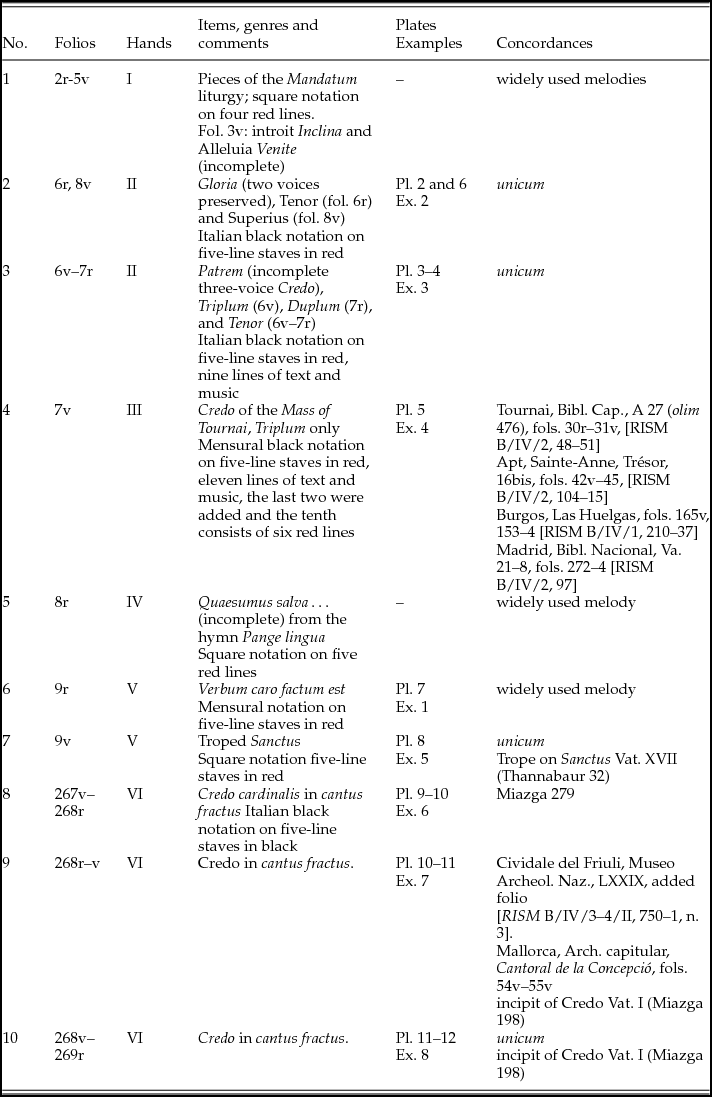
The complete and little-known gradual is on view in a cabinet of the Sala dei Papi of the museum of Santa Maria Maggiore in Rome.Footnote 8 Together with an antiphoner, these are the only two liturgical manuscripts to have escaped the transfer of all early codices from the Archive of Santa Maria Maggiore to the Vatican Library in 1931.Footnote 9 The original corpus of the gradual, which dates from the first quarter of the fourteenth century, extends over 269 parchment folios (360 mm x 260 mm). The gradual contains the temporale from the first Sunday of Advent to the 23rd Sunday after Pentecost, and the sanctorale from Andrew (30 November) to Clement (23 November), the Commune sanctorum, the Office of the Dead, a kyriale and a brief sequentiary.Footnote 10 Two clues in particular are indicative of a provenance in the south of France: the presence of a Mass for St Amantius bishop of Rodez,Footnote 11 who was also venerated as bishop of Avignon (4 November);Footnote 12 and the appearance of decorated initials similar to those found in local books during the Avignon papacy.Footnote 13 Further paleographical features equally place it in southern France in the early fourteenth century.Footnote 14 During the century after its production, several hands made additions that are now recorded in the initial fascicle and on the final three folios of the manuscript (see Table 1).
Items added to the gradual from the Basilica di Santa Maria Maggiore.

Abbreviations used: Thannabaur: Peter Josef Thannabaur, Das einstimmige Sanctus der römischen Messe in der handschriftlichen Überlieferung des 11. bis 16. Jahrhunderts, Erlanger Arbeiten zur Musikwissenschaft 1 (München, 1962). Miazga: Tadeusz Miazga, Die Melodien des einstimmigen Credo der römisch-katholischen lateinischen Kirke: eine Untersuchung der Melodien im den handschriftlichen Überlieferungen mit besonderer Berücksichtigung der polnischen Handschriften (Graz, 1976).
Palaeographically, the additions on fols. 2r–5v are the earliest and were probably copied only shortly after the main body of the manuscript. This is evinced also by the use of square notation on four red lines. All other hands can be dated between the second half of the fourteenth and the beginning of the fifteenth century. The black notation of both the polyphonic and the cantus fractus items shows for the most part typical characteristics of contemporary Italian notation such as the consistent use of puncti divisionis or pontelli.Footnote 15
The opening fascicle was written by five different hands and contains incomplete pieces. The additions (nos. 2–7) integrate polyphony, cantus fractus, a trope and some other popular pieces from the standard chant repertoire. Apart from a general preference for the ordinarium missae (nos. 2–4), no pattern or strategy can be recognised from the additions. On the contrary, they present a diversity of forms and styles. Similarly, the three monophonic chants for the Credo in cantus fractus (nos. 8–10) added on the last folios of the gradual, attest to the desire to broaden the repertoire through newly composed pieces.
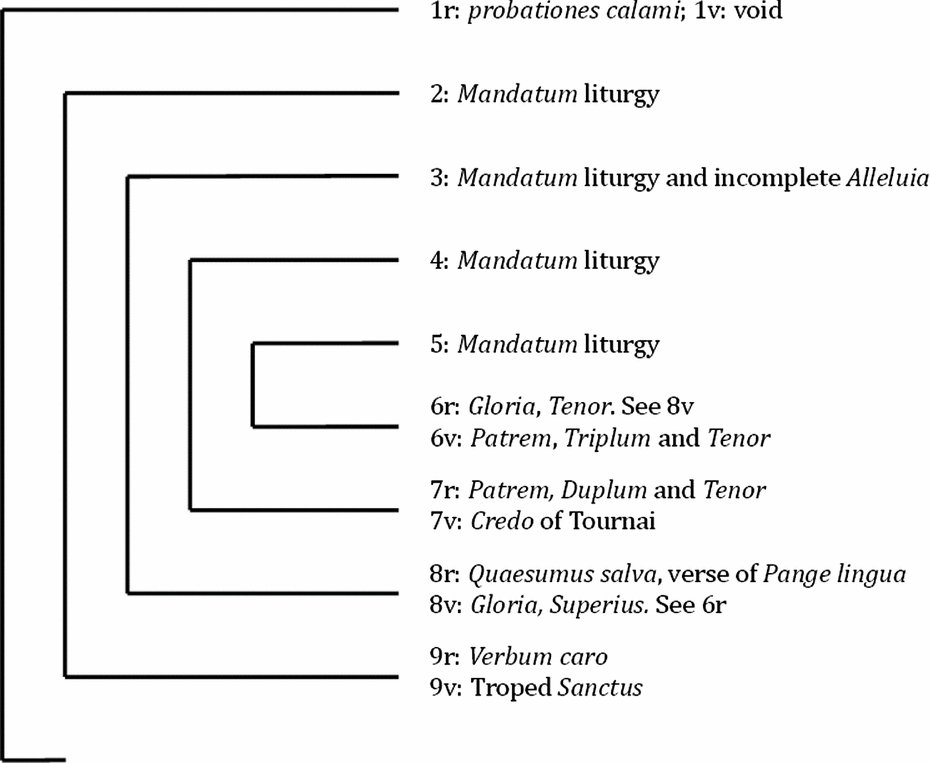
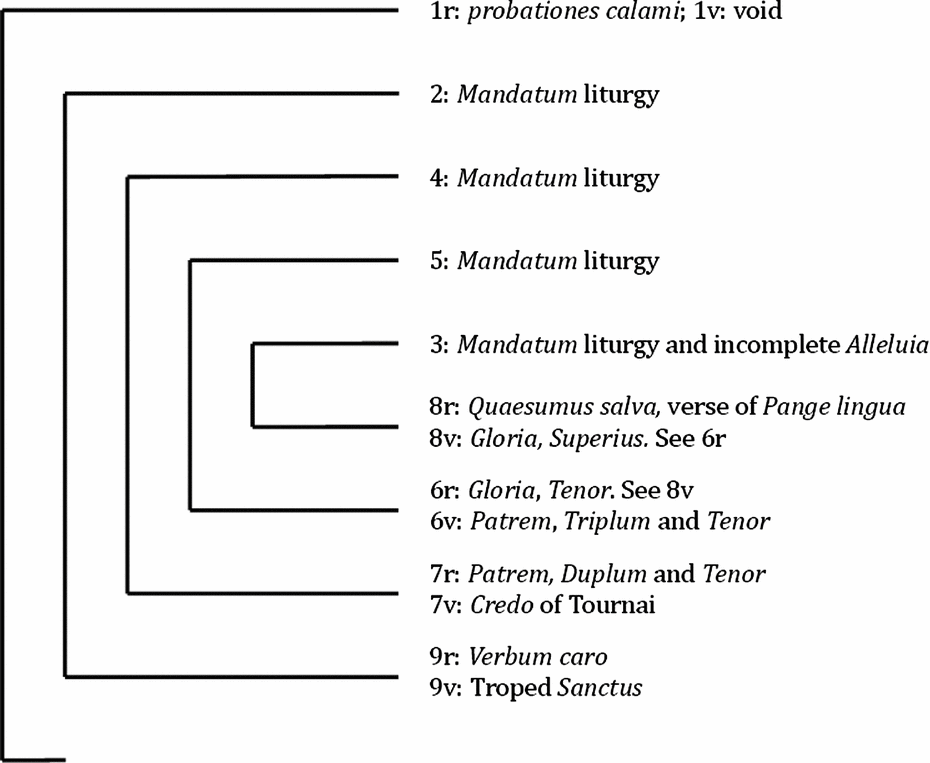
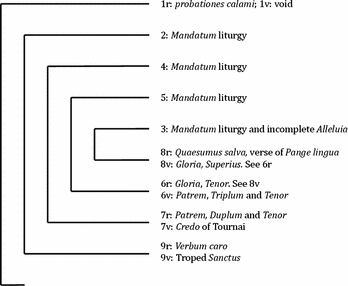
The opening fascicle was not part of the manuscript's original corpus but is a later addition, as is evident from its script, the binding structure, and the mensural and polyphonic notation of the added pieces. At some point, either when it was added to the original gradual or during a later rebinding, the opening fascicle was assembled incorrectly: the present bifolium fols. 3/8 is out of sequence. According to the disposition of the pieces, it should be inserted within the bifolium fols. 5/6, currently the innermost of the gathering, so that the Gloria superius on the present fol. 8v is followed by the Gloria tenor on the current fol 6r (see Fig. 2).Footnote 16 The reconstruction is incomplete, however, since the alleluia on fol. 3v is followed on fol. 8r of the reconstructed gathering by an acephalic copy of the hymn Pange lingua.
Actual binding of the initial fascicle.
Correct binding of the initial fascicle.
Not only do the folios of the opening appear in incorrect order, the fascicle itself appears to have been bound into the codex haphazardly. Originally, or at least temporarily in the early stages of the book's production, it was a loose supplement to the body of the manuscript and remained separate. As shown in Plate 1, fol. 9v bears the imprint of a contact with fol. 257v, where a contrapuntal voice was added to the sequence Victimae Paschali laudes in red square notation.Footnote 17 Considering the vivid colour of the imprint, this contact probably occurred shortly after the writing of the red neumes. The orientation of the red offset on fol. 9v, inverted from right to left, suggests that the present opening fascicle was separate from the manuscript and was inserted after fol. 257v, opening inward, binding outward, thus allowing the contact between the two versos, fol. 257v and fol. 9v. This implies that the additional fascicle was inserted randomly into the original gradual to keep the fascicle and gradual together; but to open and consult the fascicle, it had to be removed.
Santa Maria Maggiore, graduale. (a) The imprint of the red neumes on fol. 9v; (b) The red neumes on fol. 257.
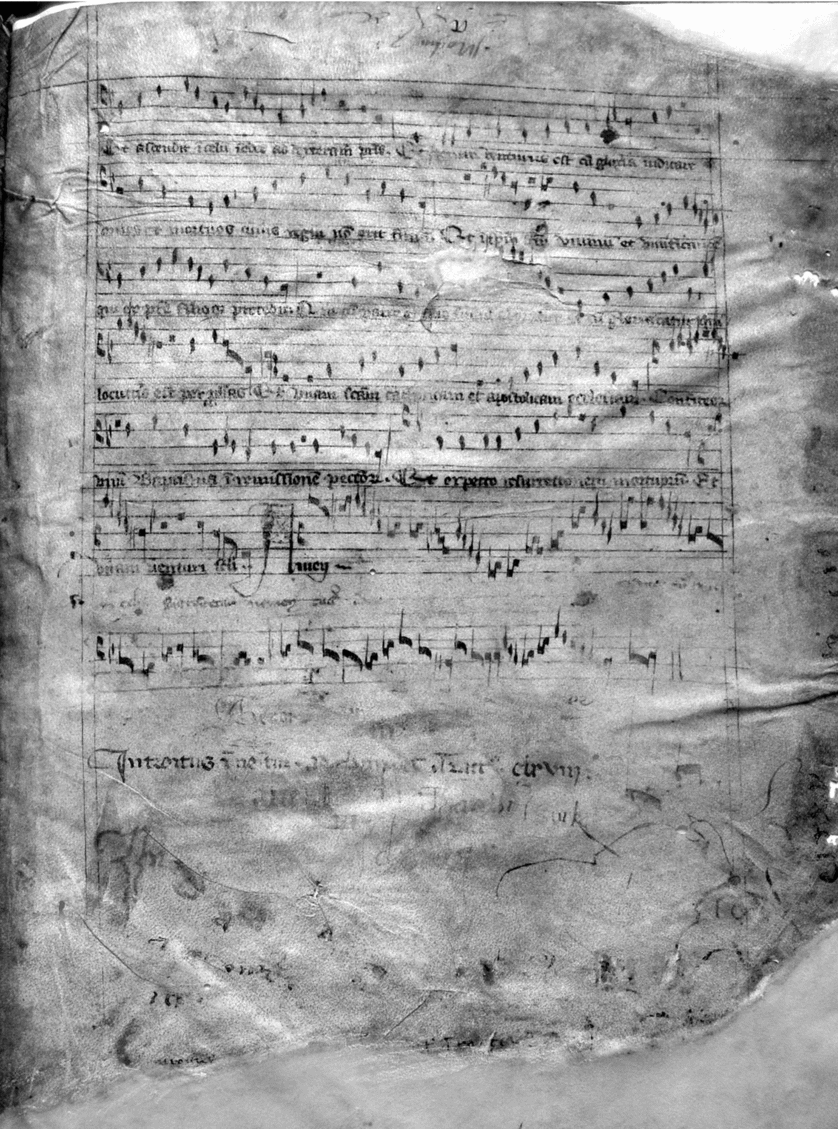
After a blank folio, the next four folios of the opening fascicle (originally fols. 2, 4, 5, 3) contain antiphons, versets and psalms for the Mandatum liturgy in black square notation on four red lines (no. 1). The series is complete and identical to that prescribed in the Franciscan ordinarium of Haymo of Faversham.Footnote 18 The chants offer no significant variants in melody or notation, although the repeated use of a virga that seems to emphasise longer notes at the end of words and phrases is distinctive. The Mandatum is followed by the introit Inclina domine aurem tuam Footnote 19 and the alleluia verse Venite exultemus Domino,Footnote 20 the latter incomplete, on the fol. 3v. The settings of the pieces for the Mandatum and these last Mass chants are not distinctive, but their uninterrupted series allows us to ascertain the correct sequence of folios and the original locations of the compositions in the fascicle. On fol. 8r, a different hand (IV) wrote the last three strophes of the hymn Pange lingua . . . certaminis with its common melody.Footnote 21 As noted above, since the alleluia verse Venite on the original fifth folio (current fol. 3v) is incomplete, and the hymn Pange lingua on the next folio (current fol. 8r) lacks its opening strophes, one or more leaves, likely a bifolium, are missing.
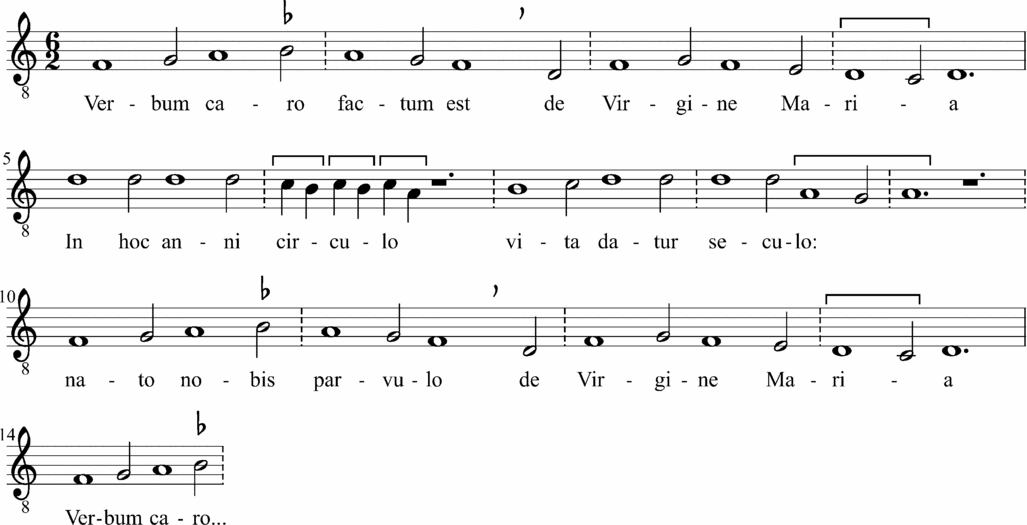
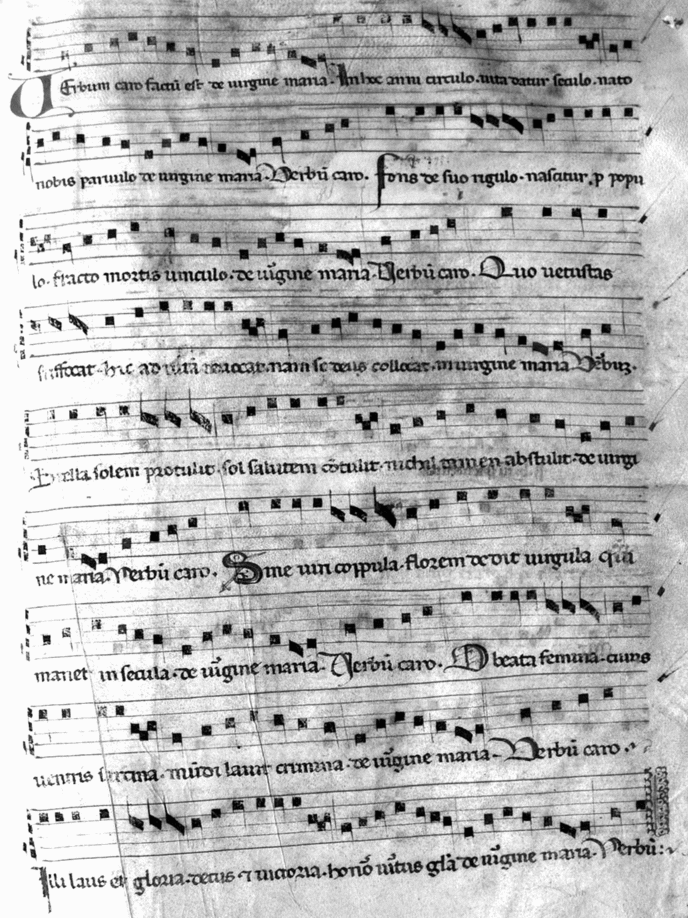
Fol. 9r, the last in the opening fascicle, contains a version of the famous pia cantio for Christmas: Verbum caro factum est (no. 6; Pl. 7; Ex. 1).Footnote 22 The text has seven four-line stanzas, the last of which (de Virgine Maria) is repeated. Between the stanzas, the refrain, Verbum caro, was repeated, as was typical of the performance tradition of this cantio.Footnote 23 The copy of the piece in the Santa Maria Maggiore manuscript carries the common widely transmitted melody in mensural notation. The only distinctive elements are in the refrain's clausula on the word ‘Maria’, where a ligature of sine proprietate et sine perfectione is found; and at the end of the first lines of each stanza, which have three ligaturae cum opposita proprietate.
Verbum caro factum est. Rome, Museo di Santa Maria Maggiore, graduale, fol. 9r.
The two-voice setting of the Gloria
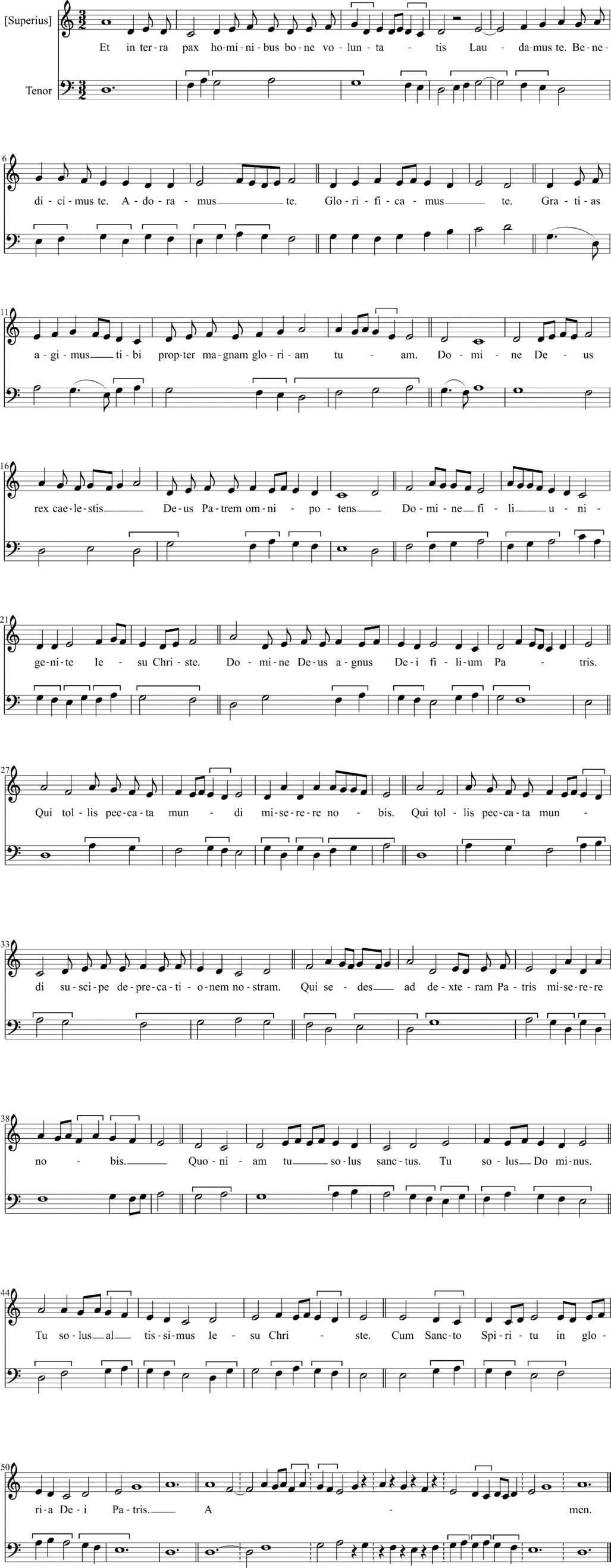
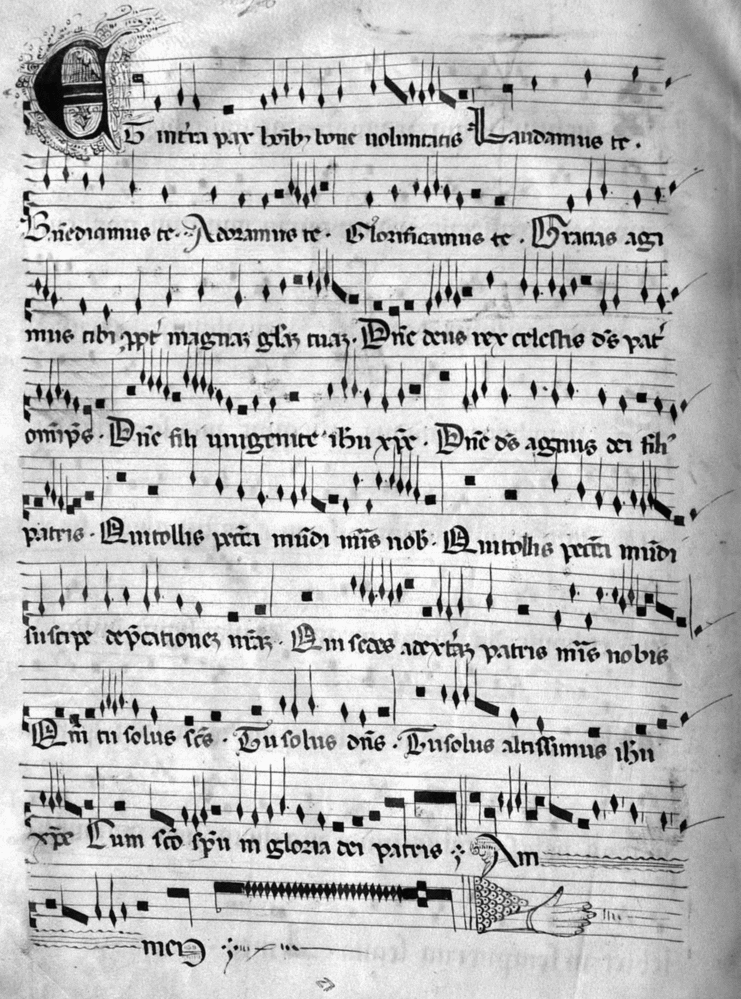
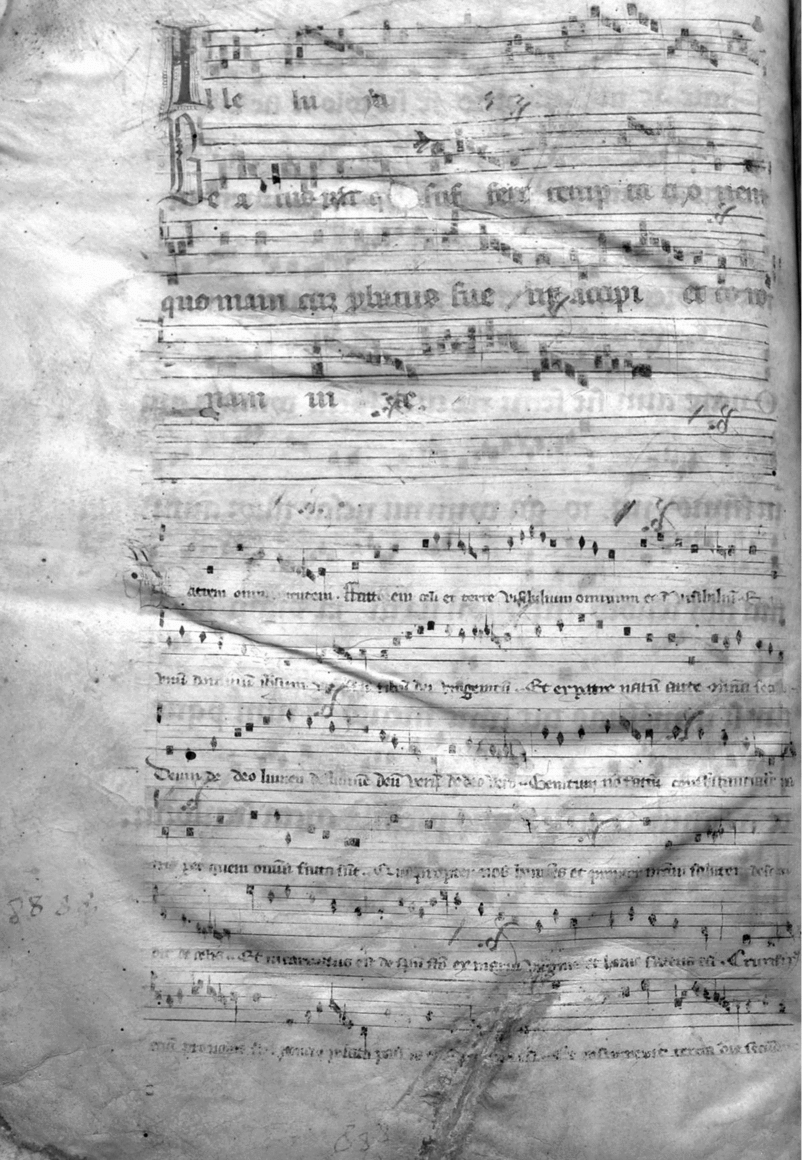
Folios 8v and 6r of the gradual of Santa Maria Maggiore, originally adjacent, contain two voices of a Gloria in an Italian black notation of the fourteenth century (Pl. 2 and 6; Ex. 2). This piece is not recorded in the common repertoires and modern editions of sacred polyphonic music of the period.Footnote 24 Although the Santa Maria Maggiore gradual preserves only two voices: a tenor (clef: f2/c4; final: d; ambitus: D–d) and a higher voice (clef: c1; final: a; ambitus: c–aa), their contrapuntal relationship suggests that it was written for three or four voices.
Santa Maria Maggiore, graduale, fol. 6r.
Gloria. Rome, Basilica di Santa Maria Maggiore, graduale, fols. 6v and 8r.
Its most interesting features are the incipit of the superius, which quotes almost literally the beginning of the Credo cardinalis (Credo IV), with its initial interval of a descending fifth (see Ex. 2, bar 1) and its characteristic cadence repeated many times in the superius (bars 3–4, 8–9, 13, 25 etc.).Footnote 25 While it may be an independent Gloria, the similarities with the setting of Credo IV suggest a connection with its famous motto, which may have served as a model to the composer.Footnote 26
The compositional style is reminiscent of contemporary French techniques; some features even connect the Gloria to the Missa de Notre Dame of Guillaume de Machaut.Footnote 27 The upper-voice is fully texted and supported by more slowly moving tenor that provides only text incipits.Footnote 28 Melodic and rhythmic repetitions are very frequent throughout the composition (e.g. bars 16–17 and 22–3, 20 and 29–30, 27–8 and 31–2, 36–7 and 49–50, 42–4 and 46). Of particular interest is the setting of the word ‘miserere’ in bars 29 and 37, where the two voices mirror each other melodically, with two ascending fifth leaps d–a in the superius and two falling fourth leaps G–D in the tenor.
A typical element of French polyphonic music used during the fourteenth century is the hoquetus, of which the Amen contains a short section (bars 55–6). While the style of the Gloria suggests an origin in France, the notation shows the typical features of the Italian music writing of the fourteenth century, specifically, a systematic use of the so-called pontelli (puncti divisionis) in the superius in order to mark the duration of a brevis, and the preference for binary division of tempus and prolatio.
The incomplete three-voice setting of the Credo
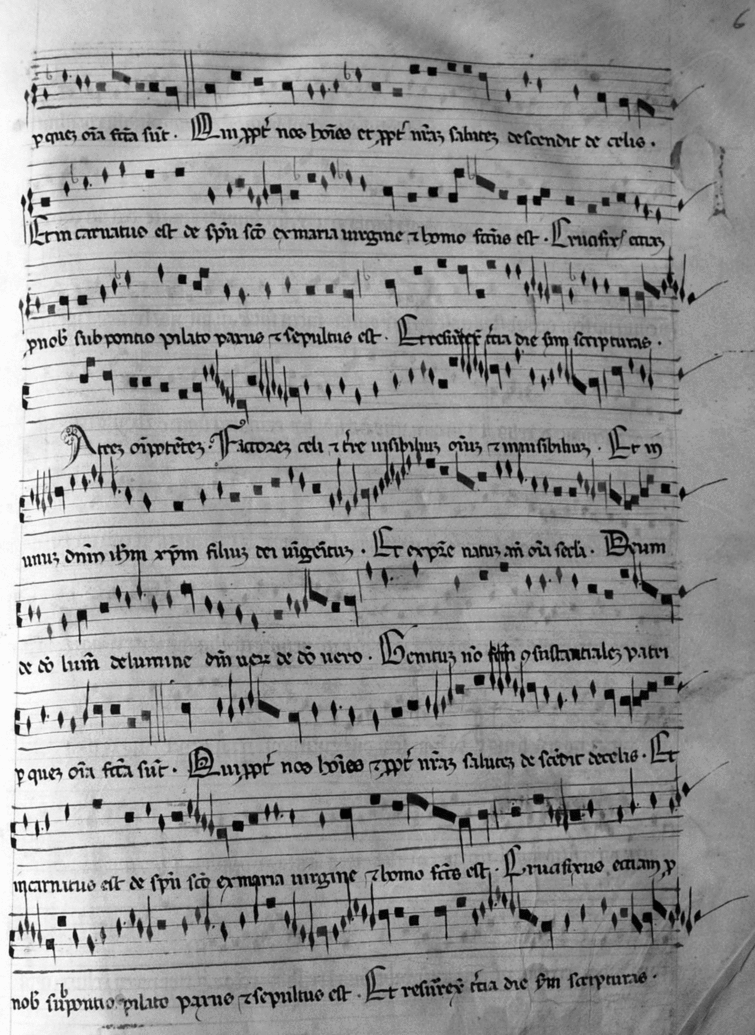
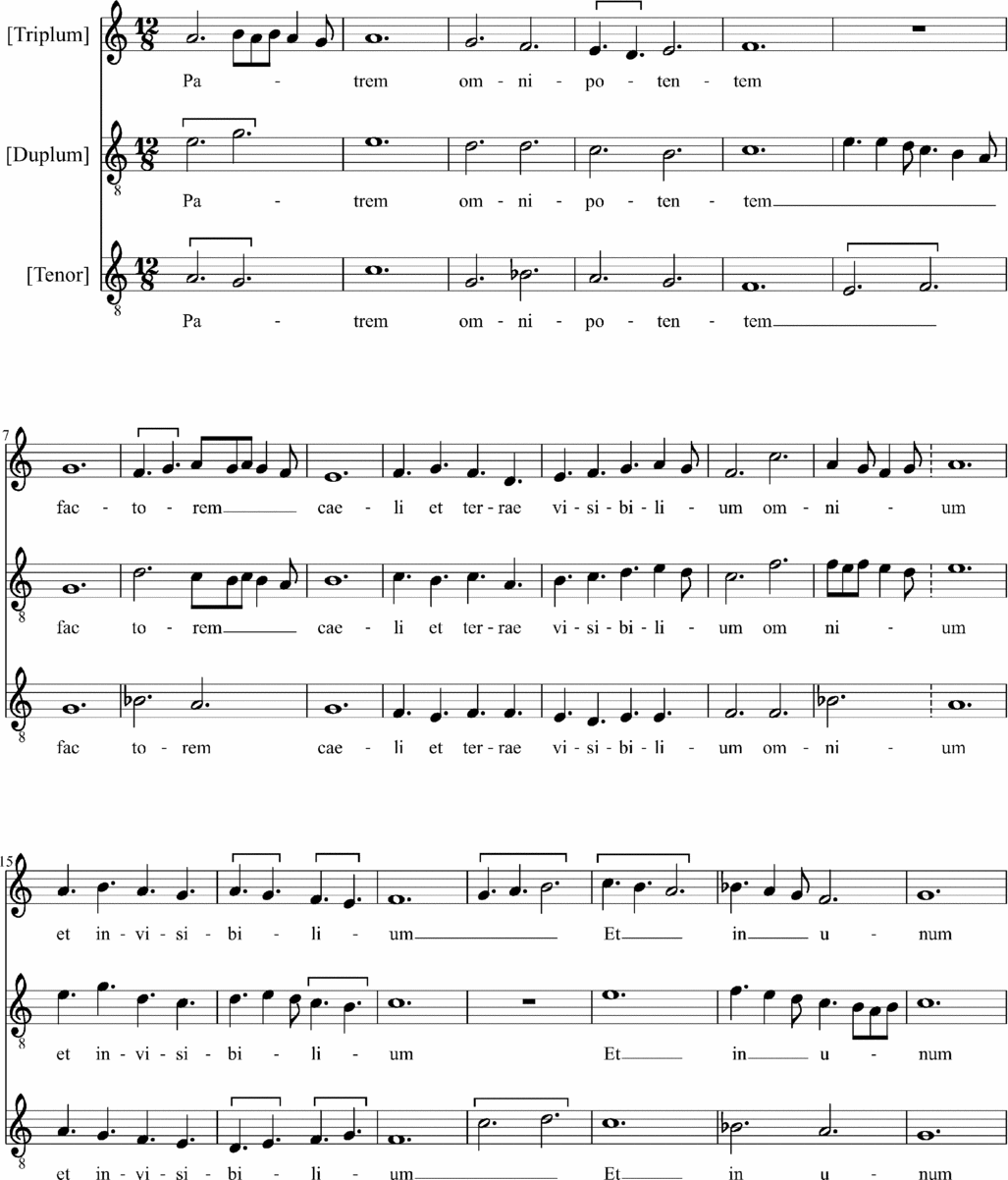
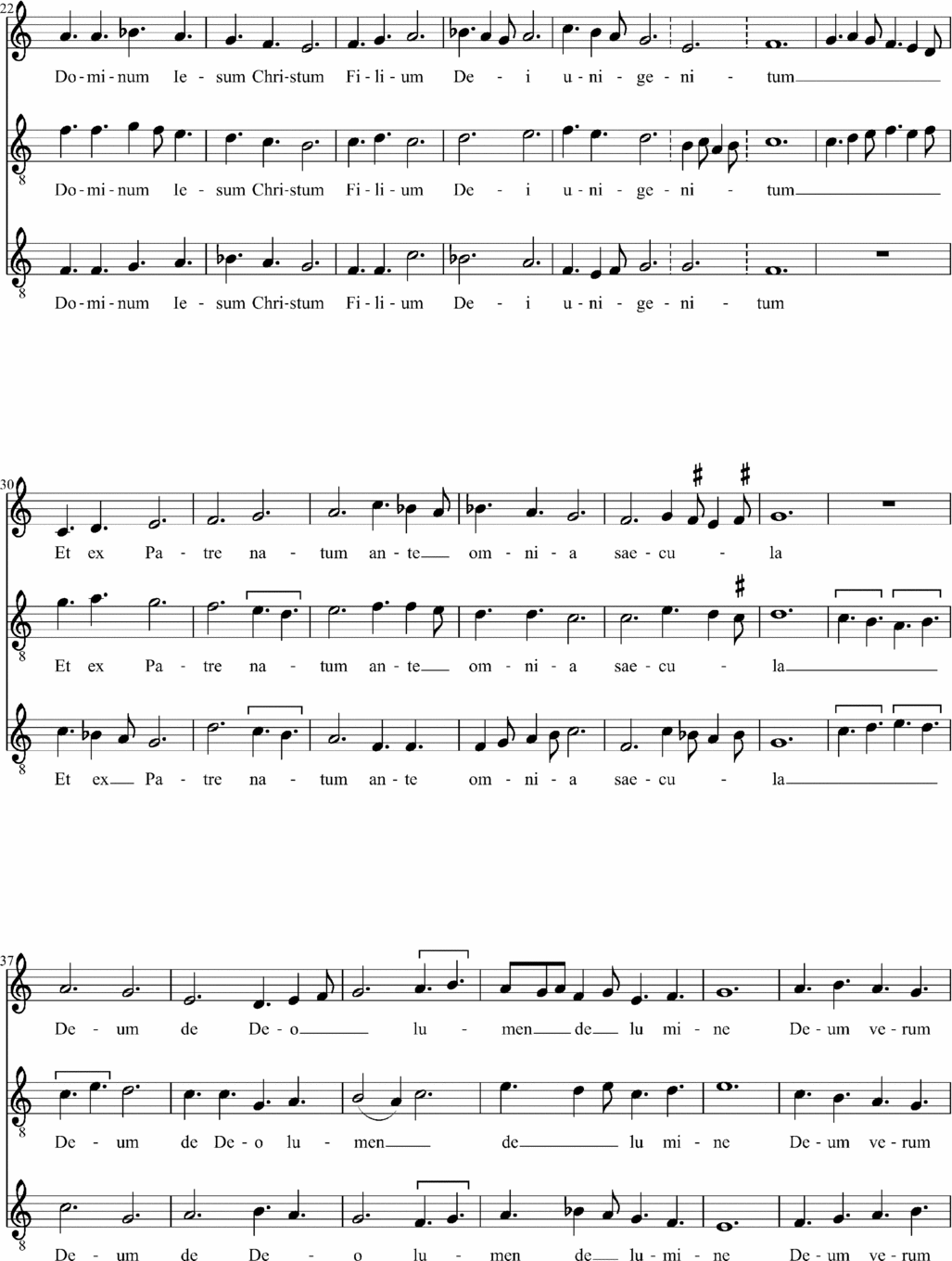
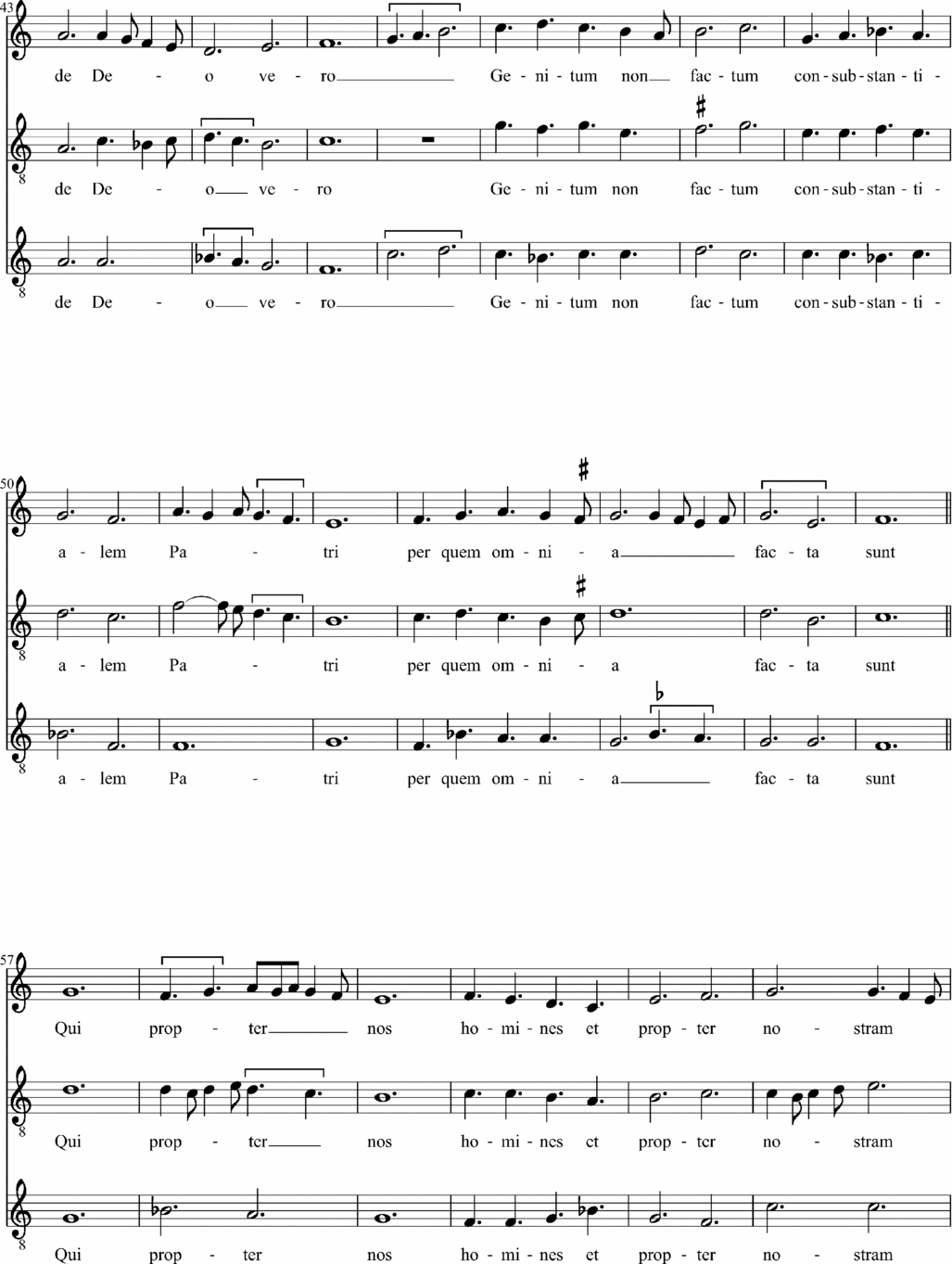
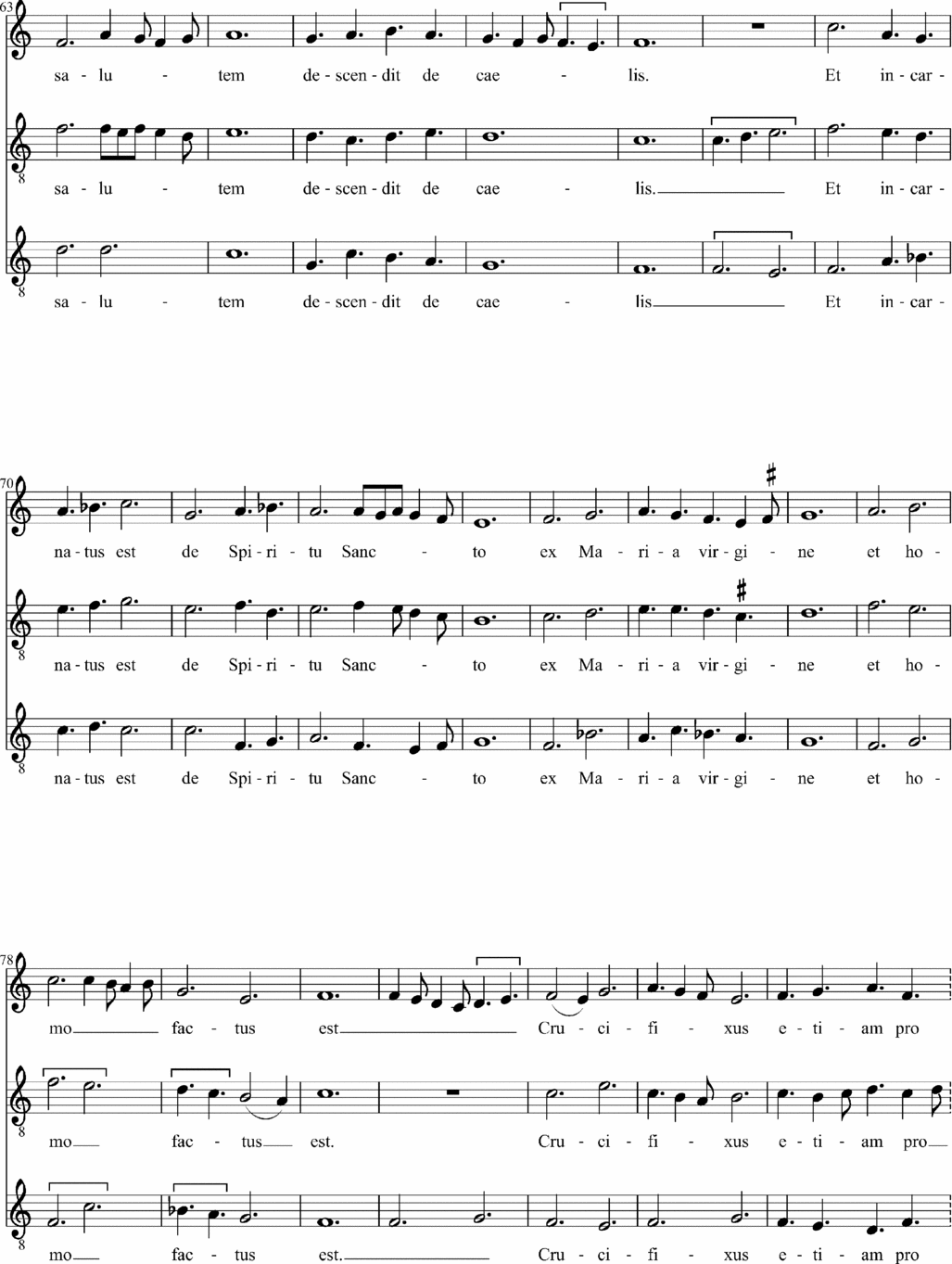
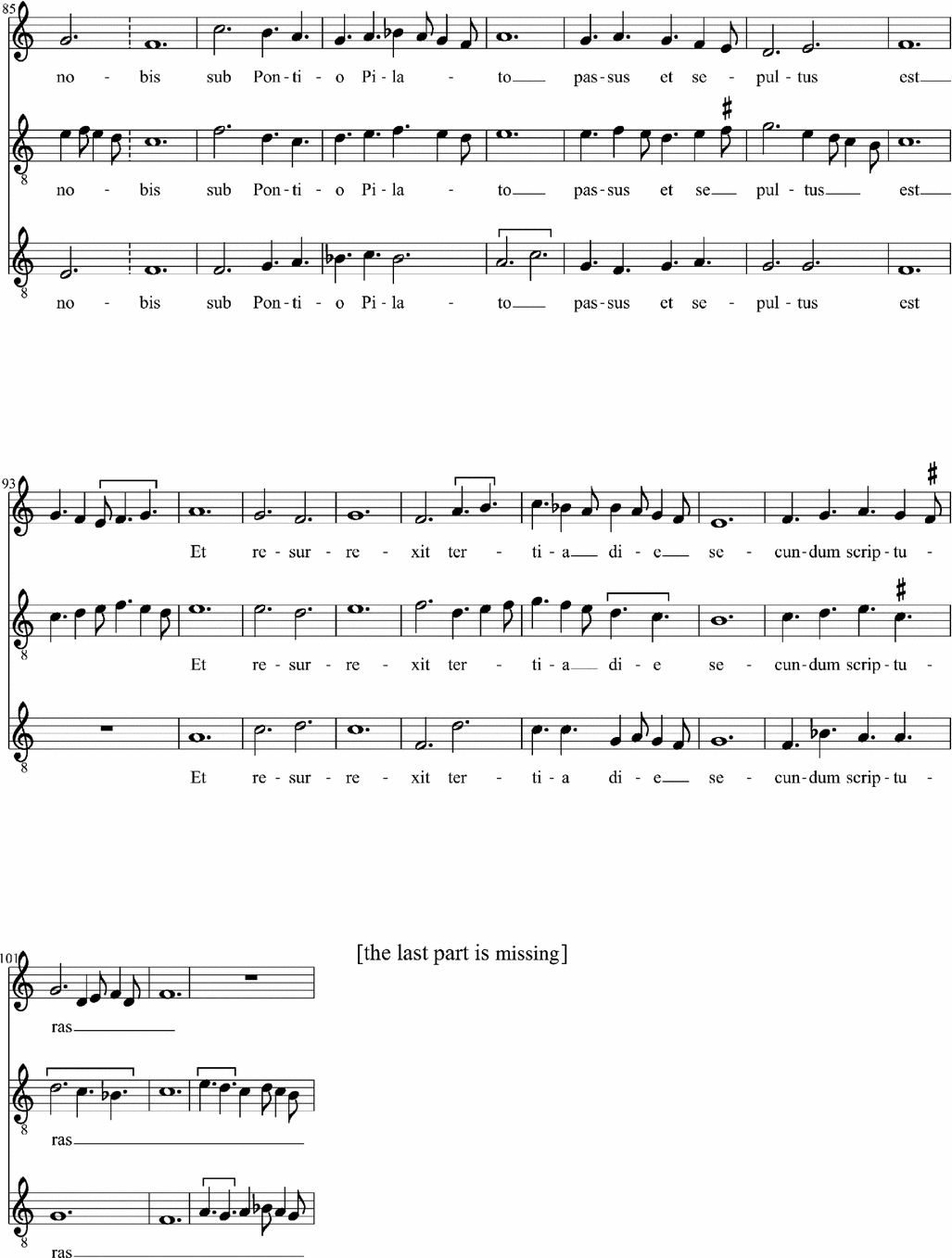
The fragment of a three-part Credo,Footnote 29 which is also without concordances, is copied onto fols. 6v–7r (Pl. 3–4; Ex. 3) by the same scribe who wrote the polyphonic Gloria. The Credo moves mainly in a homorhythmic style that is typical of conductus, with a slight preference for longer values in the tenor. Although both Gloria and Credo employ fourteenth-century black mensural notation, the Credo, unlike the preceding Gloria, cannot be connected to a particular national style. This being said, the regular use of the puncti divisionis is typical of Italian notation, which expresses here a modus imperfectus, with tempus imperfectum and prolatio maior. An Italian trait can also be recognised in the group brevis-minima followed by a punctus divisionis used to mark the duration of a brevis on the word ‘patri’ of the duplum.Footnote 30
Santa Maria Maggiore, graduale, fol. 6v.

Santa Maria Maggiore, graduale, fol. 7r.
Credo. Rome, Basilica di Santa Maria Maggiore, graduale, fols. 6v–7r.
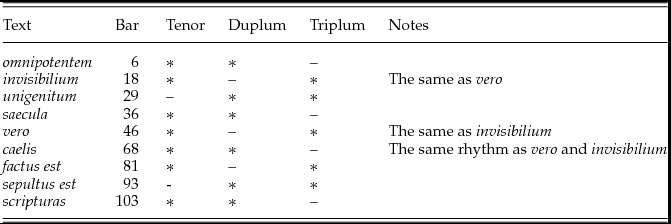
The melodic cadences (caudae) that are regularly distributed between only two of the three voices at a time and end some verses are a distinctive stylistic trait (see Table 2).Footnote 31
Credo, 3vv. (no. 3, fragment): distribution of melodic cadences.

Why the copyist interrupted the work at the word ‘scripturas’ is unknown. The presence of the custodes at the end of duplum and tenor on fol. 7r suggest that the final part of this piece should be found on fol. 7v. The fascicle, however, continues instead with another Credo (no. 4).Footnote 32
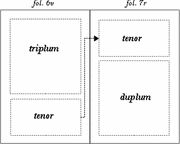
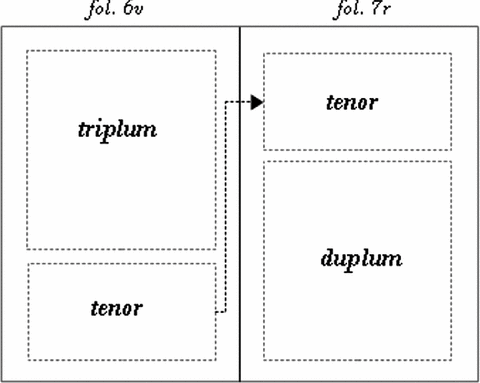
In the Credo on fols. 6v–7r, the disposition of the voices across the opening is unusual (Fig. 3). Two other representative sources of the period, Ivrea 115 and Apt 16bis, which contain a sizeable collection of polyphonic pieces, arranged the voices in the same way only in two instances.Footnote 33
Disposition of the voices in the three-voice Credo.
The presence of the word ‘paulo’ at the bottom of fol. 6v, with some other signs which are impossible to decipher, cannot be fully explained. These may be merely pen trials with no relationships to the Credo. ‘Paulo’ means ‘a little’, but it is unclear what the point of such note could be. If the word has any meaning at all, it is far more likely that it indicated the name of the composer or some other Paolo associated with the manuscript in whatever form.Footnote 34
A new source for the Credo of the Tournai Mass
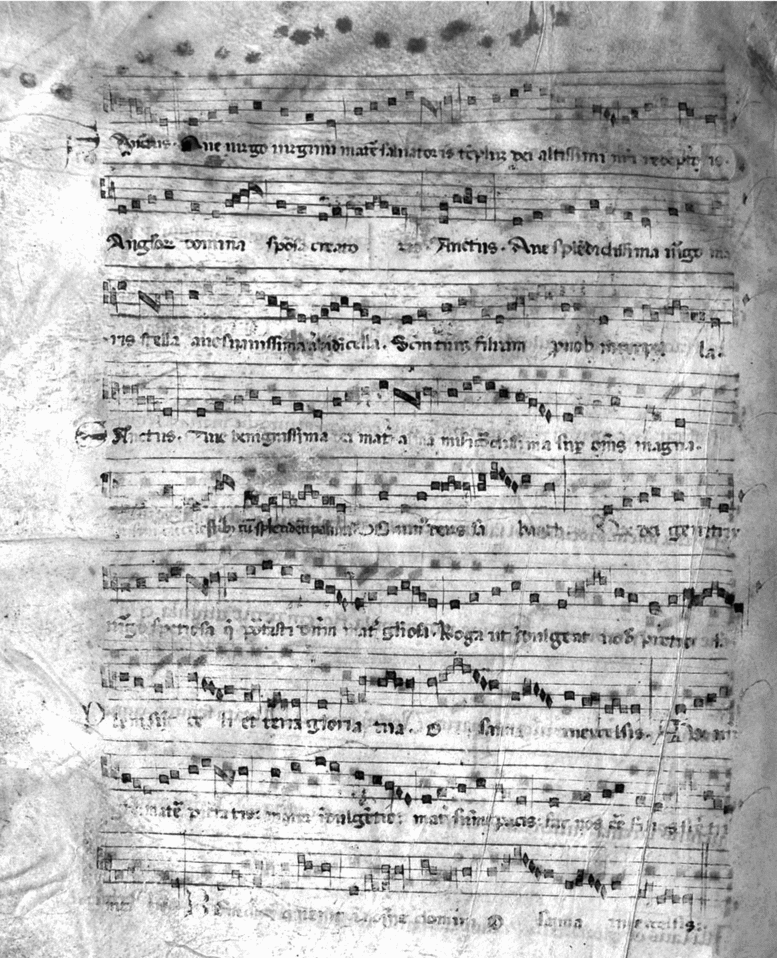
The Credo on fol. 7v is notable as a new concordance for the Mass of Tournai. Dating to the mid-fourteenth century, this mass ranks among the earliest polyphonic settings of the entire ordinarium.Footnote 35 Although presented as a cycle, it seems to have been compiled from different individual works rather than being a new composition all of a piece. The Credo, which until now has been found in four manuscripts including the Tournai manuscript, is considered as an independent and earlier composition included in the cycle.Footnote 36
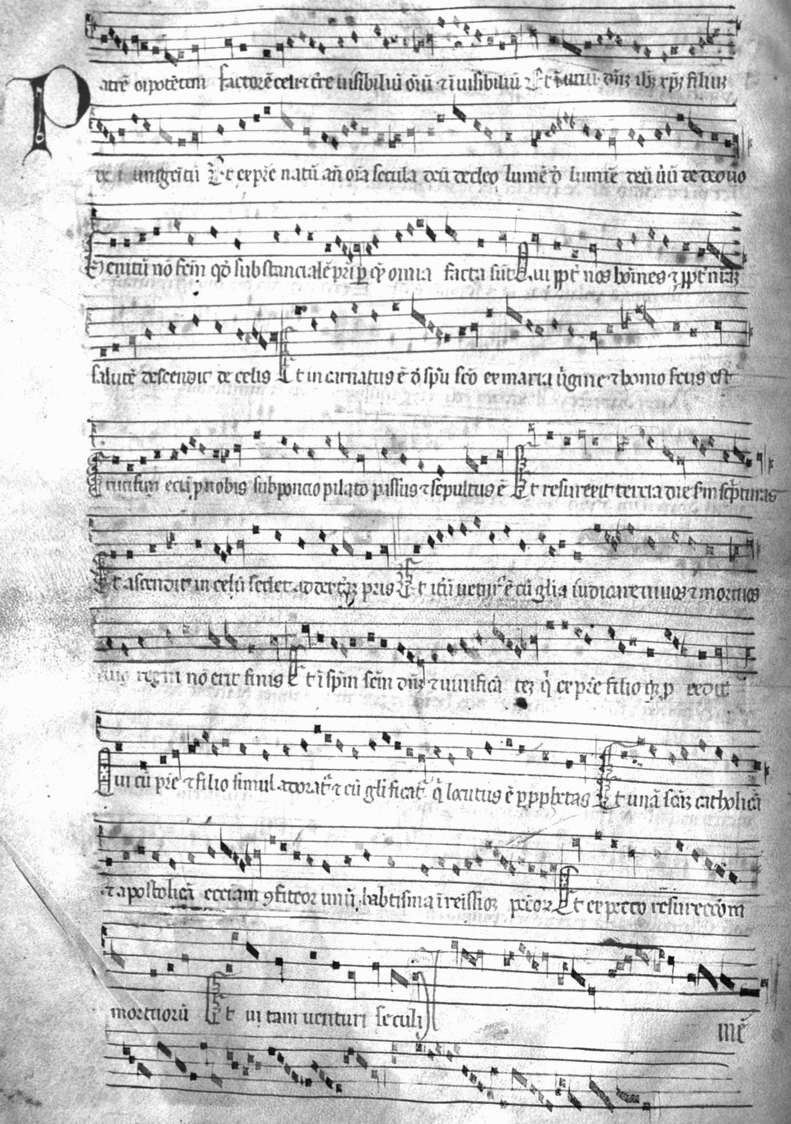
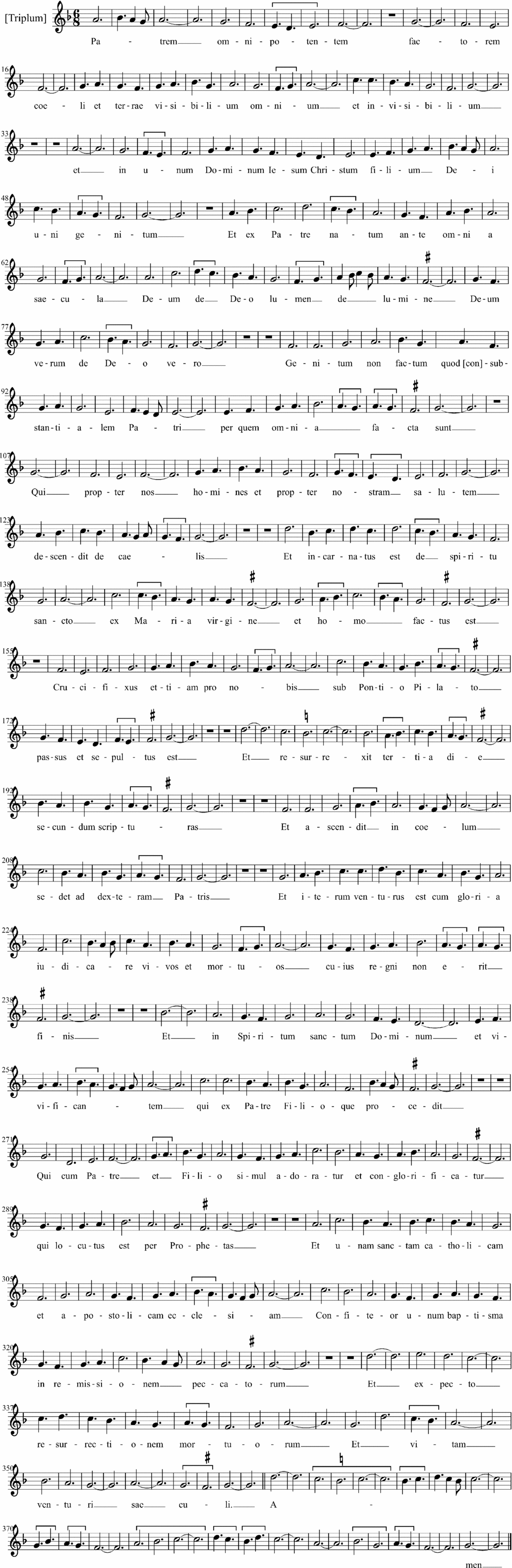
The wide dissemination of the Tournai Credo and its independent transmission is confirmed by Credo (fol. 7v) in the additions made to the Santa Maria Maggiore gradual in the late fourteenth- or early fifteenth-century (Pl. 5; Ex. 4a). Moreover, its presence in a codex that probably came from Avignon confirms the connection of this Credo and the Tournai Mass to the cultural circle associated with the French seat of the popes.Footnote 37
Santa Maria Maggiore, graduale, fol. 7v.
Credo of Tournai. Rome, Basilica di Santa Maria Maggiore, graduale, fol. 7v.
Credo of Tournai. Rome, Basilica di Santa Maria Maggiore, graduale, fragment.
Continued.

The Credo on fol. 7v preserves only the triplum of the Credo of Tournai. Its notation is very similar to that of the Tournai manuscript. The notes are written on five red lines in the same position of those of the Tournai manuscript. Although transposed down a fifth, the transposition is obtained only by the transfer of the c clef from the second to the fourth line (with the addition of b flat as a key signature). The notation shows, however, some adaptations of the original model, as a sign of the independent transmission of the Credo. Thus, in the gradual, dots of division mark the series of semibreves in groups of two, each of them for the duration of a brevis (e.g. the opening of the ‘Et iterum venturus est’ section), a practice not found in the Tournai manuscript.
Unlike the Tournai version, but similar to the other three concordances, the part is not explicitly labelled. Its layout across one full page – unlike the other sources – might even suggest independent transmission. In absence of any further clues of how the Credo came into the Santa Maria Maggiore gradual, it may well have been copied from a source that already contained only the triplum. This would imply its use as a one-voice setting in mensural notation, similar to other Credo settings in cantus fractus that were very popular at that time. Conversely, the seemingly random selection and order of works within the fascicle might suggest that the scribe wrote the triplum and, for some unknown reasons, did not continue with the other voices in exemplar on the following folios, where another copyist later wrote the cantio Verbum caro, etc.Footnote 38
Regarding the notation, the change observed from the version of the Las Huelgas manuscript, which features the conjunctura sine cauda, to that of Tournai, which uses the conjunctura with semibrevis cum cauda (minima), is followed in the Santa Maria Maggiore gradual.Footnote 39 As a result, it is closer to the version of Tournai.
At other points, the Tournai and Santa Maria Maggiore versions differ. The Credo in the gradual (Pl. 5) is more ‘timid’ in using the cauda than the manuscript of the Mass of Tournai; in several cases, the notation shows but a tentative allusion to the cauda.Footnote 40
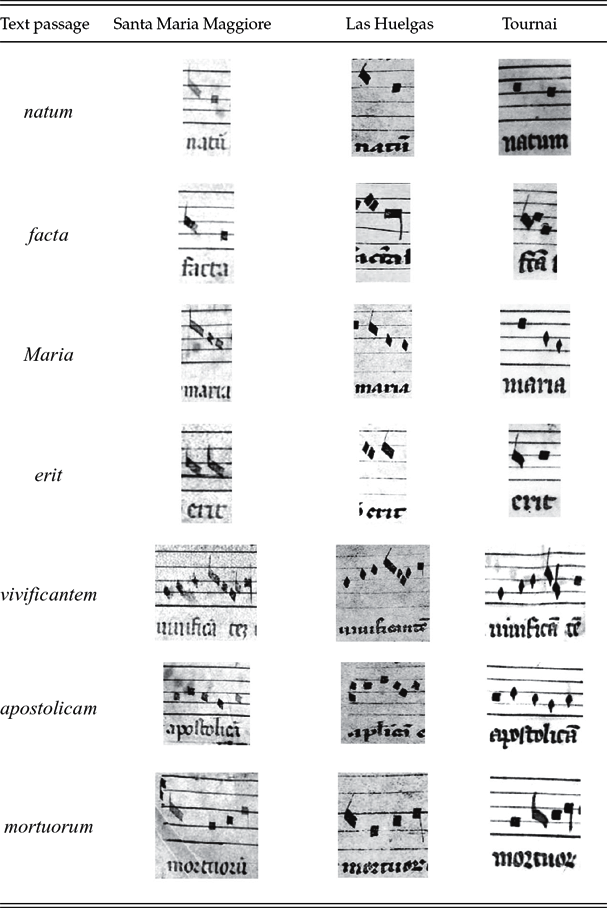
The Credo melody in the Santa Maria Maggiore gradual shows slight but significant variants from the version of Tournai. As Table 3 shows, there are at least seven variants that establish a closer link between the Santa Maria Maggiore and Las Huelgas copies than between either and the Tournai manuscript or other sources.
Credo (no. 4): variants between Santa Maria Maggiore, Las Huelgas and Tournai.
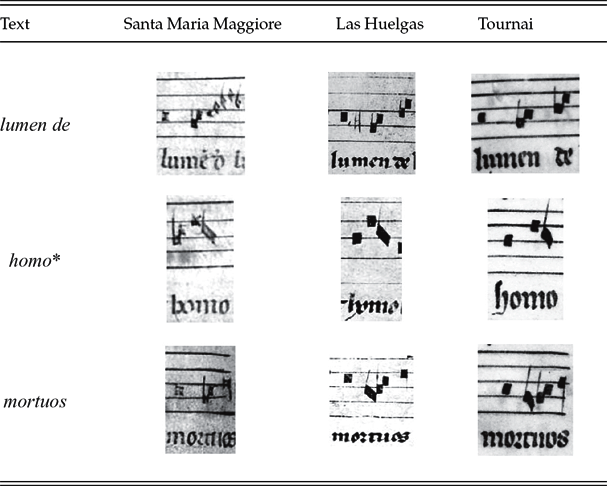
Other variants that can be found only in the Santa Maria Maggiore version suggest that the transmission from Las Huelgas to Rome is probably passed down from further sources now lost (Table 4).
Credo (no. 4): typical variants of the Santa Maria Maggiore gradual.
* This variant of Rome is shared with Apt.
An element unique to the gradual among the manuscripts containing the Tournai Credo is the total absence of sharpened notes, which are common in the other manuscripts. The Amen of the Santa Maria Maggiore version differs from all other concordances. These variants point towards an independent tradition for the Santa Maria Maggiore copy of the Tournai Credo, in which potentially the triplum was performed on its own as a Credo in cantus fractus.
Somewhat curiously, a two-line staff was drawn in after the end of the composition. They may have been intended for an alternative Amen, to be used in lieu of the notated setting. Alternatively, the two lines may be two fragments of different compositions located in that place for unknown reasons.Footnote 41
The troped Sanctus
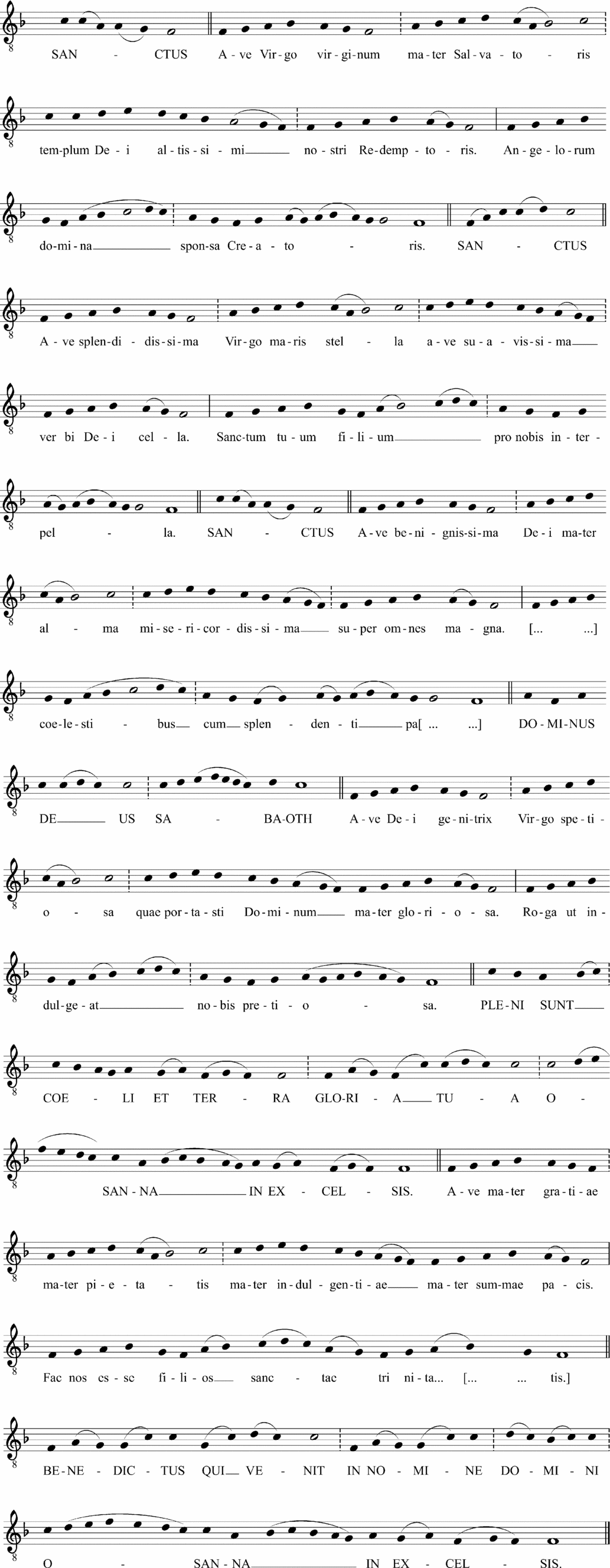
Fol. 9v presents a Sanctus (Pl. 8; Ex. 5) with a trope that was written in the same hand that also copied the cantio ‘Verbum caro’ on fol. 9r. The text of the trope is not reported in common repertoires and without concordances in other sources.Footnote 42 It consists of five parallel strophes of three verses each, with regular metre and rhymes, in the form of a hymn or a sequence, inserted after each verse of the Sanctus.Footnote 43 The syllabic structure of each verse includes two parts in a trochaic rhythm, the first part of seven syllables, with the last word proparoxytonic (Ave Virgo virginum), and the second part of six syllables (mater salvatoris).
Santa Maria Maggiore, graduale, fol. 8v.
Santa Maria Maggiore, graduale, fol. 9r.
Santa Maria Maggiore, graduale, fol. 9v.
Troped Sanctus. Rome, Basilica di Santa Maria Maggiore, graduale, fol. 9v.
Despite some lacunae, the meaning of the text is clear. It is an invocation to the Virgin Mary, using a range of grand epithets, asking her to intercede with the Lord to make human beings worthy descendants of the Trinity. The different titles given to the Virgin in this text are common in the Marian poetry of the period, as is the connection to the cult of the Trinity, especially among Sanctus tropes.Footnote 44
The trope is connected with Sanctus XVII (Thannabaur 32) and has a very simple melody that is the same for each strophe, a pattern typical of hymns.Footnote 47
Three settings of the Credo in cantus fractus
A single hand (VI) copied onto the last folios (fols. 268v–269r), which had originally been left blank, three Credos in cantus fractus, using mensural notation of the late fourteenth century. Cantus fractus is a form of chant, both monophonic and mensural, which probably originated in France in the thirteenth century and later spread widely throughout Europe, particularly in Italy. Three liturgical genres were privileged in the cantus fractus repertory: hymns, sequences and the Credo.Footnote 48
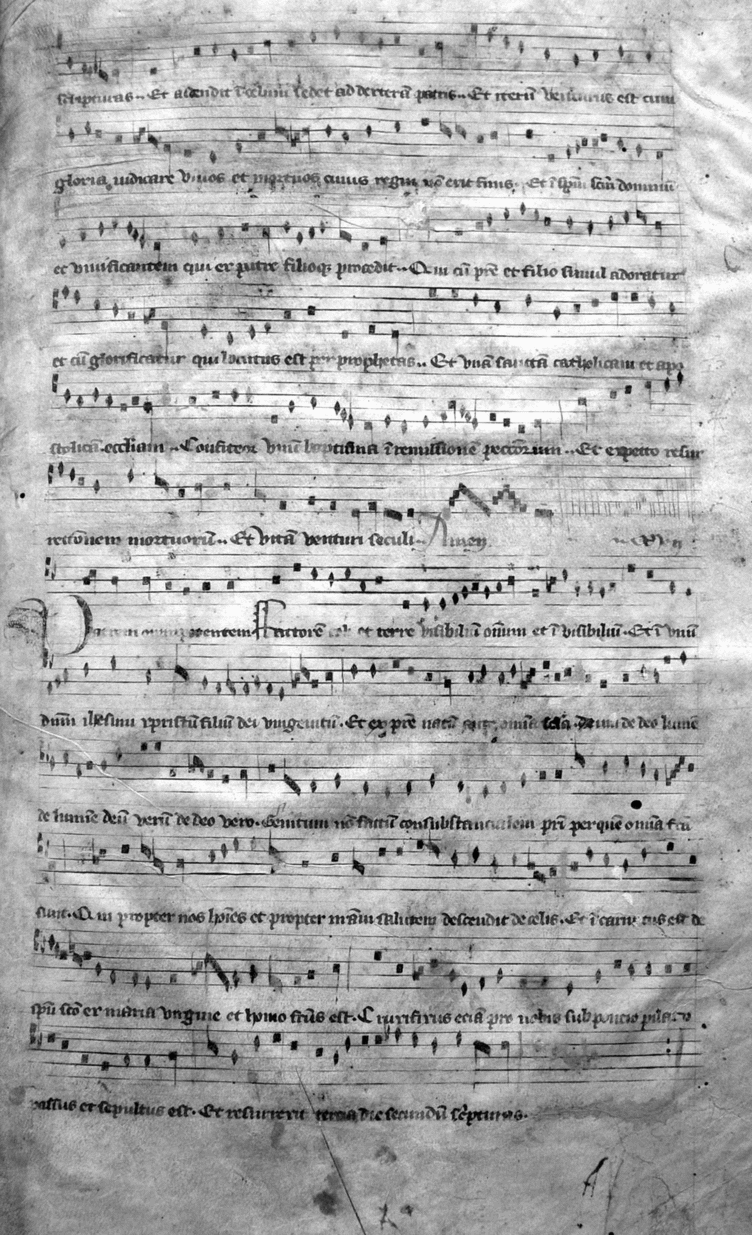
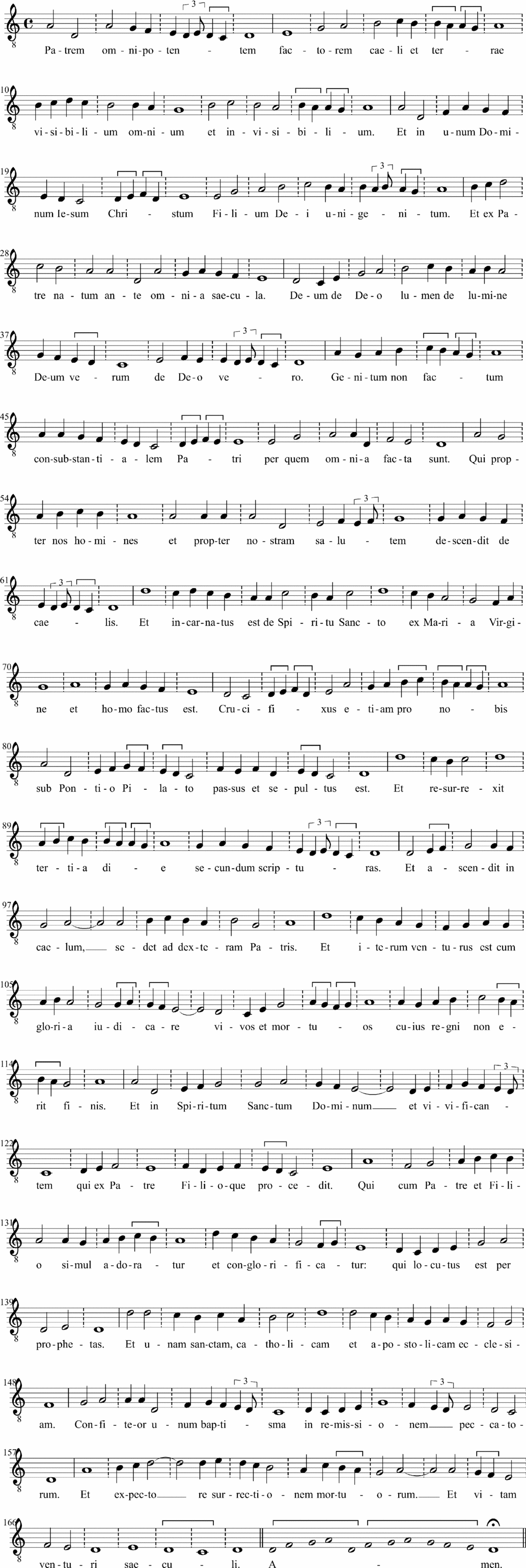
The first Credo in cantus fractus in the gradual is a setting of the famous Credo cardinalis (Miazga 279) (fols. 267v–268r; no. 8; Pl. 9–10; Ex. 6).
Santa Maria Maggiore, graduale, fol. 267v.
Santa Maria Maggiore, graduale, fol. 268r.
Credo cardinalis. Rome, Basilica di Santa Maria Maggiore, graduale, fols. 267v–268r.
The only remarkable feature of the Santa Maria Maggiore version is the treatment of the typical cadence which is uncommonly presented with two different formulae. This treatment confirms Marco Gozzi's observation that Italian variants in copying this cadence probably result from difficulties in interpreting the original French notation.Footnote 49 The gradual solves this problem in a first formula, using the sequence semibrevis, semibrevis+minima, ligatura cum opposita proprietate and, finally, longa.Footnote 50
This suggests a tempus imperfectum with a prolatio perfecta. In this case the group semibrevis + minima was interpreted as an imperfectio a parte post. In this way, the (imperfected) semibreve and minim have the same value as a semibrevis perfecta.Footnote 51 At some points in which other sources contain a solution like that used in the first formula of the gradual, the manuscript of Rome shows instead a second version in which the problem of interpretation is solved by removing a semibrevis and confirming the tempus imperfectum with two ligaturae cum opposita proprietate.Footnote 52
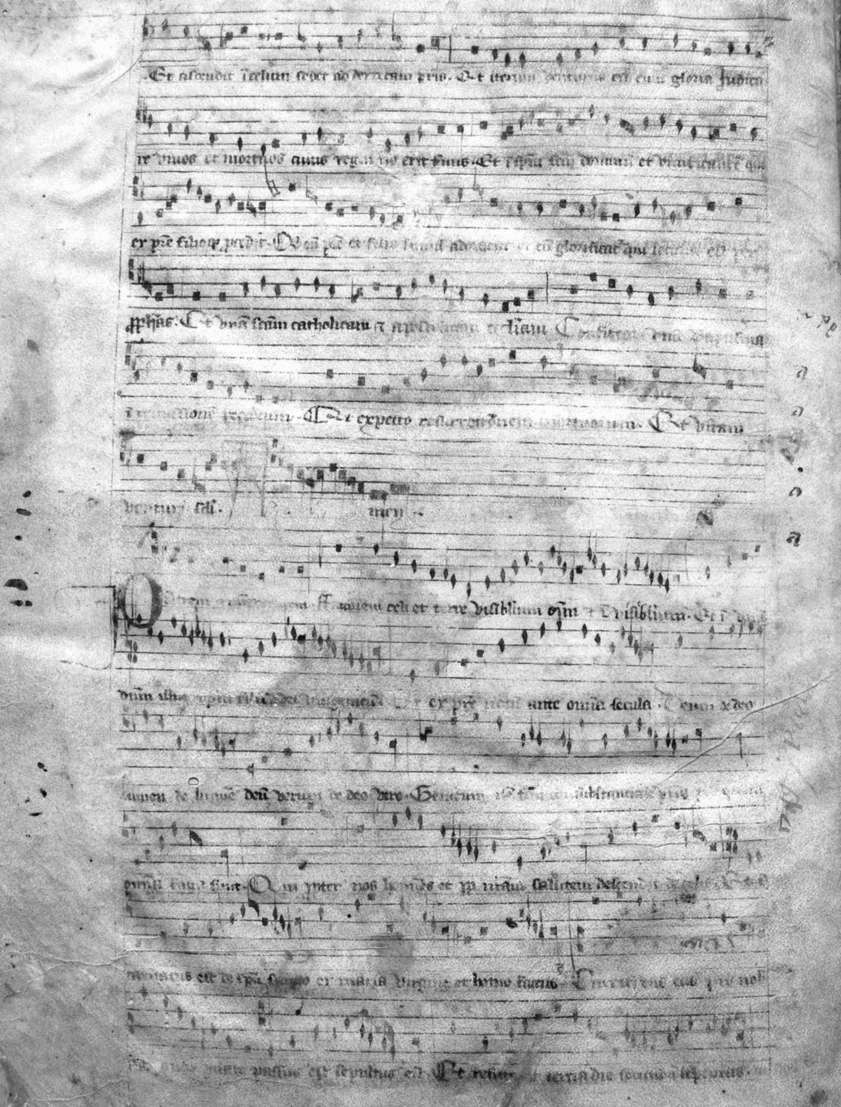
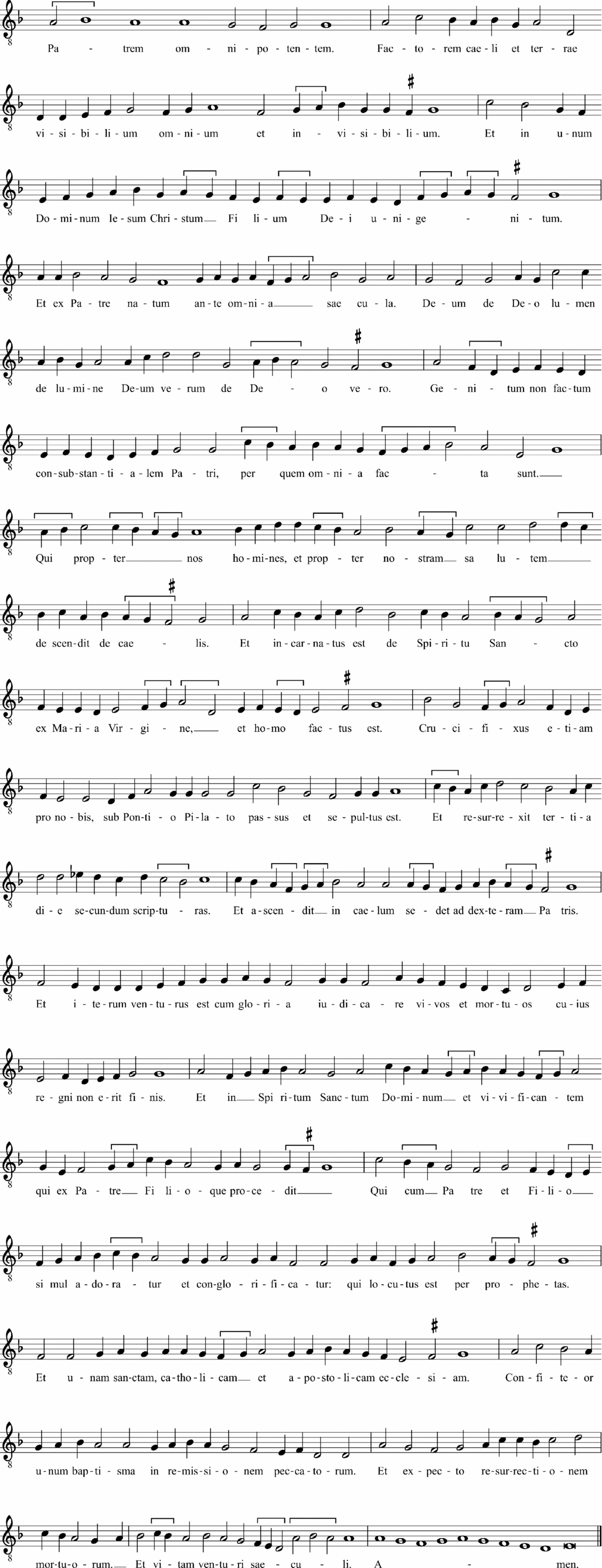
The second Credo on fol. 268 (no. 9; Pl. 10–11; Ex. 7) has concordances in two fifteenth-century sources: the folio added in a gradual of Cividale del FriuliFootnote 53 and the so-called ‘Cantoral de la Concepció’ of Mallorca.Footnote 54 The musical incipit (‘Patrem omnipotentem’) is identical with Credo I (Miazga 198). The chant's ambitus reaches from C to e flat. The black mensural notation adopts a modus imperfectum and a tempus imperfectum.
Santa Maria Maggiore, graduale, fol. 268vr.
Santa Maria Maggiore, graduale, fol. 269r.
Credo. Rome, Basilica di Santa Maria Maggiore, graduale, fol. 268r–v.
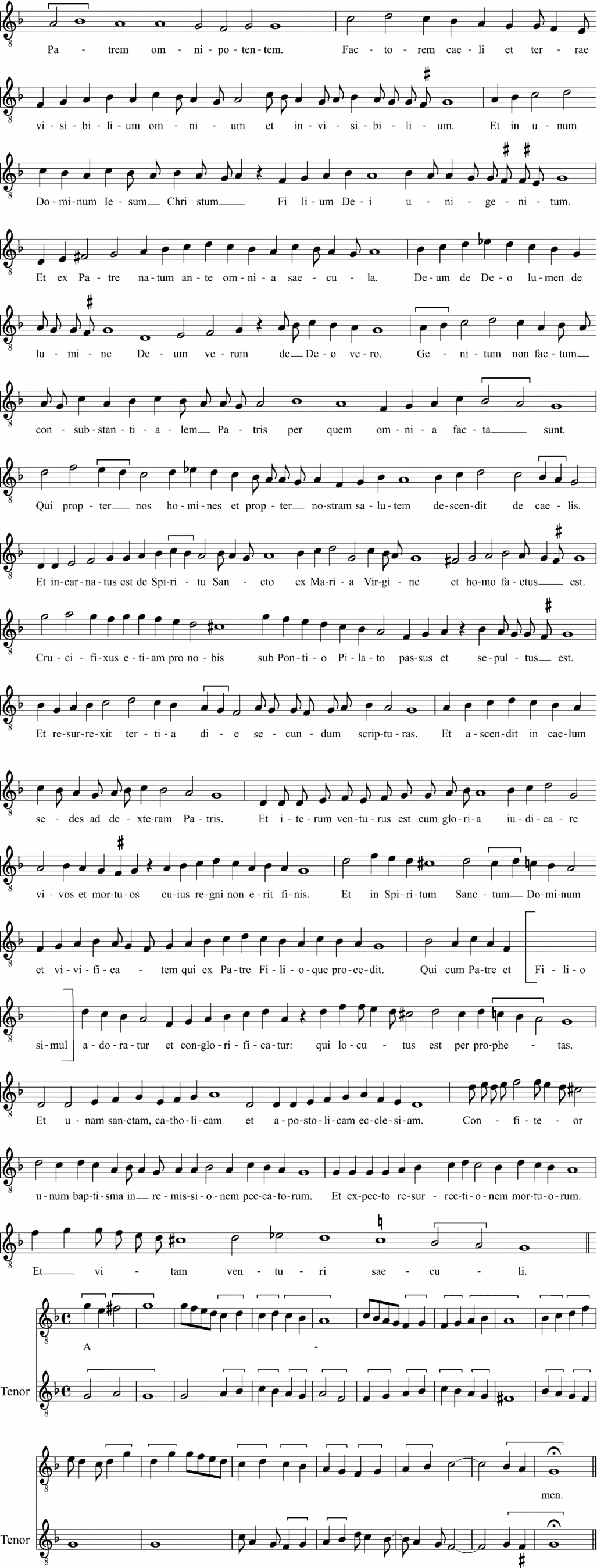
The melody of the third Credo on fols. 268v–269r (no. 10; Pl. 11–12; Ex. 8) is not found elsewhere in the repertoire. Like the two other Credos on the closing folios of the gradual, it is notated in late fourteenth-century black notation; like its immediate predecessor, its incipit is identical with Credo I. In this case, however, the chant has a slightly higher ambitus (D–aa), with some accidentals, resulting in e flat and f sharp and c sharp. It adopts a binary division throughout in modus imperfectum, tempus imperfectum and prolatio minor, which results in typical cadential syncopations.
Credo. Rome, Basilica di Santa Maria Maggiore, graduale, fols. 268v–269r.
Its most interesting feature, however, is the concluding two-voice Amen. The presence of a polyphonic Amen at the end of a Credo in cantus fractus is a frequent occurrence in Italian manuscripts of the periodFootnote 55 and supports the argument that the Credo was probably executed with the addition of at least an improvised second voice, according to the praxis of secundare.Footnote 56
Conclusion
The pieces added to the gradual of Santa Maria Maggiore include many distinctive features that make it an important source for the history of liturgical chant and polyphony of the second half of the fourteenth century.Footnote 57 First, this source adds new compositions to the known repertoire: a polyphonic Gloria, polyphonic Credo, a troped Sanctus and a Credo in cantus fractus. These discoveries increase our knowledge of the corpus of monophonic and polyphonic works for the mass ordinary, a repertoire that calls for a deeper analysis.Footnote 58 That the additions to the gradual focus on the mass ordinary corresponds with the practice known from other Italian sources of the time.Footnote 59
The additions to the Santa Maria Maggiore gradual cast valuable perspectives onto the relationship between the liturgical music of France and Italy: the main corpus of the gradual comes from southern France, specifically, the region of Avignon, as evident from its liturgical content. Almost all the additions either originated in France (the Credo of Tournai; the Credo Cardinalis in cantus fractus, the cantio Verbum caro) or show features typical of French music of the period (i.e. the style of composition of the two-voice Gloria and the two last mensural Credos). Yet, the notation of most of the added pieces – mensural or polyphonic – is typically Italian, as is shown by the consistent use of puncti divisionis, the breve as a point of reference and a preference towards its binary subdivision.
The Santa Maria Maggiore gradual and its additions are, therefore, a new witness to the circulation of French liturgical music in Italy in the second half of the fourteenth century and at the beginning of the fifteenth century. The Santa Maria Maggiore gradual is a concrete, vivid witness to cultural interaction and transfer, being an originally French gradual that came to Rome, where it received additions of French mensural and polyphonic liturgical music mostly written in Italian notation. The use of the Italian notation for spreading French compositions in Italy shows how Italian musicians accepted these pieces within their own repertoires, while retaining to their own typical notation system. Moreover, some of the added pieces (i.e. the Credo cardinalis in cantus fractus, the cantio Verbum caro) are disseminated in many other Italian sources,Footnote 60 which confirms the effectiveness of cultural migration.
The discovery of a new source containing the Credo of Tournai opens new perspectives on its musical reception and transmission. Its presence in the added fascicle of the manuscript of Santa Maria Maggiore confirms the hypothesis of an Avignonese provenance. It also confirms the special status of the Credo as a separate and independent piece within the cycle of the Mass of Tournai. Moreover, the fact that the Santa Maria Maggiore gradual contains only the triplum of the Tournai Credo points to its possible use as a mensural piece for single voice, similar to other familiar Credos in cantus fractus. It also suggests once again the mutual exchange between mensural monody and written or improvised polyphony, where a composition took its proper form during individual musical performances.
How or why the gradual found its place into the Roman Basilica di Santa Maria Maggiore in unknown, but it may have accompanied the relocation of the papal court from Avignon to Rome. Given the complex links between Italy and France in the period, two different hypotheses are most likely: either (the more probable scenario) the gradual arrived in Rome from Avignon together with the return of the Pope – in this case the added pieces could have been inserted before the gradual's transfer to Rome by an Italian musician working in Avignon, or later when the manuscript was already in Italy; or the manuscript came to Santa Maria Maggiore at a later stage, as part of a musical collection owned by a musician who worked in Rome – this musician could have come directly from the north (France or northern Italy) or from the Angevine kingdom of south and central Italy.
The Santa Maria Maggiore gradual, which has been introduced in this article, opens new perspectives onto our understanding the sacred music of the Trecento. Further research will need to establish the exact route through which the manuscript reached Rome and, through detailed comparative studies with French and Italian sources, how the process of cultural transfer and appropriation worked.