INTRODUCTION
Between 2004 and 2012, colonies of an unknown encrusting cheilostomatous bryozoan were found at four coastal sites in the North Sea. First detected in material from the Belgian and Dutch coasts, this species was provisionally placed within the genus Hippoporina Neviani, 1895 by De Blauwe (Reference De Blauwe2006, Reference De Blauwe2009). Subsequently, specimens were also found on shells near Helgoland, Germany, during macrobenthic surveys (Kuhlenkamp & Kind, Reference Kuhlenkamp and Kind2012) and De Blauwe (Reference De Blauwe2009) discovered one colony (recorded as Hippoporina sp.) in shell material from the Hinderbanken, collected by Gilson in 1905 (housed in the Royal Belgian Institute of Natural Sciences). Our present re-examination of this material has led us to ascribe all specimens to Schizobrachiella verrilli (Maturo & Schopf, Reference Maturo and Schopf1968).
Additionally, we will discuss the recent discovery of Schizobrachiella verrilli in the North Sea and the existence of a sample from 1905 in the Belgian museum. According to Hayward (Reference Hayward, Bock and Gordon2012), the genus Schizobrachiella currently includes five species worldwide and, until now, only one – Schizobrachiella sanguinea (Norman, 1868) – has been reported for Europe. Schizobrachiella sanguinea has a mainly Mediterranean distribution and a northern limit in the western part of the English Channel (Hayward & Ryland, Reference Hayward and Ryland1999; Hayward & McKinney, Reference Hayward and McKinney2002). Of the remaining species, Schizobrachiella convergens (Harmer, Reference Harmer1957) was described from Indonesia (Harmer, Reference Harmer1957) and the Red Sea (Vine, Reference Vine1986), and Schizobrachiella subhexagona (Ortmann, Reference Ortmann1890) was found in Indonesia (Harmer, Reference Harmer1957) and Japan (Ortmann, Reference Ortmann1890). Schizobrachiella porosa (Verrill, 1879) was documented for the North-west Atlantic, from Cape Cod to Cape Hatteras (Winston & Hayward, Reference Winston and Hayward2012), while Schizobrachiella verrilli shows a more widespread distribution in the western Atlantic, from Massachusetts to Brazil (Maturo & Schopf, Reference Maturo and Schopf1968; Winston, Reference Winston1982; Winston & Hayward, Reference Winston and Hayward2012) and in the eastern Pacific, from Mexico to the Galapagos Islands (as Hippoporina verrilli: Winston, Reference Winston1982; Chiriboga et al., Reference Chiriboga, Ruiz, Banks, Bungartz, Herrera, Jaramillo, Tirado, Jiménez-Uzcátegui, Ruiz, Guézou and Ziemmeck2013).
MATERIALS AND METHODS
Sampling and voucher material
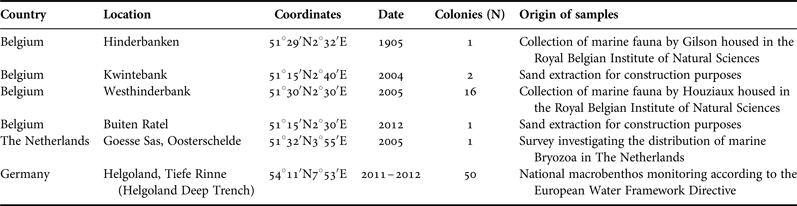
Between 2004 and 2012, samples of empty molluscan shells with attached colonies of Schizobrachiella verrilli were collected at four sites in the North Sea during various research programmes (Table 1). One of the authors (H. De Blauwe) studied the recent faunal collections by Houziaux et al. (Reference Houziaux, Kerckhof, Degrendele, Roche and Norro2008) and the historic molluscan collection by Gilson, finding additional bryozoan material (De Blauwe, Reference De Blauwe2009). Both collections are deposited in the Royal Belgian Institute of Natural Sciences (RBINS). The specimens collected recently in Belgium and in the Netherlands are located in the private collection of the second author. Voucher specimens of the German material were deposited in the first author's collection, either preserved in 70% ethanol or as dried specimens.
Sampling information for Schizobrachiella verrilli in the North Sea.

Sampling sites and methods
BELGIUM
Samples of Bryozoa were taken from shells that had accumulated on several sublittoral sandbanks belonging to a series of offshore banks running parallel to the Belgian coast, from the intertidal zone to depths of 35–40 m (Vanosmael et al., Reference Vanosmael, Willems, Claeys, Vincx and Heip1982; Houziaux et al., Reference Houziaux, Kerckhof, Degrendele, Roche and Norro2008). Several of the subtidal banks were screened for shells and their epibiotic Bryozoa (Table 1). From the Kwintebank and Buiten Ratel, coarse sand was officially extracted in order to replenish the nearby beaches, thereby providing easy access to molluscan shells with attached Bryozoa. Gravel and shell material was collected by beam trawling near the banks of Hinderbanken.
THE NETHERLANDS
The Oosterschelde is a North Sea tidal water body reaching far into the mainland. The sampling site near the Goesse Sas, at depths of 7–10 m, consisted of sandy, muddy sediments covered by a single layer of empty mussel shells – Mytilus edulis. Empty mussel shells were collected in 2005 by SCUBA diving.
GERMANY, HELGOLAND
Situated south of the island Helgoland, in the German Bight, the North Sea, about 55 km off the German coast, the Tiefe Rinne trench is a depression nearly 10 km2 in size (an area covered by a 50 m depth contour) with a maximum depth of 55–60 m in the otherwise shallow German Bight. The Tiefe Rinne is regarded as a relatively isolated and sheltered area, dominated by circalittoral shell gravel, which provides the main hard substratum, and sand and mud act as soft sediments, while stones and gravel are mostly absent (Caspers, Reference Caspers1939). Between July and August of 2011 and 2012, colonies of Schizobrachiella verrilli attached to empty shells, mostly to horse mussels (Modiolus modiolus Linnaeus, 1758) or oysters (Ostrea edulis Linnaeus, 1758), were sampled during dredging along five different transects in the Tiefe Rinne (Table 1). Material was kept in fresh seawater until further processing in the laboratory.
Observation methods
Shells from the Belgian and Dutch locations were washed in tap water and air dried. Subsequently, they were screened for bryozoans using a NOVEX-AP7 stereo-binocular microscope. Representative samples were prepared for examination with an Environmental Scanning Electron Microscope (ESEM), FEI Quanta 200. With some exceptions, they were coated with gold to improve scanning electron microscope (SEM) photography. Microscopical studies of the German material were performed on live material, on colonies preserved in 70% ethanol and on dried material. For the microscopic observations and photographic imaging, an Olympus SZX12 stereo-binocular microscope with a 1.2 Planapo objective was used. Size measurements were performed on colonies from Germany and on the SEM images of the Belgian material.
RESULTS
Taxonomic account based on European material
Schizobrachiella verrilli (Maturo & Schopf, Reference Maturo and Schopf1968), Winston & Hayward, Reference Winston and Hayward2012
Escharella pertusa? Verrill, 1875 (part)
Escharina porosa Verrill, 1879 (part)
Hippoporina verrilli Maturo & Schopf, Reference Maturo and Schopf1968
Colonies form small rounded sheets, usually encrusting empty bivalve shells (Figure 1A). Living colonies beige, changing to brown or white after death. Autozooids broadly rectangular to polygonal, slightly convex, separated by a slightly raised ridge (Figure 1B). Orifice slightly broader than long, with a broad, very shallow U-shaped sinus between small rounded condyles. Frontal shield evenly perforated by large round pores, except proximal to the orifice, becoming deeply immersed in the surface and enlarged laterally in later ontogeny. Peristome thick, incorporating a prominent proximal umbo and flaring lappets laterally (Figure 1C), abruptly ending, often tipped disto-laterally, absent distally. Prominent ovicells globular, rugose and evenly perforated, closed by the operculum of the parent zooid (Figure 1D). Calcified endooecium visible in the developing ooecium, within the newly formed secondary calcification initiated at the periphery of the ooecium. Avicularia very rare, mostly absent, small, with narrow triangular rostrum, pointing proximally outwards, situated at the distal end of the autozooid at either side of the orifice (Figure 1E). Ancestrula tatiform, surrounded by approximately ten spines, rapidly overgrown by secondary calcification from neighbouring autozooids (Figure 1F).
Schizobrachiella verrilli (Maturo & Schopf, Reference Maturo and Schopf1968): A, C, E: preserved material from Tiefe Rinne, Helgoland. B, D, F: SEM preparations of Belgian material. (A) Mature colony on shell fragment; (B) Detail of colony; (C) Zooids with prominent umbo and lateral flappets; (D) Zooids with ovicells, one ovicell under construction; (E) Two zooids with avicularia on either side of the operculum; (F) Centre of young colony with ancestrula showing remnants of spines. Scale bars: A, 3 mm; B, 500 µm; C, 300 µm; D, 200 µm; E, 100 µm; F, 200 µm.
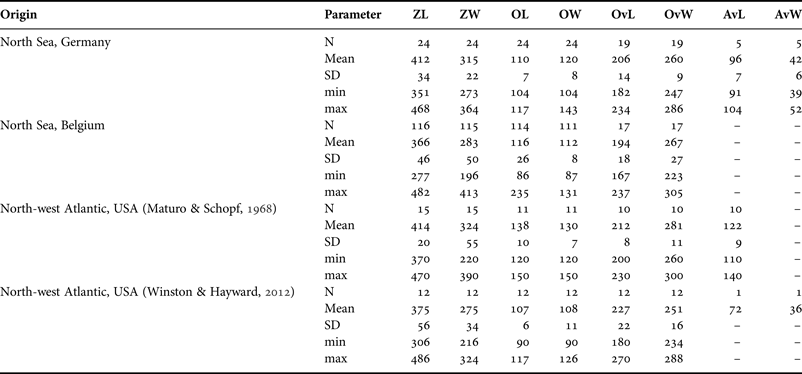
The size measurements of zooids of Belgian and German Schizobrachiella verrilli are given in Table 2. Zooids from Belgium were of a slightly smaller mean size than those from Helgoland, which might be due to the low number of zooids measured in the Helgoland material. All measurements, however, compare well to the ranges given for the North American material by Maturo & Schopf (Reference Maturo and Schopf1968) and Winston & Hayward (Reference Winston and Hayward2012) (Table 2). Their morphological descriptions are fully consistent with the taxonomic characters found in our material. Avicularia were only present on four zooids of one colony from Helgoland.
Measurements of zooids of Schizobrachiella verrilli in μm. ZL, zooid length; ZW, zooid width; OL, orifice length; OW, orifice width; OvL, ovicell length; OvW, ovicell width; AvL, avicularium length; AvW, avicularium width. Values for North-west Atlantic (USA) were taken from literature (Maturo & Schopf, Reference Maturo and Schopf1968; Winston & Hayward, Reference Winston and Hayward2012). SD, standard deviation.
Habitat
In the Belgian and Dutch samples, the 20 available colonies of Schizobrachiella verrilli occupied the inner side of empty shells, an indication that the species might avoid direct exposure to adverse physical factors when living on the sublittoral shell banks of the coastal North Sea. These banks are usually affected by strong currents, causing various substrata, such as sand and silt, to move around frequently. Most of the 50 colonies found in the recent German samples were attached to shell fragments, which had aggregated in the deep trench Tiefe Rinne near Helgoland, Germany – a very species-rich area in the German Bight (Caspers, Reference Caspers1939; Schwinn et al., Reference Schwinn, Türkay and Sonnewald2014). Searching for historic records, a comprehensive revision of the collection of Bryozoa in the Royal Belgian Institute for Natural Sciences in Brussels by the second author did not reveal any colony of S. verrilli, whereas the examination of molluscan shells already collected in 1905 by Gilson on the Hinderbanken yielded one epizooic colony of S. verrilli.
Differences between Schizobrachiella species
According to Harmer (Reference Harmer1957), the genus Schizobrachiella is characterized by a perforated frontal surface, an orifice with a wide, round sinus and hyperstomial ovicells closed by the operculum. Three species, Schizobrachiella sanguinea, Schizobrachiella porosa and Schizobrachiella subhexagona, have larger zooids than Schizobrachiella verrilli. Additionally, Schizobrachiella sanguinea differs from Schizobrachiella verrilli in the deep red colour of its live colonies and in the shape of its orifice, which is wider than long, has a distinct U-shaped sinus and lacks a peristome or umbo (Hayward & Ryland, Reference Hayward and Ryland1999; Hayward & McKinney, Reference Hayward and McKinney2002). In Schizobrachiella porosa, avicularia are missing, the condyles are downcurved and the frontal surface of its zooids is densely perforated with equally sized pores, which are smaller and more numerous than in Schizobrachiella verrilli (Winston & Hayward, Reference Winston and Hayward2012). The hexagonal zooids of Schizobrachiella subhexagona have a low peristome and usually exhibit a small, imperforated area located centrally on the frontal surface. Ovicells of Schizobrachiella subhexagona are inconspicuous, sunken and punctuate with various kinds of pores (round, slit-like or both), whereas avicularia are missing (Harmer, Reference Harmer1957). Zooids of Schizobrachiella convergens are similar in size to those of Schizobrachiella verrilli, but have only a low peristome without a prominent umbo and the paired lateral avicularia present in most zooids are directed inwards (Harmer, Reference Harmer1957; Ostrovsky et al., Reference Ostrovsky, Cáceres and Vávra2013).
DISCUSSION
Generic placement
Between 1964 and 1966, Maturo & Schopf (Reference Maturo and Schopf1968) revised the bryozoan type material collected by Verrill. Escharella pertusa? Verrill, 1875 was found to consist of two species differing in the size of their zooids. Specimens with large zooids agreed well with the description of Escharina porosa Verrill, 1879, which Verrill actually had attributed to the whole type material. Escharina porosa Verrill, 1879 was then proposed to be renamed Hippoporina porosa (Verrill, 1879) by Maturo & Schopf (Reference Maturo and Schopf1968), whereas the form with the small zooids was established as the new species Hippoporina verrilli. Their own material of Hippoporina verrilli was designated the holotype based on a colony found in 1963 at the New River Inlet, North Carolina. In the original description, polymorphic avicularia were described to occur infrequently (Maturo & Schopf, Reference Maturo and Schopf1968), whereas Winston & Hayward (Reference Winston and Hayward2012) reported avicularia to be missing in their study material, although the finding of one avicularium is listed in their table with the measurement results. Lately, remarks by D. Gordon (personal communication) concerning the ovicell structure caused Winston & Hayward (Reference Winston and Hayward2012) to finally assign Hippoporina verrilli to the genus Schizobrachiella Canu & Bassler, 1920. As D. Gordon and A. Ostrovsky communicated to us in detail (in litt.), both the ectooecium and the endooecium are calcified in Hippoporina, whereas the ovicell in Schizobrachiella is schizoporelloid, characterized by a membranous ectooecium and a secondary calcification, leaving pores corresponding to the pseudopores of the ectooecium. Therefore, our material of S. verrilli conforms, unequivocally, to the morphological characteristics of the genus Schizobrachiella.
Distribution, habitat and origin
Schizobrachiella verrilli is now the second species of the genus Schizobrachiella occurring in Europe. Its distribution range is not overlapping with that of Schizobrachiella sanguinea, which is regarded as a warm water species (Hayward & Ryland, Reference Hayward and Ryland1999). The occurrence of Schizobrachiella verrilli in the North Sea represents a substantial expansion of its geographic range, which is so far documented for the North-west Atlantic and a few sites in the eastern Pacific (Maturo & Schopf, Reference Maturo and Schopf1968; Winston, Reference Winston1982; Winston & Hayward, Reference Winston and Hayward2012). The existence of a specimen in Gilson's collection of 1905 (De Blauwe, Reference De Blauwe2009) suggests that either Schizobrachiella verrilli is native to Europe or it was already introduced in former times by transoceanic transport vectors, such as shipping. Regarding the restricted distribution of Schizobrachiella verrilli to only a very few sites in the North Sea, this species has to be considered rare in Europe and has obviously been overlooked until now. Bryozoans are often neglected due to the lack of taxonomic expertise or go unnoticed despite regular and intensive monitoring of the European coasts. Even the numerous dredge samples by Gilson in 1905 were never completely screened for the presence of Bryozoa. A study of only a small fraction of this collection by the second author revealed several species, which have recently been reported as new to the North Sea, that were already present in 1905, e.g. Setosella vulnerata (Busk, 1860), Distansescharella seguenzai Cipolla, 1921, Puellina modica Bishop & Househam, 1987 and Escharina dutertrei haywardi Zabala et al., 1993 (De Blauwe, Reference De Blauwe2009).
If Schizobrachiella verrilli was historically introduced to Europe by transoceanic transport vectors, its restricted distribution here might be an indication of its low competitiveness against native organisms or reduced resilience to certain environmental factors, such as lower winter temperatures than those of its original habitats, which are located in warm temperate to tropical waters. Ecological data about this species, however, is sparse and does not allow for any substantial conclusions. In Europe, Schizobrachiella verrilli might exist only in certain refugial environments as represented by the shell microhabitats. Several other bryozoan species of the southern North Sea and the English Channel are exclusively known from relatively undisturbed shell microhabitats (De Blauwe, Reference De Blauwe2006). Besides some scattered areas with shells, gravel and rocks, the bottom of the North Sea consists mostly of sandy and muddy sediments, unsuitable for most sessile hard-bottom fauna. Sublittoral shell banks are, therefore, important habitats for bryozoan species, providing a rather stable substratum, especially on the inner side of shells and shell fragments, and supporting high numbers of species (Blahudka & Türkay, Reference Blahudka and Türkay2002; Houziaux et al., Reference Houziaux, Kerckhof, Degrendele, Roche and Norro2008; Kuhlenkamp & Kind, Reference Kuhlenkamp and Kind2012). Such banks are often protected from anthropogenic and environmental disturbances. Generally, the bottom of the southern North Sea is severely disturbed by beam trawling, altering the diversity of the benthic fauna (Callaway et al., Reference Callaway, Engelhard, Dann, Cotter and Rumohr2007). The Dutch locality is not exposed to prevailing south–westerly winds and is not fished with bottom gear. Some deep areas between the Belgian underwater sand dunes were not directly affected by hazardous bottom fishing gear and constitute a refugium with high species numbers (Houziaux et al., Reference Houziaux, Kerckhof, Degrendele, Roche and Norro2008). Similarly, the deep trench near Helgoland is an extremely species-rich habitat due to its relatively sheltered situation and its more oceanic conditions, with less variation in temperature and salinity compared to the nearby rocky habitats of Helgoland (Caspers, Reference Caspers1939; Blahudka & Türkay, Reference Blahudka and Türkay2002; Boos et al., Reference Boos, Buchholz, Buchholz and Gutow2004). Consequently, we expect a high incidence of rare species in areas such as those sampled during our study. Apart from the recent monitoring studies on the fauna around Helgoland, comprehensive investigations concerning bryozoans in the area of the German Bight have rarely been conducted. This gives reason to anticipate more findings of new species for this area in further studies. The same situation exists in the Dutch part of the North Sea, where very little effort has been directed at the investigation of bryozoans, and where only a few recent surveys have already produced several records of species that are new to or seldom recorded in the area (Faasse et al., Reference Faasse, van Moorsel and Tempelman2013).
ACKNOWLEDGEMENTS
Our thanks to Julien Cillis of the RBINS for conducting the SEM studies of the Belgian material. We gratefully appreciate the scientific research service provided by the Alfred Wegener Institute for Polar and Marine Research in the Helmholtz Association at their Biological Station Helgoland and the invaluable support by their staff. The German investigations were partly funded by the State Agency for Agriculture, Environment and Rural Areas (LLUR), Flintbek, Schleswig-Holstein, Germany. We are grateful for the critical comments made by the reviewers, in particular, those by Jean-Georges Harmelin, which greatly improved the manuscript.