Introduction
Survival of infants and children with CHD has steadily improved. From 1979 to 1993, 67% of infants survived to one year of age, and this increased to 83% from 1994 to 2005.Reference Oster, Lee, Honein, Riehle-Colarusso, Shin and Correa1 Total life expectancy for those with CHD has also increased significantly.Reference Dellborg, Giang and Eriksson2 As survival has improved, there is a growing emphasis on the health-related quality of life and well-being of these children as they reach adulthood. Several studies have demonstrated that chronic diseases in adulthood (e.g., diabetes, heart failure, and cancer) are associated with increased financial stress and risk of poor economic well-being, which negatively impacts health outcomes.Reference Blanchette, Toly and Wood3–Reference Kim, Perry, Mossman, Dunn, Hoerger and Ramatillah6 A national study in Denmark demonstrated that adults with CHD have impaired economic self-sufficiency relative to the general population and their own siblings.Reference Madsen, Marino, Woo and Olsen7 Other studies have demonstrated that the socioeconomic factors of parents such as income, educational attainment, and insurance status influence the morbidity and mortality of their children with CHD.Reference de Loizaga, Schneider and Beck8–Reference Peyvandi, Baer and Moon-Grady10 However, little is understood about the long-term economic impact for adults in the United States (US) living with CHD.
Financial fragility, defined as an individual’s ability to pay $2,000 in an emergency, has proved to be a reliable indicator of overall financial well-being.Reference Susan and Urahn11 It reflects an individual’s capacity to adequately manage and respond to unexpected expenses, such as medical bills or car repairs.Reference Susan and Urahn11,Reference Annamaria Lusardi and Schneider12 This study aimed to determine the prevalence of financial fragility among adults with CHD living in the US. Secondarily, we aimed to compare the financial fragility of adults with CHD to their siblings individually and overall. We hypothesised that adults with CHD are at increased risk of financial fragility when compared with a healthy community sample and that greater CHD severity would correlate with higher financial fragility. In addition, we aimed to identify risk factors associated with financial fragility in various CHD severity subgroups.
Methods
Study design. We conducted a cross-sectional study using data from the CHD Project to Understand Lifelong Survivor Experience (CHD-PULSE), a multi-centre study of adults with CHD conducted from 2021 to 2023. The Paediatric Cardiac Care Consortium is a US-based registry of diagnoses, catheterisations, and surgeries for CHD from 1982 to 2011. Participants were sent a survey if they had at least one intervention for CHD from one of these 11 centres collaborating with the Paediatric Cardiac Care Consortium: Augusta University, Children’s Hospital at Washington University, Children’s Medical Center Dallas, Children’s Mercy Hospital, Children’s Minnesota Hospital of Minneapolis, Children’s National Medical Center, Cleveland Clinic, Masonic Children’s Hospital of the University of Minnesota, Medical University of South Carolina, Norton Children’s, and St Louis Children’s Hospital.Reference Oster, Yang and Shi13 Eligible participants were included if they were greater than 18 years of age, a US resident, preferred language either English or Spanish, and had identifiers to match them with National Death Index records to determine survivorship status through the end of 2020.Reference Oster, Yang and Shi13
The survey asked participants to identify their biological sibling closest in age without CHD. Invited siblings were sent a similar survey without questions related to CHD. Of the 3,133 CHD participants and 326 siblings who met inclusion criteria for the parent study, 3074 CHD respondents and 324 siblings completed the questions on economic outcomes and financial fragility and were included in this analysis. Institutional review boards at each site and the Western institutional review boards approved the study (STUDY00000303).
Variables
The parent study (i.e., CHD-PULSE) assessed long-term medical, neurocognitive, and psychosocial symptoms in adults with CHD. Demographic information, such as age, sex, race/ethnicity, educational attainment, marital status, and history of special education were collected. CHD severity was categorised into single ventricle, mild two-ventricle, moderate two-ventricle, severe two-ventricle, and unclassified based on an adapted classification scheme initially introduced in the Canadian Conference on the care of adults with CHD.Reference Oster, Yang and Shi13–Reference Spector, Menk and Knight15 CHD patients and their sibling closest in age without CHD participated in the survey.
Financial outcomes included annual household income before taxes, employment status, insurance status and denial, financial self-perception, and the ability to pay medical expenses. To assess financial fragility, we used a validated question from prior economic studies “How confident are you that your household could come up with $2,000 if an unexpected need arose within the next month?”16,Reference Paul, Yakoboski and Hasler17 Multiple-choice response options included: “I am certain my household could come up with the full $2,000” or “My household probably could come up with $2,000” as financially stable, and “I am certain my household could not come up with $2,000” or “My household probably could not come up with $2,000” as financially fragile. We obtained data on medical comorbidities (i.e., genetic disorders, chromosomal abnormalities, and prematurity) from Paediatric Cardiac Care Consortium registry data for CHD participants. These data were unavailable for non-CHD siblings.
Statistical analysis
Demographic and socioeconomic factors were compared between participants with CHD and their non-CHD siblings. Further analysis among CHD participants only described demographic and socioeconomic variables by financial fragility. Summary statistics were presented as frequencies with percentages and medians with interquartile ranges (IQR). P-values were compared using chi-square tests and Wilcoxon rank-sum tests due to the non-normal distributions of this cohort.
Logistic regression models compared the odds and adjusted odds of financial fragility by CHD status and CHD severity. We compared CHD status by two groups: (1) the whole cohort of CHD participants and non-CHD siblings and (2) matched sibling pairs from the same household. The odds of financial fragility by CHD severity were analysed in the whole cohort and among participants with CHD only. All models were adjusted for age, sex, race/ethnicity, educational attainment, and marital status.
We performed several sensitivity analyses to explore secondary aims. We stratified analyses by age at 30 years, marital status, sex, and women’s reproductive history to determine whether any of the above factors were related to self-perceptions of financial fragility. We also compared the frequency of sibling response to examine whether participants with a sibling who responded to the survey were significantly different from participants with no sibling response.
Statistical significance was determined at alpha 0.05. All analyses were performed in SAS, version 9.4 (SAS Institute Inc., Cary, NC, USA).
Results
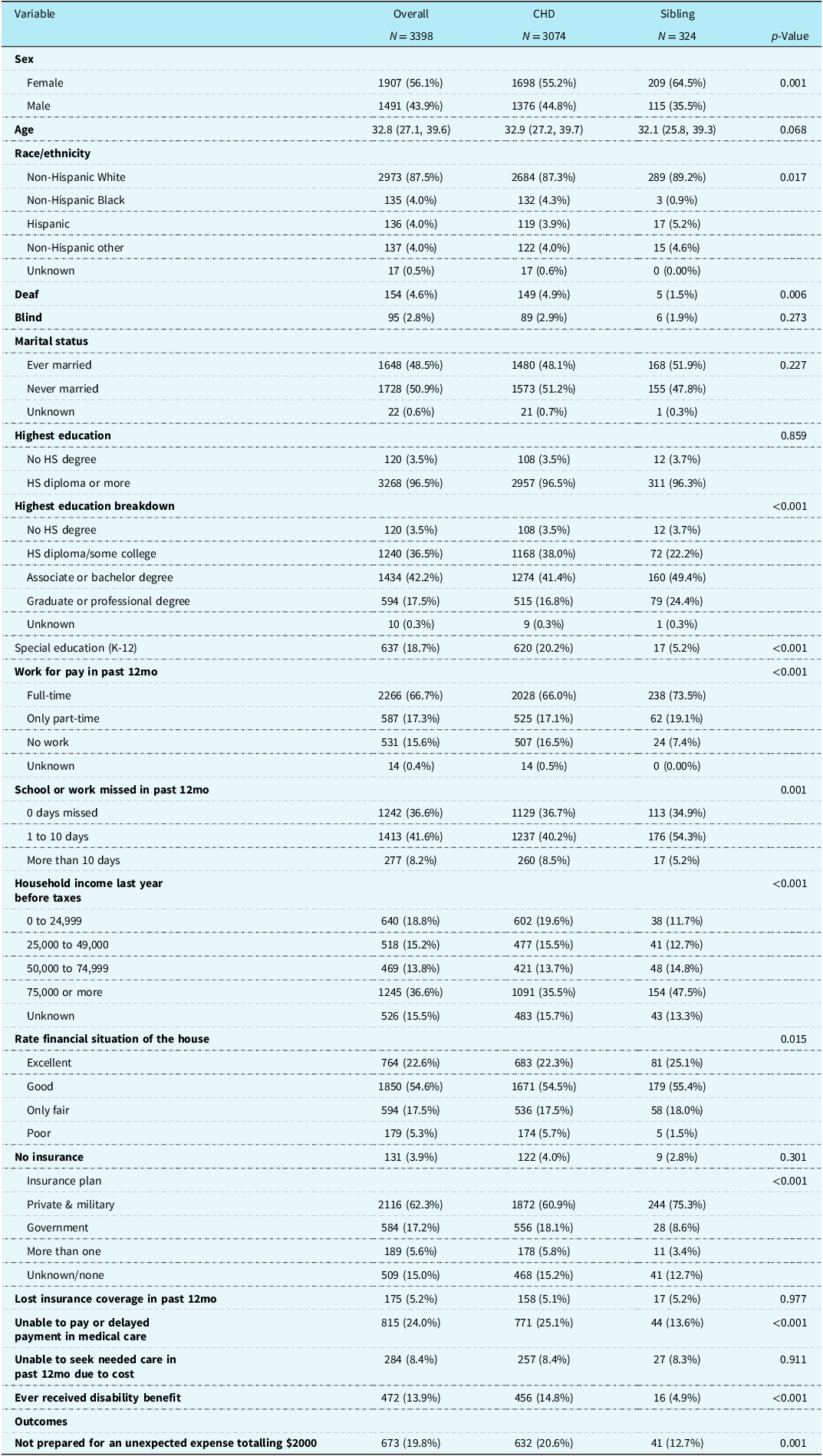
There were 3,074 adults with CHD and 324 siblings who answered the financial fragility question. The CHD group included fewer females (55.2% vs. 64.5%, p = 0.001) and fewer non-Hispanic White respondents (87.3% vs. 89.2%, p = 0.017) than the sibling group. There was no difference in age between the CHD patients and siblings (p = 0.07) (Table 1). Both groups had similar rates of attaining at least a high school diploma (CHD: 96.5%, Siblings: 96.3%, p = 0.859), but siblings more frequently earned a graduate or professional degree (CHD: 16.8%, Siblings: 24.4%, p = 0.001).
Demographics and outcomes of individuals with CHD versus siblings

Values are given in N (%) or median (IQR). p-Values are calculated by Chi-square or Wilcoxon tests without unknowns.
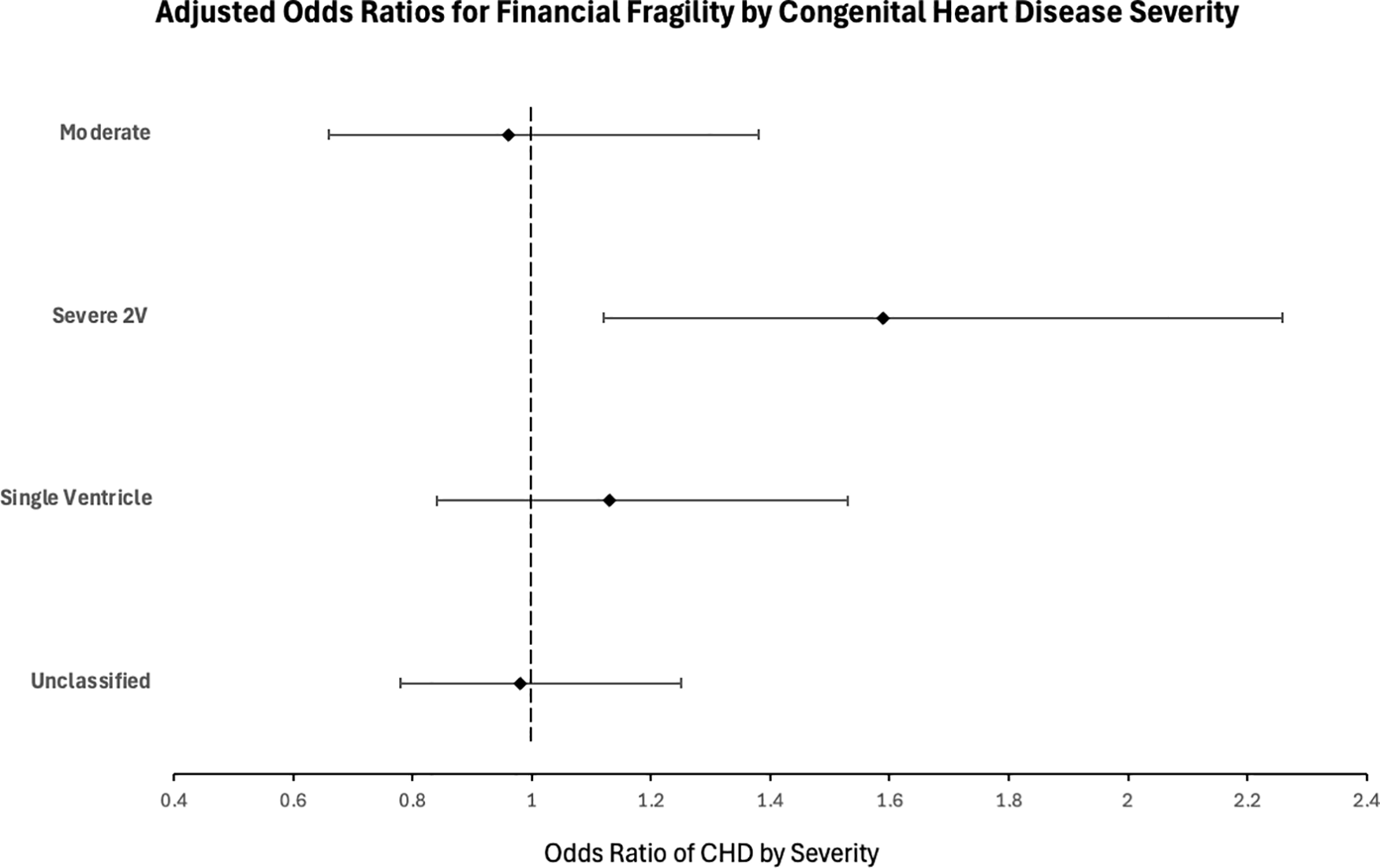
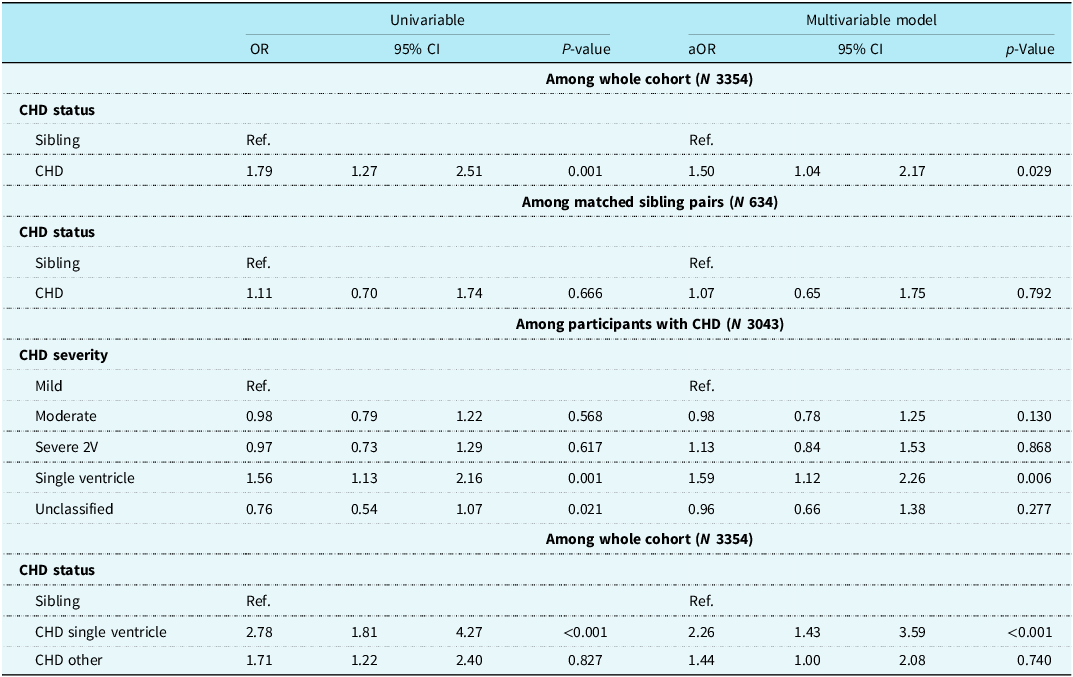
The prevalence of financial fragility was 20.6% for individuals with CHD compared to 12.7% among siblings (p = 0.001) (Table 1). In multivariable analysis, individuals with CHD had increased odds of financial fragility (aOR 1.50 95% CI 1.04–2.17, p = 0.029) compared to non-CHD siblings (Table 2). However, there was no statistical significance in unadjusted or adjusted odds of financial fragility between individuals with CHD and their matched siblings (Table 2). Among CHD severity categories, single ventricle anatomy was significantly associated with financial fragility (aOR 1.59, 95% CI 1.12–2.26, p = 0.006) compared to mild CHD (Table 2, Figure 1) and (aOR 2.26, 95% CI 1.427–3.592, p = <0.001) compared to siblings (Table 2).
Forest plot of odds ratios of financial fragility by CHD based on severity: multivariable analysis. Odds ratios derived from multivariable logistic regression models adjusted for age, sex, race/ethnicity, and marital status. Mild CHD was used as a reference group. Error bars represent 95% confidence intervals.

Figure 1. Long description
The dot plot presents adjusted odds ratios for financial fragility categorized by the severity of congenital heart disease (CHD). The x-axis represents the odds ratio of CHD by severity, ranging from 0.4 to 2.4. The y-axis lists four categories of CHD severity: Moderate, Severe 2V, Single Ventricle, and Unclassified. Each category is represented by a diamond-shaped dot, with horizontal error bars indicating 95% confidence intervals. The reference group for comparison is Mild CHD, represented by an odds ratio of 1. The Moderate category shows an odds ratio slightly above 1, with a wide confidence interval extending from approximately 0.8 to 1.6. The Severe 2V category has an odds ratio around 1.6, with a confidence interval ranging from about 1.2 to 2.2. The Single Ventricle category has an odds ratio close to 1, with a confidence interval from approximately 0.8 to 1.4. The Unclassified category shows an odds ratio slightly below 1, with a confidence interval from about 0.6 to 1.2. The plot indicates that individuals with Severe 2V CHD have the highest odds of financial fragility compared to the reference group.
Logistic regression models of the association of financial fragility with CHD severity and presence of disease: univariable and multivariable analysis

Multivariable model adjusted for age, sex, race/ethnicity, education attainment, and marital status. CHD Other = Mild, Moderate, Severe 2V, Unclassified.
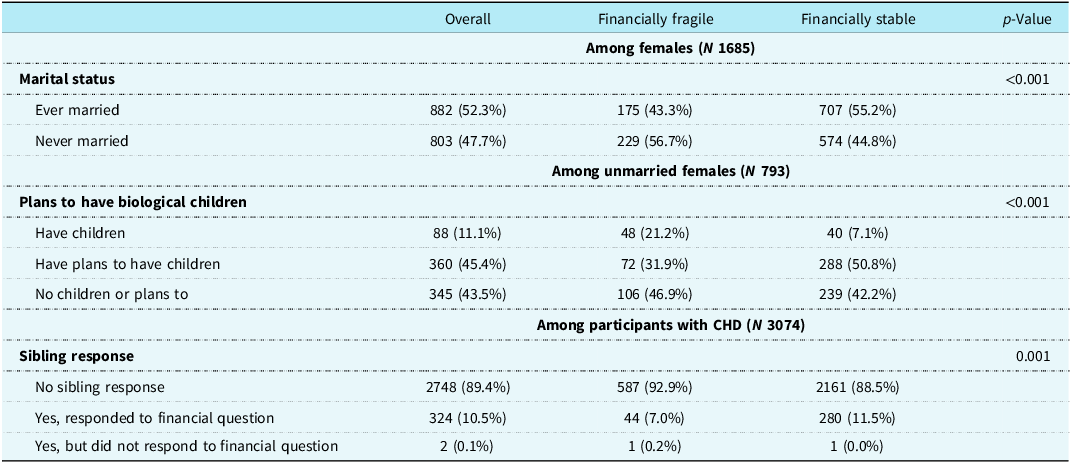
Among adults with CHD younger than 30 years old, there was no difference in financial fragility compared to their matched sibling from the same household within 10 years of age (12.9% versus 14.5%, p = 0.7, respectively). Those with CHD older than 30 years reported more financial fragility than siblings (Supplemental Table 1). There was also a difference observed based on whether adults with CHD had a sibling who participated in the survey. Those whose siblings responded had more severe CHD, but they were also significantly less financially fragile, had higher levels of education, and had greater household incomes (Supplemental Table 2).
Table 3 outlines the demographic differences between adults with CHD who were financially fragile versus non-fragile. There were no significant differences in age, frequency of genetic abnormalities, or prematurity between fragile and non-fragile adults with CHD. Adults with CHD who reported blindness were more likely to be financially fragile (p < 0.001). Those that were financially fragile were more likely to be a race other than non-Hispanic white, have single ventricle CHD, and be female. Among females, both being unmarried and having children were associated with financial fragility (p < 0.001, Table 4). They were also more likely to have a history of special education or homebound education, have missed work or school in the past 12 months due to illness, have income loss during the COVID-19 pandemic, and have lost insurance coverage in the past 12 months or have no insurance. In addition, they were less likely to have an associate’s or bachelor’s degree or full-time work in the past 12 months (Table 3).
Demographics among CHD participants (financially fragile versus financially stable)

Stratified analyses by sex, marital status, and sibling response

Financially fragile adults with CHD were less likely to have paid employment in the past 12 months and more likely to delay or forgo medical care due to cost (p < 0.001). They also reported missing more than 10 days of work or school in the preceding 12 months due to illness, and they were more likely to have lower educational attainment, lack full-time employment, and earn lower annual income (p < 0.001).
Discussion
This is the first study in the U.S. to look at the financial well-being of individuals born with CHD and their healthy siblings on a national level. When adults with CHD were compared to the overall group of siblings, they were more financially fragile, but when compared to their matched sibling, there was no difference in financial fragility. Adults with single ventricle CHD were at the highest risk of financial fragility, suggesting that economic well-being may be linked to CHD severity. Additional disabilities, such as blindness, were also associated with a higher risk of financial fragility.
Individuals with single ventricle severity were at significantly higher risk of financial fragility compared to those with milder CHD. The association of disease severity and adverse financial outcomes is well-documented in the literature for other populations with chronic illness. For example, individuals with more severe inflammatory bowel disease experience increased financial burden compared to those with less severe disease.Reference Kahn-Boesel, Cautha, Ufere, Ananthakrishnan and Kochar25 Families of children with greater medical complexity experience significantly more financial and social hardships than families of children with less complex conditions.Reference Thomson, Shah and Simmons26 These findings support the need for additional resources and anticipatory guidance for families and individuals with single ventricle CHD.
In our U.S.-specific study, adults with CHD had increased odds of financial fragility compared to healthy siblings as a group, even after adjustment. However, when compared to their matched sibling, adults with CHD had the same odds of financial fragility. Age stratification found that adults with CHD and their siblings had similar financial situations before 30 years old. After 30 years old, those with CHD reported more financial fragility than their siblings did. In understanding the similar levels of fragility in the younger group, several studies suggest that perhaps the influence of caregiver burdens and shared childhood experiences affects financial outcomes of healthy siblings.Reference Harter and Harter20,Reference Velasco, Ferraris and Eymann21 Individuals who grow up in a household with a sibling who has a chronic illness may have faced similar difficulties and limitations, resulting in similar financial outcomes. Additional studies have shown that siblings of children with a disability are at increased risk of experiencing financial hardship as an adult compared to their peers with healthy siblings.Reference Ohlsen, Wang and Buchbinder22,Reference Emerson and Giallo23 Interestingly, adults with CHD older than 30 years of age demonstrated a wider gap in financial fragility compared with healthy siblings, possibly due to siblings attaining greater wealth from higher educational achievement. Other studies have shown that healthy siblings may have similar outcomes to population controls but likely do not have superior wealth accumulation relative to their chronically ill siblings. In addition, sisters have better financial outcomes than brothers of chronically ill siblings.Reference Lovén24
According to a 2015 report from the PEW Charitable Trust, nearly 41% of residents in the US did not have enough liquid savings to produce $2,000 to cover a financial shock.16 The Federal Reserve Bank of New York’s Credit Access Survey reported that between 2021 and 2023, 29.9% to 37.3% of respondents indicated they were unlikely to come up with $2,000 in the event of an unexpected need.18 Compared to these surveys, adults with CHD actually reported a lower prevalence of financial fragility at 20.6%, while 12.7% of their siblings were financially fragile. This may reflect a survival bias such that more financially stable individuals and families may have survived into adulthood.Reference Machado, Kyriopoulos, Orav and Papanicolas19 Additional differences may be due to levels of educational attainment in the CHD and sibling groups compared to the Federal Reserve Bank of New York’s Credit Access Survey.
Demographic findings in this study were consistent with those from the PEW Charitable Trust. In our study, among non-Hispanic whites, 81.5% (2187/2684) were financially stable compared to 46.2% (61/132) of non-Hispanic Black participants and 73.9% (88/119) of Hispanic participants (Table 3). These demographics may explain the lower rates of overall financial fragility in our study, as non-Hispanic White individuals have been shown to have more liquid savings than Black and Hispanic Americans. The typical White household holds an average of 31 days of liquid savings compared to 12 days for the typical Hispanic household and five days for the typical Black household.16
This study was limited by possible nonresponse. Response rates of the parent study varied between centres from 11% to 32%, and there was limited inclusion of non-White respondents due in part to the patient populations at the 11 centres included.Reference Oster, Yang and Shi13 We corrected for this limitation by deriving adjusted odds ratios for age, sex, race/ethnicity, and marital status, and there was no nonresponse bias based on severity.Reference Oster, Yang and Shi13 Due to the nature of surveys, there is potential recall and response bias. However, our surveys were confidential to minimise discomfort with sharing sensitive financial information. Another limitation is that we did not specify whether the $2,000 emergency fund had to originate from liquid savings, credit, or borrowed funds. While these sources have different long-term implications, our primary focus was on immediate, short-term impacts and whether participants could quickly access the funds. Furthermore, in our study, those who were financially stable had higher annual household incomes and more positive ratings of their financial situation than those who were financially fragile, indicating that our financial fragility question (i.e., whether an individual can come up with $2000 in an emergency) is a good proxy for financial well-being. Finally, the surveys were collected during late 2021; thus, responses may have been impacted by the COVID-19 pandemic era.
Future studies are needed to add to the holistic understanding of CHD’s impact on an individual and their family’s financial well-being. Working to increase accessibility and resources (i.e., financial and more) for disabilities like blindness that have a demonstrated link to financial fragility will help maximise opportunities. More broadly, access to evaluation, intervention, and family resources is critical to the larger population with CHD given known neurodevelopmental and psychosocial concerns and their impact on functional independence and quality of life.
Individuals with CHD experience significant financial fragility in adulthood, and those with single ventricle anatomy and blindness are at a particularly higher risk. This study provides evidence for the need to support individuals with CHD, particularly those with single ventricle anatomy, to address their financial fragility. These findings support the need for a critical analysis of interdisciplinary strategies and policies that address health and welfare to alleviate economic hardships for individuals living with CHD so they can be active contributors to their community.
Supplementary material
The supplementary material for this article can be found at https://doi.org/10.1017/S1047951126112943.
Acknowledgements
This study was supported by the National Heart, Lung, and Blood Institute (HL122392).
Competing interests
None.