Implications
Myosin heavy-chain (MyHC) composition has been reported as an important marker of muscle-fibre types. We found that MyHC I mRNA abundance in porcine longissimus dorsi presented a decreasing trend from 7 to 180 days, and was increased by supplementation of the finishing diet with conjugated linoleic acid (CLA). These results provide important evidence for the nutritional regulation of muscle-fibre types and its application in the improvement of pork quality.
Introduction
In adult mammal, skeletal muscles are a heterogeneous tissue composed of a large variety of functionally diverse muscle fibres. According to their protein isoforms, metabolic enzyme profiles and structural and contractile properties, these muscle fibres are classified into slow-oxidative (type I), fast-oxidative (type IIa), fast-glycolytic (type IIb) and intermediate (type IIx) fibres (Bottinelli and Reggiani, Reference Bottinelli and Reggiani2000). Generally, type I and type IIa fibres utilize oxidative phosphorylation as their energy source, whereas type IIx and IIb fibres harness anaerobic metabolism to generate adenosine triphosphate (Bassel-Duby and Olson, Reference Bassel-Duby and Olson2006). The composition proportions of different fibres in muscle are considered as an important indicator of pork quality.
Conventional methods such as histochemical techniques have showed that oxidative muscle fibres are converted to glycolytic fibres within 30 days after birth, with no significant transformations occurring thereafter (Pette and Staron, Reference Pette and Staron2000). Another report showed that muscle-fibre types are influenced by numerous intrinsic and extrinsic factors such as muscle location, species, breed, genotype, gender, age, exercise, ambient temperature, nutrition and growth-promoting agents (Gondret et al., Reference Gondret, Combes, Lefaucheur and Lebret2005). The poor sensitivity of conventional methods could limit to reveal the postnatal changes of muscle-fibre types. Fortunately, analysis of MyHC protein or mRNA has been used to analyse muscle-fibre types (Schiaffino and Reggiani, Reference Schiaffino and Reggiani1996; Spangenburg and Booth, Reference Spangenburg and Booth2003), and this provides a powerful tool for understanding the postnatal changes of muscle-fibre types.
In pigs, undernutrition (feed intake restriction) increases the proportion of type I fibres and decreases the proportion of type II fibres in the longissimus muscle (Lefaucheur et al., Reference Lefaucheur, Ecolan, Barzic, Marion and Le Dividich2003). Further, sows finished out-of-doors had more type I and IIA fibres and smaller fibres than indoor-fattened pigs (Abreu et al., Reference Abreu, Quiroz-Rothe, Mayoral, Vivo, Robina, Guillen, Aguera and Rivero2006). The semitendinosus muscle of piglets born from sows fed a low-energy diet had a high proportion of type IIa fibres and a low proportion of type IIb fibres (Bee et al., Reference Bee, Guex and Herzog2004). CLA was proved to improve the expression levels of MyHC I and IIa mRNA in primary porcine skeletal muscle cells in vitro (Huang et al., Reference Huang, Yang, Liu, Jiang and Xiao2010). Thus, the exact effects of CLA on muscle fibre types in living pigs are worth studying.
In the present study, an objective is to declare the age-related changes of muscle-fibre types in postnatal pigs, and the effects of CLA on muscle-fibre types in finishing pigs. This would provide strong evidence for the CLA regulation of pork quality through changing muscle-fibre types.
Materials and methods
All animal experiments were conducted in Lvjiayuan Livestock Co. Ltd. of Zhejiang Province and followed the guidelines of the animal ethics committee of Jiangnan University, China.
Animals and feeding
Trial 1
We selected 25 male DYL (Duroc × Yorkshire × Landrace) crossbred pigs from five litters, five pigs each litter. These pigs were obtained from the same male parent. Moreover, five pigs in the same litter were divided, respectively, into five different live age groups as follows: age 7 days, live weight 2.5 ± 0.2 kg; age 30 days, 10 ± 0.25 kg; age 60 days, 20 ± 0.5 kg; age 120 days, 60 ± 1.5 kg; and age 180 days, 100 ± 2.5 kg. The pigs were creep fed from the age of 7 days and weaned on day 28. They were housed in a barn with enough space and given free access to food and drink until being slaughtered. The diet after weaning was supplied as recommended by National Research Council (NRC, 1998).
Trial 2
We selected 30 DYL crossbred hogs aged 150 days and average body weight of 69.57 kg. The pigs were divided into two experimental groups, five pens per group and three hogs per pen. The two groups received a control diet and a CLA-enriched trial diet, respectively. The control diet consisted of 60.50% corn, 16.00% wheat bran, 20.64% soya bean meal, 0.50% dicalcium phosphate, 0.95% limestone, 0.35% salt, 0.10% lysine and 1.00% premix. The nutrient contents were calculated according to NRC (1998): 16.20% crude protein, 3040 Mcal/kg metabolic energy, 0.52% Ca and 0.54% total P. The CLA-enriched trial diet was formed by adding 12 kg ethyl ester of CLA (CLA-EE) to 1000 kg of the control diet. CLA-EE was provided by Qing Dao Auhai Biotechnological company limited, and consisted of 4.60% palmitic acid C16:0, 3.70% stearic acid C18:0, 12.4% oleic acid C18:1c9, 0.6% linoleic acid C18:2c9,c12, 37.10% CLA cis-9-trans-11 isomer and 38.70% CLA trans-10-cis-9 isomer.
In the 30 days of experimental period, all pigs were housed in a naturally ventilated barn with a space allowance of 2.0 m2/pig and given free access to food and drink, and feed intake during the whole period of each pen, initial and end body weight were recorded. We also calculated average daily feed intake, average daily gain in live weight and feed conversion rate per pig.
Handling, slaughter, sampling and carcass traits
In order to follow the live pig slaughtering rules in commercial field, the pigs in the development stage-based groups were kept off feed and given free access to water for 16 h, and then slaughtered by electrical stunning and exsanguination. Samples for total RNA extraction and enzyme activity analysis were obtained immediately from the longissimus muscle adjacent to the last rib in 30 min after the exsanguination. The samples were rapidly frozen in liquid nitrogen and then stored in −80°C until analysis.
The pigs from the two nutrition-based groups were transferred from the farm to the abattoir by an ordinary commercial trucking system over ∼2.5 h, and then slaughtered by the above process. They were slaughtered by electrical stunning, exsanguinated, scalded at 65°C, skinned, eviscerated, split down and placed in a chill cooler (4°C) for 24 h. Back fat depth was measured at three points, including first rib, last rib and last lumbar vertebra. An ∼30-cm-thick portion of the longissimus muscle from the last third or fourth rib backwards was collected from the left side of the carcass and used to assess loin eye area, meat quality and muscle-fibre type. The samples for total RNA extraction and enzyme activity analysis were rapidly frozen in liquid nitrogen and then stored in −80°C until analysis.
Analysis of MyHC mRNA expression
Total RNA extraction and reverse transcription (RT)
Approximately 30-mg muscle tissues for each sample were used to extract total RNA by using the EZNA HP Total RNA kit (Omega Bio-tek, Norcross, GA, USA), according to the manufacturer's instructions. The concentration and integrity of RNA was determined using an ND1000 spectrophotometer (Thermo Company, Boston, MA, USA) and Agilent 2100 Bioanalyzer, respectively. Approximately 1 μg total RNA (RIN: 7.76 ± 0.20) was reverse transcribed in a 20-μl reaction volume by using the ReverTra Ace qPCR RT kit (Toyobo Co. Ltd., Osaka, Japan). Reaction products were frozen at −80°C.
Absolute quantitative real-time polymerase chain reaction (PCR)
PCR primers for amplification of MyHC were designed according to Tanabe et al. (Reference Tanabe, Muroya and Chikuni1999) and synthesized by Invitrogen Co. Ltd. (Shanghai, China). The sequences of MyHCs forward primers were as the following: MyHC I: F, 5′-CAC TTG CTA AGA GGG ACC TCT GAG TTC A-3′, 384 bp, U75316; MyHC IIa: F, 5′-AGC CTC TTT CTT CTC CCA GGG ACA TTC-3′, 375 bp, AB025260; MyHC IIb: F, 5′-CAT CTG GTA ACA TAA GAG GTA CAT CTA G-3′, 398 bp, AB025261; MyHC IIx: F, 5′-CTT TCC TCA TAA AGC TTC AAG TTC TGC C-3′, 429 bp, AB025262. The sequence of common reverse primers of MyHCs was 5′-ATC CAG GCT GCG TAA CGC TCT TTG AGG TTG TA-3′.
Standard templates of all target genes were prepared according to the following process described by Hu et al. (Reference Hu, Wang, Zhu, Guo and Wu2008). Recombinant plasmids were constructed using the pMD20-T vector and digested using the restriction enzyme SmaI, and verified by sequencing. SP6 RNA polymerase (Takara Co. Ltd., Dalian, China) was used to synthesize standard RNA templates. The concentration of the standard templates was measured using the ND1000 spectrophotometer. Moreover, the molecular numbers of each MyHC mRNA were calculated according to copies/μl =6.02 × 10²³ (copies/mol) × 10−9 × concentration (ng/μl)/RNA lengthen (base numbers) × 340 (g/mol per base). The standard template was divided into multiples of 10 to obtain the concentrations for 104-108 copies/μl to establish standard curves.
Real-time PCR was performed using the SYBR qPCR Mix kit (Toyobo Co. Ltd., Osaka, Japan) in StepOne Plus Real-time PCR system (Applied Biosystems, San Francisco, CA, USA). The reaction volume was 15 μl, including 0.3 μl of each primer (10 nM), 7.5 μl SYBR qPCR mix, 0.3 μl ROX reference dye, 2.0 μl cDNA synthetic products and 4.6 μl Easy dilution (Takara Co. Ltd.). The PCR was run for 20 s at 95°C, followed by 40 cycles at 95°C for 5 s and 60°C for 50 s. The reaction efficiencies of MyHC (I, IIa, IIb and IIX) were 97.87%, 97.42%, 98.01% and 97.55%, respectively. The molecular numbers (copies/mg muscle tissue) of each MyHC mRNA in unknown sample were calculated according to the above standard curves. Each MyHC mRNA composition was calculated as follows:
 $$\frac{{{\rm{MyHC}}\,{\rm{I}}\,{\rm{or}}\,{\rm{MyHC}}\,{\rm{IIa}}\,{\rm{or}}\,{\rm{MyHC}}\,{\rm{IIb}}\,{\rm{or}}\,{\rm{MyHC}}\,{\rm{IIx}}}}{{{\rm{MyHC}}\,{\rm{I}}\,{\rm{ + }}\,{\rm{MyHC}}\,{\rm{IIa}}\,{\rm{ + }}\,{\rm{MyHC}}\,{\rm{IIb}}\,{\rm{ + }}\,{\rm{MyHC}}\,{\rm{IIx}}}}\,{\rm{\times }}\,100\% $$
where MyHC I, MyHC IIa, MyHC IIb and MyHC IIx means the corresponding molecular copies/mg muscle sample.
Determination of succinate dehydrogenase (SDH) and malate dehydrogenase (MDH) activities
About 200-mg samples per pig were homogenized in 1400 μl normal saline (0.9%) and centrifuged at 3500 g for 10 min at 4°C. The resultant supernatant was diluted 50 times and used to measure SDH and MDH activities in a biochemical analyzer (BTS-370 Plus, Barcelona, Spain) by using the standard commercial kits (A022 and A021-1) from Nanjing Jiancheng Biochemical Institute, Nanjing, China. The enzyme activities were expressed as units per milligram of protein. The protein concentrations were determined using the Micro BCA Protein Assay kit (Shanghai Sangon Biological Engineering Technology and Services Co. Ltd., Shanghai, China).
Measurements of pH, meat colour, shear force, pressure loss and drip loss
We measured pH in triplicate at 45 min and 24 h postmortem by inserting a portable pH meter (Hanna, Camisano Vicentino, Italy) into the longissimus muscle at a point near the last rib. Meat colour was assessed using a CR-410 minolta chromameter (Konica-Minolta, Tokyo, Japan) on a freshly cut cross-section of the muscle after 30 min of blooming at 4°C, and Hunter l*, a*, b* and C values were recorded. Pressure loss (%) and drip loss (%) was determined according to Kauffman et al. (Reference Kauffman, Eikelenboom, van der Wal, Engel and Zaar1986) and Lundstrom and Malmfors (Reference Lundstrom and Malmfors1985), respectively, and three duplicate samples per pig. Warner-Bratzler shear force of meat was measured according to Ryu and Kim (Reference Ryu and Kim2005), and six muscle strips (1 cm × 1 cm × 2 cm) as duplicate samples. The six muscle strips were removed from each steak parallel to the longitudinal orientation of muscle fibres and sheared perpendicular to the long axis of the muscle fibres.
Statistical analyses
All statistical analysis programs were operated in SPSS 16.0, and data were expressed as means and standard error. Data in Trial 1 were analysed by one-way analysis of variance and the Duncan test (P = 0.05). In the model, age was the main effective factor, and there were five pen replicates per age for all traits. Data in Trial 2 were analysed by the t-test between the control and CLA groups. The Pearson correlation coefficients (r) were calculated to determine the relationship between MyHC mRNA composition and activities of SDH and MDH. Power test for calculating sample size was conducted through statistics analysis system program.
Results
Age-related changes of MyHC mRNA composition, MDH and SDH activities in longissimus muscle
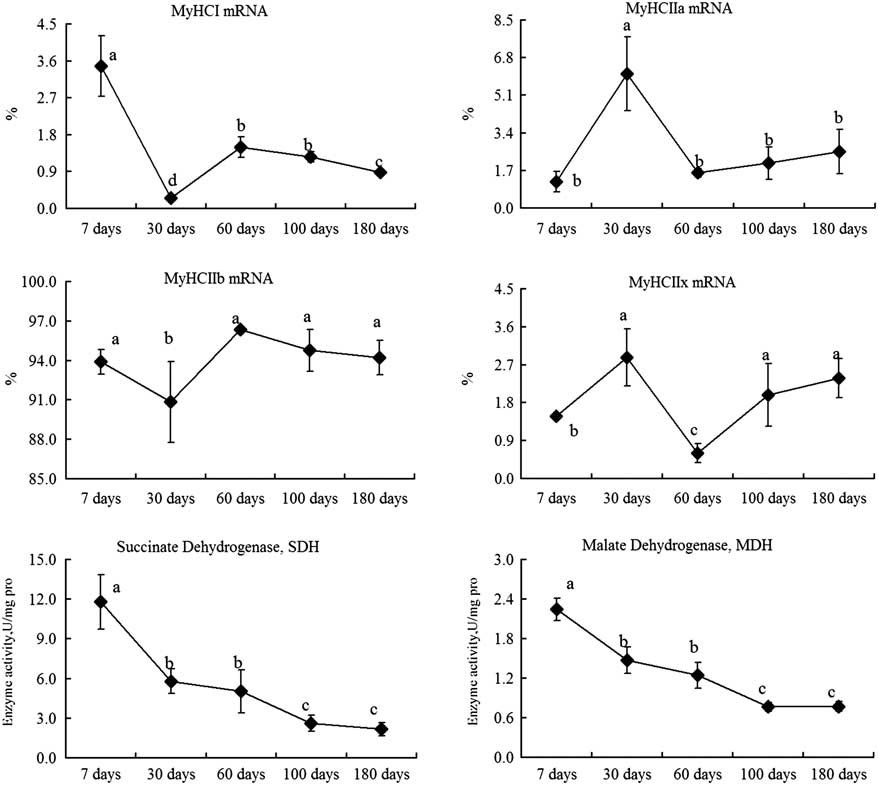
The age-related changes in the composition of the four different MyHCs mRNA and the activities of SDH and MDH are shown in Figure 1. From days 7 to 180, MyHC I mRNA abundance presented a decreasing trend, MyHC IIb mRNA abundance presented a steady trend and MyHC IIa and IIx mRNA abundances presented an increasing trend. On day 30, the MyHC I and IIb mRNA abundances were at their lowest (P < 0.05), and the MyHC IIa and IIx mRNA abundances were at their highest (P < 0.05). Only MyHC I mRNA abundance was significantly lower on day 180 than on day 100 (P < 0.05).
Age-related changes of myosin heavy-chain (MyHC) mRNA composition and the activities of succinate dehydrogenase (SDH) and malate dehydrogenase (MDH) in longissimus dorsi of Duroc × Yorkshire × Landrace (DYL) pigs. The same letters or no letters in the same line indicate no significant difference (P > 0.05), different letters indicate significant differences (P < 0.05).
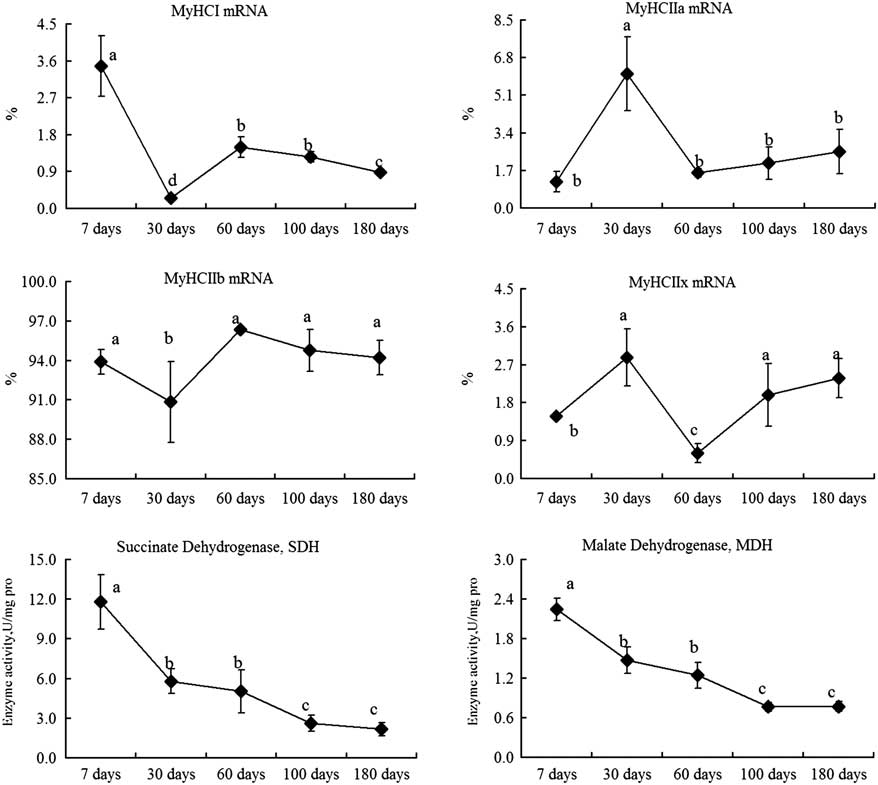
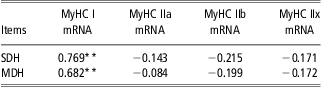
From days 7 to 180, the SDH and MDH activities presented a decreasing trend and formed three significantly different phases on days 7, 30-60 and 100-180 (P < 0.05). No significant differences in enzyme activity were found between days 30 and 60 or between days 100 and 180 (P > 0.05). And MyHC I mRNA abundance was positively correlated with the activities of SDH and MDH (Table 1, P < 0.01).
Pearson's correlations between myosin heavy-chain (MyHC) mRNA composition and activities of succinate dehydrogenase (SDH) and malate dehydrogenase (MDH)
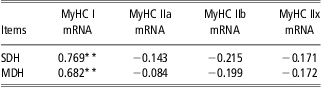
**P < 0.01.
Effects of dietary CLA supplementation on MyHC mRNA composition and SDH and MDH activities in longissimus muscle
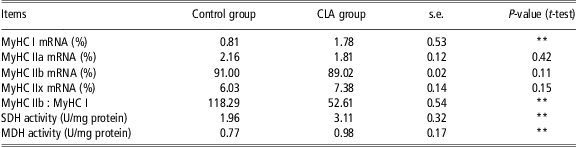
The abundances of MyHC IIa, IIx and IIb mRNA differed insignificantly between the control and CLA groups (P > 0.05, Table 2). MyHC I mRNA abundance as well as the SDH and MDH activities were significantly higher in the CLA group than in the control group (P < 0.01). In contrast, MyHC IIb : MyHC I were significantly decreased in the CLA group (P < 0.01).
Effects of a conjugated linoleic acid (CLA)-enriched diet on myosin heavy-chain (MyHC) mRNA composition, and activities of succinate dehydrogenase (SDH) and malate dehydrogenase (MDH) of longissimus dorsi in pigs
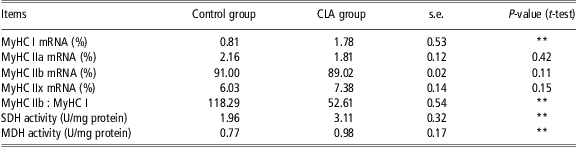
s.e. = pooled standard error.
**P < 0.01.
Effects of dietary CLA supplementation on growth performance and carcass traits
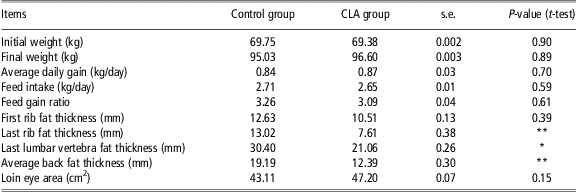
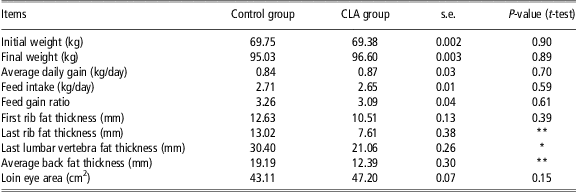
Growth performance and carcass traits in the control and CLA groups are shown in Table 3. Compared with the control group, the CLA group showed significantly lower last rib fat depth, last lumbar vertebra fat depth and average fat depth (P < 0.05). Other traits have no significant difference between the two groups (P > 0.05). For surface values, higher average daily gain and loin eye area, and lower intake per day, feed gain ratio and first rib fat depth were found in CLA group.
Effects of a conjugated linoleic acid (CLA)-enriched diet on growth performance and carcass traits in pigs
s.e. = pooled standard error.
*P < 0.05; **P < 0.01.
Effects of dietary CLA supplementation on pork quality traits
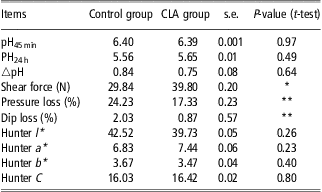
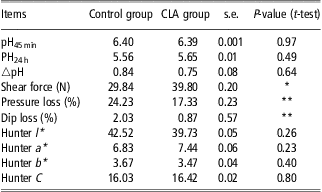
The differences in pork quality between the control and CLA groups are shown in Table 4. For pH45 min, pH24 h, ΔpH, Hunter l*, a*, b* and C, no significant differences were found between the two groups (P > 0.05). Pressure loss and drip loss were significantly lower in the CLA group than in the control group, whereas shear force was significantly higher in the CLA group than in the control group (all P < 0.01).
Effects of a conjugated linoleic acid (CLA)-enriched diet on pork quality traits of longissimus dorsi in pigs
▵pH = pH45 min−pH24 h.
s.e. = pooled standard error.
*P < 0.05; **P < 0.01.
Discussion
Diversity and plasticity of muscle-fibre types in pigs
Muscle-fibre types can markedly vary in different species and muscle types, and are influenced by many factors such as sex and breed (Ryu et al., Reference Ryu, Choi, Lee, Shin, Choe, Kim, Hong and Kim2008), age, hormones and physical activity (Schiaffino and Reggiani, Reference Schiaffino and Reggiani2011). The variability of muscle fibres is due to the existence of multiple isoforms of each myofibrillar component (Clark et al., Reference Clark, McElhinny, Beckerle and Gregorio2002). The diversity of a protein isoform is based on gene regulation through two main mechanisms (Bottinelli and Reggiani, Reference Bottinelli and Reggiani2000). First, the isoforms can be replaced by other isoforms derived from different genes of the same family, which generates diversity among the muscle fibres. Second, many genes, such as the MyHC genes, can be upregulated or downregulated independently of each other on the basis of different factors. Chang et al. (Reference Chang, Fernander and Gldspink1993, Reference Chang, Fernander and Dauncey1995) and Chang and Fernandes (Reference Chang and Fernandes1997) reported that MyHC isoforms I, IIa, IIb and IIx were prominently expressed in slow-oxidative or type I, fast-oxidative or type IIa, fast-glycolytic or type IIb fibres and intermediate or type IIx fibres, respectively. With the development of RT-PCR, the determination of MyHC mRNA (I, IIa, IIx and IIb) has become more sensitive and accurate (Choi and Kim, Reference Choi and Kim2009). The ratio of mRNA MyHC IIb : IIx is significantly decreased in the order of Duroc→Landrace→Meishan (Tanabe et al., Reference Tanabe, Murakami, Kawahara, Yamashiro, Mitsumoto, Muroya, Nakajima and Chikuni2001). MyHC I, IIa and IIx mRNA expression levels in the longissimus muscle are higher in native Korean breeds than in Landrace pigs (Kim et al., Reference Kim, Lim, Song, Kim, Park, Kim, Hwang and Lee2008), and Jinhua pigs exhibit higher MyHC I, IIa and IIx mRNA levels than Landrace pigs (Guo et al., Reference Guo, Shan, Wu, Zhu, Ren, An and Wang2011).
It was reported that oxidative fibres are converted to glycolytic fibres with age in skeletal muscles (Pette and Staron, Reference Pette and Staron2000). Our results confirm this point through MyHC mRNA composition and the activities of oxidative metabolism enzymes in porcine longissimus dorsi. Especially, MyHC I mRNA abundance and the activities of SDH and MDH presented reduction in the late finishing stage. Moreover, a positive correlation between MyHC I mRNA abundance and the activities of SDH and MDH was also found. These indicated that MyHC composition may more reasonably reflect the variability of muscle-fibre types than conventional methods, and the early stage after birth was a key point in the transition of different muscle-fibre types, which could be attributed to some factors such as weaning stress, large changes in hormonal status, nutritional environment and behaviour.
In the late finishing stage, muscle-fibre types could be not be unchanged, which was consistent with the report that several types of MyHC isoforms coexist in a single muscle fibre and are converted to an appropriate phenotype under the corresponding conditions (Baldwin and Haddad, Reference Baldwin and Haddad2001). These findings would provide a possibility for the nutritional regulation of muscle-fibre types in the late finishing period in the subsequent experiments.
Effect of dietary CLA supplementation on pork quality and muscle-fibre types
CLA has been considered as a potential dietary supplement to reduce body fat, increase lean mass and growth rate, and improve feed conversion efficiency and pork quality (Dugan et al., Reference Dugan, Aalhus and Kramer2004). In Trial 2, we found that back fat thickness significantly decreased through the addition of 1.2% CLA to the finishing diet of pigs. Loin eye area, feed conversion rate and meat colour showed some tendency to be improved.
We also found that MyHC I mRNA abundance and oxidative metabolism enzyme activities were significantly increased in the porcine longissimus muscle after the addition of CLA to the finishing diet. Our finding confirms previous reports that CLA can induce the expression levels of MyHC I and IIa mRNA in primary porcine skeletal muscle cells in vitro (Huang et al., Reference Huang, Yang, Liu, Jiang and Xiao2010). It was reported that CLA can improve the ability of some cells to transport Ca2+ (Murphy et al., Reference Murphy, Jewell, Hooiveld, Muller and Cashman2006). Chronically high intracellular Ca2+ levels can activate calcineurin, which appears to be needed in the conversion to oxidative muscle phenotype (Bigard et al., Reference Bigard, Sanchez, Zoll, Mateo, Rousseau, Veksler and Ventura-Clapier2000; Delling et al., Reference Delling, Tureckova, Lim, De Windt, Rotwein and Molkentin2000). Narkar et al. (Reference Narkar, Downes, Yu, Embler, Wang, Banayo, Mihaylova, Nelson, Zou, Juguilon, Kang, Shaw and Evans2008) found that peroxisome proliferator-activated receptor δ (PPARδ) agonist can increase oxidative myofibres in adult mice, and CLA can act as a ligand for some of PPARs family, such as PPARα, γ and δ (Meadus et al., Reference Meadus, MacInnis and Dugan2002; Bassaganya-Riera et al., Reference Bassaganya-Riera, Reynolds, Martino-Catt, Cui, Hennighausen, Gonzalez, Rohrer, Benninghoff and Hontecillas2004). Furthermore, Chang (Reference Chang2007) reported that PGC-1α activation, in partnership with nuclear hormone receptors, including PPARs, could increase oxidative capacity in skeletal muscle. These reports would provide some basis for further studies on the specific mechanism of CLA influencing muscle-fibre types.
Moreover, the water-holding capacity (WHC) of porcine longissimus muscle was significantly increased in the CLA group. According to the review by Pearce et al. (Reference Pearce, Rosenvold, Andersen and Hopkins2011), myowater can be classified into three fractions: protein-associated water, immobilized water and free water. Under normal conditions, immobilized water accounts for up to 85% of myowater and is located within the myofibril (Honikel et al., Reference Honikel, Kim and Hamm1986). During the conversion from muscle to meat, immobilized water can be driven into the extra-myofibrillar space, and this extra-myofibrillar myowater, which is more mobile, is considered to be the potential source of drip loss of meat (Bertram et al., Reference Bertram, Purslow and Andersen2002). Changes in the composition and structure of myofibrillar proteins present a logical basis for explaining the movement of water during the conversion of muscle to meat. Therefore, the increased WHC could be related to the changes in myofibrillar protein composition identified in our study and is consistent with the increased MyHC I mRNA abundance.
Conclusions
This study was the first to investigate the age-related changes of MyHC mRNA composition in the longissimus muscle of commercial pigs and the effects of CLA supplementation of the finishing diet on MyHC mRNA composition and pork quality. The results reflected that the proportion of oxidative-type fibres might present a decreasing trend from days 7 to 180, and the proportion of oxidative fibres in the longissimus muscle might be increased by the addition CLA to the finishing diet. These would provide important evidence for the application of muscle-fibre types in the improvement of pork quality and provide a new basis that may help reveal the mechanism of CLA action on meat quality.
Acknowledgements
This work was supported by grants from the National Natural Science Foundation of China (31172220), the Modern Agro-Industry Technology Research System of China (CARS-36) and the Science and Technology Projects in Zhejiang Province of China (2012C12906-4).