INTRODUCTION
Specific Language Impairment (SLI) is a neurodevelopmental disorder that affects language acquisition; in SLI, a child's non-verbal IQ is within a normal range, and there are no neurological, sensory or physical impairments that directly explain a deviant development of spoken language (Bishop, Reference Bishop1997; Leonard, Reference Leonard1998). In this article, our focus is the manifestation of phonological impairment in SLI as revealed in pseudo-word repetition tasks.
While there is general agreement that phonology is frequently impaired in children affected by SLI, the precise nature of this phonological deficit receives different explanations under the current theories. Two approaches are most relevant for the study presented here. The first approach (Gathercole & Baddeley, Reference Gathercole and Baddeley1990; Montgomery, Reference Montgomery1995) holds that the underlying cause of SLI is impairment in phonological short-term memory. The second approach (Gallon, Harris & van der Lely, Reference Gallon, Harris and van der Lely2007; Marshall, Ebbels, Harris & van der Lely, Reference Marshall, Ebbels, Harris and van der Lely2002; Marshall, Harris & van der Lely, Reference Marshall, Harris, van der Lely, Hall, Markopoulos, Salamoura and Skoufaki2003; Marshall & van der Lely, Reference Marshall and van der Lely2009; van der Lely & Howard, Reference van der Lely and Howard1993) accepts that phonological memory is impaired in SLI, but argues that the underlying cause of SLI is a grammatical deficit, with phonology being one of the possibly affected areas of grammar. When the phonological system is affected, the phonological memory is impaired, which results in poor performance on pseudo-word repetition tasks.
An important point made by Gallon et al. (Reference Gallon, Harris and van der Lely2007), Marshall et al. (Reference Marshall, Ebbels, Harris and van der Lely2002), Roy & Chiat (Reference Roy and Chiat2004), van der Lely (Reference van der Lely and Jenkins2004) and others, is that limited phonological memory is not sufficient to explain the whole range of findings on pseudo-word repetition for children with SLI. Prosodic structure and phonotactics are important parts of language development and have to be taken into account. Syllable structure, articulatory complexity, stress and word-likeness have been claimed to affect children's performance (see Chiat & Roy (Reference Chiat and Roy2007) and Roy & Chiat (Reference Roy and Chiat2004) for an overview). However, the importance of syllable structure in phonological tasks, specifically, pseudo-word repetition, has been controversial: for instance, Nickels & Howard (Reference Nickels and Howard2004) have claimed that the phoneme count was the most important factor in determining the difficulty of the repetition task.
Our study is designed to test the effects of word length and syllable complexity on the success of pseudo-word repetition by children with SLI and to compare their performance to that of the age-matched TD children.Footnote 1 The main goals of this study are to assess the relevance of syllable structure in the phonological representation of children with SLI and to shed light on whether the syllable structure plays the same role in the grammar of both groups of children. The study is based on Russian, which allows us to test the effects of syllable complexity in a language with a larger array of syllable structures than in the languages that have been considered in the literature so far (e.g. English, Italian, Swedish) and to extend the consideration of phonological perspectives on SLI to a language under-studied with respect to childhood language disorders.
MARKEDNESS AND THE ACQUISITION OF SYLLABLE STRUCTURE
The syllable in phonological theory
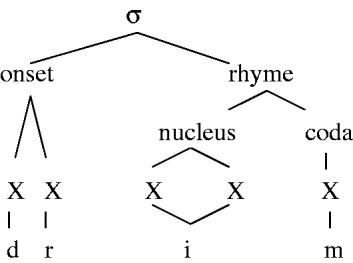
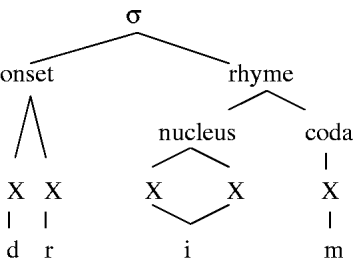
For over a century, the syllable has played a central role in phonological theory as a constituent that represents the phonologically significant organization of segments (Kiparsky, Reference Kiparsky, Dressler, Pfeiffer and Rennison1981; Saussure, Reference Saussure1916; Selkirk, Reference Selkirk, Aronoff and Oerhle1984; Sievers, Reference Sievers1881; Steriade, Reference Steriade1982; Vennemann, Reference Vennemann1972; among others). Our study makes use of a theory of syllable structure frequently assumed in the current phonological literature (for an overview, see Blevins, Reference Blevins and Goldsmith1995; Zec, Reference Zec and de Lacy2007). According to a model of subsyllabic constituency utilized in our study and illustrated in Figure 1, the syllable consists of onset and rhyme, and the latter can be further subdivided into nucleus and coda.
The syllabic structure of the English word dream (from Blevins, Reference Blevins and Goldsmith1995: 213).
Sonority is an important organizational principle in defining syllable structure. While sonority is generally defined as related to the acoustic energy of segments, the precise manner in which it can be incorporated into the grammar is subject to debate (see Clements (Reference Clements, Kingston and Beckman1990), de Lacy (Reference de Lacy2004) and Zec (Reference Zec1995) among many others). The following is the most general sonority scale:
Stops<Fricatives<Nasals<Liquids<Glides<Vowels
less sonorous more sonorous
Some types of syllables are acquired earlier in first language acquisition and are more common typologically in the languages of the world, which has been taken to suggest that these syllables are less marked than others, acquired later by children and typologically less common. For instance, onsets of rising sonority, e.g. [dr] in dream in Figure 1, are less marked cross-linguistically than onsets of falling sonority, e.g. [rd], unattested in English. Also, CV syllables are taken to be less marked than CCV syllables and CVC syllables, since in the first case, the CCV syllable has a complex onset, more marked than a simple onset in CV, and in the second case, the CVC syllable is closed, i.e. has a coda, and thus is more marked than an open CV syllable (see Rice (Reference Rice and de Lacy2007) for the discussion of markedness).
While certain syllable structure preferences (for instance, CV over CVC) are taken to be near-universal, certain other preferences (for instance, complex onsets over complex codas) are language-specific. For example, some languages allow complex onsets but ban complex codas (e.g. Dakota), and some languages allow complex codas but ban complex onsets (e.g. Klamath) (Zec, Reference Zec and de Lacy2007: 165). In cases when both complex onsets and complex codas are allowed, languages may prefer one structure to the other (e.g. Bulgarian prefers complex onsets to complex codas; Barnes, Reference Barnes, Boskovic, Franks and Snyder1997). The fact that VCV sequences are cross-linguistically syllabified as V.CV rather than VC.V has been attributed to the principle of onset maximization. This principle has been extended to inter-vocalic clusters, favoring the syllabification of a VCCV sequence as V.CCV rather than VC.CV, thus maximizing the number of consonants in the onset (modulo language-specific preferences for the onset sonority profile).
Recently, there have been suggestions in the phonological literature that the notion of markedness is flawed in that it is not precisely defined and as a result is used in too many different senses. According to Haspelmath (Reference Haspelmath2006), the term markedness is used in at least twelve meanings, which include markedness as complexity (specification for a phonological distinction, semantic markedness, formal markedness, etc.), markedness as difficulty (in phonetics, morphology or semantics), markedness as abnormality (textual, situational, typological, distributional) and so forth. While we do not dispute that the notion of markedness is ambiguous, in what follows we will continue to use the term in one sense that has been traditionally utilized in the language disorders literature, namely markedness as abnormality, classified by Haspelmath (Reference Haspelmath2006: 26) as “markedness as typological implication or cross-linguistic rarity”.
The acquisition of the syllable in normal and impaired populations
The very existence of a syllable as a unit of organization in phonology has been debated. There are researchers who argue that syllable is epiphenomenal, and all facts that have been analyzed with the help of syllable as a theoretical concept can be reanalyzed with reference to a string of phonemes alone (Ohala, Reference Ohala1992). In theory, the acquisition data from normal and impaired populations can be used to shed light on this important problem in phonological theory, but it has turned out to be a difficult task. For instance, Santiago, MacKay, Palma & Rho (Reference Santiago, MacKay, Palma and Rho2000) revealed the effect of onset complexity and number of syllables on speed of naming. However, Roelofs (Reference Roelofs2002) demonstrated that the observed effects can be accounted for by using the number of phonemes in a word as a factor, without referring to notions dependent on syllable structure, such as onset complexity.
With respect to aphasic patients, Romani & Calabrese (Reference Romani and Calabrese1998) have argued that syllable complexity is a factor that influences the accuracy of word production. On the other hand, Nickels & Howard (Reference Nickels and Howard2004) have shown a significant effect of number of phonemes on word production accuracy in English, provided that the number of syllables is controlled for. However, no evidence of the effect of the number of syllables or syllabic complexity, i.e. number of clusters, was found in aphasic patients.
As to the SLI population, Fee (Reference Fee1995), in a study based on eight members of the same English-speaking family classified as having SLI, has claimed that subjects with SLI never achieve adult competency in reproducing complex syllable patterns. Fee (Reference Fee1995) has stated that evidence for the incomplete acquisition of syllable structure is the fact that consonants in syllable-final positions and clusters are particularly susceptible to deletion or substitution errors. In a similar vein, Rescorla & Bernstein Ratner (Reference Rescorla and Bernstein Ratner1996) have argued that two-year-old toddlers with SLI use a more restricted array of syllable structures than their typically developing age-matched peers. Addressing this hypothesis, Marshall et al. (Reference Marshall, Ebbels, Harris and van der Lely2002: 61) argue that complex structures are not precisely unavailable to subjects with SLI, but merely “more error-prone”. However, it is unclear from the results of both Fee (Reference Fee1995) and Rescorla & Bernstein Ratner (Reference Rescorla and Bernstein Ratner1996) whether the errors can be interpreted as syllable-final or word-final, thus providing no unambiguous support to an analysis that favors syllable structure complexity over the number of phonemes, the problem discussed in Nickels & Howard (Reference Nickels and Howard2004) . In this study, we consider an array of different syllable structures and discuss the issues of syllable structure further.
SPECIFIC HYPOTHESES
The current study examined two factors: the number of syllables in a word and the complexity of the stressed syllable. With respect to the first factor, the consensus in the literature is that SLI involves an impairment of phonological memory. Here, we compare a group of children with SLI with a group of TD children matched in age. If Russian follows the general pattern, we hypothesize that the age-matched TD children will perform significantly better than children with SLI, an effect that was shown for English by Gathercole & Baddeley (Reference Gathercole and Baddeley1990) .
We address the issue of the necessity of the syllable as a measure of difficulty in the pseudo-word repetition task. In order to differentiate between the two competing hypotheses, one taking syllable complexity into account (Fee, Reference Fee1995; Gallon et al., Reference Gallon, Harris and van der Lely2007; Rescorla & Bernstein Ratner, Reference Rescorla and Bernstein Ratner1996) and another holding that syllabic complexity plays no role (Nickels & Howard, Reference Nickels and Howard2004), we compare the relative difficulty of syllable structures that have the same number of phonemes but different structural complexity.
There are several possible hypotheses with respect to syllable complexity as a factor. One hypothesis holds that the range of syllable structures available to children with SLI is smaller than that available to TD children (Fee, Reference Fee1995; Rescorla & Bernstein Ratner, Reference Rescorla and Bernstein Ratner1996). Another possible hypothesis, which is in the spirit of Marshall et al. (Reference Marshall, Ebbels, Harris and van der Lely2002), is that the repertoire of syllable structures is essentially the same for both groups of children. We test these hypotheses by comparing the performance of children with SLI and TD children with respect to syllable structure, using syllables with a wide range of structural complexity.
Additionally, we analyze syllable complexity as two factors, onset complexity and coda complexity. On the basis of our understanding of markedness, we hypothesize that simple onsets will be easier than complex onsets, and simple codas will be easier than complex codas. With respect to Russian, there have been a number of suggestions that Russian has some version of onset maximization present (Kozhevnikov & Chistovich, Reference Kozhevnikov and Chistovich1965; Kodzasov, Reference Kodzasov and Iartsev1990). Should this be the case, we hypothesize that we may see some evidence of onset maximization in Russian through the preference of complex onsets to complex codas in our data.
METHODS
Participants
This work is part of a larger study of familial Disorders of Spoken and Written Language (DSWL). The current experiment was conducted with monolingual Russian-speaking children. The experimental group subjects come from a village in the Arkhangel'sk region of northern Russia. The village will be referred to as Village1 for the purpose of this study. The latest population survey reports that Village1 has 865 current residents (see Reich (Reference Reich2009) for more information). Village1 is unique in that its population is rather isolated both geographically and culturally,Footnote 2 and in that the presence of language disorders in the village is significantly higher than in general population.
The second group of children that is matched to the first group in age comes from a similar rural community that we will refer to as Village2. This village is approximately of the same size and socioeconomic status as Village1 and belongs to the same dialect area of Russian, but it is not characterized by high prevalence of language disorders. There is a significant amount of intermarriage in Village1 due to its isolation, and thus we chose the control group from a different village, in order for the second group of children not to be connected to the first group biologically, thus representing the general population.
All participants' parents agreed that their child could take part in this and related studies conducted at the same time under guidelines approved by the appropriate Human Investigation Committees.
The participants were classified into the groups of SLI and TD based on the analysis of the narrative samples collected by asking children to tell a story on a basis of a picture book. We used two of the frog series stories (Mayer, Reference Mayer2003a; Reference Mayer2003b), which are frequently utilized for this purpose. Each narrative was rated by two raters with an agreement rate of 80% or higher. The rating was done with respect to phonological characteristics, well-formedness, syntactic complexity, lexicon, and semantics and pragmatics.
The phonological characteristics used for the classification of the subjects as belonging to the SLI group included the following criteria:
• phonological reduction (cluster simplification; consonant lenition, e.g. fricativization of a stop or a loss of the stop portion in an affricate, as for instance, [otʲes] instead of [otʲets] ‘father’; vowel reduction or deletion; and syllable deletion);
• misarticulation (any error with respect to primary or secondary place of articulation and manner of articulation, e.g. [s] for [∫], or [l] for [lʲ]);
• unusual sentence prosody (inappropriate intonation contour; sentential stress inappropriate to the information structure, syntactic or contrastive focus structure of the sentence; abnormal rate of speech (too fast or too slow); abnormal amplitude (too quiet or too loud); number and duration of pauses; halting speech; belabored speech);
• incorrect stress.
Well-formedness criteria included morphological and syntactic errors, e.g. incorrect agreement, case, incomplete sentences due to the omission of words, lexical errors and false starts (abandoning a syntactic structure before the end of the utterance and continuing with a new syntactic structure). Examples of morphosyntactic and lexical errors made by children classified as affected are given below. The example in (1) illustrates a case error (the object ‘dog’ is in the nominative instead of the accusative case) and a lexical error (the verb ‘to make’ is used instead of the verb ‘to take’); (2) exemplifies a mistake in gender agreement (the subject ‘frog’ is feminine, but there is a masculine agreement on the verb); (3) represents a derivational morphology error, the omission of the perfective suffix -nu (cf. the expected prɨg-nu-l-a ‘jumped’); and (4) provides an example of a false start.
(1) t∫erepax-a sdʲela-l-a sobak-a za lap-uturtle-NOM.FEM make-PAST-FEM dog-NOM.FEM by paw-ACC‘The turtle took the dog by the paw.’
(2) lʲagu∫k-a stalfrog-NOM.FEM become-PAST.MASC
(3) prɨg-l-ajump-PAST-FEM
(4) mɨ pisa-l-i … xodi-l-i tudawe write-PAST-PL go-PAST-PL there
Syntactic complexity was determined on the basis of the MLU and complex structures (SC). The MLU was calculated in terms of words, rather than morphemes, as is customary for highly inflected languages, like Russian (see, for instance, Leonard & Eyer, Reference Leonard, Eyer, Cole, Philip and Thal1996). The MLU was determined on the basis of the first 100 words used by the children.
SC was defined as the ratio of complex structures, e.g. relative clauses, embedded clauses, adjunct clauses, conjoined clauses with an overt conjunction, passive structures and wh-questions, to the total number of words in the narrative. It was previously shown that MLU and SC measurements collected using the frog stories are an effective tool for identifying SLI (Reilly, Losh, Bellugi & Wulfeck, Reference Reilly, Losh, Bellugi and Wulfeck2004).
Lexical, semantic and pragmatic criteria included failure to elaborate, semantic/pragmatic errors (e.g. switching from one utterance to another without an awareness of what is pragmatically appropriate or logical, anaphors with unclear reference, violation of Gricean maxims), narrative structure (the ability of a child to tell a connected story, with well-developed characters, a plot, a sequence of events, and a well-defined beginning and ending), and lexical richness (the number of different lexical items used).
Based on these criteria, we derived an overall status: affected overall if the narrative had at least three areas rated as affected, unaffected overall if no more than one area was affected. The children with two affected areas were open to the judgment of the rater.
The procedures for calculating the score on each of the areas used in the classification described above were slightly different. Every error of lexical, syntactic or morphological type was counted, the same procedure applied for false starts, and then the two were added together and divided by the number of words in the narrative to control for its length. The resulting number was used as the basis for rating. Scales used to assign each narrative a rating ranged from 1 to 3: 1 being affected, 2 possibly affected and 3 unaffected.
The classification analysis was carried out on a large group of children from Village1 (n=140). Twenty-seven of these children were classified as affected. Twenty-two of them participated in the pseudo-word repetition test, but the results of only fifteen children were included in the current study for the following reasons: the IQs of four children were below the cut-off point of 80, and three children refused to complete the task.
The age range of the participating children from Village1 was 4 ; 0 to 8 ; 8. Fifteen children from Village2 classified as TD using the above criteria were matched to the SLI group in age (age range 4 ; 0 to 8 ; 6). The Universal Intelligence Test (UNIT: Bracken & McCallum, Reference Bracken and McCallum1998) was used to measure the children's non-verbal IQ. Table 1 provides the means and standard deviations for age and IQ for both groups.
Descriptive statistics for Age and IQ for SLI and age-matched TD groups

Study design
The current experiment consisted of a pseudo-word repetition task with the following factors manipulated:
(a) The number of syllables in a word (1 vs. 2 vs. 3);
(b) Syllable structure (CV, CVC, VC, CCV, CCVC, CVCC, VCC, CCVCC).
The syllable structure factor can be analyzed as a combination of onset complexity (no onset: VC, VCC vs. one-consonant (single) onset: CV, CVC, CVCC vs. two-consonant (complex) onset: CCV, CCVC, CCVCC) and coda complexity (no coda: CV, CCV vs. one-consonant (single) coda: CVC, VC, CCVC vs. two-consonant (complex) coda: CVCC, VCC, CCVCC). Only the stressed syllable was manipulated. Thus, in a monosyllabic word, the word's only syllable was considered; in a disyllabic word, we manipulated either the first or second syllable; and in a trisyllabic word, it was either the first or third syllable. Most of the unstressed syllables were of the CV form. Note that in Russian the syllabic affiliation of consonants within clusters in inter-vocalic positions cannot always be determined straightforwardly (Kodzasov, Reference Kodzasov and Iartsev1990). On the basis of the study by Côté & Varlamov (in press), we made an assumption that inter-vocalic obstruent–obstruent clusters are heterosyllabic.Footnote 3 We have also treated inter-vocalic obstruent–liquid clusters as complex onsets, which is a relatively uncontroversial assumption for monomorphemic Russian words.
The structure of pseudo-words conformed to the phonotactics of Russian. For instance, we used onsets of rising sonority (such as bl, an obstruent followed by a liquid), equal sonority (such as tk, consisting of two obstruents), and falling sonority (such as rb, a liquid followed by an obstruent), which are all attested in Russian. However, we did not use onsets of falling sonority, such as mt, where a nasal is followed by an obstruent, since such structures are unattested in Russian. An example of relevant conditions for a one-syllable pseudo-word is given in (5):
(5)
a. CV ka
b. CVC kap
c. VC ap
d. CCV kra
e. CVCC kasp
f. VCC asp
g. CCVC krap
h. CCVCC krasp
The experiment took place in a quiet room and was recorded on a digital voice recorder. The repetition task was administered to the children individually by experimenters who were speakers of the same dialect of Russian as the children. Before the experiment, it was explained to the children that the words they were going to hear were not real, but made up, so they should not be surprised if the words sounded unfamiliar. The children were asked to repeat the words after the experimenter exactly as they heard them. If a child did not respond to a given pseudo-word for five seconds, the experimenter repeated the word only once. No corrections of any kind were given, and the experimenter provided the child with the same encouragement two or three times per recording session, using a one-word phrase (e.g. ‘good’, ‘great’, etc.), regardless of the child's performance.
The 144 pseudo-words were presented one at a time in a pseudo-random order to the subjects. We used the same list of pseudo-words for all subjects. The total duration of the test ranged from 5 to 12 minutes.
The recorded responses were transcribed by a linguistically trained native Russian listener. The nature of the transcription was phonemic: narrow phonetic details (for instance, vowel length, which is not contrastive in Russian) were omitted from the transcription. A second native Russian listener fully re-checked the reliability of the transcription (the discrepancy rate was less than 5%). In cases where the data were perceptually ambiguous, an acoustic analysis was performed, assessing the phonetic characteristics of the responses. The acoustic analysis was carried out in Praat (Boersma & Weenink, Reference Boersma and Weenink2007). For instance, if it was difficult to decide whether the deletion of an obstruent was complete or partial, the judgment was made on the basis of spectrogram examination: the transcriber was looking for the absence or presence of the consonantal burst on the spectrogram. The latter case would not be counted as deletion.
The responses were coded as correct/incorrect, using the following criteria for judging answers as incorrect: insertion of one or more segments, deletion of one or more segments, substitution of one segment for another, metathesis (switching the order of segments), and the absence of an audible answer. The following types of responses were not scored as incorrect: an answer that is audible but noisy and thus impossible to transcribe, the substitution of [l] with a labiovelar [w], which is characteristic of Northern Russian dialects, and the substitution of [r] with [w], which is a common characteristic of Russian children's speech. As was stated earlier, three children refused to complete the task either because of fatigue or attention span difficulty. The data from these children were not included in the study. The examiner did not make any errors in the course of the recordings. The children's response time was not considered as a factor.
RESULTS
We conducted a set of factorial analyses of variance in order to assess the differences in the factors described above, as well as their interactions, using the number of errors in the repetition of pseudo-words as the dependent variable. The α-level was set at 0·05.
A three-way repeated measures ANOVA: group (2)×syllable number (3)×syllable structure (8) was conducted with group being a between-subjects effect, syllable number and syllable structure as within-subjects effects, and age as a covariate. The following were significant between-subjects effects on the number of errors in repetitions of pseudo-words: group was significant (F(1, 27)=10·73, p=0·003, η2=0·284), as well as age (F(1, 27)=24·09, p<0·001, η2=0·471).
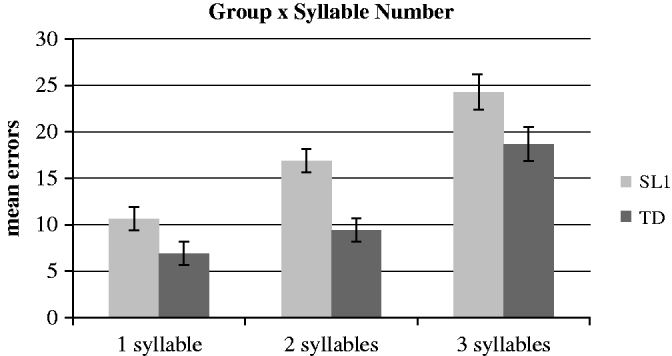
Multivariate tests were significant for main effects of syllable number (F(2, 26)=21·5, p<0·001, η2=0·623) and syllable structure (F(7, 21)=11·8, p<0·001, η2=0·798). Pairwise comparisons of estimated marginal means showed significant differences between the number of errors in one-syllable words and the number of errors in two-syllable words (12·0 vs. 14·6, p=0·004), and between the number of errors in two-syllable words and the number of errors in three-syllable words (14·6 vs. 16·9, p=0·005) for all children.
The following interactions were shown to be significant: syllable structure by age (F(7, 21)=11·8, p<.001, η2=0·553), syllable structure by syllable number (F(7, 14)=3·2, p=0·018, η2=0·762), and group by syllable number (F(2, 26)=3·7, p=0·037, η2=0·224). Pairwise comparisons of estimated marginal means for syllable number show that children with SLI make significantly more errors that TD children at every word length: for one-syllable words (10·7 vs. 6·8, p<0·001), for two-syllable words (16·9 vs. 9·4, p<0·001), and for three-syllable words (24·3 vs. 18·7, p<0·001).
However, group by syllable structure interaction was not significant (F(7,21)=1·6, p=0·191, η2=0·347).
In addition, pairwise comparisons were completed between all syllable structures. We compared syllable structures that consisted of the same number of phonemes: two phonemes (CV and VC), three phonemes (CVC, CCV and VCC), and four phonemes (CVCC and CCVC). Pairwise comparisons of estimated marginal means for syllable structures revealed that the difference between the syllables of two phonemes, CV and VC, was significant (2·46 vs. 3·9, p=0·005); the difference between the syllables of three phonemes, CVC and CCV, was also significant (2·1 vs. 4·4, p=0·002); as was the difference between CVC and VCC (2·1 vs. 9·5, p<0·001). Finally, the difference between syllables consisting of four phonemes, CCVC and CVCC, was shown to be significant (3·9 vs. 6·0, p=0·001). We also ran pairwise comparisons to determine the relative difficulty of different syllable structures. Specifically, we compared CV and CVC (2·46 vs. 2·1, p=1·0; n.s.), CVC and VC (2·1 vs. 3·9, p<0·001), VC and CCV (3·9 vs. 4·4, p=1·0; n.s.), CCV and VCC (4·4 vs. 9·5, p<0·001), CCV and CCVC (4·4 vs. 3·9, p=1·0; n.s.), CVCC and VCC (6·0 vs. 9·5, p<0·001), and VCC and CCVCC (9·5 vs. 11·28, p=0·06; n.s.).
In a more fine-grained analysis, the factor of syllable structure was further operationalized into two separate factors: onset complexity and coda complexity. As described in the ‘Methods’ section, onset complexity had three possible values: no onset, one consonant in the onset, and two consonants in the onset. Similarly, coda complexity had three possible values: no coda, one consonant in the coda, and two consonants in the coda. To analyze the effects of onset and coda complexity, we conducted two separate ANOVAs.
First, a three-way repeated measures ANOVA: group (2)×syllable number (3)×onset complexity (3) was conducted, with group being a between-subjects effect and syllable number and onset complexity as within-subjects effects, with age as a covariate. Here we also saw the main effect of group (F(1, 27)=10·73, p=0·003, η2=0·284) and age (F(1, 27)=24·09, p<0·001, η2=0·471).
In addition, there were significant within-subjects effects: the main effect of onset complexity (F(2, 26)=45·4, p<0·001, η2=0·627) and the main effect of syllable number (F(2, 26)=28·58, p<0·001, η2=0·514). There were also significant syllable number by age interaction (F(2, 26)=6·3, p=0·018, η2=0·189) and significant onset by age interaction (F(2, 26)=12·6, p<0·001, η2=0·318).
Second, a three-way repeated measures ANOVA: group (2)×syllable number (3)×coda complexity (3) was conducted, with group being a between-subjects effect and syllable number and coda complexity as within-subjects effects, with age as a covariate.
The main effects of group and age remained significant (group: F(1, 27)=10·73, p=0·003, η2=0·284; and age: F(1, 27)=24·09, p<0·001, η2=0·471). In addition, there were significant within-subjects effects: the main effect of coda complexity (F(2, 26)=38·72, p<0·001, η2=0·589) and the main effect of syllable number (F(2, 24)=28·59, p<0·001, η2=0·514). There were also significant syllable number by age interaction (F(2, 26)=6·3, p=0·018, η2=0·189) and coda by age interaction (F(2, 26)=7·75, p<0·01, η2=0·223).
The separation of syllable structure into onset complexity and coda complexity showed that the interaction of group by onset complexity and group by coda complexity were not significant (for group by onset complexity: F(2, 26)=3·9, p=0·07; for group by coda complexity: F(2, 26)=3·9, p=0·06). There were no other significant interactions in the analysis.
DISCUSSION
The analysis above reports the performance on the pseudo-word repetition task by children with SLI in comparison with age-matched TD children. As expected, the differences in the performance between the groups were significant.
The results also show that pseudo-word length (expressed as the number of syllables in a word) is an important factor that determines the children's performance on the task. As illustrated in Figure 2, the longer the pseudo-word, the more errors are associated with its repetition by both groups of children, with disyllabic words being more difficult than monosyllabic ones, and trisyllabic words being more difficult than disyllabic ones.
Mean number of errors for each syllable number (one syllable, two syllables, three syllables) by group (SLI, TD age-matched).
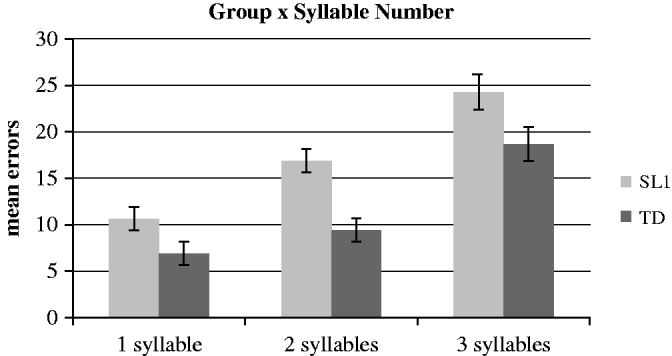
In addition, children with SLI make significantly more errors in repetition than TD children, at every word length. This appears to confirm our hypothesis that Russian children with SLI will show worse performance than their age-matched TD peers. The data show an interaction between group and syllable number, which is reminiscent of the results of Gathercole & Baddeley (Reference Gathercole and Baddeley1990) . Gathercole & Baddeley reported a significant group by word length interaction, which they interpreted as evidence that children with SLI have a primary deficit in working memory.Footnote 4 However, in our data the interaction between group and syllable number is driven by two-syllable nonwords, which makes it non-linear and difficult to interpret. Therefore, we are unable to take a strong position with respect to the interpretability of this interaction and leave this topic for future research.
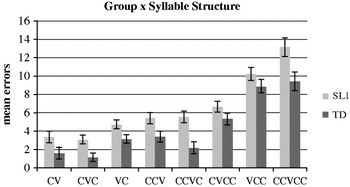
The second factor that affects the accuracy of the children's performance on the task is syllable structure. Figure 3 shows that syllable templates fall into several groups in terms of their difficulty, which roughly corresponds to their complexity: CV and CVC (two or three phonemes, no consonant clusters) appear to be the simplest in structure and the easiest ones. The structures VC, CCV and CCVC (two phonemes, no onset and single coda (VC); three phonemes, complex onset and no coda (CCV); four phonemes, complex onset and single coda (CCVC)) belong to the next group with respect to difficulty. CVCC (single onset with complex coda) is harder still, and VCC and CCVCC (three phonemes, no onset and complex coda (VCC); five phonemes, both complex onset and complex coda (CCVCC)) are the hardest in our data. Thus, the results indicate that there is a continuum of complexity of syllable structure as reflected in the children's performance on the pseudo-word repetition task. Moreover, as revealed by the fact that the interaction of group by syllable structure is not significant, children in both groups are affected in a similar fashion by the complexity of syllable structure. This finding lends support to the hypothesis that children with SLI have access to the same inventory of syllable structures as TD children, and thus the phonological grammar of children with SLI is not impoverished in this respect.
Mean number of errors for each syllable structure (CV, CVC, VC, CCV, CCVC, CVCC, VCC, CCVCC) by group (SLI, TD age-matched).

Figure 3 also illustrates several tendencies with respect to the presence of onsets and codas in a syllable. In Russian, the absence of an onset affects the difficulty of the structure. As pairwise comparisons of estimated marginal means for syllable structures show, VC syllables are significantly harder than CVC syllables, and VCC syllables are significantly harder than CVCC syllables, the only difference being the absence of the onset in the former (harder) cases. The absence of a coda, on the other hand, does not seem to matter (all else being equal): CV and CVC syllables are of the same level of difficulty for all groups, as well as CCV and CCVC syllables.Footnote 5 Typologically, these structures are predicted to differ in their markedness: there are languages that prefer syllables with onsets to onsetless syllables (e.g. German), and Russian appears to pattern with them. There are also languages that prefer open syllables to closed syllables (e.g. Hawaiian). A possible explanation for the absence of this effect in Russian is that the cross-linguistic tendency does not emerge because it is overridden by language-specific frequency effects: syllables with a single coda are extremely frequent in Russian (Avanesov, Reference Avanesov1985).
Our results with respect to syllable complexity cast doubt on the validity of accounts like that of Nickels & Howard (Reference Nickels and Howard2004) . Our data reveal that in Russian the syllable structure CV, consisting of two phonemes, is significantly easier than VC, which has the same number of phonemes. Similarly, for the structures consisting of three phonemes, CVC is significantly easier than CCV, which in turn is significantly easier than VCC. This behavior corresponds to the typological observations that syllables with onsets and with no codas (e.g. CV) are less marked than onsetless syllables and syllables with a coda (e.g. VC), and syllables without consonant clusters (e.g. CVC) are less marked than syllables with clusters (e.g. CCV). Finally, with respect to syllables that have four phonemes, CCVC is significantly easier than CVCC, the first structure having a complex onset and the second a complex coda. One interpretation of this result is that in Russian complex onsets are preferred to complex codas, which in turn can be taken to suggest that Russian-speaking children employ some strategy of onset maximization. However, more research is needed to support this tentative conclusion.
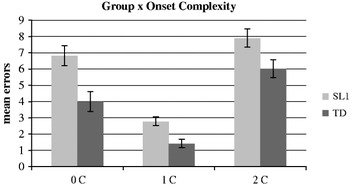
The above generalizations on syllable complexity are further supported once we divide the factor of syllable structure into two finer-grained factors: onset complexity and coda complexity. There is a significant main effect for both of these factors. Figure 4 illustrates the pattern for onset complexity. Syllables with one consonant in the onset are the easiest, onsetless syllables are harder, and syllables with complex onsets are the hardest for both groups of children. The fact that there is no interaction of onset complexity by group indicates that the increase in onset complexity is a factor that affects the performance of both groups of children, SLI and TD, in the same fashion.
Mean number of errors for onset complexity (0 consonants vs. 1 consonant vs. 2 consonants in the onset) by group (SLI, TD age-matched).

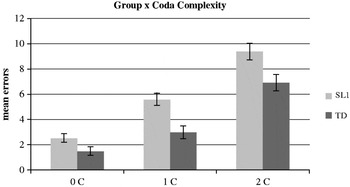
Figure 5 shows the pattern for coda complexity. Syllables with no coda are the easiest, syllables with a single consonant in the coda are harder, and syllables with complex codas are the hardest for all children. As with onsets, there is no interaction of coda complexity by group, which shows that coda complexity has the same effect on both groups of children.
Mean number of errors for coda complexity (0 consonants vs. 1 consonants vs. 2 consonants in the coda) by group (SLI, TD age-matched).

The results from the finer-grained analyses continue to demonstrate that Russian-speaking children with SLI and TD children produce similar patterns of errors in response to the same factors influencing the complexity of relevant structures. This suggests that children with SLI have access to the same phonotactic constraints with respect to complex syllable margins that TD children have.
CONCLUSIONS
This investigation has made several contributions to the study of the nature of phonological impairment and the acquisition of phonotactics by children with SLI. First, it demonstrated that in Russian, similarly to other languages, phonological memory affects the children's ability to recall words. The results indicate that for children with SLI (as well as for TD children) it is always more difficult to represent and recall a longer pseudo-word than a shorter pseudo-word, as expected.
Second, structural complexity was shown to be is an important factor in recalling pseudo-words. The patterns of repetition errors revealed in this study cannot be due solely to the limitations on working memory capacity: they reflect the phonological organization of a given word rather than the number of phonemes in a word.
Third, it was shown that syllable complexity has no specific cut-off point such that certain structures cannot be represented in the grammar of children with SLI, but is arranged on a continuum, with CV and CVC being the easiest and VCC and CCVCC being the hardest in our data. This suggests that the full array of syllable structures is available to children with SLI.
Forth, the absence of systematic group by stimulus property interactions, such as group by syllable complexity, group by onset complexity, and group by coda complexity, indicated that with respect to syllable structure, the accuracy of repetition for children with SLI is affected by the same factors as for TD children.
Our results advance the understanding of SLI phonology in two respects. First, we provided support for the claim that phonological memory is affected for children with SLI. Second, we demonstrated that children with SLI have access to the same phonological grammar as TD children.
This study suggests several possible directions for future research. First, encoding the responses as correct/incorrect results in loss of information potentially relevant to the interpretation of the data. Using finer-grained distinctions in error types, e.g. insertion, deletion, metathesis, substitution, etc., will facilitate the investigation of the nature of repair strategies used by children with SLI. Second, no data exist on the frequency of specific consonant clusters in Russian. A study that would utilize such information will make it possible to examine the effects of lexical frequency and sonority on the error rates in repetition of syllables of otherwise similar structure. Third, the location of stress was not taken into consideration in the current study. Previous studies showed the effect of stress in various languages (see, for instance, Sahlén, Reuterskioeld-Wagner, Netterlbladt & Radeborg (Reference Sahlén, Reuterskioeld-Wagner, Netterlbladt and Radeborg1999) for Swedish, Gallon et al. (Reference Gallon, Harris and van der Lely2007) for English, and Marshall & van der Lely (Reference Marshall and van der Lely2009) for English dyslexic children). Given that, unlike in these languages, stress in Russian is lexically determined so that there is no apparent regularity to its placement, we predict that the location of stress would not affect the children's performance on the pseudo-word repetition task. We also expect not to see any difference in stress-related performance between TD children and children with SLI in a language with lexical stress.