Introduction
Anorexia nervosa (AN) and bulimia nervosa (BN) are eating disorders (EDs) whose aetiopathogenesis is complex and poorly understood, although both genetic and environmental factors are thought to be implicated (Fairburn & Harrison, Reference Fairburn and Harrison2003). A role for stress in determining the onset and the natural course of these disorders has been suggested (Hagan et al. Reference Hagan, Shuman, Oswald, Corcoran, Profitt, Blackburn, Schwiebert, Chandler and Birbaum2002; Fairburn & Bohn, Reference Fairburn and Bohn2005; Corstorphine et al. Reference Corstorphine, Mountford, Tomlinson, Waller and Meyer2007), and an association between stressful life events and the onset of AN or BN has been demonstrated (Jacobi et al. Reference Jacobi, Hayward, de Zwaan, Kraemer and Agras2004; Pike et al. Reference Pike, Wilfley, Hilbert, Fairburn, Dohm and Striegel-Moore2006; Rojo et al. Reference Rojo, Conesa, Bermudez and Livianos2006). Therefore, the study of the psychobiology of the stress response in patients with EDs could be helpful in understanding the pathophysiology of AN and BN.
The stress response has two principal neurobiological components. The first involves activation of the hypothalamic–pituitary–adrenal (HPA) axis and the secretion of cortisol into the circulation. The second and faster-acting component involves activation of the sympathetic branch of the locus ceruleus/autonomic nervous system and the release of catecholamines (Chrousos & Gold, Reference Chrousos and Gold1992). Glucocorticoids participate in the control of whole-body homeostasis and the organism's response to stress (Tsigos & Chrousos, Reference Tsigos and Chrousos2002), and have a key inhibitory role in the control of HPA axis activity, favouring the termination of the stress response, which limits the duration of the total tissue exposure to glucocorticoids, minimizing their catabolic, lipogenic, anti-reproductive and immunosuppressive effects (Habib et al. Reference Habib, Gold and Chrousos2001; Adam & Epel, Reference Adam and Epel2007). The sympathetic component is responsible for the elevation of cardiovascular tone, respiratory rate, blood flow to muscles, and blood glucose, a host of effects commonly referred to as the ‘fight of flight’ response (Cannon, Reference Cannon1914).
Although dysregulations in the HPA axis and autonomic nervous system functioning have been reported in EDs (Kreipe et al. Reference Kreipe, Goldestein, DeKing, Tipton and Kempski1994; Petretta et al. Reference Petretta, Bonaduce, Scalfi, de Filippo, Marciano, Migaux, Themistoclakis, Ianniciello and Contaldo1997; Rechlin et al. Reference Rechlin, Weis, Ott, Bleichner and Joraschky1998; Murialdo et al. Reference Murialdo, Casu, Falchero, Brugnolo, Patrone, Cerro, Ameri, Andraghetti, Briatore, Copello, Cordera, Rodriguez and Ferro2007; Lo Sauro et al. Reference Lo Sauro, Ravaldi, Cabras, Faravelli and Ricca2008), so far no study has assessed simultaneously both neurobiological components of the stress response in patients with AN and BN. An easy way to assess both components of the stress response in humans is to measure salivary cortisol and α-amylase secretion after exposure to a stressful condition. Indeed, salivary cortisol is responsive to stress and closely reflects the concentrations of free cortisol in plasma (Kirschbaum & Hellhammer, Reference Kirschbaum and Hellhammer1989). Similarly, levels of salivary α-amylase have been reported to increase under both physically and psychologically stressful conditions and have been shown to be associated with norepinephrine (NE) change in response to stress (Chatterton et al. Reference Chatterton, Vogelsong, Lu, Ellman and Hudgens1996). Although most studies have so far failed to find significant correlations between stress-induced changes in peripheral NE levels and salivary α-amylase (Rohleder et al. Reference Rohleder, Nater, Wolf, Ehlert and Kirschbaum2004; Nater et al. Reference Nater, La Marca, Florin, Moses, Langhans, Koller and Ehlert2006), two pharmacological challenges have provided direct evidence that the salivary enzyme reflects central NE release instead of peripheral NE secretion under stressful conditions (Ehlert et al. Reference Ehlert, Erni, Hebisch and Nater2006; Van Stegeren et al. Reference Van Stegeren, Rohleder, Everaerd and Wolf2006). Therefore, salivary α-amylase has been proposed as a marker of the central sympathetic nervous system (SNS) component of the stress response (Chatterton et al. Reference Chatterton, Vogelsong, Lu, Ellman and Hudgens1996, Reference Chatterton, Vogelsong, Lu and Hudgens1997).
In the present study, to explore both neurobiological components of the stress response in AN and BN, we measured salivary cortisol and α-amylase responses to a psychosocial stress, using the Trier Social Stress Test (TSST; Kirschbaum et al. Reference Kirschbaum, Pirke and Hellhammer1993), in symptomatic patients with AN or BN compared to age- and sex-matched healthy controls.
Method
Patients
Twenty-three women were recruited for the study: 15 were out-patients attending the Eating Disorder Centre of the Department of Psychiatry of the University of Naples SUN and eight were healthy controls. According to DSM-IV criteria, seven patients fulfilled the diagnosis of AN restricting subtype and eight the diagnosis of BN purging subtype. Diagnostic assessment was made by a trained interviewer using the Structured Clinical Interview for Axis I DSM-IV Disorders – Patient Edition (SCID-I/P; First et al. Reference First, Spitzer, Gibbon and Williams1995). At the time of the study, the patients had never taken psychotropic medications and had no co-morbid Axis I disorders. BN patients were all vomiters; none of them abused laxatives or diuretics.
Control women were drug free and mentally healthy, as assessed by the SCID-I Non-Patient Edition (SCID-I/NP; First et al. Reference First, Gibbon, Spitzer and Williams1996); information on their eating habits was collected by an ad hoc structured clinical interview to exclude EDs, which could have occurred at subclinical severity and thereby confounded the results. The controls were menstruating regularly. Both BN patients and healthy women were tested in the follicular phase of their menstrual cycle (day 5–10 from menses).
Procedure
The experimental protocol was approved by the local ethics committee and all subjects gave their written consent after being fully informed of the nature and procedures of the study. All subjects were recruited by asking them to participate into a study in which they had to undergo a psychological stressful condition to assess their HPA axis and SNS responses to stressors, but the stressful procedure was not explained until the stress session. None of the subjects refused to participate.
The TSSTs were performed between 1530 and 1700 h because HPA axis activity is relatively stable at that time of the day, and changes induced by experimental challenges would therefore be more evident. Subjects arrived at our unit at 1530 h and spent about 20 min resting in experimental room no. 1. At the end of the resting period, the experimenter explained to the subjects that they first had to deliver a speech for a job application to a committee, for which they would have 5 min to prepare and 5 min to deliver it, and that their performance would be recorded on a video cassette recorder to enable the interview and their non-verbal behaviour to be analysed later. Then, subjects were led to experimental room no. 2, where a group of three people, referred to as ‘the committee’, were seated behind a table. The committee members were dressed in white coats and were introduced as psychiatrists and psychologists specially trained to monitor and analyse verbal and non-verbal behaviour. If a subject finished her speech in less than 5 min, standardized questions were asked. Immediately after finishing the speech, the participants were asked to serially subtract the number 13 from 2083 as fast and as accurately as possible within 5 min. On every failure, one member of the commission interfered and the participants had to start again at 2083. Saliva samples were collected at the end of the rest period (T=–10), after explaining the procedure (T=0), at the end of the TSST (T=15) and after a further 15 (T=30) and 35 min (T=50). Heart rate (HR) was measured at the end of the rest period (T=–10) and at the end of the TSST (T=30).
Participants were instructed to remove lipstick and refrain from eating, drinking (except water), smoking and brushing teeth at least 60 min before sampling and also during the testing session. Saliva samples were collected into Salivette tubes and stored at −20°C until assayed for cortisol and α-amylase levels. Patients and controls were tested in the same setting with identical procedures and the same staff present.
Biochemical analyses
Saliva cortisol concentrations were determined by using a commercially available enzyme-linked immunosorbent assay (ELISA) kit (Biochem Immunosystem, Italy); intra- and inter-assay coefficients of variation (CVs) were less than 8% and 8.7% respectively. Saliva α-amylase concentrations were also determined by a commercially available ELISA kit (Salimetrics, USA), for which intra- and inter-assay CVs were less than 7.2% and 5.8%, respectively.
Data analysis
The BMDP statistical software package (Dixon, Reference Dixon1985) was used for data analysis. A two-way repeated-measures ANOVA was used to test differences in HR and saliva cortisol and α-amylase responses to the TSST in ED patients compared to healthy controls. Between-group differences at each time point were evaluated by Tukey's post-hoc test. One-way ANOVA was used to assess differences in demographic and anthropometric variables and pre-stress hormone levels among groups.
Results
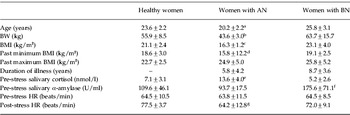
Compared to healthy controls, AN patients had significantly lower current body weight (BW), current body mass index (BMI), minimum past BMI and age. No significant difference was found in clinical and demographic parameters between BN patients and healthy women (Table 1).
Clinical and hormone characteristics of the study sample and stress-induced changes in heart rate (HR)

AN, anorexia nervosa; BN, bulimia nervosa; BW, body weight; BMI, body mass index.
Values given as mean±standard deviation.
a F 1,13=8.04, p=0.01; bF 1,13=13.14, p=0.003; cF 1,13=21.84, p=0.0004; dF 1,13=5.32, p=0.03; eF 1,13=12.20, p=0.004; fF 1,14=4.84, p=0.04 compared to healthy women; gp<0.001 compared to healthy women (Tukey's post-hoc test).
Pre-stress levels of salivary cortisol were enhanced significantly in underweight AN patients but not in BN individuals; instead, pre-stress levels of salivary α-amylase were increased significantly in BN patients but not in AN (Table 1).
Compared to controls, no significant effect for group (F 1,13=2.13, p=0.1), but a significant effect for time (F 1,13=6.50, p<0.025) and group×time interaction (F 1,13=5.70, p<0.035), emerged for AN patients in TSST-induced changes in HR. Indeed, in the AN group, the post-stress mean HR value did not differ significantly from the pre-stress value and was significantly lower than in the control group (Table 1). Instead, no significant effect for group (F 1,14=0.63, p=0.4) and no significant group×time interaction (F 1,14=1.33, p=0.2) but a significant effect for time (F 1,14=18.50, p<0.0008) emerged for BN subjects, indicating that the timing of the HR response to the TSST did not differ significantly between BN and control women.
Saliva cortisol response to the TSST
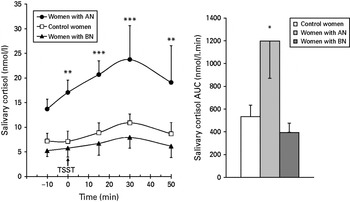
In the three-group comparison, the group×time repeated-measures ANOVA yielded a significant main effect for group (F 2,20=9.81, p<0.0015) and time (F 4, 80=3.43, p<0.015) but no significant group×time interaction (F 8,80=0.58, p=0.7), indicating that saliva cortisol levels changed significantly after the TSST and quantitative differences over the samplings existed among the groups, whereas the timing of the hormone response to the TSST did not differ significantly. When each patient group was compared to control women (Fig. 1), a significant main effect for group (F 1,13=8.23, p<0.015) and time (F 4,52=2.56, p<0.05) but no significant group×time interaction (F 4,52=0.54, p=0.7) emerged for AN patients; by contrast, no significant effect for group (F 1,14=2.41, p=0.1) and no significant group×time interaction (F 4,56=0.22, p=0.9) but a significant effect for time (F 4,56=4.01, p<0.007) emerged for BN subjects. Compared to control women, AN patients showed significantly higher saliva cortisol levels immediately before (T=0) and at each time point after the TSST test whereas no significant differences were found between BN and control women. The saliva cortisol response to the TSST, evaluated as the area under the curve (AUC), was significantly higher in AN patients (F 1,13=7.49, p=0.017) but not in BN (F 1,14=2.26, p=0.1) (Fig. 1). ANCOVAs showed no significant effects of both age (F 1,19=0.53, p=0.4) and current BMI (F 1,19=0.09, p=0.7) on saliva cortisol response to the TSST.
Salivary cortisol response to the Trier Social Stress Test (TSST) in drug-free patients with anorexia nervosa (AN), bulimia nervosa (BN) and healthy controls. Data are expressed as mean±standard error of the mean (s.e.m.). * p<0.02, ** p<0.005, *** p<0.001, versus healthy women (Tukey's post-hoc test).

Saliva α-amylase response to the TSST
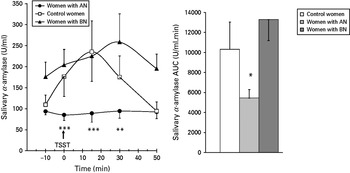
In the three-group comparison, the group×time repeated-measures ANOVA yielded a significant main effect for group (F 2,20=7.95, p<0.003) and time (F 4,80=3.67, p<0.009) but only a trend towards a significant group×time interaction (F 8,80=1.87, p=0.07), indicating that saliva α-amylase levels changed significantly after the TSST and quantitative differences over the samplings existed among the groups, whereas the timing of the hormone response to the TSST was only significant by trend. When each patient group was compared to the control women (Fig. 2), a significant main effect for group (F 1,13=5.04, p<0.05) and time (F 4,52=4.50, p<0.004) and a significant group×time interaction (F 4,52=5.12, p<0.002) emerged for AN patients; by contrast, no significant effect for group (F 1,14=2.48, p=0.1) and no significant group×time interaction (F 4,56=1.33, p=0.2) but a significant effect for time (F 4,56=4.30, p<0.005) emerged for BN subjects. Compared to control women, AN patients showed significantly lower saliva α-amylase levels immediately before (T=0) and 15 and 30 min after the TSST test whereas no significant differences were found between BN and control women. The saliva α-amylase response to the TSST, evaluated as the AUC, was significantly lower in AN patients (F 1,13=5.44, p=0.03) but not in BN (F 1,14=1.56, p=0.2) (Fig. 2). ANCOVAs showed no significant effects of both age (F 1,19=0.07, p=0.7) and current BMI (F 1,19=0.77, p=0.3) on saliva α-amylase response to the TSST.
Salivary α-amylase response to the Trier Social Stress Test (TSST) in drug-free patients with anorexia nervosa (AN), bulimia nervosa (BN) and healthy controls. Data are expressed as mean±standard error of the mean (s.e.m.). * p<0.035, ** p<0.005, *** p<0.001, versus healthy women (Tukey's post-hoc test).

Discussion
To the best of our knowledge, this is the first study to explore simultaneously the HPA axis and SNS responses to psychosocial stress in symptomatic patients with AN or BN. We found that, in healthy women, salivary α-amylase levels increased slightly before starting the TSST, peaked 15 min after stress and returned to baseline by 35 min post-stressor. By contrast, cortisol levels did not peak until 30 min post-stressor and were still elevated at the end of the experimental session. This is consistent with the reported faster reactivity of the autonomic nervous system relative to the HPA axis (Takai et al. Reference Takai, Yamaguchi, Aragaki, Eto, Uchisashi and Nishikawa2004). Compared to the control subjects, underweight AN women exhibited a preserved cortisol response to the TSST, although this occurred at significantly higher hormone levels, but a completely absent response of salivary α-amylase. No significant changes in both salivary cortisol and α-amylase responses occurred in symptomatic BN individuals, although they showed significantly enhanced pre-stress levels of the enzyme compared to healthy subjects. These findings demonstrate that, in acute AN patients, the activity of the HPA axis was basically increased (as supported by enhanced pre-stress levels of salivary cortisol) and its reactivity to psychosocial stress was preserved, although occurring at a higher level; by contrast, stress-induced activation of the SNS was completely lacking. Conversely, in symptomatic BN individuals, both neurobiological components of the stress response seemed to be normally activated by a psychosocial stressor and normal pre-stress levels of salivary cortisol, but significantly enhanced salivary α-amylase concentrations were present.
Our findings of increased pre-stress levels of salivary cortisol in underweight AN patients and of normal pre-stress levels of salivary cortisol in symptomatic BN women compared to control women are consistent with a large body of literature showing hyperactivity of the HPA axis in the acute phase of AN but not in BN (Lo Sauro et al. Reference Lo Sauro, Ravaldi, Cabras, Faravelli and Ricca2008). To our knowledge, the salivary cortisol response to the TSST has never been explored in BN and only one previous study found a blunted salivary cortisol response to the TSST in adolescent females with AN (Zonnevylle-Bender et al. Reference Zonnevylle-Bender, van Goozen, Cohen-Kettenis, Jansen, van Elburg and van Engeland2005). However, in that study AN patients were younger than ours, had co-morbid depressive and anxiety disorders, were tested when they had already partially recovered their BW, and the TSSTs were performed between 1200 and 1800 h. These clinical and methodological differences may explain the discrepancy between their results and ours.
As expected, consistent with literature data in serum and saliva (Blinder & Hagman, Reference Blinder and Hagman1986; Gwirtsman et al. Reference Gwirtsman, Kaye, George, Carosella, Greene and Jimerson1989; Kronvall et al. Reference Kronvall, Fahy, Isaksson and Theander1992), pre-stress levels of salivary α-amylase were increased in our binge-purging bulimic patients but not in restricting underweight AN individuals, because purging is known to increase salivary α-amylase levels. Although our findings are not exactly comparable to the literature data, the almost complete lack of α-amylase response to the TSST, probably mirroring a decreased activation of the sympathetic component of the stress response, is consistent with the observed lack of stress-induced HR increase in our AN patients and the reported decreased sympathetic control of cardiovascular activity in underweight patients with AN (Kreipe et al. Reference Kreipe, Goldestein, DeKing, Tipton and Kempski1994; Petretta et al. Reference Petretta, Bonaduce, Scalfi, de Filippo, Marciano, Migaux, Themistoclakis, Ianniciello and Contaldo1997; Rechlin et al. Reference Rechlin, Weis, Ott, Bleichner and Joraschky1998; Murialdo et al. Reference Murialdo, Casu, Falchero, Brugnolo, Patrone, Cerro, Ameri, Andraghetti, Briatore, Copello, Cordera, Rodriguez and Ferro2007). Therefore, literature cardiovascular data and present findings support the evidence of an overall decrease in the activity of the sympathetic branch of the autonomic nervous system in the acute phase of AN.
As salivary cortisol and α-amylase had different reaction profiles in our malnourished AN patients in response to a psychosocial stressor, the occurrence of an asymmetry between the HPA axis and the sympathetic component of the stress response may be indicated in the acute phase of AN. The factors responsible for this asymmetry are largely unknown. One possible explanation could lie in the different habituation rates of the two systems to the prolonged stress exposure represented by the patients' chronic malnutrition. In support of this idea, evidence has been provided that, in experimental animals, repeated stress exposure leads to a decreased response over time in the SNS with sustained HPA axis response (Britton et al. Reference Britton, Segal, Kuczenski and Hauger1992). Whatever the causes, it has been suggested that asymmetry between these two biological systems may have unhealthy consequences, especially in young subjects (Bauer et al. Reference Bauer, Quas and Boyce2002). In fact, El-Sheikh et al. (Reference El-Sheikh, Erath, Buckhalt, Granger and Mize2008) reported that dissociation in children's salivary α-amylase and cortisol reactivity to challenges was associated with some degree of cognitive dysfunction. The extent to which the asymmetry between the two biological components of the stress response could contribute to the pathogenesis, maintenance and/or outcome of AN remains to be determined. Moreover, although the increased tonic activity of the HPA axis in underweight AN patients seems to be secondary to malnutrition because it reverts with the recovery of BW (Lo Sauro et al. Reference Lo Sauro, Ravaldi, Cabras, Faravelli and Ricca2008), at present it is not possible to establish whether the asymmetry between the HPA axis and the SNS responses to the TSST is a primary or a secondary phenomenon in AN. As the reported decreased sympathetic control of heart activity in symptomatic AN patients is related to low weight status (Kreipe et al. Reference Kreipe, Goldestein, DeKing, Tipton and Kempski1994; Petretta et al. Reference Petretta, Bonaduce, Scalfi, de Filippo, Marciano, Migaux, Themistoclakis, Ianniciello and Contaldo1997; Rechlin et al. Reference Rechlin, Weis, Ott, Bleichner and Joraschky1998; Murialdo et al. Reference Murialdo, Casu, Falchero, Brugnolo, Patrone, Cerro, Ameri, Andraghetti, Briatore, Copello, Cordera, Rodriguez and Ferro2007), it is conceivable that the decreased SNS response, as reflected by the lack of salivary α-amylase increase after stress, could also revert with BW gain. Studies in recovered AN patients could help to clarify this issue.
One limitation of our study lies in the low number of subjects in each group, which could be responsible for false positive results because of the high inter-individual variability in the HPA axis and autonomic responses to stressors. Moreover, salivary α-amylase is an enzyme that hydrolyses starch to glucose and maltose. Given this function, salivary α-amylase levels may not be a reliable indicator of SNS activity in our AN subjects, who restrict food ingestion and especially carbohydrate consumption repeatedly. Finally, salivary gland abnormalities can occur in patients with EDs, and this may represent a further variable affecting salivary levels of both cortisol and α-amylase. Therefore, our results should be regarded as preliminary.
In conclusion, this study demonstrates that, in underweight AN individuals but not in symptomatic BN patients, salivary cortisol and α-amylase have different reaction profiles in response to a psychosocial stressor, suggesting that asymmetry between these two components of the stress response occurs in the acute phase of AN.
Declaration of Interest
None.