


Hidden away on the back inside cover of an A5 school-style notebook of music manuscript paper, Gérard Grisey taped a piece of characteristically French squared notepaper.Footnote 1 On it is written the phrase ‘Bell Strasbourg Cathedral’, and beneath it is found a hastily scribbled pencil sketch, including the hand-written stave lines (Figure 1).
Grisey, ‘Bell of Strasbourg Cathedral’, Gérard Grisey Collection, Paul Sacher Stiftung, Basel; reproduced by kind permission of the Paul Sacher Stiftung.
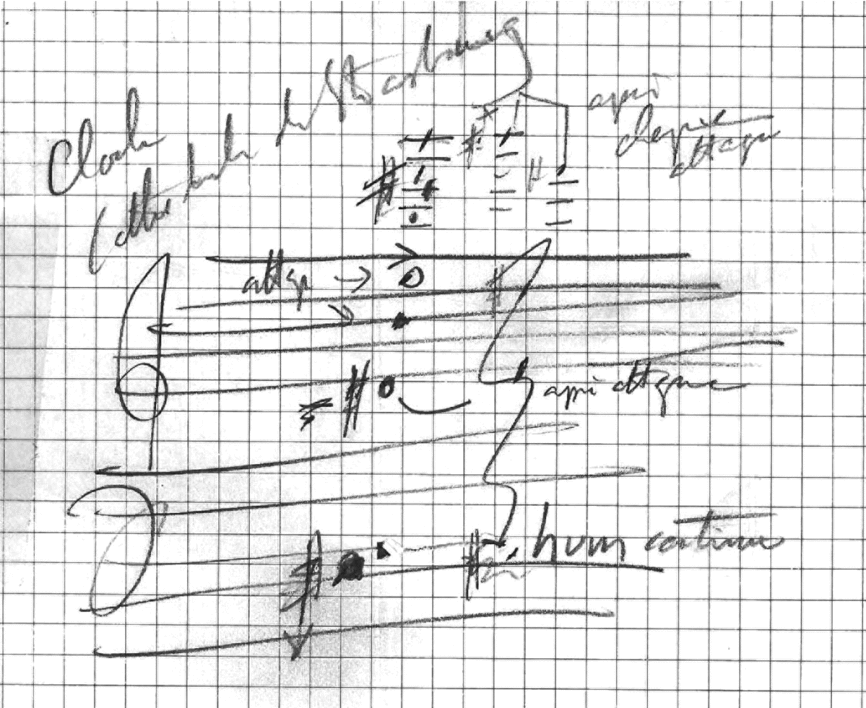
Given that Grisey includes it along with sketches for his last works, Vortex temporum and Quatre Chants pour franchir le seuil, it must surely date from the final years of his life, 1994–98. Grisey was clearly transfixed by the sound and attempted to notate it for future referenceFootnote 2 – not just the bell's ‘spectral’ profile, but also the way it is attacked, how the hum note continues, and how the sound as a whole is shaped across time. There is no obvious evidence in this notebook to connect the notation of the Strasbourg bell directly to the works being sketched, but to anyone who knows, for example, the opening of Vortex temporum (1994–96), it should be clear that the sound of the bell is never far away. A tiny, swirling fragment from Ravel's Daphnis et Chloé is transformed into the rapid, repeating arpeggios of the opening as a kind of representation of a sine wave,Footnote 3 but which might equally be understood as the sound of a tolling bell: a single, distorted spectrum (four notes on the piano are tuned down a quarter tone), like that heard in Strasbourg, each ‘attack’ slowly fading across four bars, while the cello enters periodically with a sustained ‘hum’. Similarly, the repeated rocking figures of the berceuse that concludes the Quatre Chants pour franchir le seuil have the character of a tolling bell, here suggesting a ritual dimension.
Such sounds are hardly new in Grisey. Think of the magical moment at the end of Périodes (1974) when the ensemble re-synthesizes the spectrum of the low trombone E♮ and it takes on a bell-like character, bringing a sense of repose to the patterns of inhalation and exhalation that have unfolded across the work. This was then to become the start of Partiels (1975) in the context of the vast, six-movement Espaces acoustiques. These bells of beginning and ending again imply something contemplative, ritualistic, spiritual even. Such ritualistic bells can also be heard in the music of Grisey's teacher, Messiaen, at the end of the fourth movement of Et expecto resurrectionem mortuorum (1964), for example, whose final nine-note ‘chord of resonance’ opens up a metaphorical ritual space in keeping with the Biblical quotations at the head of the movement (‘the joyful concert of the stars and the acclamation of the sons of heaven’). A single representation of the spectrum rings across the entirety of Stockhausen's spiritual/earthy/crazy Stimmung (1968), which was an important work for Grisey, and he might even have heard some of the ring-modulated sounds in Stockhausen's Gesang der Jünglinge (1955–56) and Mantra (1970) as kinds of bells. Further back in the twentieth century, in French music Grisey knew well, bells ring out across Debussy's ‘Cloches à travers les feuilles’ (1907) from the second volume of Images and Ravel's ‘La vallée des cloches’ (1905) from Miroirs. For the ‘spectral’ composers of the later twentieth century, the bell also offered infinite possibilities for both the contemplation of sound and the crossing of thresholds into ritual spaces, from Jonathan Harvey's Mortuos plango vivos voco (1980), whose sounds and structures are built in large part from an analysis of the spectral content of the tenor bell at Winchester Cathedral, to the opening of Tristan Murail's Winter Fragments (2000), a re-synthesized distorted spectrum, which chimes outwards across the work like a bell tolling in a winter landscape, in memory of his friend Grisey.
Grisey's little sketch of the Strasbourg bell thus opens a window onto a defining tendency in twentieth- and twenty-first-century music, namely a new attentiveness towards the qualities of sounds themselves. As Schoenberg noted, ‘Richard Wagner's harmony had promoted a change in the logic and constructive power of harmony. One of its consequences was the so-called impressionistic use of harmonies . . . a development which ended in what I call the emancipation of the dissonance’.Footnote 4 A feeling for harmony that was no longer dependent on the functional rules of tonality did not just serve to emancipate the dissonance, however, but also allowed music to be rethought from the perspective of points or fields of sound, focusing on textures, colours, registers, and intensities, and resulting in the creation of new kinds of musical space and time, new kinds of perception and listening. Music, one might say, turned inwards. Such thinking resonated strongly with the aesthetics of the age. Proust encapsulates it thus:
An image presented to us by life brings with it, in a single moment, sensations which are in fact multiple and heterogeneous. . . . An hour is not merely an hour, it is a vase full of scents and sounds and projects and climates, and what we call reality is a certain connexion between these immediate sensations and the memories which envelop us simultaneously with them.Footnote 5
Substitute ‘sound’ or even ‘note’ for ‘hour’, and you almost end up with a manifesto for spectralism.
The ‘nomenclature spectral is regarded by virtually every major practitioner of the trend as inappropriate, misleadingly simplistic and extremely reductive’.Footnote 6 These words undoubtedly still hold true, despite the fact that, for better or worse, the label ‘spectral music’ seems to have stuck. Hugues Dufourt is generally credited with having coined the phrase in 1979.Footnote 7 Murail, however, disputes this, arguing that the term already had a currency before that date, that he and Grisey were certainly discussing the term at the Internationale Ferienkurse für neue Musik, Darmstadt, in 1978, and that no single person can really be credited with inventing it.Footnote 8 Around the same time Grisey was deploying the label ‘liminal’.Footnote 9 In fact, no sooner had these terms emerged, than Dufourt himself was questioning them both: as early as 1980 Dufourt wrote to Grisey: ‘Use the adjective liminal if you wish, but I'm not very keen, because it's too restrictive, too “reductive” [minorant]. I gave up “spectral” some time ago [depuis belle lurette], also much too narrow.’Footnote 10 Later, Grisey appeared to accept the term spectral, but in his final essay (1998) he redefined its use: ‘The spectral adventure has allowed the renovation, without imitation of the foundations of occidental music, because it is not a closed technique but an attitude.’Footnote 11 Subsequent composers such as Marc-André Dalbavie and Philippe Hurel have also chosen to speak of spectralism more as an attitude than as a set of practices. For others still, such as Georg Friedrich Haas, Fausto Romitelli, and Kaija Saariaho, spectral thinking can inform deeply what they do, whether or not the materials they are working with are actually ‘spectral’ at all.
New technologies enabled the ever-more fine-grained analysis of sound, and the production of entirely new sounds, including later the development (by Murail and others) of fundamental pieces of computer-assisted composition software such as PatchWork. Dufourt has often written of the way in which electronic technology compelled composers to adopt new attitudes to sound: ‘electronics perform a kind of microanalysis of the sonic phenomenon, which uncovers new structures of order and an unsuspected field of possibilities’.Footnote 12 Grisey wrote in similar terms that ‘spectral music offered a formal organization and sonic material that came directly from the physics of sound, as discovered through science and microphonic access’.Footnote 13 Such thinking certainly led – in part at least – to a defining spectral moment: the foundation in Paris of Ensemble L'Itinéraire in 1973, a collective curious about sound, devoted to the exploration of new modes of expression through the creative relationship between composers and performers, often also using electronic instruments. It was just one of a number of such groups founded in that city in the 1970s with similar sorts of aims, such as its immediate predecessor MATH 72 (Murail, Abbott, Tessier, Holstein; founded 1972), 2E2M (Études et expressions des modes musicaux; founded 1971), and Ircam (Institut de recherche et coordination acoustique/musique; in development since 1970, opened 1976), which, despite its very different organization and substantial state funding, eventually became associated with all the leading spectral composers. CRISS (Collectif de recherche instrumentale et de synthèse sonore) was founded by Dufourt in 1977; its manifesto (published in September 1978) declares a clear link between musical and social change:
The techniques of electronic processing of sound are becoming the agent of a profound stylistic revolution and their integration into our civilization undoubtedly constitutes a key feature of this age.Footnote 14
L'Itinéraire was initially associated with five principal composers, Grisey, Michaël Levinas, Murail, Dufourt and Roger Tessier – the first three all shared Messiaen as teacher; they had all been scholars at the Villa Medicis, where they encountered Giacinto Scelsi and whose works had a profound impact in encouraging an intense listening inside the sound of, often, single notes; and they had all attended Darmstadt, where they came under the influence of Stockhausen. The composers of L'Itinéraire also shared a polemical aesthetic, an anti-establishment position in keeping with the broader political and social re-evaluation being undertaken in 1968 and after, opposed to both serial music and its legacy, and what they called ‘musical postmodernism’. A shared curiosity, then, about the inner life of sounds, stimulated by an engagement with technology, enabled a radical rethinking and renewal of how music could speak. Serialism, in Grisey's words, had neutralized the parameter of pitch; spectral music, on the other hand, had a temporal origin.Footnote 15 A spectral sensibility enabled composers to re-engage with time, with listening, with memory. Thus, the formation of L'Itinéraire – the composers they played, and the key works that emerged such as Grisey's Espaces acoustiques, Murail's Mémoire/Erosion and Désintégrations, and Dufourt's Saturne – represents a nodal point. For the members of L'Itinéraire, Debussy's interest in chords as autonomous sonic objects of colour and timbre was an important historical reference, while their collective exploration of sound embraced an interest in all manner of music, including that of Crumb, Ligeti, Messiaen, Risset, Scelsi, Schaeffer, Sciarrino, Stockausen, Varèse, Xenakis, and La Monte Young, most of which would not necessarily be labelled ‘spectral’, yet which shared aspects of the radical aesthetics being proposed by L'Itinéraire. Through this spectral node flowed all other kinds of music, which flowered in all sorts of new and varied directions – by, for example, Anderson, Andre, Bedrossian, Benjamin, Chin, Filidei, Haas, Harvey, Hurel, Leroux, Lindberg, Mâche, Nørgård, Radulescu, Romitelli, Saariaho, Tenney, Tulve, Vivier, and many others. While the profile of the music of all the composers listed here might, in some guise or other, be considered spectral, the range of what they produce suggests little aesthetic common ground between them, besides the fact that heightened awareness of the properties of sound can prompt new modes of musical thought and expression.
What, then, is understood by ‘spectral music’ today? What is the use of the label? It might indeed simply suggest an approach to music that in some way or other has resulted from an attention to the structure of sounds but which may, nonetheless, not actually use microtonal elements in the music that results. It might suggest an approach to music that in some way or other is concerned with the flow of time. It might suggest an approach to music that demands new ways of listening. But such features are to be found in all manner of musics. In marketing contexts, the label can be used as a kind of shorthand, but in musicological contexts it would appear to be so generalized as to say very little. Can we any longer usefully speak of spectral music at all, beyond a very particular moment in Paris in the 1970s? Perhaps, to misappropriate a book title by Bruno Latour, we have never been spectral.Footnote 16 Or perhaps we have always been spectral – when trying to find the origin of such music, Murail pointed to the ancient Tuvan tradition of throat singing.Footnote 17 If no music is spectral, or if all music is in some way spectral, then the term would appear to have little critical purchase.
It is in order to think through the implications of the term for the music with which it is generally associated that this special issue came about. While spectral music has been relatively widely discussed in French – more often than not from analytical/descriptive perspectives rather than from historical or critical ones, and usually mainly by the protagonists themselves – the body of literature in English remains relatively thin. An evaluation of the place of spectral music in the wider history and practices of the music of the late twentieth and early twenty-first centuries is long overdue. This issue represents a very small beginning to such an enterprise. Spectral thinking – rather than the science of the spectrum of sound – has been the starting point for all the articles published here, acknowledging the importance for so-called spectral music of a far wider set of concerns to do with time, space, listening, nature, and society.
A tolling bell is not just an isolated point of sound of a particular character and colour. A bell tolls across time; a bell transforms time. A bell tolls in a particular place. Bells belong in the world, shaping landscapes, summoning worshippers, celebrating birth and re-birth, lamenting the dead. Bells symbolize the passage across thresholds. It is no doubt because of some of these associations, and not just for the ‘sound itself’, that Grisey was fascinated by the Strasbourg bell, at a moment when he was immersed in the composition of two works intimately concerned with notions of time, death, and ritual. And the bell stands more broadly as a metaphor for sound spectra and their manipulation, suggesting an attitude not just to particular kinds of musical material, but also to a renewal of what might be understood as modernist thinking in music in the later twentieth century, a music concerned with the boundaries between sound and silence, between consonance and dissonance, between the coherent and the inchoate, between the certain and the uncertain, between nature and technology, between body and spirit. The finest products of what Grisey called the ‘spectral adventure’ speak profoundly of the time in which they were made. In an increasingly threatened world, a world on political and ecological thresholds, spectral thinking addresses fundamental questions about nature and being. It is with these matters that this special issue is concerned.



