Introduction
This article focuses on human rights movements that developed in Mexico in response to the escalation of political repression between 1968 and 1982. Such political violence, now officially called a dirty war, was waged primarily against the left and other activists. Although Communists had faced a long history of targeted harassment and imprisonment, President Gustavo Díaz Ordaz's (1964–70) approach to political activists marked a significant escalation. He sustained a campaign against the left that was simultaneously overt, covert, reactive, and preemptive. President Luis Echeverría (1970–76) further escalated the violence that began to wind down, but did not completely end, with President José López Portillo (1977–82). While lower in intensity than other dirty wars in the hemisphere,Footnote 1 these elected civilian presidents approved of extrajudicial detentions, torture, and even the extrajudicial executions of several hundred people (mostly males).Footnote 2 There were also thousands of cases of political activists who were held incommunicado in clandestine centers or prisons during this period. On the surface, they did not appear to be political prisoners because they had been tortured to confess to common crimes before their formal arraignment. Thus, as Alan Knight noted, “Mexican political violence appears less extreme and significant, but that is partly because it is more discreet, anonymous, prolonged and quotidian” (1999).
This article will show that the protestors and their government were engaged in a dialectical relationship in which political contention led to state violence that, in turn, led to further contention about the violation of human rights. My work not only documents the existence of an early human rights movement that has been overlooked, but also I show that it was effective. I specifically argue that over the course of 25-plus years, local activists slowly won concessions from the state even though they frequently saw major setbacks. The concessions on which I focus include two presidential orders to release political prisoners (the amnesties of 1971 and 1978), the creation of the National Human Rights Commission (the Comisión Nacional de Derechos Humanos or CNDH) in 1990, and the actual management of an armed uprising in Chiapas during that decade. Created in the aftermath of a dirty war, the CNDH's mission to “protect, observe, promote, study, and disseminate the human rights protected by the Mexican legal system” is a progressive, if incomplete, first step at institutional change. Without real sanctioning power, the CNDH is limited, and this problem is exacerbated by the fact that other institutional reforms (e.g., in the judicial system and various police institutions) are far from complete. Still, the normative implications of its investigative reports that “name” and “shame” officials help to protect citizens from politically motivated repression carried out by federal government officials. And while other institutions are in dire need of reform, the evidence gleaned from Amnesty International reports suggest that the central government’s stance toward political activists has improved since the 1990s.
In explaining why two dirty war presidents released political prisoners in 1971 and 1978 while a third president created the CNDH in 1990 and then declared a unilateral cease-fire in response to an armed uprising in Chiapas, I offer a history of the change in the federal government’s stance toward political oppositions (which is in contrast to parochial political bosses who have continued to attack those who threaten their land or political interests at the local level). This history sheds specific light on the role of nonelite political actors who promoted change through extrainstitutional and disruptive political tactics against Goliath. To be clear, I do not claim that domestic actors are insulated from the international arena or that they reject support from transnational networks of like-minded activists. Rather, I argue that nonviolent protests within nation-states are more significant, both in terms of their histories and their political impact over time, than the literature suggests. My argument, thus, builds on the social movement outcomes literature by showing that disruptive movements can influence policy even in such nondemocratic political contexts as Mexico (which transitioned to an electoral democracy in 2000).
The section that follows offers an overview of the general scholarship on the struggle for human rights as well as the movement outcomes literature. It is followed by a brief description of the sources for my historical account. The thesis to be demonstrated is that local human rights movements not only put Mexican government officials on the defensive, but also that their nonviolent protests exacted favorable policy concessions and, ultimately, some institutional reform from civilian presidents.
The Struggle for Human Rights: Local and Global Contexts
Scholars of globalization show that the global arena can exert a transformative influence on nation-states (Almeida and Johnston Reference Almeida, Johnston, Johnston and Almeida2006; Carty Reference Carty, Johnston and Almeida2006; Deflem Reference Deflem2008: 257; Dixon Reference Dixon, Stahler-Sholk, Vanden and Kuecker2008; Halliday and Carruthers Reference Halliday and Carruthers2007; Lins Ribeiro Reference Lins Ribeiro, Alvarez, Dagnino and Escobar1998; Olesen Reference Olesen, Johnston and Almeida2006; Stewart Reference Stewart, Johnston and Almeida2006; Yúdice Reference Yúdice, Alvarez, Dagnino and Escobar1998). In the human rights field, for example, the international human rights regime employs various sanctions to attempt to pressure authoritarian governments to comply with human rights norms. To take the case of the United Nations, sanctions can range from political shaming through negative reports, to economic embargos and even, in the last instance, to military intervention. Less formally, norm dissemination may occur through transnational networks of nongovernmental organizations called INGOS; in the human rights field, such INGOS are called HRINGOS. Many scholars note that better communication technologies have increasingly improved the international exchange of ideas and services, and this has resulted in the proliferation of transnational networks of civic actors (Finnemore and Sikkink Reference Finnemore and Sikkink1998; Keck and Sikkink Reference Keck and Sikkink1998; Landman Reference Landman2006; Markoff Reference Markoff1996; Risse and Sikkink Reference Risse, Sikkink, Risse, Ropp and Sikkink1999: 31; Sikkink Reference Sikkink1993). According to Risse and Sikkink, because such transnational networks have expanded since the mid-1970s, it was not until 1985 that a number of authoritarian regimes began to adopt international human rights norms (Reference Risse, Sikkink, Risse, Ropp and Sikkink1999: 31–33), a process that happens through “boomerang effects.” Boomerang processes begin
when domestic groups in a repressive state bypass their state and directly search out international allies to try to bring pressure on their states from the outside. National opposition groups, NGOs, and social movements link up with transnational networks and INGOS [international NGOs] who then convince international human rights organizations, donor institutions, and/or great powers to pressure norm-violating states. [Transnational] Networks provide access, leverage, and information (and often money) to struggling domestic groups. International contacts can “amplify” the demands of domestic groups, prise open space for new issues, and then echo these demands back into the domestic arena. (Reference Risse, Sikkink, Risse, Ropp and Sikkinkibid.: 18)
While this boomerang model recognizes that domestic and international NGOS work collaboratively, it tends to see transnational human rights networks as crucial to changing a government's record because such networks make human rights violations known to the international community (Reference Risse, Sikkink, Risse, Ropp and Sikkinkibid.: 33–34), thus providing the critical leverage against repressive regimes (Sikkink Reference Sikkink1993: 421). According to Risse and Sikkink, transnational human rights networks may also strengthen the “initially weak domestic opposition” (Reference Risse, Sikkink, Risse, Ropp and Sikkink1999: 34).
But while the human rights literature has carefully examined the role of international human rights NGOS (henceforth, HRINGOS), less attention has been paid to the history and impact of local human rights movements. As Tsutsui and Wotipka note, “the literature often downplays . . . the individual activities of local constituencies, who find ways to connect with these [HRINGOS]” (Reference Tsutsui and Wotipka2004: 588). Jean Quataert similarly observes that the external focus ignores “the local and indigenous movements for democratic reform and human rights” and, thus, the “understandings, definitions, and sense of timing” of these local movements (Reference Quataert2009: 295). About Mexico, Sikkink went so far as to say that “the absence of Mexican human rights organizations kept Mexico from becoming a concern of the [transnational] network” in the 1970s and early 1980s (Reference Sikkink1993: 430). The relative neglect of local movements may in part have to do with the global level of analysis from which many scholars proceed, and this focus frequently betrays an assumption that local movements are weak vis-à-vis the power of authoritarian states. As noted in the preceding text, local movements are assumed to be influential only when they “bypass” the state in a boomerang throw to call upon stronger international allies.
Notable exceptions notwithstanding, this perspective can imply that political change happens from the outside in, specifically when “initially weak domestic opposition[s]” call in stronger global actors to exert pressure on local states (Risse and Sikkink Reference Risse, Sikkink, Risse, Ropp and Sikkink1999: 34). While scholars such as Carruthers and Halliday (Reference Carruthers and Halliday2006) are very careful to point out that global/local interactions are not unidirectional processes by which local actors ultimately comply with global norms, my research goes a step further. I show that the strength of domestic social movements can independently pressure nondemocratic states into adopting progressive policy. Further, while Dezalay and Garth have clearly shown that local intellectuals can employ “international strategies” to win their local “palace wars” (Reference Dezalay and Garth2002: 7), I add that local nonelites—that is, those without foreign symbolic capital—also help to shape the political agendas of their governments. In short, I hold that locally disruptive, yet nonviolent, movements of nonelite actors can be effective even in nondemocracies (see also Cai Reference Cai2010).
These observations contribute to a growing body of work that argues that social movements are consequential (even unintentionally), whether by exacting favorable policy concessions from government officials in the short term, or by influencing structural change on party formation, or the extension of rights, over the long term (Trevizo Reference Trevizo2011; see Amenta et al. Reference Amenta, Caren, Fetner and Young2002, Reference Amenta, Caren, Chiarrello and Su2010; Andrews Reference Andrews2002; Baumgartner and Mahoney Reference Baumgartner, Mahoney, Meyer, Jenness and Ingram2005; Gamson Reference Gamson1990; Meyer et al. Reference Meyer, Jenness and Ingram2005; Olzak and Soule Reference Olzak and Soule2009; Piven Reference Piven2006; Soule et al. Reference Soule, McAdam, McCarthy and Su1999). Yet most of the extant scholarship focuses on the positive impact that social movements have in democratic countries, where the more favorable political opportunity structure lends itself precisely to inputs from citizens (whose protests may influence potential voters). However, undemocratic countries—those with relatively closed political systems, patronage-based party systems, as well as those likely to repress—are said to hinder (not prevent) both movement emergence and movement success (Amenta et al. Reference Amenta, Caren, Fetner and Young2002).
In contrast, I argue that protest movements can successfully achieve political rights even in nondemocracies because sustained mobilization over time can help to change domestic attitudes by dramatizing the inhumanity of state terror. Moreover, sustained local mobilization that is punctuated by dramatic collective protests events have a greater potential to influence public opinion and state legitimacy, than do episodic reports from HRINGOS or even from UN Human Rights Commissioners. My argument about the power of local movements finds empirical parallels in other authoritarian contexts beyond Mexico. Argentina's Mothers of the Plaza de Mayo movement is the closest example to the Mexican case and, as noted in the following text, that group formed during the same month of the same year as a case I document. South Africa's antiapartheid movement as well as the various dissidents of the former Soviet bloc also illuminate how local movements fought and won rights from repressive states; they did so even if they also faced cruel punishments for their activism (Quataert Reference Quataert2009: 84–108).
Accentuating the power of local movements neither denies that such movements are “embedded in [a] discursive and structural context” (Quataert Reference Quataert2009: 12) nor that international actors pressure authoritarian states to comply with international human rights norms. Rather, it seeks to correct the assumption that global actors “from above” are the dominant or most important sources of domestic political change. As Jean Quataert observes in Advocating Dignity (Reference Quataert2009), the human rights discourse has not only been a powerful “language of resistance” from below, but the ordinary people who fight against political repression have influenced the very meaning of human rights at the global level (Reference Quataert2009: 6–7). Yet the role of such local struggles is frequently glossed over by some who lose sight of the “specific historical contexts” of struggles from below (Quataert Reference Quataert2009: 9–10).
So, if local protest movements in repressive societies can change public opinion locally, raise awareness about national problems globally, and extend the definition of human rights used by transnational actors, then it follows that local movements have had a more important role to play than what has been established. I offer empirical support for this conclusion by examining the social history of grassroots political struggles for human rights in Mexico.
Data Sources
The historical analysis relies on qualitative and quantitative data on politically motivated human rights abuses by the Mexican state, as well as some local protests against, and global reactions to, such violations. The qualitative data include a presidential memoir, a draft report written under the auspices of the Mexican government that was leaked to the media (see Mexico 2006 Footnote 3 ), 26 years of Amnesty International Yearly Reports published from 1974 to 2000 and the secondary sources. President Salinas de Gotari's memoir (Reference Salinas de Gotari2002) offers a window into how movements are taken into account by a very powerful president. As Amenta and colleagues observe, the movement outcomes literature would benefit from historical analyses that “demonstrate that the [movement] challenger changed the plans and agendas of political leaders” (Reference Amenta, Caren, Chiarrello and Su2010: 301).
Additionally, in April 2012, I conducted interviews in Mexico City with long-term human rights activists and two high-ranking CNDH officials. My student, Ms. Santoyo-Borjas, interviewed four activist-mothers who worked with ¡Eureka!, one of the oldest human rights organizations in Mexico that is comprised exclusively of family members, mostly mothers, of disappeared political activists. These interviews took place in Mexico City in January 2011, more than one year before I went into the field myself. My student also interviewed Senator Rosario Ibarra, who founded ¡Eureka! and who was nominated for the Nobel Peace Prize several times for her work. Except where noted, all interviews were conducted in Spanish. The qualitative analysis also draws on a book of photographs entitled Eureka: Graphic History Mexico 1977–1989 (1989).
A quantitative data set comprised of 727 cases of rural protests against repression between 1979 and 1984 adds to the evidence. These data were gathered and coded by professor Blanca Rubio on the basis of Información Sistemática, a news-clipping archive (see Rubio Reference Rubio1987). Rubio also provided summary statistics on the “number of peasant protests protest per state between 1977–1983” as well as “the number of instances in which rural activists denounced government repression between 1977–1983” (“Denuncias Contra la Represión”). While ideal data would span 1968 through 2000, as well as include urban protests against political repression, such an integrated data set does not exist. Information on urban groups is gleaned from the secondary sources as well as my interviews.
The Emergence of a Sustained Human Rights Movement in Mexico: 1968–2000
Because a full historical account of earlier struggles against state violence in Mexico is beyond the scope of this article,Footnote 4 I begin with the modern phase of that movement in 1968. In the summer through early fall of that year, hundreds of thousands of young people in Mexico City took to the streets to demand, among other things, an end to police abuse (especially from the granaderos) as well as amnesty for political prisoners. Sparked by excessive police violence, as well as by the ongoing arbitrary arrests of members of the Communist party, students essentially demanded things that today we consider human rights demands. At the time, however, students did not have available to them what is now an internationally meaningful “human rights” master frame. For example, some of their key demands included liberty for political prisoners; the dissolution of riot police (called granaderos); and the derogation of the “Crime of Social Dissolution,” the antisubversion laws of the 1940s that made it possible to criminalize public dissent (through Articles 145 and 145b) (Guevara Niebla Reference Guevara Niebla1988: 39, 49).Footnote 5 The dirty tactics that students identified became evident to even wider audiences when their government ordered a surprise assault on a peaceful rally on October 2, 1968. The Tlatelolco massacre of more than 300 students forced many survivors into exile and observers into clandestine organizing (Trevizo Reference Trevizo2011).
Perhaps for this reason, the Centro Nacional de Comunicación Social (or CENCOS) stands out for its public adoption of the human rights master frame, as well as for the national-level impact that such a stance ultimately had within Mexico. Briefly, its central leader, José Álvarez Icaza, broke with the Catholic Church through which CENCOS was founded because Mexican bishops supported the iron-fisted management of the 1968 student movement. From that point on, and from its Mexico City perch, CENCOS began documenting authoritarian excesses in Mexico, while also becoming an activist as well as refugee center (for those fleeing persecution) (Petrich Reference Petrich2010). Within a short period, it became an important early site from which the struggle against repression would evolve into the struggle for “human rights” as such (Petrich Reference Petrich2010; see also Aguayo Quezada Reference Aguayo Quezada2009: 294).
CENCOS, moreover, would play this role long after 1968 because the central government actually stepped up repression against political dissidents in the years following the student massacre. In the Cold War politics that followed the Cuban revolution, many leaders in the region came to define even the nonviolent left as a threat to national security. Echeverría was one such leader, and the threat to national security seemed plausible given that armed guerilla groups had mushroomed both in the urban centers and in the countryside during the 1960s and especially in the 1970s. His authoritarian response was also linked to fact that all organized movements (especially in the countryside) eroded the power of the state's official organizations, the corporatist associations that delivered the vote (that kept the Partido Revolucionario Institucional, or PRI, in power for 71 years).Footnote 6 But economic interests were also at stake insofar as rural protest, the most common, threatened the land interests of agrarian capitalists (Trevizo Reference Trevizo2011).
With this national security frame, Luis Echeverría extended counterinsurgency operations even to nonviolent leftists and the peasants that they led (Trevizo Reference Trevizo2011). To illustrate, as nonviolent protest movements for better working conditions and especially for land reform continued to spread geographically, Luis Echeverría increasingly relied on the army, multiple police forces, special forces (such as Brigada Blanca or White Brigade), and even paramilitary groups (such as the “halcones” and other armed civilians) to stop them. Echeverría had CENCOS “occupied” twice by secret police (who confiscated materials from CENCOS archives) and even went so far as to order a takeover of the newspaper daily, Excelsior, on July 8, 1976 because the editor at the time (Julio Scherer García) violated the prevailing journalistic norms by reporting on political dissent (on CENCOS see Petrich Reference Petrich2010; on Excelsior see Riding Reference Riding1976).
In this context, some family members of the victims of repression came together to defend political prisoners, and some of these groups carried out their activities on university campuses in Mexico City (Mexico 2006: 709–10). One group that formed in 1972, the Comité de Defensa Física y Moral de los Presos Políticos, was comprised of artists, students, and family members of political prisoners. Another group—the Comité Político de Familiares—formed in 1974 was comprised primarily of family members of political prisoners (Mexico 2006: 710). It was not until about 1976 that family members in this organization employed the concept of the “disappeared” because, until that point, they were unsure of the exact crime against their loved ones (Mexico 2006: 712). For their part, Mexican intellectuals and lawyers working from UNAM's Instituto de Investigaciones Juridicas had studied the legal issues pertaining to human rights since the early 1970s, and these students would later become active in the struggle for human rights in Mexico (interview, Mexico City, April 2012 with Gerardo Gil Valdivia, a CNDH official who represents Mexico to the international human rights regime).
President López Portillo's (1976–82) version of authoritarianism was marginally better than his predecessor’s. López Portillo, for example, ratified the International Covenants on Civil and Political Rights and on Economic, Social and Cultural Rights, and the American Convention of Human rights. In June 1980, his government “unilaterally declared its intention to comply with the United Nations Declaration on the Protection of All Persons from Torture, and Other Cruel Inhuman or Degrading Treatment or Punishment” (Amnesty International 1986: 29). But despite some progress, his government tolerated widespread abuse of power at the local level because landed interests demanded as much (Americas Watch 1990: 55). Amnesty International reports indicate that from 1980 to 1982, large numbers of peasants, many of whom were indigenous, were held “in local jails in provincial towns,” where they were subject to especially brutal treatment (Amnesty International 1980: 152). Many such peasant prisoners were held on trumped up criminal charges, which were frequently confessed to only after they were tortured; such “confessions” were admissible in Mexican courts. Neither adolescent boys nor old men were spared brutal beatings, near asphyxiation with plastic bags, near drownings, and electric shock treatments to their testicles.Footnote 7 According to a 1982 Amnesty International report, a left-led peasant organization involved primarily in land disputes, the Coordinadora Nacional Plan de Ayala (or CNPA), estimated that there were 600 peasant political prisoners as of 1981—near the end of López Portillo's administration.
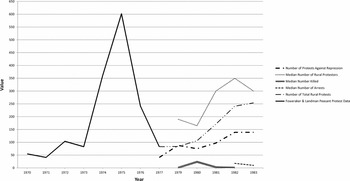
Figure 1, which tracks rural repression during López Portillo's term, illustrates a dialectical dynamic in which protest is met with state violence which then leads to antirepression contention. As indicated in the comparison between the red, green, and blue lines in figure 1, the spike in political repression (per the thick, triple line) during López Portillo's administration actually grew the number of rural protest events against repression, as well as the number of people involved in such antirepression protests.Footnote 8 Put differently, political violence was positively correlated with the strengthening of Mexico's antirepression movement (per the upward trajectory of the line representing “number of protests against repression”). This point is particularly worth noting because, as observed, Katherine Sikkink argued that Mexico had no human rights organizations prior to the late 1980s (Reference Sikkink1993: 430). The evidence presented here indicates that such organizing indeed took place, though most of the organizations did not use the human rights master frame.
The Relation of Politically Motivated Repression in the Countryside and Local Anti-Repression Protests, 1977–1983. Data Presented in Linear (not logged) form.

This was probably the case because the peasants and indigenous people who suffered much politically motivated violence were engaged in land invasions (squatting) as a way of instigating land reform and, thus, called their abuse repression. We know this because independent evidence compiled from Amnesty International identified the following Mexican organizations as their primary source of information about repression in the countryside during this period: Central Independiente de Obreros Agrícolas y Campesinos (CIOAC); Coalición de Obreros, Campesinos y Estudiantes del Istmo (COCEI); the CNPA; Partido Socialist Unificado de México (PSUM); and Organización Independiente de Pueblos Unidos de la Huastecas (OIPUH) (Amnesty International 1984). The first four in this list were left-led organizations involved in the struggle for land; in the case of the PSUM, it was manifestly the left and it, too, led struggles for land (Trevizo Reference Trevizo2011). Only the OIPUH, an indigenous organization, was not created by, or closely affiliated with, a Marxist group. While the CIOAC and COCEI were regional organizations, the CNPA and PSUM organized nationally.
But single-issue urban organizations focusing on politically motivated repression also formed during López Portillo's term. Such organizations included the “1968 Committee for Democratic Liberties” (Comité 68 Pro Libertades Democráticas), which was created in 1978 by a group of former 1968 students who had also been political prisoners. The “Front for Human Rights, Constitutional Guarantees and Democratic Liberties” (Frente Pro Defensa de los Derechos Humanos, Garantías Constitucionales y Libertades Democráticas—Comisión Independiente de Derechos Humans de Morelos) also formed in the 1970s in Morelos state. This is also true of the Association of Family Members of those Detained, Disappeared and Victimized by Human Rights Violations in Mexico, which came together in 1978 (Asociación de Familiares de Detenidos, Desaparecidos y Víctimas de Violaciones a los Derechos Humanos en México [AFADEM]) (Mexico 2006: 711–22).
Among the most influential organizations that fought politically motivated, state-sponsored repression during López Portillo's term was ¡Eureka! Founded in the mid-1970s,Footnote 9 ¡Eureka! (a.k.a. Comité Pro Defensa de Presos, Perseguidos, Desaparecidos y Exiliados Políticos, or CNPDPPDEP), is comprised of family members of disappeared political activists, most of whom are the mothers, wives, daughters, and sisters of disappeared activists. The so-called doñas (ladies) of this movement defied gender norms by holding militant protest actions that demanded the return of their disappeared family members. Since its founding this organization has demanded amnesty for political prisoners and the reappearance of activists “disappeared” by the Mexican government.
Although only some of the groups listed used the idea of “human rights” in their organization's name, this frame was better foregrounded in 1984, the year that intellectuals, lawyers, and community activists created the Mexican Academy for Human Rights in Mexico City, as well as the Commission in Defense of Human Rights in the state of Sinaloa. The following year, the bodies of prisoners who had been “disappeared” surfaced in the rubble of the federal district attorney general headquarters following a devastating earthquake in Mexico City (Amnesty International 1986: 6). As the evidence that these prisoners had been tortured was categorical, the national media reacted by refocusing on human rights violations in Mexico (Amnesty International 1986). But, as I have emphasized, this does not mean that there were no struggles for human rights earlier. Clearly the demands since the 1960s and 1970s for amnesty for political prisoners, the demand that the government end politically motivated violence, and the mothers’ demand that the government reappear missing activists are human rights issues (see the 1948 UN Universal Declaration of Human Rights, especially articles 2, 3, 5, 6, and 9).
Sergio Aguayo Quezada, a long-term human rights activist/scholar and former president of the Mexican Academy for Human Rights (1990–96), similarly notes that
the defense of human rights emerged from society itself. Specifically, it emerged as the primordial objective of some middle class civic groups created by professionals, political activists, and Christians, all of whom were dedicated to fighting authoritarianism in a non-violent way. (2009: 294, author's translation)
This is not to say that these domestic groups were isolated. Ibarra de Piedra, whose son was disappeared in 1974, worked with other mothers of disappeared activists in the Southern Cone (such as Argentina's Madres de la Plaza de Mayo) (Borjas-Santoyo phone interview, January 2011; Ibarra was called in Monterrey from Mexico City). In 1981, women (mostly mothers) from 14 Latin American countries formed “FEDEFAM,” a short-lived organization called Federación Latinoamericana de Asociaciones de Familiares de Detenidos-Desaparecidos (the Latin American Federation of Organizations of Family Members of Those Detained-Disappeared). Ibarra also visited colleges and universities and unions in the United States and Canada in the 1980s to garner international attention in her efforts to pressure the Mexican state.
Yet, despite some successes with connecting to transnational networks of other human rights activists especially in Latin America, the early human rights movement in Mexico tended to be overlooked by transnational networks that were, as Sikkink observes, focused on Central America and the Southern Cone (Reference Sikkink1993: 429). In a recent interview Aguayo explains that the organizations that fought politically motivated violence during the 1970s “were ignored by the international community because, with the exception of Amnesty International which created a small program in Mexico in the 1960s/1970s, the U.S. human rights community only created the program in the 1980s” (Aguayo interview in English, Mexico City, April 2012; emphasis mine). The dirty wars in the Southern Cone and the violence in Central America were more visible to the international community because of the scale of human loss in those countries, and perhaps also because the violence involved transnational cooperation (e.g., Operation Condor).Footnote 10
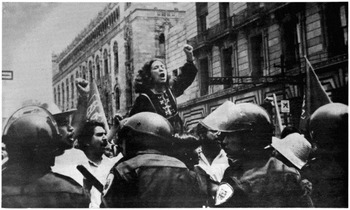
Significantly, their relative invisibility to U.S.-based transnational activists was not a problem domestically. As shown by figures 2 and 3, local activists maintained direct pressure on their government by meeting with presidents directly, holding hunger strikes, participating in hundreds of rallies and demonstrations, and raising the issue of political repression in electoral campaigns. For example, Rosario Ibarra de Piedra spoke to President Luis Echeverría 39 times and also met President López Portillo (Mexico 2006: 693).
On September 1, 1981, Rosario Ibarra de Piedra gave President José López Portillo a list of activists disappeared for political reasons.

Rosario Ibarra de Piedra at a May 1, 1988 rally in Mexico City. She is carried on the shoulders of activists from the “Frente Nacional Contra La Represion”.

Having documented that the movement against politically motivated state violence had a longer history than what has been assumed by U.S.-based scholars, the following section focuses on whether this movement was effective.
The Amnesty of 1978, the Emergence of the CNDH in 1990, and Other Movement Outcomes
According to our interviews, the women participated in ¡Eureka! both in the investigation of specific cases as well as in collective protests because they believed themselves to be effective. Some of the women argued that their activism prevented more disappearances (Santoyo-Borjas Mexico City interviews, January 2011). The view of their efficacy was shared by Amnesty International, which held that
Comité Eureka soon became a national human rights organization: it carried out its first widely publicised “plantón”, a peaceful stand out, in front of the cathedral in Mexico City, on 28 August 1978. The activities of the Comité Eureka led to a growth of public and international awareness of the problem, and to increasing pressure on the authorities to provide an official explanation of the fate and whereabouts of the “disappeared.” (Amnesty International 1998)
The clearest sign of their effectiveness came in the form of the 1978 amnesty for political prisoners. López Portillo's amnesty resulted in the release of 1,500 political prisoners held in public prisons, as well as the reappearance of 148 people “disappeared,” that is, held incommunicado, in clandestine prisons (Amnesty International 1998: 7–8). Because in January of that year the minister of interior, Jesus Reyes Heroles, had identified an “interim list” of 312 disappeared activists to the secretary general of Amnesty International, it is fair to infer that close to half of those disappeared were released from clandestine centers. According to Amnesty International,
The Comité Eureka's plantón, which also included a hunger strike, was violently disrupted by the police and triggered a national and international public outcry leading to a general amnesty for a large number of political prisoners, granted by President López Portillo in September 1978. (1998: 8)
Though Amnesty International's letter campaign and visit to Mexico early in 1978 (see Riding Reference Riding1978) may also have influenced López Portillo's decision to grant amnesty to political prisoners, Rosario Ibarra stresses the impact of the “strong political acts” of the 54 domestic organizations involved in the National Front Against Repression (Borjas-Santoyo phone interview, January 2011; Ibarra was called in Monterrey from Mexico City). Many of the organizations that she identified in that interview were, in fact, leftist unions involved in the struggle for amnesty. But her claim about their effectiveness is supported by independent evidence. López Portillo began moving in the direction of an amnesty since 1977 in the context of a growing (see figure 1) and increasingly militant domestic movement that demanded just that. For example, he promised a forthcoming amnesty when he met with local human rights activists a year before the hunger strike to which Amnesty International refers in the preceding quotation. A participant in that 1977 meeting, Ms. Blanca Hernández (president of the Fundación Diego Lucero) quoted the president as saying that “he would grant amnesty . . . as part of a [larger political] reform package, one in which all registered parties could operate within specific norms” (Mexico 2006: 711). In fact, López Portillo had already stopped criminal proceedings against 424 activists on April 4, 1977 and doing so amounted to a smaller amnesty than the one that he passed in 1978 (Mexico 2006: 678). In short, although Amnesty International along with the international “outcry” about the violence against the women was undoubtedly helpful, Mexican activists played at least as big a role in the passage of the 1978 amnesty (see also Mexico 2006: 695).
Even the student activists of a decade earlier can be said to have influenced policy. The tragic end to their peaceful movement notwithstanding, President Díaz Ordaz conceded to repeal the social dissolution provisions from the Federal Penal Code at the close of his administration (Jones Reference Jones2009). Given the weak international condemnation of the massacre at Tlatelolco,Footnote 11 the derogation of the Crime of Social Dissolution (the antisubversion laws of the 1940s) was a very specific policy concession to the 1968 student movement, although it was accompanied by the passage of new antiterrorism laws (Jones Reference Jones2009: 20). Students also forced Díaz Ordaz's government to go on record to claim that Mexico defended civil liberties. For his part, the new incoming president, Luis Echeverría (who had been minister of interior during the Tlatelolco massacre of students) pledged a democratic opening and opted for various populist policies. Regarding his “apertura democratica,” in 1971 he passed a general amnesty law that released 1,000 prisoners who had been involved in the student movements of 1968 and 1971 (Mexico 2006: 678). Again, given the anemic response of the international community to the Tlatelolco massacre, Echeverría's amnesty can be attributed directly to the work of the domestic movement that condemned the fact that Mexicans were detained by their government for their political views. He also lowered the threshold for party representation in Congress (Molinar Horcasitas Reference Molinar Horcasitas1991: 87–89). For his part, Miguel de la Madrid Hurtado (1982–88) pursued a “moral renewal” (“renovacion moral”) for the state, promising to fight corruption, improve policing, and correct abuses in public administration and the judicial system.
But the movements against politically motivated state violence did not ease up and these movements clearly influenced President Salinas de Gotari's decision to create the National Human Rights Commission (CNDH) in 1990. This point is important to underscore given that the scholarship has thus far stressed that the CNDH was created only after the international human rights network focused on Mexico's repressive record in the late 1980s (Sikkink Reference Sikkink1993: 412). In Sikkink's words, “In large part as a response to these international network pressures, the Mexican government created the National Commission on Human rights in June of 1990” (Reference Sikkink1993: 433). In her view, the international attention paid to Mexico from 1987 on influenced both the government's stance as well as public opinion within Mexico:
This situation began to change by the late 1980s, when human rights consciousness began to penetrate Mexico civil society. In 1984, only four human rights NGOS existed in Mexico, seven years later there were sixty, and by 1993 there were over two hundred independent human rights monitoring and advocacy NGOS. International attention helped create the political space within which this growth was possible. A key turning point came when a group of prestigious Mexican intellectuals, activists, and politicians set up the Mexican Academy for Human Rights in 1984. (Reference Sikkinkibid.: 430)
According to Sikkink, the dramatic rise in the number of human rights monitoring organizations in Mexico was due to the fact that two HRINGOs, Americas Watch and Amnesty International, documented human rights abuses there in two reports released in 1984 and 1986. She concludes that Salinas's administration created the CNDH in June 1990 to preempt negative publicity about Mexico's human rights record before the North American Free Trade Agreement (NAFTA) talks (Reference Sikkink1993: 432–33). For their part, Dezalay and Garth (Reference Dezalay and Garth2002) state that the work “of internationally funded human rights organizations in Mexico” and greater international attention both to electoral irregularities and human rights violations related in a growing drug war were catalysts for the creation of the commission. They add,
Indeed, reports highly critical of Mexican human rights issued by Amnesty International and Human Rights Watch, coupled with the pending NAFTA negotiations, forced Salinas to act. He announced his decision to create the CNDH while boarding a plane to meet with President George H. Bush in Washington, D.C. for the start of NAFTA discussions. (Reference Dezalay and Garthibid.: 230)
Thus, like Sikkink and her colleagues, these scholars stress international actors, international money, and/or the cosmopolitan “international strategy” of Mexican lawyers (Reference Dezalay and Garthibid.: 233). Missing from these analyses is an appreciation of the more than 20-year history of prior struggles that I documented in the preceding text. Consequently, these works do not consider the possibility that the extant antirepression organizations within Mexico may also have independently and significantly contributed to the emergence of the CNDH.
But in recent interviews, Sergio Aguayo and two high-ranking CNDH functionaries observed that the prior history of organizing mattered to the creation of the CNDH. Some of the key figures that both men identified as early risers in the antirepression movement eventually formed a part of the Mexican Academy for Human Rights in 1984, and this organization had always pressed for an ombudsman. Aguayo observes that President Salinas de Gotari created the CNDH because “he was already sensitized by the mood in the country. We had created the Mexican Academy for Human Rights in 1984. We had been working six years in favor of the creation of the CNDH” (Aguayo interview, Mexico City, April 2012). Gil Valdivia pointed to the broader effervescence of civil society, arguing that “Mexican civil society was mobilizing and the organizations were growing” (interview, Mexico City, April 2012). For his part, Luis García López Guerrero, the “First General Visitor” (or second-in-command) at the CNDH, stated that the CNDH emerged in the aftermath of a dirty war, specifically in the grievances and political struggles that it gestated (interview, Mexico City, April 2012). He stated that such struggles had “many consequences [impactos], politically, socially, culturally.” In his words, the activists involved with the Mexican Academy for Human Rights and ¡Eureka!
set the precedent for what is today called the power of the citizenry [“el poder de la ciudadania”], [and they functioned] precisely as a counter-weight, to confront the abuses of power. Their organizations [¡Eureka! and the Academy] investigated [allegations of abuse] when the Commission did not exist or otherwise helped with information. They continue to be important today. Just to give you an idea, the Commission has ties to 3,000 [Mexican] organizations which focus on various aspects of human rights. . . . So, organizations like ¡Eureka! set the precedent for the active participation of the citizenry around human rights themes. (Interview, Mexico City, April 2012)
Further, while all of my interview subjects agreed that the NAFTA context was important to the timing of the CNDH's emergence, they all stated that the domestic context was as crucial. Some pointed, for example, to the fact that there was already an ombudsman in the state of Aguascalientes since 1988; others pointed to the fact that President Salinas created the organizational precursor to the CNDH as early as 1989. All interview subjects mentioned the homicide of a human rights activist, Norma Corona. These are some of the points emphasized by President Salinas in his published memoir:
As my presidential term began, a significant gap grew between what officials in the Justice Department and those representing national and international human rights groups were telling me. Within Mexico, the claims of non-governmental organizations grew rapidly. Mexican NGOS increased in number and organizational ability, while the depth of their commitment increased. Their complaints were against the impunity acquired from the arbitrary power that law enforcement organizations had gained over the years. . . . On May 21, 1990, a terrible event convinced me of the urgent need to create a commission responsible for the defense of human rights: Norma Corona, a distinguished lawyer from the state of Sinaloa, was murdered in a street in Culiacán, the state's capital. The crime occurred after she had filed a number of reports against several members of the Federal Judicial Police assigned to fight the drug trade in that state. Norma Corona accused them of collaborating with the drug traffickers. . . .” (Salinas de Gotari Reference Salinas de Gotari2002: 319–20)
Further, while the first sentence in this quotation acknowledges the role international groups, the president's memory of events focuses on the domestic scene as he decided to create the CNDH. Pages later, former President Salinas added:
In a system where results seemed, on occasion, to be more important than the means to achieve them, and faced with a society that was organizing itself more and more and demanding unrestricted respect for human rights, it was essential to create institutional conditions that would guarantee the commission's validity. Some states of the Republic had already created institutions for the protection of human rights. We even established a unit within the Secretaría de Gobernación (Ministry of the Interior) to respond to the accusations of human rights abuse during the first year of my administration. . . . Civil society responded to the initiative. Its organized mobilization called for the validation of human rights. In the first two years of my administration alone, 200 non-governmental bodies formed for different purposes; they all demonstrated the indispensable presence of organized society in the public arena. (Salinas de Gotari Reference Salinas de Gotari2002: 325)
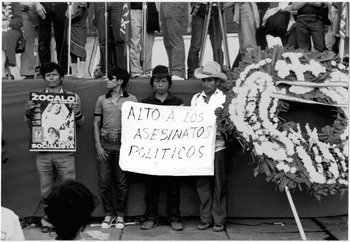
Salinas de Gotari's sensitivity to local NGOs is explained by a number of factors, not least of which is the fact that the struggle for human rights was not new in Mexico. In his 1988 presidential bid, for example, Salinas competed against three other candidates, one of whom was none other than Rosario Ibarra de Piedra. As she was the first woman to run for president in Mexico, her campaign garnered attention, one that kept a national-level spotlight on politically motivated, state-sponsored repression as well as on the disappeared (see figures 3 and 4).Footnote 12 Figure 4 is of rural men, likely indigenous, holding up a sign that reads “stop political assassinations” (“Alto a Los Asesinatos Politicos”) at the closing election rally of Ibarra de Piedra's electoral campaign in 1988.
Rural Men Protesting Political Assassinations in 1988 Election Rally in Mexico City.

But 1988 was a watershed year for other reasons. Salinas de Gotari officially received only 50 percent of the vote, the lowest level of electoral support heretofore received by the ruling party's candidate, and under conditions that made it appear that the PRI had resorted to fraud. As many people believe that Salinas stole the 1988 presidency from the left-of-center presidential contender, Cuauhtémoc Cárdenas, massive postelection protests followed. As a consequence of his electoral humiliation and in response to the less radical party's protests about local-level electoral outcomes, Salinas de Gortari tried to weaken the left opposition by strengthening the political right. He did so by conceding dozens of mayorships and even interim governorships to the right of center party, the Partido Acción Nacional (henceforth PAN), even if they did not really win those elections (Eisenstadt Reference Eisenstadt2003: 29).
The postelectoral conflict and electoral concessions that followed the 1988 presidential race ultimately grew the coalition of civic organizations from all ideological stripes that mobilized to defend the right to free elections (Aguayo Quezada Reference Aguayo Quezada2009). These concessions also generated even greater political violence because local PRI bosses felt that the central government had blocked their political careers precisely by conceding elections to opposition candidates in response to postelectoral mobilization (Eisenstadt Reference Doyle2004: 35; see also Cornelius Reference Cornelius, Cornelius, Eisenstadt and Hindley1999). Local political bosses and their subnational police allies retaliated directly against local opposition party activists, especially the left-wing PRD (for Partido de la Revolución Democrática), whose radical protests inveighed against electoral fraud thought to have been manipulated by the PRI (Eisenstadt Reference Doyle2004; see also Human Rights Watch 1997: 6–8).Footnote 13 It is estimated that between 1989 and 2000, 150 PRD activists were slain by such local (nonfederal) forces (Schatz Reference Schatz2011).
As postelectoral protests were massive, geographically widespread, and in densely populated urban centers, reports of politically motivated violence were harder to deny than the ongoing reports of human rights violations against peasants. Further, they could not be justified as counterinsurgency. Reports of electoral fraud and postelectoral violence constituted undeniable evidence of politically motivated repression. As such, on May 17, 1990, the Inter-American Commission on Human Rights called on Mexico to “assure the free and full exercise of political rights and judicial protection in accordance with Article 1.1. of the American Convention” (OEA Resolution # 01/90 Cases 9768, 9780, and 9282 Mexico). Salinas de Gotari was likely aware of this outcome as early as the fall of 1989 given that the Inter-American Commission had sent his government a preliminary report (approved on September 29 of that year). The Inter-American Commission had been reviewing cases of electoral irregularity brought by the right-of-center opposition party, the PAN, since 1985.
For their part, U.S. legislators also expressed concern about human rights violation in the context of the NAFTA negotiations but did so formally only after the CNDH had been created. For example, they held congressional hearings on Mexico's record in September 1990 and wrote a letter of concern to the Mexican government in October 1990 (Salinas de Gotari Reference Salinas de Gotari2002: 76). As noted, the CNDH was formally created in June 1990. What is more, Salinas had created the institutional antecedent to the CNDH on February 13, 1989 in the Ministry of “Government” (CNDH 2010). He did so, moreover, before he began to press for NAFTA given that his government was, in 1989, preoccupied with renegotiating the Mexican debt with a team of U.S. negotiators and with then president Bush's help (Salinas de Gotari Reference Salinas de Gotari2002). While his published memoir clearly indicates that the NAFTA negotiations dominated his attention in 1990, it also clearly shows that he was most worried about keeping Mexican oil off limits to U.S. investors, as well as assuring his U.S. counterparts that Mexico would not press for a migration provision. Under the subhead “October: a paper war over energy,” Salinas explains that the U.S. congressmen who opposed NAFTA in October 1990
were finally clear about what was really worrying them: setting up an agreement with a heavily populated, developing country, that was also their neighbor. These legislators added serious criticisms of our attention to the issues of the environment, human rights, workers’ rights, and drug trafficking. Our program of modernization, demanded by the Mexican people, was beginning to answer some of these points with deeds. (Reference Salinas de Gotariibid.: 78)
While it is possible, as one of John Ackerman's (Reference Ackerman2007) sources speculates, that as early as 1989 Salinas anticipated that U.S. legislators might raise questions about Mexico's human rights record, the evidence presented here shows that he was very concerned about the human rights movement in his own country. Just months before the creation of the CNDH, there were protests throughout Mexico against politically motivated repression (figures 3 and 4) and this movement expanded to denounce human rights violations related to the growing drug war (on the latter see Ackerman Reference Ackerman2007: 127; Americas Watch 1990: 2, 13–14).
In short, it was in the context of local protests against as well as international scrutiny of politically motivated state violence that Salinas sought to improve Mexico's stance when he created the National Human Rights Commission in 1990. Fox and Hernández similarly conclude that “[i]ncreased attention to the problems of police abuse and political violence, internationally as well as domestically, led to the creation of a governmental National Human Rights Commission” (Reference Fox and Hernández1992: 185). In other words, local as well as international factors played an important role in the birth of the CNDH.
The reasons why this would be so are highlighted by García López Guerrero who, in a recent interview, with me explained that an institution as complex as the CNDH is not created simply to
conform internationally . . . for the signing of a bilateral or multilateral treaty. Mexico's reality at the time that the CNDH was created [circa] 1989/1990, the country already had a series of social grievances regarding grave human rights violations such as disappearances, torture, extrajudicial executions. Some of the cases, such as Norma Corona, were emblematic. . . . The Commission was created to investigate forced disappearances, extrajudicial executions. (Interview, Mexico City, April 2012)
In sum, the history of local movements against political repression had a strong and direct impact on the policies of four authoritarian presidents. For more than two decades, various organizations demonstrated contentiously against politically motivated repression and, as Sikkink and her colleagues maintain, a number of these movements reached out to transnational actors for their support. In the 1970s only a weak Amnesty International responded by systematically reporting on their repression. They got more attention in the mid-1980s from Human Rights Watch and the Inter-American Commission on Human Rights and, as Sikkink and colleagues hold, this international attention did amplify their grievances. But the point I make is that the domestic movements were already loud, strong, and politically effective at the domestic level. Their various struggles over the course of 20-plus years kept the spotlight on the problem of politically motivated state violence through highly disruptive protests that pressured authoritarian presidents. Salinas de Gotari's memoir shows that their mobilizations and demands penetrated his consciousness enough for him to create the CNDH and, as I argue in the following text, to move quickly to find a negotiated solution to the armed uprising in Chiapas near the end of his term, on the very day that NAFTA went into effect.
Comparing Guerrilla Movements in Guerrero and Chiapas
Evaluating how the central government responded to the guerrilla movement in Chiapas in the early 1990s as compared to the counterinsurgency operations in the state of Guerrero during the early 1970s illuminates a change in the actual management of insurgents during two political crises. The evidence is clear that the army's operations in Chiapas in the early 1990s were more professional, disciplined, and measured vis-à-vis both guerillas and civilians as compared to their operations in Guerrero 20 years earlier.
To illustrate, army units in Guerrero not only repressed those individuals who were suspected of being guerillas, but also their direct family members and even students and villagers writ large because they were potentially allied with or possibly sympathetic to the guerrillas. The army's actions in Guerrero went well beyond the excesses of individual soldiers strained by combat. Rather, the evidence points to systematic repression, including of civilians, planned and executed as a matter of policy for Guerrero state. As noted, documents show that suspected guerrillas and even “antiregime” students in Guerrero were held at extrajudicial detentions in clandestine centers, where many were tortured and where some were summarily executed in the late 1960s and early 1970s (Mexico 2006: 314–18). The “guilt-because-student” logic turned into a “guilt-because of-kinship” logic, as illustrated by the case a woman who was raped by both an army captain and his subordinate in front of her partner. The latter had been detained because he was suspected of guerilla activities and his partner was raped for having taken him a wrap (serape). In another case, an old and disabled man was shot more than 100 times in front of his family (ibid.: 354). The mother, sister, wife, and other family members of the fugitive guerrilla leader, Lucio Cabañas, were jailed in a clandestine prison (ibid.: 314–18). Beyond the large number of arbitrary arrests, including of old men, adolescent boys, women, and children (ibid.: 339–40), the record is clear that the military engaged in interrogation by torture, robbery, plunder, and even assassinations in Guerrero state during the early 1970s (ibid.: 318).
Army officers and soldiers so blurred the line between actual armed guerrillas and suspected guerilla sympathizers that they punished entire communities located near the conflict zones. According to the government's report, a massacre was purposely staged in full public view of a “community” called “de Los Polocillos, Atocyac de Álvarez” in 1973. There is credible information that burnt corpses were dumped by army personnel in remote locations near Acapulco (ibid.: 370). Near the climax of the armed conflict, army units not only faced increasing casualties (due to hit and run guerilla ambushes), but a public humiliation occasioned when the guerrillas kidnapped (for ransom) then senator and gubernatorial candidate Reuben Figueroa Figueroa. In response, President Echeverría dispatched 10,000 additional army troops to Guerrero and these troops squeezed entire peasant communities even harder than they had previously.
By 1974, there are reports of village roundups, or forced relocations (concentración forzada de la población). There is some evidence that some of the homes in the abandoned villages were plundered and then burned (ibid.: 342). In other cases, peasants were not permitted to tend their crops and this, in turn, resulted in spoiled harvests and, undoubtedly, collective hunger (ibid.: 374). On July 21, 1974, one woman from such a village (Santiago de La Unión) wrote President Echeverría to complain “we’re all suspected of being guerrillas and we are not free to take to our homes necessary articles,” such as food (ibid.: 374). Her claims are substantiated by military records clearly indicating that supplies to some villages had, in fact, been cut off (ibid.: 372–74). Indeed, an irregular census of every member of every household in forcibly relocated villages was taken so that food rations could be distributed to families according to the size of their household. Such food rationing made possible surveillance as soldiers could account for the whereabouts of the men in each household and also the rate at which food was consumed through such rationing. If the food rations were consumed more quickly than expected, soldiers suspected that high calorie households were supplying food to the guerrillas (ibid.: 372–74). In sum, armed and unarmed, political and apolitical, young, old and even disabled citizens of Guerrero were either bludgeoned into submission, or were collectively punished because living in the conflict zone was evidence enough of complicity with the insurgents.
Twenty years later, President Salinas de Gortari would put down an even more spectacular armed uprising in the southernmost state of Chiapas. On January 1, 1994, some 3,000 armed guerrillas of the Ejército Zapatista de Liberación Nacional (EZLN) declared war on the Mexican government when attacking six large towns, briefly holding three of the towns along with several privately owned ranches. Within 24 hours, then president Salinas de Gortari ordered land and air assaults that resulted in approximately 300, mostly civilian, casualties (Eisenstadt Reference Doyle2011). In response both the national and international community decried the mismatch in arms and by the twelfth day of the uprising, the federal government announced a unilateral cease-fire in the hopes of negotiating with the Zapatistas (see also de la Luz Inclán Reference de la Luz Inclán2009: 795; Knight Reference Knight, Koonings and Kruijt1999: 118).
The peace talks would continue for two years (1994–96) and the cease-fire held even through another—this time unarmed—occupation of 38 (of a possible 111) local municipalities shortly after Ernest Zedillo assumed the presidency (de la Luz Inclán Reference de la Luz Inclán2009: 802). The truce, in fact, had created political opportunities for a large a cycle of unarmed protests in which Zapatista peasant sympathizers illegally “invaded” (squatted on) private estates. And though the militarization of Chiapas was obvious, the siege around the Lacandon Jungle sought to contain armed struggle as well as police the illegal actions of at least two dozen paramilitary groups who countermobilized to protect the landed interests of the large landowners (Eisenstadt Reference Doyle2011: 26).
Significantly, the militarization of Chiapas was meant to deter armed struggle, not assault unarmed dissidents.Footnote 14 According to de la Luz Inclán's study of 1,491 protest events in 111 distinct locations in Chiapas between 1994 and 2003, “after the ceasefire was declared, the state could only respond to Zapatista protest activity by increasing repressive threats and not by applying actual repressive measures against protestors” (Reference de la Luz Inclán2009: 798). The Zapatistas, she explains, clearly understood “that the army was not directed to repress [unarmed] protest activity” (Reference de la Luz Inclánibid.: 798, 801). Rather than meting out collective punishments to students and villagers, individuals suspected of being guerrilla commanders (EZLN leaders) were arrested using legal warrants issued against them (de la Luz Inclán Reference de la Luz Inclán2009: 802; see also Salinas de Gotari Reference Salinas de Gotari2002: 806).
Despite the government's ultimate failure to honor the San Andres Accords, the cease-fire and even the negotiations between the federal government and the Zapatistas ultimately yielded some positive policy outcomes. Though not entirely what the Zapatistas demanded, the newly elected President Ernesto Zedillo passed the “Law for Dialogue, Reconciliation, and a Dignified Peace in Chiapas” (on March 11, 1995) that guaranteed a negotiated settlement. It also suspended the arrest warrants issued against the EZLN military commanders (de la Luz Inclán Reference de la Luz Inclán2009: 803). Additionally, social spending in that state doubled during Zedillo's term (Eisenstadt Reference Doyle2011). Perhaps most noteworthy considering the fact that land reform—a central demand of the EZLN—was no longer a constitutional right, more than 6 percent of the land area in Chiapas was redistributed to peasants (Eisenstadt Reference Doyle2011: 18; see Harvey Reference Harvey1998 on the land demand). Finally, as Eisenstadt observes, the constitutional changes that followed the peace talks recognized collective indigenous rights in keeping with the International Labour Organization Treaty 169, which Mexico had ratified in 1990. By 2003, the Zapatista movement lost momentum and turned its energies to creating parallel structures of authority in the rebel-controlled locations (de la Luz Inclán Reference de la Luz Inclán2009).
The central state's tempered military response in Chiapas (as compared to Guerrero) is explained by a number of factors, including the international attention on the Zapatistas that was ingeniously cultivated by Subcomandante Marcos's communiqués and Zapatista conventions. But at least as important was the fact that Mexico was transitioning to democracy, and this process mattered on multiple levels. As documented in the preceding text, civil society was better organized in the 1990s than it had been in the 1970s, and some NGOs were resident in Chiapas. According to then president Salinas, Mexican “civil society had mobilized massively and led the demand for talks and a solution to the valid demands of the indigenous population” (Reference Salinas de Gotari2002: 805–6, 813–14, emphasis added; see also de la Luz Inclán Reference de la Luz Inclán2009: 801). The public's support for the Zapatistas was noted by local officials who strategized about vote getting in Chiapas where local elections were becoming more competitive (de la Luz Inclán Reference de la Luz Inclán2009). But national-level party leaders also took note of Mexican public opinion. Then president Salinas de Gotari, for example, recalls worrying that repressing Zapatistas would threaten the upcoming presidential election as well as the very process of democratization that the country was undergoing, a prospect that seemed certain because of their many young supporters in Mexico City (Salinas de Gotari Reference Salinas de Gotari2002: 805–7). These considerations, argues Salinas, helped him to choose “human rights” over the “extermination” option proposed by some hawks (Reference Salinas de Gotariibid.: 807). Whether or not we believe his memoir, the army's operations in the 1990s could, in fact, be monitored by a politically independent media in a way that had not been true in the 1970s, when journalists (with a few brave exceptions) were careful not to offend government officials lest the government stop purchasing ads in their newspapers or supplementing their incomes (see Lawson Reference Lawson and Middlebrook2004). Concerned with public opinion and elections, the central government responded with restraint in Chiapas once the cease-fire was declared.
In sum, the sharp contrast observed between the negotiated settlement in Chiapas and the prolonged counterinsurgency operations in Guerrero is largely explained by the broader democratizing trends: mobilization within Mexican civil society since 1968 for human rights specifically, and democratization more generally. The mano dura tactics of the early 1970s intentionally terrorized suspected guerrillas, their theoretical sympathizers, family members, students, and eventually entire villages in the absence of a well-organized civil society, real elections, or an independent media. While innocent civilians also died in Chiapas, they did so during the armed conflict. The evidence is clear that soldiers were ordered to hold their fire by the twelfth day of the conflict, and this truce both lasted and made possible favorable concessions to the unarmed wing of the Zapatista movement. Thus, according to de la Luz Inclán, “The end of this cycle of protest seems to resemble more a scenario suggested by Beissinger [2002], where a regime in transition tends to apply lower repressive measures to remain legitimate” (Reference de la Luz Inclán2009: 797).
Conclusion: Nonelites and Local and Global Political Transactions
This article traces the long-term consequences of various movements in Mexico against politically motivated repression that began as student demonstrations in 1968. Former students, their family members, Catholics, journalists, leftists, peasants, intellectuals, mothers, and others relentlessly demanded that the state release political prisoners and end politically motivated state violence; they also demanded the reappearance of those disappeared (desaparecidos), as well as an official accounting of all those who were permanently disappeared. When the nonviolent movements strengthened at the local level, they gained momentum and were able to positively influence their national government and did so even if they were repressed. For example, all amnesty laws that released political prisoners since 1968 responded to protest demands, as did the derogation of the crimes of social dissolution laws. The creation of the CNDH was also a response to the strengthening of Mexico's human rights movement, as was the actual improvement in the way in which armed insurgents were managed in Chiapas as compared to those in Guerrero 20 years prior.
In other words, the nonviolent protests against politically motivated, state-sponsored repression contributed to the evolution of the central government's stance on human rights. While the interventions of such global actors as Amnesty International, the Inter-American Commission, and U.S. legislators also mattered, the existence and growing strength of the domestic human rights movement has been overlooked or misunderstood. I have demonstrated that because the frames of these movements varied over time, earlier movements against repression have not been well understood, nor have their consequences been fully appreciated. Yet it is clear that over the course of two decades, students, peasants, mothers, Christians, journalists, lawyers, and middle-class activists protested the government's arbitrary and cruel treatment of political dissidents and their contention proved important to various authoritarian presidents.
To be clear, I am not arguing against theories that hold that other nation-states and/or transnational forces or even activists from global civil society are important. My research found evidence consistent with Sikkink and colleagues of boomerang processes in which local actors reached out to global civic actors to dramatize human rights abuses. What I add, then, is an empirical point about a longer and more effective history of domestic organizing against repression in Mexico than has been assumed by U.S.-based scholars. This, in turn, suggests that the effects of local/global transactions partly depend on the agendas and political strength of such domestic movements (see also Quataert Reference Quataert2009). At the very least, as I demonstrate in this work, international monitoring organizations cannot build their case that a government has violated human rights norms without the evidence provided by local human rights activists. In nondemocratic contexts, such evidence is gathered in bottom-up processes through which local activists establish trust with victims of violence, and the information is then carefully disseminated through broader networks.
Finally, my findings suggest that the variation in domestic protest movements at the local level is important to any explanation of the central state's various responses to political minorities. Appearances of weakness notwithstanding, movement persistence in nondemocratic settings may yield small concessions that, in turn, have the capacity to become the building blocks upon which more important legal, institutional, and cultural change later occurs. The fact that an armed movement in Chiapas was suppressed militarily as the country transitioned to democracy at the close of the twentieth century does not undo the fact that various authoritarian governments in Mexico offered not only specific policy concessions to nonviolent movements of relatively powerless people, but also that they reorganized the polity with the addition of the CNDH in 1989/1990. What is remarkable here is not the military response to armed struggle (see, e.g., Franklin Reference Franklin2009: 710; Gamson Reference Gamson1990), but that various movements influenced authoritarians to release political prisoners, create a human rights institution, and adopt a more humane stance toward both civilians and guerrillas in an insurgent region.
Taken together, the evidence suggests that nonviolent political disruption can be effective from the start of a human rights campaign, even in the face of repression and apparent movement failure, because it exposes excessive state violence to local audiences, thereby placing human rights on the local radar (see also Quataert on Argentina, South Africa, and the former Soviet Union). Even in the absence of political upheaval (e.g., demonstrations), the pressure applied by grassroots movements on government is more sustained than that which comes from episodic reports and visits from international observers. While reports from the HRINGOS are important because they effectively shame a government to relevant audiences around the globe, embarrassing details neither have the disruptive capacity, nor the staying power, of domestic movements. The ongoing drama of movements, by contrast, can sustain national and international attention for as long as the movement organizes.