Introduction
More than 16 million people in the US live with cognitive impairment (Family Caregiver Alliance, 2001), and many need assistance with daily activities (Alzheimer’s Association, 2019). Cognitive decline occurs on a continuum from minor changes in thinking or remembering that do not impact a person’s daily life to severe declines that cause impairments in communication, daily activities, and memory (Jessen et al., Reference Jessen2014). Subjective cognitive decline (SCD) is one measure of cognitive function that relies on the individual’s assessment of his or her own memory (Jessen et al., Reference Jessen2014; Rabin et al., Reference Rabin2015). SCD may indicate a disease process or the beginning of a trajectory that culminates in cognitive decline or dementia (Dufouil et al., Reference Dufouil, Fuhrer and Alpérovitch2005; Mitchell et al., Reference Mitchell2014), or it may reflect a person’s mood or depressive symptoms rather than – or in addition to – changes in cognitive function (Hohman et al., Reference Hohman, Beason-Held and Resnick2011; Yates et al., Reference Yates2017; Zlatar et al., Reference Zlatar2018). Regardless, SCD has been related to a variety of poor health outcomes including falls (Al-Sari et al., Reference Al-Sari2017), frailty (Hsieh et al., Reference Hsieh2018; Gifford et al., Reference Gifford2019), chronic health conditions (Taylor et al., Reference Taylor2020), and sleep (Bubbico et al., Reference Bubbico2019). Therefore, SCD may be an important indicator of population health in public health surveillance systems where it may not be feasible to conduct lengthy cognitive assessment batteries or clinical examinations/imaging to evaluate cognitive function (Jessen et al., Reference Jessen2014).
People who experience functional impairments or activity limitations in cognitive domains may need support or assistance from others in order to carry out daily activities (DeFries et al., Reference DeFries2009; Heller et al., Reference Heller, Scott and Janicki2018; Alzheimer’s Association, 2019). Most of the support for people with cognitive impairment living in the community is provided by family, friends, and neighbors, who are called informal caregivers (Alzheimer’s Association, 2019). These informal caregivers are often critical to enabling people with cognitive impairment to participate in their communities (World Health Organization, 2002; Talley and Crews, Reference Talley and Crews2007; Alzheimer’s Association, 2019). Having unmet needs for care is associated with institutionalization, poor health, and lower quality of life in people with dementia (Gaugler et al., Reference Gaugler2005; Black et al., Reference Black2012).
Health-related quality of life (HRQOL), a subdomain of quality of life, is “an individual’s or group’s perceived physical and mental health over time” (Centers for Disease Control and Prevention, 2000). It is a useful indicator of both individual and population health: HRQOL is associated with both morbidity and mortality, and it can be used to indicate what services or programs a community needs (Centers for Disease Control and Prevention [CDC], 2000). Substantial evidence exists to suggest that people with SCD experience reduced quality of life (Pusswald et al., Reference Pusswald2015; Hill et al., Reference Hill2017; Roehr et al., Reference Roehr2017), including in domains related to mental health, physical functioning, and social functioning (Hill et al., Reference Hill2017). These negative HRQOL impacts may result from SCD’s interference with a person’s ability to perform activities of daily living (ADLs, e.g. eating, dressing, or bathing) (Montejo et al., Reference Montejo2012) and/or their social disengagement (Rotenberg et al., Reference Rotenberg, Maeir and Dawson2019) or isolation. Given that previous studies of older adults demonstrate that unmet needs for care often result in adverse consequences like limited mobility within or outside the home, going without getting dressed, and having to stay in wet or soiled clothes (Beach et al., Reference Beach2020), we expected that unmet needs related to SCD would be associated with HRQOL.
Previous studies evaluated the prevalence and correlates of unmet needs for care among community-dwelling older adults with dementia diagnoses (Gaugler et al., Reference Gaugler2005; Black et al., Reference Black2013, Reference Black2019; Vaingankar et al., Reference Vaingankar2013; Hughes et al., Reference Hughes2014; Tapia Muñoz et al., Reference Tapia Muñoz2019; Zwingmann et al., Reference Zwingmann2019; Beach et al., Reference Beach2020). However, less is known about the needs for assistance among community-dwelling middle-aged and older adults who experience early signs of cognitive decline, namely SCD. The objectives of this study were to estimate the prevalence of unmet needs for assistance among community-dwelling middle-aged and older adults with SCD in the US, to identify characteristics associated with having an unmet need for assistance and to evaluate whether having an unmet need for assistance was associated with poorer HRQOL in mental, physical, and social domains. We hypothesized that unmet needs for SCD-related assistance would be associated with a HRQOL in all three domains.
Methods
Data source
Data for this study came from the Behavioral Risk Factor Surveillance System (BRFSS), a state-based telephone survey of noninstitutionalized (community-dwelling) adults aged 18 years and older living in the US and its territories. The BRFSS is designed to assess health status and health behaviors along with additional topics of public health importance (Mokdad, Reference Mokdad2009). Data are weighted to represent the adult population on the basis of age, sex, race/ethnicity, home ownership, and geographic region (CDC, 2013). All responses are self-reported. The 2015–2018 response rate ranged from 36.3% to 47.2% for cell phone and 45.3% to 53.3% for landline telephone surveys.
We included data from 50 states, District of Columbia, and Puerto Rico that administered the Cognitive Decline module at least once between 2015 and 2018. If a state/territory used the module in more than 1 year, we included only the most recent year of data. The Cognitive Decline module is an optional module designed to measure the prevalence of SCD among adults aged 45 years and older and to assess the impact of cognitive decline on their life and activities.
Subjective cognitive decline and unmet needs for assistance
Because our aim was to evaluate the prevalence and impact of unmet needs related to SCD, we focused on people who experienced SCD and reported needing assistance with daily activities as a result of SCD. The Cognitive Decline module is introduced to respondents as follows:
The next few questions ask about difficulties in thinking or remembering that can make a big difference in everyday activities. This does not refer to occasionally forgetting your keys or the name of someone you recently met, which is normal. This refers to confusion or memory loss that is happening more often or getting worse, such as forgetting how to do things you’ve always done or forgetting things that you would normally know. We want to know how these difficulties impact you.
The first question screens for the presence of cognitive decline: “During the past 12 months, have you experienced confusion or memory loss that is happening more often or is getting worse?” We classified respondents who said “yes” as experiencing SCD. These respondents were then asked the remaining questions in the module and were included in the study.
We used two questions in the module to classify people as having met or unmet needs for assistance related to SCD. These questions ask about day-to-day household activities or chores, which are described as activities such as cooking, cleaning, taking medications, driving, or paying bills.
-
(1) As a result of confusion or memory loss, how often do you need assistance with these day-to-day activities?
-
(2) When you need help with these day-to-day activities, and how often are you able to get the help that you need?
Response options for both questions were always, usually, sometimes, rarely, and never. The second question is only asked if respondents said always, usually, or sometimes to the first question; therefore, we classified respondents who said they always, usually, or sometimes needed assistance with day-to-day activities as needing SCD-related assistance. We classified respondents who said they always or usually got the help they needed as having their assistance needs met, while we considered respondents who needed SCD-related assistance but reported they sometimes, rarely, or never got this help as having unmet needs for assistance. These unmet needs are based on respondents’ perceptions and their self-report. We refer to them as “unmet needs” throughout the remainder of the manuscript.
Health-related quality of life
The BRFSS includes four questions about HRQOL in the core (CDC, 2000, 2018). These measures were developed by the CDC and subsequently validated against other measures including the Medical Outcomes Study Short-Form 36 and 12 (SF-36 and SF-12) (Newschaffer et al., Reference Newschaffer, Jackson-Thompson and Counte1998). We used two of these items to assess the mental health and physical health aspects of HRQOL. In addition, the Cognitive Decline module includes one item about SCD interfering with the respondent’s ability to engage socially. We used this item as a measure of HRQOL related to social functioning.
Mental health: frequent mental distress
Frequent mental distress is defined in our study as experiencing 14 days or more of poor mental health in the past 30 days using the question: “Now thinking about your mental health, which includes stress, depression, and problems with emotions, for how many days during the past 30 days was your mental health not good?”(BRFSS Coordinators, 1998; CDC, 2000). This 14-day cut point was selected because it was used as a marker for clinical depression and anxiety disorders (BRFSS Coordinators, 1998). It has since been used by CDC for tracking population health (BRFSS Coordinators, 1998; Zhao et al., Reference Zhao2018).
Physical health: frequent physical distress
Frequent physical distress is defined as experiencing 14 days or more of poor physical health in the past 30 days using the question: “Now thinking about your physical health, which includes physical illness and injury, for how many days during the past 30 days was your physical health not good?”(CDC, 2000). The measure is associated with medical care utilization (CDC, 2000), and a 14-day cut point has been used in previous studies (Strine et al., Reference Strine2005; Dwyer-Lindgren et al., Reference Dwyer-Lindgren2017) and public health measures (County Health Rankings & Roadmaps, n.d.).
Social functioning: SCD-related social limitations
We used the following question to identify the presence of SCD-related social limitations: “During the past 12 months, how often has confusion or memory loss interfered with your ability to work, volunteer, or engage in social activities outside the home?” Those who said always, usually, or sometimes were classified as having a limitation, while those who said rarely or never were classified as having no limitation in social activities due to SCD (Anderson et al., Reference Anderson2015).
Other characteristics
We classified respondents’ age in five categories (45–49, 50–59, 60–69, 70–79, and 80 years or older). We used existing categories for race/ethnicity, marital status, income, employment, education, and veteran status but collapsed some categories with sparse responses. Specifically, we created a four-category race and ethnicity variable (White, non-Hispanic; Black, non-Hispanic; any race, Hispanic; other race or multiple races, non-Hispanic), a four-category education variable (less than high school, high school equivalent, some college, college graduate), and a six-category annual household income variable (<$15,000, $15,000–24,999, $25,000–49,999, $50,000–74,999, ≥$75,000, and missing).
We created a variable to indicate whether respondents lived alone based on the number of adults and children they reported living in their household. Respondents reported whether or not they had any kind of health care coverage including health insurance. They also reported whether there was a time in the past 12 months when they needed to see a doctor but could not because of cost. We created dichotomous variables to indicate whether respondents had ever been diagnosed with one of the following chronic health conditions: heart disease (stroke, coronary heart disease, or angina), diabetes (other than gestational diabetes), arthritis (some form of arthritis, rheumatoid arthritis, gout, lupus, or fibromyalgia), chronic obstructive pulmonary disease (COPD) (includes emphysema and chronic bronchitis), cancer (other than skin cancer), and current asthma. We also created a variable to indicate whether respondents had at least one of these conditions and required respondents to have answered at least four of the six questions in order to have a value for this variable. We created a variable to indicate whether respondents had ever been diagnosed with depression and included this variable separately from other chronic health conditions because previous studies have suggested that depression may manifest as SCD and also that SCD may increase the risk of depression (Hohman et al., Reference Hohman, Beason-Held and Resnick2011; Balash et al., Reference Balash2013; Stogmann et al., Reference Stogmann2016).
Sample
Among 226,788 respondents in these states/territories during 2015–2018 who were asked the SCD screening question, 23,866 (11.0% weighted) reported SCD (Figure 1). Among those with SCD, 23,600 responded to the question about needing assistance using the always to never scale, and 7,502 (34.9% weighted) said they always, usually, or sometimes needed assistance. Among these, 7,450 provided a valid response to the frequency of receiving assistance. We further restricted our analyses to people who were not missing responses on any of the covariates or outcomes included in the regression model (i.e. age, sex, race/ethnicity, educational attainment, living alone, presence of at least one chronic condition, depression history, presence of frequent mental distress and frequent physical distress, and SCD-related social limitations), leaving us with a final analytic sample of 6,568 respondents.
Flow diagram for Behavioral Risk Factor Surveillance System respondents aged 45 years and older included in the analysis.

Statistical analysis
We calculated the weighted proportion of respondents with and without unmet needs for SCD-related assistance and describe the demographic and health status characteristics of these two groups. We used chi-square tests to compare respondents with and without unmet needs for SCD-related assistance. We did not report estimates when the unweighted denominator was <50 or the relative standard error (calculated as the weighted standard error divided by the weighted percentage, multiplied by 100) was >30.0 because these estimates may not be reliable.
We estimated the prevalence ratio (PR) for having each outcome associated with an unmet need for care using separate weighted log-binomial regression models (generalized linear models with a log link and binomial family). We selected this modeling approach because the study is cross-sectional and our outcomes were relatively common and therefore the odds ratio is unlikely to provide a good approximation of the relative risk (Barros and Hirakata, Reference Barros and Hirakata2003). We tested each model for effect modification by depression history and by age group. We adjusted each model for confounders identified using causal diagrams; namely, directed acyclic graphs (DAGs) created using DAGitty (Textor et al., Reference Textor, Hardt and Knüppel2011). Based on these DAGs, we included demographic factors associated with unmet needs for SCD assistance and each outcome: age, sex, race/ethnicity, and education (CDC, 2000; Taylor et al., Reference Taylor, Bouldin and McGuire2018). We did not include household income or employment status because our SCD-related social limitation outcome asks about SCD interfering with work. We expected employment status and income to relate to this outcome and including these measures in the model would detract from our ability to estimate this type of limitation. In addition, both variables related closely to education, which is missing less often in the dataset than income and which has a more consistent distribution across categories than employment. We ran a second set of models adjusting for the covariates listed above plus an indicator of having at least one chronic condition, and third set adding an indicator of lifetime depression diagnosis. Although we included health insurance coverage and not seeing a doctor when needed because of cost in our causal diagrams, we did not need to adjust for these variables in regression models because of their relationships to other variables included in the diagram. As a sensitivity analysis, we generated the same set of models defining respondents who rarely or never received assistance as having an unmet need in order to evaluate whether the definition of an unmet need impacted the results. We were unable to run some models with the covariates classified as described above because of small cell sizes and were limited to adjusting for race/ethnicity by including indicator variables for White, non-Hispanic, and Hispanic only. These models are noted in table footnotes.
We used the appropriate weight variable in the BRFSS public data file based on the survey version(s) on which the Cognitive Decline module appeared in each state and guidance available on the BRFSS website (CDC, 2013). All analyses were conducted in Stata version 13.1 (College Station, TX) using survey (svy) commands with a subpopulation statement to account for the complex sample design and restrict analyses to respondents aged 45 years and older. We considered p < 0.05 to indicate statistical significance, including when testing for effect modification.
Results
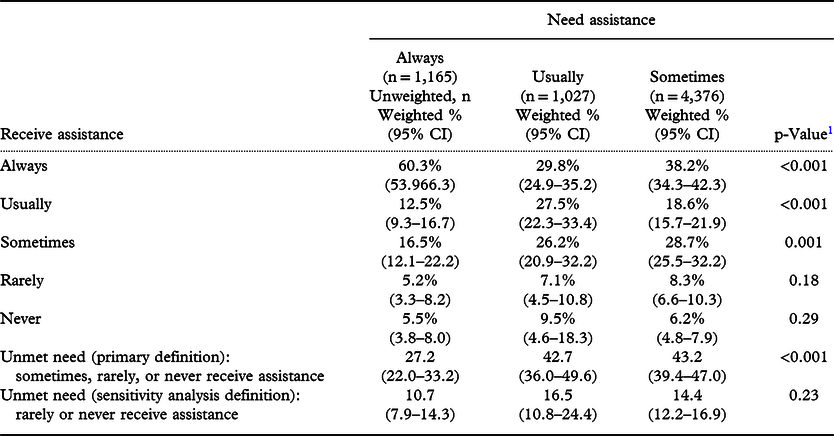
Unmet needs for care related to SCD were present among 40.2% (95% confidence interval [CI]: 37.3–43.1) of respondents with SCD who needed assistance. More than 6 in 10 middle-aged and older adults who needed SCD-related help said they needed this help “sometimes” (66.8%), about 1 in 10 said they “usually” needed this help (14.8%), and about 2 in 10 reported that they “always” needed this help (18.5%). Respondents who always needed assistance were more likely to always receive this help compared to people who needed assistance less often (Table 1). The frequency of rarely or never receiving assistance was similar regardless of how often one needed assistance. Respondents who said they always needed assistance were less likely to have an unmet need for care than those who usually or sometimes needed assistance.
Frequency of reporting need for assistance with day-to-day activities because of subjective cognitive decline (SCD) and receipt of this assistance among people aged 45 years and older with SCD (column percentages, weighted). Data from 50 states, District of Columbia, and Puerto Rico, Behavioral Risk Factor Surveillance System, 2015–2018

95% CI: 95% confidence interval for the proportion.
1 p-Value based on chi-square test of weighted percentages.
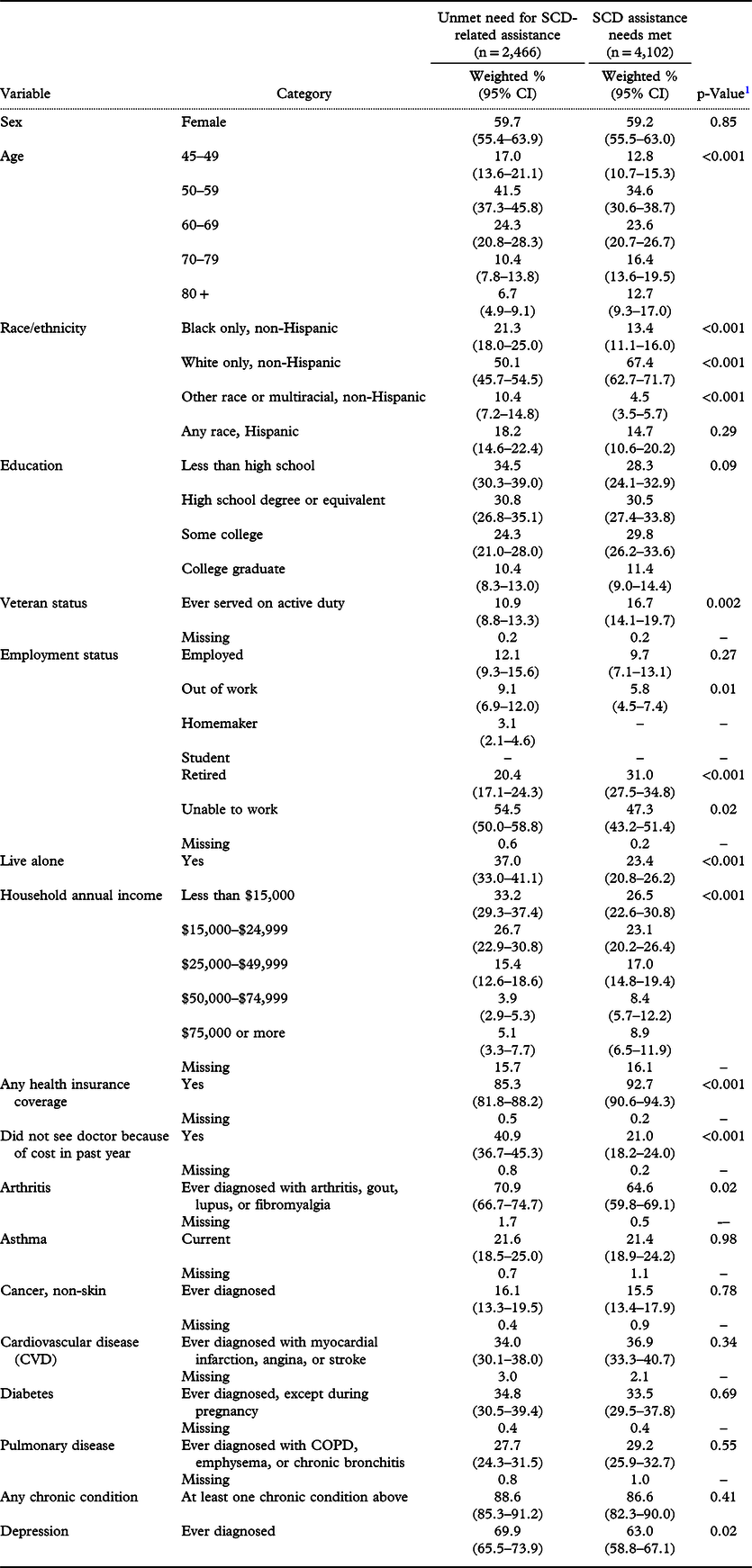
Compared to people whose SCD-related needs were met, those with unmet needs for assistance were more likely to be younger, be non-white, be out of work or unable to work, live alone, live in a lower income household, and report a cost-related barrier to medical care (Table 2). Respondents with an unmet need were less likely than those whose needs were met to be a veteran and to have any health insurance coverage. Chronic health conditions and depression were both common in this population: nearly 9 in 10 had at least 1 chronic condition and more than 6 in 10 had ever been diagnosed with depression. The prevalence of individual chronic conditions generally was similar, though arthritis and depression were both statistically more common among people with unmet needs than among those whose needs for SCD-related assistance were met. People with an unmet need had a significantly higher prevalence of a depression history than those whose needs were met.
Demographic, health, and health-related quality of life characteristics of people aged 45 years and older with and without unmet needs for assistance with day-to-day activities related to subjective cognitive decline (SCD) (column totals, weighted). Data from 50 states, District of Columbia, and Puerto Rico, Behavioral Risk Factor Surveillance System, 2015–2018

95% CI: 95% confidence interval for the proportion.
COPD, chronic obstructive pulmonary disease.
1 p-Value based on chi-square test comparing weighted percentage of people with met and unmet needs for SCD-related assistance.
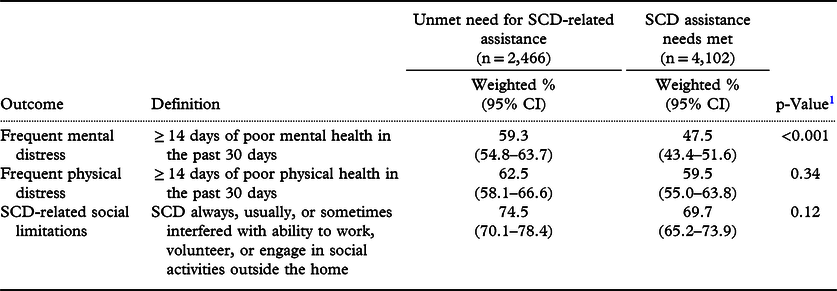
The prevalence of frequent mental distress, frequent physical distress, and SCD-related social limitations was high in both groups (Table 3). People with unmet needs were significantly more likely than people whose needs were met to experience frequent mental distress (59% versus 48%, p < 0.001). There were no significant differences in physical or social HRQOL: about 60% of both groups reported frequent physical distress, and about 70% of both groups reported social limitations. For all three HRQOL measures, the prevalence was higher among people with a history of depression than among people with no history of depression.
Prevalence of health-related quality of life outcomes among adults aged 45 years and older with and without unmet needs for assistance with day-to-day activities related to subjective cognitive decline (SCD) (column totals, weighted). Data from 50 states, District of Columbia, and Puerto Rico, Behavioral Risk Factor Surveillance System, 2015–2018

95% CI: 95% confidence interval for the weighted percentage.
1 p-Value based on chi-square test comparing weighted percentage of people with met and unmet needs for assistance related to SCD.
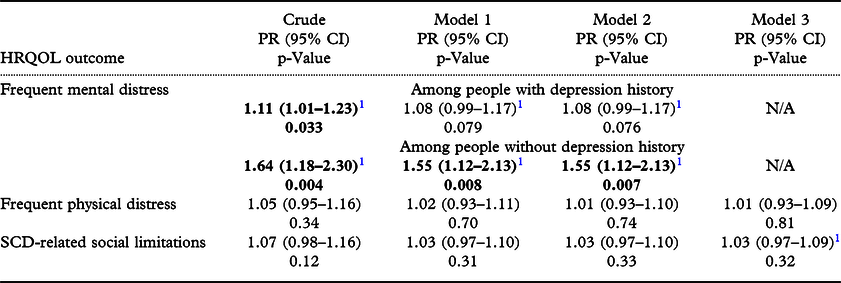
We found evidence of effect modification by depression for the frequent mental distress model only (for interaction between unmet needs and depression status, p = 0.029). Therefore, we present results for frequent mental distress stratified by depression status, while the other two HRQOL models include all respondents (Table 4). In the crude models, people with unmet needs for SCD-related assistance had a higher prevalence of frequent mental distress regardless of depression history. After accounting for sociodemographic characteristics, the PRs were attenuated for all three HRQOL outcomes. In the adjusted models, frequent mental distress was more common only among people who had never been diagnosed with depression and had an unmet need for SCD-related care (PR = 1.55, 95% CI: 1.12–2.13, p = 0.007). Among respondents with depression, unmet needs for SCD-related assistance were not associated with frequent mental distress (PR = 1.08, 95% CI: 0.99–1.17, p = 0.076). Because of the smaller sample sizes in these models (stratified by depression history), we could only include indicator variables for White, non-Hispanic, and Hispanic respondents rather than including the four-category race/ethnicity variable. We found no difference in the prevalence of frequent physical distress or social limitations between people with and without unmet needs for assistance in either the crude or adjusted models.
Association between having an unmet need for assistance with day-to-day activities because of subjective cognitive decline (SCD) and health-related quality of life (HRQOL) outcomes based on log-binomial regression models, Behavioral Risk Factor Surveillance System, 2015–2018

n= 6,568 unweighted respondents in each model.
Model 1 includes age category (45–49, 50–59, 60–69, 70–79, and 80+ years), sex, race/ethnicity category (White, non-Hispanic; Black, non-Hispanic; any race, Hispanic; other race or multiple races, non-Hispanic; see footnote 1 for exceptions), education category (less than high school, high school equivalent, some college, college graduate), and living alone.
1 Model included White, non-Hispanic and any race, Hispanic indicator variables only because of small cell sizes (models did not converge).
Model 2 includes Model 1 variables plus an indicator for having at least one of the following chronic health conditions: arthritis, asthma (current), cancer (except skin), cardiovascular disease, chronic lung disease including COPD, and diabetes.
Model 3 includes Model 2 variables plus depression history.
Statistically significant estimates (p<0.05) indicated in bold font.
PR, prevalence ratio.
95% CI: 95% confidence interval for the prevalence ratio.
Using the more restrictive definition (rarely or never receiving assistance), 14.2% of respondents were classified as having an unmet need for care and there was no difference in the prevalence of unmet needs by how often people needed assistance (Table 1). In the sensitivity analyses, the PRs for the relationship between unmet needs and each HRQOL generally were similar, although for frequent mental distress the PR was farther from the null and statistically significant for both people with and without depression (see Table S1).
Discussion
Among community-dwelling middle-aged and older adults who reported needing assistance with daily activities as a result of SCD, perceived unmet needs for assistance were relatively common: 4 in 10 people who needed help said they sometimes, rarely, or never received help. A number of sociodemographic characteristics were associated with having unmet needs. People with lower household income reported more unmet needs than those with higher income, which could result from an inability to pay for services like formal caregiving. People living alone had more unmet needs, which could reflect the lack of an in-home person to provide support or lower levels of social support in general (Roth et al., Reference Roth2007; Ko et al., Reference Ko2019). We also found that middle-aged adults more often had unmet needs for assistance than older adults, which could be a result of fewer supports being available for or tailored to middle-aged people, less knowledge about available supports, or of fewer informal caregivers being available to help (e.g. spouses are still working) (Lima et al., Reference Lima2008). The difference also might relate to lower levels of social support among middle-aged adults, especially given the high prevalence of depression and other chronic health conditions in the sample (Fischer and Beresford, Reference Fischer and Beresford2015; Werner-Seidler et al., Reference Werner-Seidler2017).
Experiencing an unmet need appears to be associated only with the mental domain of HRQOL and not physical or social domains. Specifically, unmet needs were associated with a roughly 60% higher prevalence of frequent mental distress among people without depression after accounting for demographic, socioeconomic, and health differences between people with and without unmet needs for assistance. The sensitivity analyses suggest there may be an association between unmet needs and frequent mental distress regardless of depression history, but even if so, the relationship is stronger for people without depression than for those with depression. Given the negative effects of having unmet needs for care identified in other studies (Beach et al., Reference Beach2020), it is plausible that experiencing delays or inability to complete ADLs or instrumental activities of daily living (IADLs, e.g. shopping, cooking) or to engage with others outside the home could result in poorer HRQOL. Furthermore, it is reasonable that in the presence of depression, unmet needs for care do not impact frequent mental distress – or do not impact it as strongly – because the depressive symptoms themselves have a strong relationship to frequent mental distress, independent of gaps in care, as illustrated in Table 3. Alternatively, it is possible that some unmeasured factors like personality or other aspects of mental health are associated with both reporting unmet needs and experiencing poor HRQOL. Although we expected that unmet needs would also be associated with the physical and social HRQOL domains, we did not find this to be true. These data suggest that the adverse consequences of unmet needs may not directly impact physical or social HRQOL in people with SCD who need assistance.
This study adds to the existing literature on unmet needs among people with cognitive decline by providing estimates from a community-dwelling sample of middle-aged and older adults living in all US states, the District of Columbia, and Puerto Rico. Furthermore, it suggests that at the population level, experiencing unmet needs for SCD may not negatively impact peoples’ social or physical HRQOL, only the mental domain of HRQOL. Given that SCD may be a prodromal stage of Alzheimer’s disease, the high prevalence of unmet needs and the negative impact of these unmet needs on mental HRQOL is concerning given that people with unmet needs related to SCD who go on to develop more severe disease may be entering the degenerative phases in a reduced state of mental HRQOL.
Strengths of this study include the large sample that is representative at the state level of community-dwelling middle-aged and older adults living the US. We were able to relate perceived unmet needs to both SCD-specific limitations and more general HRQOL. Although the frequency of having an unmet need for care was much lower using a more restrictive definition, the association between having an unmet need and HRQOL was similar for both definitions.
The study’s limitations include the cross-sectional nature of the data, which impedes our ability to determine the temporal sequence of unmet needs for care and the participation and HRQOL outcomes (i.e. whether poor HRQOL impacts the receipt of care rather than the other way around). Also, SCD is a self-report measure of cognitive decline and we did not have any objective measures of cognitive function to which we could compare it (Jessen et al., Reference Jessen2014). Some people who experience objective declines in their cognitive function lack awareness about this fact (anosognosia) and therefore would not have reported SCD on the BRFSS and hence been excluded from this study. Previous studies suggest that anosognosia is related to disease stage and severity (Vannini et al., Reference Vannini2017; Mondragón et al., Reference Mondragón, Maurits and De Deyn2019). Based on a model of awareness proposed by Vannini and colleagues (Vannini et al., Reference Vannini2017), we hypothesize that our study reflects the experience of people with less severe disease. Therefore, we hypothesize that the observed relationship between unmet needs and poor HRQOL would be stronger among those with anosognosia since they would likely have more advanced disease, more functional needs, and therefore more negative outcomes as a result of needs not being met. Additional limitations include the lack of information in the BRFSS about anxiety or other mental health diagnoses, personality traits, and respondents’ needs for and receipt of assistance among people without SCD. Based on the effect of including depression in the regression models, we expect additional information about respondents’ mental health would attenuate the observed associations between unmet needs and mental HRQOL. Personality characteristics might mediate or confound the relationship between perceived unmet needs and mental HRQOL; it is difficult to estimate the potential bias given the lack of published studies on the topic.
The Cognitive Decline module did undergo cognitive testing, and, when compared to objective cognitive performance measures, people with SCD tended to have lower average scores than people without SCD (Brody et al., Reference Brody2019). Using the National Health and Nutrition Examination Survey, Brody et al. reported that compared to objective cognitive performance measures, the SCD measure used in the study had low sensitivity (23%–27%) but high specificity (89%–91%) (Brody et al., Reference Brody2019). This is consistent with the definition of SCD, namely that is a reflection of both a person’s self-evaluation of their own cognition and of their mental state including mental health conditions, and highlights the fact that SCD is not solely a reflection of cognitive function or a specific disease state. Because the Cognitive Decline module is used for surveillance purposes, we did not have information about the types of assistance needed or the types of care received (e.g. formal versus informal sources), which would be helpful to fully understand what programs and services could address the care gap (Black et al., Reference Black2013). Additional research is needed to evaluate our findings longitudinally to identify information about needs that are not being met, to explore the impact of unmet needs among people with anxiety and anosognosia and people without SCD, and to develop and test interventions and policies to reduce unmet needs related to SCD that will improve participation and HRQOL.
The subset of middle-aged and older adults with SCD-related needs for assistance had substantially poorer HRQOL compared to their peers without SCD or even those with SCD who did not report needing assistance (data not shown). This disparity alone suggests the need for intervention at the population level to improve HRQOL (CDC, 2000). The results of this study suggest a need for expanded or more targeted community-based supports and services for middle-aged and older adults with SCD to meet their needs, reduce participation restrictions, and improve HRQOL. Potential interventions include engaging informal caregivers or care partners from their families or communities (Piette et al., Reference Piette2015; Gitlin et al., Reference Gitlin2019), expanding the availability of and access to community-based support programs for people with cognitive decline (Stevens et al., Reference Stevens2015; Hale-Gallardo et al., Reference Hale-Gallardo2017; Valluru et al., Reference Valluru2019), and promoting social engagement and participation for middle-aged and older adults with cognitive impairment (Turner and Morken, Reference Turner and Morken2016; Lin, Reference Lin2017). Additionally, expanding health insurance coverage or offering other supports to enable people to receive professional, long-term, in-home care for SCD could improve HRQOL. We found veterans with SCD were less likely to report an unmet need for assistance, which could be a result of the VA health care system’s Program of General Caregiver Support Services, which includes training, education, peer-support, and respite care for caregivers (Shepherd-Banigan et al., Reference Shepherd-Banigan2018a, Reference Shepherd-Banigan2018b). Although we did not have information about VA service use, these programs and services could be used as a template for other health care systems in the US to address unmet needs for assistance among people with SCD.
We expect the prevalence of unmet needs themselves and the perception of unmet needs likely varies depending on policies as well as the availability and uptake of programs at local and national levels, and also by cultural practices around caregiving and attitudes toward the use of formal supports for people experiencing cognitive decline. For example, in communities or cultures where intergenerational living is common, middle-aged and older adults with SCD may experience fewer needs for assistance since they are less likely to be living alone (Weng and Nguyen, Reference Weng and Nguyen2018; Souralová and Žáková, Reference Souralová and Žáková2019). Furthermore, the availability of tangible and also other types of support and companionship in multigenerational households may buffer against anxiety and depression (Souralová and Žáková, Reference Souralová and Žáková2019). Therefore, while we hypothesize that unmet needs related to SCD might negatively impact mental HRQOL in settings outside the US, additional research is needed to determine whether this is the case and whether cultural norms and practices might influence the relationship in different settings.
Conflict of interest
None.
Disclaimer
The findings and conclusions in this paper are those of the authors and do not necessarily represent the official position of the Centers for Disease Control and Prevention.
Authors’ roles
EDB formulated the research question, designed the study, analyzed the data, and wrote the paper. CAT, KGW, and LCM refined the research question, supported analyses and interpretation, and revised the paper. KAK, CEM, and NRM provided meaningful input on the research question and analysis and revised the manuscript.
Supplementary material
To view supplementary material for this article, please visit https://doi.org/10.1017/S1041610220001635