Animal research convincingly demonstrated that exposure to unpredictable stressors enhances context conditioning, i.e., conditioned fear responding to the context (e.g., Fanselow, Reference Fanselow1980). More specifically, the context in which unpredictable shocks (unconditioned stimulus, US) are administered acquires associative strength and therefore evokes more conditioned fear than the context in which predictable shocks are presented. As a result, an organism will prefer the context which elicits the least fear responses, in this case, the predictable context. Learning theory indeed conceptualizes the context as an extended conditioned stimulus (CS) that can become associated with the US (Rescorla & Wagner, Reference Rescorla, Wagner, Black and Prokasy1972). This implies that contextual cues will engage in cue competition (for reviews see De Houwer & Beckers, Reference De Houwer and Beckers2002; Shanks, Reference Shanks2010) with discrete CSs to gain associative strength during a classical conditioning procedure. As a result, during a fear conditioning procedure, the presence of a discrete CS predicting the US interferes with context conditioning, whereas the absence of discrete cues signaling the US promotes context conditioning.
The last decade context conditioning in humans also has gained interest. Important pioneer work has been done by Grillon who developed an elegant paradigm to examine context and cued conditioning concomitantly using baseline EMG eyeblink startle modulation as an index of contextual fear elicited by the experimental context and startle potentiated by specific cues as an index of cued fear (for an overview see Grillon, Reference Grillon2002). In a typical experiment, a Paired condition and an Unpaired condition are included. In the Paired condition, US-predictability is manipulated by repeatedly presenting the CS (visual stimulus) together with the US (aversive shock). In contrast, in the Unpaired condition, US-unpredictability is experimentally induced by repeatedly administering explicitly unpaired CS–US presentations (i.e., CS-offset never followed US-onset). Results basically corroborate animal conditioning findings and indicate that in a follow-up session, more context conditioning -as indexed by baseline eyeblink startle modulation- emerges in the unpredictable situation than in the predictable situation (Ameli, Ip, & Grillon, Reference Ameli, Ip and Grillon2001).
Recently, however, empirical findings showed that explicitly unpaired presentations of a CS and an aversive shock led to contextual fear conditioning while unpaired presentations of a similar CS with a less aversive airblast to the larynx did not lead to conditioned fear responding to the context alone (Grillon, Baas, Lissek, Smith, & Milstein, Reference Grillon, Baas, Lissek, Smith and Milstein2004). Grillon et al. (Reference Grillon, Baas, Lissek, Smith and Milstein2004) argued that unpredictability adds to emotional disturbance (i.e., chronic anticipatory contextual fear) only if it is associated with stimuli that are sufficiently unpleasant and noxious (biologically significant). A theoretical possibility is that exposure to unpredictable biologically non-significant USs does not produce context conditioning at all. According to associative learning theories, however, contextual cues are viewed as functionally equivalent to discrete cues and thus there is no reason to assume that no context conditioning would take place when a biologically non-significant US is used instead of a biological significant US. Associative models (e.g., Rescorla-Wagner model) do propose that the intensity and salience of the US will determine the asymptotic associative strength of the context. So basically, they do predict stronger context conditioning effects with biologically significant USs than with more neutral, biologically non-significant USs, but they certainly do not exclude the possibility to obtain context conditioning with biologically non-significant USs. Although, the majority of the research devoted to context conditioning and preference for predictability used aversive, biologically significant USs, also in the appetitive conditioning domain some evidence exists on the preference for signaled reinforcement over unsignaled reinforcement (e.g., food: Prokasy, Reference Prokasy1956; electrical brain stimulation : Cantor & LoLordo, Reference Cantor and LoLordo1972) suggesting that the disfavor of unpredictability is not limited to aversive USs, but at least also holds for biologically significant positive USs. Therefore, it is worthwile investigating whether a biologically significant US is indispensable to establish context conditioning through US-unpredictability. This study used the Martians task (Arcediano, Ortega, & Matute, Reference Arcediano, Ortega and Matute1996), a simple computer game in which Pavlovian associations are assessed through conditioned suppression of an on-going operant behavior.
The basic experimental design entails a 2 x 2 between-subjects factorial design manipulating the level of US-predictability and the nature of the US. In the Paired condition, the CS is always followed immediately by the US, whereas in the Unpaired condition, the CS is never followed by the US. Another crucial between-subjects manipulation is the nature of the US, i.e., half of the participants in the Paired and Unpaired conditions received an aversive, biologically significant US whereas the other half received a more neutral, biologically non-significant US. Specifically, the nature of the US was manipulated by using either an aversive human scream or a neutral sound. By virtue of its successful use as a US in human fear conditioning procedures, the human scream is suitable to serve the purpose of an aversive and biologically threatening US (Guerra et al., Reference Guerra, Bradley, Perakakis, Pinheiro, Vila and Lang2006; Hamm, Vaitl, & Lang, Reference Hamm, Vaitl and Lang1989).
To summarize, following previous empirical research it is possible that unpredictability of a biologically non-significant US does not lead to context conditioning. This would further imply that US-unpredictability is necessary but not sufficient to establish context conditioning effects, even in an expectancy-based learning task. It seems feasible that discrepancies might exist between cued conditioning and contextual conditioning in expectancy-driven conditioning tasks such as the Martians task. Context conditioning defined as chronic anticipation of an impending US requires lots of cognitive resources and has a high cost compared with cued conditioning. That is, if one would engage in contextual suppression in the Martians task persistently (i.e. for a longer time not pressing the space bar, without knowing when the US will exactly occur) lots of Martians would be able to land, leading to a great loss of points and thus a worse performance/game outcome. Hence, contextual suppression viewed as preparatory behavior can easily be justified if one is expecting a high-impact, biologically significant US, but not when a less aversive, biologically non-significant US is anticipated. On the other hand, following associative learning models US-unpredictability is expected to lead to more context conditioning in the Unpaired condition than in the Paired condition with both types of USs. So, these models allow for context conditioning with biologically non-significant USs, although they do predict that more intense and more salient USs (i.e., biologically significant) would generate stronger context conditioning effects than less intense USs (i.e., biologically non-significant). This means that US-unpredictability is sufficient to establish context conditioning. As an additional hypothesis, we expect more cued suppression in the Paired condition than in the Unpaired condition, with both types of the US. Again, conditioning effects are expected to be stronger with a more intense US.
Method
Participants
In total 52 undergraduate students (35 males, age 17–27) of the University of Leuven participated in return for course credit. Each participant was assigned randomly to one of the four conditions: PairedScream, UnpairedScream, (both n = 10), PairedAnti-laser shield, UnpairedAnti-laser shield, (both n = 16). None of the participants had any previous experience with the Martians preparation, and they were all uninformed as to the purpose of the study.
Apparatus, and Stimuli
The experiment was run on a Pentium III 730 MHz, 128 Mb RAM multimedia PC (Dell Optiplex GX110), with the participants responding on the spacebar of the computer keyboard. The Martians preparation was implemented within a flexible Windows 95 environment by Baeyens and Clarysse (Reference Baeyens and Clarysse1998) using Microsoft Visual C++ 5.0.
A single CS served as the CS- in the Unpaired condition and as the CS+ in the Paired condition. The CS was a 1.5-s presentation of a complex sound pattern (WindowsTM 95 “Sixties menu command.wav”), played back in continuous looping by means of a TyphoonTM Bass Vibration Headset. On CS assessment trials, the CS was presented for 3 s instead of 1.5 s (see Procedure ).
Following Meulders, Vervliet, Vansteenwegen, Hermans and Baeyens (Reference Meulders, Vervliet, Vansteenwegen, Hermans and Baeyens2011), context was manipulated by changing the background color of the computer screen. During the context conditioning phase and intermediate CS and context assessment trials the background was colored pink whereas during all other phases it remained black.
Type of US
The crucial manipulation in both conditions is that we varied the type of US, that is, the biological significance and aversiveness of the US. Half of the participants received the US that consisted of the simultaneous presentation of a 2-s white flashing screen (20 flashes at a rate of 10 flashes/s; flash-time = 50 ms, inter-flash-time = 50 ms) and a 2-s aversive human scream (scream10.wav Footnote 1 and modified using Audacity 1.2.6) presented in stereo at 100 dB. The other half of the participants received the US that consisted of the simultaneous presentation of a 0.5 -s white flashing screen (5 flashes at a rate of 10 flashes/s; flash-time = 50 ms, inter-flash-time = 50 ms) accompanied by a metallic sound (WindowsTM 95 “In the computer program error.wav”, played back in continuous looping) presented in stereo at 85 dB.
In a short pilot study, we examined the differences in aversiveness, intensity and startling capacity of both USs (N = 20). Aversiveness was measured using a visual analogue scale ranging from 0 (not unpleasant) to 10 (very unpleasant). Intensity was measured using the following labels: Weak, moderate, intense, enormous and unbearable, and startling capacity using the following: Weak, moderate, strong and very strong, both scored from 1 to 5, respectively. The presentation order of the two stimuli were counterbalanced. Results showed that participants rated the anti-laser shield with the human scream as significantly more aversive, M = 7.90, SD = 1.80 and M = 3.65, SD = 2.65, t(19) = 8.21, p < .001; more intense, M = 3.45, SD = 0.83 and M = 2.09, SD = 0.69, t(19) = 8.30, p < .001; and more startling, M = 3.80, SD = 1.20 and M = 2.45, SD = 0.89, t(19) = 4.61, p < .001, than the standard anti-laser shield.
Procedure
Pretraining
The aim of the pretraining phase was to establish a stable pattern of operant behavior, i.e. to consistently press the spacebar. During this phase, neither CSs nor USs were presented. The screen showed ‘‘Martians that were trying to invade Earth’’, and the task of the participant was to prevent them from landing by ‘‘shooting a laser gun at each of the Martians that would try to land’’, that is, pressing the spacebar. The instructions explained that in case of a hit, an explosion instead of a Martian would be presented. We further emphasized the importance of paced bar-pressing because a Martian would appear about every 0.25 s, and participants just had a single shot to kill each Martian.
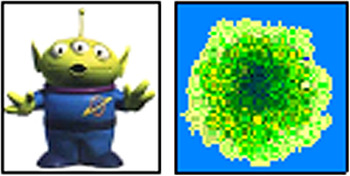
Explosions and Martians both measured 2.20 cm x 2.20 cm and were colored (see Figure 1). Martians appeared one by one in rows on the screen, from left to right and from top to bottom, at intervals of 0.25 s against a black background with a space of 0.8 cm in between each Martian or explosion. If the participant pressed the spacebar just before a new Martian was displayed, the explosion appeared at that position. The main goal was to have as few Martians and as many explosions as possible on the screen. Per Martian only one bar-press was allowed. If more than one bar-press was recorded (if the participant’s bar-pressing rate exceeded 4/s, or when she/he held the space bar down), a Martian was displayed. The screen was filled when 70 Martians or explosions (10 in each of 7 rows; inter-row distance was 2 cm) had been displayed. When the screen was filled, it scrolled up, one line at a time to make room for new Martians, in order to support a smooth progression between screens. The pretraining phase lasted for 50 s. Afterwards, participants received feedback about the total % hit rate and the number of killed and missed Martians.
Image of a Martian (left) and of an explosion (right).

Baseline measurement
This phase was identical to the pretraining phase except that it lasted for 25 s. At the end of this phase, a 3s period was recorded to serve as a baseline measurement, during which participants did not notice any changes Footnote 2 .
Instructional US phase
During this phase, the instructional US was introduced. Instructions described what would happen if participants persisted in bar-pressing during the US, namely when the Martians activated the ‘‘anti-laser shield’’: Their laser gun would temporarily become inactive, and ‘‘an inevitable invasion of thousands of Martians would be evoked’’. During this phase, four USs with an average intertrial interval (ITI) of 10 s (min = 5 s, max = 15 s) were presented. The US consisted either of the 2s simultaneous presentation of the intermittent white flashing screen plus the biologically potent human scream or the 0.5s simultaneous presentation of the white flashing screen together with the metallic sound pattern.
If no bar-press was registered during the US, the Martians kept appearing on the computer screen in the same way as during the ITIs (4/s), but if a response was recorded, the US was followed by an ‘‘invasion’’. An invasion lasted for 20 s, during which the background kept flashing (10 flashes/s), a new sound pattern was played (WindowsTM 95 ‘‘Robotz∼2.wav,’’ played back in continuous looping), and Martians invaded the screen with a time-interval of 0.04 s; moreover, the experimenter illustrated that bar-pressing was ineffective during an invasion (no explosions appeared contingent upon bar-pressing).
Context conditioning phase
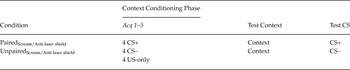
During this phase, the critical “(un)predictability training” which was hypothesized to result in differential involvement of context conditioning in the respective experimental groups, was superimposed on the operant baseline task. Participants were told that “the activation of the anti-laser shield” might be announced by “indicators” and that they could timely suppress their bar-pressing behavior in order to avoid invasions, if they discovered the relationship between the different indicators and the US. In each experiment the onset-predictability of the US was manipulated between-subjects and the Type of US was varied between-experiments (see Table 1).
Design summary

Note:
CSs are a 1.5 s-presentation of a complex sound pattern (WindowsTM 95 “Sixties menu command.wav”), played back in continuous looping. A “+” sign represents a reinforced trial and “-” sign denotes an unreinforced trial. “Acq1” and “Acq5” respectively refers to the first and the last block of the context conditioning phase. Test of (context and cued) conditioning will be carried out on the last acquisition block (Acq5). At assessment trials, the context and the CSs are presented for 3 s rather than for 1.5 s. Half of the participants received an aversive, biologically significant human scream as the US, and the other half of the participants received the standard, biologically non-significant anti-laser shield as the US.
In the Paired condition, the US was consistently preceded by the CS+; therefore, participants could avoid invasions when they suppressed their bar-pressing behavior during the CS+ sound. Five equivalent 4-trial blocks, each containing four CS+ trials were presented. On CS+ trials, the US immediately followed the offset of the CS. After each block, a context assessment trial was run, followed by a reinforced CS+ assessment trial. During the context assessment trials, bar-pressing during a period of 3 s was recorded without any noticeable changes for the participants. In order to increase the sensitivity of the suppression measure on CS+ assessment trials, the CS was presented for 3 s instead of 1.5 s Footnote 3 . The duration of the ITI was set pseudo-randomly (range = 5–15 s, M = 10 s).
In the Unpaired condition, however, the CS- was always presented explicitly unpaired with the US. Hence, participants could not predict the occurrence of the US nor avoid invasions by interrupting bar-pressing during the CS- sound. Two types of trials (US-only and CS- trials) were included. Because we decided to keep the number of US presentations constant in all experimental conditions, the total number of trials in the Unpaired condition was doubled. Five similar 8-trial blocks, each containing four CS- trials and four US-only trials, were run. Within each block, the presentation order of trials was semi-randomized, with the restriction that no more than two consecutive trials could be of the same type. In each block, a different randomization was used, and each participant was subjected to different trial randomizations. On CS- trials, the CS was presented alone without any US presented contingent upon its presentation. On US-only trials, the temporally unpredictable US was presented alone in the absence of any CSs. Again, after each block, a context assessment trial was run, followed by a CS- assessment trial, both lasting for 3 s. During the CS- assessment trial, the number of bar-presses during a 3-s CS presentation was recorded, obviously not followed by the US. The ITI was set pseudo-randomly (range = 5 s –15 s, M = 10 s).
Results
Planned comparisons were conducted on the mean number of bar-presses, respectively during the context and the CS, to evaluate the a priori formulated hypotheses. Following Kirk (Reference Kirk1995), mean square error terms and degrees of freedom appropriate for the specific contrasts were used.
Test of context conditioning
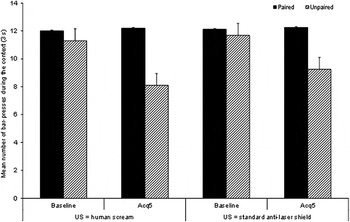
The mean number of bar-presses in response to the context during the baseline measurement and at the last block of the context conditioning phase (Acq5) for all experimental conditions are displayed in Figure 2. A 2 x 2 x 2 [Type of US (human scream/anti-laser shield) x Condition (Paired/Unpaired) x Block (Baseline/Acq5)] repeated measures ANOVA revealed significant main effects for Condition, F(1, 48) = 20.59, MSE = 5.07, p < .0001, ηp 2 = .30, and Block, F(1, 48) = 8.32, MSE = 5.22, p < .01, ηp 2 = .15. Bar-pressing behavior in response to the context became more suppressed in the Unpaired condition than in the Paired condition, as indicated by a significant Condition x Block interaction, F(1, 48) = 10.48, MSE = 5.22, p < .005, ηp 2 = .18. The main effect of Type of US, however, did not reach significance, nor did any of the interactions comprising this variable, all Fs < 1.
At the left panel: Mean number of bar-presses (and SE’s) during the context (3 s) during the baseline measurement and at the end of the context conditioning phase (Acq5) for both between-group conditions (PairedScream/UnpairedScream) receiving the aversive, biologically significant human scream as US. At the right panel: Mean number of bar-presses (and SE’s) during the context (3 s) during the baseline measurement and at the end of the context conditioning phase (Acq5) for both between-group conditions (PairedAnti-laser shield/UnpairedAnti-laser shield) receiving the biologically non-significant sound as US.

Planned comparisons confirmed that during the baseline measurement, no differences were observed in bar-pressing behavior between the Paired and the Unpaired conditions, F(1, 48) = 1.69, MSE = 2.36, p = .20. At Acq5, on the other hand, more contextual suppression of bar-pressing was found in the Unpaired conditions than in the Paired conditions, with both types of US, F(1, 48) = 19.57, MSE = 7.93, p < .0001. Within-group contrasts further showed that in the Unpaired condition, bar-pressing during the context was more suppressed at Acq5 than during the baseline measurement, F(1, 48) = 18.74, MSE = 5.22, p < .0001, which was not the case in the Paired condition, F < 1. These results suggest that onset-unpredictability of an aversive, biologically significant US as well as a more neutral, non-biologically significant US induces more context conditioning in the Unpaired condition than in the Paired condition. The present experiment, however, does not provide evidence to support the hypothesis that more intense USs produce more context conditioning, as indicated by the lack of Type of US effect.
Test of cued conditioning
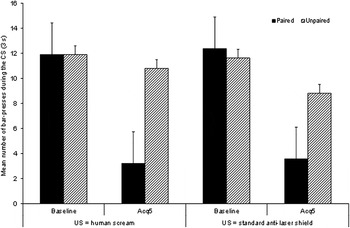
The mean number of bar-presses in response to the CS during the baseline measurement and at the end of the context conditioning phase (Acq5) are presented in Figure 3. A 2 x 2 x 2 [Type of US (human scream/anti-laser shield) x Condition (Paired/Unpaired) x Block (Baseline/Acq5)] repeated measures ANOVA showed significant main effects for Condition, F(1, 48) = 50.54, MSE = 4.46, p < .0001, ηp 2 = .51, and Block, F(1, 48) = 200.65, MSE = 3.52, p < .0001, ηp 2 = .81, but not for Type of US, F < 1. Further, a significant Condition x Block interaction emerged, F(1, 48) = 80.85, MSE = 3.52, p < .0001, ηp 2 = .63. None of the interactions with Type of US reached significance, Type of US x Condition, F(1, 48) = 3.32, MSE = 4.46, p = .07, the Type of US x Block, F(1, 48) = 1.46, MSE = 3.52, p = .23, and the 3-way interaction, F(1, 48) = 1.12, MSE = 3.32, p = .30.
At the left panel: Mean number of bar-presses (and SE’s) during the CS (3 s) during the baseline measurement and at the end of the context conditioning phase (Acq5) for both conditions (PairedScream/UnpairedScream) with the aversive, biologically significant human scream as US. At the right panel: Mean number of bar-presses (and SE’s) during the CS (3 s) during the baseline measurement and at the end of the context conditioning phase (Acq5) for the both conditions (PairedAnti-laser shield/UnpairedAnti-laser shield) with the biologically non-significant sound as US.

At baseline sampling, no different bar-pressing pattern occurred for the Paired and the Unpaired conditions, F < 1. Yet, bar-pressing patterns during the CS in both conditions did differ at Acq5, F(1, 48) = 84.80, MSE = 5.99, p < .0001. For the CS+, bar-pressing behavior became severely suppressed from baseline to Acq5, F(1, 48) = 268.12, MSE = 3.52, p < .0001, suggesting that participants in the Paired condition learned that the CS+ signals the occurrence of the US. Bar-pressing behavior in response to the CS- was also slightly more suppressed at Acq5 than during the baseline measurement, F(1, 48) = 13.38, MSE = 3.52, p < .001. The cued suppression at Acq5 in the Unpaired condition, however, remained significantly less substantial than in the Paired condition, F(1, 48) = 19.56, MSE = 7.93, p < .0001. These results indicate that onset-predictability of an aversive, biologically significant US as well as a more neutral, non-biologically significant US induces more cued conditioning in the Paired condition than in the Unpaired condition. The present experiment, however, does not provide evidence to support the hypothesis that more intense USs produce more cued conditioning, as indicated by the lack of Type of US effect.
Discussion
The present paper investigates the minimal conditions for establishing context conditioning as induced by US-unpredictability in a conditioned suppression preparation i.e. the Martians task . This task is an often used and thoroughly explored method for examining boundary conditions of learning phenomena (conditioning in absence of cue competition, Matute & Pineño, Reference Matute and Pineño1998; conditioning in absence of distractors, Costa & Boakes, Reference Costa and Boakes2011). We designed an experiment in which we manipulated US-unpredictability and the nature of the US. Two between-subjects (Paired vs. Unpaired) conditions that were hypothesized to result in differential involvement of context conditioning were included. Half of the participants in the Paired and the Unpaired conditions received an aversive, biologically potent human scream as US, whereas the other half of the participants received a more neutral, non-biologically significant sound as US.
We investigated whether context conditioning only takes place if unpredictability is induced by a biologically potent US. This would be evident when unpredictability of an aversive, biologically significant US induces more context conditioning in the Unpaired condition than in the Paired condition, but that unpredictability of a more neutral, biologically non-significant US does not. Associative learning models (Rescorla & Wagner, Reference Rescorla, Wagner, Black and Prokasy1972), however, predict that context conditioning would be more manifest in the Unpaired condition than in the Paired condition, for both types of US. So, these models allow for context conditioning with biologically non-significant USs, although they do predict that more intense and more salient USs (i.e., biologically significant) would generate stronger context conditioning effects than less intense USs (i.e., biologically non-significant). The current results partly corroborate the prediction advanced by associative learning models, that is, more contextual suppression of bar-pressing behavior was observed in the unpredictable (Unpaired) condition than in the predictable (Paired) condition with both USs. Remarkably, however, the more intense, biologically significant US (i.e., human scream) did not elicit stronger conditioned responding to the context, nor to the CS as compared with the biologically non-significant US (i.e., standard anti-laser shield). We do acknowledge that the lack of Type of US effect, both for the context and cued conditioning, essentially is a null finding, however, that does not undermine the observation that context conditioning can indeed be established with a biologically non-significant US. Notwithstanding the rather neutral character of the anti-laser shield, context conditioning effects were clearly apparent. These results suggest that a biologically potent US is not necessary for establishing conditioned responding to the context induced by US-unpredictability. The present findings thus diverge from recent empirical findings showing that context conditioning (measured as the baseline startle reflex) was only acquired with aversive shocks but not when mildly aversive airblasts were used. One might speculate on the discrepancy between the present results and those Grillon et al. (Reference Grillon, Baas, Lissek, Smith and Milstein2004). When taking a closer look at the data of Grillon and colleagues (2004), we noticed that not only context conditioning but also cued conditioning effects were less substantial with the airblast, suggesting that this stimulus might not be a suitable US. Alternatively, one could argue that the crucial difference between our data and those reported by Grillon entails the type of conditioned responding that is being measured, with autonomic fear responding serving as dependent variable in the Grillon et al. study (2004) and, arguably expectancy-based conditioned suppression serving as dependent variable in our experiments. It is feasible that participants in the Grillon study did learn about the context at an associative learning level but that this acquired knowlegde did not exert behavioral control in the airblast group. In the Grillon study, eyeblink startle measures are used to index responsiveness of the fear system and it might be that the airblast is simply not aversive enough to activate this system and therefore does not generate differences on the startle measures.
With respect to cued conditioning, we predicted that more cued conditioning would be present in the Paired condition than in the Unpaired condition. As expected, more cued suppression of bar-pressing behavior was present in the Paired condition than in the Unpaired condition in both experiments. Remarkably, the CS- also elicited slightly more conditioned suppression in the Unpaired condition compared to baseline responding, but this suppression was far less extensive than the cued suppression observed in the Paired condition. This cued suppression in the Unpaired condition might be due to residual associative strength accrued to the context (which is also present during the CS- presentation). Altogether, the observed pattern of results suggests that in the Paired condition participants learned to identify the CS as a reliable predictor for the US, whereas in the Unpaired condition the CS -at least to a certain extent- became to signal “safety” (Seligman & Binik, Reference Seligman, Binik, Davis and Hurwiwtz1977).
Finally, a possible limitation of this study that should be considered as well is the conceptualization and operationalization of context in this experiment. Properly defining “context” is a controversial business which is constantly under debate. A definition of context might be based on its perceptual features (e.g., complexity, foreground/background), spatial features (e.g., three-dimensionality), temporal features (e.g., longer duration,), and/or finally by its functional characteristics (e.g., modulatory properties, see Bouton, Reference Bouton2002). In this respect, the contexts in this experiment (i.e., the background color of the computer screen) incorporate some of these features, such as background-foreground differentiation and the longer lasting duration of the presentation of the context compared with the presentation of the cues. Nevertheless, these contexts do not involve modulatory functions and are not three-dimensional. This might impact the ecological validity of the manipulation of context in the present study. Yet, changing the background color of the computer screen has been used before to successfully manipulate contexts in the Martians task (e.g., renewal studies, Havermans, Keuker, Lataster, & Jansen, Reference Havermans, Keuker, Lataster and Jansen2005; context conditioning, Meulders et al., Reference Meulders, Vervliet, Vansteenwegen, Hermans and Baeyens2011). In addition, the background color of the computer screen is a highly salient contextual feature as it is embedded in the Martians task.
To summarize, the present results showed that unpredictability of a biologically non-significant US induced context conditioning in a human conditioned suppression task. These results suggest that a biologically significant US is not necessary to obtain such effects. Future research should strive to elucidate the sufficient conditions to establish context conditioning as induced by US-unpredictability (e.g., other forms of US-unpredictability than temporal unpredictability, i.e., varying the intensity, location or duration of the US).