I. The Roman Inquisition in the 1700s
The majority of the various studies dedicated to the Roman Inquisition, which was established in 1542 by order of Pope Paul III, focus on the first decades of the tribunal. In that phase of its existence, the Inquisition constructed its identity and its range of power, acting within the Roman Curia to obtain primacy over other congregations and to influence papal elections. Furthermore, the trials for heresy of the mid-sixteenth century are an essential resource for reconstructing the development of the religious dissent that was wide-spread in Italy and the control strategies used by the Catholic Church in the era of the Council of Trent.Footnote 1 Regarding the century that followed the emergence of the Inquisition, scholars have largely switched their focus to the intolerance towards witchcraft, to the collision between official religiosity and forms of popular religiosity, and even to the spreading of new spiritual trends, such as Quietism. Lastly, when considering the eighteenth century, which signified abolition for many offices of the Inquisition, research seems to be directed towards other matters, such as the relationship with minority peoples, in particular Jews, controlling the printing press and intolerance towards new political and philosophical movements, such as Freemasonry and the Enlightenment.Footnote 2
This brief overview gives a general idea of the wide range of studies dedicated to the Inquisition. However, very few systematic studies have been carried out on the activities of inquisitorial offices in the eighteenth century—a century usually believed to be the period in which the tribunal's power began to falter.Footnote 3 This shortage is at least partly due to the idea of decline and a “settling” of the Inquisition in the 1700s, which saw a drastic reduction in the number of trials and growing clemency on the part of judges.Footnote 4 However, while undertaking quantitative analysis, certain scholars have noted the existence of offices that buck this trend, in which inquisitorial activities increased rather than declined. This is the case in particular for the offices of Siena and Modena.
This article aims to investigate this “anomaly” by looking into one of these two tribunals, Modena, capital of the Duchy, ruled by the House of Este, from 1598. The activities of the Modena Inquisition will be examined in relation to the wider Italian context, unearthing its specific characteristics, the possible rationale behind its activities and, lastly, investigating what the Modena case can tell us about the strategies used by the Roman Church in the 1700s. To this end, this essay will use two sources that provide complementary viewpoints: the inquisitorial trials held at the Modena tribunal and the correspondence between the Holy Office in Rome and the local inquisitors.
II. An Inside Look: The Modena Tribunal
As stated above, certain studies on the Roman Inquisition found that the Modena Inquisition bucked the trend with respect to the decline of the 18th century inquisitorial offices.Footnote 5 Andrea Del Col's research, for example, has discovered that, in the 1600 and 1700s, the Modena Inquisition tried 5034 individuals compared to the 1973 tried in Venice, a much larger and more important office. For the first six decades of the eighteenth century, there were never fewer than 150 trials over a five-year period, with a peak of 316 accused individuals around the middle of the century (1746–1751).Footnote 6
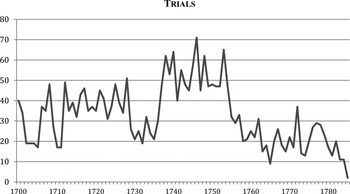
Carla Righi's analysis is even more precise: by examining the trials held by the Modena Inquisition between 1700 and 1785, the date of the abolition of the tribunal on the part of Duke Ercole III d'Este,Footnote 7 Righi has recorded an average of 32 trials per year.Footnote 8 In comparison to this benchmark, two periods in which the tribunal was particularly active can be identified (1712–1728 and 1737–1754), with a definitive drop in the number of trials in the second half of the century (from 1758 to 1785, the trials averaged 19 per year). By transferring this data to a graph, the trend of trial activity is clear.
Trials of the Modena Inquisition (1700–1785)

One can therefore conclude that, for at least the first half of the eighteenth century, the Modena Inquisition seems to have avoided the settling process found in other outlying offices, thus demonstrating a certain vitality. As a result, it is only natural to question which crimes occupied the judges. This leads to an examination of how the trials break down according to crime type.
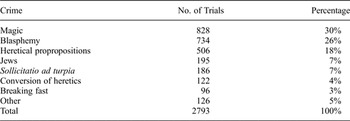
Crime Type, 1700–1785

As far as one can tell from analysing individual trial proceedings, the activities of the Modena Inquisition principally involved widespread and in-depth control, often regarding cases of little importance. A third of the accusations concern magical practices, now “declassified” to simple forms of superstition compared to the cases of witchcraft from the previous century. Almost half of the accusations focus on blasphemy and heretical propositions, which, with few exceptions,Footnote 9 involved men of low social standing, soldiers, prisoners and peasants living on the outskirts of the city. Certain examples of trials for blasphemy or heresy can help us grasp the situation. As an example, what follows is examination of the trials held at the tribunal in 1727 (the year, as will be demonstrated, in which the last individual was sentenced to death by the Modena Inquisition).
Two people were charged with heretical propositions. On the one hand, there is Lucia Massimi, a 37-year old woman married to a man from the city, who was tried for having doubted the work of Providence after having faced many hardships.Footnote 10 On the other hand is Giovanni Maria Reali, who had questioned the fiscal privileges of the clergy, stating that if the pope had known how they were used, they would have certainly been revoked.Footnote 11 Regarding the other cases, six blasphemers were tried, accused of having offended God and the saints, whether in their own shop (a watchmaker) or in a tavern (a constable).Footnote 12 In addition to trial proceedings, the inquisitors went around collecting various condemnations, such as the one against Michele Gherardini, who lived in a mountain village near Modena (Massa Toano). Gherardini was accused of allegedly disregarding the blessings of the church as he had given one of his own in his kitchen with a mortar, stating it was equally as valid as the blessing given by the priest with whom he had had significant disagreements.Footnote 13
As one can see from the data, although there are some cases of true doctrinal importance, they were rare. For the most part, the trials concern socioculturally marginalised individuals and cases of minor irreligiosity. The Modena Inquisition is thus characterised by widespread and pervasive action enforced above all outside the city, in particular in the mountains and countryside.
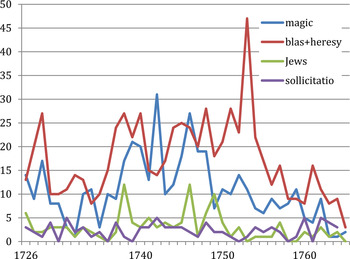
Furthermore, it is useful to understand how intolerance towards various crimes developed over time. By examining the activities of the tribunal in the four decades of the mid-eighteenth century (1726–1765), one can observe trends that vary quantitatively for certain charges. The following graph plots the trend of the four crimes to be discussed below: magic, blasphemy and heretical propositions, sollicitatio ad turpia (solicitation of sexual or immoral practices in the confessional), and trials against Jews.
To complete this analysis, one can also add the scarce data regarding another crime that had a certain significance in the inquisitorial practices of the eighteenth century: polygamy. In the period 1726–1765, there were 19 trials for polygamy out of 734 inquisitorial files (2.6%) with a downward trend from the mid-century to total disappearance in the last decades of the Modena Inquisition.Footnote 14
The various data given in the previous pages thus clearly highlight the priorities of the Modena tribunal and the volume of trials it found itself conducting. The crimes of blasphemy and heretical propositions easily constitute the largest part of their activities, closely followed by trials for magical practices of various kinds. There are fewer trials against Jews, often used as a source of funding thanks to the fines that could be imposed on the accused.Footnote 15 However, few trials are found against the clergy for soliciting penitents in the confessional and even fewer for polygamy.
In view of this backdrop, this article will try to answer the following questions: how did Rome react to the activities of the Modena tribunal? And which trials received most attention from the Holy Office?
III. An Outside Look: Modena in the Eyes of the Holy Office
The correspondence between the Holy Office and the Modena Inquisition is a fundamental resource for answering the above questions. According to inquisitorial practice, the outlying tribunals were obliged to update Rome periodically and comply with the indications provided by the Roman Congregation on each occasion. Studying the correspondence between Rome and an outlying office thus allows us to understand where the Holy Office's interest lay with respect to the mass of proceedings that they were notified of by the local tribunals.
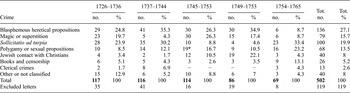
Table 2 lists the data in order to clearly demonstrate these observations. The data are broken down according to the chronological analysis of the five registers of correspondence used.Footnote 16
Letters from the Holy Office to the Modena Inquisition (1726–1765)

* 6 letters concerning the case of a prostitute; 3 letters cannot be definitively attributed.
The crimes of blasphemy and heretical propositions have been consolidated as any one accused individual was often charged with both and they are not always clearly distinguishable (only in limited cases does it concern true heresy: Jansenism, Atheism, Freemasonry). Under the item “magic,” we have collated all magical practices, searching for riches, forms of divination and superstition. Regarding crimes of a sexual nature, an item has been dedicated to solicitation in the confessional and other groups together cases of polygamy and heretical propositions related to matters of a sexual or moral nature (insofar as is possible to grasp from the correspondence). Under the item “Jews,” all missives regarding trials against leading figures of the Jewish community are collated, bearing in mind the fact that they largely concern episodes of social interaction and sexual relations between Jews and Christians. This is followed by cases of censorship or banned books, and crimes connected to ecclesiastical rank (in particular, abusing the sacraments). Lastly, under the item “other crimes,” there are collated minor crimes (conflict between clergymen, undermining the Roman Inquisition, recantations of protestants or Muslims, etc.), a few cases of feigned sanctity and crimes that are unclassifiable on the basis of the gathered data.
Trials irrelevant to the Holy Office are not included in the figures, nor are the many letters with which the congregation sent procedural instructions, communicated the names of the inquisitors or the other agents of the tribunal, or confronted matters of an economic nature owing to the Modena tribunal's habitually poor financial situation.Footnote 17
To assign the letters to one category of crime or another, traceable information in the correspondence has at times been integrated with the information provided in the trial archives.Footnote 18
The priorities of the Holy Office are clear in view of the data reported above. Looking at the percentage variations of the four main crimes, it was noted that blasphemy/heretical propositions received constant attention during the first half of the century, featuring in approximately one out of four letters (with a peak at the end of the 1730s). However, the attention paid to magical and superstitious practices fluctuates, a sign of an interest in decline. High levels of interest are maintained for solicitation in the confessional. A crime that appears in at least a quarter of the letters sent from Rome until the middle of the century, with a temporary decrease in the period 1745–1753. This drop seems be “compensated” by the emergence of other areas of moral/sexual control, above all of lay people. Indeed, intolerance towards forms of polygamy and inappropriate beliefs relating to sexual matters, and control of relations between Jews and Christians, regained momentum in that period. This era, characterised by a resurgence of Catholic antisemitism, is aligned with the papacy of Benedict XIV.Footnote 19 Regarding the letters in question, the particular attention paid to Jews is, as mentioned, strongly focussed on repressing amorous relations between Jews and Christians. This is exemplified by two cases, which, just before 1750, monopolized the majority of the letters written by cardinal inquisitors regarding Jews: the cases of Abramino Lattis and Caliman Levi-Cantarini.
The former was incarcerated around April 12, 1749 for his “intimate and scandalous familiarity with two Christian women.” The women with whom he had had sexual relations, Caterina Gozzi and Lucrezia Mareggini, were condemned to three years in prison.Footnote 20 Lattis was sentenced to 5 years in jail (he was subsequently shown clemency after having converted to Catholicism during his imprisonment).Footnote 21 The wealthy Giuseppe Levi-Cantarini, known as Caliman, was also charged with having relations with Christian women. He had promised these women that he would convert to Catholicism if they granted his desires (a promise left unfulfilled).Footnote 22 After having impregnated a young woman, he seduced, and possibly raped, another, fleeing to Trieste, fearing the wrath of the Inquisition. Furthermore, the Levi-Cantarini case caused friction between Rome and the Modena Inquisitor who, according to the cardinals, had acted too hastily in an earlier trial on June 25, 1746 for similar crimes.Footnote 23 On January 4, 1749, therefore, instructions from the Roman Congregation recommended proceeding with caution as “the speed of the earlier trial had provoked another two analogous episodes” seriously damaging the respect that the Roman Inquisition should have inspired in the Jewish community.Footnote 24
Without meaning to dwell on this matter, it is important to underline that Rome's main concern regarding Jews, as can be seen from the records that the Holy Office devoted energy to, was linked to the control of social interaction between the Jewish and Catholic communities.Footnote 25
If we move beyond simply classifying individual crimes and try instead to grasp the wider framework that pooled many of them together, we can conclude that, in the period concerned, instructions from Rome increasingly concentrated on crimes involving sexuality (solicitation, polygamy, heretical propositions of a sexual nature, and promiscuity between Jews and Christians). The primacy given to such crimes is demonstrated in their “endurance” over time. In the second half of the century, with the beginning of the decline that would lead to the abolition of the Modena tribunal, the Congregation predominantly concentrated on solicitation in the confessional and controlling the sexuality of lay people, increasingly moving away from other types of crime.
It also is important to underline the type of accused individual that attracted the attention of the Holy Office. Indeed, reading the various letters sent to Modena reveals that the majority of the cases mentioned involved representatives of the clergy and that many of the crimes of magic, blasphemy and heretical propositions dealt with by the congregation were committed by clergymen.
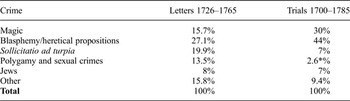
Comparing the two “points of view” (inside and outside) that this article has tried to reconstruct, a discrepancy clearly emerges between the concrete actions of the Modena Inquisition and the priorities of the Holy Office. The divide is clearly widest when considering the cases of solicitation in the confessional. In comparison with the few trials held at the Modena Inquisition, one finds a considerable number of letters dedicated to the matter from the Roman cardinals. In the four decades considered in Graph 2 (1726–1765), the number of clergy tried for solicitation does not surpass 5 per year, in contrast to the relatively higher levels of other crimes. A similar observation can be made for the trials against persons accused of polygamy, a crime for which the Roman congregation maintained a high level of interest, even though trials for this crime took place on average once every two years. In contrast, there are proportionally fewer letters regarding cases of blasphemy or magic compared with the number of trials actually held.
Breakdown of Trials by Crime (1726–1765)

The data provided in this article clearly demonstrate the discrepancy between the stance maintained by Rome and the actual activities carried out by the judges in Modena. In Table 3 is the comparison of the number of letters and trials regarding each crime, given in percentages.
Comparison of Roman Inquisition Letters/Trials Held by Percentage

*% referring to the period 1726–1765
In sum, the Holy Office was, proportionally speaking, significantly more concerned with crimes of a sexual nature (sollicitatio, polygamy and heretical propositions of a sexual/moral nature).
Confirming this discrepancy leads to two different paths of investigation: why did Rome adopt this stance? And why did Modena follow another course of action?
Regarding the Roman Inquisition, there is no doubt that the “distortion” one sees was the result of two priorities that became, according to certain historians, veritable “obsessions”: controlling sexuality and the honour of the clergy.Footnote 26 Indeed, as mentioned above, the absolute majority of the cases that the inquisitorial cardinals focussed on in correspondence concerned the clergy, not only for crimes such as solicitation in the confessional or promiscuity with Jews, but also divination practices, including many cases of searching for riches, abusing the sacraments and crimes connected to ecclesiastical rank.
However, finding the motives that led the Modena tribunal to follow the courses of action described above is not as simple. There are some hypotheses in the conclusion below. Before that, it is important to look at how the Inquisition was set up in Modena as an instrument of social discipline, aimed above all at the lowest strata of the population and, only to a lesser extent, at the higher classes. Although this observation is partly outdated, it is nonetheless useful for the purposes of this article. The crimes the tribunal took action against were those that, in the countryside and in the lower social strata, impeded applying the reforms set out in the Council of Trent decrees and by the Diocesan Synods. The pastoral visits of bishops and the missionary work of, above all Jesuit, preachers that swept the countryside in the attempt to evangelise endeavoured to prevent these very crimes.Footnote 27
The local Inquisition therefore seems to have been integrated into a better structured aggregation of efforts to moralise the countryside, by means of opposing blasphemy and the undermining of doctrine (sometimes committed unknowingly) spread throughout the lower classes. They fought magic, superstition, spells to find riches, and therapeutic practices from pre-Christian traditions. With these actions, which are normal in many respects, the Modena Inquisition acted almost always in accordance with the bishops and diocesan powers. The correspondence from Rome supports this: in many letters, cooperation between local inquisitors and bishops is encouraged, the collaboration of the episcopal officials is praised, and the bishop of Modena is sometimes assigned the task of resolving or overseeing certain cases. The Inquisition is integrated into a wider plan of social and religious control that the bishopric does not perceive as being detrimental to its own pastoral prerogatives but, on the contrary, useful to their implementation.
IV. Remote Effects: The Strange Case of Mr. Pellicciari
The divergence between the priorities of the Holy Office and the policies of the local inquisitors was not without consequences and, in at least one case, it erupted in an unforeseen manner. The most striking case is that which led to the last death penalty being issued by the Modena inquisitors. The trial against a weaver from Modena, Vincenzo Pellicciari, began in 1726 (the year we have intentionally chosen as the starting point of many statistical surveys undertaken for this article).Footnote 28 Many of his fellow workers had recounted what Pellicciari said in public.Footnote 29 Pellicciari claimed that the Virgin Mary was not a virgin and that he was convinced of this owing to his own marriage to the devil who had revealed such information to him.Footnote 30 According to the statement given by an acquaintance of the weaver, one day Pellicciari went to a meadow where he took off his clothes and invoked the demon whom he had wed. The rite was repeated every evening: the devil sodomized Pellicciari and for this reason he had decided not to take a wife.Footnote 31 On October 3, 1726, the judges summoned the accused, ordering his arrest. The deposition of Pellicciari brought to light the mental illnesses that he endured. After initially denying the charges, he admitted to having said and believed that he did not need to confess to masturbation, having unnatural relations with women or frequenting prostitutes.Footnote 32 These ideas originated from the “philanderers” he encountered when visiting the said prostitutes, who had instilled such ideas in his mind. Once he had admitted to the initial crimes, Pellicciari continued to confess: he admitted to having denied the immortality of the soul, to having had apparitions and committed sodomy with the devil that had also taught him how to cast spells.
In accordance with inquisitorial practice, the accused was asked if he intended to exercise his right to a defence. Pellicciari did not, stating he was ready to put himself at the mercy of the tribunal that would pardon his “follies.” However, the Inquisitor, Fra Antonino Pozzoli, exercised the tribunal's authority to appoint a defence lawyer. It is likely that the judges arrived at such a decision, uncommon in the event of a confession, as they hoped to obtain a request for clemency and, above all, a declaration of mental instability by means of officially appointing a lawyer to Pellicciari's case, thus avoiding a harsh and unjust sentence. The mental condition of the accused, socially marginalized and prey to hallucinations, was also evident to the inquisitors, who were looking for an excuse to end the trial with a light sentence.
Indeed, the defence lawyer begged the tribunal for clemency.Footnote 33 Although Pellicciari called into question the virginity of the Madonna, his deep repentance and the Inquisition's standard practice could obtain clemency for the accused, explained Pellicciari's lawyer. He added, “It is necessary to act with greater clemency (mitius) faced with this brute, who is like a fool and has been accustomed to a depraved life and blinded by sexual passion (venerea passione) and by the lures of the flesh.” Pellicciari did not have “full capacity of mind nor full knowledge of the heresy he proclaimed.” He was a degenerate, an individual on the margins of society and should undoubtedly be considered of unsound mind (dementia satis arguitur).
According to what one can deduce from the documentation, no discussion had yet been undertaken with Rome. The Modena judges wanted to send the trial to the Holy Office, attaching the defence proceedings that stated the insanity of the accused. The trial was thus sent on November 20, 1726 together with the defence lawyer's report.
The congregation, from what we can infer from the Holy Office minutes, was fraught with tension. On June 19, a summary of the Pellicciari trial was read in the Vatican in the presence of Pope Benedict XIII, who, considering the heretical propositions stated by the accused against the purity of the Virgin and the immortality of the soul, found him guilty of the crimes listed in the papal bulls issued by Paul IV and Clement VIII, which were punishable by death.Footnote 34 On June 21, the congregation wrote to Modena to inform them of the decision.Footnote 35 While the letter was on its way, the inquisitorial cardinals met in the Santa Maria sopra Minerva church without the pope. On June 25, they sanctioned imploring the pope to pardon Pellicciari and condemn him to perpetual confinement as an oarsmanFootnote 36 . However, on July 3, Benedict XIII reiterated that Pellicciari must be sentenced to death owing to the crimes he had committed.Footnote 37
On July 10, the letter sanctioning the sentence of the death penalty for Pellicciari arrived in Modena. The decision must have been a shock, so much so that three days later the Inquisitor visited Duke Rinaldo I d'Este to inform him. The Duke had no intention of starting a dispute with Rome to save the life of a man of such low social standing, particularly during a moment of political weakness for the Este duchy. Rinaldo thus agreed to implementing the sentence. On July 24, 1727, the Modena Inquisitor therefore passed the sentence against the illiterate thirty-four year old, Vincenzo Pellicciari. In the evening of July 29, the members of the San Giovanni Battista confraternity, assigned to comforting those about to be executed, prepared Pellicciari for death, and the following day the sentence was carried out in the town square by hanging.Footnote 38
It seems likely that the Modena judges lost control of the Pellicciari affair, as did, to some extent, even the cardinals of the Roman Congregation, who were obliged to follow the hard line of a pope destined to go down in history for his sanctimony and excessive devotion.Footnote 39 In addition to trial procedure and the rift within the Holy Office (that raises other questions on the divergence between the pope and the congregation), the Pellicciari trial allows us to see that Modena and Rome operated on two different wavelengths. The Modena judges provided the accused with a defence in order to send a document to Rome testifying to Pellicciari's insanity and, in this way, consider the extreme heretical belief he had stated appropriately.
Nonetheless, the Roman evaluation was very different. Due to the lack of sources, we cannot truly understand why Benedict XIII proceeded to impose such a harsh sentence (overly harsh compared with the practices of the tribunal). It seems that the pope's severity was not caused by true concern for the doctrinal impact of the accused, but an unease over the state of social and moral disorder that the trial had revealed. Pellicciari's punishment thus served as an example to others. In addition, it should be noted that this trial also made a certain impression on Benedict XIII due to the tales of demonic apparitions and sexual acts that filled the case. Perhaps the Pope, whose excessive zeal is recalled by the scholar Ludovico Antonio Muratori from Modena,Footnote 40 convinced himself that he was punishing someone, who, in a certain way, represented an unacceptable state of degradation and immorality, as an example to others. To remove any shred of doubt from the mind of the pope regarding such a severe punishment for Pellicciari's extreme heresy and convince him definitively, there must have been a wider context of sexual promiscuity, and the weaver unwittingly became its representative: homosexual relations, sodomy between men and women, the permissibility of masturbation, prostitution and unsavoury acquaintances. Behind his heretical statements was a world between reality and hallucination, which, in those circumstances, fed the fears and obsessions of the Roman Inquisition and head of the Catholic Church.
V. Inquisitions Compared
Before forming conclusions and answering the above question of how one can explain the Modena “anomaly,” it is necessary to verify the conditions of other Italian Inquisitions in order to understand if and in what way Modena differed. Statistical research on the activities of the Roman Inquisition is lacking and, in various cases, applies different methodologies. Besides, the loss of many inquisitorial archives interferes with a comprehensive picture of the situation in Italy. However, following the methodological approach taken by John Tedeschi and William Monter,Footnote 41 one can attempt a comparison.
Andrea Del Col's analysis of the Inquisition's activities shows that it suffered a general setback in the eighteenth century.Footnote 42 Significant decreases in the number of trials were recorded in small and large tribunals: in Venice and Aquileia (offices where the accused numbered around 500), and in Udine and Naples the decline is evident. The numbers for less significant places have not been studied. However, they do not seem to break away from the more general trend. We also find a drop in activity in places geographically closer to Modena. For the small tribunal of Imola, under the jurisdiction of the Papal State, the eighteenth century signified a phase of decline. After peaks of activity in the period 1591–1640 with an average of eleven to twelve trials per year, there is a sharp drop in the number of trials by the mid-seventeenth century. The eighteenth century confirms this downward trend with an annual average of 4 trials for the period 1713–1771.Footnote 43
The circumstances of the Reggio Emilia tribunal are less clear-cut. The second city of the Duchy of Modena conducted an average of twelve trials per year in the period 1733–1776, totalling 504. Without the details of the trials held in the previous period, one cannot establish whether the tribunal's activities dropped or increased in the eighteenth century compared with the previous century. However, we note that the same number of trials were conducted in Reggio Emilia as in significantly larger and more important tribunals, such as Venice. This comparison thus allows one to conclude that, proportionally speaking, activity levels in Reggio Emilia were sustained, even if the cases were only a third of those of neighbouring Modena.Footnote 44 It is likely, therefore, that Reggio Emilia should also be included among the offices that did not endure, or endured to a lesser degree, the collapse or settling process that hit the Roman Inquisition in the 1700s.
With respect to the general picture, the Inquisitions of Modena (with 3543 accused), Siena (with 3485) and, just outside Italian borders, Malta (with 3409 accused in the period 1744–1798) clearly buck the trend. One can thus conclude that Modena was effectively an exception, at least with respect to the tribunals whose data have been studied. It is necessary to now establish if the “quantitative” exception that Modena represented was also a “qualitative” exception, that is, regarding the type of crimes prosecuted.
Referring to the calculations proposed by Christopher Black,Footnote 45 in the area of Venice and of Friuli at the turn of the 17th century (1677–1716) a quarter of cases were for crimes of apostasy (24%) probably linked with the conversions “regulated” by the Inquisition; 12% of crimes for sollicitatio; 10% concerned heretical propositions of various kinds (including moral and sexual sin) and a slightly lower percentage (9%) abuse of the sacraments. Yet the majority of the charges, 33%, focussed on magical practices. In contrast, no cases of bigamy or concubinage were pursued. It would thus seem that the inquisitorial office in Venice was not particularly attentive to crimes connected to sexuality and was instead largely concerned with taking action against forms of superstition and in many cases against the non-Catholics, or apostate Catholics, who wandered the Venetian territories.
In the first four decades of the eighteenth century (1701–1740), the tribunal of Naples, which was more in line with counter-reform priorities, saw intolerance towards, above all, lack of devotion to the sacraments and the rituals of the Catholic Church (offerings, commandments, sacred images, relics, etc.), totalling 33% of cases; with the same percentage regarding magical practices. The number of trials for polygamy is significant, and in many respects exceptional, coming to 20% of the total.Footnote 46 The same attention paid to cases of polygamy is found in Malta (18.6%). Here, however, the majority of the accused were incarcerated for blasphemy (34%), magic (28.9%) and heretical propositions (14.2%).
Regarding the Emilia region, the general picture remains the same. In Imola, the majority of prosecuted crimes in the 1700s (1713–1771) concerned heretical propositions (29.2%), magical, superstitious and divinatory practices (24.7%), and blasphemy (20.8%). The judges prosecuted solicitation in the confessional (15.8%) and the crime of polygamy (1%) to a lesser extent. The data related to controlling sexuality are slightly higher compared with those recorded elsewhere. However, the fact that more than two thirds of cases were related to episodes of minor irreligiosity shows that the outlying tribunals of the Ecclesiastical State did not share or recognise Rome's urgency regarding the control of the sexuality of the clergy and the laity.
If, lastly, looking at the other Inquisition in the Este State, Reggio Emilia, one finds the same attention to blasphemy (8.1%), heretical propositions (13.9%) and magic (25.2%), one trial for solicitation in every 10 (9.9%) and a more marked activity of control regarding Jews (11.3%).
Therefore, although local idiosyncrasies and variables existed, at most we can conclude that the actions of the Modena tribunal, that is, the differing priorities of the Holy Office with respect to the concrete actions of the local Inquisition, were repeated elsewhere.
The comparison from the other side of the coin, that is, the outlying Inquisitions in the eyes of Rome, is less fruitful. The correspondence between the Inquisition's centre and its outer offices has been the subject of recent publicationsFootnote 47 , but they lack quantitative and statistical studies of this kind of material. Fortunately, Reggio Emilia, the second city of the Duchy of Modena, is among the few cases studied, even if the time period investigated only partly overlaps with the era studied in this articleFootnote 48 .
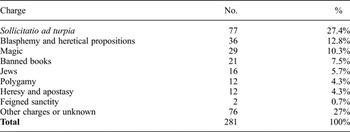
Regarding the trials, the cardinal inquisitors largely focussed on, once again, crimes of a sexual nature. Between 1646 and 1733, the letters sent by the congregation dealt principally with trials of this type. The letters concern 263 cases (involving 281 charges),Footnote 49 which break down as follows:
Crimes Identified from Letters to the Reggio Inquisition from the Holy Office (1646–1733)

The Holy Office thus primarily paid attention to crimes of a sexual nature with a marked focus on the morality of the clergy also in the case of Reggio Emilia.
Undertaking broader studies within the Roman Inquisition archives quickly reveals substantial files entirely dedicated to the control of sexuality in the eighteenth century. For example, there is a collection dedicated to the crimes of sodomy, rape and pederasty dating from the seventeenth to the eighteenth centuries and concerning many Italian cities (Rome, Ferrara, Faenza, Pesaro, Orte, Turin, Fermo, Rieti, Parma, Spoleto, Siena, Perugia, Vercelli, Mondovì, Gubbio, Cremona, Bologna, Ancona and other smaller towns).Footnote 50 A case from Modena also features in this collection, regarding a priest, Don Giuseppe Parma, who, in 1759, was accused of solicitation and sexual abuse by various adolescents from Crevalcore, a town in the countryside. The congregation ordered the Modena judges to try him, have him recant and sentence him to three years in prison and certain healthy penances (a fairly mild sentence).Footnote 51
A systematic study is yet to be undertaken and the data provided in this article need to be reworked using more analytical classification processes than are available today. However, these data seem to outline a fairly clear trend and a discrepancy between the priorities of the central and outlying offices.
VI. The Reasons Behind the Anomaly
Returning to the case examined in this article, we are yet to understand why in Modena, and for certain aspects also in Reggio Emilia, the Inquisition's activities moved at such a significant pace and what this might suggest on a more general level. Studying a wider context may be necessary, as already established,Footnote 52 since an initial explanation might lie in the political and cultural circumstances of the Este State (such circumstances would justify both the activism of Modena and the “grip” of the Reggio tribunal). Firstly, the duchy's political weakness during the years in question must be taken into account. During three wars of succession in the 1700s, the dukes were repeatedly obliged to abandon their territories and flee beyond the borders. These circumstances clearly did not give the ducal power a strong hold over its territories. In addition, the dukes were busy dealing with other more serious matters, including the very survival of the Este State itselfFootnote 53 . For this reason, we can therefore suppose that the Inquisition's actions were not blocked by this political power. It is unlikely that, in a moment of weakness, the Este duchy would have risked irritating the church authorities with the aim of reducing or limiting the actions of the tribunal.
In this respect, we can therefore note that the increase in or the grip of the Inquisition's actions signals a weakened political power and its reduced ability to control the population. On the other hand, as the Inquisition declined, the political power was bolstered. Trends in inquisitorial activities can thus be used to indicate the stability or instability of the political framework.
The conditions of the Este State in the first half of the eighteenth century confirm this interpretation: not only, as mentioned, were the dukes obliged to flee their territories during the wars of succession, they also experienced a certain vulnerability in other situations. This first occurred in 1708, when the troops of Holy Roman Emperor Joseph I occupied the territories of Comacchio, formerly part of Este lands, acquired by the Papal States in 1598. The House of Este asked the Emperor if they could once again take possession of these territories. However, despite having shown the legal legitimacy of their request, in 1725, the conflict was resolved in favour of the politically stronger pope.Footnote 54
A second example of the duchy's weakness took place in 1720, when, in an error of judgement, the son of Duke Rinaldo I, Francesco, married the daughter of the Regent of France, Charlotte Aglaé d'Orléans. The marriage, which aimed to make an ally out of the French for the duchy, was troubled: the relationships between wife, father-in-law and husband were strained and indulging the requests of the princess was a significant financial burden.
In the first half of the eighteenth century, when the Inquisition took on the key role demonstrated in this article, the duchy was thus seeking political protection, uncertain of whom to side with among the great political powers and apprehensive about its own future. It would take the political stabilisation of the Treaty of Aix-la-Chapelle (1748) and the Duchy of Modena definitively coming under Austrian rule to see, in the second half of the 1700s, the beginning of reform under Francesco III d'Este, which would strengthen the ducal power, limiting church privileges and abolishing the Inquisition.
Yet, alongside political explanations, we may also find causes linked to the personality of the duke who governed Modena for over forty years. Rinaldo I (1695–1737) was originally successful in his clerical career, becoming cardinal in 1688. Upon the death of his nephew, Francesco II d'Este, he took up the helm of the duchy, abandoning his cardinal vestments. His character, however, remained marked by a certain severity. Ludovico Antonio Muratori, who was close to the Duke as an advisor, honoured him as a sensitive man with counter-reform convictions. In his eulogy, the scholar recalls how the Duke admired self-restraint and was its “inflexible custodian.” He demonstrated his love for purity and how much “he abhorred illicit pleasures” in his actions. None in his presence dared say “vulgar” words and should someone commit some insignificant sin, they would no longer enjoy the Duke's respect. Muratori thus concludes: “From this derived his concern for removing and punishing all scandals . . . and repressing certain customs and freedoms that are fashionable in other countries.”Footnote 55 The commemorative aims of the portrait cannot conceal the Duke's sanctimonious and ascetic character, which many of his contemporaries and men of the Court would have confirmed and sometimes endured. However, it is interesting to note the consequence that this had socially, with a more focussed investigation into public morality.
More than once in his advice to the Duke and in his treatise Della pubblica felicità, dedicated to good political governance, Muratori condemned the degradation that reigned over the city. He urged that the disorder arising from the presence of masses of poor be resolved and public behaviour improved. He evoked the social function of religion: it should teach the populace to avoid wasting time in taverns and brothels, and instead provide productive and moral tasks to keep them busy. As part of his activities as a parish priest, he founded a charity for the poor and fought to restore public morality.Footnote 56
One can therefore confidently state that the themes of greater social control and of the moralisation of the behaviour of lay people and the clergy were considered to be matters of urgency in this period. In this respect, one can argue that the duke believed the Inquisition to be a useful tool for social control, as it was principally dedicated to cases involving the lowest strata of the population (probably the most effective and reliable tool considering his weak political position).
Furthermore, the importance placed on morality by Rinaldo I would explain his accommodating behaviour when faced with the request to sentence Pellicciari to death. There is further evidence showing how this bias penetrated a significant part of the Modena population: approximately one criminal out of three was sponte comparente, that is, they gave themselves up to the Inquisition,Footnote 57 and it is likely that many others gave up acquaintances, friends or colleagues. The tribunal, with its edicts of mercy and possible reconciliation with the church or with one's own conscience, was therefore another normal component of the faith, alongside the confessor, the parish priest and the travelling preacher. However, one can seemingly exclude the idea that one must principally look to the personalities of the various inquisitors that ran the Modena Inquisition for a reason behind its activism, given their high turnover (in the eighteenth century there were nineteen inquisitors, one every four and a half years).Footnote 58
In conclusion, it seems that the case of Modena was not simply an anomaly, instead, it is an example of a possible sociopolitical use of the Inquisition and shows how, in contrast to what is generally believed, the tribunal could still take on an important role in the social fabric of the 1700s.
The case is also significant (and in this instance normal rather than abnormal, that is, in line with the general trend) as it unveils a divergence between the priorities of Rome and those of the outlying offices.
Indeed, two dramatically different pictures emerge when one observes the state of affairs in which the Inquisition took action by means of the letters from Rome, or, the trials conducted in outlying tribunals. In the former case, it seems that controlling sexuality and social relations was the main focus of attention for the Inquisition, with particular emphasis on the clergy; in the latter, a social landscape of micro-irreligiosity emerged and efforts were made to bring it under control. Such divergence suggests the presence of differing necessities within the Catholic faith: Rome increasingly focussed its efforts on exerting ethical and moral control, above all linked to sexuality; on the other hand, the outlying offices, confronted with real-life situations, found it necessary to take action in the majority of cases on a preliminary level, so to speak (superstition, blasphemy, religious teachings, etc.).
Such observation thus highlights the caution that ought to be taken on a methodological level: the sources, as is commonly known, exemplify and portray a specific point of view that did not always reflect reality. The case of Modena, which is exceptional for the wealth of documentation available, demonstrates that the Holy Office and outlying offices perceived the situation differently; any historical reconstruction of events must take this discrepancy into account, bearing in mind that Rome's principal concerns did not always correspond to problems that largely pestered the fringes of Christianity.