The ability to maintain input in memory for a brief period of time (short-term memory [STM]) and the ability to store information while engaging in cognitive processing (working memory [WM]) underlie performance on a wide array of complex language tasks. For example, syntactic processing (e.g., Girbau & Schwartz, Reference Girbau and Schwartz2007; Miyake and Friedman, Reference Miyake, Friedman, Healy and Bourne1998), vocabulary learning (e.g., Baddelely, Gathercole, & Papagno, Reference Baddelely1998; Gathercole & Baddelely, Reference Gathercole and Baddeley1989, Reference Gathercole and Baddeley1990), oral language comprehension (Smith, Mann, & Shankweiler, Reference Smith, Mann and Shankweiler1986), and reading comprehension abilities (Daneman & Carpenter, Reference Daneman and Carpenter1980) have all been linked to STM and WM skills. Moreover, a larger WM capacity has also been linked to successful second language (L2) acquisition (e.g., Cheung, Reference Cheung1996; Harrington & Sawyer, Reference Harrington and Sawyer1992; Service, Reference Service1989; Service & Kohonen, Reference Service and Kohonen1995). Therefore, it is clear that STM and WM skills are crucial for language functioning, in both the native (first) language (L1) and the L2. However, surprisingly little is known about the memory system in bilinguals. This is because prior studies on bilingual memory have rarely used existing memory models to ask questions regarding the structure of bilingual memory and regarding the degree to which the constraints on memory function, established in monolinguals, generalize to bilinguals' native (L1) and L2 language performance. Moreover, none of the previous studies on bilingual memory have contrasted STM and WM performance within the same group of bilinguals. Yet, the distinction between the two systems is the cornerstone of theoretical work on memory and its relationship to cognitive and linguistic function (e.g., Kail & Hall, Reference Kail and Hall2001). The goal of this work therefore was to compare bilinguals' L1 and L2 STM and WM skills within one well-accepted memory model, and to examine the cross-linguistic relationships between the two types of memory.
PHONOLOGICAL STM AND WM
We contextualize this study within the theoretical framework of Baddeley's WM model (e.g., Baddeley, Reference Baddeley2000; Baddeley & Hitch, Reference Baddeley, Hitch and Bower1974). According to the model, WM comprises multiple cognitive components whose functions include moment to moment processing, monitoring, and maintenance of information. In the WM model (Baddeley, Reference Baddeley2000), there are three specialized temporary-buffer systems: phonological loop (responsible for processing of phonologically based information); visuospatial sketchpad (responsible for processing of nonlinguistic visuospatial information); and episodic buffer (responsible for integrating information from various sources). The phonological loop itself has two subsystems: the phonological store and the rehearsal process. Phonological input is stored in the phonological store and the subvocal rehearsal prevents this information from decaying over time. The central executive in the WM model acts as a supervisory attentional system (Norman & Shallice, Reference Norman, Shallice, Davidson, Schwartz and Shapiro1986). The role of the central executive is to coordinate the three temporary buffer systems, to focus and switch attention, and to activate representations in the long-term memory that are relevant to the task at hand. The central executive is generally considered to be a domain-general mechanism, in that it is not specific to linguistic tasks (e.g., Engle, Kane, & Tuholski, Reference Engle, Kane, Tuholski, Miyake and Shah1999).
The notion of the central executive is crucial to the distinction that the WM model draws between STM and WM. The difference between STM and WM lies in whether or not the memory task involves additional cognitive processing. This distinction applies to both the phonological memory and the visual–spatial memory systems (although the visuospatial sketchpad may have a stronger tie to the central executive than the phonological loop; e.g., Baddeley, Reference Baddelely1996; Quinn & McConnell, Reference Quinn and McConnell1996). STM is a less dynamic system, mostly storing information temporarily, whereas WM is a more dynamic system, storing and transforming information simultaneously, and engaging a domain general cognitive mechanism (e.g., Baddeley & Hitch, Reference Baddeley, Hitch and Bower1974; Engle, Tuholski, Laughlin, & Conway, Reference Engle, Tuholski, Laughlin and Conway1999; Newell, Reference Newell and Chase1973). Thus, WM tasks are usually dual tasks where participants are engaged in cognitive processing, while at the same time also retaining information for subsequent retrieval, whereas STM tasks are usually single-component tasks where participants are simply maintaining information for a brief period of time. Because WM but not STM tasks have been found to predict performance on complex cognitive tasks such as reading comprehension and reasoning, WM is considered to reflect domain-general executive attention (Conway et al., Reference Conway, Kane, Bunting, Hambrick, Wilhelm and Engle2005; Conway, Kane & Engle, Reference Conway, Kane and Engle2003; Engle et al., Reference Engle, Kane, Tuholski, Miyake and Shah1999; Kane & Engle, Reference Kane and Engle2002).
For phonological memory specifically, STM refers to the ability to store verbal information for a short period of time and it depends on the function of the phonological loop. Phonological WM refers to the ability to store verbal information for a short period of time while engaging in a cognitive processing task and it depends on the function of both the phonological loop and the central executive. For example, phonological STM tasks include word recall tasks (where participants must remember and then retrieve a list of familiar words; e.g., Cowan et al., Reference Cowan, Day, Saultus, Keller, Johonson and Flores1992) and forward digit-span tasks (where participants must remember the sequence in which a series of digits occurred and retrieve the digits in the same order they were heard; e.g., Jacobs, Reference Jacobs1987). Conversely, phonological WM tasks include reading- and listening-span tasks (where participants must read or listen to sentences, judge the grammaticality or meaningfulness of the sentences, and memorize the last words in the sentences for subsequent retrieval; e.g., Daneman & Cerpenter, Reference Daneman and Carpenter1980) and backward digit-span tasks (where participants must remember series of digits and retrieve them in a reverse order; e.g., Conklin, Curtis, Katsanis, & Iacono, Reference Conklin, Curtis, Katsanis and Iacono2000).
Although this distinction between STM and WM is well accepted in the literature, previous work on phonological memory in bilinguals has not used this distinction to formulate hypotheses regarding the possible differences in the degree to which STM versus WM skills interact across bilinguals' two languages. Thus, despite the fact that a number of previous studies demonstrated the existence of cross-linguistic relationships between bilinguals' phonological STM (e.g., Harrington & Sawyer, Reference Harrington and Sawyer1992; Masoura & Gathercole, Reference Masoura and Gathercole1999; Windsor, Kohner, Lobitz, & Pham, Reference Windsor, Kohnert, Lobitz and Pham2010) and WM skills (e.g., Alptekin & Ercetin, Reference Alptekin and Erçetin2010; Harrington & Sawyer, Reference Harrington and Sawyer1992; Miyake & Friedman, Reference Miyake, Friedman, Healy and Bourne1998; Osaka & Osaka, Reference Osaka and Osaka1992) in the L1 and the L2, to date there has been no comparative work examining whether STM versus WM skills show different association patterns across languages. Moreover, the mechanisms that underlie the cross-linguistic associations for phonological memory performance remain unclear. The classic interpretation of the observed L1/L2 correlations for phonological memory measures has generally relied on the notion of transfer. That is, it has been proposed that the ability to maintain information in STM, practiced in bilinguals' L1, transfers to their ability to do so in their L2 (e.g., Thorn & Gathercole, Reference Thorn and Gathercole1999). In this sense, the relationships between L1 and L2 phonological memory performance is posited to reflect the same cross-linguistic transfer of skills as the relationships observed for phonological awareness (e.g., Dickinson, McCabe, Clark-Chiarelli, & Wolf, Reference Dickinson, McCabe, Clark-Chiarelli and Wolf2004), morphological processing (e.g., Nicoladis, Reference Nicoladis2002), syntactic abilities (e.g., Paradis & Navarro, Reference Paradis and Navarro2003) and reading skills (e.g., Da Fontoura & Siegel, Reference Da Fontoura and Siegel1995; Koda, Reference Koda1993; Schiff & Calif, Reference Schiff and Calif2007; Verhoeven, Reference Verhoeven1994). However, it may be that the cross-linguistic relationships found for phonological memory performance are rooted in the reliance on a single domain-general process for both the L1 and L2 performance. Specifically, it is possible that the phonological memory in bilinguals' two languages involves the activation of the central executive, a mechanism that is by definition not specific to language. If so, then the relationship between L1 and L2 performance should be stronger for WM tasks than for STM tasks, because the WM tasks rely on the central executive.
Although none of the previous studies on phonological memory in bilinguals have attempted to contrast STM and WM performance in the same group of bilinguals, there are indications in the literature that WM measures may be more strongly related for L1 and L2 than STM measures. The previous studies of phonological memory in bilinguals that included both the STM and the WM measures were not focused on evaluating STM and WM skills against each other. Instead, these studies focused on delineating an association between STM or WM performance and another language domain, such as vocabulary learning in the L1 (e.g., Baddeley et al., Reference Baddeley, Gathercole and Pappagno1998; Gathercole & Baddeley, Reference Gathercole and Baddeley1989, Reference Gathercole and Baddeley1990; Gathercole, Willis, Emslie, & Baddeley, Reference Gathercole, Willis, Emslie and Baddeley1992), vocabulary learning in the L2 (e.g., Cheung, Reference Cheung1996; Masoura & Gathercole, Reference Masoura and Gathercole2005), or foreign language learning in general (e.g., Komos & Safar, Reference Kormos and Sáfár2008; Harrington & Sawyer, Reference Harrington and Sawyer1992; Miyake & Friedman, Reference Miyake, Friedman, Healy and Bourne1998). For example, Harrington and Sawyer (Reference Harrington and Sawyer1992) investigated whether WM skills in L1 (Japanese) and L2 (English) were related to bilinguals' L2 reading skill. Correlation analyses revealed that STM in L2 (as indexed by digit-span tasks and word-span tasks) was not related to English proficiency, but that WM in L2 (as indexed by reading-span tasks) was significantly related to English proficiency, especially to grammar and reading scores on the Test of English as a Foreign Language. Therefore, there is indirect evidence that phonological WM may be a more interactive system than phonological STM. This hypothesis is logical in light of the underlying differences between WM and STM: whereas STM relies on the storage capacity of the phonological loop, WM also involves the central executive—an attention mechanism that is not, strictly speaking, tied to language. In the current study, we questioned whether there would be differences in the degree to which L1 and L2 performance levels were associated for the STM versus the WM tasks. We did so through the use of the nonword repetition (NWR) task, which is a traditional and reliable measure of phonological memory.
THE NWR AS A PHONOLOGICAL MEMORY MEASURE
The NWR task involves the ability to repeat nonsense words, and is one of the most frequently used phonological memory tasks. It is a good predictor of language learning ability in children (e.g., Gathercole & Baddeley, Reference Gathercole and Baddeley1990), adults (e.g., Vallar & Baddeley, Reference Vallar and Baddeley1984), and L2 learners (e.g., Service, Reference Service1989, Reference Service1992). The NWR task is also considered a relatively pure measure of phonological memory capacity because participants must retain the phonological representations of nonwords to accomplish the task, without being able to rely on lexical information to support repetition performance (e.g., Gathercole & Baddeley, Reference Gathercole and Baddeley1989). As a result, the NWR task is largely free of cultural bias unlike other tasks that are more dependent on language experience (e.g., Ellis Weismer et al., Reference Ellis Weismer, Tomblin, Zhang, Buchwalter, Chynoweth and Jones2000; Oetting & Cleveland, Reference Oetting and Cleveland2006; Rodekohr & Haynes, Reference Rodekohr and Haynes2001). In the current study, we employed the NWR task to index bilinguals' phonological memory performance in the L1 and L2. We manipulated the structure of the NWR task to index both phonological STM and phonological WM. Because the WM system involves temporal storage of information while engaging in complex cognitive activities such as learning, reasoning, and comprehension (Baddeley, Reference Baddeley, Baddeley, Eysenck and Anderson2009), it is possible to transform a STM task (like NWR) into a WM task by combining the STM task with a cognitive processing task (e.g., Bialystok & Feng, Reference Bialystock and Feng2009; Daneman & Capenter, Reference Daneman and Carpenter1980). In previous studies, for example, a word-span task that indexes STM was transformed into a WM task by combining it with a sentence-judgment task (e.g., Daneman & Carpenter, Reference Daneman and Carpenter1980). However, the strategy of combining a STM task with a complex language processing task is less helpful in investigating WM in bilinguals' L2, because proficiency issues are likely to influence participants' ability to process complex sentences. Thus, L1/L2 differences on a task like the reading span may reflect both the differences in the memory capacity as well as the differences in overall language skills (including lexical–semantic knowledge, grammatical ability, etc.). Moreover, the comparison of WM versus STM performance is made more difficult by the fact that it is nearly impossible to control the time elapsing between presentation of the to be remembered stimuli and the cue to retrieve theses stimuli in a word-span task versus a listening-span task. Because the ability to maintain information in phonological memory is constrained by time-based decay, any attempt to contrast STM and WM tasks is made more difficult by the need to equate the time characteristics across the STM and the WM tasks.
In this study, we used a simple NWR task to measure STM capacity and a complex NWR task to measure WM capacity. On the WM task, NWR task (indexing the storage component of the WM task) was combined with an animacy-judgment task (indexing the cognitive-processing component of the WM task). Although the animacy-judgment task requires the participant to process linguistic information, the task is significantly less cognitively complex than sentence processing. The selection of the linguistic secondary task was dictated by the WM literature, which strongly suggests that the involvement of the central executive is elevated when the processing (secondary) task shares modality with the storage (primary) task (e.g., Fry & Hale, Reference Fry and Hale1996; Hale, Michelle, & Fry, Reference Hale, Michelle and Fry1997; Hale et al., Reference Hale, Myerson, Rhee, Weiss and Abrams1996). Moreover, this manipulation enabled us to control the length of time between the presentation of the nonword and the cue to retrieve it across both the STM and the WM task. Other studies that have used similar dual-task approaches to index STM and WM demonstrated that inclusion of an intervening cognitive task into the STM measure generally acts to decrease the STM performance (e.g., Ang & Lee, Reference Ang and Lee2010; Postle, D'Esposito, & Corkin, Reference Postle, D'Esposito and Corkin2005). For example, Ang and Lee (Reference Ang and Lee2010) used a simple visual patterns task to index visual STM, and embedded a matrix-equation task within the visual patterns task to index visual WM. In addition to distinguishing STM and WM functions, the use of the NWR task also enabled us to capitalize on two well-established patterns of performance associated with NWR to ask where phonological memory function (STM and WM) differs across bilinguals' two languages. These patterns reflect the relationship between phonological memory function and underlying linguistic knowledge and the inherent capacity constraints associated with the phonological memory system.
One robust pattern of findings associated with the NWR task is that nonword repetition performance reflects knowledge of language-specific phonotactics. Phonotactic probability refers to the likelihood of occurrence of a sound/a pair of sounds in words of the target language (e.g., Storkel, Maekawa, & Hoover, Reference Storkel, Maekawa and Hoover2010). Typically, NWR performance improves for nonwords that more closely correspond to language-specific phonotactic patterns. This relationship between nonword repetition performance and L1 phonotactic knowledge has been observed in children (e.g., Beckman & Edward, Reference Beckman, Edwards, Broe and Pierrehumbert2000; Edwards, Beckman, & Munson, Reference Edwards, Beckman and Munson2004; Munson, Reference Munson2001) and in adults (e.g., Thorn & Frankish, Reference Thorn and Frankish2005). For example, Edwards et al. (Reference Edwards, Beckman and Munson2004) showed that children were more accurate in repeating nonwords with high-frequency phonological sequences than with low-frequency phonological sequences. Moreover, they found that children with large vocabularies were less influenced by phonotactic probability than children with small vocabularies, suggesting that NWR performance also reflects lexical abilities. Thus, examining bilinguals' NWR performance across their dominant and nondominant language should reveal whether discrepancies in language abilities across the bilinguals' two languages would be reflected in their phonological memory performance. A similar hypothesis was tested by Thorn and Gathercole (Reference Thorn and Gathercole1999) in bilingual children. Thorn and Gathercole (Reference Thorn and Gathercole1999) demonstrated a link between bilinguals' NWR performance and their proficiency in the two languages. Two groups of children, English–French bilingual children and English-speaking children learning French as an L2 were administered vocabulary tests and STM tasks (digit-span and NWR) in both languages. English–French bilingual children had comparable vocabulary knowledge in both languages and performed equivalently on the STM tasks in two languages. However, English children learning French as an L2 had better vocabulary knowledge in L1 than L2, and performed better on the NWR task in L1 than in L2. This suggested that NWR performance in bilinguals' two languages is tied to their linguistic competence in each language.
Another pattern of findings associated with NWR performance is the length effect. The length effect generally means that repetition accuracy decreases as the length of the nonwords increases. Length effects have been observed across multiple languages (e.g., Archibald & Gathercole, Reference Archibald and Gathercole2006; Girbau & Schwartz, Reference Girbau and Schwartz2007). The general explanation for length effects is based on the idea that with passage of time, traces laid down for the new phonological forms decay in the STM (Baddedely, Thomson, & Buchanan, Reference Baddeley, Thompson and Buchanan1975; Burgess & Hitch, Reference Burgess and Hitch2006). Because longer items take more time to repeat, there is greater decay of longer items than of shorter items in the phonological memory system. Given this mechanism, it may be hypothesized that all things being equal, length effects would be more robust in the bilinguals' L2 than their L1, because encoding of phonological representations may be weaker in L2 than in L1.
THE CURRENT STUDY
In the current study, we compared phonological STM and WM performance in bilinguals' two languages, also testing the length effects in bilinguals' phonological memory function. We took into account the relationship between NWR performance and language-specific knowledge when formulating the general hypothesis regarding broad differences between bilinguals' L1 and L2 performance. Because in the current study, we tested bilinguals who were native speakers of Korean and L2 speakers of English, we expected NWR performance to reflect these differences in language dominance. Specifically, we expected better NWR performance in bilinguals' L1 (Korean) than in their L2 (English), across both the STM and the WM tasks. Because length effects are localized to the speed with which traces decay in the phonological loop, it was likely that we would observe length effects in both of bilinguals' two languages. However, it was also possible that the initial strength of the traces would be contingent on bilinguals' language dominance, such that L1 traces would be stronger than L2 traces. As a result, there would be differences across the L1 and the L2 with regard to the robustness of length effects. For example, it was possible that due to the initially weaker traces in the L2 than in the L1, the length effect would be more robust in bilinguals' L2 than in their L1. Given the lack of data about the cross-linguistic relationships associated with STM and WM in bilinguals, we also examined the degree to which L1 and L2 performance were associated with each other for the two different phonological memory tasks (STM and WM). We had two alternative hypotheses with regard to this goal of the study. First, it was possible that there would be equally strong relationships between L1 and L2 performance on all phonological memory tasks. This prediction is logical if the L1/L2 relationships on phonological memory tasks reflect the same transfer-based cross-linguistic relationships posited for linguistic processing tasks. That is, if phonological memory skills attained in L1 can transfer to phonological memory tasks in L2, then significant cross-linguistic relationships should be observed for all phonological memory tasks. Second, it was possible that there would be a stronger relationship between L1 and L2 performance on the WM tasks than on the STM tasks. This prediction was based on the studies suggesting that the WM tasks (but not the STM tasks) involve activation of the central executive, a domain-general mechanism. Reliance on the domain-general mechanism during WM performance would result in more robust relationships between L1 and L2 for the WM tasks than for the STM tasks.
METHOD
Participants
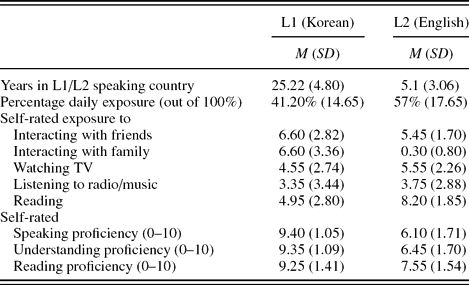
Twenty Korean–English adult bilinguals (mean age = 29.7 years, SD = 4.93) participated in the study, including 10 males and 10 females. Participants were undergraduate and graduate students at the University of Wisconsin–Madison, and they were recruited from the Korean campus community through fliers on campus and through word of mouth. As a group, participants reported 19.8 years of education (SD = 3.71). All participants spoke Korean as their L1 and acquired English as an L2 during early teen years, with a mean acquisition age of 11.25 years (SD = 2.83). All participants indicated that Korean was their dominant language. Participants rated their L1 and L2 proficiency levels on a Likert scale where 0 = no knowledge and 10 = nativelike knowledge. On average, participants rated their L1 speaking proficiency as 9.40 (SD = 1.05), L1 understanding proficiency as 9.35 (SD = 1.09), and L1 reading proficiency as 9.25 (SD = 1.41). Participants also indicated high L2 proficiency levels: Self-rated levels of L2 speaking proficiency and L2 understanding proficiency were similar, with a mean of 6.10 (SD = 1.74) for speaking and a mean of 6.45 (SD = 1.7) for understanding while the self-rated levels of L2 reading proficiency were higher, with a mean of 7.55 (SD = 1.54). All participants rated their levels of L1 speaking proficiency as higher than L2 speaking proficiency. Only one participant rated his/her level of L1 understanding as less proficient than of L2 understanding, and one participant rated his/her levels of L1 understanding and L1 reading as similar to the levels of L2 understanding and reading. Overall, self-rated proficiency levels revealed that bilingual participants were more proficient speaking, t (19) = 9.08, p < .05, understanding, t (19) = 7.71, p < .05, and reading, t (19) = 4.99, p < .05, Korean (their L1) than English (their L2). The mean level of L1 exposure on a daily basis was 41% (SD = 14.65) and the mean level of L2 exposure on a daily basis was 57% (SD = 17.65). The mean number of years participants had spent in an L1-speaking country was 25.22 years (SD = 4.80) and the mean number of years participants had spent in an L2-speaking country was 5.1 years (SD = 3.05). We also collected data regarding participants' current levels of exposure to their L1 and L2 in various contexts. The participants' self-reports suggest extensive exposure to both languages in this group of bilinguals. See Table 1 for detailed information on participant characteristics and for comparisons across the two languages.
Demographic characteristics of Korean–English bilinguals

Note: L1/L2, first language/second language.
Stimuli
We used the NWR task to measure bilinguals' phonological memory, and manipulated the task to index both the STM and the WM in bilinguals' two languages. STM was measured via a simple NWR task, where participants repeated nonwords of increasing length. WM was measured via a complex NWR task, where the NWR task was combined with an animacy judgment task.
Ninety-six Korean nonwords were constructed based on the list of phonologically plausible Korean syllables (Lee, Reference Lee2006). Of these, 32 were two-syllable nonwords, 32 were four-syllable nonwords, and 32 were six-syllable nonwords. Using Lee's syllables, the two-syllable nonwords were constructed by combining 16 consonant–vowel (CV) and 16 CVC syllables, four-syllable nonwords were constructed by combining 32 CV and 32 CVC syllables, and six-syllable nonwords were constructed by combining 48 CV and 48 CVC syllables (see Appendix A for Korean stimuli). Ninety-six English nonwords were selected from an established corpus of nonword stimuli (Gupta et al., Reference Gupta, Lipinski, Abbs, Lin, Aktunc and Ludden2004), and the structure of English nonwords across the three levels of the syllable length was the same as of Korean nonwords (see Appendix B for English stimuli). The stimuli were split, so that in each language, there were 16 pairs of two-syllable nonwords, 16 pairs of four-syllable nonwords, and 16 pairs of six-syllable nonwords. Each member of the pair was presented in either the STM task or the WM task, counterbalanced across participants. It is important to point out that all English nonwords followed English phonotactics, although some contained relatively infrequent sound combinations (Gupta et al., Reference Gupta, Lipinski, Abbs, Lin, Aktunc and Ludden2004). Similarly, the Korean nonwords followed Korean phonotactics although some contained relatively infrequent sound combinations. Although it is impossible to compare and equate the phonotactics of the English and Korean stimuli given that no database exists for deriving Korean phonotactic probabilities, the two databases (Gupta et al., Reference Gupta, Lipinski, Abbs, Lin, Aktunc and Ludden2004; Lee, Reference Lee2006) used similar procedures to derive the nonwords. In order to ensure further comparability between the English and the Korean nonwords, the nonword stimuli across the two languages were precisely matched on acoustic duration in msecs.
Participants repeated the two lists of nonwords in two conditions. In the STM task, participants heard a nonword and repeated it as accurately as possible. In the WM task, participants first heard the nonword, followed by an auditory presentation of a noun. Participants decided whether the noun was animate or inanimate, and then repeated the nonword as accurately as possible. The animate and inanimate nouns selected for the WM task in both languages were matched on frequency, concreteness, and familiarity in each language. The Korean frequency values were obtained from The National Institute of the Korean Language's 2003 Modern Korean Usage Frequency Survey (The National Institute of the Korean Language, 2010). The frequency of the Korean words was calculated through multiplying the raw number of times a word occured in the surveyed materials by a million and then dividing the resulting number by the total number of words included in the Korean database. This method ensured that the calculations of lexical frequency were comparable for English and Korean, because English frequency values were based on the occurrence of a word per million. The values of concreteness and familiarity for the Korean nouns were obtained after translating Korean words into English and determining the ratings of the English translations based on MRC Psycholinguistic Database. English animate and inanimate nouns were also matched on frequency (based on the values from Kucera & Francis, Reference Kucera and Francis1967), concreteness, and familiarity (MRC Psycholinguistic Database). Korean nonwords and nouns were recorded by a female native speaker of Korean, whereas the English nonwords and nouns were recorded by a female native speaker of English. All recordings were made in the soundproof booth at a 20-kHz sampling rate, and saved as .wav files. These .wav files were then normalized using Praat to 70-dB amplitude in order to ensure comparable acoustic parameters across conditions and languages.
In two conditions (STM and WM), the time between the presentation of the nonword and the cue to repeat it was set to 4000 ms. The nonwords of different lengths were presented as blocks, with each participant tested on all two-syllable nonwords first, followed by four-syllable nonwords, and six-syllable nonwords. Within each block, the sequence with which the particular nonwords were presented was randomized for each participant.
Procedure
All participants visited the lab twice, approximately a week apart. During the first session, they were administered NWR tasks in Korean and during the second session, they were administered NWR tasks in English as well as standardized tests of English vocabulary knowledge and nonverbal IQ. All participants were first tested in Korean because piloting revealed that the English NWR task and the standardized English vocabulary measures proved stressful for the participants. Therefore, in order to ensure that the participants return for the second visit, the decision was made to test all participants in Korean first, so that they could experience success with the experimental task. Because the two sessions were scheduled at least 1 week apart, the performance on the English NWR task was unlikely to be influenced by the participants' performance on the Korean NWR task.
Korean session. Participants were administered STM and WM tasks in Korean. The order of the tasks was counterbalanced so that half of participants did the STM task first and the other half did the WM task first. The two-syllable nonwords were presented first, followed by four-syllable nonwords, and six-syllable nonwords. For the STM task, on each trial participants heard a Korean nonword, and after 4000 ms they were asked to repeat back what they heard as accurately as they could. The picture of microphone on the screen cued participants to begin repeating the nonword. After producing the nonword, they were asked to press the space bar to continue with the next nonword. For the WM task, on each trial participants heard a Korean nonword, followed by a real Korean word. They decided whether the real Korean word was animate or inanimate by pushing a key on the keyboard. A total of 4000 msec after the presentation of the nonword, the participant was prompted to repeat the Korean nonword by the picture of a microphone on the screen. After production of the nonword, the participant pressed space bar to continue with the next nonword. The participants were asked to pronounce the nonwords as clearly as possible. Each participant's productions were recorded.
English session. Participants were administered STM and WM tasks in English by a native English speaker. The procedure was identical to the Korean session. In addition, all participants were administered standardized tests of English vocabulary including the Peabody Picture Vocabulary Test—III (PPVT-III; Dunn & Dunn, Reference Dunn and Dunn1997) and the Expressive Vocabulary Test (EVT; William, Reference William1997). The PPVT-III is a standardized measured of receptive vocabulary. Participants listened to a stimulus word presented by the experimenter and were asked to choose the picture that best represented the meaning of the word, given four options. The EVT is a standardized measure of expressive vocabulary ability. The experimenter read a target word (e.g., teacher) while presenting the corresponding picture (e.g., a picture of a teacher), and the participants produced a synonym to the target word (e.g., educator, instructor, tutor). Unfortunately, parallel vocabulary measures were not available in Korean. However, because all participants indicated that Korean, their L1, was also their dominant language at the time of the study, it was deemed safe to assume that their Korean vocabulary knowledge would exceed their English vocabulary knowledge. English vocabulary measures were administered to ensure that the bilinguals had sufficient knowledge of English. This was important in order to make the comparisons between L1 and L2 NWR performance meaningful (i.e., if bilinguals' knowledge of English were extremely poor, it would render the comparisons between L1 and L2 performance pointless). For this reason, the scoring criteria for the English vocabulary tests were not adjusted for the nonnative speakers in the current study. Deriving standard scores enabled us to establish how the English vocabulary knowledge in our group of participants compared to the expected knowledge of English vocabulary in the native speakers.
Although the use of standardized tests with nonnative speakers is biased in terms of diagnosing language difficulties (e.g., Carter et al., Reference Carter, Lees, Murira, Gona and Neville2005; Mahon, Crutchley, & Quinn, Reference Mahon, Crutchley and Quinn2003), it is, in fact, a useful metric for comparing the knowledge base of nonnative speakers to that of the native speakers of the same age. The participants performed within the low-average range on the two vocabulary measures. For the PPVT-III, participants attained a raw score of 164.10 (SD = 18.32), with the standard scores of 88.45 (SD = 10.39). For the EVT, participants attained a raw score of 142.20 (SD = 20.80) with the standard score of 97.05 (SD = 13.15). Although it is common for receptive vocabulary to exceed expressive vocabulary performance, in both typical populations (e.g., Allman, 2003; Laufer, Reference Laufer1998) and atypical populations (e.g., Laws & Bishop, Reference Laws and Bishop2003; Miller, Reference Miller, Miller, Leddy and Leavitt1999), in the present study, the bilinguals' EVT performance levels exceeded their PPVT-III performance levels. This may be an outcome of the different testing procedures for the two measures. On the PPVT-III, the target word is only pronounced once by the experimenter, and therefore there is a chance that a nonnative speaker will mis-parse the auditory target, and will make an error in identifying a correct picture associated with the target word. On the EVT, the experimenter is allowed to prompt the participant to come up with another synonym depending on the participant's response, and thus, there may be more room for improving one's performance on the EVT than on the PPVT-III.
All participants were also administered the visual matrices subtest of the Kaufman Brief Intelligence Test—II (KBIT-II; Kaufman & Kaufman, Reference Kaufman and Kaufman2004). The visual matrixes subtest of the KBIT-II measures nonverbal intelligence. The experimenter presented pictures/abstract designs that had a regular pattern with one element omitted. The participants were asked to choose the picture that would fit the pattern. Although the instructions for the visual matrixes were read to the participants in English, the administration of the task itself does not require the use of language, because the task is completely nonlinguistic. Therefore, it was deemed appropriate for the administration to the Korean–English bilinguals in this study. The participants scored well above average on the KBIT-II, with the raw score of 41.79 (SD = 2.94) and the standard score of 115.79 (SD = 11.12). Finally, all participants were asked to fill out the Language Experience and Proficiency Questionnaire (Marian, Blumenfeld, & Kaushanskaya, Reference Marian, Blumenfeld and Kaushanskaya2007). Data from this questionnaire were used to determine participants' L2 acquisition history, including age of L2 acquisition, self-reported levels of L2 proficiency, and length of L2 exposure.
Coding
Coding and scoring were completed by a native speaker of English for English NWR, and a native speaker of Korean for Korean NWR task. Proportion correct score was obtained for each nonword by calculating the proportion of correctly produced phonemes out of total number of phonemes per nonword. Clear coding and scoring criteria were established for the English NWR performance that instructed the coder to code all subphonemic differences between the target production and the participants' production as correct. This was done in order to give participants credit for NWR performance despite differences in production due to Korean accent. As a result of this coding scheme, all productions that were subphonemic deviations from the target were coded as correct. That is, Korean-accented productions of phonemes that were recognizable as the target phoneme by the native English coder were scored as correct. Conversely, all English productions where phonemic differences were detected (e.g., when the produced phoneme and the target phoneme were different phonemes in English) were scored as incorrect. For instance, the correct pronunciation of an English nonword todem is /toʊdɛm/ with the first vowel stressed. If a participant produced /toʊdam/ instead of /toʊdɛm/, phoneme /ɛ/ was coded as produced incorrectly, and the overall proportion correct score for the nonword was 0.8. However, if a participant produced /toʊdɛm/ with both vowels stressed, the vowels were coded as correct as they were recognizable as the target vowels, and the overall proportion correct score for the nonword was 1. An independent coder who was a native speaker of English coded 10% of English NWR data, randomly selected from the 20 participants. Interrater agreement between the two coders ranged from 90% to 100%, with an average of 97% for the simple NWR task, and from 88% to 98%, with an average of 93% for the complex NWR task. For Korean NWR performance, coding and scoring were completed by a native speaker of Korean, and the same coding and scoring criteria were established for the Korean NWR data as for the English NWR data. Any production in which a phoneme deviated from the target Korean phoneme, or in which a phoneme was added or omitted was coded as incorrect. An independent coder who was a native speaker of Korean recoded 10% of the Korean NWR data, randomly selected from 20 participants. Interrater agreement between the two Korean coders ranged from 94% to 100%, with an average of 98% for the simple NWR task, and from 92% to 100%, with an average of 97% for the complex NWR task.
Analyses
Three types of analyses were conducted. First, to examine whether there was an effect of language (L1/L2), task (STM/WM), and syllable length (two, four, and six syllables) on NWR performance, a 2 × 2 × 3 repeated-measures analysis of variance (ANOVA) was conducted. Second, to examine whether there were differences between L1 and L2 in performance on the secondary animacy judgment task in the WM condition, we conducted a 2 × 3 repeated-measures ANOVA, with language (L1/L2) and length (two, four, and six syllables) as within-subjects independent variables. Third, we ran two correlation analyses. The first correlation analysis was conducted to test the relationship between STM and WM tasks across two languages. Correlation analyses were performed where bilinguals' STM and WM L1 performance was correlated with their STM and WM L2 performance. The second correlation analysis was conducted to examine whether there were associations between STM and WM measures within each language. Correlation analyses were performed where bilinguals' STM and WM performance were correlated separately for L1 and L2.
RESULTS
NWR performance on the STM versus WM task in the L1 versus the L2
The repeated-measures ANOVA revealed a main effects of language, F (1, 19) = 87.01, p < .0001, η2p = 0.82, and a main effect of syllable length, F (2, 38) = 111.39, p < .0001, η2p = 0.85. Bilinguals were more accurate in L1 (M = 0.91, SD = 0.03) than in L2 (M = 0.82, SD = 0.05). They were also more accurate on the STM task (M = 0.91, SD = 0.03) than on the WM task (M = 0.83, SD = 0.06), and they were more accurate on two-syllable nonwords (M two-syllable = 0.93, SD = 0.03) than on four-syllable (M four-syllable = 0.90, SD = 0.03) and six-syllable nonwords (M six-syllables = 0.76, SD = 0.08) and more accurate on four-syllable nonwords than on six-syllable nonwords. In addition, the ANOVA revealed significant two-way interactions between language and task complexity, F (1, 19) = 38.13, p < .001, η2p = 0.67, between language and syllable length, F (2, 38) = 19.22, p < .001, η2p = 0.50, and between task complexity and syllable length, F (2, 38) = 33.63, p < .001, η2p = 0.64.
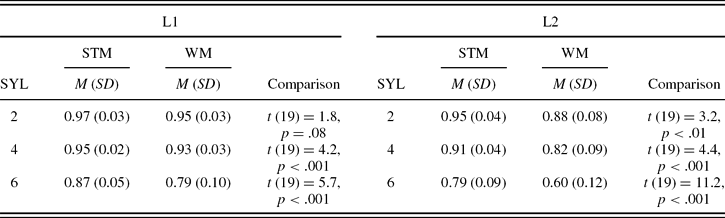
Follow-up comparisons were undertaken to identify the loci of the various interactions. In the first set of analyses, performance across the various syllable lengths was contrasted for the STM versus the WM task in each of the bilinguals' two languages (see Table 2). These analyses revealed that in the L2, participants performed better on the STM than on the WM tasks across all three syllable lengths. However, in the L1, participants performed better on the STM than on the WM tasks only for four- and six-syllable nonwords. There were no significant differences between STM and WM performance for the two-syllable nonwords in participants' L1.
Performance on the STM task versus the WM task within each language across SYL lengths
Note: STM, short-term memory; WM, working memory; SYL, syllable; L1, first language; L2, second language.
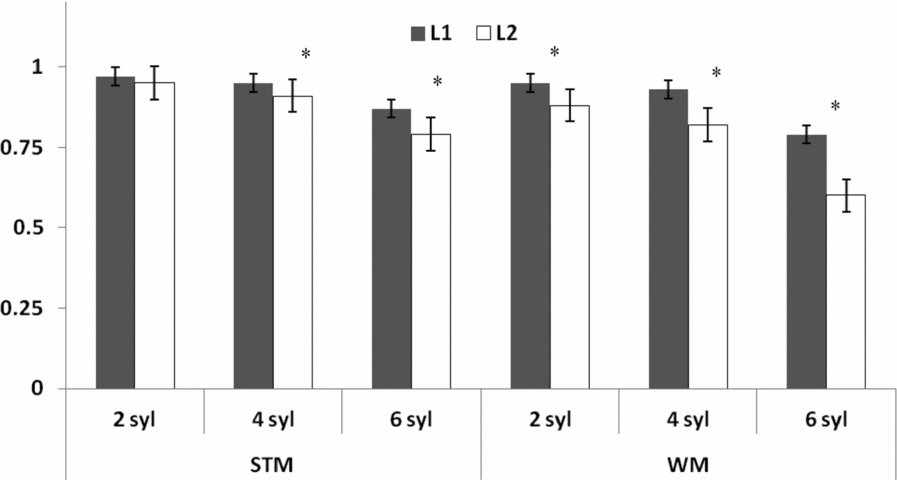
In the second set of analyses (see Figure 1), paired-samples t tests were used to compare bilinguals' performance in L1 versus L2 on STM and WM tasks across the various syllable lengths. These analyses showed that on the WM tasks, bilinguals performed better in their L1 than in their L2, across all three syllable lengths. However, on the STM tasks, bilinguals performed better in their L1 than in their L2 only for four- and six-syllable nonwords. For two-syllable nonwords, there was no significant difference between bilinguals' performance on the L1 versus the L2 STM task, although the direction of the difference trended with other comparisons.
Performance on the short-term memory (STM) task and the working memory (WM) task across syllable levels in first language (L1) versus second language (L2). For the STM task, the difference between L1 and L2 was not significant for two-syllable nonwords, t (19) = 1.8, p = 0.09, but was significant for four-syllable, t (19) = 4.1, p < 0.001, and six-syllable nonwords, t (19) = 4.6, p < 0.001. For the WM task, the difference between L1 and L2 was significant for two-syllable, t (19) = 4.4, p < 0.001, four-syllable, t (19) = 6.1, p < 0.001, and six-syllable nonwords, t (19) = 8.7, p < 0.001. Significant comparisons are marked by an asterisk.
The interaction between language and syllable length in the overall ANOVA was driven by the fact that the difference between L1 and L2 performance was larger for four-syllable nonwords (Cohen d = 2.04) and six-syllable nonwords (Cohen d = 1.97) than for two-sylalble nonwords (Cohen d = 1.21), and that the difference between shorter and longer nonwords (between four-syllable and six-syllable nonwords) was more robust for the L2 (Cohen d = 3.27) than for the L1 (Cohen d = 2.63). The interaction between language and task complexity reflected the fact that task-complexity differences were stronger for the L2 (Cohen d = 2.13) than for the L1 (Cohen d = 1.55), and that L1/L2 differences were stronger for the WM task (Cohen d = 2.67) than for the STM task (Cohen d = 1.30). The interaction between task difficulty and syllable length in the overall ANOVA was driven by the fact that the difference between the STM and the WM performance was larger for the longer nonwords (Cohen d = 3.58) and that the difference between shorter and longer nonwords (between four-syllable and six-syllable nonwords) was more robust for the WM task (Cohen d = 3.55) than for the STM task (Cohen d = 2.20).
Together, these analyses revealed that participants' NWR performance was better in their L1 than in their L2, in the STM task than in the WM task, and for shorter nonwords than for longer nonwords. However, the differences between L1 and L2 performance were less robust for easier tasks (i.e., for the STM tasks and for two-syllable nonwords), and the task complexity and length effects were more robust for the participants' L2 than for their L1.
Animacy judgment performance on the WM task
Participants' performance on the animacy judgment task was analyzed using a 2 × 3 ANOVA, with language (Korean vs. English) and syllable length (two, four, and six syllables) as within-subjects independent variables. The results revealed a main effect of language, F (1, 19) = 48.16, p < .001, η2p = 0.72. Participants were more accurate on the animacy judgment tasks in L1 (M = 0.96, SD = 0.04) than in L2 (M = 0.84, SD = 0.08). There was no effect of syllable length, F (2, 38) = 1.90, p = .16, η2p = 0.09 and a nonsignificant trend for an interaction between language and syllable length, F (2, 38) = 2.98, p = .06, η2p = 0.14.
Correlations analyses
First, correlation analyses were run to examine the relationships between bilinguals' L1 and L2 phonological memory performance (see Figures 2 and 3). Correlation analyses revealed that for the STM task (Figure 2), at lengths of two syllables (r = .09, p = .70) and four syllables (r = .15, p = .52), there was no significant relationship between bilinguals' L1 and L2 performance. However, there was a relationship between L1 and L2 performance for the STM task at the six-syllable length (r = .51, p < .05). There were also positive and significant relationships on WM tasks between L1 and L2 across all three syllable lengths (Figure 3). The L1 performance at the two-syllable length was positively correlated with the performance in L2 (r = .51, p < .05). Similarly, the performance at the length of four syllables (r = .49, p < .05) and six syllables (r = .64, p < .01) in L1 showed positive correlations with the performance in L2.
Cross-linguistic correlations on the short-term memory task for two-, four-, and six-syllable nonwords. [A color version of this figure can be viewed online at http://journals.cambridge.org/aps]
Cross-linguistic correlations on the working memory task for two-, four-, and six-syllable nonwords. [A color version of this figure can be viewed online at http://journals.cambridge.org/aps]
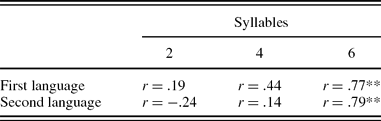
Second, correlation analyses were conducted to examine whether there were associations between STM and WM tasks within each language (see Table 3). The results revealed that for both languages, STM and WM performance correlated strongly for six-syllable nonwords, but did not correlate significantly for two-syllable and four-syllable nonwords.
Correlations at two-, four-, and six-syllable lengths between short-term and working memory tasks within each language
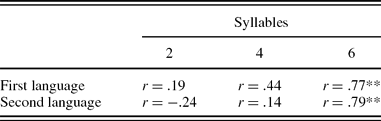
**p < .01.
DISCUSSION
The current study examined phonological memory performance in bilinguals' L1 and L2. The findings were that Korean–English bilinguals performed better in their L1 (Korean) than in their L2 (English), on STM tasks than on WM tasks, and with shorter nonwords than with longer nonwords. In addition, we found that the length effect was more robust in the L2 than in the L1 and on the WM tasks than on the STM tasks. We also found that the relationship between L1 and L2 performance was stronger for the WM than for the STM tasks, and that the relationship between the STM and the WM tasks was stronger for longer nonwords in both the L1 and the L2.
The finding that bilinguals performed better in L1 than in L2 is in line with previous data in that the results of the current study support an L1 advantage in bilingual processing even on tasks that are less knowledge based. Recent studies that examined bilinguals' STM using the NWR task have focused on the link between NWR performance and other linguistic tasks in the L2. One clear finding in these studies is that the bilinguals' performance on the NWR task in L1 is more accurate than their performance on the NWR task in L2 (e.g., Masoura & Gathercole, Reference Masoura and Gathercole1999; Windsor et al., Reference Windsor, Kohnert, Lobitz and Pham2010). Performance on the NWR task depends on the ability to quickly store phonological representations of unknown words in phonological memory without being able to rely on semantic information to accomplish the task. It is likely that in the current study, stronger phonological representations were associated with the L1 than the L2 because Korean–English bilinguals in this study were dominant and more proficient in their L1 than their L2.
Bilinguals were also more accurate on the STM task than on the WM task. According to Baddeley's WM model (2000), two subsystems of the phonological loop are the phonological store and the rehearsal process. The role of the phonological store is to maintain the verbal information for a brief period of time by representing input as phonological code. The ability to do so accurately decays with time. An active rehearsal process can prevent the decay by rehearsing the newly stored information (e.g., Baddeley & Logie, Reference Baddeley, Logie, Miyake and Shah1999). One explanation of the finding that bilinguals performed better on the STM task than the WM task is that they may have had more rehearsal opportunities during the STM task than during the WM task. Although the time between the presentation of the nonword and the cue to repeat it was set to 4000 ms across both conditions, an animacy judgment task was inserted in the WM task, whereas the STM task was not accompanied by another cognitive processing task. It would thus be more feasible for participants to rehearse the partial phonological representations of nonwords before repeating them on the STM task than on the WM task.
It is interesting that the difference between STM and WM performance was stronger for bilinguals' L2 than for their L1. This finding may be interpreted to suggest that increased difficulty levels associated with non-L1 processing sharpen the divide between the two types of task, and make the WM task especially demanding. However, it may also be that the increased difficulties associated with the WM task in the L2 are not an outcome of the decreased NWR performance per se, and instead are a reflection of a relatively greater difficulty associated with performing the secondary task (animacy judgment) in the L2 than in the L1. Although the nouns selected for the English animacy-judgment task were all high-frequency, early-acquired nouns, and the accuracy on the animacy-judgment task in L2 was high (84%), we did observe significantly better performance on the animacy judgment task in Korean than in English. Therefore, the possibility remains that the reduced levels of L2 performance on the WM task were partially due to participants' difficulties with making animacy judgments on the English nouns (for a similar argument regarding L2 reading, see Pienemann & Johnston, Reference Pienemann, Johnston and Nunan1987). Therefore, a fruitful direction for future research would be to contrast the effect of a linguistic secondary task to a nonlinguistic secondary task in bilinguals' WM performance in the L1 versus the L2. In the present study, we aimed to ensure high levels of interference between the secondary and the primary tasks, and therefore chose a linguistic secondary task for our WM measure. However, if it were demonstrated that differences between STM and WM performance were also more robust in bilinguals' L2 when the secondary task was nonlinguistic in nature, it would serve as a strong confirmation that L2 processing imposes greater demands on the phonological memory system. In fact, a promising direction for future research would be to contrast linguistic and nonlinguistic STM and WM performance in bilinguals, in order to delineate the degree to which verbal memory relies on domain-general nonlinguistic processes. The current study can serve as the first crucial step in this line of research, because it demonstrates that the link between L1 and L2 phonological memory performance in bilinguals becomes stronger with increased task demands.
In this study, bilinguals showed consistent decline in their NWR performance with an increase in syllable length from two to four to six syllables. This decline was apparent across not only the bilinguals' two languages but also across the STM and the WM tasks. This finding is in line with previous research where the length effect was observed (e.g., Archibald & Gathercole, Reference Archibald and Gathercole2006; Girbau & Schwartz, Reference Girbau and Schwartz2007; Summers, Bohman, Gillam, Peña, & Bedore, Reference Summers, Bohman, Gillam, Peña and Bedore2010). The typical interpretation of length effects is that longer syllables/items take a longer time to rehearse in the phonological loop, and that therefore more forgetting tends to occur for longer syllables/items than for shorter ones (Baddeley & Logie, Reference Baddeley, Logie, Miyake and Shah1999). Our finding of the length effects in both Korean and English supports previous findings with monolingual speakers of various languages, which indicate that the syllable length effect is not language specific (e.g., Archibald & Gathercole, Reference Archibald and Gathercole2006; Girbau & Schwartz, Reference Girbau and Schwartz2007; Radeborg, Barthelom, Sjöberg, & Sahlén, Reference Radeborg, Barthelom, Sjöberg and Sahlén2006). The new finding in our study is that the length effect appears to be more robust in bilinguals' nonnative language than in their native language. We attribute the stronger syllable-length effect observed in the L2 than in the L1 in the current study to the more demanding nature of the NWR task in L2 than in L1. However, it should be noted that although all nonwords in L1 and L2 were constructed based on the phonotactics of each language and although we matched the nonwords in length across the two languages, it is possible that factors we did not account for may have contributed to the differences observed between L1 and L2 NWR performance.
There was a stronger relationship observed between L1 and L2 on the WM task than on the STM task. Actually, L1 and L2 STM performance did not correlate for the two-syllable and four-syllable nonwords. Although we expected stronger cross-linguistic associations for the WM than for the STM task, we did not expect entirely nonsignificant cross-linguistic correlations for the STM task. Previous studies have shown that NWR performance did correlate between bilinguals' L1 and L2 (e.g., Masoura & Gathercole, Reference Masoura and Gathercole1999; Service & Kohonen, Reference Service and Kohonen1995). One reason why the present study revealed such weak relationships between L1 and L2 STM performance may be the phonological (and broad linguistic) distance between English and Korean. Specifically, Korean and English are highly phonologically distinct in that many phonemes do not overlap across the two languages, and the phonotactic rules are quite dissimilar for English and Korean (e.g., in terms of allowable syllable structures; e.g., Ha, Johnson, & Kuehn, Reference Ha, Johnson and Kuehn2009). Language-specific phonological knowledge influences phonological memory performance (Jusczyk, Luce, & Charles-Luce, Reference Jusczyk, Luce and Charles-Luce1994; Messer, Leseman, Boom, & Mayo, Reference Messer, Leseman, Boom and Mayo2010; Thorn & Frankish, Reference Thorn and Frankish2005). Therefore, the phonological distance between bilinguals' two languages may weaken the cross-linguistic associations on the STM task. It is possible that for bilinguals who speak two languages that share higher phonological overlap than English and Korean (i.e., Spanish and English), a stronger association between two languages might be observed for the STM tasks.
Another factor that may have mitigated the cross-linguistic relationships observed in the present study was participants' nonverbal intelligence. This group of bilinguals scored 1 SD above the mean on the visual matrixes subtest of the KBIT-II, a measure of performance IQ. It may be that in participants who fall within the average range of nonverbal IQ, the relationships between L1 and L2 phonological memory performance levels are instantiated differently than in participants who function at the peak of cognitive ability. Although our sample was not large enough to test this hypothesis, we conducted correlation analyses that related participants' nonverbal IQ scores and their performance on the phonological memory tasks. These analyses revealed that the nonverbal IQ scores did not correlate significantly with participants' L2 or L1 phonological memory performance, for either the STM or the WM tasks, and at any levels of syllable length. Further, when nonverbal IQ was partialed out in correlation analyses, the relationships reported in the Results section remained unchanged. These findings should be interpreted cautiously given the constrained range of values in the nonverbal IQ data. It is feasible that a factorial approach to intelligence (where participants are divided into groups based on their IQ scores) would yield a different pattern of findings. What is important to note for the present study is that correlations for the WM task were very strong across all syllable lengths despite the phonological distance separating English and Korean, and that these correlations were not mitigated by nonverbal intelligence of the participants in the sample. The involvement of the central executive in WM performance is a likely explanation for this pattern of findings.
Previous research used dual-task methodology such as the reading span task (e.g., Daneman & Carpenter, Reference Daneman and Carpenter1980) or the operation span task (e.g., Tuner & Eagle, Reference Tuner and Engle1989) to measure the WM capacity. These paradigms engage participants in doing a processing task (reading sentences or solving a string of arithmetic operations) while at the same time keeping track of an increasing list of words. A processing task requires controlled attention, and the central executive in the WM model is responsible for allocating controlled attention to a task at hand (e.g., Baddeley & Hitch, Reference Baddeley, Hitch and Bower1974; Baddeley & Logie; Reference Baddeley, Logie, Miyake and Shah1999). WM tasks, therefore, involve a more domain-general attention mechanism, whereas STM tasks depend on the phonological loop and are more specific to the linguistic domain. We thus interpret the stronger relationship between L1 and L2 on the WM than on the STM task in our study as suggesting that WM tasks involve domain-general attentional mechanisms, and that reliance on these mechanisms is what underlies the association between L1 and L2 WM performance.
However, one difficulty with this interpretation stems from the fact that we found a significant correlation between L1 and L2 at the six-syllable level on the STM task. If WM tasks but not STM tasks engender cross-linguistic correlations through reliance on domain-general mechanisms, why would there be a significant correlation for the STM task? One explanation for these findings is that cross-linguistic correlations were stronger for tasks that were more challenging and that thus yielded higher variability in the participants' performance. This explanation would account for both a correlation between L1 and L2 for the STM task with six-syllable nonwords, and for strong correlations between L1 and L2 on the WM tasks. However, there is reason to argue that the stronger correlations in the WM data than in the STM data are not simply an outcome of the increase in the difficulty levels. The significant correlation between L1 and L2 performance was observed for the WM (but not the STM) task at the two-syllable level. Just like the STM performance, the WM performance at the two-syllable level was very high for both the L1 (M = 0.95) and the L2 (M = 0.88). Yet, the correlation between L1 and L2 performance was nonsignificant for the STM task (r = .09, p = .70), but was highly significant (r = .51, p = .02) for the WM task. This indicates that the WM task invited a stronger correlation between L1 and L2 for the two-syllable nonwords than the STM task, despite highly accurate levels of performance.
How then do we interpret the findings of strong cross-linguistic correlations for the STM task with six-syllable nonwords? One suggestion is that the involvement of the central executive in phonological memory performance is a matter of degrees, with more complex/demanding STM tasks also relying on the central executive. This argument has been made a number of times in previous research, where the involvement of domain-general cognitive processes was demonstrated not only in the WM tasks but also in the STM tasks (Cowan, Reference Cowan, Miyake and Shah1999; Majerus, Heiligenstein, Gautherot, Poncelet, & Van der Linden, Reference Majerus, Heiligenstein, Gautherot, Poncelet and Van der Linden2009; Unsworth & Engle, Reference Unsworth and Engle2006). For example, Unsworth and Engle (Reference Unsworth and Engle2006) found that participants' performance on difficult STM measures (e.g., longest lists on a word-span task) and WM measures (e.g., a reading-span task) shared a large amount of common variance. They suggested that the common variance reflected the fact that both types of tasks demanded focused attention. Similarly, we believe that the central executive may have to come in to keep track of nonwords with the increase in syllable length on the STM task. The correlation analyses that were conducted within each language confirm this interpretation. These analyses revealed that STM and WM performance levels were correlated only for the six-syllable nonwords (in both the L1 and the L2), but not for two- and four-syllable nonwords. Therefore, these results suggest a common underlying mechanism to the WM and the STM systems for the more complex/demanding STM tasks. Together, the correlation findings of the current study point to a possibility that WM tasks and the more demanding STM tasks may rely on the central executive.
The current study has a number of clinical implications for the assessment of bilingual clients with regard to their language abilities. Although our bilingual participants were more dominant in Korean than in English (as indicated by all participants selecting Korean as their dominant language), they also self-reported fairly high levels of English proficiency across domains (speaking, reading, and understanding) and a large degree of exposure to English in their daily activities (57%). Yet, despite the frequent current use of English, and despite the fact that the participants have been living in the United States for an average of 5.1 years, their performance on the English vocabulary measures was in the low average range (26th percentile for the receptive vocabulary and 44th percentile for the expressive vocabulary). This confirms the long-standing understanding of the biases associated with administering standardized language measures to nonnative speakers. What is perhaps more interesting, is that bilinguals performed better in Korean than in English on the nonword repetition task, and this was especially true for the WM tasks. Nonword repetition has been described as a processing-based (rather than a knowledge-based) language measure, in that it reflects the ability to process information on-line rather than to retrieve information stored in the long-term memory (e.g., Dollaghan & Campbell, Reference Dollaghan and Campbell1998). As a result, it has been proposed that nonword repetition-type tasks can be used to index language performance in minority populations whose language knowledge is reduced compared to majority populations, but who are not actually language impaired, including low socioeconomic status populations (e.g., Engel, Santos, & Gathercole, Reference Engel, Santos and Gathercole2008) and dialect speakers (e.g., Rodekohr & Haynes, Reference Rodekohr and Haynes2001). For example, Campbell, Dollaghan, Needleman, and Janosky (Reference Campbell, Dollaghan, Needleman and Janosky1997) showed that minority children performed less well than majority children on a knowledge-based language measure but that the two groups had comparable levels of performance on the nonword repetition task. Therefore, it may have been expected that the participants in the present study would perform as well on the English NWR task as on the Korean NWR task. The findings in the current study both support and challenge this expectation.
In support of the use of NWR measures to avoid bias in L2 language assessment, we found that L1 and L2 NWR performance levels were similar for the two-syllable nonwords on the STM task. However, this was the easiest task that yielded the highest accuracies in participants' L1 and L2. The clinical usefulness of the two-syllable NWR task is therefore limited, because everyone performs well on this measure. For all other conditions, bilinguals performed significantly better in their L1 than in their L2, suggesting that increases in difficulty levels on the processing-based task widen the gap between native language and nonnative language NWR performance. Therefore, although the utility of the NWR task for indexing language skills in bilinguals needs to be gauged based on the comparison to monolinguals’ performance, the findings of the current study indicate that discrepancies in language knowledge seep into NWR performance in bilinguals. That is, NWR tasks do not completely eliminate the gap between linguistic performance levels in the L1 versus the L2. However, it should be pointed out that the findings of the present study can only be generalized to bilinguals with similar language history to our participants. We suggest that performance on nonword repetition tasks, which is inherently tied to the ability to accurately store and reproduce language-appropriate phonological information, would be contingent on the specific linguistic experiences in bilinguals (both in terms of the particular languages a bilingual speaks, and in terms of L1/L2 experience levels). For example, it is likely that for bilinguals who were immersed in their L2 for a longer duration of time than our participants, the L2 nonword repetition performance would be higher than the levels observed here. Therefore, future work should implement a similar paradigm with different groups of bilingual speakers in order to examine how broadly the STM versus WM and L1 versus L2 differences apply in bilingual populations. Moreover, the current findings may be used as a springboard for future studies that would examine the extent to which phonological memory skills can predict language production and comprehension in bilinguals' L1 and L2. The current study, where each participant served as his/her own control in terms of performing both a STM and a WM task, was successful in demonstrating that in this group of bilinguals, L1 versus L2 differences apply to STM and WM tasks in distinct ways.
In conclusion, this study provides crucial detail regarding cross-linguistic relationships between bilinguals' STM and WM systems. Although extensive previous studies on bilingual memory exist, to date, there has not yet been a study that contrasted L1 versus L2 STM and WM skills within the same group of bilinguals. Doing so in the present study enabled us to discover that length effects (a well-attested phenomenon in memory literature) are more robust for working-memory tasks and for the L2 in bilingual adult speakers, and that L1 versus L2 differences influence phonological memory performance, and do so more strongly for the WM than for the STM tasks. Finally, the current study suggests that there may be a more robust association of WM than of STM skills between the bilinguals' two languages. Although it is well known that bilinguals' two languages form a dynamic interface (e.g., Baten, Loeys, & Hofman, Reference Baten, Loeys and Hofman2010), the degree to which cognitive mechanisms that underlie language processing interact across the two languages remains understudied. The results of the present work suggest that a single, domain-general attentional-control mechanism may be at the root of the cross-linguistic relationships observed for performance on WM tasks. Therefore, the phonological memory system is a crucial component of cognitive architecture in bilinguals, because it serves as an interface between domain-general cognitive processes (the central executive) and language-specific processes (the phonological loop and long-term linguistic knowledge).
Korean nonwords (List A, List B)
English nonwords list (List A, List B)
ACKNOWLEDGMENTS
This research was supported by the UW–Madison Graduate School WARF Grant (to M.K.). The authors are grateful to Stephanie Van Hecke, Jenna Osowski, Julie Winer, and Marissa Stern for help with data collection and data coding.