INTRODUCTION
With the exception of ecosystems based on chemosynthetic pathways for the production of organic matter, communities in the deep sea depend ultimately on the flux of particulate organic matter from the euphotic zone (Gage, Reference Gage and Tyler2003). At the Porcupine Abyssal Plain Sustained Observatory (PAP-SO) in the north-east Atlantic, extensive scientific research conducted by the BENGAL programme during the period September 1996–October 1998 (Billett & Rice, Reference Billett and Rice2001), showed that the organic matter flux to the seabed varies on seasonal and inter-annual time scales, both in terms of quantity and biochemical composition (Witbaard et al., Reference Witbaard, Duineveld, van der Weele, Berghuis and Reyss2000; Kiriakoulakis et al., Reference Kiriakoulakis, Stutt, Rowland, Vangriesheim, Lampitt and Wolff2001; Lampitt et al., Reference Lampitt, Bett, Kiriakoulakis, Popova, Ragueneau, Vangriesheim and Wolff2001, Reference Lampitt, Salter, de Cuevas, Hartman, Larkin and Pebody2010).
In addition, radical changes were observed in the benthic ecosystem. Significant increases in abundances occurred in protozoan (Gooday et al., Reference Gooday, Malzone, Bett and Lamont2010) and metazoan meiofauna (Kalogeropoulou et al., Reference Kalogeropoulou, Bett, Gooday, Lampadariou, Martinez Arbizu and Vanreusel2010), macrofauna (Soto et al., Reference Soto, Paterson, Billett, Hawkins, Galeron and Sibuet2010) and (mainly) megafauna (Billett et al., Reference Billett, Bett, Reid, Boorman and Priede2010). The small elpidiid holothurian Amperima rosea (Perrier, 1896) in particular showed an increase of over two orders of magnitude in its abundance (the ‘Amperima Event’ was used to describe this ecosystem change) (Billett et al., Reference Billett, Bett, Rice, Thurston, Galeron, Sibuet and Wolff2001). The radical change in the abundance of A. rosea, in conjunction with increases in the abundances of the holothurian Ellipinion molle (Theel, 1879) and the ophiuroid Ophiocten hastatum Lyman, 1878, led to the rapid utilization of phytodetritus deposited on the seafloor (Bett et al., Reference Bett, Malzone, Narayanaswamy and Wigham2001; Gage et al., Reference Gage, Anderson, Tyler, Chapman and Dolan2004). Although direct evidence is not conclusive, it has been suggested that the proliferation of A. rosea and the other species was related to the selective uptake of fresh phytodetritus and specific organic compounds within it; that is, the carotenoids β-carotene, zeaxanthin and echinenone (Wigham et al., Reference Wigham, Hudson, Billett and Wolff2003a; FitzGeorge-Balfour et al., Reference FitzGeorge-Balfour, Billett, Wolff, Thompson, Hudson and Tyler2010), which resulted in high fecundity and significant changes in reproductive output in A. rosea (Matsuno & Tsushima, Reference Matsuno and Tsushima1995; Wigham et al., Reference Wigham, Tyler and Billett2003b).
The large-scale changes observed in A. rosea abundance over the 1996–1998 period and over a large area of the Porcupine Abyssal Plain (Billett et al., Reference Billett, Bett, Rice, Thurston, Galeron, Sibuet and Wolff2001), were not recorded in other holothurian species. The psychropotid Psychropotes longicauda Theel, 1882 and the synallactid Pseudostichopus aemulatus Solis-Marin & Billett, 2004 showed a gradual and consistent increase in abundance, while the synallactid Pseudostichopus villosus Theel, 1886 showed little variation (Billett et al., Reference Billett, Bett, Reid, Boorman and Priede2010). In contrast, the deimatid Oneirophanta mutabilis Theel, 1879 showed a long-term decrease in its abundance accompanied by a similar trend in biomass (Billett et al., Reference Billett, Bett, Reid, Boorman and Priede2010). Most of these holothurian species, with the exception of A. rosea, have shown little selectivity in feeding (Iken et al., Reference Iken, Brey, Wand, Voigt and Junghans2001; Wigham et al., Reference Wigham, Hudson, Billett and Wolff2003a; FitzGeorge-Balfour et al., Reference FitzGeorge-Balfour, Billett, Wolff, Thompson, Hudson and Tyler2010), although O. mutabilis has shown evidence of selective uptake of fresh phytodetritus and sterols (Witbaard et al., Reference Witbaard, Duineveld, Kok, van der Weele and Berghuis2001; Neto et al., Reference Neto, Wolff, Billett, Mackenzie and Thompson2006; FitzGeorge-Balfour et al., Reference FitzGeorge-Balfour, Billett, Wolff, Thompson, Hudson and Tyler2010). All these species are considered to be dioecious, broadcaster spawners, with asynchronous patterns of gametogenesis and spawning. Large differences occur in their maximum oocyte size, fecundity and mode of larval pelagic development (Tyler & Billett, Reference Tyler and Billett1987; Billett, Reference Billett1991; Tyler & Young, Reference Tyler and Young1992; Ramirez-Llodra et al., Reference Ramirez-Llodra, Reid and Billett2005). Intra-ovarian brooding is known in one cosmpolitan species, O. mutabilis, but paradoxically in only one population in the Panama Basin (Hansen, Reference Hansen1975). This population was notable also for the presence of males with active spermatogenesis, whereas in all other populations sampled worldwide no reproductively active male O. mutabilis have ever been found (Tyler & Billett, Reference Tyler and Billett1987; Ramirez-Llodra et al., Reference Ramirez-Llodra, Reid and Billett2005).
The synallactid Paroriza prouhoi Herouard, 1902 is a characteristic species of the Porcupine Abyssal Plain (Tyler et al., Reference Tyler, Young, Billett and Giles1992). Studies on its feeding ecology have revealed the absence of selective feeding and no consistent seasonal or long-term trends have been noted in the biochemical compounds in its body tissues (Iken et al., Reference Iken, Brey, Wand, Voigt and Junghans2001; FitzGeorge-Balfour et al., Reference FitzGeorge-Balfour, Billett, Wolff, Thompson, Hudson and Tyler2010). Photographic evidence has shown that the simultaneous hermaphrodite P. prouhoi forms pairs on the seafloor (Mauviel & Sibuet, Reference Mauviel, Sibuet, Laubier and Monniot1985; Tyler et al., Reference Tyler, Young, Billett and Giles1992), a feature that distinguish P. prouhoi from the other holothurian species in the abyssal north-east Atlantic. This study combined histological examinations of the ovaries and testes of P. prouhoi over the time series with data on its abundance and biomass to determine whether reproductive output in hermaphrodites might change with time and in particular with the large environmental changes evident on the Porcupine Abyssal Plain at the time of the ‘Amperima Event’.
MATERIALS AND METHODS
Study site and field sampling
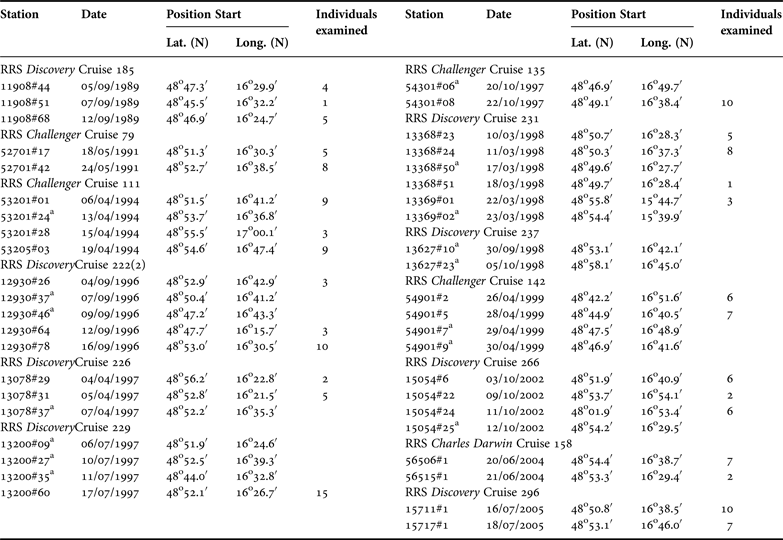
The collection of specimens was carried out within a 20 nautical mile radius around the Porcupine Abyssal Plain Sustained Observatory (PAP-SO) (48o50′N 16o30′W) from May 1989 to July 2005 and covering different seasons of the year (Billett & Rice, Reference Billett and Rice2001) (Figure 1; Table 1). Samples were obtained with a semi-balloon otter trawl (OTSB 14) which has an effective width of 8.6 m and a net height of approximately 1.5 m from the footrope to the headline. The body of the net is made of 44 and 37 mm stretch mesh netting while the cod end has a 13 mm mesh liner. After sorting, samples were fixed in 5% borax-buffered seawater formaldehyde and transferred to 80% methylated spirit after 3–5 d.
Porcupine Abyssal Plain Sustained Observatory (PAP-SO).

Samples from cruises at the PAP-SO used in the present study.
a, Samples that were used solely to the examination of abundance and biomass temporal patterns.
Processing of samples
ABUNDANCE AND BIOMASS
Individuals were counted and wet weighed in the laboratory. Biomass data should be regarded as minimum values because holothurians lose about 40% of their wet weight on preservation (Conand, Reference Conand1989). Variations in the mean values of abundance and biomass amongst cruises were tested with analysis of variance, one-way ANOVA. Prior to the analyses, the homogeneity of variance was tested and, when necessary, data were log-transformed.
BIOMETRY
Samples of Paroriza prouhoi were selected from each of twelve cruises (Table 1). A total of 162 individuals were examined. For each individual the following parameters were measured: (1) total length (TL), from mouth to anus (±0.1 cm), (2) tissue wet weight (Tww) (±0.1 g), following the removal of the coelomic fluid, (3) gonad wet weight (Gww), quantified as total Gww (ovary and testis) and separately for ovary only based on examination under a dissecting microscope (±0.01 g), and (4) body wall wet weight (Bww) (±0.1 g), following the removal of the gonads, alimentary canal and respiratory trees (Conand, Reference Conand1981).
Morphometric relationships were estimated using power function (y = a × x b which is solved as logy = loga + blogx) applying a linear regression analysis (Zar, Reference Zar1984).
GONAD INDICES
The measurements of gonad wet weight (total, ovary and testis) and body wall wet weight were used to calculate the Gonad Index (GI) through the equation:
 $$GI = \displaystyle{{Gww} \over {Bww}} \times 100 \quad \lpar \hbox{Shiell} \, \, \& \, \, \hbox{Uthicke, 2006}\rpar$$
The mean GI was calculated for each cruise and was compared among the cruises as well as between the periods prior to and after the ‘Amperima Event’ using one-way ANOVA and t-test.
FECUNDITY
The estimate of fecundity was based on the examination of 35 samples in the largest and best preserved ovaries. Owing to shrinkage of the ovaries it was not possible to determine the fecundity of all the specimens. The ovaries used for fecundity measurements were obtained from a number of different cruises.
To determine fecundity, two nodules from each ovary were selected at random and weighed to an accuracy of 0.001 g. The nodules were dissected and the number of oocytes in the nodules was determined using a dissecting microscope. The number of oocytes contained in the two nodules, the weight of the nodules and the weight of the whole ovary were used to estimate fecundity (Ramirez-Llodra et al., Reference Ramirez-Llodra, Reid and Billett2005).
GAMETOGENESIS
Samples from gonad tissues were dehydrated in graded alcohols, cleared in Histoclear and embedded in paraffin wax. Sections were cut at 7 µm and stained with haematoxylin and eosin. Gonad examination and photography were carried out with a light microscope. The Feret diameter (D) (i.e. the diameter in an oocyte for which the nucleus was visible in the section) of 100 oocytes was measured from each ovary (Costelloe, Reference Costelloe1985) using SigmaScan Pro 4 image analysis software. The measurements were grouped into 50 µm size-classes (Tyler et al., Reference Tyler, Young, Billett and Giles1992). The oocyte-size distributions were compared between the cruises using the Kolmogorov–Smirnov test (Sokal & Rohlf, Reference Sokal and Rohlf1995).
In addition, the mean oocyte diameter and the ratio between previtellogenic and vitellogenic oocytes (P) were recorded for each individual. Temporal variability in these two parameters i) among the cruises and ii) between periods prior to and after the ‘Amperima Event’ were tested with one-way ANOVA and t-test (Sokal & Rohlf, Reference Sokal and Rohlf1995).
RESULTS
Temporal variation in abundance and biomass
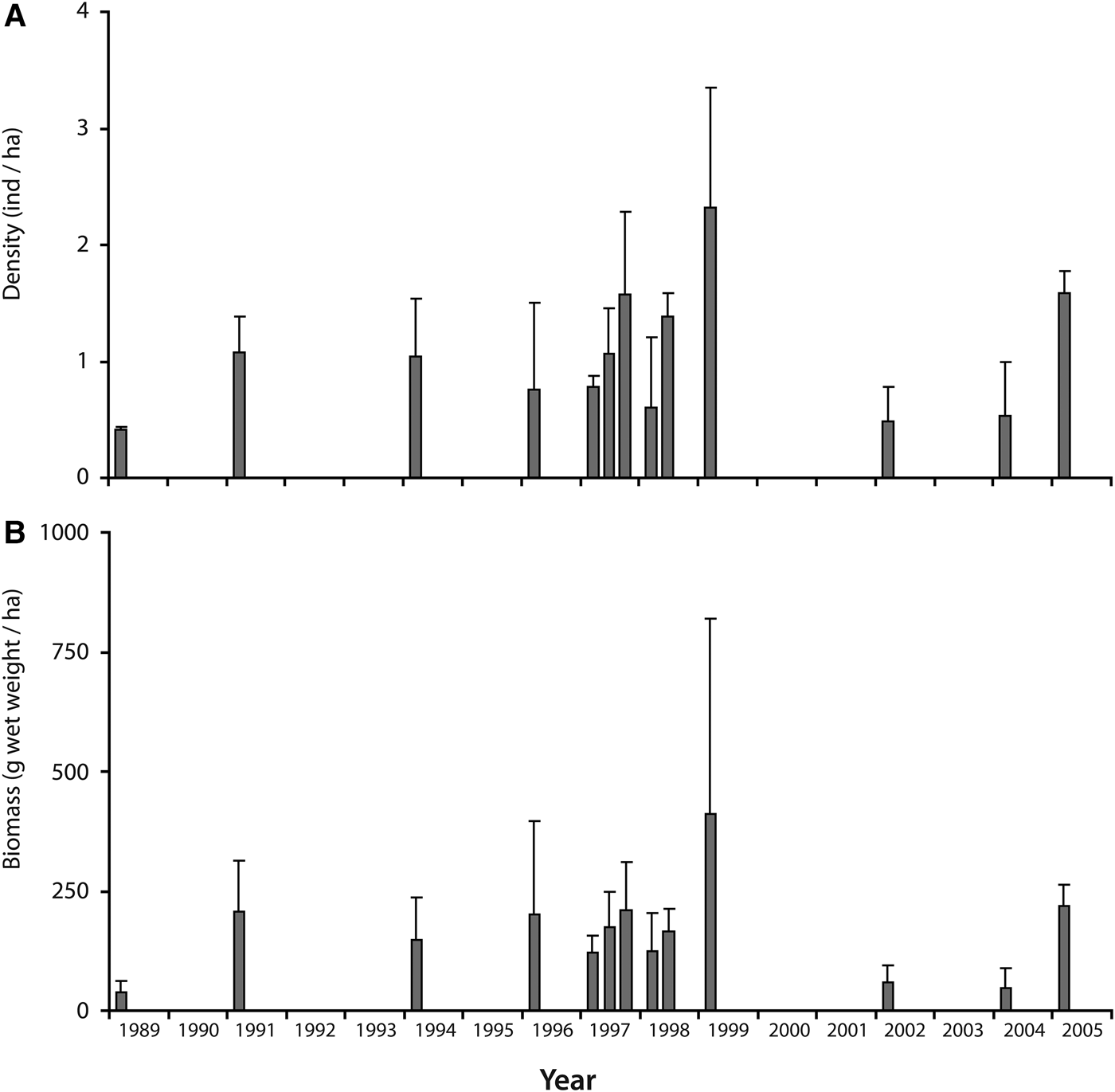
Paroriza prouhoi abundance showed significant differences between the cruises (F12, 30 = 3.65, P < 0.05) (Figure 2A). The peak value in April 1999 was significantly different from the values recorded in September 1989/September 1996/March 1998/October 2002 (Tukey's HSD multiple comparisons, P < 0.05). There were no significant differences between the periods prior to and after the ‘Amperima Event’ (t 36 = 0.71, P > 0.05).
Temporal variation in the density (A) and biomass (B) of Paroriza prouhoi at PAP-SO. Mean values and standard deviations are given.
The biomass values showed significant differences between the cruises (F12, 30 = 2.67, P < 0.05) (Figure 2B). Significant differences were recorded between September 1989 and April 1999 (Tukey's HSD multiple comparisons, P < 0.05). There were no significant differences between the periods prior to and after the ‘Amperima Event’ (t36 = 0.60, P > 0.05).
Biometry
Overall, 162 individuals of P. prouhoi were dissected and measured. Most individuals were adults (88%). The mean value ±SD for the total length (TL) was 24.1 ± 4.6 cm, N = 162, the tissue wet weight (Tww) was 134.15 ± 45.98 g, and the body wall wet weight (Bww) was 42.33 ± 16.18 g.
The biometric measurements were significantly correlated: Tww = 0.288·TL1.9139 (r = 0.84, P < 0.01, N = 162), Bww = 0.1289·TL1.8022 (r = 0.79, P < 0.01), and Bww = 0.8914·Tww0.7834 (r = 0.78, P < 0.01).
The ovaries in adults constituted between 62.6 and 95% of the total wet weight of the gonad. The ovary and testis wet weights were significantly correlated (r = 0.72, P < 0.01, N = 143). Also, the ovary index and the testis index were significantly correlated (r = 0.70, P < 0.01). Finally, neither the ovary wet weight nor the testis wet weights were significantly correlated with the Body wall wet weight (P > 0.05).
Gametogenesis
The ovaries of all the adults contained both previtellogenic and vitellogenic oocytes throughout the year. The previtellogenic oocytes were roughly spherical in shape with a basophilic cytoplasm and a large central nucleus; they were either attached to the germinal epithelium of the ovary wall or they were found in the lumen of the gonad nodules (Figure 3A, B). At a Feret diameter of ~100 µm, the primary oocytes underwent vitellogenesis and significant biochemical changes (e.g. acidophilic cytoplasm) occurred. Oocytes of various sizes were surrounded by accessory cells (Figure 3B). The maximum oocyte diameter recorded was 371 µm. In the testis, mature spermatozoa were present in the lumen throughout the year (Figure 3D). In some cases, spermatozoa were found to co-exist with spermatocytes, which showed columnar development (Figure 3C). The body wall wet weight of the smallest individual with vitellogenic oocytes was 16.6 g. The ovaries in juveniles contained only previtellogenic oocytes (Figure 3A); however, in some of the testes in juveniles, mature spermatozoa were evident (Figure 3C).
Paroriza prouhoi gonad histology and gametogenesis: (A) ovary of juvenile individual where the ramifying ducts (rd) arise from the central gonoduct (cg) and contain previtellogenic oocytes (pvo); ct connective tissue; (B) ovary of adult individual where vitellogenic oocytes (vo) coexist with previtellogenic oocytes (pvo); fc follicular cells, gw gonad wall, l lumen, n nucleus; (C) testis containing columns of spermatocytes (sc) and spermatozoa (sz); ge germinal epithelium; (D) testis with densely packed spermatozoa (sz); cg, central gonoduct; ct, connective tissue; gw, gonad wall; rd, ramifying ducts.
Fecundity and gonad indices
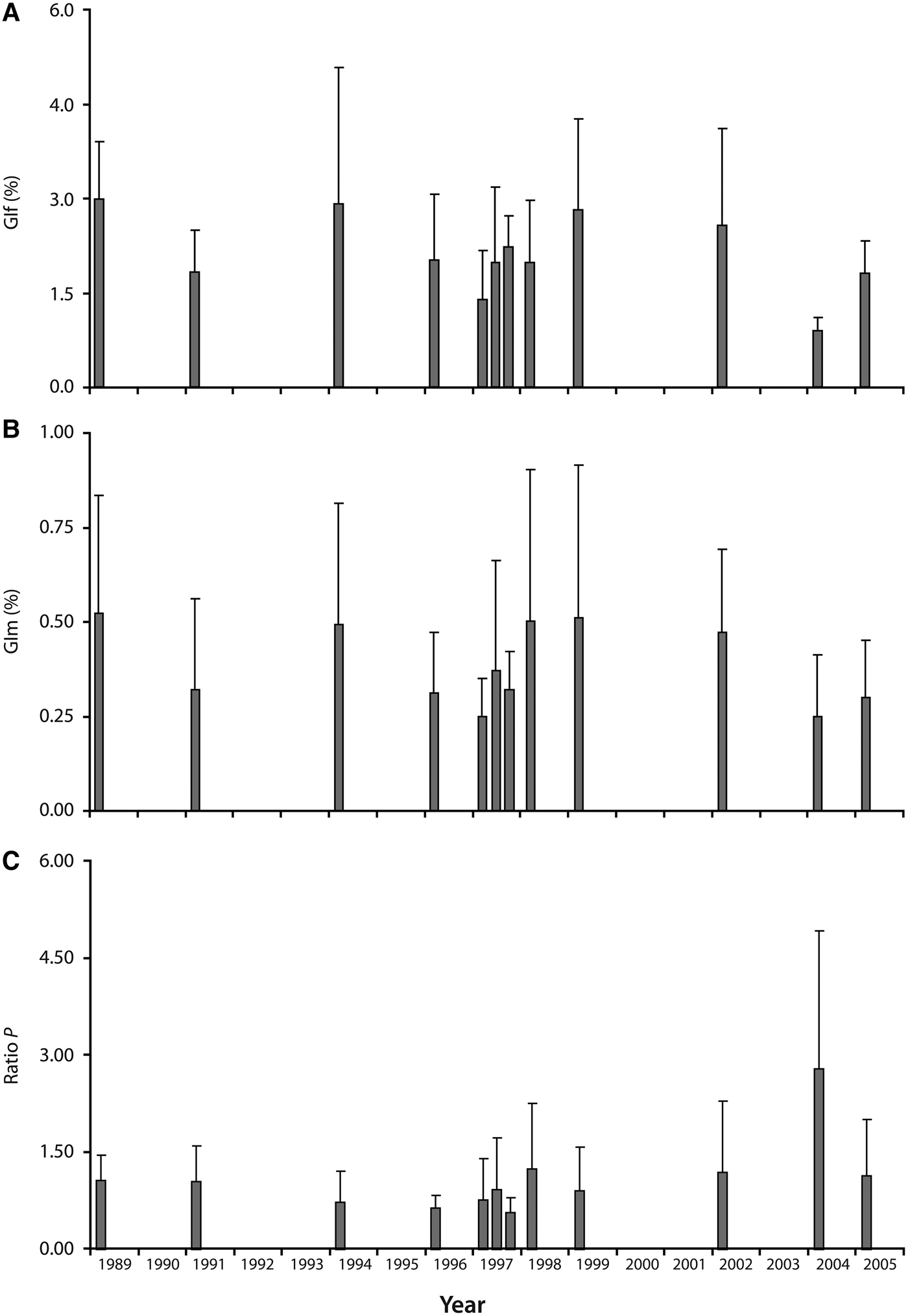
Fecundity ranged from 734 to 31,888 oocytes per individual (mean ± SD: 13,609 ± 6,943). The mean gonad index showed significant differences among the cruises (F11, 131 = 3.02, P < 0.01). Significant differences were observed between June 2004 and September 1989/April 1994/April 1999/October 2002 as well as between September 1989 and April 1997 (Tukey's HSD multiple comparisons, P < 0.05). This variability was attributed to the significant differences in the mean ovary index (F11, 131 = 3.21, P < 0.001) (Figure 4A); the mean testis index did not reveal any variations (Tukey's HSD multiple comparisons, P > 0.05) (Figure 4B). The mean gonad index showed a significant difference between the period prior to (2.69%) and the period after the ‘Amperima Event’ (2.27%) (t125 = −2.06, P < 0.05), as seen in the mean ovary index (2.25 to 1.89% respectively) (t125 = −2.07, P < 0.05). In contrast, the testis index did not show a significant difference between the two periods (t125 = −1.14, P > 0.05).
Temporal variation in the ovary index (GIf (%)) (A), testis index (GIm (%)) (B) and Ratio P (C) of Paroriza prouhoi individuals at PAP-SO. Mean values and standard deviations are given.
Temporal variation in the ratio between previtellogenic and vitellogenic oocytes and in mean oocyte size
The ratio between the previtellogenic and vitellogenic oocytes (P) showed significant differences between cruises (F11, 131 = 3.64, P < 0.001) (Figure 4C). The ratio P recorded in June 2004 was exceptionally high and was significantly different from all other samples (Tukey's HSD multiple comparisons, P < 0.05). There was no significant difference in ratio P between the periods prior to and after the ‘Amperima Event’ (t125 = 0.83, P > 0.05).
The mean oocyte diameter showed significant variation between individuals within each cruise. In addition, significant differences were recorded between the cruises (F11, 131 = 2.41, P < 0.01). These differences were prominent between October 1997 and June 2004 as well as between April 1994 and June 2004 (Tukey's HSD multiple comparisons, P < 0.05) (Figure 5). The differences in the mean oocyte diameter that were recorded for the periods prior to and after the ‘Amperima Event’ were not significant (t125 = 0.41, P > 0.05).
Temporal variation in the mean oocyte diameter (μm) of Paroriza prouhoi individuals at PAP-SO; note that data are presented by month and not by subsequent years.
Oocyte-size frequency distribution
The oocyte-size distribution for each individual did not reveal any evidence for the synchronous development of oocytes; previtellogenic and vitellogenic oocytes coexisted in all ovaries. The absence of synchronous development was also evident at the population level; oocytes were distributed over a relatively wide size range in all samples (Figure 6). A relatively high percentage of the oocytes (40–45%) measured less than 100 µm. The remaining oocytes were mainly in size-classes up to 250 µm in diameter (40–45%). Only a small percentage of oocytes (10–20%) occurred in the largest size-classes (300–350 µm) (Figure 6). The examination of the pooled oocyte-size distribution through the Kolmogorov–Smirnov test did not reveal significant differences between the cruises.
Oocyte size–frequency distribution of Paroriza prouhoi individuals at PAP-SO. N: number of individuals; Error bars: standard deviation.
DISCUSSION
Hermaphroditism, pairing and reproduction in P. prouhoi
The presence of hermaphrodites in the deep regions of the north-east Atlantic is an unusual characteristic in megafaunal echinoderms. Only a very few species from the classes Ophiuroidea (i.e. Ophiacantha fraterna Verrill, 1885, cited as Ophiacantha bidentata in Tyler & Gage, Reference Tyler and Gage1982; see Martynov & Litvinova (Reference Martynov and Litvinova2008) for details) & Holothuroidea (i.e. Mesothuria intestinalis (Ascanius & Rathke, 1805) (Mortensen, Reference Mortensen1927), Paroriza pallens (Koehler, 1896) and Paroriza prouhoi (Tyler et al., Reference Tyler, Young, Billett and Giles1992) share this feature. In a few instances, hermaphroditic individuals have been recorded in otherwise dioecious holothurian species, such as the elpidiids Peniagone azorica Marenzeller von, 1892 and Peniagone diaphana (Theel, 1882) (Tyler et al., Reference Tyler, Gage and Billett1985a) and the molpadiid Cherbonniera utriculus Sibuet, 1974 (Tyler et al., Reference Tyler, Billett and Gage1987).
The formation of aggregations in the deep-sea environment has been recorded for a number of echinoderms (Billett & Hansen, Reference Billett and Hansen1982; Gutt & Piepenburg, Reference Gutt and Piepenburg1991; Young et al., Reference Young, Tyler, Cameron and Rumrill1992). Up to now, the precise mechanism behind these aggregations is not fully understood (Gutt & Piepenburg, Reference Gutt and Piepenburg1991; Hamel & Mercier, Reference Hamel and Mercier1996). They may be formed in response to patchy food resources (Grassle et al., Reference Grassle, Sanders, Hessler, Rowe and McLellan1975) or as a mechanism to enhance fertilization success (Tyler et al., Reference Tyler, Young, Billett and Giles1992; Young et al., Reference Young, Tyler, Cameron and Rumrill1992). Pairing behaviour seems to be particularly important in the biology of P. prouhoi. Even though individuals are hermaphrodites, pairing may assist genetic exchange when eggs are released. This may be key for P. prouhoi because the abundance of the species is generally very low in the abyss (Tyler et al., Reference Tyler, Young, Billett and Giles1992).
The pattern of asynchronous oocyte development in P. prouhoi resembles reproductive patterns that have been recorded for dioecious holothurians from bathyal (Tyler et al., Reference Tyler, Muirhead, Billett and Gage1985b, Reference Tyler, Eckelbarger and Billett1994; Billett, Reference Billett1991) and abyssal depths (Tyler & Gage, Reference Tyler and Gage1983; Tyler et al., Reference Tyler, Gage and Billett1985a, Reference Tyler, Billett and Gage1987; Tyler & Billett, Reference Tyler and Billett1987; Wigham et al., Reference Wigham, Tyler and Billett2003b; Ramirez-Llodra et al., Reference Ramirez-Llodra, Reid and Billett2005) in the north-east Atlantic. Only a small number of species, mainly echinoderms, have been shown to have seasonal patterns of gametogenesis (Tyler et al., Reference Tyler, Grant, Pain and Gage1982; Tyler, Reference Tyler1988; Gooday, Reference Gooday2002; Gage et al., Reference Gage, Anderson, Tyler, Chapman and Dolan2004). This phenomenon has been related mainly to the seasonal deposition of phytodetritus during the early summer months in certain regions (Tyler et al., Reference Tyler, Grant, Pain and Gage1982; Billett et al., Reference Billett, Lampitt, Rice and Mantoura1983). There is no clear pattern evident in this study between the deposition of organic matter and changes in the reproductive output of P. prouhoi. Species with seasonal patterns of gametogenesis generally share common life-history characteristics, that is, small oocyte size, high fecundity and planktotrophic development of their larvae (Tyler & Gage, Reference Tyler and Gage1980; Tyler & Pain, Reference Tyler and Pain1982; Tyler et al., Reference Tyler, Billett and Gage1990; Campos-Creasey et al., Reference Campos-Creasey, Tyler, Gage and John1994; Ramirez-Llodra, Reference Ramirez-Llodra2000, Reference Ramirez-Llodra, Southward, Tyler, Young and Fuiman2002). The reproductive characteristics of P. prouhoi differ from seasonally-reproducing species in having a larger oocyte diameter and lower fecundity, suggesting lecithotrophic larval development (Billett, Reference Billett1991; Sewell & Young, Reference Sewell and Young1997).
Long-term observations in P. prouhoi reproduction dynamics
The examination of parameters such as the mean oocyte diameter, the ratio between previtellogenic and vitellogenic oocytes, and the mean testis index did not show significant changes between the periods prior to and after the ‘Amperima Event’. By contrast, the mean ovary index showed significant changes between the two periods, which may be attributed to the very low ovary index values recorded in June 2004. These observations indicate that over the period 1989–2005, the energy investment to the production of gametes did not change. Taking into account the intimate link between diet and reproduction (e.g. FitzGeorge-Balfour et al., Reference FitzGeorge-Balfour, Billett, Wolff, Thompson, Hudson and Tyler2010) it could be suggested that, over the examined period, the accessibility of P. prouhoi to energy resources remained unchanged. This suggestion is directly supported through evidence on species feeding ecology. Iken et al. (Reference Iken, Brey, Wand, Voigt and Junghans2001) reported relatively high δ 15N values in the body wall of P. prouhoi, indicating the utilization of refractory or frequently recycled organic material of low nutritional value. In addition, Wigham et al. (Reference Wigham, Hudson, Billett and Wolff2003a) showed that phaeophorbides (chlorophyll-a degradation products) were present in significant concentrations in the gut contents in P. prouhoi, suggesting it feeds on more refractory organic matter. FitzGeorge-Balfour et al. (Reference FitzGeorge-Balfour, Billett, Wolff, Thompson, Hudson and Tyler2010) did not find a significant temporal variation in the concentration of chlorophyll-a in the gut contents of P. prouhoi. Levels of chlorophyll-a were generally low, unlike other species of holothurians sampled at the same time. Generally, these authors suggested that there was little variation in the biochemistry of gut contents or tissues in P. prouhoi. It would seem that the feeding mode of P. prouhoi changes little with time and this may be correlated to the apparent lack of variation in its reproductive output. Similar patterns of feeding and reproduction are apparent in the synallactid Pseudostichopus villosus (Billett et al., Reference Billett, Bett, Reid, Boorman and Priede2010).
Large-scale changes in some taxa have occurred in recent years in the abyssal north-east Atlantic (Billett et al., Reference Billett, Bett, Reid, Boorman and Priede2010). Although direct evidence is not conclusive, the ‘Amperima Event’ seems to have been caused through changes in environmental conditions (i.e. food supply) rather than being the outcome of stochastic changes in species populations. The response of the benthic megafaunal taxa to enhanced inputs of organic matter to the deep-sea floor, however, varies considerably. While some species, such as A. rosea, show large changes in feeding and reproductive processes (Wigham et al., Reference Wigham, Hudson, Billett and Wolff2003a, Reference Wigham, Tyler and Billettb), others such as P. prouhoi show no response. In order to predict the effects of long-term climate change on deep-sea ecosystems, therefore, it will be necessary to address benthic communities at the species level.
ACKNOWLEDGEMENTS
We would like to thank the officers, crew and scientists aboard RRS ‘Discovery’, RRS ‘Challenger’ and RRS ‘Charles Darwin’ for their invaluable work over the years. Also, thanks to Alexios P. Lolas and Amy Scott-Murray for their assistance in the preparation of the figures. Finally, thanks to two anonymous referees for their constructive comments on the manuscript.
FINANCIAL SUPPORT
This paper makes a contribution to the Census of Marine Life (CoML) field project, on the Census of the Diversity of Abyssal Marine Life (CeDAMar), the EU Network of Excellence on Marine Biodiversity and Ecosystem Functioning (MarBEF), the European project Hotspot Ecosystem Research and Man's Impact on European Seas (HERMIONE) (EU contract number 226354), and the UK Natural Environment Research Council Strategic Research Project ‘Oceans 2025’. Georgios Kazanidis greatly acknowledges the “Alexander S. Onassis Public Benefit Foundation” for the awarded scholarship (F-ZF 028/2009-2010) for Postgraduate Studies at the University of Southampton.