Introduction
The orange wheat blossom midge, Sitodiplosis mosellana (Géhin) (Diptera: Cecidomyiidae) (hereafter called ‘wheat midge’), is a serious pest of spring and winter wheat, Triticum aestivum Linnaeus (Poaceae), and durum wheat, T. durum, in North America, Europe, and Asia (Bruce et al. Reference Bruce, Hooper, Ireland, Jones, Martin and Smart2007; Doane and Olfert Reference Doane and Olfert2008; Gaafar and Volkmar Reference Gaafar and Volkmar2010; Miao et al. Reference Miao, Wu, Gong, He, Duan and Jiang2013; Jacquemin et al. Reference Jacquemin, Chavalle and De Proft2014). Wheat midge is now a chronic pest, particularly in Canada’s Prairie Provinces (Olfert et al. Reference Olfert, Mukerji and Doane1985; Lamb et al. Reference Lamb, Wise, Olfert, Gavloski and Barker1999; Jorgensen et al. Reference Jorgensen, Otani and Evenden2020). The damage caused by feeding larvae reduces wheat yield and grain quality (Lamb et al. Reference Lamb, Tucker, Wise and Smith2000b). Olfert et al. (Reference Olfert, Mukerji and Doane1985) estimated yield losses of $CAD 30 million per year over the course of the first major wheat midge outbreak in Saskatchewan, Canada in the 1980s. Damage estimates have exceeded $CAD 300 million per year in Canada, with losses averaging $CAD 60 million per year (Wise, personal communication).
Female wheat midge adults lay eggs on newly emerged wheat heads, and the eggs hatch in four to seven days, depending on temperature (Mukerji et al. Reference Mukerji, Olfert and Doane1988). Wheat midge has three larval instars (Gagne and Doane Reference Gagne, Doane and Smith1999), but only the first two instars feed on developing wheat kernels (Doane et al. Reference Doane, Mukerji and Olfert2000). The nonfeeding third-instar larvae drop to the soil when humidity is high and burrow into the soil to diapause in overwintering cocoons within 5 cm of the soil surface (Hinks and Doane Reference Hinks and Doane1988; Gagne and Doane Reference Gagne, Doane and Smith1999; Doane and Olfert Reference Doane and Olfert2008). Diapause terminates with the arrival of warm and moist weather conditions (Basedow Reference Basedow1977) after 25 mm of rain through May (Elliott et al. Reference Elliott, Mann and Olfert2009). The third-instar larvae then crawl to the soil surface to pupate (Doane and Olfert Reference Doane and Olfert2008). In Canada, wheat midge adults emerge after a three- to four-week pupation (Lamb et al. Reference Lamb, Wise, Olfert, Gavloski and Barker1999). Both the emergence of wheat midge adults and susceptible spring wheat stages generally coincide in late June to early July in Canada (Lamb et al. Reference Lamb, Wise, Olfert, Gavloski and Barker1999).
Hinks and Doane (Reference Hinks and Doane1988) described the main requirements for laboratory rearing of wheat midge and maintained a colony for one annual cycle, although emergence of wheat midge larvae after diapause was low. Ding and Lamb (Reference Ding and Lamb1999) developed a method to obtain wheat midge oviposition in the lab, which was subsequently used in other studies to develop wheat resistance against wheat midge (Lamb et al. Reference Lamb, McKenzie, Wise, Barker, Smith and Olfert2000a, Reference Lamb, Sridhar, Smith and Wise2003). Wise and Lamb (Reference Wise and Lamb2004) described the effects of soil type, soil temperature, and length of diapause period on larval emergence after diapause in laboratory conditions – the basic conditions needed to successfully overwinter wheat midge. Based on the life-history research described above and the accumulated experience of rearing wheat midge in three laboratories, this paper summarises methods currently used for successfully mass rearing this important pest. Here, we describe the steps in a rearing protocol needed to maintain a laboratory colony of wheat midge, independent of current field densities. This method can be used for mass rearing wheat midge for use in laboratory experiments to study its biology (Lamb et al. Reference Lamb, Sridhar, Smith and Wise2003; Gharalari et al. Reference Gharalari, Smith, Fox and Lamb2009) or for identifying new sources of crop resistance in wheat such as the Sm1 gene or oviposition deterrence (Lamb et al. Reference Lamb, McKenzie, Wise, Barker, Smith and Olfert2000a, Reference Lamb, Smith, Wise, Clarke and Clarke2001).
Materials and methods
Wheat midge field collection
Wheat midges for laboratory use were collected from infested fields located at multiple Agriculture and Agri-Food Canada sites in Manitoba and Saskatchewan, Canada. Since 1996, the susceptible spring wheat cultivar ‘Roblin’ was sown in mid- to late May each year at a highly wheat midge–infested site in Manitoba to maximise larval production for field collections (Lamb et al. Reference Lamb, Smith, Wise, Clarke and Clarke2001). Initially, a few spikes were sampled after preanthesis to determine the abundance of larvae at the sites, and then stems were excised at 4–5 cm below the spike in the last week of July or the first week of August in most years (Lamb et al. Reference Lamb, Wise, Olfert, Gavloski and Barker1999). If larval collection happens later than the first week in August, there is a greater risk of third-instar larvae dropping from the spikes to the soil, where they are difficult to collect. Excised spikes were placed in open-topped plastic containers to dry at room temperature. Larvae were extracted from the spikes within four weeks of the field collection. Extraction was done by breaking apart spikes over a white tray and separating the larvae from seeds and chaff. Larvae left in the dried spikes for five or more weeks were susceptible to mortality from desiccation (Wise and Lamb Reference Wise and Lamb2004). This hand-collection method was labour intensive. To increase the speed of larval collection, field-harvested spikes can be fed through a standalone belt thresher (Almaco Machine Company, Nevada, United States of America), with the fan speed reduced. The fan speed should be turned down such that the small chaff and orange larvae are not blown out of the sample; this speed adjustment requires the user to manipulate settings based on the individual threshing machine being used. Separating third-instar larvae from the chaff and wheat seeds allows the larvae to be more efficiently counted out into the overwintering containers.
Laboratory rearing
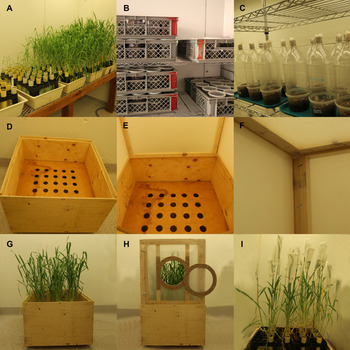
The larvae were grouped into sets of 75–200 individuals and added to the surface of a sandy, clay–loam soil in 500-mL plastic containers. The soil was a combination of clay, sand, and organic matter such as peat, which maximises moisture absorption and distribution. Clay and sand each consisted of approximately 40% of the original soil mix. Peat would have comprised approximately 20% of the original soil mix, but it would have quickly decomposed. Hence, after a second or third re-use, the soil was almost entirely comprised of clay and sand, with varying quantities of wheat chaff that would have been added each time larvae were added. Sand hastened the moistening of the substrate and prevented water from settling out on the surface, which can reduce oxygen levels in the soil and the survival of overwintering larvae. Clay retains moisture throughout the soil (Wise and Lamb Reference Wise and Lamb2004). The soil was 4–5 cm deep in each container. Approximately 75–100 mL of water added to this medium fully moistened the soil quickly but not to saturation. Containers with larvae were sealed and kept in the shade at room temperature for three to four weeks to allow the larvae to form cocoons before storage at 2.5 °C (Fig. 1B). A six-month period of cool storage ensured the maximum adult emergence, but storage periods of 12 months or more provided healthy adults (Wise and Lamb Reference Wise and Lamb2004).
Rearing system of wheat midge in the laboratory: A, different stages of the wheat cultivar ‘Roblin’ grown in hydroponics; B, containers with wheat midge cocoons sealed and kept at 2.5 °C for a minimum of six months; C, wheat midge emergence bottles placed on a steel shelf; D, wooden-cage base holding a plywood sheet with a five-by-five array of 3.5-cm holes to support 25 wheat plants; E, inside view of a wooden cage without wheat plants; F, the cage’s inside and outside coverings separated by wooden frame; G, wooden base holding wheat plants; H, circular opening on the front of the cage for adult introduction; I, wheat midge-infested wheat spikes covered with glassine pollination bags. Photo credit: Chaminda De Silva Weeraddana.

After artificial overwintering, containers with wheat midge larvae were transferred to a temperature-controlled room at 19 °C (day) and 17 °C (night) with a 16-hour light:8-hour dark photoperiod. Usually, a small amount of water was added to the surface of the soil after it was brought out of storage to lightly moisten the surface. After one week, the opaque container lids were replaced with clear plastic cages. These cages were constructed by cutting the bottom off a 2-L soft drink bottle and nestling it atop the container with the spout plugged with cloth mesh or a cotton ball (Fig. 1C). Adult midges emerged three to four weeks after removal from cold storage.
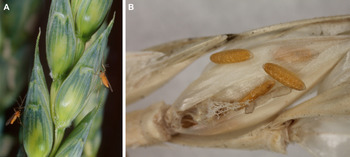
A major difference between laboratory-reared and wild-collected wheat midge larvae is the presence of parasites in some field-collected larvae. The egg parasitoid Macroglenes penetrans (Kirby) (Hymenoptera: Pteromalidae) emerged one to two days after most adult midges, which allows parasites to be excluded from the bioassay cages and kept out of the subsequent generations of laboratory-reared colony midges (Wise and Lamb Reference Wise and Lamb2004). The number of female and male adults was counted in the cages every day. The sex of each adult was confirmed by the size of the body, the length of the antennae, and the genitalia on the final abdominal segment. Males are smaller and have longer antennae than females do, and they have parameres instead of an ovipositor (Felt Reference Felt1912; Wang et al. Reference Wang, Li, Liu, Li, Cheng and Zhu-Salzman2016; Fig. 2A). Wheat midge females produce single-sex families (Smith et al. Reference Smith, Wise and Lamb2004), and an adequate number of wheat midges must therefore be allowed to emerge from overwintering containers to assure an approximately equal ratio of males and females. Within 24–48 hours of emergence, adults were added to a bioassay cage containing wheat and used for experiments or varietal screening.
A, Male (left) and female (right) adult wheat midge on a wheat spike. The sex of each adult wheat midge was identified by the size of the body, the length of antennae, and the last abdominal segment: males have a slender body and longer antennae than females do; on females, the ovipositor is visible on the last abdominal segment, whereas parameres are visible on males. Photo credit: Agriculture and Agri-Food Canada. B, Third-instar larvae encapsulated in the remaining exuvial of the second-instar larvae. Photo credit: Taylor Kaye.

Wheat plant production
The Canadian spring wheat cultivar, ‘Roblin’, has been used to maintain wheat midge colonies because it is highly susceptible and grows quickly to a convenient height under laboratory conditions suitable for wheat midge. Plants were grown individually in cylindrical Ray Leach supercell cones (length: 21 cm, top diameter: 3.8 cm; Stuewe & Sons, Inc., Corvallis, Oregon, United States of America) filled with Promix growing medium (Premier Tech Horticulture, Rivière-du-Loup, Québec, Canada). The bottom of each cone was plugged with a piece of soft, porous paper to prevent soil from exiting. The soil-packed cones were placed in plastic racks that have 98 holes (width 30.5 cm, length 61 cm, height 17.2 cm; Stuewe & Sons, Inc.), but we used only 49 holes for cones to separate rapidly growing plants. The plastic racks with cones were initially placed in tubs of water, such that the bottom 5–6 cm of the cones were submerged for one week to premoisten the soil, before the racks were transferred to tubs with a hydroponic media containing a water-soluble fertiliser (20:20:20, N:P2O5:K2O; Peters Professional, Dublin, Ohio, United States of America; supplier: HJS Wholesale Ltd., Winnipeg, Manitoba, Canada). Fertiliser solution was prepared by dissolving 6 g of fertiliser in 20 L water, and the solution was replaced every week until heading at approximately seven to eight weeks (Fig. 1A). Wheat spikes at a suitable stage, 25–75% of the spike emerged from the boot (Zadoks growth stage 53–57; Zadoks et al. Reference Zadoks, Chang and Konzak1974), were selected and moved to a bioassay room (Fig. 1G and H).
Wheat midge infestation
Wheat midge females oviposit at dusk and dawn, starting just before sunset until complete darkness in the evening and then again as the sun is rising (Reeher Reference Reeher1945; Pivnick and Labbé Reference Pivnick and Labbé1993), and they prefer warm, calm, and humid conditions for oviposition (Pivnick and Labbé Reference Pivnick and Labbé1993). These conditions (daytime temperature: 19 °C; nighttime temperature: 17 °C with 50%–60% relative humidity) were used in the bioassay room to maximise the survival and egg deposition of ovipositing adult females. This room provided 12 hours of full light preceded by two hours of dawn and followed by two hours of dusk. Light intensity was gradually lowered or elevated to simulate natural dusk and dawn conditions using a programmable electronic circuit (Lutron Electronics Co., Coopersburg, Pennsylvania, United States of America). Alternatively, a bank of Phillips dimmable, programmable LED light bulbs (model number: 9290022266; colour temperature: 2000–65 000 K; lumen output: 9.5 W with 800 lm; Philips Canada, Markham, Ontario, Canada) controlled through WiFi using the WiZ app (WiZ Connected, Hong Kong, China; available from Google Play and Apple App stores) can be placed above the bioassay chamber and programmed with dimmable dusk and dawn cycle, at a fraction of the cost of installing a programmable electronic circuit in a growth cabinet.
Any tillers at a growth stage not suitable for oviposition were removed, and the remaining tillers were supported by stakes. Plants were placed in wooden cages (a symmetrical cube 60 cm on a side; Fig. 1H). The outside of the cage was covered with transparent 0.15-mm-thick polyethylene film (thickness according to Canadian general standards board) and with an inner layer of mesh to prevent adults from becoming trapped on water droplets that often formed on the polythene (Fig. 1F). The inside and outside coverings were separated by 2.5 cm (Fig. 1F). The cage was placed on a 40-cm-high wooden base, with four wheels, to support the cage’s movement (Fig. 1G). The bottom of the cage had a large plastic basin to hold water for the plants. A plywood sheet with a five-by-five array of 3.5-cm holes was placed on the top of the plastic basin to support 25 test plants (Fig. 1D, E).
Everywhere inside the cage (except the plants) was misted with water to saturation to maintain a high humidity before the midge adults were added, which extended the life of females. Water would build up on the polythene but not on the mesh layer. Newly emerged male and female midges in approximately equal numbers were added to the cage through a 22-cm circular opening on the front of the cage (Fig. 1H). Bottles were held inside the cage and gently tapped to encourage adults to fly to the plants, at a rate of one or two females per wheat spike.
Plants were removed after being exposed to wheat midge adults for two to three days. The wheat spikes were then covered with glassine pollination bags (Lawson Pollination Bags, Northfield, Illinois, United States of America) that were closed at the bottom with a paper clip to protect eggs from desiccation and to encourage self-pollination of the wheat (Fig. 1I). The plants were then moved to a greenhouse and kept in tubs partly filled with water. Tubs were covered with black plastic to slow the rate of algal growth in the water. After three to four weeks, the heads of the wheat plants were excised, the pollen bags were removed, and third-instar larvae were extracted from spikes by gently pulling back the glumes. The third-instar larvae could be identified by the presence of the remaining exuvium of the second-instar that encases the larva (Fig. 2B). Sieves (mesh size 12 and 14) were used to separate larvae from the chaff.
The overwintering methods used for laboratory-reared third-instar larvae were the same as those used for the field-collected larvae. Laboratory-reared larvae, because of more optimal feeding conditions and the absence of parasitism, provided a larger and more predictable number of adults from overwintering containers than field-collected larvae did. Adding field-collected larvae to the culture each summer maintained the genetic diversity of the colony.
Results and discussion
To assess the yield of adults after diapause using the mass-rearing method described here, we tested eight containers with 75 (n = 6) or 100 (n = 2) wheat midge larvae per container in 2020. Adult emergence was 50.3% ± 12.5% (mean ± standard error) after an average of 322 ± 7.2 days (range: 294–340 days) of diapause at 2.5 °C. The sex ratio of the emerged adults was 1:1 (male:female). The first male emerged at 21.8 ± 0.4 days and the first female emerged at 22.8 ± 0.4 days after the containers were transferred to temperatures of 17 °C (night) and 19 °C (day). Adults emerged during a period of 10.8 ± 1.4 days (range: 5–16 days). After the first emergence, male peak emergence occurred at 3.2 ± 0.6 days and female peak emergence occurred at 5.0 ± 0.5 days. Most adults emerged in mid- and late afternoon. These results are within the ranges reported by Wise and Lamb (Reference Wise and Lamb2004) at similar temperatures using various unmixed soil types, although their rates of postdiapause adult emergence of wild-collected midges were lower. The consistent number of adults emerging and the timing of emergence can be coordinated with plant production to ensure successful oviposition on large numbers of plants at the suitable stage. The method can be scaled up or down by anticipating the number of adults needed for a particular series of tests and by transferring the appropriate number of overwintering containers out of cold storage.
Larvae survived a number of years in cold storage, assuring the availability of wheat midges when field populations were low (Wise and Lamb Reference Wise and Lamb2004). However, laboratory stocks can, and probably should, be replenished from field collections when wild-type populations are abundant. Thousands of diapausing larvae have routinely been stored long term at 2.5 °C, ready for use. This mass-rearing method has been used successfully in Winnipeg, Manitoba throughout the year, even in years when midge infestations in the field are low, and it has been readily scaled up for use in long-term wheat-breeding programmes and scaled down for short-term experiments on the biology of wheat midge and interactions of wheat midge with its host, such as screening wheat lines for antibiotic resistance and oviposition-deterrence traits (Lamb et al. Reference Lamb, McKenzie, Wise, Barker, Smith and Olfert2000a, Reference Lamb, Tucker, Wise and Smith2000b, Reference Lamb, Smith, Wise, Clarke and Clarke2001, Reference Lamb, Sridhar, Smith and Wise2003; Wise et al. Reference Wise, Lamb and Smith2001; Gharalari et al. Reference Gharalari, Smith, Fox and Lamb2009) and determining parasitism rates (Dufton et al. Reference Dufton, Laird, Floate and Otani2021). This rearing method will be useful as a result of a resurgence in international interest in crop resistance to insect pests of wheat following the development of commercially viable crop resistance to wheat midge in Canada (Berzonsky et al. Reference Berzonsky, Ding, Haley, Harris, Lamb, McKenzie and Janick2005). This method may also serve as a stimulus for developing similar rearing methods for other gall midges that are important pests worldwide (Harris et al. Reference Harris, Stuart, Mohan, Nair, Lamb and Rohfritsch2003).
Acknowledgements
Robert Bilodeau made valuable technical contributions to the method during its development. The authors are grateful to David Holder at the Department of Entomology, University of Manitoba for building wooden cages to continue the wheat midge colony and to Wilf Fritz at the Agriculture and Agri-Food Canada Saskatoon Research and Development Centre for copying the design for the Saskatoon, Saskatchewan colony. They are indebted to Taylor Kaye for the construction of the dimmable, programmable WiFi-linked LED light bank during his tenure with the Saskatoon wheat midge colony. The authors also thank the editor and the two anonymous reviewers for their helpful comments to improve the manuscript. This project was funded by the Saskatchewan Agriculture Development Fund (grant 20140250), Western Grains Research Foundation, the Saskatchewan Wheat Development Commission, Manitoba Agriculture, Food and Rural Development, Agriculture and Agri-Food Canada, and the Canadian Wheat Research Cluster.