Introduction
Recent changes in the music industry, emphasising live performances over recorded music, have caused an increased interest in the concert promoter. While research on live music has commonly focused on either the audience or the artists, scholars in popular music studies have recently started to pay attention to this important actor who connects artists with their audiences. The term promoter is ‘widely used in the music industry to describe the person or company responsible for the physical organisation and presentation of a concert or festival’ (Shepherd et al. Reference Shepherd, Horn, Laing, Oliver and Wicke2003, p. 561). In this article, we pay special attention to how concert promoters think. What are their motivations and attitudes, what are their goals? In their opinion, what is a good concert and what is a good promoter?
Based on both qualitative and quantitative data collected in Norway, we identify two dimensions in concert promotion: a paternalistic and a demand-driven approach. In presumably the most comprehensive study of concert-promoters written, The History of Live Music in Britain (Frith et al. Reference Frith, Brennan, Cloonan and Webster2013, Reference Frith, Brennan, Cloonan and Webster2019, Reference Frith, Brennan, Cloonan and Webster2021), based on a historical study of concerts and concert promoters in Britain, the authors make a distinction between ‘state-funded promoters’, ‘commercial promoters’ and ‘enthusiast promoters’. This categorisation may also be applied to our Norwegian material. However, when studying the motivations and the different approaches to concert promotion, we suggest an alternative categorisation defining five typologies of concert promoters: the idealist, the curator, the rationalist, the entrepreneur and the instrumentalist. These typologies, we argue, may be found across state-funded, commercial and enthusiast promoters, and should thus have relevance in other contexts than the Norwegian one.
Despite being a limited market, the Norwegian case holds a general interest also for a number of other reasons. First, the Norwegian music industry adapted early to digitisation and changed from physical phonograms to streaming. Second, The Norwegian case resembles a music infrastructure in a sparsely populated country with a considerable element of public cultural policy measures compared with, for example, Britain.
What do we know about concert promoters?
In 2007, Simon Frith stated that ‘Live music matters’, both economically and socially, thereby claiming that the live-scene deserves significantly more attention from researchers than it had previously experienced. According to Frith, previous accounts (e.g. Longhust 1995; Negus Reference Negus1992, Reference Negus1996; Shuker Reference Shuker2001) had taken for granted that the recording sector was the most important. However, this was at a time when the economic importance of live music was rapidly growing, and only a few years later, the total revenue of live music outscored the revenue from recorded music.Footnote 1
Consequently, since then, increasing attention has been paid to live music, and in 2011 Brennan and Webster also made us aware that ‘concert promoters matter’. Brennan and Webster, along with other scholars at the University of Glasgow and the University of Edinburgh, have made several important contributions to the work on concert promoters, particularly in the UK, and also on the worldviews of these actors (Cloonan Reference Cloonan2012). In recent years, several studies on concerts and concert promoters have been conducted globally (Carah et al. Reference Carah, Regan, Goold, Rangiah, Miller and Ferris2020; Holt Reference Holt2010, Reference Holt2020; Kleppe et al. Reference Kleppe, Berge and Hjelmbrekke2019; van der Hoeven and Hitters Reference van der Hoeven and Hitters2019, Reference van der Hoeven and Hitters2020).
Brennan and Webster clarify the most important concepts of being a concert promotor. With reference to Keith Negus, they describe how the task of a promoter includes ‘hiring venues, arranging stages, sorting out public address systems and lighting, employing caterers and security personnel, advertising the show and coordinating the sale of tickets’ (Negus Reference Negus1992, p. 130). In addition, the concert promoter is responsible for the safety of the concert, and not least, the financial sustainability of the event. The latter makes concert promotion a risky business. According to Cloonan, risk-taking is essential to concert promoters’ self-image, and constitutes their worldview, particularly when promoting medium-sized artists, where expenses are relatively high while the income potential is highly insecure.
As mentioned initially, the history of live music in Britain by Frith et al. provides a thorough description and analysis of concert promoters in Britain since the Second World War. In the first volume (1950–1967) they introduce a classification of promoters in order to describe live music events in 1950s Britain (Frith et al. Reference Frith, Brennan, Cloonan and Webster2013, p. 15). According to their classification, these three types have different motivations for promoting concerts: ‘the enthusiast promoters [put on shows] because they want to … The state-funded promoter promotes live music via subsidy and for policy reasons – educational, cultural, social and economic while the commercial promoter puts on concerts to make money’ (Frith et al. Reference Frith, Brennan, Cloonan and Webster2013, emphasis ours). They further show examples of how different promoters belonging to a ‘folk discourse’, ‘art discourse’ and ‘pop discourse’ may fit into this classification. As we will show, we found that the motivations among the different Norwegian promoters are more diverse than the three types described by Frith et al.
The Danish scholar Fabian Holt has also conducted several important studies on concert promoters. In his book, Everyone Loves Live Music, Holt (2020) presents a comparative case study of festivals and club-scenes in New York, Amsterdam, Brussels and Copenhagen. Holt particularly emphasises the institutional dimension of concert promotion and how the club scene has been commercially institutionalised within the last 30 years:
The commodification of popular music performance events follows a trajectory in modernity from civic to commerce-based forms of leisure. Voluntary civic associations played a central role in urban musical life in the eighteenth and nineteenth centuries, and new forms of popular music production evolved with the rise of corporate cultural industries in the twentieth century in the context of wider social and technological change. (Holt Reference Holt2020, p. 265)
This change has provided the audience with incredible sound experiences and remarkable scenography. Nevertheless, such regulated environments rarely reach ‘liminal levels and engage … little if any audience reflexively about the relationship between music, self and everyday life (Ibid, p. 269). Both Frith et al.'s and Holt's studies benefit from a historical perspective and thus the ability to describe change. Because of the limited work conducted on promoters in the Norwegian case, we have no such ambition. Nevertheless, the situation described by Holt as commercial institutionalism has several similarities to what we have described as the ‘price of professionalization’ in another paper on concert promoters (Kleppe and Berge Reference Kleppe and Berge2022). As we will show, this rationalisation of live music events happens, at least in Norway, both within the commercial and state-funded and even in the voluntary field of concert promotion.
Concert promotion in Norway
As already noted, in Norway, scholars have placed little attention on concert promoters. While some research has been conducted on festival promoters (Henningsen et al. Reference Henningsen, Håkonsen and Løyland2015; Maasø Reference Maasø2018; Tjora Reference Tjora2013), in general concert promoters, who set up concerts all year around, have been subject to very little scholarly attention. This was one reason why in 2019, financed by Arts Council Norway, we initiated a broad investigation of promoters in Norway. The investigation included various types of concert promoters within a broad sample of music genres. The empirical data behind the investigation included 44 qualitative interviews with concert promoters and artists, a survey sent out to 510 concert promoters, financial accounts from 787 concerts, and data on ticket sales from all of the large ticket companies in Norway. The results from the project were published as a Norwegian monograph (Kleppe et al. Reference Kleppe, Berge and Hjelmbrekke2019), and the data sample also makes up the grounds for the analysis in this article.
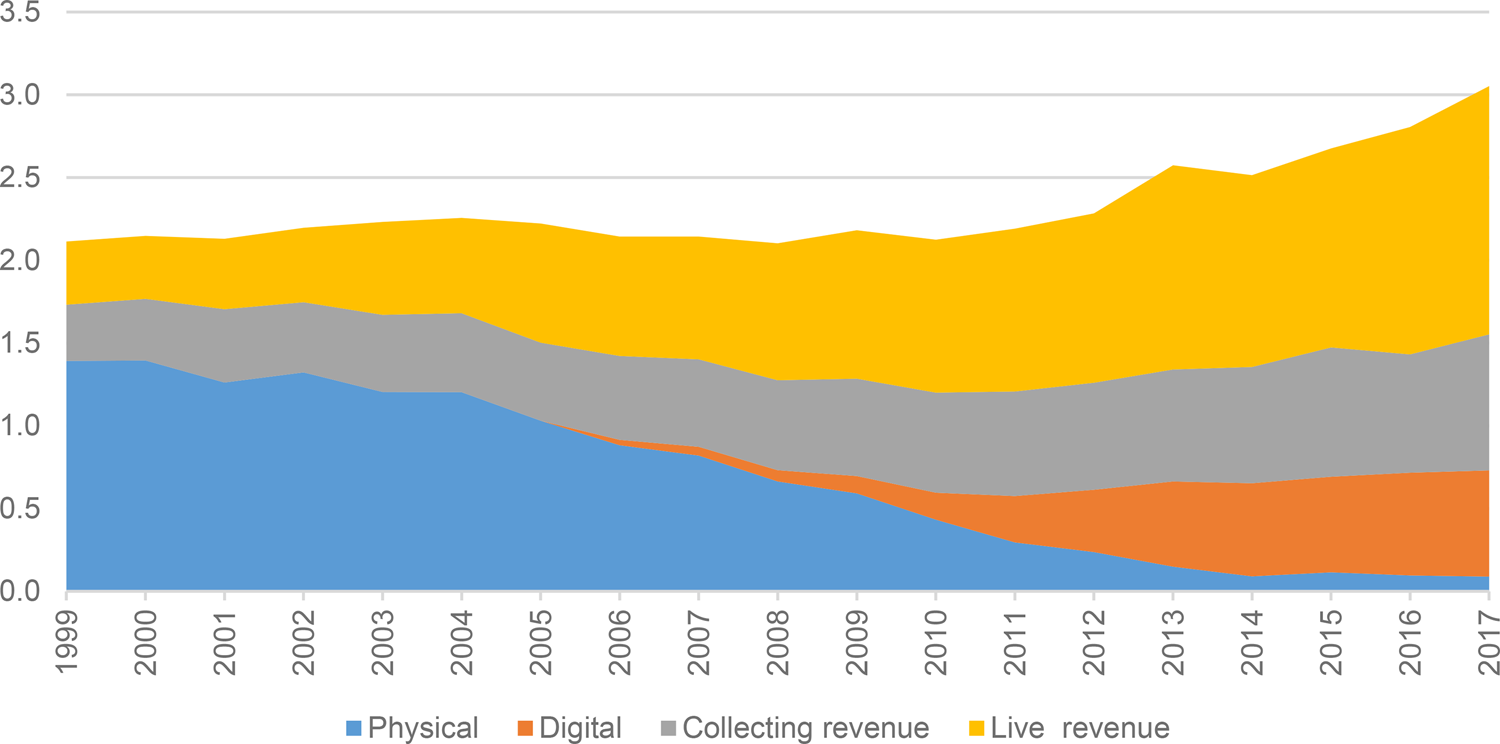
In Norway, as in the rest of the world, live music has played an ever more important role in the music industry. Statistics from IFPI Norway, as well as the two copyright societies, TONO and GRAMO, show that concert revenue has risen from approximately 20% of total revenues at the start of the millennium to half of all revenues in 2017 (Figure 1). Total concert revenue has tripled in the period in real terms. Surveys from Statistics Norway further show that Norwegians are attending concerts increasingly often, particularly older persons (Vaage Reference Vaage2017). The situation during the Covid-19-pandemic of course caused a state of emergency. However, there are many indications that this situation is a temporary one.
Physical and digital sales (IFPI), collecting revenue (Gramo/TONO) and live revenue (TONO), in billions 2017-NOK

Nevertheless, owing to these global trends, there are some differences between concert promotion and concert promoters in a small country like Norway and promoters in countries such as UK and USA. In this section, we will present a brief overview of concert promotion in Norway. Even though large promoters such as Live Nation also promote most of the mega-events in Norway, there exists a large variation of concert promoters, including both public and private ones of different sizes. First, as indicated in the introduction, a significant division runs between concert promoters who specialise in festivals and promoters who organise concerts throughout the year. In this article, we will focus on the latter.
Brennan and Webster (Reference Brennan and Webster2011) make a separation among: (a) the artist-affiliated model, whereby the promoter is linked to the artist in some way; (b) the independent model, whereby the promoter acts as a facilitator; and (c) the venue model, whereby the venue acts as promoter. These three models may also be found in Norway, even though the latter two are most common. In our empirical material, we identified seven different categories of concert promoters, festivals excluded (Kleppe et al. Reference Kleppe, Berge and Hjelmbrekke2019). The most straightforward category of concert promoters includes private house concerts, in which the audience is invited into a private house for a public concert. This has developed into a small trend in recent years. These DIY promoters are generally persons with a great interest in music, inviting artists to their home and leaving all of the box-office income to the artist. Hotels, pubs and restaurants are important venues for musicians in Norway as in the rest of the world. Sometimes, they are only used as venues for independent promoters or artist-affiliated promoters, but commonly the pub or the restaurant itself promotes the concert. Churches and congregations are also important promoters of concerts in Norway. In addition to music associated with services, several congregations also promote concerts for ordinary audiences.
The next category, Network Clubs or Genre promoters, is important for live music in Norway. In Anglo-American literature the word club is commonly used to describe intimate venues, operated commercially or as non-profits, often restricted by membership, occupation, sexual orientation and musical taste (Frith et al. Reference Frith, Brennan, Cloonan and Webster2019). In the Nordic countries, most clubs are organised as member-based voluntarily organisations typically promoting concerts once a month in a bar, hotel or kulturhus (see below). Most of these clubs are genre-specific and are part of a network of clubs organised under several genre-specific umbrella organisation (Kleppe et al. Reference Kleppe, Berge and Hjelmbrekke2019).Footnote 2 Student promoters share some common traits with Network clubs/genre promoters, as they are both voluntarily operated. However, while the first is commonly genre-specific, student promoters promote artists from many different genres for a student audience. Commonly, student promoters also have their own venue often owned by student society and located at a campus.Footnote 3 Kulturhus-es exist in more than 100 municipalities in Norway. These art centres or concert halls are commonly owned by municipalitiesFootnote 4 and include different facilities such as a movie theatre, library and rehearsal space. However, all of them have a venue, often more than one, of various sizes, which provide both classical and popular music concerts. Six of the kulturhus-es also have their own state-subsidised professional symphonic orchestra. Even though these venues are subsidised, they all need to make considerable box-office income. Private promotors/music halls primarily exist in large cities in Norway. These are promoters mainly working with concerts in addition to shows, stand-up and performing arts. Some of them are rather small similar to a club, others are larger holding a capacity of up to 1500. In addition to Live Nation, there are also some private independent promoters without a permanent venue promoting concerts in different venues throughout the year. This also includes outdoor-arena concerts, although those are relatively rare in Norway. Owing to the sparse population, the number of promoters that operate strictly on a commercial basis is limited.
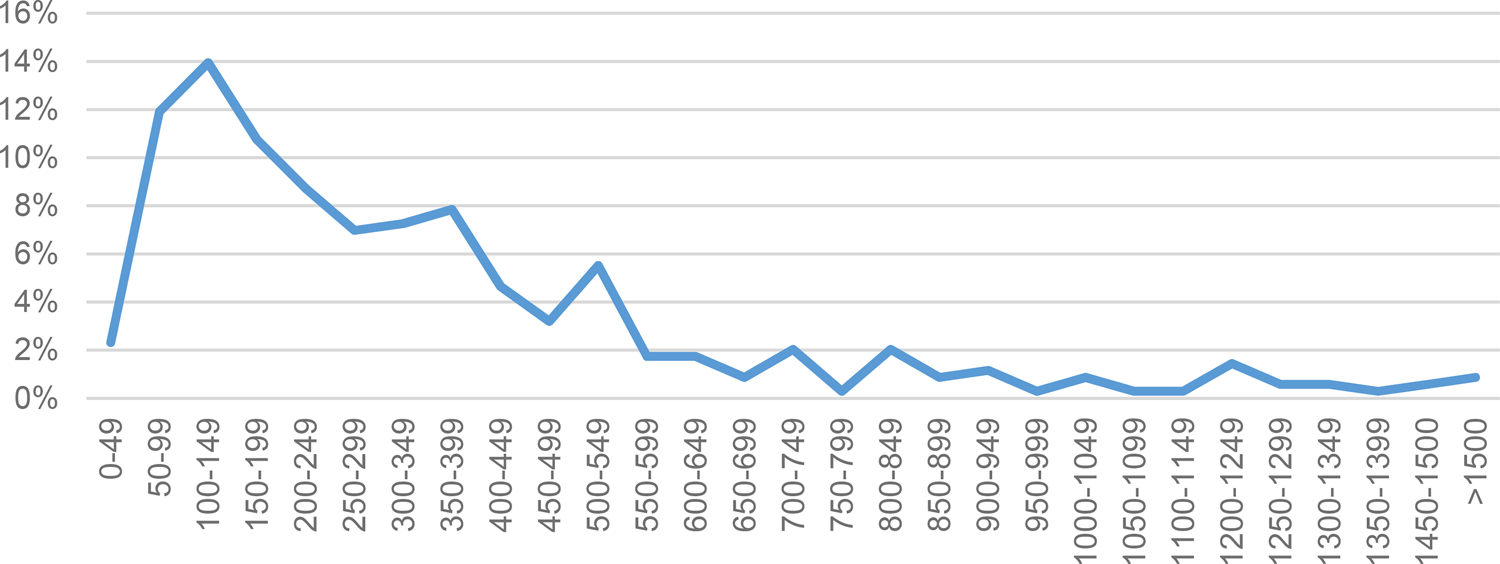
Looking at venue size (See figure 2), we find that more than half of Norwegian promoters work with venues which have an audience capacity below 250. A similar study from Live DMAFootnote 5 showed that half of European venues had a capacity of under 400. Even though there is a significant difference between these numbers, as the Norwegian venues are almost half the size of the European ones, it could be argued that the difference is not that big. This in turn suggests that the Norwegian case is relevant also in a European and perhaps international context.
Plot of venue sizes in Norway (Kleppe et al. Reference Kleppe, Berge and Hjelmbrekke2019).

Looking at the promoters’ economy, we found that 23% of the 747 concerts in our dataset had a box-office income below €500, whereas 47% had a box-office income below €1000.Footnote 6
Looking at the income profile of the concert promoters in our survey, 48% was box-office income, 3% sponsor income and 6% sales profit, while 10% was other contributed income. The rest, 33%, was public support, either local or from Arts Council Norway. Nonetheless, there were large variations between genres in terms of public support. Promoters of traditional and folk music received 66%, jazz promoters 48% and rock/pop promoters 20%, respectively, of their income from public support. While most genres received the largest share of public support from the central state level, rock and pop music received the most from local government.
The average expenses from our survey show that artist fees consisted of 38% of total expenses, whereas 17% were other concert-related expenses such as PA, backline, lodging, etc. Twenty-five per cent of the expenses were wages (several of the promoters worked on a voluntary basis), 7% housing expenses and 14% other expenses.
Having outlined these basic features of Norwegian concert promoters, mainly building on quantitative data, let us now turn to the qualitative data within the sample, in order to analyse what motivates and drives the promoters.
Making the perfect concert: between paternalism and demand models
The motivation of concert promoters is closely related to the question: what makes promoters skilled in their jobs, and how are successful concerts produced? Concert promoters come and go. Particularly within the category of private promoters/music halls and genre promoters, the turnover is relatively large, with many failing and many new ones being established (see e.g. Kleppe et al. Reference Kleppe, Berge and Hjelmbrekke2019). This fact is not necessarily negative in itself; on the contrary, it ensures that the audience is constantly provided with a new and relevant offer, that artists get new places to perform and that promoters are secured creative spaces where they have the chance to test new, innovative ideas and models. Hence, to promote concerts successfully over time is as fine an art as the actual performances of the artists that reside in the concert venues. There are numerous perspectives related to great concert promotion, and the answer to the question ‘what defines a skilled concert promoter?’ will depend on who you ask. The promoters will have certain views, the artists others. Venue employees or volunteers will have their opinions, while the audiences have theirs. Even though we have identified some research literature findings (Behr et al. Reference Behr, Brennan and Cloonan2016; Burland and Pitts Reference Burland and Pitts2010; Pitts Reference Pitts2010), we have limited empirical data (at least in our Norwegian case) to both audience and non-audience thoughts about optimal venue and concert experiences, and why they go to concerts or not. Promoters’ and artists’ (including the professional mediators they use, such as agents and managers) thoughts we know much better, not least as a result of talking to many of them in our 2019 project. In the following, we will focus on the promoters’ perspective of their work, i.e. how the promoters see themselves, and we start the analysis by focusing on what the promoters think about the audience.
A classic distinction within cultural policy research is that between the cultural producer's or distributor's desire to move or educate an audience – what is often referred to in terms of art's civilising capacity or bildung – and his or her desire to please that same audience (Bjørnsen Reference Bjørnsen2012; Harding Reference Harding2015; Lee Reference Lee2008; Murray Reference Murray2004). A similar distinction exists between concert promoters who mainly curate their programmes on the basis of what they want their audiences to hear and see, and promoters who primarily book artists that their audiences demand, i.e. between what can be seen as a form of paternalism on the one side, and market adaptation on the other. As we have seen, the quantitative data material identifies that a majority of the concerts over time have had a higher artist fee than their box-office income in Norway. This suggests at least two things. First, that they are funded from sources other than ticket sales, most prominently from bar sales or public cultural policy funding schemes. Second, concert promoters consider factors other than profitability to be the most important drivers for their work, as we may assume that insufficient ticket sales over time cannot be fully compensated for by other funding, at least not if profit is the number one objective. An interesting question related to this is whether reliable access to public funding for concerts makes it easier to be a paternalist concert promoter, and whether countries that offer such funding hence end up with more paternalist, enthusiast promoters, as a more market-based business environment would force the promoters more extensively to follow audience taste. This could very well be the case; we have not tested it, as this article does not make international comparison. However, given the large number of off-mainstream promoters that exist also within low public subsidy markets, one could suspect that this is more than a Norwegian/Nordic tendency.
Consequently, even though the size of the audience is presumably essential to most promoters, our findings suggests that to many promoters, the quality of an audience matters more than the size. It could thus be claimed that it is a myth that most promoters, even at the commercial end of the industry, are only in it for the money, letting go of the desire to give the audience not what it wants, but what the promoter wants. In the following, making use of the qualitative data from our empirical material, predominately interview material with Norwegian concert promoters from all geographical parts of the country and within all event categories, we elaborate on this assumption, asking the following question: from the promoter's point of view, what makes the perfect concert?
The audience should smile as they return home
Most promoters agree that a concert needs an audience in order to be a proper concert, but it is more unclear how large this audience needs to be in order for the concert to be perceived as a success. When we asked different promoters what they considered a successful concert, they often started with the audience and the audience's reactions. If the audience was happy, if ‘they smiled when they walked out of the venue’, as one of the informants put it, then the concert was a success, regardless of many other parameters. One informant, who was responsible for a large venue, quickly pinpointed a pleased audience as the target of a successful concert: ‘When the guests leave the concert and have had a nice experience, when we live up to their expectations. We are in showbiz. The audience wants a show’. Another promoter from a smaller club that once a year also turns into a festival, emphasised that ‘everybody should have a good time. If they do, the concert is a success’. A folk music venue highlighted ‘a full house and a smiling audience, who praises the quality’ as important goals. One promoter maintained that a successful concert is:
A successful meeting between music, artist and audience. A concert may be sold out, but when the audience leaves, it is satisfied, but not in ecstasy. Then, a concert may lose money, but the audience leaves with stars in their eyes, and talk and laugh for a long time. The same with musicians. So, the interaction must be there. Artistic and economic success must go hand in hand. We have to think about the economy, but we do what we do because we live and breathe music. It is an ongoing discussion within our venue, but it is important that no part gets to decide too much. One must book with both the brains and the heart.
It is interesting to observe that the informant draws a division between economic and artistic skills, in which the former is linked with rationality (brains) and the latter with emotions (heart). The way the informant insists that a sold-out venue is not a success in itself, if at the same time the audience is not happy, we would say is typical in our empirical material.
This ambivalence towards sold-out concerts may contribute to explain one of the interesting findings from the quantitative data material, namely that so many concerts in Norway lose money. It highlights the fact that most promoters desire a large crowd, but not if it is not a satisfied one. What this satisfaction is all about is more unclear, but it is fair to assume that it also entails, at least for the promoters’ part, a positive response to the artistic idea of the concert, as asserted by the promoter. This also entails the promoters being able to interpret and operationalise audiences’ cultural taste. Here the analysis may favour from the renowned French art sociologist Pierre Bourdieu's theory of taste and distinction (Bourdieu Reference Bourdieu1984). In the book Distinction, Bourdieu points towards a distinction between culture that has high symbolic value, but a small (rather disinterested) audience, and culture that has less symbolic value, but a larger (and perhaps more enthusiastic) audience. The disinterested–enthusiastic dichotomy reference in parentheses refers to Kant, who in his seminal work A Critique of Judgment connected disinterestedness with the claim to universal validity of the judgment of taste (Kant and Bernard Reference Kant and Bernard1914). For Kant, interest meant a kind of pleasure that is not connected with desire; it is neither grounded in desire, nor does it produce it (Zangwill Reference Zangwill2003). With regard to this distinction, Bourdieu was clearly inspired by Kant. Bourdieu further assumes that the affectionate relationship with art is less connected to intellect than an analytical one, and that this is determined by class (and education). In the art world, and this includes most concert promoters, it seems, the latter is connected with a higher symbolic value. The question is, however, whether the promoters have to choose between an audience that will not prefer ‘intellectually’ oriented concerts, or one that does not want to attend crowd pleasers. In an attempt to elaborate on this question, we again turn to Bourdieu.
The distinction between high and low symbolic value and this conceptual framework's relation to a small/large audience appears frequently in the empirical material. Everyone we talked to in one way or another mentioned the problem that lies in the space between the promoter's desire to organise concerts that they are proud of (or at least can vouch for) and his or her need to secure a decent audience. This problem is also central to numerous cultural policy and art sociology theories, asking what guides consumers’ cultural habits. Are such habits related to class or social position? Moreover, are they the result of free choices? In Bourdieu's (1984) analysis of the art field, an important point is that social fields, not unlike electric fields, are filled with tension between their actors. According to Bourdieu, the field of art is characterised by an ongoing struggle to achieve a status, honour and profits that have been negotiated, and are thus seen as legitimate within the field itself, what he terms ‘symbolic goods’ (Reference Bourdieu1993a, Reference Bourdieu and Bourdieub). These struggles are framed by both visible/formal (schools or positions) and invisible/informal (cultural capital) power structures, in which different gatekeepers, on different levels, provide or deny the actors access to central hierarchies of power and profits that they strategically seek. Bourdieu believes that the actors always, almost by nature, hold strategic agencies, so that they in the short or long term can achieve as many gains and symbolic goods as possible. As mentioned, according to Bourdieu's theories, taste is a function of class and habitus (which is the embodiment of class determinism), and audiences’ preferences in terms of what concerts they attend will consequently be guided by and closely linked to their socio-cultural positions. In addition, taste becomes an important part of a distinguishing process, in which an elite takes ownership of ‘good’ taste.
Bourdieu's theories related to taste and cultural consumers’ behaviour have earned him many followers, and could be said to have had a constitutive effect on the cultural sector both in Norway and internationally as far back as to the 1970s. At the same time, others have claimed that Bourdieu's analyses do not fully capture the collaboration and interaction that we know takes place across the apparent conflict lines of the cultural sector, particularly not in territories other than that of France (Boltanski and Thévenot Reference Boltanski and Thévenot2006; Bryson Reference Bryson1996; Elster Reference Elster1981; Erickson Reference Erickson1996; Jonvik Reference Jonvik2017; Lamont and Thévenot Reference Lamont and Thévenot2000; Sirnes Reference Sirnes2002). Scholars have also criticised Bourdieu's theories for not capturing the full picture regarding the social background/cultural preferences complex. In relation to the Norwegian context, Flemmen (Reference Flemmen2014) presents a good summary of this. He writes that the correlation between class and cultural distinction is in dispute. For example, you have some who think that such a correlation used to be the case, but is now dissolved or irrelevant. This is, it is argued, because of an increased individualisation, i.e. social change processes that dissolve everything that is collective (Flemmen Reference Flemmen2014), or a postmodern tendency, in which the distinction between high and low culture has collapsed.
Furthermore, according to Flemmen, there is a related claim that there does exist a correlation between social position and cultural consumption, but with a different content than before, e.g. that today's elites are not into high culture. Instead, today's distinctions go between those who are ‘omnivorous’ in their culture consumption – that is, those who without effort confess to 12-tone music, ice hockey, Ingmar Bergman movies and street art, all at the same time – and those who have narrower tastes, and exclusively consume one certain type of popular music. This theory is called the ‘omnivore’ thesis (see, for example, Peterson and Kern Reference Peterson and Kern1996), referring to the biology term ‘omnivorous’, meaning indiscriminately eating all types of foods. According to this thesis, corporate CEOs no longer only listen to classical music as a symbolic expression of class or position, but also to pop music (and often both), with the blue collar worker freely attending classical concerts if he or she likes them. Society has increasingly become characterised by freedom of choice and consumer culture, and the fact that people unhindered are used to choosing what they want has become integrated into the social structure to such a degree that distributers also fully adapt to this. Netflix and Spotify offer all imaginative genres, doing so completely without the normative guidelines that formerly tended to come with a physical transaction, in which the sale was often strained and customised long before the actual customer entered the site of the sale (whether it was a record store or a concert venue).
In addition, both popular culture and how it is perceived have changed in recent years. From being the protest culture of young generations, a broad stratum of people today will argue that popular music potentially holds quality on the same terms as, for example, classical music. From being regarded as one-dimensional and flat assembly line-produced commodities exclusively made with a commercial objective (see e.g. Horkheimer and Adorno Reference Horkheimer and Adorno1972), popular culture is now widely seen as rich and diverse, in the same way as other genres. Not only has popular music's reputation improved, but the professionalism and quality of its largest live productions have also increased, and today, attending a Beyoncé concert in many ways both equals and exceeds attending a grand opera performance: both are magnificent in their own unique ways.
Despite such critiques, Flemmen points out, you have those who stick to Bourdieu's theory that social classes still come with distinct life styles and tastes. One problematic aspect with the omnivore thesis, namely, is that despite a few isolated examples like urban hipsters consuming both Bergman movies and attending hockey matches, the general trends and changes in people's cultural habits do not sustain the omnivore hypothesis. On the contrary, empirical data shows that despite general changes in social conditions, like improved welfare and levels of prosperity, most of the traditional distinctions within culture consumption stay the same (Mangset Reference Mangset2012). The ones that previously primarily consumed (so-called) high culture are the ones that now have become omnivorous, and not the general audience. The ones that have always consumed popular, so-called low culture, still to a very small degree attend concerts or events with opera or free jazz (Vaage Reference Vaage2018), and as the report asserts, ‘[e]ducation has a strong correlation with cultural activity’. These are hypotheses that Norwegian promoters, not least those who organise concerts with classical music, folk music or jazz, have in the back of their minds as they work with defining target groups, programming and market communication, although perhaps more as experience-based gut feelings than in the form of research-based knowledge.
Bourdieu's theory is that the art field is a battleground where different interests fight over scarce profits. However, does this paint an accurate and true picture? Is the distinction between concerts that appeal to a wide audience – what somewhat crudely could be called a commercial profile – and concerts that highlight an artistic quality profile, with less focus on what audiences they may generate, really so clear? In the current situation, is it possible even to think about concert promotion and organising without having to think strategically about the size of the audience? We claim the answer is no. Our empirical material suggests a field that without exception is programmed for as large an audience as possible within respective target groups and focus areas. At the same time, this claim needs some nuancing. Perhaps even the question is too banal. All promoters desire an audience; however, there are significant differences in how the promoters operate to reach them.
The relevant question is perhaps rather whether it could be claimed that there are significant differences between promoters in terms of being benign to responding to consumers’ desires and demands on the one hand, and wanting to ‘educate’ the audience, and consequently influencing consumer behaviour on the other hand. We believe so, and therefore suggest an analytical distinction between what we term a ‘demand model’ and a ‘paternalistic’ model within the field of concert promotion. Even though we believe that this explicit analytical concept is new to concert promotion research, its roots are found in the rich soil of general cultural policy research. For example, in Mangset and Hylland (Reference Mangset and Hylland2017, p. 113), it is stated:
In Norwegian cultural policy, great emphasis has traditionally been placed on public education and the democratization of culture, that is, on the proliferation of high culture (Dahl and Helseth Reference Dahl and Helseth2006, Mangset Reference Mangset2012). The basis of this tradition is the idea that it is imperative to educate common people by exposing them to expressions of high artistic and/or cultural quality. By bringing ‘superior’ cultural expressions to the general population, it has been expected it would accrue to a higher level of refinement and knowledge. The idea has often been that it is necessary to direct attention away from the easily accessible cultural expressions that are commonly demanded: mass culture and trivial culture.
In the next section, we put this distinction to analytical work, by suggesting a range of concert promoter archetypes.
A typology of concert promoters
Both the quantitative and qualitative data of our research led us to the conclusion that there exist (at least) five different types of concert promoters in Norway. We have already seen how Brennan and Webster (Reference Brennan and Webster2011) separate between an independent model, an artist-affiliated model and a venue model for concert promoters. We have also described the Norwegian landscape of concert promoters, including private, public and voluntary promoters. This tripartite classification of concert promoters is similar to Frith et al.'s classification of concert promoters as ‘enthusiast’, ‘state-funded’ and ‘commercial’ (Frith et al. Reference Frith, Brennan, Cloonan and Webster2013).
In the previous section we also discussed a distinction between a ‘demand model’ and a ‘paternalistic model’, which in turn is linked to terms such as ‘commerce’ and ‘credibility’. Our typology of concert promoters may be applied across the aforementioned categories, and may not be mutually disqualifying. Promoters may feel related to several of these ideal types. However, we believe that the five ideal types can have explanatory power with regard to how promoters think and act, and thus constitute a useful analytical approach to study intermediaries such as concert promoters.
The idealist
After interviewing 40 promoters, idealism seems to be a keyword in describing concert promoters. A large number of promoters seem to be driven by an intrinsic motivation, or at least a motivation to work that cannot be limited to economic profit. In studies of artists, this intrinsic motivation is commonly referred to as something which separates artists from other workers (see e.g. Frey Reference Frey1997; Kris and Kurz Reference Kris and Kurz1979 [1934]; Røyseng et al. Reference Røyseng, Mangset and Borgen2007; Throsby Reference Throsby, Peacock and Rizzo1994). However, this can easily be applied to promoters as well. Although the promoters are often the counterpart to the artists in economic negotiations, they are nevertheless ‘musicians’ angels’, who put a lot of effort into the artists and music of their choice. One of the precise hallmarks of the idealist promoter is their personal preferences for the music and the artists. When most volunteer promoter clubs are genre-specific, and when the clubs discuss the music profile of their bookings, it will commonly be due to idealists with strong personal preferences.
In our study, idealism was not associated with any particular genre, as jazz, classical and pop promoters all shared this characteristic. Several promoters also expressed a passion towards local artists, wanting to help them to reach a larger audience. The idealist was eager not only to promote artists, but also to provide the audience with a good experience: ‘It's great to see excitement among the audience’, says one promoter; ‘It's amazing to see people having fun’, says another. The idealist hence combines a slightly paternalistic approach, claiming that he or she knows what good music is like, with an audience approach, wishing the best for those attending the concert. The idealist may have several similarities with what Frith et al. (Reference Frith, Brennan, Cloonan and Webster2013) define as the ‘enthusiast‘. Indeed, we found most idealists to be among voluntary promoters. However, we also found that this attitude is commonly shared by both public and private promoters as well.
The curator
While the idealist is passionate about the music, and highly aware of his or her music preferences, the curator approaches music preferences in a more self-reflective and self-conscious way. She is also more aware of her position and her capability to curate a certain concert programme. She has an artistic ambition, and thus partly sees herself as an artist. Curating is perhaps best known from the visual arts field, where curating is an artistic work putting together an exhibition (see e.g. Ventziskavov Reference Ventziskavov2014). In the performing arts, the artistic director has a corresponding role in choosing the piece to be played. Most orchestras also have a chief conductor with a corresponding role.
Among the promoters in our study, we find few promoters with such characteristics. However, in the survey, several promoters reported having an artistic council that obviously had a curating ambition. This was particularly evident among promoters dealing with genres like folk music,Footnote 7 classical, and contemporary music. One classical music promoter we interviewed said that as a CEO, she made suggestions for artists for the artistic council, who then decided who they wished to promote. Once the decision was made, it was her responsibility to make a deal with the chosen artist. Other promoters told us that the organisation had stated an artistic mandate for their work and their priorities.
In the economic negotiations, the curator also differed from the idealist. While economic presuppositions have always been a considerable part of idealists’ decision-making, the curator first made his or her artistic decision and then negotiated the fee.
The rationalist
A recent professionalisation of concert promoters has prompted a rationalist approach to concert promotion (see, for example, Kleppe and Berge 2022). An increased need for financial control, tidy appointments and steady working conditions has set the framework for the promoters’ work and artistic decisions. This has led to a promoter type with a significant rationalistic approach. Max Weber claimed that modern, rational society brought with it a disenchantment with the world (Weber Reference Weber1994, Reference Weber2012 [1905]). A sober, natural-scientific approach to the world has its price, he argued; it leaves little room for mystery, for the human soul and the urge for an existential meaning with existence (Weber Reference Weber1994, 2012 [1905]). Based on our research, we argue that a greater focus on professionalisation may have resulted in the ‘disenchantment’ of the promoter role. One of our informants acknowledges this. He says:
I would rather not meet too many of the artists. I'm at work, I'm here for the audience. I simply become a poorer negotiator if I take selfies with the artists. I never sit down to drink beer with artists. It makes me less efficient.
Between the lines in this quote, we sense a realisation of the fact that too much of what many promoters claim got them started in the first place – the desire to team up and hang out with artists – does not comply with being a professional and efficient promoter. Many of the promoters with whom we spoke want to do as good a job as possible. They admit that they have some personal favourites, but they cannot let this get in the way of doing a good job. The rationalist is probably a character we find everywhere. However, among promoters we particularly met this attitude among private, commercial promoters, as well as among state promoters and cultural centres. They have a job to do, and they must do it properly.
The entrepreneur
Throughout history, there has been a range of concert promoters setting up large enterprises of concert promotion. In the US, San Francisco-based Bill Graham was one of the first promoters to develop a large company for concert promotion. In Boston, Don Law developed a similar business. During the 1960s, several large promoters appeared across the USA, and in subsequent years, several of those expanded their activity to include production, merchandise, tour management and ticket sales. They also acquired large venues (White and Preston Reference White and Preston2014). Most of these companies were acquired by SFX Entertainment, and they later became part of Live Nation.
Even though Live Nation has become a giant among promoters, there are several smaller promoters sharing an entrepreneur mentality, persons organising their work with the aim of developing a strong, viable business. The live entrepreneur is commonly an idealist with a love of music, but who also seeks pleasure in building up a strong hallmark as a promoter. In Norway, such entrepreneurs have run several of the private clubs and extended their activity to include festivals, record labels, etc.Footnote 8
One could of course distinguish between the commercial promoter, who primarily wants to make money, and the idealist, who primarily wants to develop music. In Fabian Holt's study of promoters in New York, he finds rather strict distinctions between idealistic entrepreneurs and commercial entrepreneurs (Holt Reference Holt2020). He also emphasises how the idealistic entrepreneurs are slowly becoming colonised by commercialism. Nevertheless, based on our Norwegian data, we find it hard, if not impossible, to make such a distinction. Some of the musicians we interviewed told us about greed, but this exists just as much among public promoters as among private promoters. For several of these promoters, making money, promoting good music and developing a music business go hand in hand. That being said, one should not forget that John C. Malone, chair of Liberty Media, which owns significant shares in Live Nation, has a fortune of more than $9.3 billion.Footnote 9 There is money to be made in concert promotions, and some earn a lot more than others.
The instrumentalist
The fifth approach to concert promotion is the instrumentalist, those promoting concerts for the sake of something else other than the pure musical experience. Frith et al. (Reference Frith, Brennan, Cloonan and Webster2019) describe how live music in Britain has been embedded in social rituals such as services, weddings, military parades and football matches, and that these uses have been more or less ignored by musical historians. The history of concerts is also a history of dance parties, in which the purpose of live music is primarily to make people dance or to accompany a social event.
Concerts are also commonly presented at fairs and markets in order to entertain the audience and attract more customers to the event. A series of agencies hire artists to entertain at private events. When something is to be opened, celebrated, sold or bought, the event is commonly accompanied by a concert. On the other hand, when someone is annoyed, live music may be the solution. A quick Google search shows, for example, that people rock against racism, communism, violence, cancer, trafficking, homelessness, suicide, TPP,Footnote 10 Bush, and Trump. For decades, live music and activism have been closely interrelated. Some of the most successful concerts in the 1980s were the Live Aid events in London and Philadelphia. One may of course discuss whether dance events, social rituals and activist concerts are primarily concerts or primarily instrumental events. Nevertheless, several promoters setting up such concerts may not be primarily motivated by promoting music, but rather by promoting a cause, an event or a product.
Conclusion
Most concert promoters do not consider themselves to be as artists. However, from a sociological point of view, there are several similarities between how artists’ behaviour has been described by cultural sociologists and the promoters’ behaviour found in our empirical material. As we have shown in this study, Bourdieu's theory of social fields, and Peterson and Kern's theory of the omnivore, may well be applied to concert promoters, in order to shed light on the link between personal taste and market adoption in concert promotion. In our view, most promoters do not adhere solely to either one of the models, but operate in the space between a paternalistic approach, in which he or she presents what they believe is in the audience's best interest, and a demand-based approach, in which the promoter brings to the stage whatever he or she believes the audience wants. The two-part approach indicated follows a Bourdieusian dualistic approach, with opposite poles defining the field. Still, this approach reflects a highly theoretical strategy, which is perhaps the main reason why Bourdieu has been so critically questioned. The theory does not seem sufficient to cover the complexity and diversity of the empirical world. Of course, theory also opens up nuances and dynamics, but always at the cost that it then loses clarity and the analytical strength of an effective narrative. In our case, the model with the paternalist and market-adopted promoter clearly does not cover the rich empirical diversity of in-between-pole practitioners. This is suggested by our own typology of such in-between positions of music promotion. However, the poles interestingly define the framework or logic to which all positions gravitate and relate in some way or another. We therefore argue that they represent a powerful tool in order to effectively arrange the central features at stake in the field.
In our case, applying another term from cultural sociology (or perhaps more precisely, cultural economics), we find that what cultural economist Bruno Frey refers to as intrinsic motivation (1997) is extremely strong among concert promoters, particularly highlighted within the ideal type of the idealist. The idealists are thus the most common type of promoter. They share the same non-monetary approach that artists have been commonly known for, in which work is not primarily motivated through income, but rather through their commitment to making art (Frey Reference Frey2003; Throsby Reference Throsby, Peacock and Rizzo1994), and gravitate strongly towards the paternalist pole of the framework described above. Borrowing insight from art sociology such as the one mentioned, this could also explain the poor economic situations of promoters in our study, in which more than 50% of the concerts in 2018 had a higher artist fee than box-office income.
Our five typologies of promoters may clearly be explained in line with Holt's argument (2020). Both cultural policy, demographics and other structural frameworks define the way promoters work and think. Some are expected to earn money; others are expected to present avant-garde concerts of high artistic quality. Nevertheless, according to the theory of Holt, one could maybe expect a more direct connection between the categories of concert promoters presented initially and the five typologies of promoters. To some extent, we found correlation between these two. However, the fact that Norway is a small country may explain why promoters in different categories also share similar motivations for their work. Everybody knows that the most influential promoters and promoters also commonly change jobs from, for example, a student venue via a club scene to a ‘kulturhus’.
Consequently, we therefore believe that our typology of five different approaches to concert promotion, in combination with the ideal-type dualism of a paternalist-market adoption model, is useful to understand and analyse concert promotion as cultural production. However, it remains to be seen whether this framework is applicable to territories with larger concert economies. We think so, especially if the theoretical model is supplemented with empirical data suited to helping nuance the theory. Either way, the field of concert promotion is a field where this and several other questions are eagerly awaiting their answers.