




No CrossRef data available.
LEARNING CONTEXT AND ITS EFFECTS ON SECOND LANGUAGE ACQUISITION: Introduction
Published online by Cambridge University Press: 23 April 2004
Extract
Thirty years ago, Dell Hymes (1972) observed that knowing what goes on outside the school setting is necessary to understanding what goes on inside. He noted further that “the key to understanding language in context is to start not with language but with context … [and then to] systematically relate the two” (pp. xix–lvii). Recently, the importance of learning context has stirred debate within SLA circles, and two coexisting lines of research have contributed to the overall picture that researchers and pedagogues have on SLA. On the one hand, scholars such as Long (1997) contended that it is important to provide an understanding of the acquisition process in psycholinguistic terms relatively independent of external factors (e.g., sociolinguistic variables or the particular methodology employed in a classroom). Researchers such as Firth and Wagner (1997) contended that the best predictive models of SLA consider the interaction of social activity and psycholinguistic elements.
Information
- Type
- Research Article
- Information
- Copyright
- © 2004 Cambridge University Press
Thirty years ago, Dell Hymes (1972) observed that knowing what goes on outside the school setting is necessary to understanding what goes on inside. He noted further that “the key to understanding language in context is to start not with language but with context … [and then to] systematically relate the two” (pp. xix–lvii). Recently, the importance of learning context has stirred debate within SLA circles, and two coexisting lines of research have contributed to the overall picture that researchers and pedagogues have on SLA. On the one hand, scholars such as Long (1997) contended that it is important to provide an understanding of the acquisition process in psycholinguistic terms relatively independent of external factors (e.g., sociolinguistic variables or the particular methodology employed in a classroom). Researchers such as Firth and Wagner (1997) contended that the best predictive models of SLA consider the interaction of social activity and psycholinguistic elements.
Clearly, the differing views on the importance of external factors reflect the prolonged academic debate on the relative merits of essentialism—that is, the cognitive essence of the individual who observes the world objectively determines what he or she learns—and social constructivism—that is, knowledge is a social contract influenced by historic and cultural variables (Burr, 1995). Context of learning and the influence of external factors, in addition to their theoretical interest to SLA researchers, are also important to educators involved in language policy issues and program design because such professionals must devise cohesive curricula that facilitate language acquisition.
CONTEXTS OF LEARNING: EXPANDING THE HORIZONS OF SLA
The 1980s and especially the 1990s saw an increased interest in the types of tasks in which learners might engage to advance acquisition (Chaudron, 2001; Long & Crookes, 1992). For the sake of generalizability and representativeness, the dominant assumption was that a cognitive model of SLA could best explain the interaction between (a) input-oriented, output-oriented, interactional, and task-based instructional techniques and (b) acquisition. Researchers concentrated on the relative efficacy of implicit and explicit teaching strategies (e.g., Robinson, 1996), the effects of consciousness-raising techniques (e.g., Fotos, 1994; Fotos & Ellis, 1991), whether learners' attention should be directed at form during meaning-focused lessons (e.g., Doughty & Williams, 1998; Lightbown & Spada, 1990; Williams & Evans, 1998), the role of negative feedback (e.g., Long, Inagaki, & Ortega, 1998), the psycholinguistic principles of input processing (e.g., VanPatten, 1996), and the role of output on development (e.g., DeKeyser & Sokalski, 1996). The results of this research suggest that there is no clear-cut superior methodology or instructional technique that facilitates acquisition, even if techniques that emphasize meaningful language use are more commensurate with what psychologists know about how the brain internalizes new knowledge (Norris & Ortega, 2001).1
Both focus-on-form (i.e., providing reactive interventions to breakdowns in comprehension that encourage learners to focus on some linguistic feature) and focus-on-forms (in which language curricula carefully sequence the introduction of grammatical phenomena to learners according to the relative linguistic complexity of the phenomena to be taught, such as the grammar-translation approach) approaches in general have proven to be effective agents of learning, and neither has proven to be more effective than the other in the short term. Norris and Ortega (2001) examined the relative benefits of focus-on-form and focus-on-forms approaches in a meta-analysis of 77 research studies conducted between 1980 and 1998, concluding that “although both [focus-on-form] and [focus-on-forms] instructional approaches result in large and probabilistically trustworthy gains over the course of an investigation, the magnitude of these gains differs very little between the two instructional categories” (p. 210).
There is a growing suspicion about the inadequacy of a theory of SLA that does not accommodate both the role of cognition (i.e., psycholinguistic principles and general-problem faculties) and the variables defining the learning context (Norris & Ortega, 2001). Crookes (1997) suspected that highly analytical approaches to studying SLA (e.g., employing only parametric statistical techniques to offer populous generalizations) removes developmental observations “to a greater or lesser degree from their social setting” (p. 100). Long (1997) acknowledged that “a broader, context-sensitive, participant-sensitive, generally sociolinguistic orientation might prove beneficial for SLA research” but cautioned against the adoption of research practices that provide solely “local, particular events” (p. 322). Conversely, Kramsch (1993) exhorted that local or particular accounts of SLA are inevitable because the historical situatedness and local context of language users are reflected in the learner's interlanguage and because the learner rarely encounters in authentic interactions stereotypical versions of the target culture. In between these two perspectives is Swain's (1985) position that “pushed” output, which occurs in social interactions with speakers of the second language (L2), is a crucial ingredient in the development of complex morphosyntactic abilities. Recently, Chaudron (2001) observed: “The increasing effort seen in the 1990s to document the details of classroom interaction with respect to linguistic and social features is encouraging, but it will have to be coupled with a well-developed social and pedagogical theory” (p. 65).
Context-Sensitive Accounts of SLA
The employment of (and so the nature of) a context-sensitive theory of SLA is potentially controversial given that relevant theories force the researcher to consider linguistic knowledge as an extension of (rather than existing independently of) culture and experiences (Atkinson, 2002). One of the earliest and most well cited accounts of context's relationship to linguistic knowledge is Hymes (1962, 1974), who detailed how eight factors interact to establish a context for interpersonal communication: setting, participants, end (or purpose), act sequence (form and content of an utterance), key (verbal and nonverbal manner), instrumentalities (choice of channel and code), norms of interaction and interpretation, and genre (see Paige, Jorstad, Siaya, Klein, & Colby, 2002). Developmental differences have been predicted to occur as a function of the context of learning even by those focusing on the development of cognitive accounts of SLA. According to Ellis (1994), the process of language change and so acquisition—in addition to factors such as stylistic variability, cognitive variables, and the accommodation of new variations—are powered by normative pressures. Ellis claimed that, along with the integrative motivational factors, learners experience either institutional or pedagogic normative pressures. We surmise that social pressure tends to accompany institutional pressures, and both have an especially strong effect on study abroad learners. On the other hand, contact with the target community is weak in so-called foreign language classrooms, and so the normative pressure there is pedagogical in nature.
Batstone (2002) reminded researchers that learners essentially confront two contexts: communicative and learning. Communicative contexts require that the learner use the L2 as a tool of sorts for exchanging information and participating in important social and interpersonal functions. Learning contexts are those in which input and learner output are fashioned (normally with the assistance of a teacher) so that learners will attend to form and take risks toward the ultimate goal of improving their linguistic expertise. Furthermore, in communicative contexts, learners may or may not be as oriented toward furthering their linguistic development as they would be in a learning context.
To appreciate the theoretical importance of this distinction, it is useful to consider the three contexts in which high school or university level students typically find themselves. First, the formal language classroom (AH, for “at home”) is heavily biased toward learning contexts; although pedagogues have made great strides in creating tasks in which formal classroom learners use the L2 as a communicative tool, it would be difficult to argue that such learners regularly confront the affective variables that are built heavily into social and interpersonal functions of their L2. Second, in the intensive domestic immersion (IM) context—which, for our purposes, is most frequently a summer program—students dedicate all of their time to studying the L2 in a first language (L1) setting. In this context, where the surrounding culture is their L1, a balance is stuck between learning and communicative contexts because participants are asked to agree, in principle, to switch the language that they use for social and interpersonal functions to the L2. Of course, such interaction may not be totally natural, given that it does not always involve contact with native speakers (NSs) nor is interaction embedded in authentic target culture situations. Third, there is the study abroad (SA) context, where learners study the L2 in the target culture and often live with host families. Studying abroad heavily involves both communicative and learning contexts which may entail a hybrid communicative-learning context. Students attend formal classes and thus employ the L2 in learning contexts. They also negotiate communicative contexts. Furthermore, informational exchanges frequently involve NSs and are within the target culture, requiring that students develop sophisticated strategies of social interaction. Concerning the hybrid communicative-learning context, as Miller and Ginsberg (1995) and Carson and Longhini (2002) reported, SA learners often consciously attempt to utilize in communicative interactions explicit knowledge that they have attained from their (concurrent classroom) learning experiences. Batstone (2002) wondered whether there is a threshold level of development at which learners can truly benefit (in terms of the intake of new L2 forms) from communicative contexts. He speculated that the risk-taking behavior that facilitates pushed output takes time to emerge because interpersonal relationships, and thus linguistic exchanges, are difficult to establish. He also warned that, although forced social interaction with the L2 may lead to the development of complex morphosyntactic abilities, pushed output can also incur threats to face and ultimately risk taking.
Lantolf and his colleagues (Lantolf, 1994, 2000; Lantolf & Appel, 1994) contended that a comprehensive theory of SLA should incorporate principles derived from sociocultural theory. Advocating a Vygotskian approach to SLA, this perspective views SLA as a social semiotic construct. It predicts that learning occurs as a result of mentorship and sociocultural activity. The form-meaning associations that learners make are situationally and culturally based, and the resulting symbols (i.e., knowledge of the L2) mediate conscious thought relating to those situations and cultural phenomena. The prediction is that metalinguistic knowledge will vary in important ways depending on the context of learning and that learners' knowledge of various levels of linguistic representation (e.g., sociolinguistic, discursive, lexical, phonological, and strategic knowledge) will vary widely from one learning context to another because each context is defined by a unique set of situations and a (local) culture. This theory also implicates that immersed contexts that provide learners with inadequate opportunities for linguistic apprenticeship or mentorship will not advance L2 development. Although such a perspective appears to suggest that SLA is only as predictable as the context of learning, Kramsch (2000) submitted that a consideration of a learning context's repertoire of discourses (e.g., topics, interactional conventions, written and oral genres, or the extent to which a lesson is or is not teacher fronted) provides the most salient data points to understand the effects of sociocultural variables on SLA.
Firth and Wagner (1997) strongly criticized the cognitive bias in SLA theory building and some of the shortcomings of the representativeness axiom, challenging researchers to incorporate more frequently the individual's goals. As an extension, Firth and Wagner suggested that the object of inquiry might not only be an idealized, final-state target L2 competence. If language is a sociocultural phenomenon, then L2 varieties that involve nonnative speakers (e.g., English as a lingua franca of business) need also to be accounted for and considered in building a theory of SLA.
Following Gee (1992), Atkinson (2002) encouraged investigators to adopt a sociocognitive perspective on SLA, drawing on connectionist views of the cognition of language, which do not see language as modularized in the brain but rather as intertwined with (and so inseparable from) experiences, cultural knowledge, emotions, and self-identity. Atkinson contended that learning is a part of everyday life because novices and experts are regularly paired in interactions and work. A comprehensive theory of SLA should delineate what these teaching opportunities are and encourage instruction to emulate such interactions. A sociocognitive perspective also implies that SLA entails the incorporation of linguistic symbols for expressing encyclopedic knowledge about realms such as culture, schooling, power, ideology, social ecology, and embodied action taking. For the immersed learner, especially for the SA participant, the notions raised by Atkinson again suggest that, if “language as a cultural phenomenon” is more salient to the learner than “language as a system of levels of linguistic representation,” focusing on traditional metrics of acquisition such as grammatical development might not capture important gains by learners whose learning is not limited to the formal classroom.
Types of Contexts
For the most part, research concerned with models of SLA and its relationship to instruction has primarily directed itself at the formal academic classroom for adult (college age) students. Additionally, there is research that, for the most part, focuses on the types of immersion settings described by Johnson and Swain (1997). In such settings, where the goal is additive bilingualism and where most study is content-based, school-age students tend to live, full-time, in the L2 culture. Such immersion contexts differ from the short-term intensive domestic immersion programs for college-age L2 students.
Researchers examining acquisition in SA settings and IM curricula have been keenly aware of the physical and social conditions that defined where and who they were studying. The indirect impact of the SA learning context on the formal academic classroom may not be trivial, as students are increasingly complementing their classroom L2 experiences with experiences abroad—even students not majoring in a foreign language. According to the Institute of International Education's most recent edition of Open Doors 2001 Report on International Educational Exchange, in the 1999–2000 academic year, 143,590 American students enrolled in classes abroad. The data also indicated that 64% of these students traveled to countries where an L2 predominates and that 92% had majors other than a foreign language.
Research on Study Abroad Learning Contexts.
Education folklore has proclaimed that SA and IM contexts would accelerate acquisition. Yet, DeKeyser (1991) observed that SLA within a SA context of learning is unexpectedly complex. At the very least, the study of SLA within and across various contexts of learning forces a broadening of our perspective of the most important variables that affect and impede acquisition in general. Indeed, Freed (1998) surmised that SA data on L2 learning “offer some unanticipated surprises” (p. 49).
Freed (1995a) provided the first collection of studies that captured the current state of the art of research on SA. As of that time, much of the available data on the efficacy of the SA context was, although generally positive, problematic for two reasons. First, some investigations made claims about the benefits of SA using only test scores, which provided limited information about the actual linguistic benefits of this learning context. Others measured linguistic gains in the SA context with a test that provided only a single holistic score in the form of an oral proficiency rating. Finally, some research either did not provide comparative data (i.e., contrasting SA and AH learners) or did not employ any sort of control group. All told, research as of that time indicated that, although SA was beneficial in many ways, it might not be superior to AH classroom instruction in some important aspects of linguistic development (e.g., morphosyntactic abilities) and for all levels of development.
In a summary of L2 learning in the SA context that appeared 3 years later, Freed (1998) suggested that the linguistic benefits for these learners included the ability
to speak with greater ease and confidence, expressed in part by a greater abundance of speech, spoken at a faster rate and characterized by fewer dysfluency-sounding pauses. [Such students] … display a wider range of communicative strategies and a broader repertoire of styles … and their linguistic identities extend beyond the expected acquisition of oral skills to a new self-realization in the social world of literacy. (p. 50)
This review integrated research by colleagues who had investigated various aspects of L2 learning in a SA context in French, Spanish, Japanese, and Russian and examined the effects of SA from a number of perspectives. Brecht, Davidson, and Ginsberg (1995) examined predictors of success abroad, revealing that SA learners are more likely to attain higher levels of proficiency and that preprogram reading and grammar skills might be the primary indicators of success in a SA setting. Several researchers who used the ACTFL Oral Proficiency Interview (OPI) as a measure of success abroad (Brecht et al.; Milleret, 1990; O'Connor, 1988; Veguez, 1984) demonstrated significant gains for SA students. Freed (1995b) found that SA learners seem to attain an overall enhanced fluency (i.e., more fluid speech with fewer gaps and pauses). Lafford (1995) found that SA students had greatly enhanced communicative skills. Milton and Meara (1995) provided evidence that the SA context may be an especially important agent in the acquisition of vocabulary. Interestingly, consistent with concerns of investigators advocating sociocognitive perspectives on SLA, the SA context may also ultimately highlight individual differences in terms of students' improvement in grammatical accuracy and the acquisition of new grammatical structures (Guntermann, 1995; see also DeKeyser, 1986).
With respect to sociolinguistic skills, Marriot (1995) demonstrated that the acquisition of Japanese politeness strategies varies from student to student, which may be attributable to the extent to which individual learners want to conform to such social conventions. Siegal (1995) presented evidence about the pragmatic conflicts encountered by SA students of Japanese as they acquired improved sociolinguistic skills. Regan (1995) also demonstrated the growing sociolinguistic sophistication of L2 students of French as they acquired the ability to delete the French negator particle ne, seeming to be more nativelike in their speech but also overusing this sociolinguistic variable when compared to NSs of French.
The research on the effectiveness of classroom instruction during the SA experience was ambiguous. Miller and Ginsberg (1995) reported that students often reject or become ambivalent about the value of concurrent classroom instruction. Brecht and Robinson (1995), however, contended that SA learners do, on the whole, value their concurrent classroom experiences and that negative cultural interactions within the classroom can taint learners' perceptions of its worth.
More recent investigations on the efficacy of SA contexts have continued to focus on the development of sociolinguistic competence and the influence of sociocultural factors on learners' gains abroad. Pragmatic competence appears not to develop quickly in the SA context (Hoffman-Hicks, 1999; Rodríguez, 2001). There is some evidence that L1 discourse behaviors can have negative effects on social relationships and potential interactions abroad (Wilkinson, 1995). Furthermore, sociocultural attitudes relating to gender and race within the target culture influence the efficacy of the SA experience (Talburt & Stewart, 1999).
Researchers have continued to examine the effects of the SA context on lexical and grammatical development. DeKeyser (1991) and Regan (1995) failed to show any advantage for gains in syntactic control for students in the SA context. By contrast, Isabelli (2000) identified grammatical features that appear to benefit significantly from the SA experience, such as tense, aspect, and—to a certain degree—agreement features. Additional research (Schell, 2000) suggested that the learner experiences a significant period of time when various inflectional features compete in apparent free variation during the initial stages of acquisition abroad and that lexical development helps to consolidate such variation. Both Brecht et al. (1995) and Golonka (2000) sought to better understand the preprogram variables that are likely to predict success within SA programs.
Introspective data of learners abroad from diary studies indicate that sexist attitudes toward women may account for observations that males benefit slightly more overall from the SA context than females (Polanyi, 1995). Furthermore, Wilkinson (1998) argued that intercultural sensitivity (e.g., the degree to which a learner is ethnocentric) can have important positive and negative ramifications for the efficacy of a host-family experience abroad, which in turn affects the extent to which the learner identifies culturally and linguistically with the target culture that the host family represents.
Research on Intensive Domestic Immersion Learning Contexts.
Partially in response to the growth of research on SA contexts of learning, investigators have turned their interests to the agents that affect and impede SLA in IM curricula. This research has been sociolinguistic and ethnographic in nature. Apart from suggesting that such immersion settings may have important consequences on the affective conditions of the learner (Liskin-Gasparro, 1998), the research suggests that the L1 and the L2 might come to exist in a diglossic relationship, especially if the L2 does not meet the social needs of the learner (e.g., the adolescent's preoccupation with social identity and the expression of such) or if L2 use is artificial (Liskin-Gasparro). Tarone and Swain (1995) noted that, partly because only a single, formal register of communication is taught in typical school immersion classrooms, the L2 is used for institutional purposes and the L1 for peer-to-peer social interactions. Still, Broner (2000) suggested that diglossia may be too simplistic of an explanation for the IM setting, revealing that children use the L2 according to interlocutor, in keeping with content area (i.e., the type of encyclopedic knowledge involved in a given task), whether they are on or off task, and even for metalinguistic observations, such as conscious mediation in the L2.
Additional Research on the Effects of Learning Context on SLA.
Important insights about the effects of learning context on SLA have also originated in research on uninstructed learning in the naturalistic environment. The Second Language Acquisition by Adult Immigrants study was conducted from 1981 to 1988 in five European countries by the Max Planck Institut für Psycholinguistik (see Perdue, 1993). Consistent with the prediction of Kramsch (for instance, 1993), this body of research has demonstrated the importance of discursive pressures on grammatical development in uninstructed L2 contexts. It has led to the postulate that, alongside a learner's metalinguistic knowledge and L2 skills that emerge in planned discourse, there exists a basic L2 variety that is morphosyntactically noncomplex and stable across time regardless of any gains a learner demonstrates in planned production.
Finally, although diary studies are uncommon in the SLA literature, some notable studies have highlighted the importance of intake or making form-meaning connections—with some degree of consciousness—from L2 input when novice learners acquire a language in the target culture (Schmidt & Frota, 1986). Carson and Longhini (2002) reported that naturalistic learning contexts influence the types and frequency of learning strategies that a learner employs. Although the learner that they studied employed strategies such as reading a grammar book and writing out verbs, such strategies appeared not to lead to intake. Their study also indicated that continuous communicative demands might make memorization impractical and may lead to frequent use of compensation and communicative strategies.
THE GOALS OF THE ISSUE: CONTEXT OF LEARNING AS A VARIABLE IN SLA
Acknowledging, as we have, that the primary contexts of learning available for most college-age students are limited to the AH classroom, short-term IM settings, and SA programs, the goal of the studies presented here is to consider a series of comparisons in linguistic gain—or lack thereof—and possible features responsible for the presence or lack of these gains.
This issue invites the reader to consider the impact of learning context on SLA while underscoring challenges that will face future investigators tackling such a multifaceted set of variables. The three contexts previously discussed are the focus of the papers presented here, each of which contrasts learner development in at least two of the contexts: AH learners (i.e., American students studying an L2 in their home university setting), SA learners, and IM learners. The articles focus on the acquisition of French, Spanish, and Japanese as L2.
The first four studies (Segalowitz & Freed; Lafford; Collentine; Diaz-Compos) use data sets from a single study sponsored by the Center for International Education Exchange (CIEE). The semester-long study involved 46 learners of Spanish in two learning contexts: a formal university AH classroom group (n = 20) at the University of Colorado at Boulder, and a SA (n = 26) group in Alicante, Spain.
Before the treatment period, the participants completed the SAT II Spanish test (the version excluding the listening portion), with the AH averaging 512.5 (SD = 108.3) placing them—on average—at the beginning of the third semester of university-level Spanish instruction in the United States; the SA group averaged 441.9 (SD = 89.9) on the SAT II, which placed them slightly before the middle of the second semester, F(1, 44) = 5.82, p = .02, eta2 = .12.2
Interestingly, in contradistinction to Brecht et al. (1995), a comparison of the group's overall performance of the SA on the Spanish SAT II (i.e., measuring preprogram reading and grammar abilities) did not predict gains in oral proficiency based on improvement in OPI ratings.
In an effort to assess the extent to which learners in any learning context employ the L2 outside their classroom experiences, each of the studies used some form of the Language Contact Profile (LCP). The most recent version of the LCP is included in this issue (Freed, Dewey, Segalowitz, & Halter), accompanied by an introduction to its history, motivation, and purpose. The LCP, designed for both before- and after-study experiences, asks students to self-report prior formal exposure to the L2 and time spent using the L2 outside the classroom (reading, writing, speaking, and listening), time spent using the L2 (how much, what type, and with whom), and the proportion of time they spent using the L2 and their L1. The appendix following this introduction summarizes key LCP findings relevant to all studies in this issue, except Dewey's, who used a modified version to focus on the assessment of students' reading patterns in the IM and SA contexts.3
Dewey employs a Reading Language Contact Profile (RLCP), a self-report of language use focusing largely on reading activities. The appendix of this introduction does not report on Dewey's key RLCP findings because this would be duplicative of what Dewey presents in this issue.
The first of the four Spanish studies (Segalowitz & Freed) peruses the construct of fluency—that vague yet often-used term to describe the language abilities of students who have been abroad. The authors operationalize the construct of fluency and compare the differential effects of learning context on this complex phenomenon. Specifically, they compare the two groups on gains in oral fluency (measured by speech rate and hesitation phenomena), overall proficiency gains with measures of cognitive fluency measured by lexical recognition, lexical access automaticity, and speed and efficiency of attention control. The authors present a series of never-before-tested relationships between these variables in a study of context of learning. Segalowitz and Freed further examine these variables in relation to the learners' reported use of the L2 outside the classroom. They report significant effects for the SA context on learners' oral fluency and overall proficiency. Segalowitz and Freed also report that these variables interact in complex ways and that certain cognitive threshold effects determine the degree of overall gains that learners will make.
Lafford examines the differential effects of SA and AH contexts on learners' use of communication strategies (CSs), or conscious learner strategies that bridge a perceived communication gap from a lack of L2 knowledge, performance problems, or interactional problems. Her results are interesting in that they ask the reader to consider that CSs may become less important to learners as they gain greater access to opportunities to use the L2 for communicative purposes. She reports that the SA learners attained over time the ability to carry out dialogic interaction with a NS in an academic interview situation with fewer communication gaps, which may be the result of their increased narrative and discursive abilities or perhaps their increased fluency and less focus on forms. Conversely, Lafford reports that the AH group decreased CS use over time yet still used more than the SA group. Lafford speculates this to be attributable to elements of a classroom environment (expectations of roles of students and interlocutors, etc.).
Collentine studies gains in grammatical and lexical abilities in AH and SA groups. His results indicate that an examination of discrete grammatical items and a count of unique lexical items show that the AH context facilitates more lexico-grammatical growth. However, Collentine also compares the two groups in terms of two important discourse features that he operationalizes with corpus linguistic tools: learners' narrative abilities and the semantic density of the words with which they convey their ideas. He reports that the SA context allows learners to make greater improvements in these regards than their AH counterparts.
The Díaz-Campos study indicates that a SA context may not have as much influence on certain phonological abilities of learners as does the number of years that a learner studies the L2. He compares the effects of the SA and AH experiences, surmising that the treatment period was not sufficiently long for meaningful gains to be made by either group on the phonological features he examined (i.e., a variety of Spanish consonants). Both groups improved during the treatment period, and the SA group demonstrated an overall trend toward improved pronunciation. However, neither group improved on one of the most difficult consonantal phenomena of Spanish—namely, the production of intervocalic voiced fricatives.
The acquisition of oral fluency, this time in French, and in three learning contexts—AH, SA, and IM—is studied by Freed, Segalowitz, and Dewey. Similar to the Spanish study, the SA students improved significantly more than the AH group in fluency. However, the oral fluency of the IM group improved more than either group, which appears to be attributable to the fact that these types of immersion students use the L2 more outside the classroom than do AH or even SA learners.
Dewey turns to Japanese to examine the effect of learning context on reading behaviors and the development of reading comprehension by L2 learners in SA and IM settings. The results are mixed in that neither group improved significantly more in its comprehension abilities. A self-assessment measure indicated that SA students felt more confident reading. However, IM learners came to self-monitor their own comprehension less than the SA learners and to respond affectively to, and so interact with, their readings more often.
Finally, Lazar provides a statistician's perspective on an increasingly important topic in SLA research: how to identify the primary developmental agents in SLA when the data sets considered contain both external and internal data points. She discusses causal inference tools—and their underlying assumptions—that underscore both the immense task that SLA researchers face and the methodological and mathematical considerations that future researchers would do well to consider. She begins by noting that, in the strictest sense, research on the effects of learning context is observational rather than experimental and a priori all studies under this sort of research design are extremely limited in their abilities to make causal inferences. Lazar underscores the importance of replication studies, a theory-building mechanism that SLA researchers have only recently begun to discuss in any serious fashion.
SUMMARY
The studies in this issue present the opportunity to carefully compare the impact on L2 learning of the primary learning contexts available to American students. Above all, they provide no evidence that one context of learning is uniformly superior to another for all students, at all levels of language learning, and for all language skills. There appear to be advantages for superior gains in the acquisition of morphosyntactic control in the formal AH classroom. Such a finding is consistent with findings of prior research. Similarly, nativelike phonological control appears to be equally available in the AH context as in the SA context, at least for the variables studied here. As there is no such prior research, it remains for future scholars to explore this unanticipated finding. By contrast, greater gains in the acquisition of lexical breadth and narrative ability are manifested in the SA context, again reinforcing the results of prior studies. Although the nature of the studies discussed here did not offer the opportunity to consider sociolinguistic competence, there appear to be subtle differences in the types of CSs used by students in the AH compared to the SA contexts. At the same time, SA students have been found to make significant gains in oral fluency, particularly when this is defined as ease and smoothness of speech, which is produced at more nativelike speed. This finding in particular parallels that which has been reported in several other studies.
Among the studies reported here, perhaps the greatest surprise derives from the fact that students in the SA context do not emerge as those with strengths superior to those who spend periods of time in an IM context. Many IM students tend to make greater gains in the areas studied—in both the oral and literate domains—than do their SA counterparts.
Numerous challenges remain in attempting to understand the influence of context of learning on SLA. One of the most salient is the need to balance empirical findings with long-held assumptions (and occasional findings by respected colleagues) about the benefits of the SA context when compared to other contexts of learning. Crucial to all continuing explorations of this puzzling question is the need to further refine testing instruments and better define the linguistic features to be measured as well as the social conditions surrounding, affecting, and perhaps impeding learner gains. Perhaps most important is the recognition of the need to develop a consistent research agenda that addresses the interaction of individual cognitive abilities and the differential aspects of learning contexts.
APPENDIX
This appendix summarizes key LCP findings relevant to all studies in this issue, except that of Dewey, who used a modified version to focus on the assessment of students' reading patterns in the IM and SA contexts.
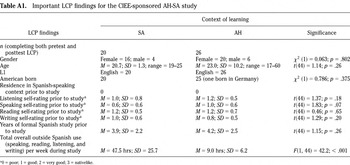
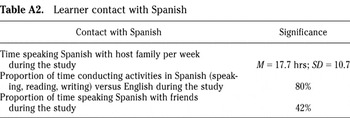
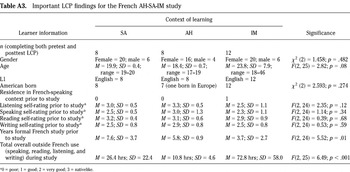
Important LCP findings for the CIEE-sponsored AH-SA study are given in Table A1. Table A2 presents three other highlights that can be gleaned from the LCP data, relevant only to the SA group during the study. Important LCP findings for the French AH-SA-IM study are given in Table A3.
Important LCP findings for the CIEE-sponsored AH-SA study

Learner contact with Spanish

Important LCP findings for the French AH-SA-IM study

Additional highlights of the LCP data, relevant only to the SA group or the IM group during the study, are as follows. For the SA group, the mean time spent speaking French with the host family per week was 10.5 hours, SD = 13.8. The proportion of time spent conducting activities in French (speaking, reading, and writing) versus English differed across the SA and IM groups: For the SA group, this figure was 46%, whereas for the IM group, it was 93%.
References
REFERENCES
Atkinson, D.
(2002).
Toward a sociocognitive approach to second language acquisition.
Modern Language Journal,
86,
525–545.Google Scholar
Batstone, R.
(2002).
Contexts of engagement: A discourse perspective on
“intake” and “pushed output.”
System,
30,
1–14.Google Scholar
Brecht, R.,
Davidson, D., &
Ginsberg, R.
(1995).
Predictors of foreign language gain during study abroad. In
B. F. Freed (Ed.),
Second language acquisition in a study abroad context (pp.
37–66).
Amsterdam:
Benjamins.
Brecht, R., &
Robinson, J.
(1995).
On the value of formal instruction in study abroad: Student
reactions in context. In
B. F. Freed (Ed.),
Second language acquisition in a study abroad context (pp.
317–334).
Amsterdam:
Benjamins.
Broner, M.
(2000).
Impact of interlocutor and task on first and second language use in
a Spanish immersion program.
Unpublished doctoral dissertation,
University of Minnesota,
Minneapolis.
Burr, V.
(1995).
An introduction to social constructionism.
London:
Routledge.
Carson, J. G., &
Longhini, A.
(2002).
Focusing on learning styles and strategies: A diary study in an
immersion setting.
Language Learning,
52,
401–438.Google Scholar
Chaudron, C.
(2001).
Progress in language classroom research: Evidence from The Modern
Language Journal, 1916–2000.
Modern Language Journal,
85,
57–76.Google Scholar
Crookes, G.
(1997).
SLA and language pedagogy: A socioeducational perspective.
Studies in Second Language Acquisition,
19,
93–116.Google Scholar
DeKeyser, R.
(1986).
From learning to acquisition? Foreign language development in a
U.S. classroom and during a semester abroad.
Unpublished doctoral dissertation,
Stanford University,
CA.
DeKeyser, R.
(1991).
Foreign language development during a semester abroad. In
B. F. Freed (Ed.),
Foreign language acquisition: Research and the classroom (pp.
104–119).
Lexington, MA:
D. C. Heath.
DeKeyser, R., &
Sokalski, K. J.
(1996).
The differential role of comprehension and production practice.
Language Learning,
46,
613–642.Google Scholar
Doughty, C., &
Williams, J. (Eds.).
(1998).
Focus on form in classroom second language acquisition.
New York:
Cambridge University Press.
Ellis, R.
(1994).
Second language acquisition.
Oxford:
Oxford University Press.
Firth, A., &
Wagner, J.
(1997).
On discourse, communication, and (some) fundamental concepts in SLA
research.
Modern Language Journal,
81,
285–300.Google Scholar
Fotos, S.
(1994).
Integrating grammar instruction and communicative language use
through grammar consciousness-raising tasks.
TESOL Quarterly,
28,
323–351.Google Scholar
Fotos, S., &
Ellis, R.
(1991).
Communicating about grammar: A task-based approach.
TESOL Quarterly,
25,
605–628.Google Scholar
Freed, B. F.
(1995a).
Language learning and study abroad. In
B. F. Freed (Ed.),
Second language acquisition in a study abroad context (pp.
3–33).
Amsterdam:
Benjamins.
Freed, B. F.
(1995b).
What makes us think that students who study abroad become fluent?
In
B. F. Freed (Ed.),
Second language acquisition in a study abroad context (pp.
123–148).
Amsterdam:
Benjamins.
Freed, B. F.
(1998).
An overview of issues and research in language learning in a study
abroad setting.
Frontiers,
4,
31–60.Google Scholar
Gee, J. P.
(1992).
The social mind.
London:
Bergin & Garvey.
Golonka, E.
(2000).
Identification of salient linguistic and metalinguistic variables
in the prediction of oral proficiency gain at the advanced-level
threshold among adult learners of Russian.
Unpublished doctoral dissertation,
Bryn Mawr College,
PA.
Guntermann, G.
(1995).
The Peace Corps experience: Language learning in training and in
the field. In
B. F. Freed (Ed.),
Second language acquisition in a study abroad context (pp.
149–170).
Amsterdam:
Benjamins.
Hoffman-Hicks, S.
(1999).
The longitudinal development of French foreign language pragmatic
competence: Evidence from study abroad participants.
Unpublished doctoral dissertation,
Indiana University,
Bloomington.
Hymes, D.
(1962).
The ethnography of speaking. In
T. Gladwin (Ed.),
Anthropology and human behavior (pp.
15–53).
Washington, DC:
W. C. Sturtevan.
Hymes, D.
(1972).
Reinventing anthropology.
New York:
Random House.
Hymes, D.
(1974).
Foundations in sociolinguistics: An ethnographic approach.
Philadelphia:
University of Pennsylvania Press.
Isabelli, C.
(2000).
Motivation and extended interaction in the study abroad context:
Factors in the development of Spanish language accuracy and
communication skills.
Unpublished doctoral dissertation,
University of Texas,
Austin.
Johnson, R. K., &
Swain, M. (Eds.).
(1997).
Immersion education: International perspectives.
New York:
Cambridge University Press.
Kramsch, C.
(1993).
Context and culture in language teaching.
Oxford:
Oxford University Press.
Kramsch, C.
(2000).
Social discursive constructions of self in L2 learning. In
J. Lantolf (Ed.),
Sociocultural theory and second language learning (pp.
133–153).
Oxford:
Oxford University Press.
Lafford, B.
(1995).
Getting into, through, and out of a survival situation: A
comparison of communicative strategies used by students studying
Spanish abroad and “at home.” In
B. F. Freed (Ed.),
Second language acquisition in a study abroad context (pp.
97–121).
Amsterdam:
Benjamins.
Lantolf, J. P.
(1994).
Sociocultural theory and second language learning: Introduction to
the special issue.
Modern Language Journal,
78,
418–420.Google Scholar
Lantolf, J. P.
(2000).
Sociocultural theory and second language learning.
Oxford:
Oxford University Press.
Lantolf, J. P., &
Appel, G.
(1994).
Vygotskian approaches to second language research.
Norwood, NJ:
Ablex.
Lightbown, P., &
Spada, N.
(1990).
Focus on form and corrective feedback in communicative language
teaching: Effects on second language learning.
Studies in Second Language Acquisition,
12,
429–448.Google Scholar
Liskin-Gasparro, J.
(1998).
Linguistic development in an immersion context: How advanced
learners of Spanish perceive SLA.
Modern Language Journal,
82,
159–175.Google Scholar
Long, M.
(1997).
Construct validity in SLA research: A response to Firth and Wagner.
Modern Language Journal,
81,
318–323.Google Scholar
Long, M., &
Crookes, G.
(1992).
Three approaches to task-based syllabus design.
TESOL Quarterly,
26,
27–56.Google Scholar
Long, M.,
Inagaki, S., &
Ortega, L.
(1998).
The role of implicit negative feedback in SLA: Models and recasts
in Japanese and Spanish.
Modern Language Journal,
82,
357–371.Google Scholar
Marriot, H.
(1995).
Acquisition of politeness patterns by exchange students in Japan.
In
B. F. Freed (Ed.),
Second language acquisition in a study abroad context (pp.
197–224).
Amsterdam:
Benjamins.
Miller, L., &
Ginsberg, R.
(1995).
Folklinguistic theories of language learning. In
B. F. Freed (Ed.),
Second language acquisition in a study abroad context (pp.
293–316).
Amsterdam:
Benjamins.
Milleret, M.
(1990, August).
Assessing the gain in oral proficiency from summer foreign study.
Paper presented at the summer meeting of American Association of
Teachers of Spanish and Portuguese, Miami, FL.
Milton, J., &
Meara, P.
(1995).
How periods abroad affect vocabulary growth in a foreign language.
Review of Applied Linguistics,
107–108,
17–34.Google Scholar
Norris, J. M., &
Ortega, L.
(2001).
Does type of instruction make a difference? Substantive findings
from a meta-analytic review.
Language Learning,
51,
157–213.Google Scholar
O'Connor, N.
(1988, December).
Oral proficiency testing of junior year abroad: Implications for
the undergraduate curriculum.
Paper presented at the annual meeting of the Modern Language
Association, New Orleans, LA.
Paige, M.,
Jorstad, H.,
Siaya, L.,
Klein, F., &
Colby, J.
(2002).
Culture learning in language education: A review of the literature.
Retrieved December 6, 2003, from the University of Minnesota, Center
for Advanced Research on Language Acquisition, web site:
http://carla.acad.umn.edu/IS-litreview/litreview.html.
Perdue, C.
(1993).
Adult language acquisition: Crosslinguistic perspectives: Vol. 2.
The results.
New York:
Cambridge University Press.
Polanyi, L.
(1995).
Language learning and living abroad: Stories from the field. In
B. F. Freed (Ed.),
Second language acquisition in a study abroad context (pp.
271–292).
Amsterdam:
Benjamins.
Regan, V.
(1995).
The acquisition of sociolinguistic native speech norms: Effects of
a year abroad on second language learners of French. In
B. F. Freed (Ed.),
Second language acquisition in a study abroad context (pp.
245–268).
Amsterdam:
Benjamins.
Robinson, P.
(1996).
Learning simple and complex second language rules under implicit,
incidental, rule-search, and instructed conditions.
Studies in Second Language Acquisition,
18,
27–68.Google Scholar
Rodríguez, S.
(2001).
The perception of requests in Spanish by instructed learners of
Spanish in the second- and foreign-language contexts: A longitudinal
study of acquisition patterns.
Unpublished doctoral dissertation,
Indiana University,
Bloomington.
Schell, K.
(2000).
Functional categories and the acquisition of aspect in L2 Spanish:
A longitudinal study.
Unpublished doctoral dissertation,
University of Washington,
Seattle.
Schmidt, R. W., &
Frota, S. N.
(1986).
Developing basic conversational ability in the second language: A
case study of an adult learner of Portuguese. In
R. R. Day (Ed.),
Talking to learn: Conversation in second language acquisition (pp.
237–320).
Rowley, MA:
Newbury House.
Siegal, M.
(1995).
Individual differences and study abroad: Women learning Japanese
in Japan. In
B. F. Freed (Ed.),
Second language acquisition in a study abroad context (pp.
225–244).
Amsterdam:
Benjamins.
Swain, M.
(1985).
Communicative competence: Some roles of comprehensible input and
comprehensible output in its development. In
S. Gass &
C. Madden (Eds.),
Input in second language acquisition (pp.
235–253).
Rowley, MA:
Newbury House.
Talburt, S., &
Stewart, M.
(1999).
What's the subject of study abroad? Race, gender, and
“living culture.”
Modern Language Journal,
83,
163–175.Google Scholar
Tarone, E., &
Swain, M.
(1995).
A sociolinguistic perspective on second language use in immersion
classrooms.
Modern Language Journal,
79,
166–178.Google Scholar
VanPatten, B.
(1996).
Input processing and grammar instruction.
Norwood, NJ:
Ablex.
Veguez, R.
(1984, April).
The oral proficiency interview and the junior year abroad: Some
unexpected results.
Paper presented at the Northeast Conference on the Teaching of
Foreign Language, New York.
Wilkinson, S.
(1995).
Foreign language conversation and the study abroad transition: A
case study.
Unpublished doctoral dissertation,
The Pennsylvania State University,
University Park.
Wilkinson, S.
(1998).
On the nature of immersion during study abroad: Some participant
perspectives.
Frontiers,
4,
61–80.Google Scholar
Williams, J., &
Evans, J.
(1998).
What kind of focus and on which forms? In
C. Doughty &
J. Williams (Eds.),
Focus on form in classroom second language acquisition (pp.
139–155).
New York:
Cambridge University Press.
Important LCP findings for the CIEE-sponsored AH-SA study
Learner contact with Spanish
Important LCP findings for the French AH-SA-IM study
 You have
Access
- 156
- Cited by