1 Introduction
Listening poses grave challenges to English as foreign language (EFL) learners. In order to comprehend, the learner must immediately process and segment an ongoing stream of sounds. Written text, by contrast, allows readers to rely on word boundaries to segment a stream of speech. What prevents EFL learners from comprehending speech is their weak ability to segment speech and recognize words (Chen, Reference Chen2002; Chen & Chang, Reference Chen and Chang2011; Goh, Reference Goh2000; Sun, Reference Sun2002). Generally, second language (L2) or EFL students possess a limited capacity in their short-term memory and tend to quickly forget what was heard, as they feel rushed to comprehend the new input (Goh, Reference Goh2000).
Some researchers have referred to reduced forms, commonly found in spoken English, as the hurdle to comprehension (Bowen, Reference Bowen1975; Brown & Hilferty, Reference Brown and Hilferty1986; Ito, Reference Ito2001; Rosa, Reference Rosa2002; Weinstein, Reference Weinstein2001). Natural English is found to be replete with reduced forms, perhaps more so in informal than in formal language use (Rosa, Reference Rosa2002). Therefore, reduced forms instruction has been considered critical to listening comprehension. Reduced forms are defined as the “phonological simplifications or variations” (Ito, Reference Ito2001) and depict “the spontaneous pronunciation changes in adjacent words or sounds spoken at a natural speed” (Bowen, Reference Bowen1975). Collectively, reduced forms designate “the processes of contraction, elision, assimilation, and reduction” (Brown & Hilferty, Reference Brown and Hilferty1986).
Listening instructions, however, do not often prepare the students well for authentic listening where reduced forms are frequent. Chaudron (Reference Chaudron1988) argued that in-class modifications (in four aspects: phonological, lexical, syntactical, and discursive) of natural speech widen the gap between in-class talk and informal and natural talk. Fan (Reference Fan1993) also indicated that students in Asia were more predisposed, by the prevalent teaching practice, to reading than to listening. To prevent widening the gap in performance between reading and listening, Guillory (Reference Guillory1998) indicated that L2 listening instruction should refrain from over-facilitation of full captioning, and keyword captioning might be a better alternative to promote listening comprehension where the learners can “listen more and read less” (op. cit.: 104). Despite the importance of teaching reduced forms, more needs to be done in terms of research and pedagogical material development (Rosa, Reference Rosa2002). The current study is a response to a need for the facilitation of authentic listening instruction, aided by different modes of caption interventions, that is, full caption, keyword-only (i.e., reduced-form keywords) caption, and annotated keyword caption. The study investigated to what extent the different modes of caption use centered on reduced forms benefit students’ listening comprehension.
2 Literature review
Past research has investigated how different means of aid, mostly textual, impacted listening comprehension. Five major strands in the literature were identified: (1) captions and subtitles as the main intervention in listening instruction, (2) caption use and proficiency level in listening instruction, (3) different forms of textual aids in listening instruction, (4) language used in subtitles and (5) bimodal or multimodal scaffold in listening comprehension.
The studies reviewed here show mixed results regarding the use of textual aids. While a number of studies elucidated the positive impact of applying textual aids, e.g., subtitles and transcripts, other studies did not find equally compelling evidence. Similarly, while some studies encouraged multi-modal presentation of listening lessons or tasks, some cautioned against it for concerns of possible cognitive overload.
2.1 Captions/subtitles as the main intervention in listening instruction
During the 1990s, a few researchers confirmed the benefits of captions and subtitles in listening performance. The presence of subtitles, in Markham's study (1999), was found to significantly improve students’ ability to recognize words in the video and in a later listening-only task. Guillory (Reference Guillory1998) included three different caption modes, i.e., full-text, keyword, and no caption, in listening instruction, and indicated that the full-text caption group outperformed the other two even though the gap in performance between full and keyword groups was insignificant. Guillory proposed that the keyword version may have assisted the learners in much the same way as full caption did but additionally, keyword captions could focus learners’ processing capacity on the auditory channel and enhance listening comprehension.
More recently, Winke, Gass and Sydorenko (Reference Sydorenko2010) found captions contributed better to learning than no captions with regard to novel vocabulary recognition and overall comprehension. When captions were present for the learners’ first viewing, a better performance was observed. Caption use seemed also to benefit learners across a range of proficiency levels on condition that the content and complexity were attuned to the learners. Chen (Reference Chen2011) developed synchronized subtitles for EFL college learners and found the intervention assisted the learners to summarize the key points in the video better than those who did not have subtitles. Huang and Eskey (Reference Huang and Eskey2000) investigated the effect of captions on ESL students’ listening comprehension and found that the application helped the students in terms of listening, general comprehension, and vocabulary acquisition.
These studies have all established how captions or subtitles enhanced listening comprehension, summarizing key points in listening tasks or word recognition. While all the studies focused on captions or subtitles as the main medium of assistance, Guillory (Reference Guillory1998) further investigated different modes of captions and their impact on listening and found that full and keyword captions had better potential to enhance learning. In particular, keyword captions may assist in a way that focuses listeners’ processing capacities on the auditory channel.
2.2 Caption use and proficiency level in listening instruction
The relationship between caption use and students’ proficiency levels has been explored in some studies. Taylor (Reference Taylor2005) found that captions benefited third-year college students more than first-year students to whom the co-existence of sound, image, and caption was distracting. Grgurović and Hegelheimer (Reference Grgurović and Hegelheimer2007) found that the higher proficiency group used more subtitles for a longer period of time and the lower proficiency group used subtitles the least. They recommended the provision of subtitles, so that students can be given more control to access the kind of help they need to pace their learning. By contrast, Pujola (Reference Pujola2002) observed that lower proficiency students accessed more textual help both in terms of transcripts and scripts whereas higher proficiency students use more rewind/replay functions.
Lwo and Lin (Reference Lwo and Lin2012) compared four different types of captions (no captions, Chinese captions, English captions, and Chinese plus English captions) and their effects on students of different proficiency levels in a multimedia learning context and demonstrated that the effect of different captions varied depending on students’ proficiency levels. Lower proficiency students performed better with the presence of L2 (English) captions or L1 plus L2 captions than with no captions. Quite similarly, Rooney (Reference Rooney201 also observed better performance with lower proficiency students when captions were implemented. In the study, three types of keyword captions (10%, 30% and 50% of the total scripts) were shown to 90 EFL learners of three proficiency levels: elementary, intermediate and advanced. Significant improvement was observed only in the elementary group, who viewed partial captions accounting for 50% of the total scripts. In terms of perception, the participants generally preferred 30% captions presented to them.
These studies revealed the importance of taking learners’ proficiency levels into account because learners responded and performed differently when provided with different types of captions. To cater to the needs of learners of different proficiency levels, different designs and modes of delivery should therefore be carefully considered.
2.3 Different forms of textual aids in listening instruction
A number of studies combined more than one textual aid to investigate the different effects. Studies conducted earlier have demonstrated the importance of applying textual aids, including captions and transcripts. Chung (Reference Chung1999) introduced two interventions, captions and advance organizersFootnote 1 (AOs), and found that captions played a more critical role in enhancing students’ comprehension, while the two combined stimulated even better performance. Jafari and Hashim (Reference Jafari and Hashim2012) also utilized AOs in the form of two types of written aids, key sentences (sentences which show the gist of the chosen passages) and key vocabulary (difficult vocabulary and idiomatic expressions critical to understanding the passages) to assist EFL learners in listening comprehension. The two experimental groups which received each textual aid respectively were found to improve more than those in the control group which received no such intervention; however, no difference was observed in learners of different proficiency levels. Hsu (Reference Hsu1994) studied textual repetition in the form of transcript, among other helps provided (audio repetition and a dictionary), and found that transcripts were the most frequently accessed aids. A positive correlation between the access of transcripts and listening comprehension scores was observed. Students also conveyed their preference in using this aid. Grgurović and Hegelheimer (Reference Grgurović and Hegelheimer2007) offered not only subtitles but also transcripts as help options, revealing that subtitles were more frequently used for longer periods of time than transcripts while performance was affected by students’ proficiency levels.
Jones and Plass (Reference Jones and Plass2002) applied both textual and pictorial annotations to aid with listening tasks and found that, in terms of both comprehension and vocabulary acquisition, the two aids combined achieved better results. However, in delayed test, students performed better with pictorial annotations available, independent of textual aids. Similarly, Maleki and Rad (Reference Maleki and Rad2011) investigated whether “multidimensional representation of input” (op. cit.: 28), on one hand, condensed and paraphrased scripts, and on the other, static image (both complemented by listening texts and verbal stimuli), may enhance listening comprehension in students of different proficiencies. They revealed that static images contributed to better performance than scripts, and that visual aids were particularly beneficial to lower proficiency students while textual aids were more advantageous to higher proficiency students.
Overall, these studies shed light on the benefits of introducing different textual aids to stimulate listening comprehension. Of these, captions and subtitles enhanced learning more than transcripts. And combining both textual and pictorial aids was more effective than single textual format. Pictorial aids were particularly helpful in two aspects: to help retain knowledge and to cater to low proficiency learners.
2.4 Language used in subtitles
Subtitles, usually denoting “on-screen text in the native language of the viewers” (Markham & Peter, Reference Markham and Peter2003: 332), were introduced in both L1 and L2 to investigate the effects on listening comprehension. In the 1990s, Garza (Reference Garza1991) introduced Russian subtitles, the L2, for advanced ESL learners and found a positive correlation between the application and students’ performance. Borras and Lafayette (Reference Borras and Lafayette1994) also integrated L2 subtitles for ESL college students and found that subtitles positively impacted students’ performance both in terms of comprehension and production.
Most recent studies seem to support the findings in the 1990s. Hayati and Mohmedi (Reference Hayati and Mohmedi2011) found subtitles in the target language (L2) better assisted EFL learners, compared to subtitles in L1 and no subtitles. When introducing multi-modal help (sound, image, and subtitles) in listening tasks, Guichon and McLornan (Reference Guichon and McLornan2008) found that subtitles in L2 were more helpful than those in L1 in terms of reducing lexical interference when similar modalities were held constant. However, Markham and Peter's (2003) study revealed opposite results. They argued that subtitles in L1 better promoted comprehension, while subtitles in L2 ranked second and no subtitles ranked third.
In all, these studies pointed out that providing and rendering subtitles in L2 contributes to listening comprehension more than no subtitles and subtitles in L1 do.
2.5 Bimodal or multimodal scaffold in listening comprehension
Some studies scrutinized the potential advantages of bimodal or multimodal applications in listening instruction and how different modes of input afforded specific listening tasks. Two studies conducted in the 1990s revealed conflicting findings about bimodal scaffolding. Baltova (Reference Baltova1999) reported that bimodal use of sound and subtitles in L2 benefited L2 learners, even the inexperienced ones. However, Pujola (Reference Pujola2002) argued that the simultaneous presence of audiovisual and textual aids was negatively correlated with performance.
Recently, Hayati and Mohmedi (Reference Hayati and Mohmedi2011) indicated that listening comprehension instruction may benefit from the bimodal input, listening while reading, which would enhance learners’ recall and recognition of words in later tests. Guichon and McLornan (Reference Guichon and McLornan2008) introduced four modalities to scaffold listening and found that students exposed to multi-modalities, i.e., sound, image, and subtitles, tended to perform better. Sydorenko (Reference Sydorenko2010) examined the effect of different input modalities on students’ vocabulary gains, listening and written recognition of word forms and concluded that captioned video helped students perform better on written recognition of word forms and gains of word meanings while non-captioned video assisted students to score better on aural recognition. Chang, Lei, and Tseng (2011) confirmed that double modes, text plus sound, were more effective than single mode listening instruction. However, while textual aids resulted in enhanced listening comprehension along with reducing cognitive load, the effect lasted only temporarily. As soon as the text aids faded out, learners had a difficult time adjusting to a single mode environment.
While these studies, save one (Pujola, Reference Pujola2002), converge on the general benefits of multimodal input on listening comprehension, they also suggested that different modalities contributed in various ways. To optimize learning, the application of different modalities is recommended but thoughtful scaffolding should also be in place to help learners to adjust to different modalities.
The literature reviewed above largely converges on the benefits of applying textual aids in promoting listening comprehension. A few variables have been tested, including modality, language used, learners’ proficiency levels, types of captions, all of which exert great influence on performance. In particular, captions and subtitles were found to play a critical role in learners’ listening comprehension. More may be done to investigate how different modes of captioning can stimulate performance. Built on and informed by the literature, this study probes the use of full, keyword, and annotated keyword captions (a format similar to pictorial presentations) to distinguish the different effects each mode may bring. Instead of assuming general listening competence, this study singled out reduced forms instruction which is considered critical to listening comprehension (Brown & Hilferty, Reference Brown and Hilferty1986; Ito, Reference Ito2001; Rosa, Reference Rosa2002) to implement the different modes of captions.
Given that different modes of textual aids contributed differently to performance (e.g., Guillory, Reference Guillory1998; Jones & Plass, Reference Jones and Plass2002; Maleki & Rad, Reference Maleki and Rad2011), this study sought to investigate how three modes of captions, full, keyword-only, and annotated keyword captions, may contribute to reduced forms learning and improve listening comprehension. This study is driven by two research questions. The first question explored whether an overall improvement could be seen after the captioned intervention. The second question probed more deeply into whether the improvement is variant, regarding the four types of listening comprehension questions participants were tested on.
1. How are the different modes of captioned aids (full, keyword-only, and annotated keyword captions) helpful in improving students’ overall listening comprehension?
2. What types of listening comprehension question (dictation cloze, short dialogue comprehension, reduced-form recognition, and reduced-form marking) do the different modes of captions help more in improving students’ performance?
3 Methods
Past research has shed light on how various modes and modalities may contribute to listening comprehension differently. This study built on this by introducing three modes of captions, in the form of full, keyword, and annotated keyword captions, to ascertain the benefits of each mode in enhancing listening for reduced forms. To answer the research questions, an empirical study was conducted based on an experimental design using a quantitative approach.
3.1 Participants
The study recruited 44 EFL students (15 male and 29 female), aged 23 on average in their undergraduate or graduate studies at a university in northern Taiwan. These participants represented a rather homogeneous group in terms of the university they came from and their English proficiency level (per self-report). The participants were randomly assigned to one of the three groups: 15 in the full caption group, 15 in the keyword-only caption group, and 14 in the annotated keyword caption group.
3.2 Instruments
3.2.1 Different modes of captions
The study developed a mechanism to automatically render full captions in videos for learning. The captions come from four sources, animation, cartoons, movies, and TV series, and were rendered into full, reduced-form keyword, and annotated keyword captions, by way of Support Vector Machine (SVM) techniques (Wu, Lee & Yang, Reference Wu, Lee and Yang2008). As a result, a total of 51 video clips were stored in a database. The total duration of the 51 clips is 65 minutes with each clip ranging approximately from 30 to 120 seconds, which is considered an appropriate time span for learning (Thompson & Rubin, Reference Thompson and Rubin1996). Overall, the mechanism makes handling large amounts of aural data possible to cater to the needs of listening instruction and, more specifically, reduced forms instruction.
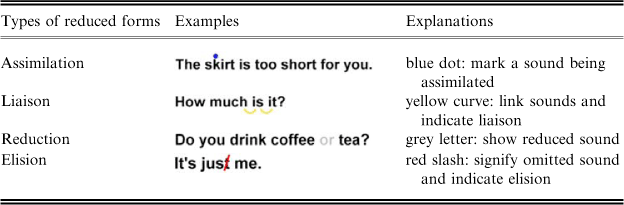
Reduced-form keyword captions were categorized into four types: assimilation, liaison, reduction, and elision. As an attempt to better assist learning the four reduced forms, pictorial symbols were added to make the four types salient. The system first searched words and phrases with reduced forms from the captions and then added annotation symbols to them – a blue dot to mark a sound being assimilated, a yellow curve to link sounds and indicate liaison, a grey letter to show reduced sound, and a red slash to signify omitted sound and indicate elision. Table 1 shows the four reduced-form symbols for annotated keyword captions.
Symbols for annotated keyword captions

The three groups of participants all watched the same clips and only the modes of captions were different. Unlike full captions, keyword-only captions display keywords when reduced forms are present while annotated keyword captions observe the same principle in addition to attaching the four symbols to explicitly mark the four types of reduced forms. Figure 1 shows the three modes of captions. From the top, the first illustration is an example of full captions, the second shows keyword-only captions and the third typifies annotated keyword captions, which adds symbols to the keyword captions to make reduced forms more salient.
Examples of the three modes of captions (full, keyword, annotated keyword captions)
3.2.2 Listening comprehension test
A pre-test and a post-test were administered, comprising the same listening comprehension content. The test was developed based on a range of listening textbooks (Chao, Reference Chao2005; Hagen & Grogan, Reference Hagen and Grogan1992; Stone, Reference Stone2008), and was checked by a native speaking English teacher. Questions were recorded by native speakers, who spoke in a natural way, presenting an authentic spoken language context.
The listening comprehension test consists of 41 questions for a total of 104 points. There are four types of question: dictation cloze, short dialogue comprehension, reduced-form recognition, and reduced-form marking. Each question type includes a mixture of the four types of reduced forms (assimilation, liaison, reduction, and elision). The first type is dictation cloze, with fifteen questions, each worth two points, accounting for thirty points in total. Participants were required to listen and fill in the blank of each sentence. The answer may be more than one word. The second type is short dialogue comprehension. There are twelve short dialogues, each followed by a single multiple choice question worth two points, for a total of 24 points. Participants were required to listen to the dialogue and answer the question and choose the best answer. The third type is reduced-form recognition, which contains ten questions, each followed by a single multiple choice question, two points per question and twenty points in total. Participants were required to choose the correct reduced-form annotation based on what they had heard. The fourth type includes four sentences to be marked by the participants. Each correct marking earns them three points for a total score of thirty points. Unlike the third type, here participants were required to listen, and mark each sentence with appropriate reduced-form symbols without multiple choices presented. The listening comprehension test is a paper-and-pencil test and participants were required to answer each question within the designated time (for a sample of the questions, please refer to Appendix A).
3.3 Procedure
This study consisted of four steps, illustrated in Figure 2. The entire procedure took approximately 115 minutes. The steps were as follows.
The procedure of this study
Step 1: Listening comprehension test (pre-test): Participants completed a listening comprehension test of approximately 15 minutes to assess their baseline knowledge regarding reduced forms.
Step 2: Orientation and demo: Before the intervention, participants were required to access a reduced-form instruction online, which provided definition and examples of the four types of reduced forms. In addition, they were also given a demonstration of how to use the tool properly. During the demonstration process, the participants were encouraged to pose questions. As it turned out, all the students familiarized themselves with the system and completed the process in 20 minutes.
Step 3: Intervention: Participants were divided into three groups, who watched the video clips with full, keyword-only, and annotated keyword captions respectively. Except for different modes of captions, the sequence and the number of the clips were all the same to ensure participants received equal input. Once the video clip started playing, it could not be paused, and it played through until the end. The intervention lasted about 65 minutes.
Step 4: Listening comprehension test (post-test): After watching the video clips, participants took the same listening comprehension test again for about 15 minutes.
3.4 Data analysis
To answer the first research question, a paired sample t-test, a one-way analysis of covariance (ANCOVA), and a Fisher's Least Significant Difference (LSD) post hoc test were performed. The paired sample t-test was employed to compare the pre-test and post-test scores of the three groups. To examine whether significant difference existed between groups, a one-way analysis of covariance (ANCOVA) was employed. The independent variable is the different groups, including full caption, keyword-only caption, and annotated keyword caption groups. The dependent variable is the post-test score of the listening comprehension test and the covariate is the participants’ score on the pre-test. To further evaluate differences among the three groups, the Fisher's LSD post hoc test was carried out under the condition that the result of ANCOVA is significant.
To answer the second research question, a one-way ANCOVA and a Fisher's LSD post hoc test were again employed to examine how the three types of intervention impacted the participants’ post-test performance in the four question types (dictation cloze, short dialogue comprehension, reduced-form recognition, and reduced-form marking). The independent variable is the different groups. The dependent variable is the post-test score of each question type and the covariate is the participants’ score on the pre-test of each question type. Similarly, the Fisher's LSD post hoc test was carried out to further evaluate differences among the three groups.
4 Results and discussion
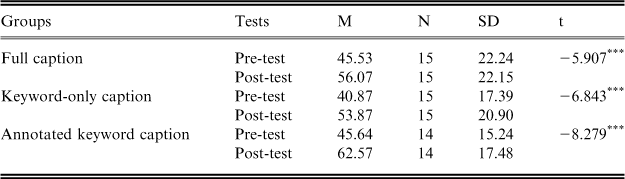
To compare the pre-test and post-test scores of the three groups, the paired-sample t-test was applied. Table 2 shows the results in terms of mean scores (M), number of participants per group (N), standard deviation (SD), and t value. The results indicate that all the participants in the three groups exhibited significant improvement (p < 0.001) from the pre-test. In particular, the annotated keyword caption group demonstrated most significant improvement in the mean score by 16.93 while the full caption group shows least increase by 10.54.
Pre-test and post-test scores for the three groups
***p < .001
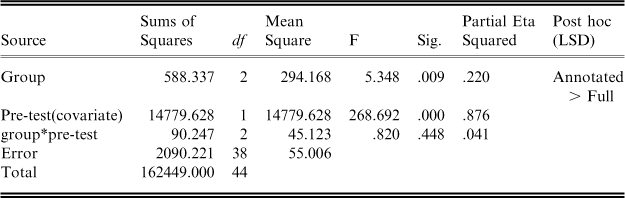
To examine whether a significant difference existed between groups, the one-way ANCOVA was employed. The independent variable is the different groups. The dependent variable is the post-test score and the covariate is the pre-test score. A preliminary analysis evaluating the homogeneity-of-regression assumption indicates that the relationship between the covariate and the dependent variable does not differ significantly as a function of the independent variable (F (2, 38) = .820, p = .448), and Levene's test does not differ significantly (F (2, 41) = .323, p = .726). The ANCOVA is significant (F (2, 38) = 5.348, p < .01) (see Table 3). The Fisher's LSD post hoc test was carried out to further evaluate differences among the three groups. The results indicate a significant difference in performance between the annotated keyword caption group and the full caption group (p < .05). This confirms previous findings, which suggest that full captions or scripts may not be all beneficial. For example, Chang et al. (Reference Chang, Lei and Tseng2011) argued that while textual aids stimulated better performance the effect was temporary. Once such scaffold faded out, students had difficulty adjusting to authentic listening tasks. Preparing students with keyword captions might be a more profitable alternative not only in facilitating learning but also to ease the transitional phase to authentic listening tasks. Rooney (Reference Rooney2011) demonstrated that implementing partial captions was effective but while learners performed better with 50% than 10% of the scripts, they recommended even fewer captions at the proportion of 30% of total scripts. Our finding also resonated with Jones and Plass (Reference Jones and Plass2002) and Maleki and Rad (Reference Maleki and Rad2011) in terms of the efficacies of introducing pictorial aids. Our study implemented annotated keyword captions that were found to facilitate both reduced forms learning and overall listening comprehension. Guillory (Reference Guillory1998) also suggested that keyword captions have better potential to focus listeners on listening rather than on reading off the screen.
Analysis of covariance for test score by different groups
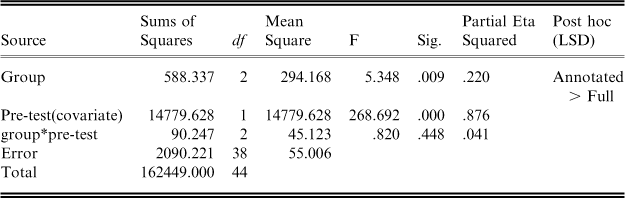
R Squared = .881 (Adjusted R Squared = .865)
Annotated = Annotated keyword caption group, Full = Full caption group
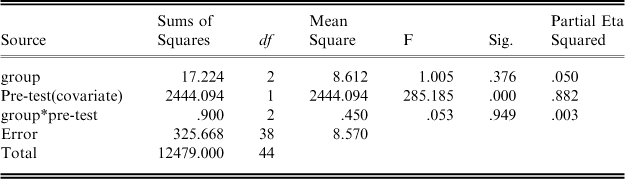
To examine how the three types of intervention impacted the participants’ post-test performance in the four question types, the one-way ANCOVA was again employed to each question type. The independent variable is the different groups. The dependent variable is the post-test score and the covariate is the pre-test score of each question type. For dictation cloze, a preliminary analysis evaluating the homogeneity-of-regression assumption indicates that the relationship between the covariate and the dependent variable does not differ significantly as a function of the independent variable (F (2, 38) = .053, p = .949), and Levene's test does not differ significantly (F (2, 41) = 2.879, p = .068). The ANCOVA is not significant (F (2, 38) = 1.005, p = .376) (see Table 4), indicating no significant difference among the three groups in the question type of dictation cloze.
Analysis of covariance for dictation cloze by different groups
R Squared = .883 (Adjusted R Squared = .868)
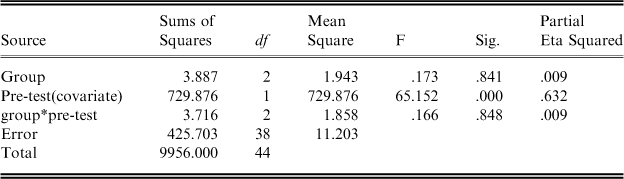
In terms of short dialogue comprehension, again, the relationship between the covariate and the dependent variable does not differ significantly as a function of the independent variable (F (2, 38) = .166, p = .848), and Levene's test does not differ significantly (F (2, 41) = .885, p = .420). The ANCOVA is not significant (F (2, 38) = .173, p = .841) (see Table 5). Similar to dictation cloze questions, no significant difference is found when comparing the performances of the three groups in the question type of short dialogue comprehension.
Analysis of covariance for short dialogue comprehension by different groups
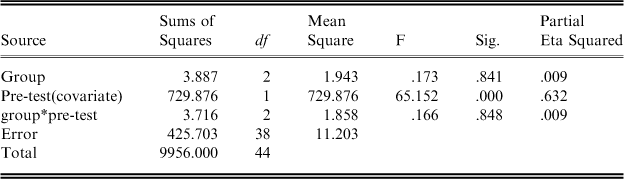
R Squared = .634 (Adjusted R Squared = .586)
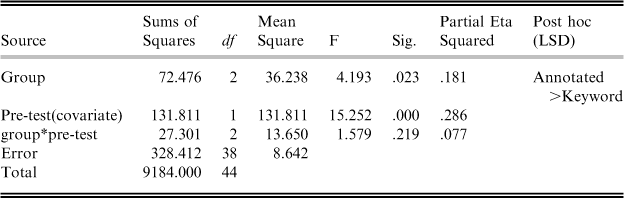
For reduced-form recognition, similarly, the relationship between the covariate and the dependent variable does not differ significantly as a function of the independent variable (F (2, 38) = 1.579, p = .219), and Levene's test does not differ significantly (F (2, 41) = 2.795, p = .073). The ANCOVA is significant (F (2, 38) = 4.193, p < .05) (see Table 6). To further examine differences among the three groups, the Fisher's LSD post hoc test was performed. The results show that a significant difference exists between the annotated keyword caption group and the keyword-only caption group (p < .01). In other words, students performed better in the annotated keyword caption group than in the keyword-only caption group.
Analysis of covariance for reduced-form recognition by different groups
R Squared = .414 (Adjusted R Squared = .336)
Annotated = Annotated keyword caption group, Keyword = Keyword-only caption group
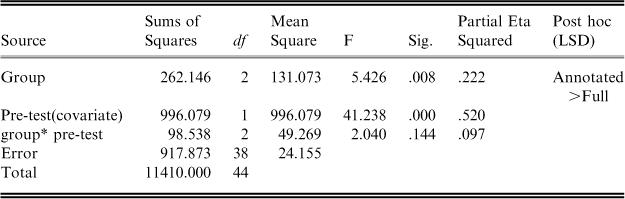
Lastly, in the reduced-form marking question type, again, the relationship between the covariate and the dependent variable does not differ significantly as a function of the independent variable (F (2, 38) = 2.040, p = .144), and Levene's test does not differ significantly (F (2, 41) = .074, p = .928). The ANCOVA is significant (F (2, 38) = 5.426, p < .01) (see Table 7). To further evaluate differences among the three groups, the Fisher's LSD post hoc test was employed. The results show a significant difference between the annotated keyword caption group and the full caption group (p < .05). In other words, students performed better in the annotated keyword caption group than in the full caption group.
Analysis of covariance for reduced-form marking by different groups
R Squared = .596 (Adjusted R Squared = .543)
Annotated = Annotated keyword caption group, Full = Full caption group
Overall, the results indicate that all the three groups improved from pre-test after the intervention. When comparing the mean score of the three groups, the annotated keyword caption group held the highest mean score over the other two groups. When comparing the performance between groups, the annotated keyword caption group significantly outperformed those in the full caption group. Furthermore, among the four question types, the annotated keyword caption group excelled in reduced-form recognition when compared to the keyword-only caption group and in the reduced-form marking versus the full caption group.
Generally, the improvement made on reduced-form recognition both by way of annotated keyword captions and keyword captions was found to positively impact listening comprehension. Specifically, annotated keyword captions were found to enhance learners’ ability to recognize reduced forms better than both keyword captions and full captions, potentially resulting from the addition of the pictorial symbols which contributed to their knowledge retention. While past research has investigated the effect of different kinds of textual aids on listening comprehension, few have combined pictorial symbols and captions to ascertain the maximum effect of captions in listening comprehension given the prevalence of captions in language teaching. Many studies probed the benefits of different modalities, for example, pictorial symbols versus text, but not exploring different modes of the same modality which this study investigated. Overall, our study has found that more textual scaffolds, caption and symbols combined, contributed to better listening comprehension while implementing full captions is the least helpful of the three modes of captions. In addition to decreasing the number of captions, which has been tested and recommended by scholars (e.g., Guillory, Reference Guillory1998; Rooney, Reference Rooney2011), our study further affirms the importance of inserting pictorial modes to enhance reduced forms performance which has direct bearing on general listening comprehension ability.
5 Conclusion and implications
The current study explores how different types of captions, full, keyword-only, and annotated keyword captions, impact EFL students’ listening comprehension. Informed by past studies, which proposed that reduced forms instruction is critical to improving listening comprehension, annotated keyword captions were developed specifically to alert learners to the different types of reduced forms by way of pictorial symbols. Previous studies have demonstrated a positive outcome when introducing captions or subtitles to enhance listening comprehension (Chung, Reference Chung1999; Grgurović & Hegelheimer, Reference Grgurović and Hegelheimer2007; Huang & Eskey, Reference Huang and Eskey2000; Jones & Plass, Reference Jones and Plass2002; Markham, Reference Markham1999; Winke et al., Reference Winke, Gass and Sydorenko2010). However, few investigated whether enhanced visual effect to keyword captions, i.e., annotated keyword captions, may enhance learning outcome further. This study revealed that annotated keyword captions not only helped the participants to score higher in listening comprehension test but this mode of caption also assisted learners to perform better in both recognizing and marking reduced forms, which is positively related to their overall listening comprehension performance.
The results suggest that reduced forms instruction has the potential to help EFL learners to improve overall listening comprehension. In reduced forms instruction, keyword captions may be more helpful than full captions and the captions are best executed with reduced-form relevant pictorial symbols. Doing this may enhance learners’ visual memory and retain their knowledge, resulting in better listening comprehension performance.
There are a few limitations to the present study. Given the short-term training and instruction, salient difference may not be readily observable. First, the participants may resort to their short-term memory in answering questions. To address this, a delayed test may be implemented to examine whether better performance resulting from watching annotated keyword captions remains constant. Second, given that this study recruited a relatively small sample of participants, generalization is unlikely regarding how the three types of captions may be distinguished in effect. For future research, larger sample and a long-term treatment may provide additional evidence and expand understanding in listening comprehension instruction. Finally, while participants in the study shared homogeneous academic background in terms of the university they came from and their English proficiency level (per self-report), for future research, participants could be grouped by alternative variables such as gender, proficiency levels (subjected to pre-test before participation), and so forth before the intervention.
The study has found that annotated keyword captions may be beneficial in terms of assisting with the learning of reduced forms. Improvement in reduced forms performance has also been positively linked to overall listening comprehension. For future pedagogical design, less caption is recommended. Specifically, annotated keyword captions, enhanced with pictorial symbols, may better focus learners’ attention and improve their listening comprehension.
Acknowledgements
The authors would like to thank Ms. Jia Fen Liu for assisting in the system development. The authors would also like to thank all the subjects who participated in the study. This study was partially supported by grant (NSC 100-2628-S-008-002-MY3) from the National Science Council of Taiwan.
Appendix A