1 Introduction
In 2012, Antunes and Freitas [Reference Antunes and Freitas1] proved that among all axes-parallel ellipses that are centered at the origin and of a fixed area, the ellipse enclosing the most lattice points from
 $\mathbb{Z}_{{>}0}^{2}$
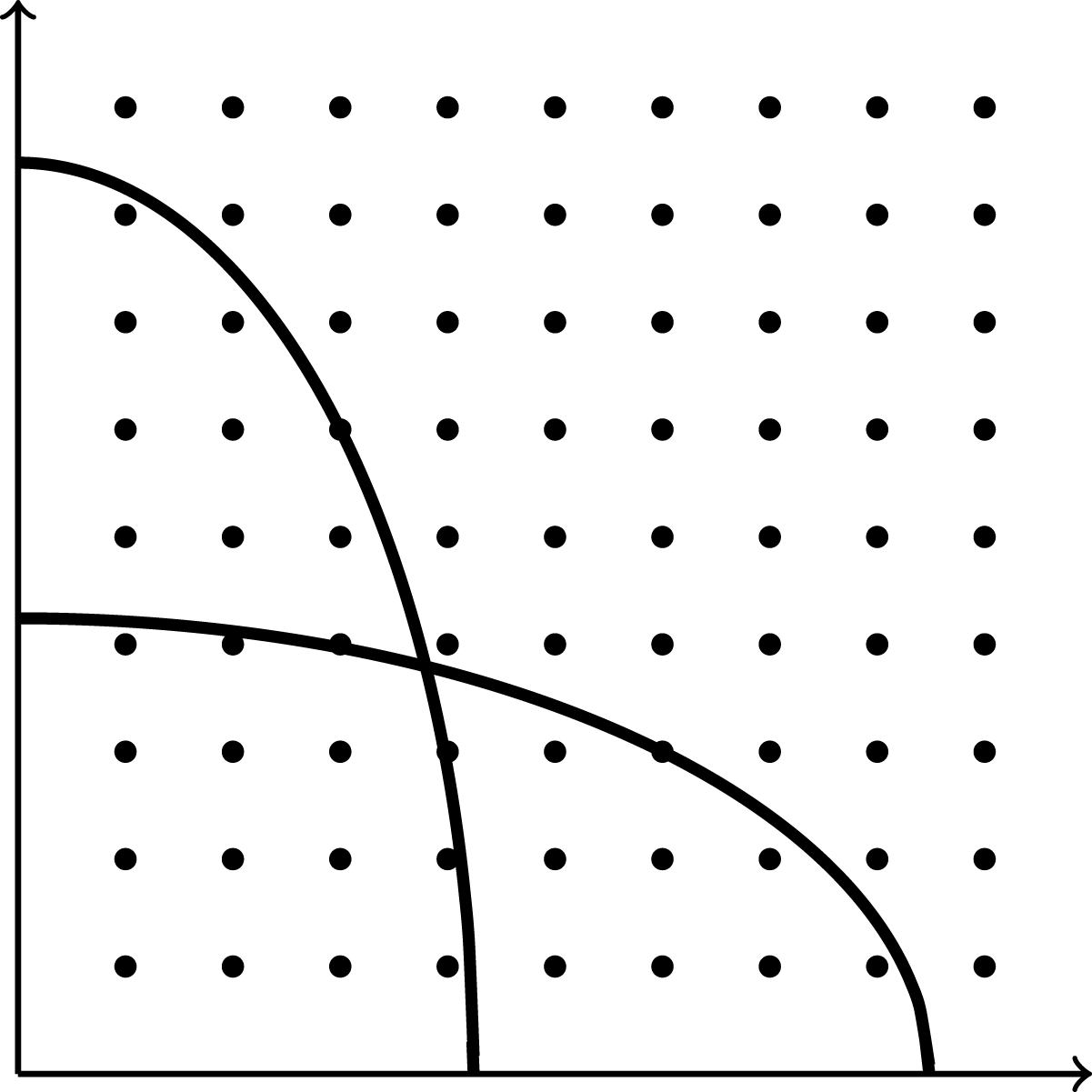
converges to the circle as the area becomes large; see Figure 1. This problem originally arose in the study of variational aspects of spectral geometry, more specifically in the context of minimizing large eigenvalues of the Laplace operator on rectangles.
Formally, let
 $R_{a}$
denote a
 $1/a\times a$
rectangle, and
 $\unicode[STIX]{x1D706}_{1,a}\leqslant \unicode[STIX]{x1D706}_{2,a}\leqslant \cdots \,$
denote the eigenvalues of the Dirichlet–Laplacian
 $-\unicode[STIX]{x1D6E5}$
on
 $R_{a}$
. The explicit form of the eigenvalues allows us to compute the number of eigenvalues below a certain threshold as the number of lattice points inside an ellipse:
 $$\begin{eqnarray}\#\{k\in \mathbb{Z}_{{>}0}:\unicode[STIX]{x1D706}_{k,a}\leqslant \unicode[STIX]{x1D70B}^{2}r^{2}\}=\#\{(m,n)\in \mathbb{Z}_{{>}0}^{2}:(am)^{2}+(n/a)^{2}\leqslant r^{2}\}.\end{eqnarray}$$
A natural question is now the following: among all rectangles with area 1, which minimizes the
 $k$
th eigenvalue of the Dirichlet–Laplacian? If we denote a sequence of minimizers by
 $(R_{a_{k}})$
, then the behavior of
 $(a_{k})$
is rather complicated and not well understood. However, Antunes and Freitas managed to determine the asymptotic behavior.
Theorem (Antunes and Freitas [Reference Antunes and Freitas1]). We have
 $$\begin{eqnarray}\lim _{k\rightarrow \infty }a_{k}=1.\end{eqnarray}$$
This means, geometrically, that the ellipse which encloses the most positive integer lattice points tends towards a circle as the area tends towards infinity. This result was quite influential and has inspired several other works in high frequency shape optimization [Reference Antunes and Freitas2, Reference Berger5, Reference Bucur and Freitas8, Reference van den Berg, Bucur and Gittins13, Reference van den Berg and Gittins14] and new lattice point theorems [Reference Ariturk and Laugesen3, Reference Laugesen and Liu11]. We especially emphasize the recent results of Laugesen and Liu [Reference Laugesen and Liu11] and Ariturk and Laugesen [Reference Ariturk and Laugesen3], which motivate this paper. Laugesen and Liu extended the result of Antunes and Freitas to a large family of concave curves (which includes the
 $\ell ^{p}$
-unit balls for
 $1<p<\infty$
). Ariturk and Laugesen [Reference Ariturk and Laugesen3] established a similar result for a large class of decreasing convex curves (which includes the
 $\ell ^{p}$
-unit balls for
 $0<p<1$
).
Among all ellipses with the same area, which captures the most lattice points?

1.1 Triangles capturing points
The approaches in [Reference Ariturk and Laugesen3, Reference Laugesen and Liu11] do not cover the
 $p=1$
case (corresponding to triangles) and the case was left as an open problem:
The case
 $p=1$
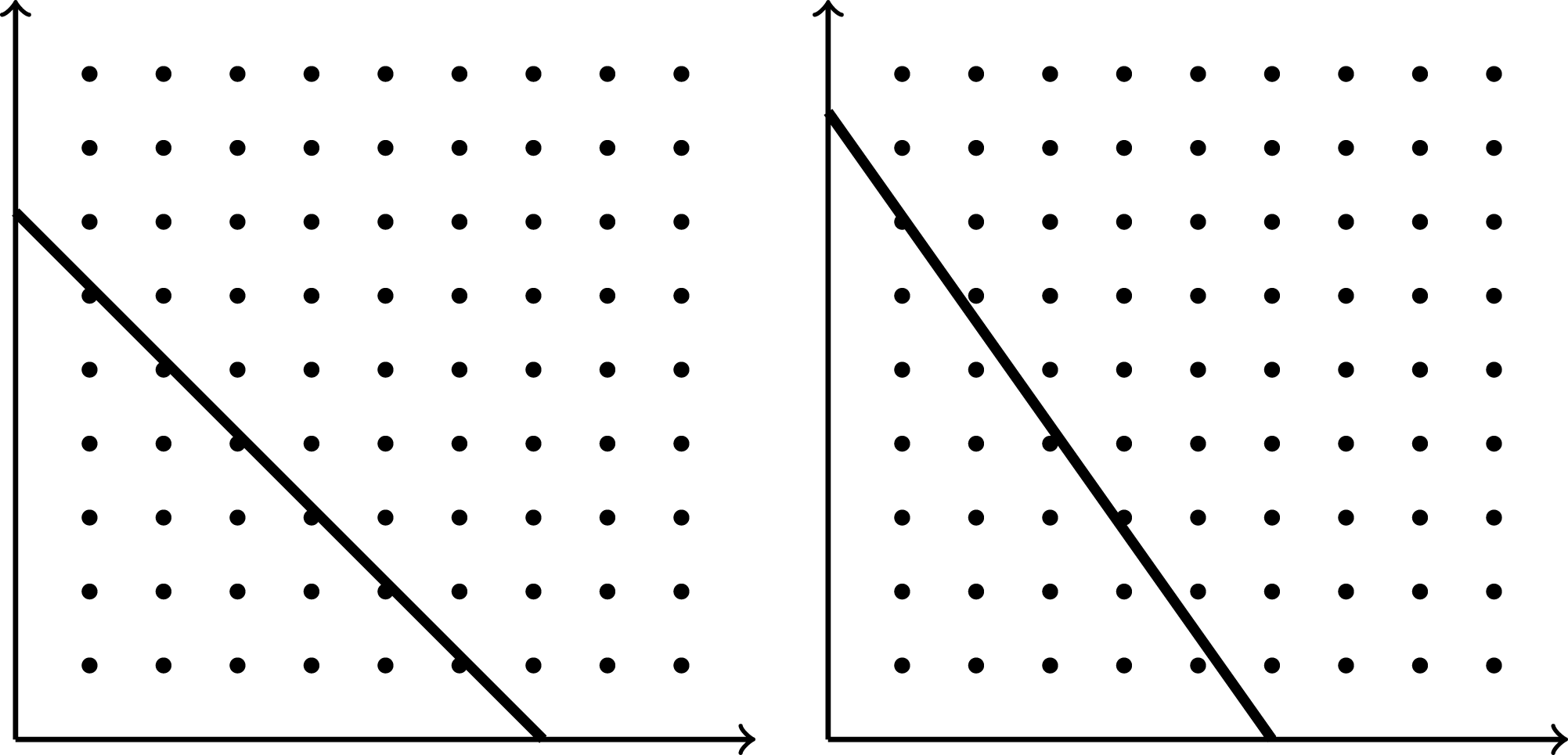
remains open, where the question is: which right triangles in the first quadrant with two sides along the axes will enclose the most lattice points, as the area tends to infinity? [...] Our numerical evidence suggests that the right triangle enclosing the most lattice points in the open first quadrant (and with right angle at the origin) does not approach a 45–45–90 degree triangle as
 $r\rightarrow \infty$
. Instead one seems to get an infinite limit set of optimal triangles. (From [Reference Laugesen and Liu11]; see the illustration in Figure 2.)
The purpose of our paper is to prove these statements.
Among triangles with fixed area, which contains the most lattice points?

A standard lattice point counting method is to use the Poisson summation formula to express the number of lattice points in a domain as the area of the domain plus an error term related to the decay of the Fourier transform of the indicator function of the domain, which in turn is related to the curvature of the boundary of the domain. It is therefore not surprising that a lack of curvature would yield different behavior and require different techniques. Here, both number theory and dynamical systems start to play a role. The purpose of this paper is to establish several basic results, and to prove that there is indeed no limiting shape. In fact, we prove there is an infinite number of triangles each of which is optimal for an infinite number of arbitrarily large areas. We emphasize that these questions seem to be remarkably rich, and many open problems remain (some of which are discussed in §2.7).
2 Main results
2.1 Two problems
There are two ways to approach the problem: pick a large area and ask which triangle maximizes the number of enclosed lattice points, or fix a specific triangle and try to understand the number of lattice points it contains as it is dilated. The question described in the introduction asks the first question and, a priori, the second problem is strictly simpler. However, it turns out that it is possible to obtain sufficiently good control on the error estimates to pursue the second approach and obtain results for the original question. We start by presenting some results for the simpler question and then explain how the techniques can be adapted to deal with the harder problem.
2.2 Dilating fixed triangles
Let
 $N_{\unicode[STIX]{x1D6FD}}(\unicode[STIX]{x1D6FC})$
denote the number of positive lattice points contained in the triangle with vertices
 $(0,0),(\unicode[STIX]{x1D6FC}/\sqrt{\unicode[STIX]{x1D6FD}},0)$
, and
 $(0,\unicode[STIX]{x1D6FC}\sqrt{\unicode[STIX]{x1D6FD}})$
, i.e.,
 $$\begin{eqnarray}N_{\unicode[STIX]{x1D6FD}}(\unicode[STIX]{x1D6FC})=\#\{(k,m)\in \mathbb{Z}_{{>}0}^{2}:m\leqslant \unicode[STIX]{x1D6FC}\sqrt{\unicode[STIX]{x1D6FD}}-k\unicode[STIX]{x1D6FD}\},\end{eqnarray}$$
where
 $\mathbb{Z}_{{>}0}$
is the set of positive integers. The slope of the hypotenuse of this triangle is
 $-\unicode[STIX]{x1D6FD}$
so we refer to
 $\unicode[STIX]{x1D6FD}$
as the slope parameter or simply the “slope” of the triangle. Similarly, since
 $\unicode[STIX]{x1D6FC}^{2}/2$
is the area of this triangle we refer to
 $\unicode[STIX]{x1D6FC}$
as the area parameter. The subtleties of estimating
 $N_{\unicode[STIX]{x1D6FD}}(\unicode[STIX]{x1D6FC})$
occur near the boundary of the given triangle. An estimate based on the length of the boundary shows that
 $$\begin{eqnarray}N_{\unicode[STIX]{x1D6FD}}(\unicode[STIX]{x1D6FC})=\frac{\unicode[STIX]{x1D6FC}^{2}}{2}+{\mathcal{O}}_{\unicode[STIX]{x1D6FD}}(\unicode[STIX]{x1D6FC})\quad \text{as }\unicode[STIX]{x1D6FC}\rightarrow \infty ,\end{eqnarray}$$
where the implicit constant in the error term depends on
 $\unicode[STIX]{x1D6FD}$
. This suggests
 $$\begin{eqnarray}\frac{N_{\unicode[STIX]{x1D6FD}}(\unicode[STIX]{x1D6FC})-\unicode[STIX]{x1D6FC}^{2}/2}{\unicode[STIX]{x1D6FC}}\quad \text{as a suitable renormalization},\end{eqnarray}$$
which isolates the interesting behavior happening at the linear scale.
Theorem 1. The limit
 $$\begin{eqnarray}\lim _{\unicode[STIX]{x1D6FC}\rightarrow \infty }\frac{N_{\unicode[STIX]{x1D6FD}}(\unicode[STIX]{x1D6FC})-\unicode[STIX]{x1D6FC}^{2}/2}{\unicode[STIX]{x1D6FC}}\end{eqnarray}$$
exists if and only if
 $\unicode[STIX]{x1D6FD}$
is irrational, and if the limit exists, then it is smaller than
 $-1$
. Moreover, we have that the set
 $$\begin{eqnarray}\unicode[STIX]{x1D6EC}\overset{\text{def}}{=}\biggl\{\unicode[STIX]{x1D6FD}\in \mathbb{Q}:\limsup _{\unicode[STIX]{x1D6FC}\rightarrow \infty }\frac{N_{\unicode[STIX]{x1D6FD}}(\unicode[STIX]{x1D6FC})-\unicode[STIX]{x1D6FC}^{2}/2}{\unicode[STIX]{x1D6FC}}>-1\biggr\}\end{eqnarray}$$
is non-empty, contained in
 $[1/3,3]$
, has
 $1$
as a unique accumulation point, and has Minkowski dimension of at most
 $3/4$
. Moreover, for any finite subset
 $\unicode[STIX]{x1D6E4}\subset \unicode[STIX]{x1D6EC}$
, there exists
 $\unicode[STIX]{x1D6FD}\in \unicode[STIX]{x1D6EC}\setminus \unicode[STIX]{x1D6E4},$
such that
 $$\begin{eqnarray}\limsup _{\unicode[STIX]{x1D6FC}\rightarrow \infty }\Bigl(N_{\unicode[STIX]{x1D6FD}}(\unicode[STIX]{x1D6FC})-\max _{\unicode[STIX]{x1D6FE}\in \unicode[STIX]{x1D6E4}}N_{\unicode[STIX]{x1D6FE}}(\unicode[STIX]{x1D6FC})\Bigr)>0.\end{eqnarray}$$
The result may be summarized as follows: if one is interested in triangles that, at least for a sequence of areas tending toward infinity, capture a lot of lattice points relative to other triangles of equal area, then the slope should not be irrational: for irrational slopes, we have
 $N_{\unicode[STIX]{x1D6FD}}(\unicode[STIX]{x1D6FC})<\unicode[STIX]{x1D6FC}^{2}/2-\unicode[STIX]{x1D6FC}+o_{\unicode[STIX]{x1D6FD}}(\unicode[STIX]{x1D6FC})$
. On the other hand, there is an infinite set
 $\unicode[STIX]{x1D6EC}$
of rational slopes such that for all
 $\unicode[STIX]{x1D6FD}\in \unicode[STIX]{x1D6EC}$
we have
 $N_{\unicode[STIX]{x1D6FD}}(\unicode[STIX]{x1D6FC})\geqslant \unicode[STIX]{x1D6FC}^{2}/2-(1-\unicode[STIX]{x1D6FF}_{\unicode[STIX]{x1D6FD}})\unicode[STIX]{x1D6FC}+o_{\unicode[STIX]{x1D6FD}}(\unicode[STIX]{x1D6FC})$
for infinitely many arbitrarily large
 $\unicode[STIX]{x1D6FC}$
(depending on
 $\unicode[STIX]{x1D6FD}$
), where
 $\unicode[STIX]{x1D6FF}_{\unicode[STIX]{x1D6FD}}>0$
is a positive constant depending on
 $\unicode[STIX]{x1D6FD}$
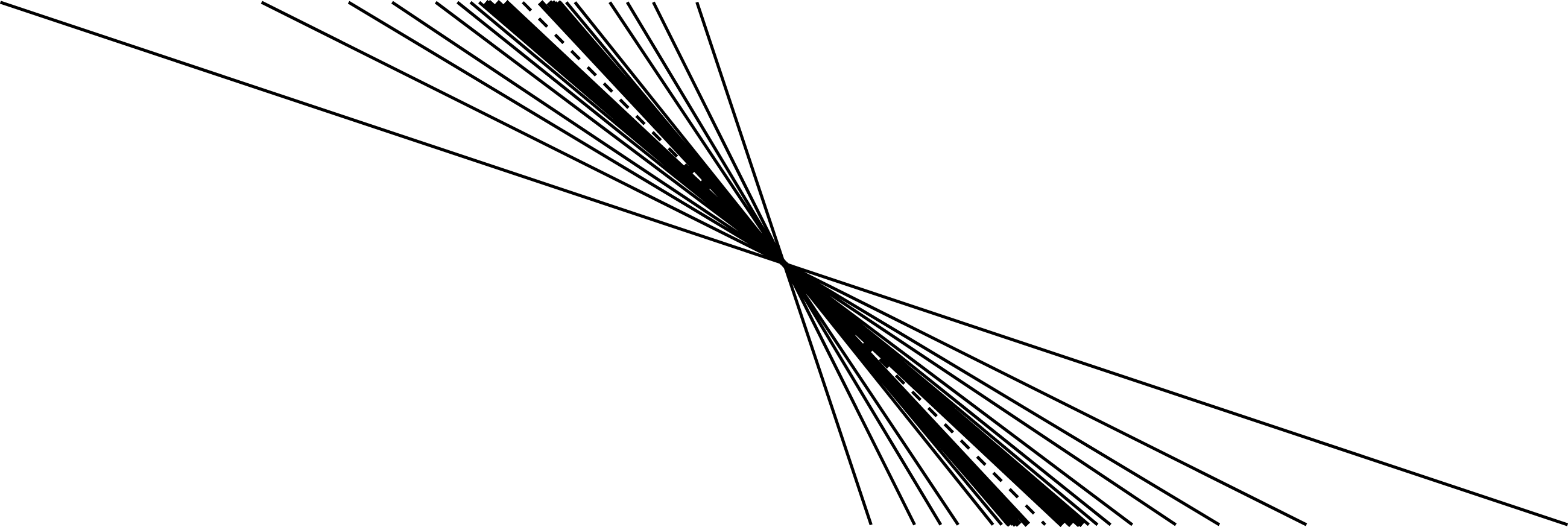
. The set
 $\unicode[STIX]{x1D6EC}$
(see Figure 3) has a rather non-trivial structure and is fractal in the sense that its Minkowski dimension is at most
 $3/4$
.
Slopes in
 $\unicode[STIX]{x1D6EC}$
start to cluster (not shown) around the slope
 $-1$
(dashed).

Finally, the dynamics of
 $\unicode[STIX]{x1D6EC}$
in terms of capturing lattice points are non-trivial: every finite subset
 $\unicode[STIX]{x1D6E4}\subset \unicode[STIX]{x1D6EC}$
is at least sometimes uniformly worse at capturing lattice points than some element
 $\unicode[STIX]{x1D6FD}\in \unicode[STIX]{x1D6EC}\setminus \unicode[STIX]{x1D6E4}$
.
2.3 Slopes that are optimal for arbitrarily large areas
We define the limit set
 $S$
as the set of slopes that capture a maximal number of lattice points for arbitrarily large areas
 $$\begin{eqnarray}S=\mathop{\bigcap }_{r>0}\mathop{\bigcup }_{\unicode[STIX]{x1D6FC}>r}\underset{\unicode[STIX]{x1D6FD}>0}{\operatorname{argmax}}\,N_{\unicode[STIX]{x1D6FD}}(\unicode[STIX]{x1D6FC}).\end{eqnarray}$$
The next theorem confirms the suspicion of Laugesen and Liu by establishing that the limit set is non-trivial. More precisely, we show that the limit set contains infinitely many elements of
 $\unicode[STIX]{x1D6EC}$
.
Theorem 2. There is an infinite subset of
 $\unicode[STIX]{x1D6EC}$
contained in
 $S$
:
 $$\begin{eqnarray}\#\{p/q\in \unicode[STIX]{x1D6EC}\cap S\}=\infty .\end{eqnarray}$$
While we do not have a precise description of the infinite subset of
 $\unicode[STIX]{x1D6EC}$
which is contained in
 $S$
, the proof of Theorem 2 implies that for every square-free number
 $k\in \mathbb{N}$
(i.e. a number that does not contain any prime factor more than once) there exists an element
 $p/q\in \unicode[STIX]{x1D6EC}\cap S$
such that
 $pq=ks^{2}$
where
 $s\in \mathbb{N}$
.
2.4 Bad areas exist
In Theorem 1 we established that if
 $\unicode[STIX]{x1D6FD}$
is irrational, then the limit
 $$\begin{eqnarray}\lim _{\unicode[STIX]{x1D6FC}\rightarrow \infty }\frac{N_{\unicode[STIX]{x1D6FD}}(\unicode[STIX]{x1D6FC})-\unicode[STIX]{x1D6FC}^{2}/2}{\unicode[STIX]{x1D6FC}}\quad \text{exists and is strictly less than }-1.\end{eqnarray}$$
In fact, as we will see in Lemma 5, it is possible to choose an irrational slope
 $\unicode[STIX]{x1D6FD}$
such that the above limit is arbitrarily close to
 $-1$
. Informally speaking, this means that there exists a fixed triangle with an irrational slope which captures at least
 $\unicode[STIX]{x1D6FC}^{2}/2-(1+\unicode[STIX]{x1D6FF})\unicode[STIX]{x1D6FC}$
lattice points for all sufficiently large areas, where
 $\unicode[STIX]{x1D6FF}>0$
is an arbitrary fixed constant. The following theorem states that there exists “bad” areas where it is difficult to do much better than this.
Theorem 3 (Bad areas exist).
We have
 $$\begin{eqnarray}\liminf _{\unicode[STIX]{x1D6FC}\rightarrow \infty }\sup _{\unicode[STIX]{x1D6FD}}\frac{N_{\unicode[STIX]{x1D6FD}}(\unicode[STIX]{x1D6FC})-\unicode[STIX]{x1D6FC}^{2}/2}{\unicode[STIX]{x1D6FC}}=-1.\end{eqnarray}$$
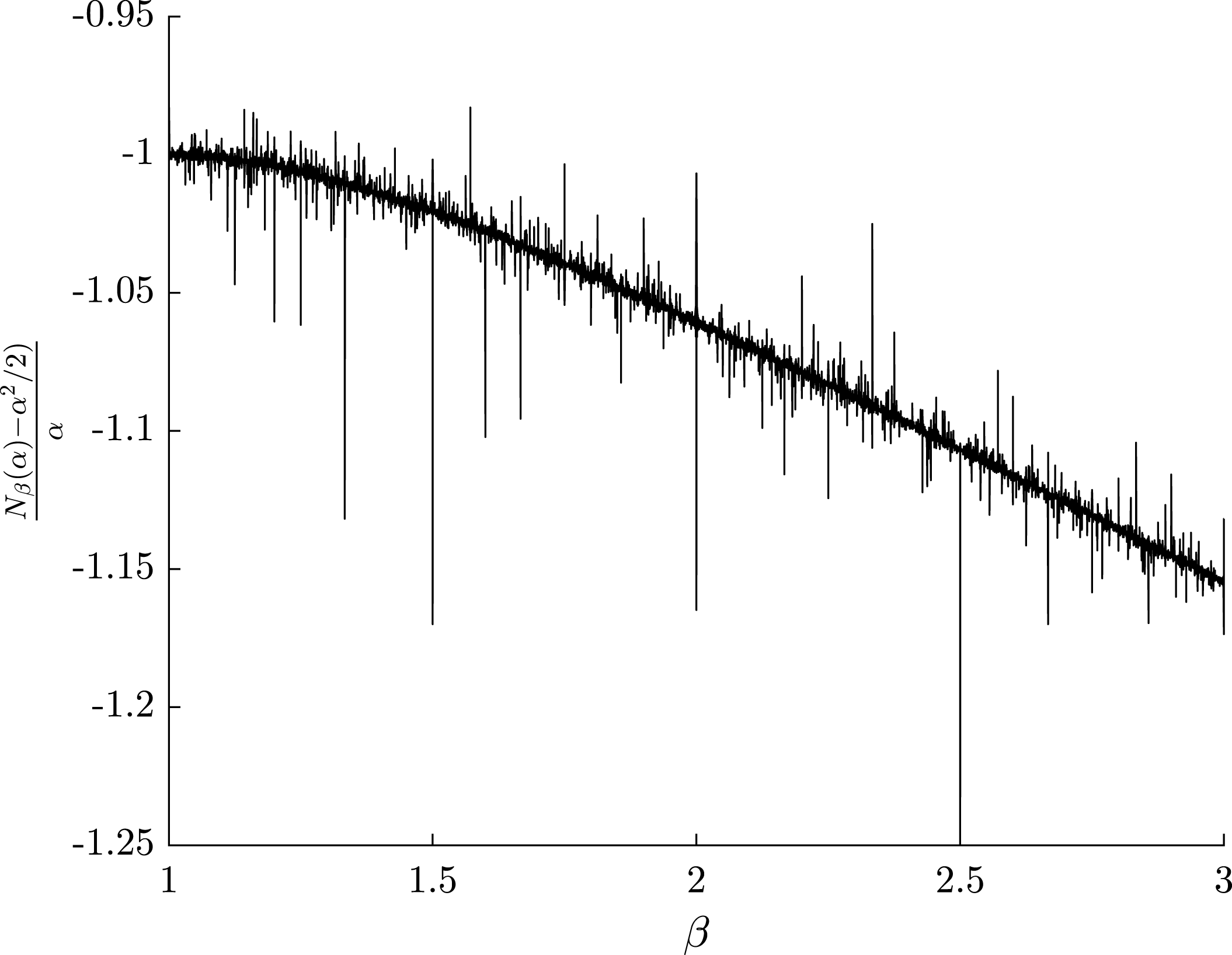
A “bad” area at
 $\unicode[STIX]{x1D6FC}=15541.957707$
. No triangle with area
 $\unicode[STIX]{x1D6FC}^{2}/2$
is particularly good at capturing lattice points. The downward sloping curve is
 $(-\sqrt{\unicode[STIX]{x1D6FD}}-\sqrt{1/\unicode[STIX]{x1D6FD}})/2$
(see Lemma 5).

We illustrate Theorem 3 in Figure 4: a “bad” area at
 $\unicode[STIX]{x1D6FC}=15541.957707$
was found numerically (essentially by aligning many rational slopes to perform poorly via Lemmas 12 and 13), where
 $$\begin{eqnarray}\sup _{\unicode[STIX]{x1D6FD}}\frac{N_{\unicode[STIX]{x1D6FD}}(\unicode[STIX]{x1D6FC})-\unicode[STIX]{x1D6FC}^{2}/2}{\unicode[STIX]{x1D6FC}}\approx -0.98035,\end{eqnarray}$$
which is close to the worse case value of
 $-1$
.
2.5 Rational and irrational slopes
Along the way to the proof of Theorem 1 we obtain several smaller results; in particular, we obtain fairly explicit control of the behavior of
 $N_{\unicode[STIX]{x1D6FD}}(\unicode[STIX]{x1D6FC})$
for rational slopes
 $\unicode[STIX]{x1D6FD}\in \mathbb{Q}$
.
Lemma 4 (Rational slopes).
Suppose that
 $p$
and
 $q$
are positive coprime integers. Then
 $$\begin{eqnarray}\displaystyle N_{p/q}(\unicode[STIX]{x1D6FC}) & = & \displaystyle \frac{\unicode[STIX]{x1D6FC}^{2}}{2}-\frac{\sqrt{p/q}+\sqrt{q/p}-\sqrt{1/pq}\,(1-2\{\unicode[STIX]{x1D6FC}\sqrt{pq}\})}{2}\unicode[STIX]{x1D6FC}+{\mathcal{O}}_{p,q}(1)\nonumber\\ \displaystyle & & \displaystyle \quad \text{as }\unicode[STIX]{x1D6FC}\rightarrow \infty ,\nonumber\end{eqnarray}$$
where
 $\{x\}:=x-\lfloor x\rfloor$
denotes the fractional part of
 $x$
.
Observe that the coefficient of
 $\unicode[STIX]{x1D6FC}$
in this asymptotic formula is oscillatory. For example, if
 $p=q=1$
, then Lemma 4 implies that
 $$\begin{eqnarray}N_{1}(\unicode[STIX]{x1D6FC})=\frac{\unicode[STIX]{x1D6FC}^{2}}{2}-\biggl(\frac{1}{2}+\{\unicode[STIX]{x1D6FC}\}\biggr)\unicode[STIX]{x1D6FC}+{\mathcal{O}}(1),\end{eqnarray}$$
which may be understood as periodic oscillation around
 $\unicode[STIX]{x1D6FC}^{2}/2-\unicode[STIX]{x1D6FC}$
. In contrast, we have the following asymptotic result for irrational slopes.
Lemma 5 (Irrational slopes).
Suppose that
 $\unicode[STIX]{x1D6FD}>0$
is irrational. Then
 $$\begin{eqnarray}N_{\unicode[STIX]{x1D6FD}}(\unicode[STIX]{x1D6FC})=\frac{\unicode[STIX]{x1D6FC}^{2}}{2}-\frac{\sqrt{\unicode[STIX]{x1D6FD}}+\sqrt{1/\unicode[STIX]{x1D6FD}}}{2}\unicode[STIX]{x1D6FC}+o_{\unicode[STIX]{x1D6FD}}(\unicode[STIX]{x1D6FC})\quad \text{as }\unicode[STIX]{x1D6FC}\rightarrow \infty .\end{eqnarray}$$
Here, the coefficient of
 $\unicode[STIX]{x1D6FC}$
is non-oscillatory, and thus, the behavior of
 $N_{\unicode[STIX]{x1D6FD}}(\unicode[STIX]{x1D6FC})$
eventually stabilizes relative to
 $\unicode[STIX]{x1D6FC}$
. However, by the arithmetic mean geometric mean inequality
 $$\begin{eqnarray}\frac{\sqrt{\unicode[STIX]{x1D6FD}}+\sqrt{1/\unicode[STIX]{x1D6FD}}}{2}\geqslant 1\quad \text{with equality if and only if }\unicode[STIX]{x1D6FD}=1,\end{eqnarray}$$
and therefore, if
 $\unicode[STIX]{x1D6FD}>0$
is irrational, then there exists a constant
 $\unicode[STIX]{x1D6FF}_{\unicode[STIX]{x1D6FD}}>0$
such that
 $$\begin{eqnarray}N_{\unicode[STIX]{x1D6FD}}(\unicode[STIX]{x1D6FC})<\frac{\unicode[STIX]{x1D6FC}^{2}}{2}-(1+\unicode[STIX]{x1D6FF}_{\unicode[STIX]{x1D6FD}})\unicode[STIX]{x1D6FC}\end{eqnarray}$$
for sufficiently large
 $\unicode[STIX]{x1D6FC}$
(depending on
 $\unicode[STIX]{x1D6FD}$
). Thus, when
 $\unicode[STIX]{x1D6FC}$
is sufficiently large (depending on
 $\unicode[STIX]{x1D6FD}$
) the number of lattice points captured by a triangle with an irrational slope
 $\unicode[STIX]{x1D6FD}$
is always less than the number captured by some triangle with a rational slope. Indeed, consider the rational slope
 $(n+1)/n$
. A Taylor expansion of the result of Lemma 4 for this slope yields
 $$\begin{eqnarray}N_{(n+1)/n}(\unicode[STIX]{x1D6FC})\geqslant \frac{\unicode[STIX]{x1D6FC}^{2}}{2}-\biggl(1+\frac{1}{2n}\biggr)\unicode[STIX]{x1D6FC}+{\mathcal{O}}_{n}(1).\end{eqnarray}$$
Hence, if
 $1/(2n)<\unicode[STIX]{x1D6FF}_{\unicode[STIX]{x1D6FD}}$
, then
 $N_{(n+1)/n}(\unicode[STIX]{x1D6FC})>N_{\unicode[STIX]{x1D6FD}}(\unicode[STIX]{x1D6FC})$
for all sufficiently large
 $\unicode[STIX]{x1D6FC}$
depending on
 $\unicode[STIX]{x1D6FD}$
and
 $n$
(which can be chosen in terms of
 $\unicode[STIX]{x1D6FD}$
).
2.6 Optimality of the right isosceles triangle
The original question of Laugesen and Liu was based upon the conjecture that triangles which capture a maximal number of lattice points may not approach the right isosceles triangle in the large area limit. However, intuitively the right isosceles triangle should perform quite well when its hypotenuse intersects lattice points. We show that if
 $\unicode[STIX]{x1D6FC}=n$
, where
 $n\in \mathbb{N}$
, then the isosceles triangle captures strictly more elements than any other triangle. However, at the same time, the right isosceles triangle is only better than a generic irrational slope close to 1 for slightly more than half the time (results of this type were suspected in Laugesen and Liu [Reference Laugesen and Liu11], see their §9).
Proposition 6. We have, for every
 $n\in \mathbb{N}$
,
 $$\begin{eqnarray}N_{1}(n)=\frac{n(n-1)}{2}>\sup _{\unicode[STIX]{x1D6FD}\neq 1}N_{\unicode[STIX]{x1D6FD}}(n).\end{eqnarray}$$
If
 $\unicode[STIX]{x1D6FD}\in \mathbb{R}\setminus \mathbb{Q}$
is a positive irrational number, then
 $$\begin{eqnarray}\displaystyle & & \displaystyle \lim _{T\rightarrow \infty }\frac{1}{T}|\{0\leqslant \unicode[STIX]{x1D6FC}\leqslant T:N_{1}(\unicode[STIX]{x1D6FC})<N_{\unicode[STIX]{x1D6FD}}(\unicode[STIX]{x1D6FC})\}|\nonumber\\ \displaystyle & & \displaystyle \quad =\left\{\begin{array}{@{}ll@{}}\displaystyle \frac{3-\sqrt{\unicode[STIX]{x1D6FD}}-\sqrt{1/\unicode[STIX]{x1D6FD}}}{2}\quad & \displaystyle \text{if}~\unicode[STIX]{x1D6FD}\in \biggl(\frac{7-3\sqrt{5}}{2},\frac{7+3\sqrt{5}}{2}\biggr)\\ 0\quad & \text{otherwise.}\end{array}\right.\nonumber\end{eqnarray}$$
2.7 Open problems
Many open problems remain. We only list the few that naturally arise out of the results in this paper; it does seem like a particularly fruitful area of research.
(1) Can the limit set be completely characterized? Specifically, is there an explicit subset
 $\unicode[STIX]{x1D6E4}\subseteq \unicode[STIX]{x1D6EC}$
such that
$\unicode[STIX]{x1D6E4}=S$
?
(2) Suppose we define the extended limit set
Clearly$$\begin{eqnarray}\tilde{S}=\mathop{\bigcap }_{r>0}\overline{\mathop{\bigcup }_{\unicode[STIX]{x1D6FC}>r}\underset{\unicode[STIX]{x1D6FD}>0}{\operatorname{argmax}}\,N_{\unicode[STIX]{x1D6FD}}(\unicode[STIX]{x1D6FC})}.\end{eqnarray}$$
$S\subseteq \tilde{S}$
, and thus
$\tilde{S}$
also contains an infinite subset of
$\unicode[STIX]{x1D6EC}$
, but does
$S=\tilde{S}$
?(3) Can any of these results be extended to polygonal shapes? What happens for shapes that are curved but contain a straight line segment somewhere?
(4) The intuition coming from Fourier analysis suggests that a convex curve with vanishing curvature at a point should still be somewhat well behaved—is it possible to get precise results in this intermediate case between strictly convex and flat line segments?
(5) It is well understood that the natural analog of Pick’s theorem, a crucial ingredient in our approach, does not hold in higher dimensions. A substitute is given by the notion of Ehrhart polynomials (see e.g. the very nice book of Beck and Robins [Reference Beck and Robins4]). Is it possible to adapt our approach to attack higher-dimensional problems by replacing our use of Pick’s formula (which we only use in a very mild way) by Ehrhart polynomials?


2.8 Organization and notation
We say
 $$\begin{eqnarray}f(x){\lesssim}_{h}g(x)\quad \text{if and only if}\quad f(x)\leqslant C_{h}\cdot g(x),\end{eqnarray}$$
for a fixed constant
 $C_{h}>0$
that only depends on
 $h$
. Similarly, we say
 $f(x){\gtrsim}_{h}g(x)$
if and only if
 $g(x){\lesssim}_{h}f(x)$
, and we say
 $f(x){\sim}_{h}g(x)$
when
 $f(x){\lesssim}_{h}g(x)$
and
 $f(x){\gtrsim}_{h}g(x)$
. If the implicit constant does not depend on a parameter
 $h$
, then we simply write
 ${\lesssim}$
,
 ${\gtrsim}$
, and
 ${\sim}$
, respectively. The remainder of this paper is organized as follows. Section 3 discusses Pick’s theorem, establishes basic results for irrational slopes, and presents a basic fact from number theory. Section 4 is devoted to the proof of Theorem 1. Section 5 establishes basic results that will be required for the proofs of Theorems 2 and 3. Finally, Theorems 2 and 3 are proven in §6.
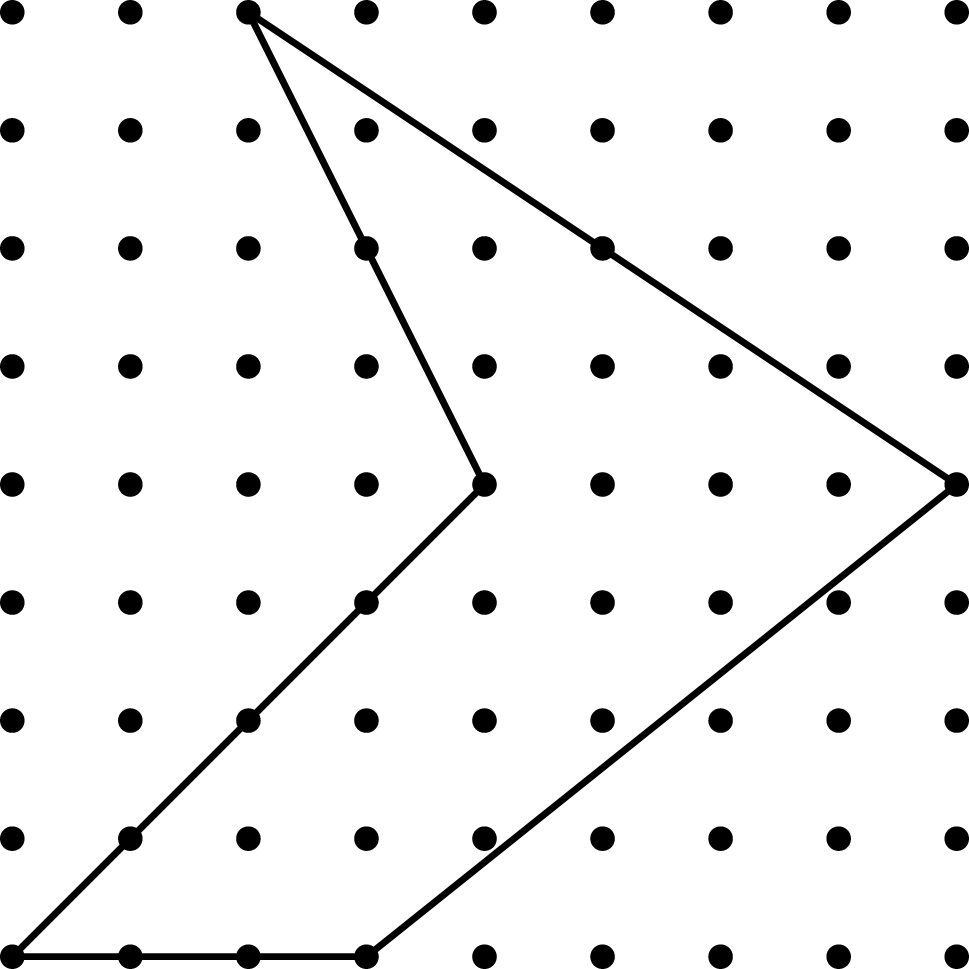
A polygon with 17 interior lattice points,
 $12$
boundary lattice points, and area
 $22$
.

3 Some useful tools
3.1 Pick’s theorem
Pick’s theorem [Reference Pick12] is a classical statement relating the area
 $A$
of a polygon whose vertices are on integer lattice points to the number
 $I$
of interior lattice points and the number
 $B$
of lattice points on the boundary via
 $$\begin{eqnarray}A=I+\frac{B}{2}-1;\end{eqnarray}$$
see Figure 5.
The triangles that we are interested in do not, in general, have vertices on lattice points, and therefore, Pick’s theorem does not directly apply. Rather, given a triangle
 $T$
we will consider the convex hull
 $C$
of the lattice points contained in
 $T$
. The convex hull
 $C$
is a polygonal domain whose vertices are on lattice points, which contains the same number of lattice points as
 $T$
. By Pick’s theorem, the total number
 $I+B$
of lattice points contained in
 $C$
is
 $$\begin{eqnarray}I+B=A+\frac{B}{2}+1,\end{eqnarray}$$
where
 $I$
is the number of interior lattice points in
 $C$
,
 $B$
is the number of lattice points on the boundary of
 $C$
, and
 $A$
is the area of
 $C$
. Thus, by Pick’s theorem, we have reduced the problem of determining the number of lattice points in
 $T$
to estimating the area of the convex hull
 $C$
as well as the number of lattice points on the boundary of
 $C$
.
3.2 Irrational slopes
This section presents a self-contained geometric-combinatorial characterization of irrationality. Let
 $C_{\unicode[STIX]{x1D6FD},\unicode[STIX]{x1D6FE}}(N)$
denote the convex hull of the non-negative lattice points under the line
 $y=\unicode[STIX]{x1D6FD}x+\unicode[STIX]{x1D6FE}$
whose
 $x$
-coordinate is at most
 $N$
. More precisely,
 $$\begin{eqnarray}C_{\unicode[STIX]{x1D6FD},\unicode[STIX]{x1D6FE}}(N):=\text{convex hull}(\{(k,m)\in \mathbb{Z}_{{\geqslant}0}^{2}:k\leqslant N\wedge m\leqslant \unicode[STIX]{x1D6FD}k+\unicode[STIX]{x1D6FE}\}).\end{eqnarray}$$
In the following Lemma, we show that
 $\unicode[STIX]{x1D6FD}>0$
is irrational if and only if the boundary
 $\unicode[STIX]{x2202}C_{\unicode[STIX]{x1D6FD},\unicode[STIX]{x1D6FE}}(N)$
of the convex hull
 $C_{\unicode[STIX]{x1D6FD},\unicode[STIX]{x1D6FE}}(N)$
contains
 $(1+\unicode[STIX]{x1D6FD})N+o_{\unicode[STIX]{x1D6FD}}(N)$
lattice points. That is to say, the part of the boundary of the convex hull that is neither on the
 $x$
-axis nor on the line
 $x=N$
contains less than linear lattice points in
 $N$
.
Lemma 7. Suppose
 $\unicode[STIX]{x1D6FD}>0$
and
 $0\leqslant \unicode[STIX]{x1D6FE}<1$
are arbitrary. Then
 $\unicode[STIX]{x1D6FD}>0$
is irrational if and only if
 $$\begin{eqnarray}\#(\unicode[STIX]{x2202}C_{\unicode[STIX]{x1D6FD},\unicode[STIX]{x1D6FE}}(N)\cap \mathbb{Z}^{2})=(1+\unicode[STIX]{x1D6FD})N+o_{\unicode[STIX]{x1D6FD}}(N)\quad \text{as }N\rightarrow \infty .\end{eqnarray}$$
Proof. Fix
 $\unicode[STIX]{x1D6FD}>0$
and
 $0\leqslant \unicode[STIX]{x1D6FE}<1$
. Observe that the number of lattice points on
 $\unicode[STIX]{x2202}C_{\unicode[STIX]{x1D6FD},\unicode[STIX]{x1D6FE}}(N)$
that are either on the
 $x$
-axis or the line
 $x=N$
is
 $$\begin{eqnarray}\#\{(k,m)\in \unicode[STIX]{x2202}C_{\unicode[STIX]{x1D6FD},\unicode[STIX]{x1D6FE}}(N)\cap \mathbb{Z}^{2}:m=0\vee k=N\}=(1+\unicode[STIX]{x1D6FD})N+{\mathcal{O}}(1).\end{eqnarray}$$
Therefore, it suffices to show that the number of lattice points on
 $\unicode[STIX]{x2202}C_{\unicode[STIX]{x1D6FD},\unicode[STIX]{x1D6FE}}(N)$
that are neither on the
 $x$
-axis nor on the line
 $x=N$
is
 $$\begin{eqnarray}\#\{(k,m)\in \unicode[STIX]{x2202}C_{\unicode[STIX]{x1D6FD},\unicode[STIX]{x1D6FE}}(N)\cap \mathbb{Z}^{2}:m>0\wedge k<N\}=o_{\unicode[STIX]{x1D6FD}}(N).\end{eqnarray}$$
Each of these lattice points has a unique
 $x$
-coordinate so if we define
 $$\begin{eqnarray}A:=\{k<N:(\exists m>0:(k,m)\in \unicode[STIX]{x2202}C_{\unicode[STIX]{x1D6FD},\unicode[STIX]{x1D6FE}}(N)\cap \mathbb{Z}^{2})\},\end{eqnarray}$$
then it suffices to show that
 $$\begin{eqnarray}\#A=o_{\unicode[STIX]{x1D6FD}}(N)\quad \text{as }N\rightarrow \infty .\end{eqnarray}$$
If
 $\unicode[STIX]{x1D6FD}$
is rational, then it is not hard to show that
 $A$
will contain linear lattice points in
 $N$
(e.g. see the proof of Lemma 4). Suppose
 $\unicode[STIX]{x1D6FD}>0$
is irrational; we prove by contradiction. Without loss of generality we may suppose that
 $\unicode[STIX]{x1D6FD}\geqslant 1$
(otherwise, we may consider the triangle with slope
 $1/\unicode[STIX]{x1D6FD}$
which encloses the same number of positive lattice points). Suppose there exists a constant
 $\unicode[STIX]{x1D700}>0$
such that for arbitrarily large
 $N$
 $$\begin{eqnarray}\#A\geqslant \unicode[STIX]{x1D700}N.\end{eqnarray}$$
The following argument is independent of
 $\unicode[STIX]{x1D6FE}$
. We argue as follows: for at least
 $\unicode[STIX]{x1D700}N/2$
elements in
 $A$
, it is true that the next element in
 $A$
is at distance less than
 $4/\unicode[STIX]{x1D700}$
. If that were false, then
 $$\begin{eqnarray}N\geqslant \max _{a\in A}a-\min _{a\in A}a\geqslant \biggl(\frac{\unicode[STIX]{x1D700}}{2}N\biggr)\frac{4}{\unicode[STIX]{x1D700}}\geqslant 2N,\end{eqnarray}$$
which is a contradiction. We now study the slope of the boundary of the convex hull
 $C_{\unicode[STIX]{x1D6FD},\unicode[STIX]{x1D6FE}}(N)$
between each of these
 $\unicode[STIX]{x1D700}N/2$
points, and their following points in
 $A$
. Since each of the following points is at most distance
 $4/\unicode[STIX]{x1D700}$
away, it is clear that each slope is a rational number
 $p/q$
with denominator less than
 $4/\unicode[STIX]{x1D700}$
and
 $p/q\leqslant \unicode[STIX]{x1D6FD}+1$
. The cardinality of this set of slopes is bounded
 $$\begin{eqnarray}\#\biggl\{\frac{p}{q}:1\leqslant q\leqslant \frac{4}{\unicode[STIX]{x1D700}}\wedge 1\leqslant p\leqslant (\unicode[STIX]{x1D6FD}+1)q\biggr\}\leqslant \mathop{\sum }_{q=1}^{\lfloor 4/\unicode[STIX]{x1D700}\rfloor }(\unicode[STIX]{x1D6FD}+1)q\leqslant \frac{16(1+\unicode[STIX]{x1D6FD})}{\unicode[STIX]{x1D700}^{2}}.\end{eqnarray}$$
The second ingredient is a consequence of convexity: consecutive slopes are monotonically decreasing. The third ingredient is that the slope cannot be constant over too long a stretch: more precisely, let
 $$\begin{eqnarray}\unicode[STIX]{x1D6FF}_{\unicode[STIX]{x1D6FD},\unicode[STIX]{x1D700}}=\min \biggl\{\biggl|\unicode[STIX]{x1D6FD}-\frac{p}{q}\biggr|:1\leqslant q\leqslant \frac{4}{\unicode[STIX]{x1D700}}\wedge 1\leqslant p\leqslant (\unicode[STIX]{x1D6FD}+1)q\biggr\}.\end{eqnarray}$$
We emphasize that
 $\unicode[STIX]{x1D6FF}_{\unicode[STIX]{x1D6FD},\unicode[STIX]{x1D700}}$
only depends on
 $\unicode[STIX]{x1D6FD}$
and
 $\unicode[STIX]{x1D700}$
. Since
 $\unicode[STIX]{x1D6FD}$
is irrational, we have that
 $\unicode[STIX]{x1D6FF}_{\unicode[STIX]{x1D6FD},\unicode[STIX]{x1D700}}>0$
. Let us now assume that the slope
 $p/q$
occurs over a long stretch. If
 $p/q>\unicode[STIX]{x1D6FD}$
, then
 $p/q\geqslant \unicode[STIX]{x1D6FD}+\unicode[STIX]{x1D6FF}_{\unicode[STIX]{x1D6FD},\unicode[STIX]{x1D700}}$
and we see that the stretch can be at most of length
 $\unicode[STIX]{x1D6FF}_{\unicode[STIX]{x1D6FD},\unicode[STIX]{x1D700}}^{-1}$
(because the line would otherwise intersect the irrational line). If
 $p/q<\unicode[STIX]{x1D6FD}$
, then the line would eventually (depending on
 $\unicode[STIX]{x1D6FF}_{\unicode[STIX]{x1D6FD},\unicode[STIX]{x1D700}}$
) be at distance bigger than 1 from the irrational line and this would allow us to identify a lattice point outside the convex hull, which would be a contradiction. Altogether, this implies that
 $$\begin{eqnarray}\frac{\unicode[STIX]{x1D700}N}{2}\leqslant \frac{16(1+\unicode[STIX]{x1D6FD})}{\unicode[STIX]{x1D700}^{2}}\frac{1}{\unicode[STIX]{x1D6FF}_{\unicode[STIX]{x1D6FD},\unicode[STIX]{x1D700}}},\end{eqnarray}$$
and hence
 $$\begin{eqnarray}N\leqslant \frac{32(1+\unicode[STIX]{x1D6FD})}{\unicode[STIX]{x1D700}^{3}}\frac{1}{\unicode[STIX]{x1D6FF}_{\unicode[STIX]{x1D6FD},\unicode[STIX]{x1D700}}}<\infty ,\end{eqnarray}$$
which is the desired contradiction. ◻
We remark that the asymptotic error
 $o_{\unicode[STIX]{x1D6FD}}(N)$
cannot, in general, be improved because for any fixed
 $N$
one can take an irrational number sufficiently close to 1 such that the error term is actually arbitrarily close to order
 $N$
. Moreover, the convergence of the error term
 $o(N)/N$
to 0 can be seen to be arbitrarily slow by considering slopes given by Liouville-type numbers
 $$\begin{eqnarray}\displaystyle & & \displaystyle \mathop{\sum }_{n=1}^{\infty }\frac{1}{10^{n!}},\quad \mathop{\sum }_{n=1}^{\infty }\frac{1}{10^{(n!^{n!})}},\ldots \nonumber\end{eqnarray}$$
that are extremely well-approximated by rationals. However, the proof can be made quantitative under an additional assumption on
 $\unicode[STIX]{x1D6FD}$
as the next corollary shows. We have no reason to assume that the following result is sharp; it seems likely that using more powerful techniques (the continued fraction expansion of
 $\unicode[STIX]{x1D6FD}$
) one should be able to obtain much stronger results.
Corollary. Let
 $\unicode[STIX]{x1D707}>0$
. If
 $\unicode[STIX]{x1D6FD}$
satisfies the diophantine condition
 $$\begin{eqnarray}\text{for all }\frac{p}{q}\in \mathbb{Q}:\quad \biggl|\unicode[STIX]{x1D6FD}-\frac{p}{q}\biggr|\geqslant \frac{c}{q^{\unicode[STIX]{x1D707}}},\end{eqnarray}$$
then
 $$\begin{eqnarray}\#\{(k,m)\in \unicode[STIX]{x2202}C_{\unicode[STIX]{x1D6FD},\unicode[STIX]{x1D6FE}}(N)\cap \mathbb{Z}^{2}:m>0\wedge k<N\}={\mathcal{O}}(N^{(\unicode[STIX]{x1D707}+2)/(\unicode[STIX]{x1D707}+3)}).\end{eqnarray}$$
Proof. We argue as above and observe again that the number of possible small fractions satisfies
 $$\begin{eqnarray}\#\biggl\{\frac{p}{q}:1\leqslant q\leqslant \frac{4}{\unicode[STIX]{x1D700}}\wedge 1\leqslant p\leqslant (\unicode[STIX]{x1D6FD}+1)q\biggr\}\leqslant \frac{16(1+\unicode[STIX]{x1D6FD})}{\unicode[STIX]{x1D700}^{2}}.\end{eqnarray}$$
Since
 $q\leqslant 4\unicode[STIX]{x1D700}^{-1}$
, we have, by assumption,
 $$\begin{eqnarray}\unicode[STIX]{x1D6FF}_{\unicode[STIX]{x1D6FD},\unicode[STIX]{x1D700}}=\min \biggl\{\biggl|\unicode[STIX]{x1D6FD}-\frac{p}{q}\biggr|:1\leqslant q\leqslant \frac{4}{\unicode[STIX]{x1D700}}\wedge 1\leqslant p\leqslant (\unicode[STIX]{x1D6FD}+1)q\biggr\}\geqslant \frac{c}{(4/\unicode[STIX]{x1D700})^{\unicode[STIX]{x1D707}}}.\end{eqnarray}$$
This shows that
 $$\begin{eqnarray}N\leqslant \frac{32(1+\unicode[STIX]{x1D6FD})}{\unicode[STIX]{x1D700}^{3}}\frac{1}{\unicode[STIX]{x1D6FF}_{\unicode[STIX]{x1D6FD},\unicode[STIX]{x1D700}}}\leqslant \frac{c^{\prime }}{\unicode[STIX]{x1D700}^{3+\unicode[STIX]{x1D707}}}\quad \text{and thus}\quad \unicode[STIX]{x1D700}\leqslant \frac{c^{\prime \prime }}{N^{1/(3+\unicode[STIX]{x1D707})}}.\end{eqnarray}$$
This shows that the maximum size of the set is
 $$\begin{eqnarray}\unicode[STIX]{x1D700}N\leqslant c^{\prime \prime }N^{(\unicode[STIX]{x1D707}+2)/(\unicode[STIX]{x1D707}+3)}.\square\end{eqnarray}$$
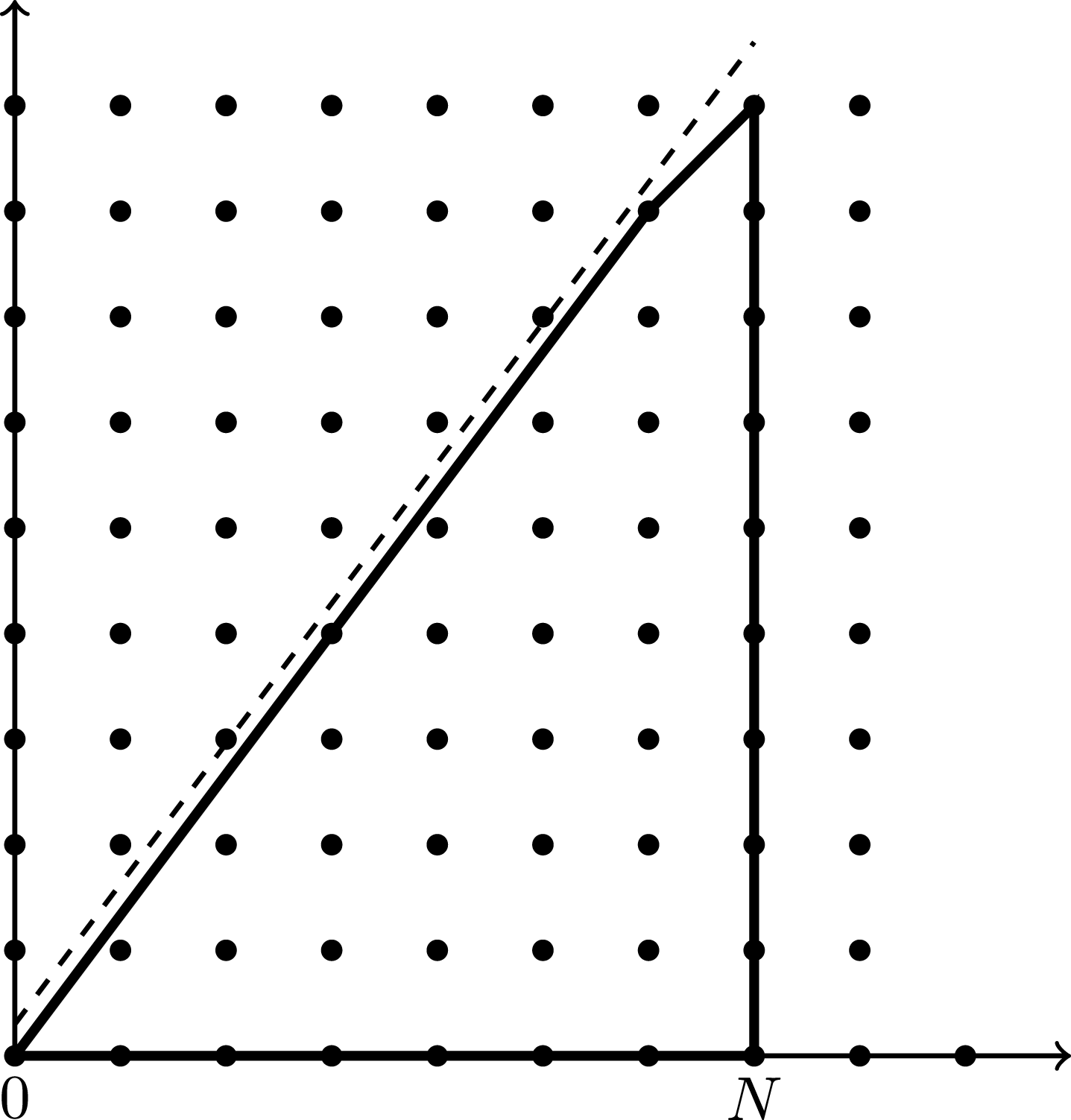
We also need that the area of the convex hull
 $C_{\unicode[STIX]{x1D6FD},\unicode[STIX]{x1D6FE}}(N)$
approaches the area enclosed by the line
 $y=\unicode[STIX]{x1D6FD}x+\unicode[STIX]{x1D6FE}$
, the
 $x$
-axis, and the line
 $x=N$
, see Figure 6.
The line
 $y=\unicode[STIX]{x1D6FD}x+\unicode[STIX]{x1D6FE}$
(dashed) and the boundary of the convex hull
 $C_{\unicode[STIX]{x1D6FD},\unicode[STIX]{x1D6FE}}(N)$
(bold).

Lemma 8. Let
 $\unicode[STIX]{x1D6FD}>0$
be an irrational number, and
 $0\leqslant \unicode[STIX]{x1D6FE}<1$
be arbitrary. Then
 $$\begin{eqnarray}|C_{\unicode[STIX]{x1D6FD},\unicode[STIX]{x1D6FE}}(N)|={\textstyle \frac{1}{2}}\unicode[STIX]{x1D6FD}N^{2}+\unicode[STIX]{x1D6FE}N+o_{\unicode[STIX]{x1D6FD}}(N)\quad \text{as }N\rightarrow \infty .\end{eqnarray}$$
Proof. Let
 $\unicode[STIX]{x1D700}>0$
be arbitrary. We will prove the existence of an integer
 $m_{\unicode[STIX]{x1D6FD},\unicode[STIX]{x1D700}}\in \mathbb{N}$
with the property that for all
 $k\in \mathbb{N}$
 $$\begin{eqnarray}\max _{k\leqslant j\leqslant k+m_{\unicode[STIX]{x1D6FD},\unicode[STIX]{x1D700}}}\{\unicode[STIX]{x1D6FD}j+\unicode[STIX]{x1D6FE}\}\geqslant 1-\unicode[STIX]{x1D700},\end{eqnarray}$$
where, as usual,
 $\{x\}=x-\lfloor x\rfloor$
denotes the fractional part of
 $x$
. This will then establish the statement as follows: it guarantees that in every consecutive block of
 $m_{\unicode[STIX]{x1D6FD},\unicode[STIX]{x1D700}}$
lattice points one of them is
 $\unicode[STIX]{x1D700}$
close to the limiting line
 $y=\unicode[STIX]{x1D6FD}x+\unicode[STIX]{x1D6FE}$
: this immediately shows that the area of the convex hull is at most
 ${\sim}\unicode[STIX]{x1D700}N$
away from the area enclosed by the line
 $y=\unicode[STIX]{x1D6FD}x+\unicode[STIX]{x1D6FE}$
, the
 $x$
-axis, and the line
 $x=N$
, which implies the result. For convenience of notation, we consider
 $\{\unicode[STIX]{x1D6FD}j+\unicode[STIX]{x1D6FE}\}_{j=1}^{\infty }$
a sequence on the torus
 $\mathbb{T}\cong [0,1]$
. The desired statement would follow if we knew that there exists
 $m_{\unicode[STIX]{x1D6FD},\unicode[STIX]{x1D700}}\in \mathbb{N}$
with the property that for all
 $k\in \mathbb{N}$
 $$\begin{eqnarray}\{\unicode[STIX]{x1D6FD}j:k\leqslant j\leqslant k+m_{\unicode[STIX]{x1D6FD},\unicode[STIX]{x1D700}}\}\quad \text{is a}~\unicode[STIX]{x1D700}\text{-net on}~\mathbb{T}.\end{eqnarray}$$
Recall that a
 $\unicode[STIX]{x1D700}$
-net is a set of points such that every element of
 $\mathbb{T}$
is at most at distance
 $\unicode[STIX]{x1D700}$
from one of the points in this net. Now we exploit the linear structure of the sequence
 $\unicode[STIX]{x1D6FD}(k+j)=\unicode[STIX]{x1D6FD}k+\unicode[STIX]{x1D6FD}j$
. The desired statement is rotation invariant, so it is equivalent to show the existence of a
 $m_{\unicode[STIX]{x1D6FD},\unicode[STIX]{x1D700}}\in \mathbb{N}$
such that
 $$\begin{eqnarray}\{\unicode[STIX]{x1D6FD}j:1\leqslant j\leqslant m_{\unicode[STIX]{x1D6FD},\unicode[STIX]{x1D700}}\}\quad \text{is a}~\unicode[STIX]{x1D700}\text{-net on}~\mathbb{T}.\end{eqnarray}$$
This is now implied by the fact that a Kronecker sequence with an irrational
 $\unicode[STIX]{x1D6FD}$
is uniformly distributed (first established by Weyl [Reference Weyl15]) and that uniformly distributed sequences have the size of the maximal gap tending to 0 (an easy exercise that can be found, for example, in the book of Kuipers and Niederreiter [Reference Kuipers and Niederreiter10]).◻
3.3 Aligning multiples
Given a set
 $\{a_{1},\ldots ,a_{n}\}$
of positive real numbers, we may consider their multiples
 $(ka_{1})_{k=1}^{\infty }$
,
 $(ka_{2})_{k=1}^{\infty },\ldots ,(ka_{n})_{k=1}^{\infty }$
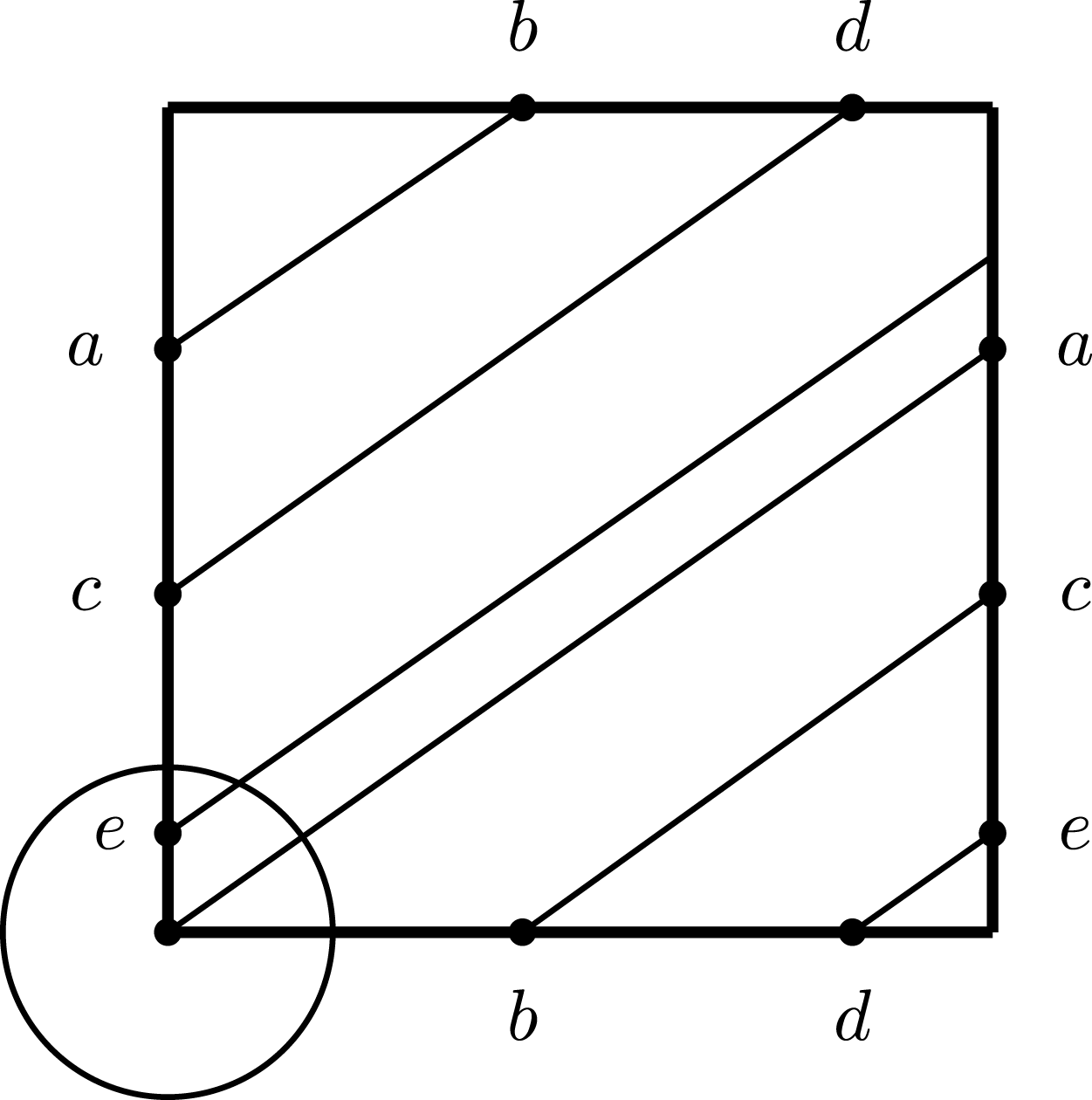
. The main result from this section is that there exists arbitrarily small intervals that contain an element from each sequence; see the illustration in Figure 7. The statement is a folklore result and a standard application of the Poincaré recurrence theorem.
Lemma 9. Suppose
 $\{a_{1},a_{2},\ldots ,a_{n}\}\subset \mathbb{R}_{{>}0}$
. Then for all
 $\unicode[STIX]{x1D700}>0$
, there exists
 $\{b_{1},b_{2},\ldots ,b_{n}\}\subset \mathbb{Z}_{{>}0}$
and
 $m\in \mathbb{N}$
such that
 $$\begin{eqnarray}\max _{1\leqslant i\leqslant n}|a_{i}b_{i}-m|\leqslant \unicode[STIX]{x1D700}.\end{eqnarray}$$
Every linear flow on the torus eventually returns close to the origin.

Proof. We make use of the Poincaré recurrence theorem: it states that given a measure space
 $(X,{\mathcal{A}},\unicode[STIX]{x1D707})$
and a measure-preserving transformation
 $T$
from
 $X$
to itself almost every point from a given set
 $A\in {\mathcal{A}}$
with
 $\unicode[STIX]{x1D707}(A)>0$
returns to the set
 $A$
infinitely many times or, formally,
 $$\begin{eqnarray}\unicode[STIX]{x1D707}(\{x\in A:(\exists k\in \mathbb{N}:(\forall \ell >k,T^{\ell }(x)\notin A))\})=0,\end{eqnarray}$$
for every
 $A\in {\mathcal{A}}$
. We consider the torus
 $\mathbb{T}^{n}=X$
equipped with the Lebesgue measure
 $\unicode[STIX]{x1D707}$
and consider the measure-preserving transformation
 $$\begin{eqnarray}T(x_{1},x_{2},\ldots ,x_{n})=\biggl(x_{1}+\frac{1}{a_{1}},x_{2}+\frac{1}{a_{2}},\ldots ,x_{n}+\frac{1}{a_{n}}\biggr).\end{eqnarray}$$
We apply the Poincaré recurrence theorem to the set
 $$\begin{eqnarray}A=\biggl\{x\in \mathbb{T}^{n}:~\sup _{1\leqslant i\leqslant n}|x_{i}|\leqslant \frac{\unicode[STIX]{x1D700}}{4\max (a_{1},\ldots ,a_{n})}\biggr\}\in {\mathcal{A}}.\end{eqnarray}$$
Since
 $\unicode[STIX]{x1D707}(A)>0$
, there exists at least one
 $x_{0}\in A$
such that
 $T(x_{0}),T(T(x_{0})),\ldots \,$
returns to
 $A$
infinitely often. Then, because of the underlying linearity of
 $T$
, we have that
 $$\begin{eqnarray}T^{\ell }(0)=T^{\ell }(x_{0})-x_{0},\end{eqnarray}$$
and thus, with the triangle inequality, for infinitely many
 $\ell \in \mathbb{N}$
 $$\begin{eqnarray}T^{\ell }(0)\in \biggl\{x\in \mathbb{T}^{n}:~\sup _{1\leqslant i\leqslant n}|x_{i}|\leqslant \frac{\unicode[STIX]{x1D700}}{2\max (a_{1},\ldots ,a_{n})}\biggr\}.\end{eqnarray}$$
Put differently, we have for suitable
 $c_{1},c_{2},\ldots ,c_{n}\in \mathbb{N}$
that
 $$\begin{eqnarray}\biggl|\frac{\ell }{a_{i}}-c_{i}\biggr|\leqslant \frac{\unicode[STIX]{x1D700}}{2\max (a_{1},\ldots ,a_{n})}.\end{eqnarray}$$
Multiplication with
 $a_{i}$
shows that
 $$\begin{eqnarray}|\ell -a_{i}c_{i}|\leqslant \frac{\unicode[STIX]{x1D700}}{2}\end{eqnarray}$$
from which the result follows. ◻
The argument immediately suggests several ways of how this result could be improved. The worst possible case is when the vector
 $(a_{1},a_{2},\ldots ,a_{n})$
is badly approximable in which case the one-parameter flow
 $\{(a_{1}t,a_{2}t,\ldots ,a_{n}t):t>0\}$
is effectively exploring the entire torus and may require a very long time to return to the origin. In contrast, linear dependence, getting trapped in subspaces or being well approximable by rational numbers, shorten the return time.
4 Proof of Theorem 1
This section is organized as follows. First, we prove Lemmas 4 and 5 which provide asymptotic formulas for
 $N_{\unicode[STIX]{x1D6FD}}(\unicode[STIX]{x1D6FC})$
as
 $\unicode[STIX]{x1D6FC}\rightarrow \infty$
for fixed rational and irrational slopes, respectively. Second, we show that the Minkowski dimension of
 $\unicode[STIX]{x1D6EC}$
is at most
 $3/4$
. Third, we use Lemmas 4 and 5 to complete the proof of Theorem 1.
4.1 Rational slopes: Lemma 4
If
 $p$
and
 $q$
are positive coprime integers, then Lemma 4 states that
 $$\begin{eqnarray}N_{p/q}(\unicode[STIX]{x1D6FC})=\frac{\unicode[STIX]{x1D6FC}^{2}}{2}+\frac{-\sqrt{p/q}-\sqrt{q/p}+\sqrt{1/pq}(1-2\{\unicode[STIX]{x1D6FC}\sqrt{pq}\})}{2}\unicode[STIX]{x1D6FC}+{\mathcal{O}}_{p,q}(1).\end{eqnarray}$$
The interesting behavior of this expression occurs in the coefficient of
 $\unicode[STIX]{x1D6FC}$
. This coefficient is periodic with period
 $1/\sqrt{pq}$
and peak-to-peak amplitude
 $1/\sqrt{pq}$
. Furthermore, as
 $p$
and
 $q$
tend towards infinity this coefficient approaches
 $(-\sqrt{p/q}-\sqrt{q/p})/2$
. This convergence is suggestive of the behavior of irrational numbers, whose counting function converges to a quadratic polynomial in
 $\unicode[STIX]{x1D6FC}$
as
 $\unicode[STIX]{x1D6FC}\rightarrow \infty$
.
Proof of Lemma 4.
Suppose that a triangle with vertices
 $(0,0)$
,
 $(\unicode[STIX]{x1D6FC}\sqrt{q/p},0)$
, and
 $(0,\unicode[STIX]{x1D6FC}\sqrt{p/q})$
is given. If a line of slope
 $-p/q$
intersects the
 $x$
-axis at
 $\unicode[STIX]{x1D6FC}\sqrt{q/p}-b$
and the point
 $(k,m)\in \mathbb{Z}^{2}$
, then
 $$\begin{eqnarray}m=-\frac{p}{q}\biggl(k-\unicode[STIX]{x1D6FC}\sqrt{\frac{q}{p}}+b\biggr).\end{eqnarray}$$
Solving for
 $b$
yields
 $$\begin{eqnarray}b=\frac{\unicode[STIX]{x1D6FC}\sqrt{pq}-(qm+kp)}{p}.\end{eqnarray}$$
The smallest non-negative value of
 $b$
that can be written in this form for some
 $(k,m)\in \mathbb{Z}^{2}$
is
 $$\begin{eqnarray}b^{\ast }=\frac{\unicode[STIX]{x1D6FC}\sqrt{pq}-\lfloor \unicode[STIX]{x1D6FC}\sqrt{qp}\rfloor }{p}.\end{eqnarray}$$
Indeed, since
 $p$
and
 $q$
are coprime
 $\{qm+kp:k,m\in \mathbb{Z}\}=\mathbb{Z}$
. Let
 $T^{\ast }$
be the triangle with vertices
 $(0,0)$
,
 $(\unicode[STIX]{x1D6FC}\sqrt{q/p}-b^{\ast },0)$
, and
 $(0,\unicode[STIX]{x1D6FC}\sqrt{p/q}-(p/q)b^{\ast })$
, and
 $C$
be the convex hull of the non-negative lattice points enclosed by the triangle with vertices
 $(0,0)$
,
 $(\unicode[STIX]{x1D6FC}\sqrt{q/p},0)$
, and
 $(0,\unicode[STIX]{x1D6FC}\sqrt{p/q})$
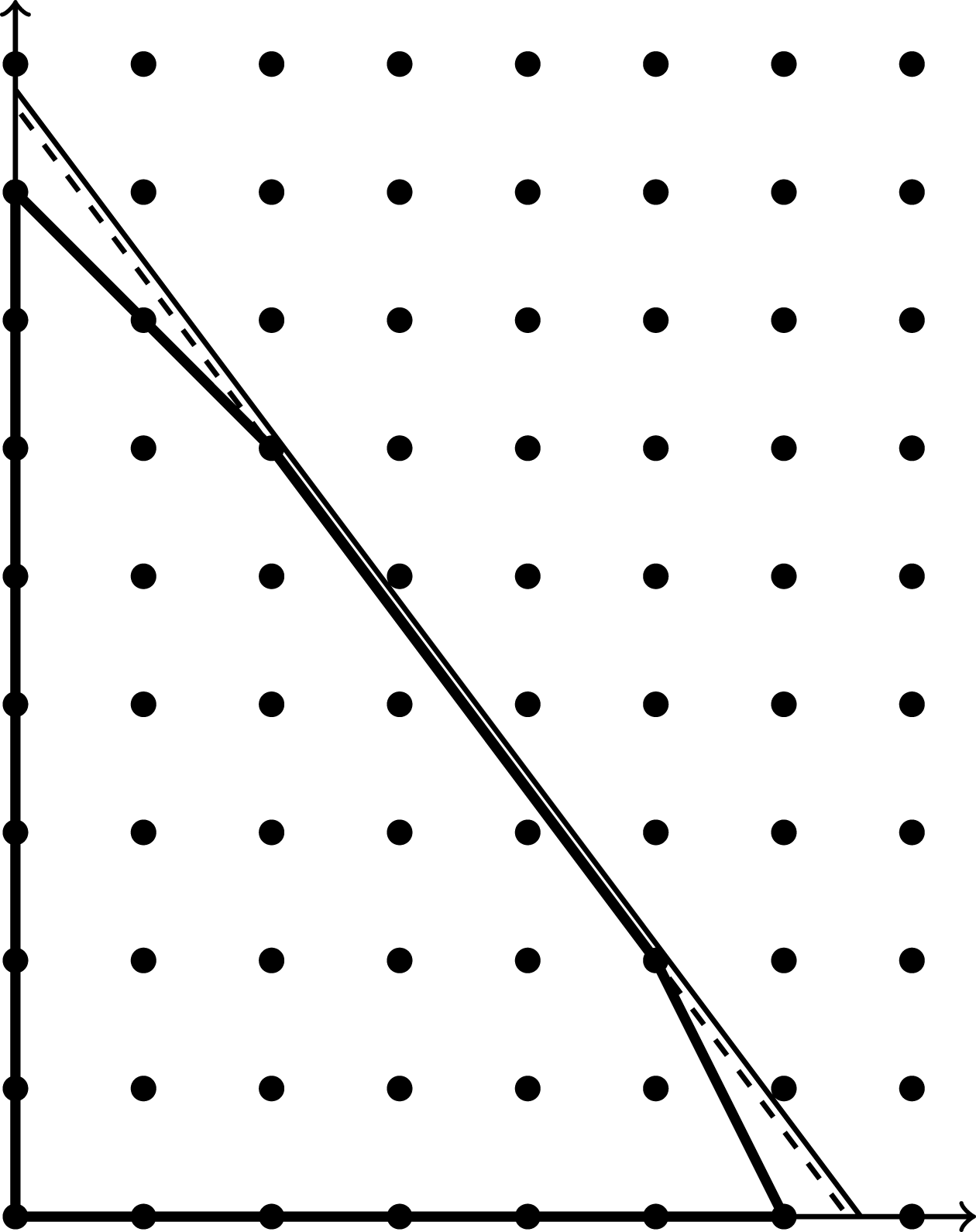
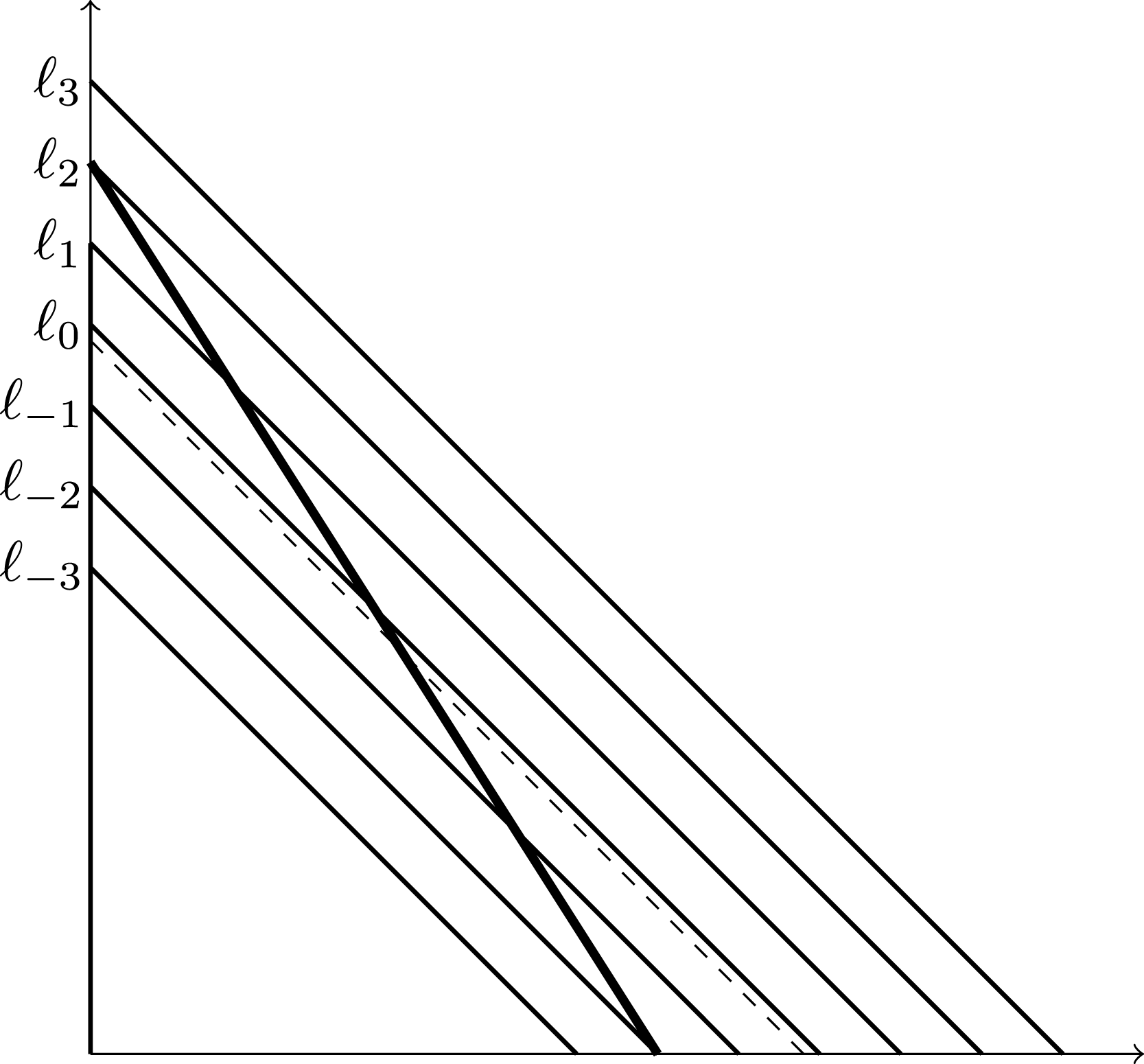
; see Figure 8.
Triangle
 $T^{\ast }$
(dashed) and boundary of convex hull
 $C$
(bold) for a given triangle (solid).

To summarize,
 $b^{\ast }\geqslant 0$
is the smallest non-negative number such that the line
 $$\begin{eqnarray}y=-\frac{p}{q}\biggl(x-\unicode[STIX]{x1D6FC}\sqrt{\frac{q}{p}}+b^{\ast }\biggr)\end{eqnarray}$$
intersects some lattice point, and the segment of this line such that
 $0\leqslant x\leqslant \unicode[STIX]{x1D6FC}\sqrt{q/p}-b^{\ast }$
is the hypotenuse of the triangle
 $T^{\ast }$
. Therefore, the lattice points enclosed by the triangle
 $T^{\ast }$
are exactly those enclosed by the triangle with vertices
 $(0,0)$
,
 $(\unicode[STIX]{x1D6FC}\sqrt{q/p},0)$
, and
 $(0,\unicode[STIX]{x1D6FC}\sqrt{p/q})$
. It follows that the convex hull
 $C$
is contained in the triangle
 $T^{\ast }$
. We assert that
 $$\begin{eqnarray}\displaystyle T^{\ast }\setminus C & \subset & \displaystyle \left[0,q\right]\times \biggl[\unicode[STIX]{x1D6FC}\sqrt{\frac{p}{q}}-p-\frac{p}{q}b^{\ast },\unicode[STIX]{x1D6FC}\sqrt{\frac{p}{q}}-\frac{p}{q}b^{\ast }\biggr]\nonumber\\ \displaystyle & & \displaystyle \cup \,\biggl[\unicode[STIX]{x1D6FC}\sqrt{\frac{q}{p}}-q-b^{\ast },\unicode[STIX]{x1D6FC}\sqrt{\frac{q}{p}}-b^{\ast }\biggr]\times [0,p].\nonumber\end{eqnarray}$$
Indeed, the hypotenuse of
 $T^{\ast }$
intersects lattice points periodically because it has a rational slope
 $-p/q$
. Therefore, it must intersect exactly one lattice point with
 $x$
-coordinate
 $0\leqslant x<q$
and exactly one lattice point with
 $y$
-coordinate
 $0\leqslant y<p$
(since
 $p$
and
 $q$
are coprime). The line segment between these two points must be contained in the convex hull
 $C$
. We conclude that the hypotenuse of
 $T^{\ast }$
and
 $C$
only possibly differ in the above union of rectangles. Therefore, the area of
 $T^{\ast }$
and
 $C$
differ by at most
 ${\mathcal{O}}_{p,q}(1)$
, and moreover, the boundary of
 $T^{\ast }$
and the boundary of
 $C$
contain the same number of lattice points up to error on the order of
 ${\mathcal{O}}_{p,q}(1)$
. Next, we use Pick’s theorem to estimate the number of lattice points in the convex hull
 $C$
. Let
 $A$
denote the area of
 $C$
,
 $B$
denote the number of lattice points on the boundary of
 $C$
, and
 $I$
denote the number of lattice points in the interior of
 $C$
. By Pick’s theorem
 $$\begin{eqnarray}\displaystyle I+B & = & \displaystyle A+\frac{B}{2}+1\nonumber\\ \displaystyle & = & \displaystyle \frac{(\unicode[STIX]{x1D6FC}\sqrt{p/q}-(p/q)b^{\ast })(\unicode[STIX]{x1D6FC}\sqrt{q/p}-b^{\ast })}{2}\nonumber\\ \displaystyle & & \displaystyle +\,\frac{\unicode[STIX]{x1D6FC}\sqrt{p/q}+\unicode[STIX]{x1D6FC}\sqrt{q/p}+\unicode[STIX]{x1D6FC}\sqrt{1/pq}}{2}+{\mathcal{O}}_{p,q}(1).\nonumber\end{eqnarray}$$
Subtracting the lattice points on the
 $x$
and
 $y$
axes yields
 $$\begin{eqnarray}\displaystyle N_{p/q}(\unicode[STIX]{x1D6FC}) & = & \displaystyle I+B-\unicode[STIX]{x1D6FC}\sqrt{p/q}-\unicode[STIX]{x1D6FC}\sqrt{q/p}+{\mathcal{O}}_{p,q}(1)\nonumber\\ \displaystyle & = & \displaystyle \frac{\unicode[STIX]{x1D6FC}^{2}}{2}-b^{\ast }\unicode[STIX]{x1D6FC}\sqrt{p/q}+\unicode[STIX]{x1D6FC}\frac{-\sqrt{p/q}-\sqrt{q/p}+\sqrt{1/pq}}{2}+{\mathcal{O}}_{p,q}(1)\nonumber\\ \displaystyle & = & \displaystyle \frac{\unicode[STIX]{x1D6FC}^{2}}{2}+\unicode[STIX]{x1D6FC}\frac{-\sqrt{p/q}-\sqrt{p/q}+\sqrt{1/pq}(1-2\{\unicode[STIX]{x1D6FC}\sqrt{pq}\})}{2}+{\mathcal{O}}_{p,q}(1).\nonumber\end{eqnarray}$$
The final step results from substituting
 $b^{\ast }=\{\unicode[STIX]{x1D6FC}\sqrt{pq}\}/p$
, where
 $\{\unicode[STIX]{x1D6FC}\sqrt{pq}\}=\unicode[STIX]{x1D6FC}\sqrt{pq}-\lfloor \unicode[STIX]{x1D6FC}\sqrt{pq}\rfloor$
denotes the fractional part of
 $\unicode[STIX]{x1D6FC}\sqrt{pq}$
. This completes the proof.◻
4.2 Irrational slopes: Lemma 5
To prove Lemma 5 we combine the results of Lemmas 7 and 8. We note that those results are formulated for triangles in a different configuration for simplicity of exposition; a reflection and translation makes these results applicable to triangles discussed in this proof.
Proof of Lemma 5.
Suppose a triangle with vertices
 $(0,0)$
,
 $(\unicode[STIX]{x1D6FC}/\sqrt{\unicode[STIX]{x1D6FD}},0)$
, and
 $(0,\unicode[STIX]{x1D6FC}\sqrt{\unicode[STIX]{x1D6FD}})$
is given. Let
 $C$
denote the convex hull of the non-negative lattice points enclosed by this triangle. The number of lattice points contained in this triangle is equal to the number
 $I+B$
of lattice points contained in the convex hull
 $C$
, which by Pick’s theorem equals
 $$\begin{eqnarray}I+B=A+\frac{B}{2}+1,\end{eqnarray}$$
where
 $I$
is the number of lattice points in the interior of
 $C$
,
 $B$
is the number of lattice points on the boundary of
 $C$
, and
 $A$
is the area of
 $C$
. Let
 $$\begin{eqnarray}\unicode[STIX]{x1D6FE}=\unicode[STIX]{x1D6FD}\biggl(\frac{\unicode[STIX]{x1D6FC}}{\sqrt{\unicode[STIX]{x1D6FD}}}-\biggl\lfloor\frac{\unicode[STIX]{x1D6FC}}{\sqrt{\unicode[STIX]{x1D6FD}}}\biggr\rfloor\biggr)\quad \text{and}\quad N=\biggl\lfloor\frac{\unicode[STIX]{x1D6FC}}{\sqrt{\unicode[STIX]{x1D6FD}}}\biggr\rfloor.\end{eqnarray}$$
If the convex hull
 $C$
is reflected about the line
 $x=N$
and translated
 $N$
units to the left, then it will be in the configuration of Lemmas 7 and 8 with
 $\unicode[STIX]{x1D6FE}$
and
 $N$
as specified above. Applying the results of these Lemmas, we conclude that
 $$\begin{eqnarray}B=(1+\unicode[STIX]{x1D6FD})N+o_{\unicode[STIX]{x1D6FD}}(N)=\biggl(\sqrt{\unicode[STIX]{x1D6FD}}+\sqrt{\frac{1}{\unicode[STIX]{x1D6FD}}}\biggr)\unicode[STIX]{x1D6FC}+o_{\unicode[STIX]{x1D6FD}}(\unicode[STIX]{x1D6FC}),\end{eqnarray}$$
and
 $$\begin{eqnarray}A=\frac{1}{2}\unicode[STIX]{x1D6FD}N^{2}+\unicode[STIX]{x1D6FE}N+o_{\unicode[STIX]{x1D6FD}}(N)=\frac{\unicode[STIX]{x1D6FC}^{2}}{2}+o_{\unicode[STIX]{x1D6FD}}(N).\end{eqnarray}$$
Hence, the number
 $\#(C\cap \mathbb{Z}_{{>}0}^{2})$
of positive lattice points in the convex hull
 $C$
is equal to the number
 $I+B$
of non-negative lattice points in
 $C$
minus the number
 $(\sqrt{\unicode[STIX]{x1D6FD}}+\sqrt{1/\unicode[STIX]{x1D6FD}})\unicode[STIX]{x1D6FC}+{\mathcal{O}}(1)$
of lattice points in
 $C$
that are either on the
 $x$
-axis or
 $y$
-axis
 $$\begin{eqnarray}\displaystyle \#(C\cap \mathbb{Z}_{{>}0}^{2}) & = & \displaystyle I+B-\biggl(\sqrt{\unicode[STIX]{x1D6FD}}+\sqrt{\frac{1}{\unicode[STIX]{x1D6FD}}}\biggr)\unicode[STIX]{x1D6FC}+{\mathcal{O}}(1)\nonumber\\ \displaystyle & = & \displaystyle \unicode[STIX]{x1D6FC}^{2}/2-\frac{\sqrt{\unicode[STIX]{x1D6FD}}+\sqrt{1/\unicode[STIX]{x1D6FD}}}{2}\unicode[STIX]{x1D6FC}+o_{\unicode[STIX]{x1D6FD}}(\unicode[STIX]{x1D6FC}),\nonumber\end{eqnarray}$$
which is the desired statement. ◻
4.3 Minkowski dimension
The discussion following Lemma 5 implies that
 $\unicode[STIX]{x1D6EC}$
only contains rational numbers. We can use the asymptotic formula in Lemma 4 to show that the rational numbers
 $p/q$
in
 $\unicode[STIX]{x1D6EC}$
have to be increasingly close to 1 as the denominator increases. This allows us to prove the following Lemma.
Corollary. If
 $p/q\in \unicode[STIX]{x1D6EC}$
, then
 $|q-p|\leqslant 2\sqrt{q}+1$
. Moreover,
 $\dim \unicode[STIX]{x1D6EC}\leqslant 3/4$
.
Proof. From Lemma 4 (rational slopes), we see that
 $p/q\in \unicode[STIX]{x1D6EC}$
implies
 $$\begin{eqnarray}-\sqrt{\frac{p}{q}}-\sqrt{\frac{q}{p}}+\sqrt{\frac{1}{pq}}\geqslant -2.\end{eqnarray}$$
Multiplying with
 $\sqrt{pq}$
yields
 $$\begin{eqnarray}-p-q+1\geqslant -2\sqrt{pq}.\end{eqnarray}$$
This yields a quadratic inequality with equality exactly for
 $p=q\pm 2\sqrt{q}+1$
. It now suffices to compute the Minkowski dimension
 $$\begin{eqnarray}\dim _{}\biggl\{\frac{p}{q}\in \mathbb{Q}:q\geqslant 1\wedge |p-q|\leqslant 2\sqrt{q}+1\biggr\}.\end{eqnarray}$$
These rational numbers accumulate around 1. It is easy to see that, for every
 $\unicode[STIX]{x1D700}>0$
,
 $$\begin{eqnarray}\displaystyle & & \displaystyle \biggl\{\frac{p}{q}\in \mathbb{Q}_{{>}0}:|p-q|\leqslant 2\sqrt{q}+1\biggr\}\nonumber\\ \displaystyle & & \displaystyle \quad \subseteq [1-\unicode[STIX]{x1D700}^{1/4},1+\unicode[STIX]{x1D700}^{1/4}]\cup \biggl\{\frac{p}{q}\in \mathbb{Q}_{{>}0}:q\leqslant \frac{9}{\sqrt{\unicode[STIX]{x1D700}}}\wedge |p-q|\leqslant 2\sqrt{q}+1\biggr\}.\nonumber\end{eqnarray}$$
Covering the first set with
 $\unicode[STIX]{x1D700}$
-boxes requires
 ${\sim}\unicode[STIX]{x1D700}^{-3/4}$
boxes. As for the second set, we simply put a box around every element which puts an upper bound on the number of boxes required at
 $$\begin{eqnarray}\displaystyle & & \displaystyle \#\biggl\{\frac{p}{q}\in \mathbb{Q}:q\leqslant \frac{9}{\sqrt{\unicode[STIX]{x1D700}}}\wedge |p-q|\leqslant 2\sqrt{q}+1\biggr\}\nonumber\\ \displaystyle & & \displaystyle \quad \lesssim \mathop{\sum }_{k=1}^{9\unicode[STIX]{x1D700}^{-1/2}}\sqrt{k}\sim (\unicode[STIX]{x1D700}^{-1/2})^{3/2}\sim \unicode[STIX]{x1D700}^{-3/4}.\square\nonumber\end{eqnarray}$$
4.4 Proof of Theorem 1
Proof. We quickly re-iterate why no irrational slope can be optimal for a sequence of areas tending to infinity. Lemma 5 implies that
 $$\begin{eqnarray}N_{\unicode[STIX]{x1D6FD}}(\unicode[STIX]{x1D6FC})=\frac{\unicode[STIX]{x1D6FC}^{2}}{2}-\unicode[STIX]{x1D6FC}\frac{\sqrt{\unicode[STIX]{x1D6FD}}+\sqrt{1/\unicode[STIX]{x1D6FD}}}{2}+o_{\unicode[STIX]{x1D6FD}}(\unicode[STIX]{x1D6FC})\end{eqnarray}$$
and, since
 $1\in \mathbb{Q}$
, we have
 $$\begin{eqnarray}\frac{\sqrt{\unicode[STIX]{x1D6FD}}+\sqrt{1/\unicode[STIX]{x1D6FD}}}{2}>1,\end{eqnarray}$$
which means that the asymptotic number of lattice points is eventually dominated by the rational slope
 $(n+1)/n$
for
 $n$
sufficiently large (see the discussion following Lemma 5). The very same reason, combined with Lemma 4, shows that the limit set
 $\unicode[STIX]{x1D6EC}$
can only contain rational slopes with
 $$\begin{eqnarray}-\sqrt{\frac{p}{q}}-\sqrt{\frac{q}{p}}+\sqrt{\frac{1}{pq}}\geqslant -2.\end{eqnarray}$$
This can be used to show that
 $\unicode[STIX]{x1D6EC}\subset [1/3,3]$
: if
 $p/q\geqslant 3$
and
 $p/q\in \unicode[STIX]{x1D6EC}$
, then
 $$\begin{eqnarray}-\sqrt{\frac{p}{q}}-\sqrt{\frac{q}{p}}\leqslant -2.3\quad \text{and thus}\quad \sqrt{\frac{1}{pq}}\geqslant 0.3.\end{eqnarray}$$
This last inequality is only true for finitely many rational numbers that can be explicitly checked by hand. The case
 $p/q\leqslant 1/3$
follows from symmetry considerations. A similar argument establishes the non-trivial dynamics: suppose it were indeed the case that the finite set of slopes
 $$\begin{eqnarray}\unicode[STIX]{x1D6E4}=\biggl\{\frac{p_{1}}{q_{1}},\frac{p_{2}}{q_{2}},\ldots ,\frac{p_{n}}{q_{n}}\biggr\}\subset \unicode[STIX]{x1D6EC}\end{eqnarray}$$
captures more lattice points for all sufficiently large areas then any other triangle whose slope is not in the set. We know that the counting function
 $N_{p/q}$
is oscillating periodically around a limit value and has (relatively) small values in a periodically occurring manner. More precisely, for every
 $p/q\in \mathbb{Q}$
there exists
 $\unicode[STIX]{x1D700}_{p,q}>0$
and
 $\unicode[STIX]{x1D6FF}_{p,q}>0$
such that for all
 $k\in \mathbb{N}$
,
 $$\begin{eqnarray}\text{for all }\unicode[STIX]{x1D6FC}\in \biggl(\frac{k}{\sqrt{pq}}-\unicode[STIX]{x1D700}_{p,q},\frac{k}{\sqrt{pq}}\biggr):\quad N_{p/q}(\unicode[STIX]{x1D6FC})\leqslant \unicode[STIX]{x1D6FC}^{2}/2-(1+\unicode[STIX]{x1D6FF}_{p,q})\unicode[STIX]{x1D6FC}.\end{eqnarray}$$
If the limiting set is finite, then we can obtain a uniform
 $\unicode[STIX]{x1D6FF}>0$
that is valid for all elements of
 $\unicode[STIX]{x1D6E4}$
and use Lemma 9 to very nearly align the location of the minima. Comparing with slope
 $(n+1)/n$
for
 $n$
sufficiently large (depending only on
 $\unicode[STIX]{x1D6FF}$
) then yields a contradiction. In fact, a stronger alignment result is proved in Lemma 13, from which the conclusion that
 $\unicode[STIX]{x1D6EC}$
is infinite immediately follows—this will be explained in greater detail and used at the end of the paper.◻
4.5 Proof of Proposition 6
Proof. We want to show
 $N_{1}(n)>N_{\unicode[STIX]{x1D6FD}}(n)$
for all
 $\unicode[STIX]{x1D6FD}\not =1$
and all
 $n\in \mathbb{N}$
. Consider the triangle with vertices
 $(0,0)$
,
 $(x,0)$
, and
 $(0,y)$
satisfying
 $xy=n^{2}$
and without loss of generality
 $y\geqslant x$
(and thus
 $y\geqslant n$
). First, observe that
 $$\begin{eqnarray}N_{1}(n)=\frac{n(n-1)}{2}=\frac{n^{2}}{2}-\frac{n}{2}.\end{eqnarray}$$
Consider the convex hull
 $C$
of the non-negative lattice points enclosed by the triangle with vertices
 $(0,0)$
,
 $(x,0)$
, and
 $(0,y)$
. Let
 $I$
and
 $B$
denote the number of lattice points in the interior and on the boundary of
 $C$
, respectively, and let
 $A$
denote the area of
 $C$
. By Pick’s theorem
 $$\begin{eqnarray}I+B=A+\frac{B}{2}+1.\end{eqnarray}$$
The number of points
 $B$
on the boundary of
 $C$
can be written
 $$\begin{eqnarray}B=\lfloor x\rfloor +\lfloor y\rfloor +D+1,\end{eqnarray}$$
where
 $D$
denotes the number of (strictly) positive lattice points on the boundary of
 $C$
. Then
 $$\begin{eqnarray}N_{y/x}(n)=I+D=A+\frac{-\lfloor x\rfloor -\lfloor y\rfloor +D+1}{2}.\end{eqnarray}$$
The area
 $A\leqslant xy/2=n^{2}/2$
, and
 $D\leqslant \lfloor x\rfloor$
. Therefore
 $$\begin{eqnarray}N_{y/x}(n)\leqslant \frac{n^{2}}{2}-\frac{\lfloor y\rfloor +1}{2}.\end{eqnarray}$$
If
 $\lfloor y\rfloor \geqslant n+1$
, then the result immediately follows from this inequality. Otherwise, if
 $n<y<n+1$
, then the triangle with vertices
 $(0,0),(x,0)$
, and
 $(0,y)$
does not intersect the line of slope
 $-1$
, which intersect the
 $y$
-axis at
 $n+1$
. The number of positive lattice points under this line is exactly
 $n^{2}/2-n/2$
so we conclude
 $$\begin{eqnarray}N_{y/x}(n)\leqslant \frac{n^{2}}{2}-\frac{n}{2},\end{eqnarray}$$
which completes the proof. ◻
5 Lemmas for the Proof of Theorems 2 and 3
We begin by proving three lemmas that further characterize good slopes, and one lemma that characterizes the dynamics of integral multiples of radicals. These lemmas strengthen previous lines of reasoning, and together lead to proofs of Theorems 2 and 3. Throughout this section we use the notation
 $$\begin{eqnarray}f(x){\lesssim}_{h}g(x)\;\Longleftrightarrow \;f(x)\leqslant C_{h}g(x),\end{eqnarray}$$
for all
 $x$
where
 $C_{h}$
is a constant only depending on
 $h$
.
5.1 Good slopes have many positive lattice points on their convex hull’s boundary
First, we quantify the notion of a good slope by asking that the number of lattice points captured by such slopes exceeds
 $\unicode[STIX]{x1D6FC}^{2}/2-\unicode[STIX]{x1D6FC}$
by a term that is linear in
 $\unicode[STIX]{x1D6FC}$
. Specifically, for any
 $\unicode[STIX]{x1D6FE}>0$
we say that
 $\unicode[STIX]{x1D6FD}>0$
is a
 $\unicode[STIX]{x1D6FE}$
-good slope at area
 $\unicode[STIX]{x1D6FC}>0$
provided
 $$\begin{eqnarray}N_{\unicode[STIX]{x1D6FD}}(\unicode[STIX]{x1D6FC})>\frac{\unicode[STIX]{x1D6FC}^{2}}{2}-\unicode[STIX]{x1D6FC}+\frac{\unicode[STIX]{x1D6FE}}{2}\unicode[STIX]{x1D6FC}.\end{eqnarray}$$
Let
 $C$
denote the convex hull of the non-negative lattice points enclosed by the triangle with vertices
 $(0,0)$
,
 $(\unicode[STIX]{x1D6FC}/\sqrt{\unicode[STIX]{x1D6FD}})$
, and
 $(0,\unicode[STIX]{x1D6FC}\sqrt{\unicode[STIX]{x1D6FD}})$
. To be clear, by points enclosed by the triangle we mean the set of points in the interior or on the boundary of the triangle. Let
 $$\begin{eqnarray}d_{\unicode[STIX]{x1D6FD}}(\unicode[STIX]{x1D6FC})=\frac{\#\{n\in \unicode[STIX]{x2202}C\cap \mathbb{Z}_{{>}0}^{2}\}}{\unicode[STIX]{x1D6FC}}\end{eqnarray}$$
denote the number of positive lattice points on the boundary of the convex hull
 $C$
divided by
 $\unicode[STIX]{x1D6FC}$
. We will show that if
 $\unicode[STIX]{x1D6FD}$
is a
 $\unicode[STIX]{x1D6FE}$
-good slope for an area
 $\unicode[STIX]{x1D6FC}$
, then, if
 $\unicode[STIX]{x1D6FC}$
is sufficiently large,
 $d_{\unicode[STIX]{x1D6FD}}(\unicode[STIX]{x1D6FC})\gtrsim \unicode[STIX]{x1D6FE}$
.
Lemma 10. For all
 $\unicode[STIX]{x1D6FE}>\unicode[STIX]{x1D702}>0$
and all sufficiently large areas (where sufficiently large depends only on
 $\unicode[STIX]{x1D6FE},\unicode[STIX]{x1D702}$
) we have
 $$\begin{eqnarray}\unicode[STIX]{x1D6FD}\text{is }\unicode[STIX]{x1D6FE}\text{-good at }\unicode[STIX]{x1D6FC}\;\Longrightarrow \;d_{\unicode[STIX]{x1D6FD}}(\unicode[STIX]{x1D6FC})>\unicode[STIX]{x1D702}\quad \text{and}\quad 1/4\leqslant \unicode[STIX]{x1D6FD}\leqslant 4.\end{eqnarray}$$
Proof. Suppose
 $\unicode[STIX]{x1D6FD}>0$
is given. Let
 $C$
denote the convex hull of the non-negative lattice points enclosed by the triangle with vertices
 $(0,0),$
 $(\unicode[STIX]{x1D6FC}/\sqrt{\unicode[STIX]{x1D6FD}},0)$
, and
 $(0,\unicode[STIX]{x1D6FC}\sqrt{\unicode[STIX]{x1D6FD}})$
. We have
 $$\begin{eqnarray}N_{\unicode[STIX]{x1D6FD}}(\unicode[STIX]{x1D6FC})=I+D,\end{eqnarray}$$
where
 $I$
is the number of lattice points in the interior of
 $C$
, and
 $D$
is the number of (strictly) positive lattice points on the boundary of
 $C$
. If
 $X$
and
 $Y$
denote the number of lattice points on the boundary of
 $C$
and on the
 $x$
-axis and
 $y$
-axis, respectively, then Pick’s theorem yields the alternative representation
 $$\begin{eqnarray}N_{\unicode[STIX]{x1D6FD}}(\unicode[STIX]{x1D6FC})=A+\frac{-X-Y+D}{2}+{\mathcal{O}}(1),\end{eqnarray}$$
where
 $A$
is the area of
 $C$
. Bounding
 $A\leqslant \unicode[STIX]{x1D6FC}^{2}/2$
and substituting explicit expressions for
 $X$
,
 $Y$
, and
 $D$
into the above equation gives
 $$\begin{eqnarray}N_{\unicode[STIX]{x1D6FD}}(\unicode[STIX]{x1D6FC})\leqslant \frac{\unicode[STIX]{x1D6FC}^{2}}{2}+\unicode[STIX]{x1D6FC}\frac{-\sqrt{\unicode[STIX]{x1D6FD}}-\sqrt{1/\unicode[STIX]{x1D6FD}}+d_{\unicode[STIX]{x1D6FD}}(\unicode[STIX]{x1D6FC})}{2}+{\mathcal{O}}(1).\end{eqnarray}$$
Choose
 $M_{\unicode[STIX]{x1D6FE},\unicode[STIX]{x1D702}}>0$
such that
 $(\unicode[STIX]{x1D6FE}-\unicode[STIX]{x1D702})M_{\unicode[STIX]{x1D6FE},\unicode[STIX]{x1D702}}/2$
is greater than the implicit constant in the above expression. Then for all
 $\unicode[STIX]{x1D6FC}>M_{\unicode[STIX]{x1D6FE},\unicode[STIX]{x1D702}}$
 $$\begin{eqnarray}N_{\unicode[STIX]{x1D6FD}}(\unicode[STIX]{x1D6FC})>\frac{\unicode[STIX]{x1D6FC}^{2}}{2}-\unicode[STIX]{x1D6FC}+\frac{\unicode[STIX]{x1D6FE}}{2}\unicode[STIX]{x1D6FC}\;\Longrightarrow \;\frac{-\sqrt{\unicode[STIX]{x1D6FD}}-\sqrt{1/\unicode[STIX]{x1D6FD}}}{2}+\frac{d_{\unicode[STIX]{x1D6FD}}(\unicode[STIX]{x1D6FC})}{2}>-1+\frac{\unicode[STIX]{x1D702}}{2}.\end{eqnarray}$$
Since for all
 $\unicode[STIX]{x1D6FD}>0$
,
 $\sqrt{\unicode[STIX]{x1D6FD}}+\sqrt{1/\unicode[STIX]{x1D6FD}}\geqslant 2$
we conclude
 $$\begin{eqnarray}d_{\unicode[STIX]{x1D6FD}}(\unicode[STIX]{x1D6FC})>\unicode[STIX]{x1D702}.\end{eqnarray}$$
The statement
 $1/4\leqslant \unicode[STIX]{x1D6FD}\leqslant 4$
follows as above: if
 $\unicode[STIX]{x1D6FD}>4$
, then already the linear term shows that the result cannot hold. (This result could be improved to
 $1/3\leqslant \unicode[STIX]{x1D6FD}\leqslant 3$
as indicated above but this is not necessary here, any explicit bound suffices for our purposes.)◻
5.2 Good slopes are close to rational slopes
We now establish that any
 $\unicode[STIX]{x1D6FE}$
-good slope
 $\unicode[STIX]{x1D6FD}$
must be close to a rational number
 $p/q$
with denominator
 $q\lesssim 1/\unicode[STIX]{x1D6FE}$
.
Lemma 11. For all
 $\unicode[STIX]{x1D6FE}>\unicode[STIX]{x1D702}>0$
and all sufficiently large areas (depending on
 $\unicode[STIX]{x1D6FE},\unicode[STIX]{x1D702}$
) we have that for all
 $\unicode[STIX]{x1D6FD}\geqslant 1$
 $$\begin{eqnarray}\displaystyle & \displaystyle \unicode[STIX]{x1D6FD}\text{is }\unicode[STIX]{x1D6FE}\text{-good}\quad \;\Longrightarrow \;\quad \text{there exists }\frac{p}{q}\in \mathbb{Q}\,\cap \,[1,4]\text{ such that } & \displaystyle \nonumber\\ \displaystyle & \displaystyle \biggl|\unicode[STIX]{x1D6FD}-\frac{p}{q}\biggr|{\lesssim}_{\unicode[STIX]{x1D6FE},\unicode[STIX]{x1D702}}\frac{1}{\unicode[STIX]{x1D6FC}}\quad \text{and}\quad q<\frac{1}{\unicode[STIX]{x1D702}}. & \displaystyle \nonumber\end{eqnarray}$$
Proof. We quickly summarize the idea behind the proof before giving technical details: if the curved part of the boundary of the convex hull has many points, then many of the slopes that arise have to be rational with a small denominator; a pigeonhole argument shows that one of these has to occur for a long stretch: the true slope
 $\unicode[STIX]{x1D6FD}$
must closely match the rational number over that long stretch, otherwise the convex hull would look differently. Let
 $\unicode[STIX]{x1D6FE}>\unicode[STIX]{x1D702}>0$
be given, and suppose that
 $\unicode[STIX]{x1D6FD}>0$
is
 $\unicode[STIX]{x1D6FE}$
-good for area
 $\unicode[STIX]{x1D6FC}>0$
. Since we have assumed
 $\unicode[STIX]{x1D6FD}\geqslant 1$
, applying Lemma 10 for
 $\unicode[STIX]{x1D702}^{\prime }=\sqrt{\unicode[STIX]{x1D702}\unicode[STIX]{x1D6FE}}>0$
gives
 $$\begin{eqnarray}d_{\unicode[STIX]{x1D6FD}}(\unicode[STIX]{x1D6FC})>\unicode[STIX]{x1D702}^{\prime }\quad \text{and}\quad 1\leqslant \unicode[STIX]{x1D6FD}\leqslant 4.\end{eqnarray}$$
Let
 $C$
denote the convex hull of the non-negative lattice points enclosed by the triangle with vertices
 $(0,0)$
,
 $(\unicode[STIX]{x1D6FC}/\sqrt{\unicode[STIX]{x1D6FD}},0)$
, and
 $(0,\unicode[STIX]{x1D6FC}\sqrt{\unicode[STIX]{x1D6FD}})$
. We call
 $\overline{\unicode[STIX]{x2202}C\cap \mathbb{R}_{{>}0}^{2}}$
the “curved” part of the boundary of the convex hull
 $C$
. Let
 $S_{i}$
denote the line segment from
 $(x_{i},y_{i})$
to
 $(x_{i}+q_{i}n_{i},y_{i}-p_{i}n_{i})$
where
 $x_{i},y_{i},q_{i},p_{i},n_{i}\in \mathbb{Z}_{{\geqslant}0}$
and
 $p_{i}$
and
 $q_{i}$
are coprime. Formally,
 $$\begin{eqnarray}S_{i}=\biggl\{(x,y):y=-\frac{p_{i}}{q_{i}}(x-x_{i})+y_{i}\text{ for }x_{i}\leqslant x\leqslant q_{i}n_{i}+x_{i}\biggr\}.\end{eqnarray}$$
The curved part of the convex hull can be expressed as a union of such line segments
 $$\begin{eqnarray}\overline{\unicode[STIX]{x2202}C\cap \mathbb{R}_{{>}0}^{2}}=\mathop{\bigcup }_{i=1}^{m}\biggl\{(x,y):y=-\frac{p_{i}}{q_{i}}(x-x_{i})+y_{i}\text{ for }x_{i}\leqslant x\leqslant q_{i}n_{i}+x_{i}\biggr\},\end{eqnarray}$$
where the sequences
 $(x_{i})_{i=1}^{m}$
and
 $(p_{i}/q_{i})_{i=1}^{m}$
are strictly increasing. The reason that we may assume that
 $p_{i}/q_{i}$
is strictly increasing with
 $x_{i}$
is that a decrease in
 $p_{i}/q_{i}$
would violate the convexity of
 $C$
, and adjoining segments of equal slope can be grouped into a single segment. Note that since we assumed
 $p_{i}$
and
 $q_{i}$
are coprime, each line segment can be decomposed into
 $n_{i}$
smaller segments which intersect lattice points at their endpoints, but not in their interiors. With this notation,
 $$\begin{eqnarray}\mathop{\sum }_{i=1}^{m}n_{i}=\unicode[STIX]{x1D6FC}d_{\unicode[STIX]{x1D6FD}}(\unicode[STIX]{x1D6FC})+1\geqslant \unicode[STIX]{x1D702}^{\prime }\unicode[STIX]{x1D6FC}.\end{eqnarray}$$
We have assumed
 $\unicode[STIX]{x1D6FD}\geqslant 1$
as a hypothesis to the lemma. (However, the lemma applies equally well to slopes of less than
 $1$
by flipping the entire triangle around the
 $y=x$
diagonal and considering slopes
 $q/p$
and
 $1/\unicode[STIX]{x1D6FD}$
instead.) The assumption
 $\unicode[STIX]{x1D6FD}\geqslant 1$
implies that the length of the side of the triangle on the
 $x$
-axis is at most
 $\unicode[STIX]{x1D6FC}$
and
 $$\begin{eqnarray}\unicode[STIX]{x1D6FC}\geqslant \mathop{\sum }_{i=1}^{n}q_{i}n_{i}.\end{eqnarray}$$
Multiplying by
 $\unicode[STIX]{x1D702}^{\prime }$
and applying Markov’s inequality for a parameter
 $\unicode[STIX]{x1D706}>0$
gives
 $$\begin{eqnarray}\unicode[STIX]{x1D702}^{\prime }\unicode[STIX]{x1D6FC}\geqslant \unicode[STIX]{x1D702}^{\prime }\mathop{\sum }_{i=1}^{m}q_{i}n_{i}\geqslant \unicode[STIX]{x1D702}^{\prime }\unicode[STIX]{x1D706}\mathop{\sum }_{q_{i}\geqslant \unicode[STIX]{x1D706}}n_{i}.\end{eqnarray}$$
Multiplying by
 $-1/(\unicode[STIX]{x1D702}^{\prime }\unicode[STIX]{x1D706})$
, adding
 $\sum _{i=1}^{m}n_{i}$
, and using
 $\sum _{i=1}^{m}n_{i}\geqslant \unicode[STIX]{x1D702}^{\prime }\unicode[STIX]{x1D6FC}$
gives
 $$\begin{eqnarray}\mathop{\sum }_{q_{i}<\unicode[STIX]{x1D706}}n_{i}\geqslant \mathop{\sum }_{i=1}^{m}n_{i}-\frac{\unicode[STIX]{x1D6FC}}{\unicode[STIX]{x1D706}}\geqslant \biggl(\unicode[STIX]{x1D702}^{\prime }-\frac{1}{\unicode[STIX]{x1D706}}\biggr)\unicode[STIX]{x1D6FC}.\end{eqnarray}$$
Setting
 $\unicode[STIX]{x1D706}=\unicode[STIX]{x1D6FE}/(\unicode[STIX]{x1D702}^{\prime })^{2}$
yields
 $$\begin{eqnarray}\mathop{\sum }_{q_{i}<\unicode[STIX]{x1D6FE}/(\unicode[STIX]{x1D702}^{\prime })^{2}}n_{i}\geqslant \frac{\unicode[STIX]{x1D6FE}-\unicode[STIX]{x1D702}^{\prime }}{\unicode[STIX]{x1D6FE}}\unicode[STIX]{x1D702}^{\prime }\unicode[STIX]{x1D6FC}.\end{eqnarray}$$
Substituting
 $\unicode[STIX]{x1D702}^{\prime }=\sqrt{\unicode[STIX]{x1D6FE}\unicode[STIX]{x1D702}}$
and using the fact that
 $q_{i}\geqslant 1$
gives
 $$\begin{eqnarray}\mathop{\sum }_{q_{i}<1/\unicode[STIX]{x1D702}}q_{i}n_{i}\geqslant \mathop{\sum }_{q_{i}<1/\unicode[STIX]{x1D702}}n_{i}\geqslant c\unicode[STIX]{x1D6FC}\quad \text{where }c=\frac{\unicode[STIX]{x1D6FE}-\sqrt{\unicode[STIX]{x1D6FE}\unicode[STIX]{x1D702}}}{\unicode[STIX]{x1D6FE}}\sqrt{\unicode[STIX]{x1D6FE}\unicode[STIX]{x1D702}}.\end{eqnarray}$$
We assert that
 $$\begin{eqnarray}\mathop{\sum }_{q_{i}<1/\unicode[STIX]{x1D702}:1\leqslant p_{i}/q_{i}\leqslant 4}q_{i}n_{i}\geqslant \frac{c\unicode[STIX]{x1D6FC}}{2}.\end{eqnarray}$$
Indeed, otherwise either
 $$\begin{eqnarray}\mathop{\sum }_{q_{i}<1/\unicode[STIX]{x1D702}:p_{i}/q_{i}\leqslant 1-\unicode[STIX]{x1D702}}q_{i}n_{i}\geqslant \frac{c\unicode[STIX]{x1D6FC}}{4}\quad \text{or}\quad \mathop{\sum }_{q_{i}<1/\unicode[STIX]{x1D702}:p_{i}/q_{i}\geqslant 4+\unicode[STIX]{x1D702}}q_{i}n_{i}\geqslant \frac{c\unicode[STIX]{x1D6FC}}{4}.\end{eqnarray}$$
Since
 $1\leqslant \unicode[STIX]{x1D6FD}\leqslant 4$
, either case would imply that a part of the convex hull of length greater than
 $c\unicode[STIX]{x1D6FC}/4$
consists of slopes that are either all less than
 $\unicode[STIX]{x1D6FD}$
by
 $\unicode[STIX]{x1D702}$
or all greater than
 $\unicode[STIX]{x1D6FD}$
by
 $\unicode[STIX]{x1D702}$
. In either case, when
 $\unicode[STIX]{x1D6FC}$
is sufficiently large (depending on
 $\unicode[STIX]{x1D6FE},\unicode[STIX]{x1D702}$
), this leads to a contradiction because these parts of the convex hull would deviate from the line of slope
 $\unicode[STIX]{x1D6FD}$
by more than
 $1$
. Thus, informally speaking, we have that at least a constant proportion (determined by
 $\unicode[STIX]{x1D6FE},\unicode[STIX]{x1D702}$
) of the curved part of the boundary of the convex hull
 $C$
consists of segments with rational slopes contained in
 $[1,4]$
with denominators less than
 $1/\unicode[STIX]{x1D702}$
. The number of such slopes is
 $$\begin{eqnarray}\#\biggl\{\frac{p_{i}}{q_{i}}\in \mathbb{Q}\cap [1,4]:q<1/\unicode[STIX]{x1D702}\biggr\}\leqslant 4/\unicode[STIX]{x1D702}^{2}.\end{eqnarray}$$
Therefore, by the pigeonhole principle there exists a slope
 $p_{i}/q_{i}$
such that
 $$\begin{eqnarray}\frac{p_{i}}{q_{i}}\in \mathbb{Q}\cap [1,4]\quad \text{such that }q_{i}<\frac{1}{\unicode[STIX]{x1D702}}\quad \text{and}\quad q_{i}n_{i}\geqslant \frac{c\unicode[STIX]{x1D702}^{2}}{8}\unicode[STIX]{x1D6FC}.\end{eqnarray}$$
We emphasize that since slopes of line segments on the boundary of the convex hull are monotone, these
 $n_{i}$
segments of length
 $q_{i}$
are next to each other, which means that the convex hull has a very long line segment of a fixed rational slope in
 $[1,4]$
whose denominator is less than
 $q_{i}$
. The length of the projection of this line segment on the
 $x$
-axis is greater than
 $(c\unicode[STIX]{x1D702}^{2}/8)\unicode[STIX]{x1D6FC}$
. The difference in the height change of the line of slope
 $-\unicode[STIX]{x1D6FD}$
and this line segment of slope
 $-p_{i}/q_{i}$
must be less than
 $1$
 $$\begin{eqnarray}\biggl|(\unicode[STIX]{x1D6FD}-p_{i}/q_{i})\frac{c\unicode[STIX]{x1D702}^{2}}{8}\unicode[STIX]{x1D6FC}\biggr|\leqslant 1.\end{eqnarray}$$
Moving the term
 $(c\unicode[STIX]{x1D702}^{2}/8)\unicode[STIX]{x1D6FC}$
to the right-hand side yields the result, as recall that the constant
 $c>0$
depends only on
 $\unicode[STIX]{x1D702}$
and
 $\unicode[STIX]{x1D6FE}$
.◻
5.3 Slopes near poorly performing rational slopes cannot perform well
In the following we show that if a rational slope performs poorly at a specific area, then any nearby slope cannot perform particuarlly well at the same area, that any nearby slope associated to the same area cannot perform particularly well. This result may be regarded as a type of stability statement. Recall that by Lemma 4
 $$\begin{eqnarray}N_{p/q}(\unicode[STIX]{x1D6FC})=\frac{\unicode[STIX]{x1D6FC}^{2}}{2}+\frac{-\sqrt{p/q}-\sqrt{q/p}+\sqrt{1/pq}(1-2\{\unicode[STIX]{x1D6FC}\sqrt{pq}\})}{2}\unicode[STIX]{x1D6FC}+{\mathcal{O}}_{p,q}(1).\end{eqnarray}$$
For large
 $\unicode[STIX]{x1D6FC}$
(depending on
 $p$
and
 $q$
) the performance of a rational slope is worst when
 $$\begin{eqnarray}\{\unicode[STIX]{x1D6FC}\sqrt{pq}\}\in (1-\unicode[STIX]{x1D700},1),\end{eqnarray}$$
for some small
 $\unicode[STIX]{x1D700}>0$
. We show that at such
 $\unicode[STIX]{x1D6FC}$
any slope
 $\unicode[STIX]{x1D6FD}$
close to
 $p/q$
cannot perform very well.
Lemma 12. Suppose
 $p$
and
 $q$
are coprime positive integers, and
 $c>0$
is fixed. Then, for all
 $\unicode[STIX]{x1D700}>0$
,
 $$\begin{eqnarray}\{\unicode[STIX]{x1D6FC}\sqrt{pq}\}\in (1-\unicode[STIX]{x1D700},1)\quad \text{and}\quad \biggl|\unicode[STIX]{x1D6FD}-\frac{p}{q}\biggr|<\frac{c}{\unicode[STIX]{x1D6FC}}\;\Longrightarrow \;N_{\unicode[STIX]{x1D6FD}}(\unicode[STIX]{x1D6FC})\leqslant \frac{\unicode[STIX]{x1D6FC}^{2}}{2}-\unicode[STIX]{x1D6FC}+{\mathcal{O}}_{p,q}(1+\unicode[STIX]{x1D700}\unicode[STIX]{x1D6FC}),\end{eqnarray}$$
and furthermore,
 $$\begin{eqnarray}\{\unicode[STIX]{x1D6FC}\sqrt{pq}\}=0\quad \text{and}\quad 0<\biggl|\unicode[STIX]{x1D6FD}-\frac{p}{q}\biggr|<\frac{c}{\unicode[STIX]{x1D6FC}}\;\Longrightarrow \;N_{\unicode[STIX]{x1D6FD}}(\unicode[STIX]{x1D6FC})\leqslant \frac{\unicode[STIX]{x1D6FC}^{2}}{2}-\unicode[STIX]{x1D6FC}+{\mathcal{O}}_{p,q}(1).\end{eqnarray}$$
Proof. Suppose
 $\{\unicode[STIX]{x1D6FC}\sqrt{pq}\}\in (1-\unicode[STIX]{x1D700},1)$
where
 $\unicode[STIX]{x1D700}>0$
. By Lemma 4, the function
 $N_{p/q}(\unicode[STIX]{x1D6FC})$
satisfies
 $$\begin{eqnarray}N_{p/q}(\unicode[STIX]{x1D6FC})=\frac{\unicode[STIX]{x1D6FC}^{2}}{2}+\frac{-\sqrt{p/q}-\sqrt{q/p}-\sqrt{1/pq}}{2}\unicode[STIX]{x1D6FC}+{\mathcal{O}}_{p,q}(1+\unicode[STIX]{x1D700}\unicode[STIX]{x1D6FC}).\end{eqnarray}$$
We are interested in understanding
 $N_{\unicode[STIX]{x1D6FD}}(\unicode[STIX]{x1D6FC})$
for slopes
 $\unicode[STIX]{x1D6FD}$
close to
 $p/q$
. The situation is clarified by considering the set of all lines of slope
 $-p/q$
which intersect a lattice point. These lines intersect the
 $x$
-axis and
 $y$
-axis periodically with period
 $1/p$
and
 $1/q$
, respectively. Moreover, each line intersects one lattice point for every
 $q$
units traveled in the
 $x$
-direction. There is a rather clean and unifying picture (see Figure 9) with three main components. First, we draw a dashed line representing the hypotenuse of the triangle associated with slope
 $-p/q$
and area
 $\unicode[STIX]{x1D6FC}^{2}/2$
. Second, we draw all lines of slope
 $-p/q$
that intersect a lattice point, and label these lines by
 $\ell _{j}$
for
 $j\in \mathbb{Z}$
. Third, we draw a bold line of slope
 $-\unicode[STIX]{x1D6FD}$
associated with a triangle of area
 $\unicode[STIX]{x1D6FC}^{2}/2$
; this line represents the result of tilting the dashed line a bit.
The hypotenuse of the rational triangle (dashed), all parallel lines of the same slope that intersect a lattice point (solid), and the hypotenuse of a triangle with a nearby slope (bold).

We make two remarks about Figure 9. First, observe that the dashed line occurs directly below a line of slope
 $-p/q$
which intersects a lattice point; this corresponds to the fact that
 $\{\unicode[STIX]{x1D6FC}\sqrt{pq}\}\in (1-\unicode[STIX]{x1D700},1)$
since the hypotenuse will intersect a lattice point when
 $\unicode[STIX]{x1D6FC}\sqrt{pq}$
is an integer. Second, note that each line of slope
 $-p/q$
which intersects a lattice point, intersects a lattice point periodically (intersecting one lattice point for every
 $q$
units on the
 $x$
-axis); thus, up to errors of order
 ${\mathcal{O}}(1)$
, the number of lattice points captured from such a line is proportional to the length of the captured line segment. In the context of Figure 9 let us consider the result of tilting the dashed line of slope
 $-p/q$
in terms of the number of captured lattice points. Relatively quickly (and depending on
 $\unicode[STIX]{x1D700}$
), we capture half the lattice points on
 $\ell _{0}$
without losing any lattice points. However, this is basically the best that we can do: afterwards, when we start gaining lattice points on
 $\ell _{1}$
, we simultaneously lose about the same number of lattice points on
 $\ell _{-1}$
and, more generally, lose about the same number on
 $\ell _{-i}$
as we gain on
 $\ell _{i}$
. It remains to make this notion precise. We first consider the lattice points gained from the line
 $\ell _{0}$
. The total number of lattice points on the line
 $\ell _{0}$
is
 $\unicode[STIX]{x1D6FC}/\sqrt{pq}$
and we add at most half of them. Observe that
 $$\begin{eqnarray}\displaystyle N_{p/q}(\unicode[STIX]{x1D6FC})+\frac{1}{2}\unicode[STIX]{x1D6FC}\sqrt{\frac{1}{pq}} & {\leqslant} & \displaystyle \frac{\unicode[STIX]{x1D6FC}^{2}}{2}-\unicode[STIX]{x1D6FC}\frac{\sqrt{p/q}+\sqrt{q/p}}{2}+{\mathcal{O}}_{p,q}(1+\unicode[STIX]{x1D700}\unicode[STIX]{x1D6FC})\nonumber\\ \displaystyle & {\leqslant} & \displaystyle \frac{\unicode[STIX]{x1D6FC}^{2}}{2}-\unicode[STIX]{x1D6FC}+{\mathcal{O}}_{p,q}(1+\unicode[STIX]{x1D700}\unicode[STIX]{x1D6FC}),\nonumber\end{eqnarray}$$
and therefore adding half the points on
 $\ell _{0}$
does not violate the bound of the Lemma. Second, we note that since
 $|\unicode[STIX]{x1D6FD}-p/q|<c/\unicode[STIX]{x1D6FC}$
where
 $c>0$
is a fixed constant, it follows that the line of slope
 $\unicode[STIX]{x1D6FD}$
can only intersect
 $O_{p,q}(1)$
lines
 $\ell _{j}$
. Thus, it suffices to show that the net change in the number of lattice points resulting from the intersection of our tilted line with the lines
 $\ell _{j}$
and
 $\ell _{-j}$
is
 ${\mathcal{O}}_{p,q}(1+\unicode[STIX]{x1D700}\unicode[STIX]{x1D6FC})$
. The equation of the line of slope
 $-\unicode[STIX]{x1D6FD}$
, which intersects the
 $y$
-axis at
 $\unicode[STIX]{x1D6FC}\sqrt{\unicode[STIX]{x1D6FD}}$
is
 $$\begin{eqnarray}y=-\unicode[STIX]{x1D6FD}x+\unicode[STIX]{x1D6FC}\sqrt{\unicode[STIX]{x1D6FD}}.\end{eqnarray}$$
The family of lines of slope
 $-p/q$
that intersect a lattice point are given by the equation
 $$\begin{eqnarray}y=-\frac{p}{q}x+(\unicode[STIX]{x1D6FC}+\unicode[STIX]{x1D701})\sqrt{\frac{p}{q}}+\frac{j}{q},\end{eqnarray}$$
where
 $j\in \mathbb{Z}$
and
 $0<\unicode[STIX]{x1D701}<\unicode[STIX]{x1D700}/\sqrt{pq}$
since
 $\{\unicode[STIX]{x1D6FC}\sqrt{pq}\}\in (1-\unicode[STIX]{x1D700},1)$
. We will refer to the line of parameter
 $j$
as
 $\ell _{j}$
. The
 $x$
-coordinate
 $x_{j}$
of the intersection of
 $\ell _{j}$
with the line of slope
 $-\unicode[STIX]{x1D6FD}$
is
 $$\begin{eqnarray}x_{j}=\frac{\unicode[STIX]{x1D6FC}\sqrt{\unicode[STIX]{x1D6FD}}-(\unicode[STIX]{x1D6FC}+\unicode[STIX]{x1D701})\sqrt{p/q}-j/q}{\unicode[STIX]{x1D6FD}-p/q}.\end{eqnarray}$$
We now add the number of lattice points gained from intersecting the line
 $\ell _{j}$
and subtract those lost from intersecting
 $\ell _{-j}$
(see Figure 9). The net change in lattice points on the lines
 $\ell _{j}$
and
 $\ell _{-j}$
is equal to
 $1/q$
times
 $$\begin{eqnarray}\displaystyle x_{j}-\biggl(\sqrt{\frac{q}{p}}\unicode[STIX]{x1D6FC}-\frac{j}{p}-x_{-j}\biggr)+{\mathcal{O}}_{p,q}(1) & = & \displaystyle 2\unicode[STIX]{x1D6FC}\frac{\sqrt{\unicode[STIX]{x1D6FD}}-\sqrt{p/q}}{\unicode[STIX]{x1D6FD}-p/q}-\sqrt{\frac{q}{p}}\unicode[STIX]{x1D6FC}\nonumber\\ \displaystyle & & \displaystyle -\,2\frac{\unicode[STIX]{x1D701}\sqrt{p/q}}{\unicode[STIX]{x1D6FD}-p/q}+\frac{j}{p}+{\mathcal{O}}_{p,q}(1).\nonumber\end{eqnarray}$$
Now we estimate the first and second term on the right-hand side of the above equation
 $$\begin{eqnarray}\displaystyle 2\frac{\sqrt{\unicode[STIX]{x1D6FD}}-\sqrt{p/q}}{\unicode[STIX]{x1D6FD}-p/q}\unicode[STIX]{x1D6FC}-\sqrt{\frac{q}{p}}\unicode[STIX]{x1D6FC} & = & \displaystyle \frac{2\unicode[STIX]{x1D6FC}}{\sqrt{\unicode[STIX]{x1D6FD}}+\sqrt{p/q}}-\sqrt{\frac{q}{p}}\unicode[STIX]{x1D6FC}\nonumber\\ \displaystyle & {\leqslant} & \displaystyle \frac{2\unicode[STIX]{x1D6FC}}{2\sqrt{p/q}}-\sqrt{\frac{q}{p}}\unicode[STIX]{x1D6FC}+{\mathcal{O}}_{p,q}(1)\nonumber\\ \displaystyle & = & \displaystyle {\mathcal{O}}_{p,q}(1).\nonumber\end{eqnarray}$$
Since the line of slope
 $\unicode[STIX]{x1D6FD}$
intersects
 ${\mathcal{O}}_{p,q}(1)$
lines
 $\ell _{j}$
, the term
 $j/p$
is
 ${\mathcal{O}}_{p,q}(1)$
. It remains to estimate the term
 $2\unicode[STIX]{x1D701}\sqrt{p/q}/(\unicode[STIX]{x1D6FD}-p/q)$
. The key observation is that if the line of slope
 $\unicode[STIX]{x1D6FD}$
intersects the line
 $\ell _{j}$
(it suffices to consider the line
 $\ell _{1}$
) then it must be tilted enough such that
 $|\unicode[STIX]{x1D6FD}-p/q|$
is not that small, in particular,
 $$\begin{eqnarray}\frac{1}{|\unicode[STIX]{x1D6FD}-p/q|}={\mathcal{O}}_{p,q}(\unicode[STIX]{x1D6FC}).\end{eqnarray}$$
Since
 $0<\unicode[STIX]{x1D701}<\unicode[STIX]{x1D700}/\sqrt{pq}$
we conclude the term
 $2\unicode[STIX]{x1D701}\sqrt{p/q}/(\unicode[STIX]{x1D6FD}-p/q)$
is
 ${\mathcal{O}}_{p,q}(\unicode[STIX]{x1D700}\unicode[STIX]{x1D6FC})$
. Thus, in combination, we have
 $$\begin{eqnarray}x_{j}-\biggl(\sqrt{\frac{q}{p}}\unicode[STIX]{x1D6FC}-\frac{j}{p}-x_{-j}\biggr)+{\mathcal{O}}_{p,q}(1)={\mathcal{O}}_{p,q}(1+\unicode[STIX]{x1D700}\unicode[STIX]{x1D6FC}).\end{eqnarray}$$
This establishes the first statement of the lemma. If
 $\{\unicode[STIX]{x1D6FC}\sqrt{pq}\}=0$
and
 $0<$
 $|\unicode[STIX]{x1D6FD}-p/q|<c/\unicode[STIX]{x1D6FC}$
, then we still capture half of the points on the line
 $\ell _{0}$
so the first part of the proof is unchanged. Furthermore, the analysis of the net change from the intersections with the lines
 $\ell _{j}$
and
 $\ell _{-j}$
is stable as
 $\unicode[STIX]{x1D700}\rightarrow 0$
, so the second statement of the lemma follows from an identical argument to the first.◻
5.4 Aligning radicals
In this section we establish an alignment result for the fractional part of integer multiples of radicals of square-free integers. We say
 $n\in \mathbb{N}$
is square-free provided
 $n$
can be expressed as the product of distinct prime numbers. Furthermore, we say irrational numbers
 $v_{1},v_{2},\ldots ,v_{m}$
are linearly independent over the rationals if
 $$\begin{eqnarray}(v_{1},v_{2},\ldots ,v_{m})\cdot n\not =0\quad \text{for all }n\in \mathbb{Z}^{m}\setminus \{0\}.\end{eqnarray}$$
The key idea used to establish the alignment result in this section is the following result of Besicovitch [Reference Besicovitch6] (several different proofs are given by Boreico [Reference Boreico7]).
Theorem (Besicovitch [Reference Besicovitch6]). Suppose
 $n_{1},n_{2},\ldots ,n_{m}$
are distinct square-free integers. Then
 $$\begin{eqnarray}\sqrt{n_{1}},\sqrt{n_{2}},\ldots ,\sqrt{n_{m}},\end{eqnarray}$$
are linearly independent over the rationals.
As usual, given a vector
 $v=(v_{1},v_{2},\ldots ,v_{m})\in \mathbb{R}^{m}$
, define the vector of fractional parts
 $\{v\}\in \mathbb{R}^{m}$
by
 $$\begin{eqnarray}\{v\}=(v_{1}-\lfloor v_{1}\rfloor ,v_{2}-\lfloor v_{2}\rfloor ,\ldots ,v_{m}-\lfloor v_{m}\rfloor ).\end{eqnarray}$$
This theorem can be combined with Kronecker’s theorem [Reference Kronecker9]: it says that if
 $v\in \mathbb{R}^{m}$
is a vector whose entries combined with 1 are linearly independent over
 $\mathbb{Q}$
, then
 $$\begin{eqnarray}\{kv\}_{k\in \mathbb{N}}\quad \text{is uniformly distributed in}~[0,1]^{m}.\end{eqnarray}$$
We will not require uniform distribution, we shall only use that uniformly distributed sequences are dense. Our main ingredient is the following.
Lemma 13. Suppose
 $n_{1},n_{2},\ldots ,n_{m-1}\in \mathbb{N}$
are distinct square-free numbers bigger than 1 and assume that
 $n_{m}$
is a prime number that does not divide any of the
 $n_{1},\ldots ,n_{m-1}$
. Then there exists infinitely many numbers of the form
 $\unicode[STIX]{x1D6FC}=k\sqrt{n_{m}}$
for
 $k\in \mathbb{N}$
such that
 $$\begin{eqnarray}\{\unicode[STIX]{x1D6FC}(\sqrt{n_{1}},\ldots ,\sqrt{n_{m-1}})\}\in (1-\unicode[STIX]{x1D700},1)^{m-1}.\end{eqnarray}$$
Proof. Since
 $n_{m}$
is a prime that does not divide any of the other numbers, the list
 $$\begin{eqnarray}1,n_{m},n_{1}n_{m},n_{2}n_{m},\ldots ,n_{m-1}n_{m}\end{eqnarray}$$
is a list of distinct square-free numbers. By the theorem of Besicovitch [Reference Besicovitch6], their roots are linearly independent and thus, by Kronecker’s theorem, the sequence
 $$\begin{eqnarray}k(\sqrt{n_{m}},\sqrt{n_{m}n_{1}},\sqrt{n_{m}n_{2}},\ldots ,\sqrt{n_{m}n_{m-1}})\quad \text{is uniformly distributed.}\end{eqnarray}$$
As a byproduct, the sequence is dense and there exists a subsequence that is contained in
 $[0,1]\times (1-\unicode[STIX]{x1D700},1)^{m-1}$
from which the result then follows since
 $$\begin{eqnarray}\displaystyle & & \displaystyle k(\sqrt{n_{m}},\sqrt{n_{m}n_{1}},\sqrt{n_{m}n_{2}},\ldots ,\sqrt{n_{m}n_{m-1}})\nonumber\\ \displaystyle & & \displaystyle \quad =k\sqrt{n_{m}}(1,\sqrt{n_{1}},\sqrt{n_{2}},\ldots ,\sqrt{n_{m-1}}).\square\nonumber\end{eqnarray}$$
6 Proof of Theorem 2: there is an infinite subset of
$\unicode[STIX]{x1D6EC}$
in
$S$


This section is devoted to establishing Theorem 2: the limit set
 $$\begin{eqnarray}S=\mathop{\bigcap }_{r>0}~\mathop{\bigcup }_{\unicode[STIX]{x1D6FC}>r}\underset{\unicode[STIX]{x1D6FD}>0}{\operatorname{argmax}}\,N_{\unicode[STIX]{x1D6FD}}(\unicode[STIX]{x1D6FC})\end{eqnarray}$$
contains infinitely many elements from
 $\unicode[STIX]{x1D6EC}$
.
6.1 Warming up
The proof follows essentially from using all the lemmas in the right order, however, since this is rather lengthy we start by giving a much simpler statement first. It has the advantage of being quite transparent and demonstrating the outline of the argument.
Proposition 14. We have
 $3/2\in \unicode[STIX]{x1D6EC}\cap S$
.
Proof. Recall that, for any
 $\unicode[STIX]{x1D6FE}>0$
, we say that a slope
 $\unicode[STIX]{x1D6FD}>0$
is a
 $\unicode[STIX]{x1D6FE}$
-good at area
 $\unicode[STIX]{x1D6FC}>0$
if
 $$\begin{eqnarray}N_{\unicode[STIX]{x1D6FD}}(\unicode[STIX]{x1D6FC})>\frac{\unicode[STIX]{x1D6FC}^{2}}{2}-\unicode[STIX]{x1D6FC}+\frac{\unicode[STIX]{x1D6FE}}{2}\unicode[STIX]{x1D6FC}.\end{eqnarray}$$
We start by remarking that
 $3/2$
is
 $\unicode[STIX]{x1D6FE}$
-good at areas
 $\unicode[STIX]{x1D6FC}=k\sqrt{6}$
for
 $k\in \mathbb{N}$
for
 $$\begin{eqnarray}\unicode[STIX]{x1D6FE}=0.36<2-\sqrt{{\textstyle \frac{3}{2}}}-\sqrt{{\textstyle \frac{2}{3}}}+\sqrt{{\textstyle \frac{1}{6}}}.\end{eqnarray}$$
Without loss of generality (by symmetry) we may restrict our consideration to slopes
 $\unicode[STIX]{x1D6FD}\geqslant 1$
. We fix this value of
 $\unicode[STIX]{x1D6FE}$
and use Lemma 11 with
 $\unicode[STIX]{x1D702}=1/3$
to conclude
 $$\begin{eqnarray}\displaystyle & \displaystyle \unicode[STIX]{x1D6FD}~\text{is}~\unicode[STIX]{x1D6FE}\text{-good}\quad \;\Longrightarrow \;\quad \text{there exists }\frac{p}{q}\in \mathbb{Q}\cap [1,5]\text{ such that } & \displaystyle \nonumber\\ \displaystyle & \displaystyle \biggl|\unicode[STIX]{x1D6FD}-\frac{p}{q}\biggr|\lesssim \frac{1}{\unicode[STIX]{x1D6FC}}\text{ and }q<3. & \displaystyle \nonumber\end{eqnarray}$$
Then there is a finite list of slopes whose denominator is less than 3 and this list is given by
 $$\begin{eqnarray}G=\{1,2,3,4,5,{\textstyle \frac{3}{2}},{\textstyle \frac{5}{2}},{\textstyle \frac{7}{2}},{\textstyle \frac{9}{2}}\}.\end{eqnarray}$$
Put differently, for area
 $\unicode[STIX]{x1D6FC}=k\sqrt{6}$
with
 $k\in \mathbb{N}$
, the only slopes that could potentially be better than
 $3/2$
are close to an element in
 $G$
:
 $$\begin{eqnarray}\unicode[STIX]{x1D6FD}~\text{is}~\unicode[STIX]{x1D6FE}\text{-good}\quad \;\Longrightarrow \;\quad \text{there exists }\frac{p}{q}\in G\text{ such that}\quad \biggl|\unicode[STIX]{x1D6FD}-\frac{p}{q}\biggr|\lesssim \frac{1}{\unicode[STIX]{x1D6FC}}.\end{eqnarray}$$
We will now construct areas of the form
 $\unicode[STIX]{x1D6FC}=k\sqrt{6}$
such that most slopes in
 $G$
perform pretty badly and will then use the stability statement of Lemma 12 to conclude that nearby slopes are not performing particularly well either. By Lemma 4 the behavior of a rational slope
 $p/q$
is determined by
 $\{\unicode[STIX]{x1D6FC}\sqrt{pq}\}$
for large areas
 $\unicode[STIX]{x1D6FC}$
. Therefore, we consider the set
 $$\begin{eqnarray}A=\biggl\{\sqrt{pq}:\frac{p}{q}\in G\wedge p,q\text{ coprime}\biggr\}.\end{eqnarray}$$
Explicitly,
 $$\begin{eqnarray}A=\{1,\sqrt{2},\sqrt{3},2,\sqrt{5},\sqrt{6},\sqrt{10},\sqrt{14},3\sqrt{2}\}.\end{eqnarray}$$
We will now extract the set
 $A_{1}$
of square-free radicals that appear in
 $A$
 $$\begin{eqnarray}A_{1}=\{\sqrt{2},\sqrt{3},\sqrt{5},\sqrt{6},\sqrt{10},\sqrt{14}\}.\end{eqnarray}$$
Our goal is to align everything around real numbers of the form
 $\unicode[STIX]{x1D6FC}=\sqrt{6}k$
for
 $k\in \mathbb{N}$
which leaves us with
 $A_{2}=A_{1}\setminus \{\sqrt{6}\}$
 $$\begin{eqnarray}A_{2}=\{\sqrt{2},\sqrt{3},\sqrt{5},\sqrt{10},\sqrt{14}\}.\end{eqnarray}$$
Lemma 13 implies that for every arbitrarily small
 $\unicode[STIX]{x1D700}_{1}>0$
there exist infinitely many
 $\unicode[STIX]{x1D6FC}=k\sqrt{6}$
for
 $k\in \mathbb{N}$
such that
 $$\begin{eqnarray}\{\unicode[STIX]{x1D6FC}(1,\sqrt{2},\sqrt{3},\sqrt{5},\sqrt{10},\sqrt{14},\!)\}\in (1-\unicode[STIX]{x1D700},1)^{6}.\end{eqnarray}$$
Thus, adding the elements
 $2$
and
 $3\sqrt{2}$
back into the list
 $$\begin{eqnarray}\{\unicode[STIX]{x1D6FC}(1,\sqrt{2},\sqrt{3},2,\sqrt{5},\sqrt{10},\sqrt{14},3\sqrt{2})\}\in (1-3\unicode[STIX]{x1D700},1)^{8}.\end{eqnarray}$$
As customary, we can start the argument with
 $\unicode[STIX]{x1D700}/3$
and absorb the constant. This means that there are infinitely many and arbitrarily large areas
 $\unicode[STIX]{x1D6FC}$
such that for all
 $p/q\in G\setminus \{3/2\}$
 $$\begin{eqnarray}\{\unicode[STIX]{x1D6FC}\sqrt{pq}\}\in (1-\unicode[STIX]{x1D700},1),\end{eqnarray}$$
while
 $$\begin{eqnarray}\{\unicode[STIX]{x1D6FC}\sqrt{6}\}=0.\end{eqnarray}$$
Lemma 12 then implies the result.◻
6.2 Proof of Theorem 2
Proof. We will now see how the argument sketched in a special case in the section above can be modified to work in general. We have already seen that
 $\{1\}\subset \unicode[STIX]{x1D6EC}$
. Suppose the statement is false and
 $$\begin{eqnarray}\unicode[STIX]{x1D6EC}\cap S\quad \text{is a finite set }\biggl\{\frac{p_{1}}{q_{1}},\ldots ,\frac{p_{n}}{q_{n}}\biggr\}.\end{eqnarray}$$
Let us then consider the slope
 $\unicode[STIX]{x1D6FD}=(p_{r}+1)/p_{r}$
where
 $p_{r}$
is a prime number larger any of the
 $p_{i}$
or
 $q_{i}$
. By Lemma 4, the slope
 $\unicode[STIX]{x1D6FD}$
is going to be
 $\unicode[STIX]{x1D6FE}$
-good at areas
 $\unicode[STIX]{x1D6FC}=k\sqrt{p_{r}(p_{r}+1)}$
where
 $k\in \mathbb{N}$
, where
 $\unicode[STIX]{x1D6FE}$
is some fixed number depending only on
 $p_{r}$
. The set of rational numbers that can ever be
 $\unicode[STIX]{x1D6FE}$
-good for infinitely many areas is finite and we shall denote it by
 $G$
. We now consider the set
 $$\begin{eqnarray}A=\biggl\{\sqrt{pq}:\frac{p}{q}\in G\biggr\},\end{eqnarray}$$
write every single element as
 $\sqrt{pq}=a\sqrt{b}$
with
 $a\in \mathbb{N}$
and
 $b\in \mathbb{N}$
and square-free (this decomposition is unique) and compile, as above,
 $A_{1}$
as the collection of all such
 $\sqrt{b}$
. Finally, we remove the element that arises from the square-free decomposition of
 $\sqrt{p_{r}(p_{r}+1)}$
. A difference to the proof above is that this element may correspond to more than one slope
 $p/q$
. Lemma 13 allows, for
 $\unicode[STIX]{x1D700}>0$
, to find infinitely many areas
 $\unicode[STIX]{x1D6FC}=\sqrt{p_{r}(p_{r}+1)}k$
,
 $k\in \mathbb{N}$
, such that
 $$\begin{eqnarray}\{\unicode[STIX]{x1D6FC}\sqrt{p_{r}(p_{r}+1)}\}=0\quad (\text{by construction of}~\unicode[STIX]{x1D6FC})\end{eqnarray}$$
while for all
 $\sqrt{b}\in A_{2}$
 $$\begin{eqnarray}\{\sqrt{b}\}\in (1-\unicode[STIX]{x1D700},1).\end{eqnarray}$$
Moreover, by Lemma 12 and the fact that we are dealing with finitely many rationals, we can pick a sufficiently small
 $\unicode[STIX]{x1D700}>0$
such that for infinitely many
 $\unicode[STIX]{x1D6FC}=\sqrt{p_{r}(p_{r}+1)}k$
 $$\begin{eqnarray}\{\sqrt{pq}\unicode[STIX]{x1D6FC}\}\in (1-\unicode[STIX]{x1D700},1),\end{eqnarray}$$
with
 $\unicode[STIX]{x1D700}>0$
so small that
 $p/q$
cannot beat a
 $\unicode[STIX]{x1D6FE}$
-good slope—however, this is only true for
 $p/q\in G$
whose square-free part does not coincide with the square-free part of
 $\sqrt{p_{r}(p_{r}+1)}$
. This square-free part, however, is bound to contain at least
 $p_{r}$
because
 $p_{r}$
is prime and does not divide
 $p_{r}+1$
. At the same time, by choice of
 $p_{r}$
, no element in the supposedly finite set
 $\unicode[STIX]{x1D6EC}\cap S$
can be affected. This means that we have constructed a finite set of slopes, distinct from
 $\unicode[STIX]{x1D6EC}\cap S$
, and an infinite, unbounded sequence of areas such that the optimal slope is in that new finite set. By pigeonholing, at least one of the elements has to be in
 $\unicode[STIX]{x1D6EC}\cap S$
by applying Lemma 12.◻
6.3 Proof of Theorem 3
Proof. It suffices to show that for every
 $\unicode[STIX]{x1D6FE}>0$
and a sequence of
 $(\unicode[STIX]{x1D6FC}_{k})$
going to infinity
 $$\begin{eqnarray}\sup _{\unicode[STIX]{x1D6FD}}N_{\unicode[STIX]{x1D6FD}}(\unicode[STIX]{x1D6FC}_{k})\leqslant \frac{\unicode[STIX]{x1D6FC}_{k}^{2}}{2}-\unicode[STIX]{x1D6FC}_{k}+\frac{\unicode[STIX]{x1D6FE}}{2}\unicode[STIX]{x1D6FC}_{k}.\end{eqnarray}$$
In the language of Lemma 10, this means that we are asking for areas such that no
 $\unicode[STIX]{x1D6FE}$
-good slope exists. Lemma 11 implies that a
 $\unicode[STIX]{x1D6FE}$
-good slope
 $\unicode[STIX]{x1D6FD}$
has to be rather close to rational slope
 $|p/q-\unicode[STIX]{x1D6FD}|\lesssim \unicode[STIX]{x1D6FC}^{-1}$
satisfying
 $q\lesssim 10/\unicode[STIX]{x1D6FE}$
(in particular, the set of rational numbers with this property is finite). We know from Lemma 12 that slopes near badly performing rational slopes cannot perform well. However, since there are only finitely many rational slopes, we can find alignments where not a single one performs well. These alignments correspond to areas where the optimal slope has to be different from a number close to one of these few selected
 $\unicode[STIX]{x1D6FE}$
-good rational numbers.◻
Acknowledgements
We are grateful to Rick Laugesen and Shiya Liu for helpful discussions and to an anonymous referee for many helpful suggestions for improvement and pointing out the reference to the work of Besicovitch [Reference Besicovitch6].