INTRODUCTION
The Intergovernmental Panel on Climate Change (IPCC), an international scientific body organized to assess the risks of climate change, has found that the “unequivocal warming of the climate system” as observed in the increase of global average temperature, melting of glaciers and sea level rise is “very likely due to anthropogenic” (i.e., originating in human activity) greenhouse gas concentration.Footnote 1 Consistent with this finding, the prime focus of the current climate change regime led by the United Nations Framework Convention on Climate Change (UNFCCC) is the reduction of greenhouse gas emissions.Footnote 2
The UNFCCC's utilitarian focus leaves certain aspects of cultural heritage on the sidelines of debate and policy. To what extent does climate change influence cultural heritage? Capturing a causal link between climate change and ever-changing cultural heritage presents a serious challenge. The distinction between normal climatic variability and anthropogenic causes adds complexity to such a determination. Recent observations that climate change increasingly makes people move appear to provide an existential foundation for linking climate causes and cultural heritage effects. As discussed in the following text, experts warn that one of the gravest effects of climate change concerns human mobility.Footnote 3 In other words, a significant number of people are likely to be forced to, or to voluntarily leave their homeland because of, for example, shoreline erosion, coastal flooding, and agricultural disruption.Footnote 4 Countries with populations on the verge of such displacement note that the impact of climate change concerns their survival and security, and “the cultural identity of an entire nation is under threat.”Footnote 5
So far, the adverse effects of climate change on cultural heritage tend to be considered primarily in connection with tangible or physical cultural properties, such as buildings, monuments, or archeological sites destroyed by extreme weather events.Footnote 6 Conversely, the effects of climate change on less tangible cultural heritage such as the loss of oral tradition and languages have been receiving less attention.Footnote 7
While the interaction between climate change and cultural heritage has a range of tangible and intangible dimensions, the present article focuses on the “intangible aspects of cultural heritage”Footnote 8 as affected by climate change. It explores legal and policy options to place climate change considerations in the context of ongoing efforts to protect intangible cultural heritage within the relevant international legal frameworks.
The second section of the article provides some factual background on climate change-driven migration in and from countries such as the Small Island Developing States (SIDS).Footnote 9 Where climate change combines with generally weak law and policy for culture and traditions, some SIDS may face significant cultural loss in the years to come. To support this assessment, this section also presents selected statistics and data relevant to climate change displacement and cultural heritage in these regions.
Against this background of climate change displacement and vulnerability of cultural heritage, the third section of the article looks at several existing climate change-related international legal frameworks applicable to the protection of intangible cultural heritage. In terms of the relationship between climate change and cultural heritage, the climate change regime under the UNFCCC primarily recognizes the usefulness of traditional knowledge in the context of climate change adaptation. This acknowledges the role of local knowledge systems in the way in which local communities understand and adapt to changes in climate.Footnote 10 This section also touches on the risk management approach of UNESCO and principles under international refugee law to protect cultural rights of refugees.
The fourth section of the article draws attention to lessons from policymaking efforts on shaping a sui generis rights-based system for protecting “traditional cultural expressions” or “expressions of folklore”Footnote 11 complementing any existing intellectual property-based protection through the World Intellectual Property Organization (WIPO) and certain regional intellectual property authorities. On the basis of those efforts, this section explores certain law and policy options to enhance the protection of intangible cultural heritage against cultural loss triggered by climate change displacement.
BACKGROUND: CLIMATE CHANGE DISPLACEMENT AND CULTURAL HERITAGE
Climate Change Makes More People Move
The frequency and severity of certain hazards combined with vulnerability have been generally attributed to climate change.Footnote 12 The IPCC, which assesses scientific, technical, and socioeconomic information relevant to the understanding of climate change,Footnote 13 notes migration as one of the likely key consequences of climate change,Footnote 14 without asserting any “monocausal relationship.”Footnote 15 International agencies concerned with migration and displacement observe that “gradual and sudden environmental changes are already resulting, with anywhere between 50 and 200 million people moving as a result [of rising sea levels, floods, droughts, famine and hurricanes] by the middle of the century, either within their countries or across borders, on a permanent or temporary basis.”Footnote 16 (However, in the absence of a harmonized definition of climate change displacementFootnote 17 and baseline information on levels of climate change causing displacement,Footnote 18 such estimates may vary.)
To answer basic qualitative and quantitative questions,Footnote 19 the Inter-Agency Standing Committee (IASC), a mechanism for inter-agency coordination of humanitarian assistance among key United Nations (UN) and non-UN humanitarian organizations,Footnote 20 set up an expert group in 2008. Taking an existing categorization for internally displaced persons as a basis, this expert group developed a typology classifying causes of movement, nature of movement, and existing legal frameworks for those moving within or beyond borders.Footnote 21
The first category is “sudden-onset disaster displacement”Footnote 22 such as floods and storms: for example, 36 million people in 2008 (including 15 million in the Sichuan earthquake in China alone).Footnote 23 The second category is “slow-onset disaster displacement”Footnote 24 such as drought.Footnote 25 The third category, singled out from the second, is displacement linked to sea-level rise.
Climate change displacement linked to sea-level rise is predicted to grow exponentially,Footnote 26 particularly in SIDS, Africa,Footnote 27 the Asian mega deltas, and the polar regions.Footnote 28 Four relocation cases are often dubbed as “the climate canaries”Footnote 29 heralding such trends: the Cartaret islands in Papua New Guinea,Footnote 30 the Lateu village in Vanuatu,Footnote 31 the Shishmaref village on Sarichef island in Alaska,Footnote 32 and the submerged Lohachara island in India's Hooghly River.Footnote 33
While in many cases climate change-displaced persons remain within their country, some may cross borders, into an uncertain legal status.Footnote 34 In particular, SIDS have been considering the prospect of international climate change relocation. For example, in 2008 the president of the Maldives announced that the government would begin to divert a portion of the country's tourist revenue to buying a new homeland as an insurance policy against climate change.Footnote 35 He says Sri Lanka and India are regarded as suitable destinations because of their similar cultures, cuisines, and climates; and Australia is under consideration because of its vast unoccupied land.Footnote 36
Kiribati is also looking to acquire land elsewhere so as to relocate communities in danger of being uprooted by rising sea levels.Footnote 37 Its government has been trying to secure enhanced labor migration options such as nursing, with an initial target of about 1,000 citizens annually to work in Australia and New Zealand.Footnote 38 Through remittances, such migrants can support their extended family members remaining in Kiribati.Footnote 39
It should be noted that relocation between islands or abroad is increasingly common for Pacific islanders. For instance, Tuvalu is a small coral atoll nation—0.1 times the size of Washington, DC—with the highest point reaching only 16 feet above average sea level.Footnote 40 It is often depicted as one of the areas most vulnerable to climate change.Footnote 41 It had an estimated population of 10,000 as of July 2010.Footnote 42 A significant number of additional Tuvaluans have left, including some 3,000 to New Zealand, 300 to Australia, and others to the United States.Footnote 43 Such migration reportedly is motivated by environmental concerns, such as sea-level rise, tidal flooding, and salinity of limited arable land, in addition to other economic, political, and social reasons.Footnote 44
The Vulnerability of Cultural Heritage to Climate Change Displacement
When climate change causes migration, what does this mean for the cultural heritage of the land left behind? It has been observed that refugee camps generally show a high level of cultural activity.Footnote 45 This phenomenon has been explained as “an empowering way of securing continuity and some semblance of stability” while “enabling [the refugees] to experiment with” new identities, strategies for adaptation and survival.Footnote 46 Indeed, maintaining cultural values and traditions on a longer-term basis after settling in a foreign country poses a significant challenge.
A survey of the Tuvaluan community in New Zealand observes that, “although community-based culture is still evident through their church activities, island celebration functions and sports events, they are not as strong as back home in the islands.”Footnote 47 Reported reasons include the changes in lifestyle and financial conditions that come with living in New Zealand.Footnote 48 Naturally, the traditional Tuvaluan culture blends with that of New Zealand, with the dispersed nature of Tuvaluan settlement in the country further diluting the community-based culture.Footnote 49
Not only those who have left, but also those still on the islands experience “a deep sense of ‘loss’ or at least an expectation of inevitable looming ‘loss’ of place of the home islands which form the very core of their identities.”Footnote 50 The loss of their culture and traditions is mentioned as one of the biggest concerns of South Pacific islanders preparing to move.Footnote 51 Such feelings of “losing ground” are hardly surprising, because the relationship of indigenous peoples to their land is particularly important to their sovereignty and identity: Will they be able to maintain their culture on foreign soil?Footnote 52
Few available statistics specifically document the extent of climate change-related vulnerabilities of cultural heritage.Footnote 53 Within the limits of this article, it may be useful to review certain indicators pertaining to SIDS: for example, whether or not a country is a member of UNESCO; the extent of UNESCO-listed cultural heritage; and the number of languages in the SIDS. Partial and secondary as some of these data may be, they do suggest that protecting the SIDS' cultural heritage from the effects of climate change is more than an academic concern.Footnote 54
In terms of natural and tangible cultural heritage protection, all of the 38 SIDS that are UN members have also joined the UNFCCC and UNESCO. With five exceptions (Bahamas, Nauru, Singapore, Timor-Lesté, and Tuvalu),Footnote 55 they are also members of UNESCO's World Heritage Convention. Although the number of actually inscribed World Heritage properties is relatively small, SIDS members of the convention count 28 items on the World Heritage List (whereas Belize's Barrier Reef Reserve SystemFootnote 56 also features on the list of World Heritage in Danger).
Another illustration of protectable culture is provided by the Convention for the Safeguarding of Intangible Cultural Heritage (the ICH Convention)Footnote 57 established in 2003, together with the Representative List of the Intangible Cultural Heritage of Humanity.Footnote 58 Out of a total of 232 listed items, only six relate to SIDS: “Language, Dance and Music of the Garifuna” in Belize; “La Tumba Francesa” in Cuba; “The Cocolo Dance Drama Tradition” and “The Cultural Space of the Brotherhood of the Holy Spirit of the Congos of Villa Mella,” both in the Dominican Republic; “The Maroon Heritage of Moore Town” in Jamaica; “The Lakalaka, Dances and Sung Speeches of Tonga”; and “Vanuatu Sand Drawing.”Footnote 59
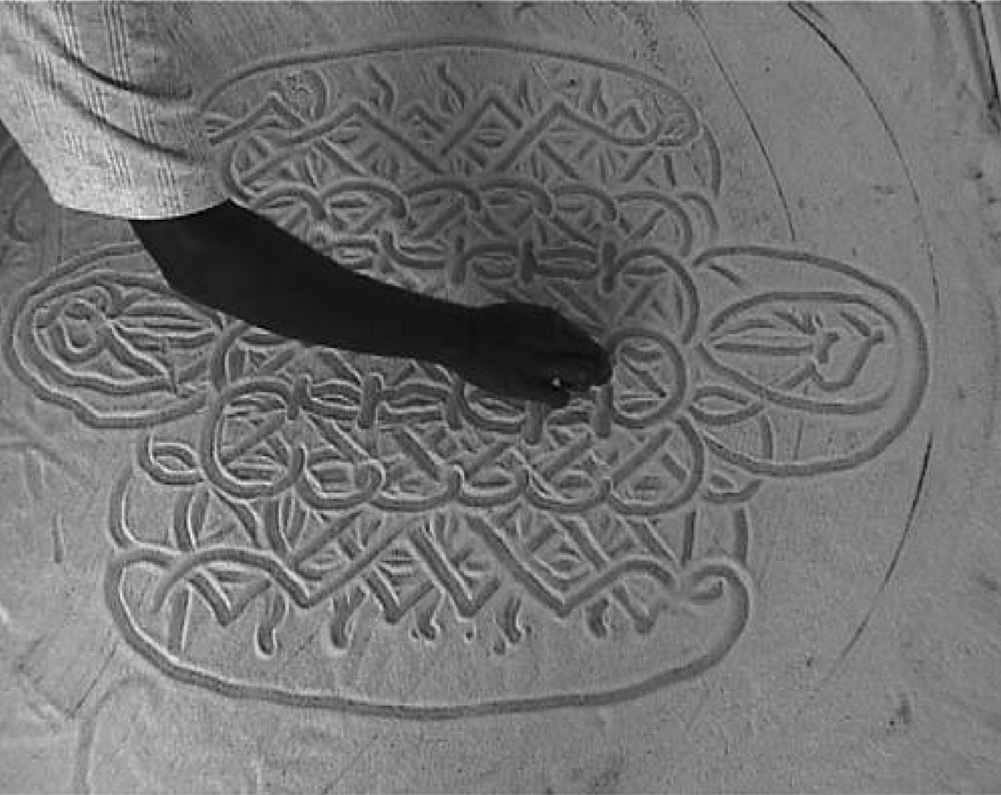
Vanuatu Sand Drawing (© Vanuatu National Cultural Council).

The Vanuatuan item exemplifies the intangible heritage involved, its vulnerability, and safeguarding efforts. Proclaimed a Masterpiece of the Oral and Intangible Heritage of Humanity by UNESCO in 2003,Footnote 60 Vanuatu's sand drawings are artful geometric patterns produced directly on the ground to transmit traditional knowledge about local history, indigenous rituals, kinship systems, natural phenomena, and farming techniques.Footnote 61 Sand drawing also represents a means of communication among the members of various language groups in the north of the Vanuatu archipelago.Footnote 62 Expert sand drawers possess intimate knowledge of the numerous graphic patterns and a deep understanding of their complex layers of meaning.Footnote 63
To help preserve the practice and meaning of Vanuatu sand drawing, Vanuatu's National Cultural Council, a representative body of cultural policy, initiated a National Action Plan for the Safeguarding of Sand Drawing in 2000.Footnote 64 Sponsored by UNESCO and Japan Funds-in-Trust for the Preservation and Promotion of Intangible Cultural Heritage, the National Action Plan consisted of two components: revitalization, transmission, and promotion; and legal protection, income generation, and inventory-making.Footnote 65 One project outcome is the National Sand Drawing Festival established in 2004.Footnote 66
A further indicator of vulnerable cultural diversity are the local languages in SIDS.Footnote 67 Statistics show SIDS' rich linguistic heritage. For example, Papua New Guinea is one of the most linguistically diverse and complex areas in the world, with close to 850 indigenous languages spoken,Footnote 68 and at least as many traditional communities, among a population of about 6 million.Footnote 69 Among these languages, UNESCO's Atlas of the World Languages in Danger identifies at least 98 as vulnerable, endangered, or even extinct.Footnote 70 See Figure 2.
UNESCO Atlas of the World Languages in Danger—Papua New Guinea. (© UNESCO, http://www.unesco.org/culture/en/endangeredlanguages/atlas)

Vanuatu, a much smaller country with a population of 240,000, still has 110 languages, 46 of which are considered to be at critical risk.Footnote 71 Efforts to revitalize such languages notwithstanding,Footnote 72 such findings appear to reflect a general trend. Table 1 lists the aforementioned selected indicators of protectable cultural heritage in SIDS, together with the net migration rate per country.
Selected Indicators of Protectable Cultural Heritage in Small Island Developing StatesFootnote 73Footnote 74Footnote 75

* In the World Heritage in Danger.
CLIMATE CHANGE-RELATED INSTRUMENTS AND INTANGIBLE CULTURAL HERITAGE
The Climate Change Regime Focuses on the Utility of Traditional Knowledge
Historically, traditional knowledgeFootnote 76 has been an important source of local innovation to provide solutions for adjusting to the conditions of nature. In this sense, the use of traditional knowledge is often discussed in the context of knowledge dissemination and technology transfer for climate change adaptation. For example, the UN Convention to Combat Desertification (UNCCD)Footnote 77 documented the practical relevance of traditional knowledge in member countriesFootnote 78 for sustainable management of dryland ecosystems.Footnote 79 The UNFCCC, too, acknowledges the importance of using traditional knowledge in climate change adaptationFootnote 80 and aims to promote its dissemination in developing countries. Local knowledge systems can help communities understand and adapt to change in climate.Footnote 81
Conversely, given the primary concern with the reduction of greenhouse gas emissions under the UNFCCC and the Kyoto Protocol, aspects of cultural heritage less utilitarian for the purpose of greenhouse gas reduction, such as traditional cultural expressions (TCEs) or expressions of folklore, hardly figure in the ongoing climate change discussion. For instance, the Kyoto Protocol's Clean Development Mechanism (CDM) projects allow developed countries to invest in greenhouse gas emission reduction projects in developing countries, and in return they receive credit for the remission reduction or removal achieved.Footnote 82 Not surprisingly, there is no current CDM project directly involving the protection of TCEs or expressions of folklore, or indeed of cultural heritage in a broader sense.Footnote 83
The National Adaptation Program of Action (NAPA), intended to address the urgent adaptation needs of Least Developed Countries under the auspices of the UNFCCC,Footnote 84 also seems to neglect projects directly related to the protection of cultural heritage. A few SIDS—Samoa, the Solomon Islands, and Vanuatu—have submitted NAPA projects in relation to their tourism industry,Footnote 85 but without express reference to the protection of cultural heritage.
UNESCO's Risk Management Approach for Climate Change Adaptation: The ICOMOS Position
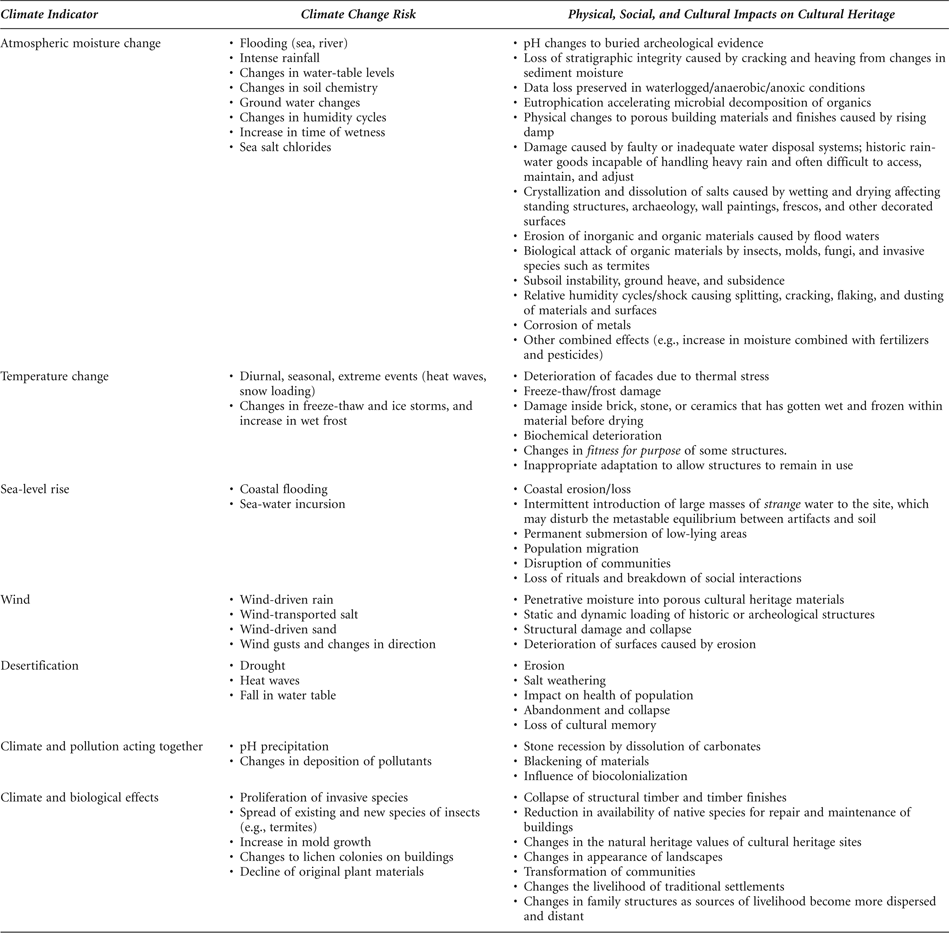
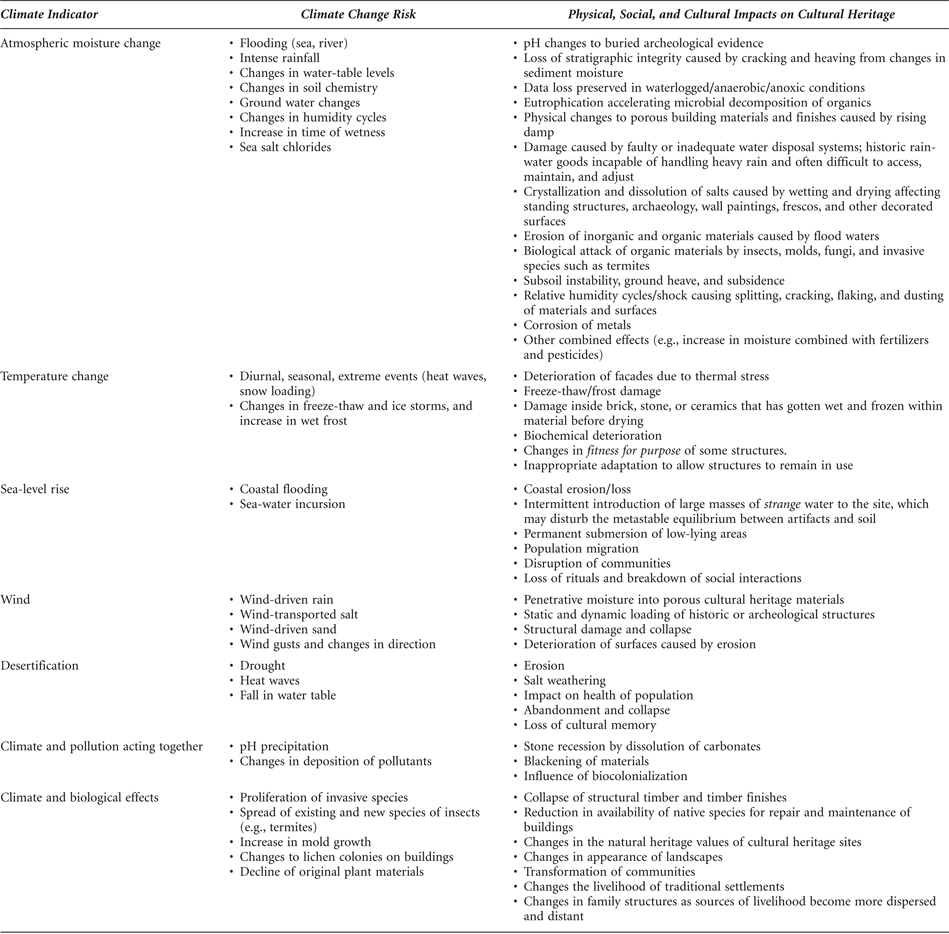
The UNESCO World Heritage Centre, in its report on climate change and World Heritage,Footnote 86 recognizes climate change as one of a range of factors affecting our natural and cultural heritage. Set out in the following text is UNESCO's itemization of principal climate change risks and their impact on cultural heritage.Footnote 87
UNESCO: Principal Climate Change Risks and Impacts on Cultural HeritageFootnote 88
Noting that conservation of World Heritage is essentially about “the management of change” and that the climate is one such area of change, UNESCO recommends a three-part strategy for safeguarding World Heritage against the emerging climate conditions:Footnote 89
• Preventive actions: monitoring, reporting and mitigation of climate change effects through environmentally sound choices and decisions at a range of levels: individual, community, institutional and corporate.
• Corrective actions: adaptation to the reality of climate change through global and regional strategies and local management of plans.
• Sharing knowledge: including best practices, research, communication, public and political support, education and training, capacity building, networking, etc.Footnote 90
Taking a similar approach, the International Council on Monuments and Sites (ICOMOS) concludes that
climate change adaptation for cultural heritage should be mainstreamed into the existing methodologies for preservation and conservation of sites, buildings, settlements, landscapes, movable objects and the living traditions and that appropriate standards and protocols should be developed for the purpose. Equally cultural heritage needs and concerns should be mainstreamed into institutional processes and policies for disaster reduction.Footnote 91
Skeptical about such risk management approaches, some scholars observe that, in the climate change regime, cultural heritage struggles to compete against an “avalanche of other urgent resource-demanding concerns.”Footnote 92 Part of the problem, they assert, is the cultural heritage regime itself paying little attention to the “cultural heritage values”Footnote 93 for mankind. The human and cultural dimension of climate change implies “the need to consider how the loss of tangible heritage places, sites and structures will affect communities and the intangible aspects of culture, or on finding locally appropriate response to this potential loss.”Footnote 94 Such understanding of how climate change jeopardizes entire cultures and ways of life is viewed as a catalyst for action.Footnote 95 For example, if adequately motivated,Footnote 96 indigenous people have a key role not only in observing change, but also in developing adaptive models to cope.Footnote 97
Emerging Climate Change Refugee Policy Proposals and Cultural Heritage
Current international refugee law incorporates the principles of nondiscrimination and national treatment. According to the Convention Relating to the Status of Refugees (the 1951 Refugee Convention),Footnote 98 the host country must not discriminate refugees on race, religion, or country of origin.Footnote 99 Also, the host country is required to provide treatment “at least as favorable as that accorded to their nationals with respect to freedom to practice their religion and freedom as regards the religious education of their children.”Footnote 100
The latter principle of national treatment is also applied to the protection of industrial property and of rights in literary, artistic, and scientific works. A refugee must be accorded in the country in which he or she has his habitual residence the same protection as is accorded to the nationals of that country.Footnote 101 In addition, the 1951 Refugee Convention provides for “intergenerational transmission and the non-interference of this transmission,”Footnote 102 a right of association,Footnote 103 and freedom of movement.Footnote 104
One limitation of national treatment or most-favored nation clauses is that, if the host country does not offer its nationals adequate protection of cultural identity or heritage per se, climate change refugees can hardly expect better protection. Considering that international refugee law does not yet cater to issues specifically associated with climate change displacement,Footnote 105 some are advocating the creation of a treaty covering climate change refugees.Footnote 106 Proponents of such an agreement argue that as climate change refugees' intangible cultural heritage “is no longer preserved by the laws and institutions of their home state, the legal protection of [climate change refugees'] cultural autonomy may be regarded as a mechanism of preservation, … and safeguarding intangible cultural heritage can further support the relocation of entire population and social groups.”Footnote 107 Further, some argue that environmental refugees should be given a right to “constitute themselves collectively and maintain their collective identity.”Footnote 108
LESSONS FROM RIGHTS-BASED PROTECTION OF TRADITIONAL CULTURAL EXPRESSIONS
A wide range of public considerations underlies ongoing efforts to protect intangible cultural heritage.Footnote 109 While the 2003 UNESCO Convention does not provide a separate definition of protection as such,Footnote 110 the 2005 UNESCO Convention on the Protection and Promotion of the Diversity of Cultural Expressions (the 2005 UNESCO Convention) defines it as “the adoption of measures aimed at the preservation, safeguarding and enhancement of the diversity of cultural expressions.”Footnote 111 The 1985 UNESCO-WIPO Model Provisions for National Laws on the Protection of Expressions of Folklore against Illicit Exploitation and Other Prejudicial Actions (the 1985 UNESCO-WIPO Model Provisions) states inter alia that “protection should be against any improper utilization of expressions of folklore [or traditional cultural expressions], including the general practice of making profit by commercially exploiting such expressions outside their originating communities without any recompense to such communities.”Footnote 112
For practical purposes, protection of intangible cultural heritage needs to focus on two goals: to prevent “misappropriation” by third parties without prior informed consent; and, especially relevant in the context of climate change, to prevent loss as such.Footnote 113 Increasingly, it is thought that both of these goals can be served by according specific rights to holders of intangible cultural heritage and that tailored rights can motivate them to preserve, practice, and promote their traditional assets even after they leave their homeland. In this regard, this section of the article briefly describes the soft-law making process for the protection of traditional cultural expressions at WIPO and other intergovernmental institutions and situates the climate change dimension in that process.
Rights-Based Mechanisms in Some South Pacific Countries
It has been noted that, for South Pacific islanders,
the concept of ownership (either by individuals, families or communities) of songs, dances and other forms of traditional knowledge and custom has been well-established for a long period of time … and the knowledge [of such traditional cultural expressions] was a commodity exchanged between local groups in the past.Footnote 114
To decide ownership disputes, courts often relied on customary law.Footnote 115 An example is In the Matter of the Nagol Jump, in which case a group of applicants tried to prevent others from performing the Nagol jump on the island of Santo (the Nagol jump is a traditional ceremony, similar to bungee jumping, from the island of Pentecost).Footnote 116 The Supreme Court of Vanuatu decided the case on “substantial justice” and “in conformity with custom”, finding that the Nagol jumping should “return” to its origins in Pentecost.Footnote 117
In recent years, a growing number of South Pacific countries have been formally integrating the protection of traditional cultural expressions into existing intellectual property lawFootnote 118 and, additionally, have been developing a sui generis protection system generally based on the Secretariat of Pacific Community's 2002 Model Law on Traditional Knowledge and Expression of Culture (“South Pacific Model Law”).Footnote 119 Administration and advancement of the South Pacific Model Law are now in the hands of the Pacific Island Forum Secretariat, which has further established the Traditional Knowledge Implementation Action Plan,Footnote 120 with the aim of assisting the Cook Islands, Fiji, Kiribati, Palau, Papua New Guinea, and Vanuatu in their implementation of traditional knowledge and traditional cultural expressions protection. Similar activities address the needs of other SIDS such as Niue, Samoa, and the Solomon Islands.Footnote 121
Major Components of Sui Generis Protection
International efforts to provide a sui generis basis for the protection of traditional cultural expressions have focused primarily on instruments of soft law, such as the aforementioned 1985 UNESCO-WIPO Model Provisions.Footnote 122 In 2000 the WIPO General Assembly created the WIPO Intergovernmental Committee on Intellectual Property and Genetic Resources, Traditional Knowledge and Folklore (IGC) to negotiate appropriate protection mechanisms.Footnote 123 In 2006 the IGC developed draft objectives, principles, and substantive provisions for the protection of traditional cultural expressions/expressions of folklore (IGC Draft).Footnote 124 While the IGC work has progressed to a stage of text-based expert meetings,Footnote 125 regional developments saw not only the creation of the South Pacific Model Law, but also the adoption by the African Regional Intellectual Property Organization (ARIPO) of the Swakopmund Protocol on the Protection of Traditional Knowledge and Expression of Folklore within the Framework of ARIPO.Footnote 126 The principal elements of these instruments may be summarized as follows.
Subject Matter and Scope of Protection
As defined in the IGC Draft, “traditional culture expressions” or “expressions of folklore” are any forms, whether tangible or intangible, in which traditional culture and knowledge are expressed, appear or are manifested, and comprise forms of expressions or combinations that are verbal, musical, by action, or tangible.Footnote 127 Such expressions should be protected against acts of misappropriation.Footnote 128
The South Pacific Model Law recognizes concepts of “traditional cultural rights” and “moral rights” to traditional knowledge or expressions of culture. Moral rights thereby refer to the right of attribution of ownership,Footnote 129 the right against derogatory treatment,Footnote 130 and the right to equitable benefits from derivative works with commercial nature.Footnote 131
Traditional cultural rights are described as encompassing rights in relation to cultural expressions to authorize or prevent their reproduction, publication, public performance or display, broadcast, translation, adaptation, arrangement, transformation, modification, fixation (such as by making a photograph, film, or sound recording), making available online, creation of derivative works, making, using, offering for sale, selling, importing, exporting, or use in any other material form.Footnote 132
Exceptions and Limitations
The IGC Draft foresees exceptions and limitations to these rights for teaching and learning, noncommercial research or private study, criticism or review, reporting news or current events, use in the course of legal proceedings, the making of recordings and other reproductions of traditional cultural expressions for purposes of their inclusion in an archive or inventory for noncommercial cultural heritage safeguarding purposes, and incidental uses.Footnote 133 Interestingly, the South Pacific Model Law limits the teaching exception to “face to face” teachingFootnote 134 and does not provide exceptions for the making of recordings for purposes of archiving.Footnote 135
Beneficiaries
The beneficiaries are the indigenous people and traditional and other cultural communities in whom the custody, care, and safeguarding of the traditional cultural expressions are entrusted in accordance with their customary law and practice; and who maintain, use, or develop the traditional cultural expressions as being characteristic of their cultural and social identity and cultural heritage.Footnote 136
Term of Protection
The South Pacific Model Law states that traditional cultural rights as well as moral rights continue in perpetuity, are inalienable, and cannot be waived or transferred.Footnote 137 Conversely, the IGC Draft foresees protection as long as traditional cultural expressions remain registered or notified according to any rules on formalities; and for secret traditional cultural expressions, as long as they remain secret.Footnote 138
Formalities
As a general rule, the protection as such of traditional cultural expressions is not dependent on any formality.Footnote 139 However, registration or notification systems may be envisaged.Footnote 140
In terms of user procedures, the South Pacific Model Law identifies two contractual avenues for a prospective user of traditional cultural expression for noncustomary purposes to seek prior informed consent: (1) applying to a ‘Cultural Authority’ in charge of identifying beneficiaries and acting as a liaison between prospective users and the beneficiaries; or (2) directly dealing with the beneficiaries.Footnote 141
Sanctions, Remedies and Exercise of Rights
The IGC Draft states that accessible, appropriate, and adequate enforcement and dispute-resolution mechanisms, border measures, sanctions, and remedies, including criminal, civil, and administrative remedies should be available in case of breach of protected traditional cultural expressions.Footnote 142 In addition, the South Pacific Model Law specifically refers to public apology, alternative dispute resolution (ADR), and customary law options.Footnote 143
Relationship with Intellectual Property Protection and Other Forms of Protection
The IGC Draft provides that the envisaged sui generis protection does not replace, but is complementary to, protection under intellectual property laws and programs for the safeguarding, preservation, and promotion of cultural heritage, and other available legal and nonlegal measures.Footnote 144 Likewise, the South Pacific Model Law affirms that traditional cultural rights do not affect any rights existing under intellectual property law or other national law.Footnote 145 It may thereby be noted that while creators of works derived from traditional cultural expressions benefit from intellectual property protection, under the South Pacific Model Law such third parties would also be subject to obligations to the original right holders.Footnote 146
International and Regional Protection
In dealing with the “technical question of how rights and interests of foreign holders” in traditional cultural expressions should be recognized in national laws,Footnote 147 the IGC Draft takes the notion of national treatmentFootnote 148 as a starting point and proposes to supplement it with mutual recognition, reciprocity or assimilation.Footnote 149 The South Pacific Model Law refers to enforcement through reciprocal arrangement.Footnote 150
Adding the Climate Change Dimension
Building on the principal components of sui generis protection of traditional cultural expressions cited as an example, this final part adds three brief and diverse considerations that might usefully figure in negotiation and implementation of these instruments, with a view to safeguarding intangible cultural heritage in the face of climate change and climate change displacement.
Cross-Border Protection
The cross-border aspect of climate change displacement lends weight to the international dimension of protection of intangible cultural heritage. Acknowledging such international protection as priority,Footnote 151 the IGC in its norm-setting process for traditional cultural expressions explored, inter alia, whether it should seek to determine at the international level how their misappropriation and use should be suppressed, and through what kind of legal instruments.Footnote 152 Taking the existing international protection of copyright as an example, the Berne Convention prescribes minimum standards of protection that are binding on all member states. However, with views differing among participants in the IGC process on the desirable degree of protection for traditional knowledge or traditional cultural expressions, and its relation to the existing international intellectual property rights system, the IGC Draft eventually opted for “a neutral form so as not to preempt the policy choices.”Footnote 153
National treatment is helpful where the host country provides sufficient protection for the intangible cultural heritage of its nationals. Likewise, reciprocal arrangements, such as those adopted in the South Pacific Model Law, are useful if the host country and the country of origin share an effective standard of protection of such rights. The challenge is how to accommodate national self-determination in this regard while ensuring international protection. Further awareness of the cultural impact of climate change migration might stimulate the development of a minimum standards approach coupled with an international registration system, perhaps somewhat comparable maybe to the system for appellations of origin established by the Lisbon Agreement.Footnote 154
More Funding Initiatives
Legal protection alone cannot maintain intangible cultural heritage. Funding is essential, for example to support education, promotion, recording and archiving. One of the first initiatives in this direction is the WIPO Voluntary Fund for Accredited Indigenous and Local Communities, launched in 2010.Footnote 155 One year earlier, the 2005 UNESCO ConventionFootnote 156 created the International Fund for Cultural Diversity (IFCD). The purpose of the IFCD is to promote sustainable development and poverty reduction in developing countries through support for projects and activities aiming to foster the emergence of a dynamic cultural sector.Footnote 157 The first batch of funding requests has been received, but only few came from SIDS and none were related to climate change.Footnote 158 Here again, further awareness of the threat that climate change poses to intangible cultural heritage may improve the financial basis for giving effect to legal protection.
Training, Good Practices, National Policies: It Takes a Village
A 2007 survey of practices and protocols regarding the safeguarding of cultural heritage and related intellectual property issues revealed a strong interest on the part of museums, libraries, and archives in South Pacific countries in receiving training on such issues and developing good practices and guidelines.Footnote 159
To respond to such needs, WIPO operates the Creative Heritage Project,Footnote 160 which aims to offer practical training to local communities, museums, and archives in developing countries on recording, digitizing, and disseminating their creative cultural expressions as well as on intellectual property issues.Footnote 161 A pilot program undertaken with a Maasai community and National Museums of Kenya confirmed the introduction of intellectual property rights management as a useful tool for promoting the safeguarding and legal protection of intangible heritage.Footnote 162
Becoming increasingly aware of their cultural interests, some South Pacific countries are taking the lead in researching the impact of climate change on their cultural heritage. For example, Vanuatu has adopted a cultural research policyFootnote 163 under which the Vanuatu National Cultural Council approves research projects consistent with the country's research priorities, such as language documentation, cultural and historic site documentation, documentation of indigenous histories, and case studies of contemporary social change. Research projects must substantially involve indigenous communities, scholars and students,Footnote 164 and commercial proceeds of any research products are to be shared between the council and the researcher.Footnote 165
CONCLUSION
The impact of climate change on cultural heritage hardly figures in current climate change policymaking, with its dominant focus on greenhouse gas emissions and their direct consequences. Likewise, the conventional perspective of cultural heritage risk management concerns especially the loss of tangible heritage sites and structures, and to a lesser extent how such loss will affect communities and the intangible aspects of culture. However, as climate change displacement materializes, these human dimensions will demand increasing attention.
One perspective on cultural property is as part of “the cultural heritage of all mankind,”Footnote 166 whatever the place of origin or present location.Footnote 167 Another view of cultural property is as “a national cultural heritage” invoking in nations or communities a special interest to attribute unique character to their cultural objects and to legitimize demands for retaining cultural property.Footnote 168
The emergence of international climate change issues in cultural heritage, intangible as well as tangible, could complicate such distinction of interests. Accommodation may need to be made for climate change-related regulation, international human rights law concerning climate change refugees, and intellectual property rights or sui generis rights relevant to the protection and promotion of traditional knowledge and traditional cultural expressions, especially in terms of cross-border protection.
ACKNOWLEDGEMENTS
I wish to thank Professor John H. Merryman of Stanford Law School for his inspiring support and the reviewers and the editors of IJCP for their helpful suggestions.