Many regions of Turkey are known to be at risk of natural disasters such as floods, earthquakes, and avalanches and of unnatural disasters such as terrorist attacks and traffic accidents. Anatolia, where most of Turkey is located, is an earthquake region. Scientists estimate that 30,000 people may die during the probable earthquake in Istanbul, in addition to the severe environmental and economic losses. This prediction requires urgent measures to be taken in Turkey in regard to the organization of the disaster victim identification (DVI) process that constitutes an important part of disaster management. The DVI organization is defined to perform the procedures for identification of the disaster victims both legally and medically through the use of physical and biological evidence.Reference Dinler, Sahin and Baydar1-Reference Tuğ and Yasar4
Identification of disaster victims covers the period between the occurrence of the disaster and completion of the identification process. This period includes the collection of the antemortem (AM) and postmortem (PM) data of the individuals to be identified, their comparison, and reporting of the data.Reference Blau and Briggs5 Visual (photographic and radiographic) data, personal items, physical evidence, external examination (ie, general physical features, specific features, fingerprints), and internal examination (ie, autopsy, genetic identification, and intraoral examination) findings are evaluated during the identification process in individuals whose body integrity has been impaired due to fragmentation or decay.Reference Clement6-Reference Ozaslan, Iscan and Ozaslan9
Forensic science experts have various responsibilities during disasters. Although the structure of forensic sciences varies by country, the assumption is that there should be a sufficient number of experienced forensic experts, forensic dentists, radiology technicians, forensic photographers, morgue technicians, expert personnel to archive personal items and evidence, fingerprinting specialists, and forensic anthropologists on the identification team, which is led by the forensic medicine specialist.Reference Sam10-Reference Graham12 Dentists are one of the basic assets to be included on DVI teams because teeth are the hardest structures of the body, they suffer the least damage from external factors, they vary only slightly after death, and they show characteristics that are specific to each individual. Due to these features, teeth analysis can be used as a reliable method to identify individuals whose bodies have decomposed or become unrecognizable.Reference Obafunwa, Faduyile and Soyemi13-Reference Afsin and Gunce20 Identification based on dental records is an extremely safe and rapid method that can be used especially in adults who have undergone various dental treatments throughout their lifetime.Reference Schuller-Gotzburg and Suchanek21-Reference James23 The only requirement for the use of these data is regular and accurate AM records. Deviation of each tooth, dental restorations, fillings, dental anomalies, as well as data regarding jaws and intraoral soft tissues should be recorded correctly in registers for reliability of dentist’s data in identification. Dentists should therefore be included on DVI teams for AM data collection, AM data collection for PM data evaluation, PM evaluation, and comparison and reporting. The dentists undertaking this task should be knowledgeable and accurate with regard to record keeping.Reference Obafunwa, Faduyile and Soyemi13, Reference Sweet14
The purpose of this study was to determine the level of knowledge of the participants about the role of dentists in disasters and to question the effectiveness of the AM records they keep for dental identification.
Methods
This descriptive study was conducted between December 2015 and June 2016. Registered dentists (n=20.280) from the Turkish Dental Association were invited to complete the organization’s online survey. A total of 539 dentists participated in the volunteer workshop.
Data Collection
The first part of the questionnaire consisted of 5 descriptive questions related to personal and workplace information, and the second part consisted of 20 questions aimed at determining the level of knowledge of dentists on the duties and responsibilities during disasters.
Statistical Analysis
The data were analyzed using SPSS 22.0 (IBM Corp, Armonk, NY). Categorical variables were presented as numbers and percentages, and continuous variables were presented as mean±standard deviation. Chi-square analysis was used in the evaluation of the knowledge levels of dentists of the duties and responsibilities in disasters by group. The statistical significance level was accepted as P<0.05.
Results
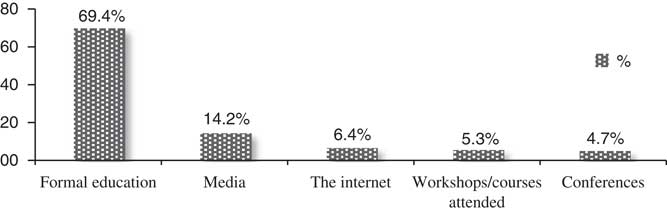
There were 320 (59.4%) female and 219 (40.6%) male dentists participating in the study. Participants graduated from various universities in Turkey, including Ankara University (17.9%), Hacettepe University (15.7%), Istanbul University (15.1%), Gazi University (13.8%), and various other (12.5%) faculties of dentistry. The mean age was 37.4±12.6 years. Of this group, specialists made up 45.6% and general dentists, 54.4%. Most of the physicians included in the study were working in faculties of dentistry and outpatient clinics (Table 1). We found that 359 (66.6%) dentists had received information on forensic dentistry. The distribution of the information sources is shown in Figure 1.
Distribution of the Main Information Sources of Dentists Who Had Previous Knowledge of Forensic Dentistry.

Distribution of Participants Based on Demographic Characteristics

a Percentage values were calculated based on n values of the relevant questions.
b Other faculties of dentistry included Suleyman Demirel, Abant İzzet Baysal, On Dokuz Mayıs, İnönü, Azerbeycan, Black Sea Technical, Kırıkkale, Dicle, Arabic American, Cumhuriyet, Kocaeli, Near East, Viyana, Samara, Cukurova, Erciyes, Tisrin, and Nisantası University.
We found that 74.2% had some knowledge about disasters (Table 2). However, based on the same group sample, 41.7% of dentists were not aware of the existence of a safe and effective organization for identification in Turkey (data not shown). Those participants aware of the international term, disaster victim identification, comprised 20.5% (see Table 2). Table 3 shows the distribution of participants’ responses of DVI knowledge based on the university they attended.
Distribution of Participants’ Responses to Questions on Disasters and DVI

a The numbers and percentages are for those who answered “yes” to the relevant question; the percentages have been calculated based on the number of persons (n) who answered the relevant question.
Distribution of Participants’ Knowledge of DVI Based on the University They Graduated From

a Other universities included Suleyman Demirel, Abant Đzzet Baysal, On Dokuz Mayıs, Đnonu, Azerbeycan, Black Sea Technical, Kırıkkale, Dicle, Arabic American, Cumhuriyet, Kocaeli, Near East, Viyana, Samara, Cukurova, Erciyes, Tisrin, and Nisantası University.
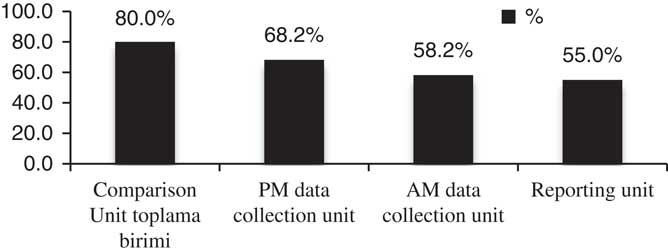
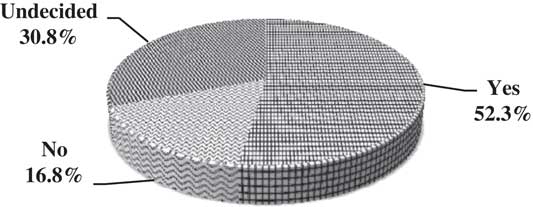
In Table 4, of the 534 participants who responded, 383 (71.7%) reported that they registered their patients’ data, and 140 (36.6%) of the 383 participants stated they felt their records were sufficient for identification. All intraoral findings and records of existing radiography, photograph, and mouth models are normally required for identification; 61 (43.6%) of 140 dentists were found to include all data necessary for identification. Participants who expressed knowledge of DVI and responded to the relevant question found the following identification methods, among others, “Definitely Reliable”: DNA analysis (99.1% ), dental examinations (90.7%), fingerprint analysis (87.2%), and autopsy (75.5%) (Table 5). The distribution of responses by dentists who expressed knowledge about DVI to the question, Which unit of the identification team should the dentists be included in?, is shown in Figure 2. Of the 107 participants who had DVI knowledge, only 56 (52.3%) were interested in working on the DVI team (Figure 3).
Distribution of Responses Given by Dentists Who Were Knowledgeable About DVI to the Question, Which Unit of the Identification Team Should the Dentists Be Included in? (More Than 1 Option was Marked in the Relevant Question.)

The Desire of Participants to Work on the DVI Team. (The Percentages Were Calculated Based on the 107 Subjects Who Had Knowledge of DVI and Answered the Question.)

Distribution of Dentists’ Responses Regarding Their Patient Records

a More than 1 option was marked for the relevant question.
Views of the Participants on the Reliability of the Identification Methods

a The total number of subjects expressing knowledge of DVI was 110; n is the number of persons who expressed knowledge of DVI and answered the relevant question.
Discussion
The knowledge level of the dentists about the role of dentists in disasters was evaluated in this study. Most of the dentists in the study stated they knew the definition of a disaster and were aware of the existence of an organization related to disasters in Turkey. However, only 20.5% of the participants stated having had knowledge about DVI. We believe there are 2 reasons for this. The first reason is that there is no effective DVI organization for which the functions have been officially defined in Turkey. The second reason is that most of the dentists have not received formal forensic dentistry training, and the subject is usually discussed in only 1 hour of theoretical training in the curriculum of those who do receive the relevant training.
The role of dentists in the DVI organization is to match the PM and premortem dental records of unidentified individuals so that they can be identified. This process is simple, but its implementation is complex. Therefore, the DVI team should include those professionals with forensic dentistry training and experience and who are team players as well.Reference Clement24, Reference Hill, Hewson and Lain25 Two studies conducted on forensic dentistry training in TurkeyReference Aka26, Reference Ozkan, Gunce and Inanıcı27 showed that the formal education given in the faculties of dentistry is provided by forensic medical experts under the topic of forensic medicine, but the curriculum does not include practical work in the area of forensic dentistry, and the number of theoretical courses is insufficient. Forensic dentistry education at the doctorate level is not yet available in the faculties of dentistry in Turkey. Only Istanbul University, Forensic Medicine Institute’s forensic doctorate program is available in this respect.Reference Ozkan, Gunce and Inanıcı27 Many members of the European Union have forensic dentistry training at the masters and doctorate levels, and some others train dentists in specialized courses and certificate programs.Reference Lorkiewicz-Muszyńska, Przystańska, Łabęcka and Kruszelnicki28
Identification in DVI studies is conducted with the comparison of all data obtained after the PM procedures are carried out according to the state of the body, and the results are compared with all AM data that can be collected.Reference Wagner18 Only DNA analysis is used for identification in Turkey and in some other countries.Reference Gunce29 Dentists with DVI knowledge (20.5%) in our study stated that the most effective methods for identification were DNA analysis, dental examinations, fingerprint analysis, and autopsy, in order of reliability. DNA analyses can actually provide reliable results if there is a relative to be used for matching. Tooth data should basically be used for identification in problematic situations. In the absence of premortem dental records, it is necessary to use personal items and physical characteristics, which are considered secondary data. Regular dental records or dental radiographs of individuals enable the effective use of dental data for identification in Europe and North America.Reference Petju, Suteerayongprasert, Thongpud and Hassiri15 Teeth are also one of the safest DNA sources for DNA analyses.Reference Tuğ and Yasar4, Reference Schuller-Gotzburg and Suchanek21, Reference Doğan30-Reference Lijnen and Willems33
Forensic dentists as well as dental records seem to be underutilized even in problematic cases in Turkey.Reference Gunce29 We believe this is the case because forensic dentistry has developed only recently or the number of physicians working in this field is very low. Insufficient content and quality of the dentist records necessary for patient identification use are other important factors. Our results also show that dentist records are not very useful for the use of identification. Only 71.7% of dentists in our study reported that they register patient data. For the records of dentists to be sufficient for identification, they should include all intraoral findings, photographs, and mouth models. When the results of the study are evaluated from this point of view, the records of only 29.5% of the dentists were reliable for identification. The records of only 43.6% (n=61) of the physicians (N=140) who thought that their records were sufficient for identification were found to be actually sufficient.
Identification studies in recent disasters show that identification of 90% of the disaster victims has been achieved with dental data in countries where dental records are kept regularly.Reference Sweet14, Reference Petju, Suteerayongprasert, Thongpud and Hassiri15, Reference Soomer, Ranta and Penttila34-36 There are several legal requirements regulating the registration of dental records in European and North American countries. Furthermore, dental prostheses are sometimes required to include identifying marks for the patient’s forensic identification in the United Kingdom and the United States.Reference Sweet14, Reference Dumancic, Kaic and Njemirovskij35, 36 Although there is a legal regulation regarding the retention of dental records in Turkey, it seems that there are some deficiencies in the content of the records.
Only 52.3% (n=56) of dentists with DVI knowledge participating in the study were eager to participate on the DVI team. This is a clear indication of inadequate training on the importance of the dentist in DVI identification units.
Limitations
Participation of the dentists in the study was voluntary. Although the total number of dentists who agreed to participate was 539, this number does not include all of the members of the Turkish Dental Association; that number is much higher.
Conclusions
The study shows that dentists in Turkey do not have sufficient knowledge and training to be effective participants on the DVI team. The use of dental data is an effective method for identification. However, to achieve this, data should be recorded correctly. Dentists in Turkey record data that are relevant only to the procedure they have performed, but not all of the oral findings and dental records are generally inadequate. As a result, this decreases the reliability of premortem dental records in our country, making it impossible to use them during a disaster identification process. The solutions of the problems observed at the identification stage require the following:
(1) Establishing an effective DVI organization
(2) Including the police, gendarmerie, forensic specialists, DNA experts, as well as forensic dentists in the identification units of these teams to be established
(3) Providing theoretical and practical training for the team in each unit of the DVI organization
(4) Using the DVI forms internationally available for DVI work
(5) Making sure that dentist records are in accordance with the DVI form standard
(6) Supporting scientific studies on DVI and monitoring any new developments abroad
(7) Providing more effective forensic dentistry courses during undergraduate dentistry education
(8) Establishing forensic dentistry doctorate programs and training DVI specialist dentists to be employed in the identification units
Funding
This study was approved by the Baskent University Medical and Health Sciences Research Council and Ethics Committee (Project no: KA 15/360 and KA 16/140) and supported by the Baskent University Research Fund.