Introduction
Starch from materials such as maize is an important source of energy in poultry diets and has several industrial uses. The production of maize may no longer be able to keep pace with the demands from agriculture, and will result in increased demand for other cereals for food, further worsening the food-feed competition in the near future. This situation has increased research interest in alternative energy sources for poultry feeding.
The mango (Mangifera indica L.) tree, which originated from South-East Asia, is now widespread in tropical and sub-tropical areas of the world (Sukonthasing et al., Reference SUKONTHASING, WONGRAKPANICH and VERHEIJ1991; Orwa et al., Reference ORWA, MUTUA, KINDT, JAMNADASS and ANTHONY2009). Mango is ranked as the third most important tropical fruit crop after bananas and plantains (FAO, 2011) with its production estimated at 39 million tonnes in 2010 (Jedele et al., Reference JEDELE, HAU and VON OPPEN2003; FAO, 2011). Taking mango seed as 20 to 60% of the whole fruit, and the kernel as 45 to 75% of the seed (Maisuthisakul and Gordon, Reference MAISUTHISAKUL and GORDON2009), this represents between 4 and 18 million tonnes of mango kernel available per year. Due to its abundance and its limited use as a by-product in most parts of the world, there is economic advantage in investigating the use of mango kernel meal in poultry feeding.
Mango seed kernel (MSK) is reported to be a good source of carbohydrates (NFE) (El Saadany et al., Reference EL SAADANY, FODA and EL SAADANY1980; Jansman et al., Reference JANSMAN, VERSTEGEN, HUISMAN and VAN DEN BERG1995; Teguia, Reference TEGUIA1995; Anand and Maini, Reference ANAND and MAINI1997; Diarra and Usman, Reference DIARRA and USMAN2008; Diarra et al., Reference DIARRA, USMAN and IGWEBUIKE2010; Reference DIARRA, SALEH, KWARI and IGWEBUIKE2011), and contains high quantities of proteins and fats (Anand and Maini, Reference ANAND and MAINI1997). The major problem affecting the nutritional value of MSK is that it contains various antinutritional factors. Although there are reports of the consumption of MSK as porridge in India (El Saadany et al., Reference EL SAADANY, FODA and EL SAADANY1980; Opeke, Reference OPEKE1982), this by-product has limited food, feed or industrial uses in most mango producing countries thus making it readily available. MSK meal has received much research attention in recent years as an alternate energy source for poultry. This paper reviews the composition of MSK, its recommendations in poultry diets and the effects of processing on its nutritional quality.
Nutritive composition of mango seed kernel (MSK)
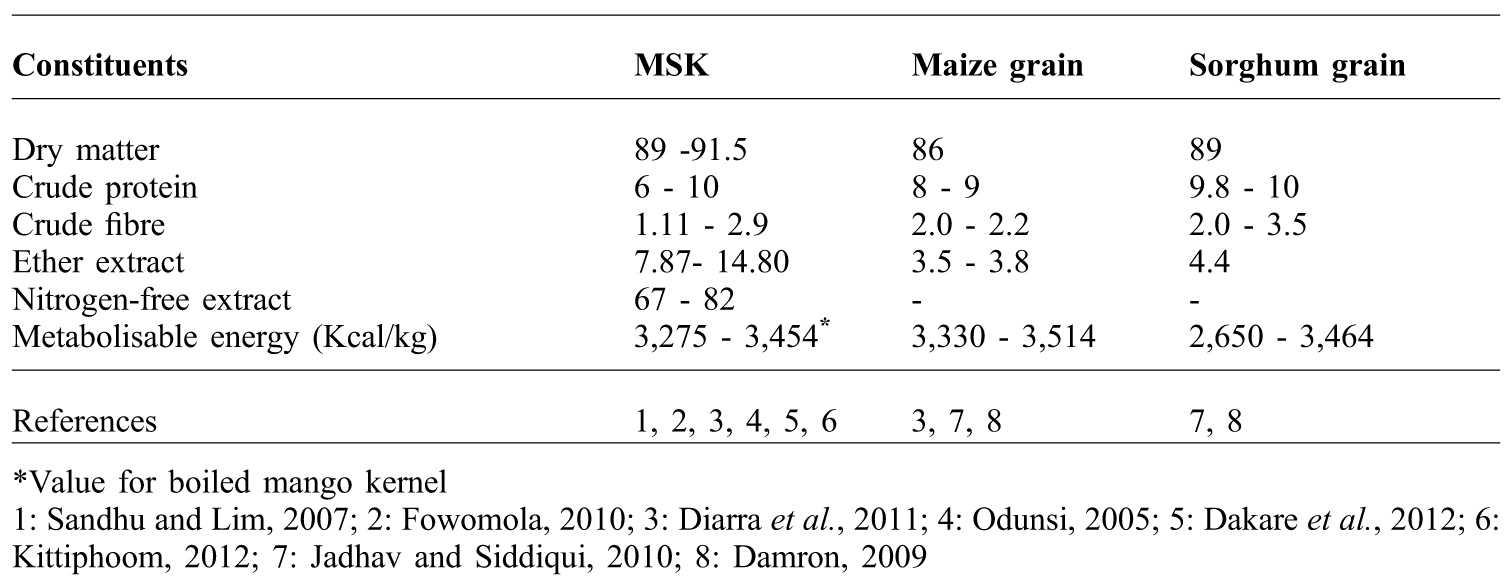
Mango seeds consist of about 68% kernel, 29% shell and 3% testa (Odunsi, Reference ODUNSI2005). There is a vast body of information on the nutritional composition of MSK, however it is difficult to give representative values for the constituents as they vary widely (Table 1).
Proximate composition of dry mango seed kernel (MSK), maize, and sorghum grains (g/100 g DM).

*Value for boiled mango kernel
1: Sandhu and Lim, Reference SANDHU and LIM2007; 2: Fowomola, Reference FOWOMOLA2010; 3: Diarra et al., Reference DIARRA, SALEH, KWARI and IGWEBUIKE2011; 4: Odunsi, Reference ODUNSI2005; 5: Dakare et al., Reference DAKARE, DANLADI, ABEL and SUNDAY2012; 6: Kittiphoom, Reference KITTIPHOOM2012; 7: Jadhav and Siddiqui, Reference JADHAV and SIDDIQUI2010; 8: Damron, Reference DAMRON2009
Among the factors responsible for differences in composition, variety receives the most attention, as, according to Kansci et al. (Reference KANSCI, KOUBALA and MBOME2008), there are about 1,000 varieties of mango world-wide. Varietal differences in the composition of MSK are well documented (Lakshminarayana et al., Reference LAKSHMINARAYANA, CHANDRASEKHARA RAO and RAMALINGASWAMY1983; Percival et al., Reference PERCIVAL, TALCOTT, CHIN, MALLAK, LOUNDS-SINGLETON and PETTIT-MOORE2006; Rodriguez et al., Reference RODRIGUEZ, DI PIERRO, GIOIA, MONACO, DELGADO, COLETTA and MARINI2006; Rocha Ribeiro et al., Reference ROCHA RIBEIRO, QUEIROZ, LOPES RIBEIRO de QUEIROZ, CAMPOS and PINHEIRO SANT'ANA2007; Mirghani et al., Reference MIRGHANI, YOSUF, KABBASH, VEJAYAN and YOSUF2009). Lakshminarayana et al. (Reference LAKSHMINARAYANA, CHANDRASEKHARA RAO and RAMALINGASWAMY1983) analysed the kernel from 43 varieties of mango in India and reported wide differences in protein (4.0-8.1%), fat (3.7-12.6%) and ash (1.0-3.7%) on a dry matter basis. Similarly, Sandhu and Lim (Reference SANDHU and LIM2007) reported the starch content of two cultivars of mango (Chausa and Kuppi) in South Korea to be 75.6 and 80.0% respectively.
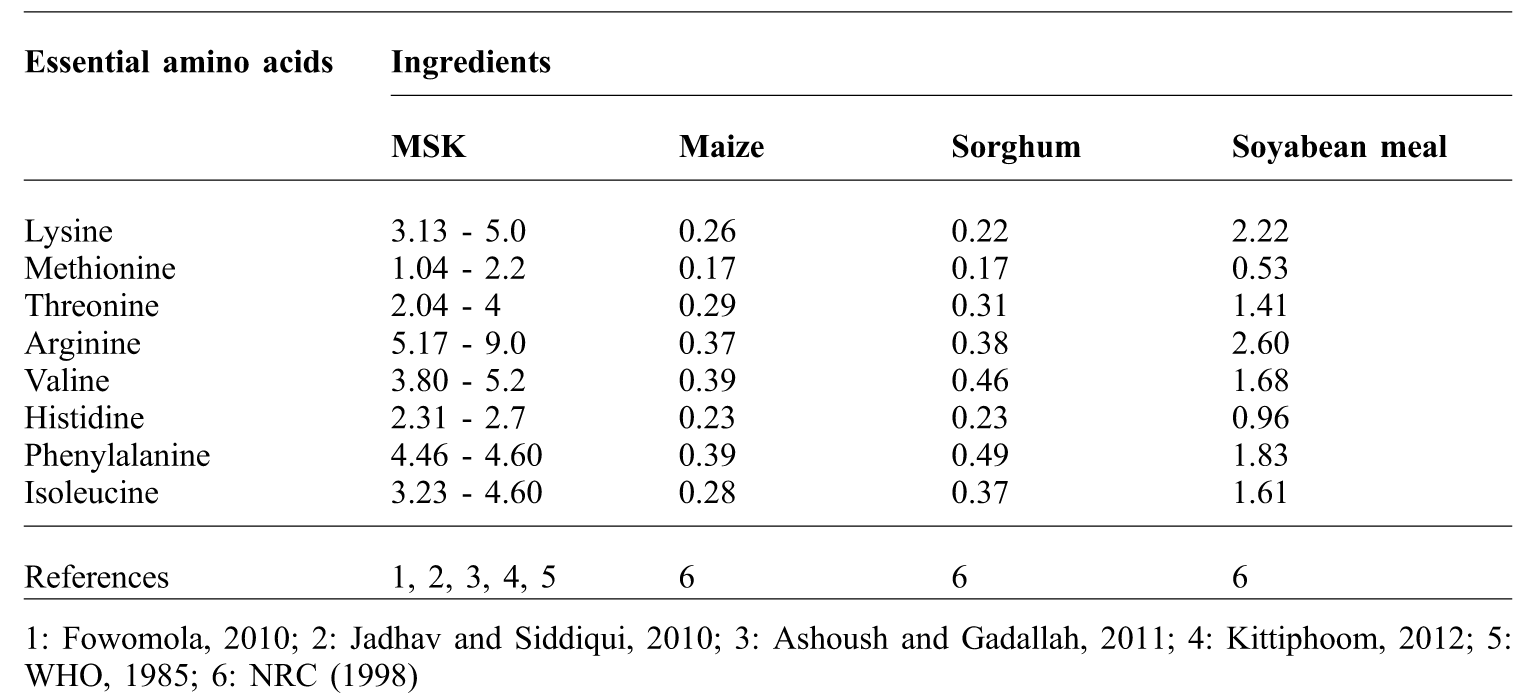
Mango seed kernel (MSK) is a good source of starch (58-80%) (El Saadany, 1980; Garg and Tandon, Reference GARG and TANDON1997; Sandhu and Lim, Reference SANDHU and LIM2007) and is high in fats (Diarra et al., Reference DIARRA, SALEH, KWARI and IGWEBUIKE2011) which combine to give a metabolisable energy (ME) value comparable to that of maize (Diarra et al., Reference DIARRA, SALEH, KWARI and IGWEBUIKE2011). However, the carbohydrates contained in MSK are reported to be poorly digested by poultry. Ravindran and Rajaguru (Reference RAVINDRAN and RAJAGURU1985) reported that only 52.5% of MSK carbohydrates were metabolised by poultry. The protein content of dried MSK (6-13%) (Kiflewahid et al., Reference KIFLEWAHID, POTTS and DRYSDALE1982; Dhingra and Kapoor, Reference DHINGRA and KAPOOR1985; Ravindran and Rajaguru, Reference RAVINDRAN and RAJAGURU1985; Arogba, Reference AROGBA1999; Odunsi, Reference ODUNSI2005; Ekpe et al., Reference EKPE, UMOH and EKA2007; Fowomola, Reference FOWOMOLA2010; Diarra et al., Reference DIARRA, SALEH, KWARI and IGWEBUIKE2011) is comparable to that of maize and has a good essential amino acid profile especially in terms of lysine and methionine (Fowomola, Reference FOWOMOLA2010; Jadhav and Siddiqui, Reference JADHAV and SIDDIQUI2010) (Table 2).
Essential amino acid profile of mango seed kernel (MSK) (g/100g protein), maize, sorghum and soyabean meal proteins (g/100 g DM).
1: Fowomola, Reference FOWOMOLA2010; 2: Jadhav and Siddiqui, Reference JADHAV and SIDDIQUI2010; 3: Ashoush and Gadallah, Reference ASHOUSH and GADALLAH2011; 4: Kittiphoom, Reference KITTIPHOOM2012; 5: WHO, 1985; 6: NRC (1998)
MSK meal is moderately rich in oil (6-16%) (Schieber et al., Reference SCHIEBER, STINTZING and CARLE2001; Gunstone, Reference GUNSTONE2006; Jadhav and Siddiqui, Reference JADHAV and SIDDIQUI2010; Medina et al., Reference MEDINA, PAREDES, RODRIGUEZ, MORENO, BELEN-CAMACHO, GARCIA and OJEDA2010; Diarra et al., Reference DIARRA, SALEH, KWARI and IGWEBUIKE2011), which is a good source of stearic (24-57%) and oleic (34-56%) acids which can be fractionated to yield olein and stearin (Gunstone, Reference GUNSTONE2006).
Anti-nutritional factors in MSK
Despite its high content of nutrients, the use of MSK in poultry feeding is limited by the presence of several anti-nutritional factors (ANFs). The major ANFs identified in MSK include tannins and cyanogenic glucosides (Teguia, Reference TEGUIA1995; Ravindran and Sivakanesan, Reference RAVINDRAN and SIVAKANESAN1996; El Boushy and Van Der Poel., 2000; Farag, Reference FARAG2001; Sanon and Kanwe, Reference SANON and KANWE2010; Ashoush and Gadallah, Reference ASHOUSH and GADALLAH2011; Dakare et al., Reference DAKARE, DANLADI, ABEL and SUNDAY2012). Oxalates (Ravindran and Sivakanesan, Reference RAVINDRAN and SIVAKANESAN1996; Dakare et al., Reference DAKARE, DANLADI, ABEL and SUNDAY2012) and phytates, saponins, alkaloids and flavonoids (Dakare et al., Reference DAKARE, DANLADI, ABEL and SUNDAY2012) have been reported in trace quantities, but these may not constitute major constraints to the feeding of MSK to poultry. Table 3 summarises the ANFs content of MSK.
Anti-nutritional factors in mango seed kernel (MSK) meal.
1: Ashoushand Gadallah (2011); 2: Teguia (Reference TEGUIA1995); 3: Sanon and Kanwe (Reference SANON and KANWE2010); 4: Farag (Reference FARAG2001); 5: Dakare et al. (Reference DAKARE, DANLADI, ABEL and SUNDAY2012); 6: Ravindran and Sivakanesan (Reference RAVINDRAN and SIVAKANESAN1996); 7: Fowomola (Reference FOWOMOLA2010)
A dietary tannin concentration of 0.5% has been reported to reduce feed intake in chickens (Vohra et al., Reference VOHRA, DRATZER and JOSLYN1966), decrease nitrogen retention and cause 5% mortality in rats (Glick and Joslyn, Reference GLICK and JOSLYN1970). Jansman et al. (Reference JANSMAN, HUISMAN and VANDER POEL1989) reported that the tolerated level of dietary tannic acid by chicks was 0.3%. Diarra et al. (Reference DIARRA, SALEH, KWARI and IGWEBUIKE2011) observed that adult birds tolerate more tannin than young chicks. Concentrations of hydrocyanic acid (HCN) as low as 25 mg/kg diet affect the performance of laying hens while broiler performance was reported to be affected only when the concentration reached 100 mg/kg (Panigrahi, Reference PANIGRAHI1996). Additionally, dietary trypsin inhibitor activity as low as 2.8 mg/kg has been associated with poor growth performance in broilers (Perilla et al., Reference PERILLA, CRUZ, DE BELALCAZAR and DIAZ1997).
Effects of processing on the ANF content of MSK
The effects of different processing methods on the reduction of ANFs in MSK have been investigated. Soaking and boiling were reported to significantly lower the ANF contents of MSK (Teguia, Reference TEGUIA1995; Ravindran and Sivakanesan, Reference RAVINDRAN and SIVAKANESAN1996; Diarra et al., Reference DIARRA, SALEH, KWARI and IGWEBUIKE2011). An additional advantage of soaking or boiling was seen as an increase in the ME content of the kernel (Ravindran and Sivakanesan, Reference RAVINDRAN and SIVAKANESAN1996; Diarra et al., Reference DIARRA, SALEH, KWARI and IGWEBUIKE2011). Ravindran and Sivakanesan (Reference RAVINDRAN and SIVAKANESAN1996) observed an increase in the ME from 7.9 MJ/kg DM in the dried raw kernel to 10.3 MJ/kg DM in the boiled and soaked kernels. The increased nitrogen-free extract (soluble carbohydrates) observed in the processed kernels compared to the raw kernels (Ravindran and Sivakanesan, Reference RAVINDRAN and SIVAKANESAN1996; Diarra et al., Reference DIARRA, SALEH, KWARI and IGWEBUIKE2011; Dakare et al., Reference DAKARE, DANLADI, ABEL and SUNDAY2012) was probably due to the breakdown of complex carbohydrate fractions. Recently, Amao and Siyanbola (Reference AMAO and SIYANBOLA2013) reported an increase in the ME content of dry heat treated MSK compared to the raw MSK. Soaking, boiling, autoclaving, acid or alkali treatment have been reported to remove tannins and trypsin inhibitors (El Boushy and Van Der Poel., 2000; Farag, Reference FARAG2001; Dakare et al., Reference DAKARE, DANLADI, ABEL and SUNDAY2012) and the HCN (El Boushy and Van Der Poel, Reference EL BOUSHY and VAN DER POEL2000; Dakare et al., Reference DAKARE, DANLADI, ABEL and SUNDAY2012) in MSK.
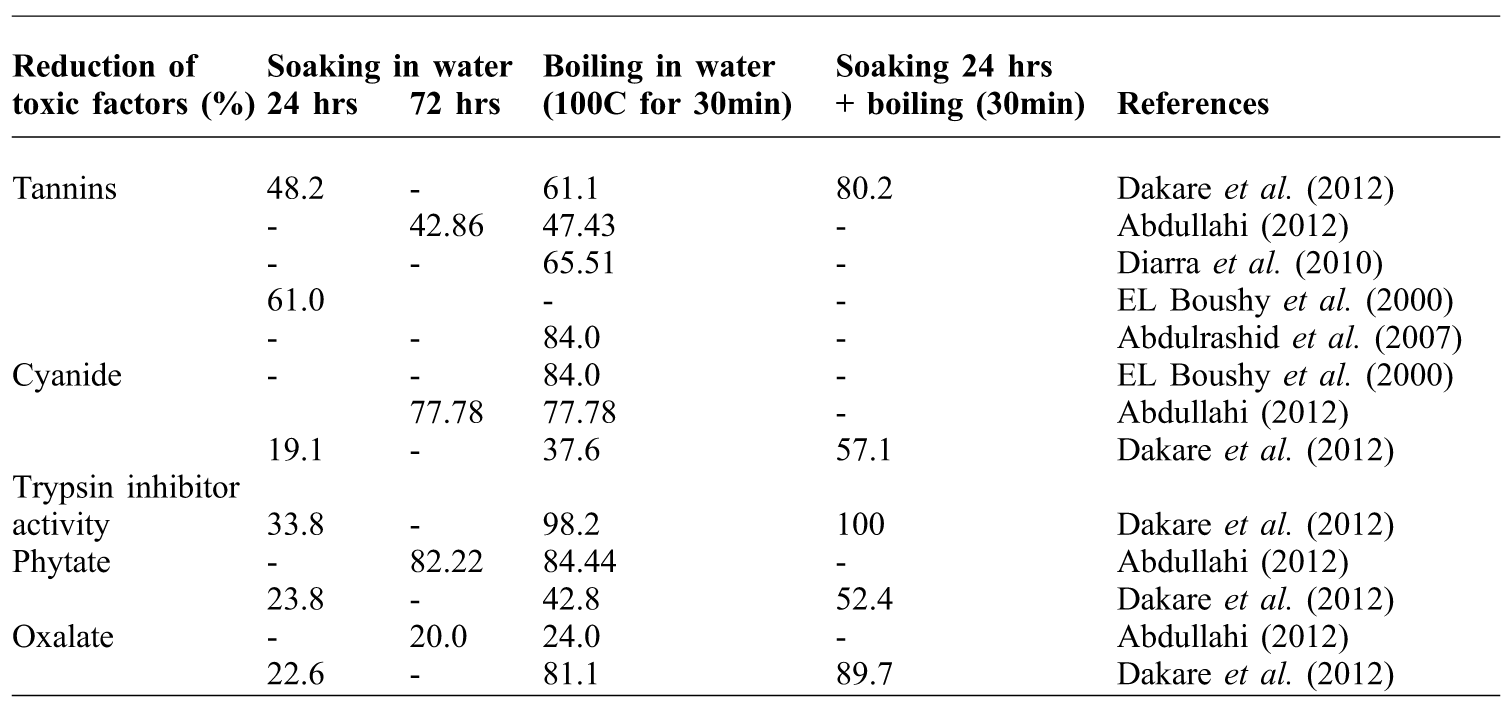
El Boushy and Van Der Poel (Reference EL BOUSHY and VAN DER POEL2000) observed that soaking was more efficient in removing tannins and HCN from MSK than boiling, acid or alkali treatment. In another report, Ravindran and Sivakanesan (Reference RAVINDRAN and SIVAKANESAN1996) found boiling to be more efficient in removing tannins and HCN compared to soaking. Treating with acid followed by alkali treatment removed all of the tannins and much of the cyanogenic glucosides of MSK (Patil et al., Reference PATIL, NETKE and DABADGHAO1982). Dakare et al. (Reference DAKARE, DANLADI, ABEL and SUNDAY2012) reported significant reduction of tannin, HCN, trypsin inhibitor activity and oxalate in boiled compared to soaked MSK, while boiling in alkali was most efficient in reducing phytic acid content. The authors observed that boiling following soaking further reduced the concentration of these factors in mango kernel. Abdullahi (Reference ABDULLAHI2012) investigated the effect of processing on the reduction of anti-nutritional factors in MSK and found that boiling in water was more efficient in reducing phytate and oxalate while soaking efficiently reduced HCN. Maximum tannin reduction and enhancement of MSK proteins were obtained by the combined action of soaking and autoclaving (Messay and Shimelis, Reference MESSAY and SHIMELIS2012).
From the previous evidence, it is difficult to recommend a single processing method, but factors such as the variety of mango, the type of toxic factors present and the cost of processing should be considered when deciding the best method to implement. Where heat treatment is to be adopted, temperature and duration need to be defined to minimise losses of nutrients. Leaching of soluble nutrients in soaking water may also occur, thus the need for research into optimum soaking conditions is required. The effects of selected domestic processing methods on the ANFs contents of MSK are shown in Table 4.
Effect of selected processing methods on the antinutritional factor reduction in mango seed kernel (MSK).
Feeding trials
broilers
Feeding of MSK to broiler chickens is well documented. Patil et al. (Reference PATIL, NETKE and DABADGHAO1982) observed that replacing 14.1% dietary maize with raw MSK had no adverse effects on broiler chickens growth, but 28.2% replacement caused growth to be adversely affected. In corroboration, Teguia (Reference TEGUIA1995) reported adverse effects on weight gain and feed consumption of broiler chickens fed 20% ground MSK as replacement of maize. Recently, Amao and Siyanbola (Reference AMAO and SIYANBOLA2013) observed significantly lower feed intake, higher body weight and better feed conversion in finishing broilers fed 30% dry heat treated MSK as a replacement for maize compared to the maize-fed control group.
There are reports to show that performance losses in birds fed raw MSK above 10% of the diet (as a replacement for maize) were lessened with processing (Joseph and Abolaji, Reference JOSEPH and ABOLAJI1997; Farag, Reference FARAG2001; Odunsi, Reference ODUNSI2005; Diarra and Usman, Reference DIARRA and USMAN2008; Diarra et al., Reference DIARRA, SALEH, KWARI and IGWEBUIKE2011). Odunsi (Reference ODUNSI2005) observed significant growth depression in broilers fed more than 10% raw MSK as a replacement for maize, while 20% replacement with soaked MSK had no adverse effects on broiler growth. Similarly, Joseph and Abolaji (Reference JOSEPH and ABOLAJI1997) observed no adverse effects of feeding 10% raw or 20% boiled mango kernel as a replacement for maize on broiler performance (feed intake, weight gain and feed efficiency).
The bitter taste of MSK has been attributed mainly to the presence of tannins (Ravindran and Sivakanesan, Reference RAVINDRAN and SIVAKANESAN1996; Arogba, Reference AROGBA2000). Ravindran and Sivakanesan (Reference RAVINDRAN and SIVAKANESAN1996) observed improvements in broiler performance with processed MSK in parallel with tannin reduction, indicating that tannins are largely responsible for the poor nutritive value of raw MSK.
The effect of age on the ability of birds to tolerate dietary MSK has been reported. Diarra and Usman (Reference DIARRA and USMAN2008) observed that replacing 20% maize with raw MSK in broiler chickens diets significantly depressed performance during the starter phase which were compensated for during the finisher phase; suggesting that the ability of broiler chickens to utilise MSK increases with age. Similarly, Diarra et al. (Reference DIARRA, SALEH, KWARI and IGWEBUIKE2011) reported that the replacement of 50 and 70% of dietary maize with boiled MSK in broiler starter and finisher diets respectively significantly reduced feed cost without adverse effects on growth and feed utilisation.
layers
Unlike broilers, documented information on the feeding of MSK to laying hens is still limited. Odunsi (Reference ODUNSI2005) observed depressed feed intake, rate of lay, egg mass, and feed efficiency in laying hens above 10% replacement of maize with raw MSK. However, shell quality was maintained with up to 15% replacement and internal egg qualities were not affected even at 25% replacement. These results suggest that raw MSK cannot readily replace maize in laying hens’ diets. Like in broilers, processing might however, allow higher levels of inclusion but this does not seem to have been investigated at the moment.
organ weights, haematology and serum biochemistry
There are reports on the effects of feeding MSK on organ weights, haematology and serum bio-chemical constituents of broiler chickens. Odunsi (Reference ODUNSI2005) observed increased weights of the liver and lungs in broiler chickens fed 20% raw MSK as a replacement for maize compared to the control, but the weights of heart, kidneys and spleen were not affected by the replacement. Up to 25% replacement of maize with cooked MSK had no deleterious effects on the weights of the liver, heart and lungs. As the liver is primarily concerned with detoxification by converting toxic materials into forms that can be readily excreted, the increased liver weight on the raw MSK diet might be a response to toxic substances which were overcome by processing. Abdullahi (Reference ABDULLAHI2012) observed no adverse effects of replacing 100% of dietary maize with soaked MSK on the weights of the liver, kidney and spleen of broiler chickens, but the weights of lungs and heart increased with increasing level of MSK in the diet. Recently however, Amao and Siyanbola (Reference AMAO and SIYANBOLA2013) fed finishing broilers 30% dry heat treated MSK for maize and observed reduced weights of the liver, heart and pancreas compared to the control.
Haematology and blood chemistry of broilers were not affected when dietary maize was replaced with 60% boiled (Diarra et al., Reference DIARRA, USMAN and IGWEBUIKE2010), 100% soaked (Abdullahi, Reference ABDULLAHI2012) and 30% dry heat processed (Amao and Siyanbola, Reference AMAO and SIYANBOLA2013) MSK. These results suggest that several factors including the variety, age of birds, processing method and conditions need to be looked into when considering MSK as a feed ingredient for poultry.
further research
Several chemical additives have been used to improve the utilisation of tannins by poultry. Supplementation of tannin rich diets with DL-methionine has been reported to overcome the adverse effects of tannins (Armstrong et al., Reference ARMSTRONG, FEATHERSTON and ROGLER1974; Elkin et al., Reference ELKIN, FEATHERSTON and ROGLER1978) by hydrolysing them into gallic acid which is excreted via urine as 4-O- methyl gallic acid (Potter and Fuller, Reference POTTER and FULLER1968). Tannin binding agents such as polyethylene glycol (PEG), activated charcoal, gelatine and polyvinylpyrrolidone (PVP) have been shown to improve the nutritional value of tannin-rich feeds (Jones and Mangan, Reference JONES and MANGAN1977; Hewitt and Ford, Reference HEWITT and FORD1982; Salunkhe et al., Reference SALUNKHE and KADAM1990; Maghsoud and Akbar, Reference MAGHSOUD and AKBAR2011). These substances contain large number of oxygen atoms which form strong bonds with the hydrogen in phenolic groups of tannins and precipitate them from solution (Jones, Reference JONES1965). At the moment however, there is little or no documented information on the use of these additives in MSK-based diets. This could form an important area for further research with the view of maximising the inclusion of this valuable and readily available resource in poultry diets.
Conclusions
Mango seed kernel has potentially attractive nutritional attributes that are useful when considering its inclusion in poultry diets, but the presence of a number of anti-nutritional factors (tannins, cyanide, trypsin inhibitors etc.) and the poor digestibility of its carbohydrates seem to limit its utilisation by poultry. Raw MSK is not recommended at more than 10% replacement rates for maize in layer and broiler diets, but processed kernels can be included at the rates of 25 and 50% as replacements for maize in layers and broilers diets respectively. The use of additives (amino acids and tannin binding agents) as supplements to mango seed kernel-based diets for maximum utilisation by poultry may also be considered. The seasonality of the crop and problems of seed collection due to the lack of processing plants in most mango producing areas, as well as the cost of processing may, however, hinder the effective harnessing of mango seed kernel as poultry feed.