The fish leech, Pterobdella amara Kaburaki, Reference Kaburaki1921 is a common parasite previously recorded in Pastinachus sephen (cowtail stingray) and Himantura uarnak (reticulated whip-ray) from India and the east coast of Australia, and Dasyatis akajei (Japanese red ray) in Japan (Burreson Reference Burreson2006). Pastinachus sephen is an extremely common species of benthic ray recorded from the Indo-Pacific and can attain sizes of 200 cm disc width (Last & Stevens, Reference Last and Stevens2009). Known as the cowtail stingray on account of a skin fold on the tail, it is not considered harmful to humans and typically flees when encountered making it difficult to observe. This species spends a lot of time concealed below the sediments and can swim off at great acceleration when disturbed, and for this reason close and accurate observation can be difficult. During a recent research trip to Ningaloo Reef (23°07′48.28′S 113°45′44.70E), individuals of a small population of Pastinachus sephen were caught in hand nets in a shallow lagoon and humanely euthanized for an ongoing age and growth study. One individual of this species was located in less than 1 m of water, occupying the surf zone without concealment early in the morning at high tide. It made no attempt at evasion and initially it was thought to be deceased because it had lost its dark bronze coloration and instead was pale-blue and confirmation of the species had to be made from the deep skin fold on its tail.
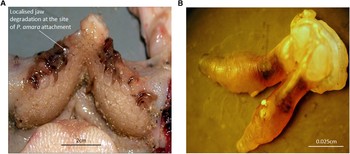
The ray was caught in a hand net where it showed the first signs of movement which appeared to be slow, and at no time did it display any behaviour to suggest it was attempting to get away. The ray was immediately euthanized and subsequently weighed, measured and dissected. The animal weighed 5 kilos and had a disc width (DW) of 99 cm and a total length (TL) of 149 cm. Three other comparable individuals of this species taken at this location had DW of 99 cm, 81 cm and 100 cm (TL 189 cm, 130 cm and 184 cm) and weighed 16, 12 and 21 kilos respectively. Upon dissection of the animal, the buccal cavity, gills, inter-nasal flap, pharynx and oesophagus contained high densities (approximately 60–100) of gnathiid isopod larvae and 30 individuals of the parasitic leech Pterobdella amara, located in the dentition of the upper jaw (Figure 1A). The gnathiid isopods were all of a similar size measuring approximately 4–6 mm each, while the leeches were attached basally to the dentition plates on the upper surface of the jaw and were approximately 1–2 cm in length (Figure 1B). The jaw was in various stages of degradation with individual plates either completely removed or in the process of being removed at the sites where leeches were attached. It is therefore likely that the degradation seen in the jaw was caused by the presence of the parasite. In addition to this, the stomach was empty of any prey item or sediment and was bloated when compared with other comparable specimens. The body cavity also contained a brown fluid surrounding the organs which flowed freely when the initial incision was made, which is common to all further specimens of ray which have been found to host this species of leech (N = 9).
(A) Upper jaw of host showing Pterobdella amara attached to the surface and localized areas of jaw degradation; (B) two individual P. amara still attached to a part of the jaw.

It is hypothesized that the external appearance of this cowtail stingray, the apparent degradation of the jaw and the unusually low body weight was caused by a combination of the leech species and the gnathiid isopods. In addition, this is the first time that this species of leech has been described from Western Australia and has subsequently been lodged in the WA Museum, catalogue no. WAM V7613. Previous to this find, very few parasites had been noted on the six species of stingray sampled at this location (N = 143). However, two further species of stingray, the leopard whip-ray (Himantura leoparda) and the porcupine ray (Urogymnus asperrimus) have been found with Pterobdella amara attached to the jaw which is a new host record for Western Australia. The parasite specimens from these two new hosts have also been lodged at the WA Museum under catalogue nos. WAM V7709 and 7710.
ACKNOWLEDGEMENTS
I thank E. Burreson for identification of the leech, A. Grutter and B. Lester for suggestions; S. Ridley and M. Drevander for field work and M. van Keulen from Murdoch University and M. Meekan from The Australian Institute of Marine Science, for funding.