The Hashemite Kingdom of Jordan is located in one of the most tense geopolitical spaces on Earth. After Syria descended into civil war, political commentators were quick to warn that violence might spread to neighboring countries and that Jordan could be next (see Schenker Reference Schenker2013 and Rothe Reference Rothe2015).
The kingdom possesses all attributes highlighted in the literature as susceptible to the cross-border spread of political violence: a weak economy, large inflows of refugees, and the presence of transnational terrorists. Yet Jordan has stayed surprisingly safe. The country was considered among the nine safest countries in the world in 2017 (Jordan Times 2017c). The case of Jordan may, therefore, offer clues to how other countries in high-risk environments can avoid contagion—or what the literature terms “spillover”—from nearby conflicts.
We focus here on one particular type of spillover: that involving transnational jihadist terrorism. Footnote 1 We present new data on jihadist attack activity in Jordan. Based on a wide range of primary sources in Arabic and English gathered through online platforms and fieldwork, we compiled a novel dataset of jihadist attack activity in the kingdom. While existing research on terrorism in Jordan and other non-Western countries tends only to examine launched attacks, we also include foiled terrorist plots to give a more accurate and comprehensive picture of the jihadist threat. Our data show that there have been few attacks (only fifteen in total and six after 2014), and we ask why this is the case. We situate this puzzle in the theoretical debate on the trans-border diffusion of violence. The reason is that nearly all jihadist attack activity in Jordan involves transnational links and drivers (refer to online appendix B and C). Our analysis of what prevents jihadist spillover to Jordan suggests that most existing research has underestimated how state-level factors such as repressing or co-opting subversive militants and securing borders can limit the spread of armed conflict from one country to another. Footnote 2
We address a gap in the literature on spillover. This literature has mostly focused on the question of whether or not the phenomenon occurs, and the extent to which the spread of political violence is correlated with factors such as proximity to conflict zones. Footnote 3 While there now is general agreement that spillover exists, the early literature has been criticized for overestimating its incidence. Black (Reference Black2013), for example, shows that spillover is more rare than previously thought and that research on the topic has focused too much on correlation and too little on causation. The literature has since moved beyond identifying correlations, and has begun examining the mechanisms through which violence spreads across borders (e.g., Checkel Reference Checkel and Checkel2013).
In broad terms, scholars have highlighted that fragile states and states experiencing significant inflows of refugees are more susceptible to the spread of political violence across borders (e.g., Salehyan and Gleditsch Reference Salehyan and Skrede Gleditsch2006; Young et al. Reference Young, Stebbins, Frederick and al-Shahery2014, 7-10). The logic is that states with weak economies and institutions are more at risk because they have fewer means with which to fortify themselves against spillover, while inflows of refugees can fuel ethnic tensions and alter the balance of power in host states. More important, however, is the role of transnational networks of rebels (Salehyan Reference Salehyan2009). Such networks can spread their campaigns across borders, potentially assisting sympathizers in neighboring countries or inspiring would-be militants to take up arms.
While considerable attention has been paid to cases where spillover happens, fewer studies have analyzed the counterfactual situations in which diffusion does not occur. Some scholars have begun to look at firewalls against diffusion. Solingen (Reference Solingen2012), for example, stresses the need for examining cases of non-diffusion. Beardsley (Reference Beardsley2011) examines how peacekeeping can prevent conflict contagion. Kathman (Reference Kathman2011) looks at the role of external interventions in limiting the spread of conflict, whereas Danneman and Ritter (Reference Danneman and Hencken Ritter2014) focus on the role of states’ preemptive repression. However, too little attention has been paid so far to cases where spillover should be expected, yet has not occurred or has been very limited. Footnote 4 Knowledge of what prevents this phenomenon is, therefore, scarce. Jordan is particularly suitable as a subject for study because the country displays the classic attributes highlighted in the literature for increasing the risk of spillover and yet has witnessed few jihadist attacks.
The kingdom borders Syria and Iraq. It is a major recipient of refugees from adjacent theaters of conflict (e.g., it has had to accommodate an influx of 1.3 million Syrian refugees; see Jordan Times 2018). It is in perpetual economic crisis (Schenker Reference Schenker2016). There is a sizable presence of transnational jihadist rebels and terrorists in Syria and Iraq, while Jordan itself is home to a growing jihadist community (Sowell Reference Sowell2015). Added to this, there are many reasons why transnational jihadists might want to target the kingdom. Jordan is a key ally of the United States and has been one of the most important partners in combating international terrorism since 9/11. Jordan has also maintained peaceful relations with Israel. It signed a peace treaty with that country in 1994, a treacherous act in the eyes of jihadists.
We test three explanations for the low incidence of jihadist violence in Jordan. We hypothesize as to whether particular observable factors and phenomena can be identified as the mechanisms limiting jihadist spillover in Jordan, and assess the empirical evidence for and against the validity of each hypothesis. The hypotheses themselves are derived from the (scarce) literature on factors that prevent spillover, research on transnational rebels, and interview data from our fieldwork in Jordan.
We first examine a hypothesis that the chaos in the Middle East has caused a “reverse demonstration effect,” which has instilled a propensity for self-preservation among Jordanian citizens functioning as a bulwark against jihadist spillover. Second, we probe the argument that the threat is limited because the country’s jihadists prefer to engage in violence abroad rather than at home. Third, we examine the proposition that Jordan’s counterterrorism policy has prevented spillover.
Though both a reverse demonstration effect and a preference among jihadists to fight abroad seem to have played roles in limiting the threat of jihadist spillover, our findings suggest that the most important explanation is the Jordanian state’s approach to terrorism. Jordan practices what we term “calibrated repression.” The kingdom’s overall approach to internal subversive forces, such as protesters and rioters, has been described as “soft security” (Ryan Reference Ryan2018, 217-219). The approach to transnational jihadists, however, is not “soft.” By “calibrated repression,” we mean that the regime proactively represses immediate jihadist threats while containing less militant elements through co-optation. This approach has kept jihadist violence to a minimum in the country. The findings align with the part of the spillover literature that stresses how state policies can inhibit the cross-border spread of political violence (Braithwaite Reference Braithwaite2010; Danneman and Ritter Reference Danneman and Hencken Ritter2014).
There are three main limitations to our approach. First, while the mechanisms relevant to Jordan likely apply to other states in the region, we lack comparable data on terrorist violence and cannot make a comprehensive comparison at this stage. We do, however, offer some comparative observations based on the limited data available on other states. The extent to which our findings can be generalized and contribute to the literature on spillover is considered in the conclusion. The second limitation concerns the outcome we seek to explain. While the evidence we present suggests that Jordan’s security apparatus will continue to counter transnational jihadism effectively, the jihadist threat to Jordan has not ended and might change with time. The third limitation concerns the reliability of sources. Terrorism and insurgency involve secretive underground activities. Sources can, therefore, be biased or provide erroneous or incomplete information. There is ultimately no way around this problem, except to gauge each source critically and triangulate with other sources or data whenever possible.
We proceed as follows. The first section presents data on the scope of jihadist spillover into Jordan and compares the level of violence in the kingdom to that in other countries in the region. In the second section, we test three hypotheses as to what limits the spillover threat in Jordan. Last, we conclude and discuss the implications of our findings.
The Jihadist Spillover Threat to Jordan
In this section, we present a new dataset on jihadist attack activity in Jordan. It demonstrates how the phenomenon ought primarily to be considered a spillover effect from abroad, as opposed to terrorism “from within” by local subversives. The online appendices describe all known terrorist plots in Jordan since the 1990s and provide measurements on how they can be seen as diffusion from outside conflict zones. While jihadist terrorist activity in Jordan has been discussed in reports and books, systematic data are lacking (see, e.g., Abu Rumman and Abu Hanieh Reference Abu Rumman and Abu Hanieh2013; Speckhard Reference Speckhard2017).
Unlike its Iraqi and Syrian neighbors, Jordan has neither experienced jihadist insurgency nor urban terrorism on a large scale. Still, the kingdom has clearly faced a jihadist threat spilling over mainly from these two neighboring countries. Particularly, the Islamic State (IS) and its predecessor al-Qaeda in Iraq have spread violence to Jordan, either by sending attack teams to the country or directing and supporting local jihadists from abroad. There has also been indirect diffusion in the way that these groups have inspired jihadists in Jordan to carry out operations on their behalf.
Jordanian jihadism has always been intrinsically connected to the broader transnational jihadist movement. Similar to other Arab countries, jihadism emerged as an organized force in Jordan in the early 1990s when veterans returned from the anti-Soviet war in Afghanistan. Several militant groups with Islamist leanings—such as Jaysh Muhammad—were active in Jordan during this period, but the group known as Bay’at al-Imam is considered the first jihadist group in the country. During the 2000s, the jihadist movement in Jordan grew (Wagemakers Reference Wagemakers2014; Abu Rumman and Shteiwi Reference Abu Rumman and Shteiwi2018, 17-20). However, it also split into two main parts—one favoring Abu Musab al-Zarqawi’s “extreme” approach to jihad and the other Abu Muhammad al-Maqdisi’s more “moderate” approach (Wagemakers Reference Wagemakers2018). In the 2010s, this development has continued. While the movement counts more members today than before, Footnote 5 it remains as divided as ever between those supporting IS (claiming to be al-Zarqawi’s heirs) and those siding with al-Qaeda and al-Maqdisi in their intra-jihadist competition (Abu Rumman and Shteiwi Reference Abu Rumman and Shteiwi2018, 29-32).
Our dataset contains information on attack plots dating back to 1994 when the first cases of jihadist terrorism occurred in Jordan. In contrast to previous studies that only focus on launched attacks, we also look at plots that have been foiled by counterterrorism. This provides a fuller picture of the jihadist spillover threat to Jordan than just looking at attacks.
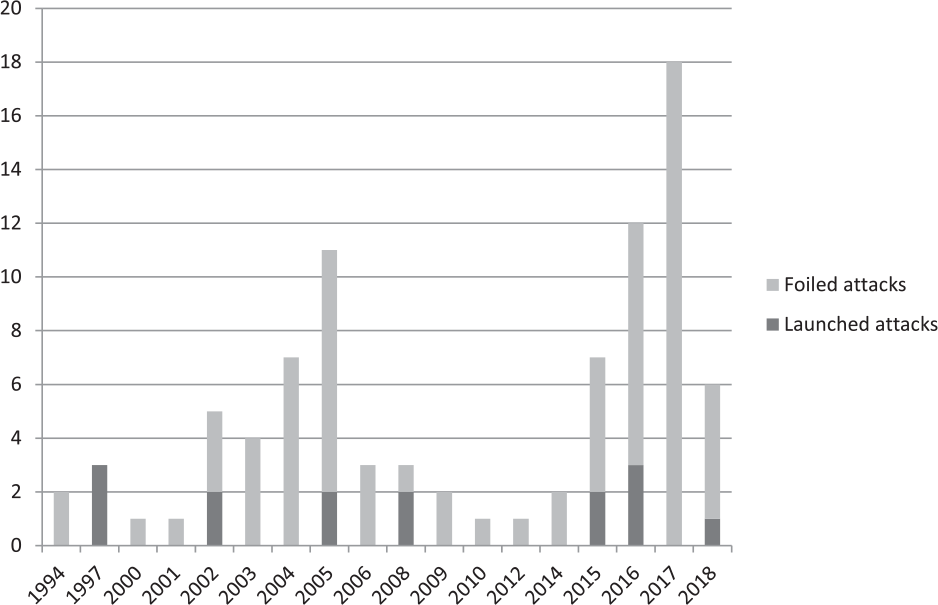
According to the dataset, there were 121 plots between 1994 and 2018. Because information on some of the plots is limited, we divided the dataset into “well-documented plots” (n = 89) and “vague plots” (n = 32). This distinction is based on the credibility of the sources and how well each plot fulfills the following documentation criteria: 1) the involvement of known jihadist perpetrators; 2) the existence of an identified target or targets; and 3) the presence of concrete evidence (such as bomb materials). So as not to generalize from questionable data, we based the quantitative output only on the eighty-nine well-documented cases. Although terrorism is a contested concept, the differences in its definition do not affect the analysis presented here. Our dataset consists mostly of information on shootings and bombings (or plans for them) motivated by political and religious extremism in a country during peacetime. This falls well within what is considered terrorism by most scholars, regardless of how they define other aspects of it (for more on definitions of terrorism, see Schmid Reference Schmid and Schmid2013).
With regard to the scope of plots and attacks, two general observations are worth highlighting. First, considering that Jordan possesses the classic attributes that make countries vulnerable to spillover, the number of attacks seems low relative to some other countries (discussed later). Between 1994 and 2018, jihadists were able to carry out only fifteen attacks in Jordan; the remaining seventy-four well-documented plots were foiled. The fifteen actual attacks varied significantly in scope, from minor incidents involving Molotov cocktails to large-scale bombings. There were two attacks with more than ten deaths: the Amman hotel bombings in 2005, and the Kerak attack in 2016. However, most of the attacks were small-scale and caused few or no casualties. In total, we counted eighty-six fatalities (excluding perpetrators). Of these deaths, sixty were caused by one incident, the 2005 Amman hotel bombings.
The second observation is that the number of attacks in Jordan does not fully represent the scale of the jihadist threat in the country. The fact that there were seventy-four foiled jihadist plots in the period examined indicates a more significant threat than is implied by the number of attacks carried out.
Looking more closely at the jihadist threat to Jordan, we find only three minor attacks causing zero casualties in the 1990s. These attacks were spillover from the anti-Soviet war in Afghanistan. Returned veterans from this war were behind all plots during this decade. The threat increased significantly in the early 2000s, when al-Zarqawi, the leader of al-Qaeda in Iraq, sent attack teams to Jordan to carry out large-scale attacks against his home country. Such attacks teams were responsible for at least ten plots. Approximately 50% of plots in the 2000s involved direct assistance from al-Qaeda, whereas the rest were inspired by the group. While most plots were foiled, an attack team sent by al-Zarqawi was responsible for the hotel bombings in 2005. After these bombings, jihadist plotting in Jordan remained at a low level until the rise of IS in 2014. Since then, the threat has reached unprecedented levels. Yet unlike al-Zarqawi’s al-Qaeda in Iraq, IS has not been able to dispatch operatives who have carried out attacks in Jordan. However, local IS-followers have been able to carry out six attacks between 2014 and 2018—the largest being the Kerak attack mentioned earlier. Unable to carry out attacks in Jordan themselves, IS operatives in Syria have persuaded local jihadists to plot operations in the kingdom. This has led to a significant increase in plots that are directed by IS from afar. Footnote 6
We have not come across comparable data for the entire period on jihadist spillover in other countries in the region. However, the number of attacks perpetrated by IS in Jordan after the organization’s rise in 2014 was markedly lower than in Turkey and Lebanon. Together with Jordan and Iraq, Turkey and Lebanon have been most affected by the Syrian conflict. According to the Global Terrorism Database (GTD), between 2014 and 2017, there were seventy-three attacks by IS in Turkey and forty-five in Lebanon. Footnote 7 Moreover, GTD’s data show that there were twenty-eight IS-connected attacks in Saudi Arabia between 2014 and 2017, another country in the region often portrayed as efficient in dealing with terrorist threats.
In sum, Jordan has experienced a few attacks, one of them very lethal, but most plots have been averted. States such as Turkey, Lebanon, and Saudi Arabia have seen more attacks from 2014 to 2017 than Jordan has for the entire period from 1994 to 2018. This leads to the question of why there have been so few attacks in the kingdom.
Explanations
In this section, we test three hypotheses as to why jihadist spillover into Jordan has been limited. The hypotheses were generated in the following way.
We first looked at the limited literature that addresses obstacles against spillover and identified three candidate mechanisms at the society, actor, and state level of analysis: 1) reverse demonstration effect, 2) jihadist preference for foreign fighting, and 3) calibrated repression. In what follows, we describe what each hypothesis entails. The first has to do with how society as a whole reacts to perceived threats. The second relates to how the ideology and preferences of violent actors shape the threat, while the last pertains to how state policies affect the threat.
During fieldwork in Jordan in October 2017, August 2018 and January 2019, we presented our interviewees (Jordanian researchers, journalists, and officials) with the open question of what inhibits jihadist violence in the kingdom. Overall we conducted fifteen semi-structured in-depth interviews and six group discussions. The interviewees stressed similar factors as our three candidate mechanisms, but provided additional information and context. We then used their answers to formulate hypotheses based on the existing literature, but adapted to the Jordanian context. Next we tested these hypotheses against various types of data. We also consider counterfactuals and that the hypothesized mechanisms likely interplay on the outcome. None of the hypotheses can be dismissed as having no effect based on the evidence at hand, but the analysis makes a strong case for calibrated repression being the main factor.
Hypothesis 1: Reverse Demonstration Effect
Theoretically, while the outbreak of conflict in one state generally increases the risk of spillover to its neighbors, the opposite is also possible. Black (2012, 53-54) refers to this as “reverse demonstration effect.” The chaos caused by civil war in one country might sometimes decrease the risk of conflict spreading to its neighbors, as potential rebels and populations in neighboring states—seeing the horrors caused by the hostilities—decide they do not want to suffer the same fate. As a result, potential insurgents refrain from rebelling, while members of the population who might previously have been sympathetic to rebel causes stop supporting and might even start working against elements advocating or seeking to initiate armed rebellion (ibid.).
Several interviewees said this dynamic is at play in Jordan. They explained that the chaos in the Middle East has caused many activists to desist from putting too much pressure on the Jordanian regime, particularly following the deterioration of the conflict in Syria. Moreover, they argued that this fear of chaos had triggered a sense of civic duty across different segments of the Jordanian population for preserving the country’s stability. Footnote 8 They proposed that jihadist groups such as IS have struggled to gain a foothold or to project violence into Jordan because the population is willing to confront forces threatening the kingdom. Footnote 9 However, such a sense of civic duty is difficult to measure. Because we cannot ascertain that the interviewees were not giving us an “official narrative” of loyalty to the nation, we focus on whether or not a propensity for self-preservation among Jordanians has contributed to reducing the threat.
The first hypothesis we want to test is, therefore;
H1: Violent spillover in Jordan has been limited because a reverse demonstration effect instills a propensity for self-preservation into the Jordanian population, which leads people to take part in protecting the country from jihadist violence.
Such propensity for self-preservation could be suggested by a lack of popular support for—or, in some cases, public rejection of—terrorist groups. If this mechanism has limited jihadist spillover, there should be evidence of successful actions by members of the public to counter jihadist recruitment or attacks. Such actions could include alerting the authorities to radicalized individuals and returned foreign fighters, taking up arms and conducting citizen’s arrests of terrorists, and making use of societal institutions or structures (such as the tribal system) to curb recruitment. On the other hand, if self-preservation were not a factor we should find evidence of support for jihadism, Jordanians looking the other way, or collaborating with terrorists.
Evidence
While Jordan’s population is quite homogeneous, there are divides along tribal, geographic, ethnic, and religious identities. Most important is the divide between the Palestinian community (accounting for >50% of the population) and the Transjordanian one. In 1970‒1971, Jordan’s future was at stake during the conflict known as “Black September,” which pitted Palestinian guerillas against the Hashemite regime. There has not been a similar crisis since. Since the outbreak of the Arab Spring in 2011, Jordan has seen large demonstrations demanding reforms. However, the protestors have rarely called for regime change. According to Ryan (2018, 77), this is because they believed Jordan to be vulnerable due to the huge influx of Syrian refugees and the threat from IS. This is one indicator that the reverse demonstration effect matters.
There are multiple examples of members of the Jordanian public contributing to efforts to counter jihadists. When al-Qaeda in Iraq targeted the kingdom, locals helped Jordanian authorities foil several plots. In 2004, a tip-off enabled the security services to stop a lethal plot by al-Zarqawi’s organization in Iraq. The imminent attack involved plans to launch coordinated vehicle-borne bombings against the headquarters of the General Intelligence Directorate (GID), the Jordanian prime minister’s office, and the U.S. embassy (BBC 2004). There have been several other examples of tip-offs from the public being instrumental in foiling planned attacks, including a plot against U.S. president George W. Bush in 2006 (Mail & Guardian 2007).
Since the emergence of the threat to Jordan from IS in 2014, there have also been examples of civilian response that have gone beyond the alerting of authorities and have included active participation in armed defense. In the aftermath of the Baqa’a attack in 2016, in which a lone gunman killed five GID-personnel, locals helped the police arrest the suspect close to a mosque (Daily News 2016). During the Kerak attack in 2016, residents took up arms and assisted the security forces during the exchange of fire with the terrorists (7iber [Ink] 2016).
As for preventive approaches, often referred to as “countering violent extremism” (CVE), several civilian led-initiatives—such as Athar, a digital counterextremism campaign (Irfaa Saawtak [Raise Your Voice] 2016)—to curb jihadist radicalization have emerged in Jordan. While the effectiveness of such campaigns in limiting spillover cannot be quantified, it is plausible that they contribute to reduced jihadist recruitment—thus making it harder for terrorists to operate within Jordan.
If the impact of CVE initiatives is unclear, the effectiveness of tribal structures in limiting jihadist violence seems more certain. It appears that the tribes have had some success dissuading their youth from engaging in subversive activities. IS has several times condemned the tribes for their role in Jordan’s fight against jihadism (Jihadology 2015). Publicly, the tribes have voiced their rejection of jihadism and reiterated their fidelity to Jordan, such as when IS released a video calling for Jordanians to revolt against the regime in April 2017 (Ray al-Yawm [Today’s Opinion] 2017).
Civil society’s stand against jihadism can also be seen from surveys. Opinion polls reinforce the hypothesis that a reverse demonstration effect has been in play (usually in tandem with public revulsion against terrorist acts). Support for jihadist groups has decreased significantly on two occasions when brutal attacks made it clear to Jordanians that the jihadists posed a threat to their country. The first decline happened after the 2005 Amman hotel bombings (see Pew Research Center 2009). Most of the victims were Jordanian wedding guests, which caused public outrage. The second occurred after IS burned to death a captured Jordanian pilot, Moaz al-Kasasbeh, in early 2015. Before his killing, IS had gained some support in Jordan, but this plummeted afterward. Footnote 10 In 2015, as much as 96% of the Jordanian population had a very negative view of IS (Lia Reference Lia2016, 77). At this point, support for IS in Jordan was the lowest in the Arab world.
All of this indicates that a reverse demonstration effect has, in fact, played a role in limiting the spillover. Were it not for citizens’ propensity for self-preservation, a higher proportion of plots might have led to attacks. There is little doubt that intelligence provided by the public has helped the authorities foil plots, and that tribes have kept their members in line. On the other hand, while polls demonstrate declining support for jihadist groups, they also show that a considerable number of Jordanians still look favorably upon such organizations. In 2015, for example, roughly 2% of respondents in a poll held a somewhat or very positive view of IS (ibid.). Polls can be misleading, and one should be cautious about reading too much into them. Nonetheless, if representative of the Jordanian population, this share would amount to approximately 200,000 individuals. Such data indicate that although a reverse demonstration effect might be working against jihadism in Jordan, it is hardly a sufficient explanation for the limited number of attacks. There are more than enough Jordanians who are positively inclined towards jihadism and thus susceptible to recruitment by transnational terrorist networks.
Moreover, the drop in support for jihadist groups following major attacks does not seem to have had immediate effects on attack activity. As our dataset shows, plots actually increased after the Kasasbeh incident in 2015. In fact, the number of plots against Jordan was never higher than in 2016 and 2017 (refer to figure 1). There was, however, a substantial decrease in attack activity from 2005 to 2006 following the Amman hotel bombings and the ensuing public outrage in Jordan against Zarqawi’s terrorist group. Yet, as we describe later, this decrease in plotting was mostly due to a tougher turn in Jordanian counterterrorism.
Launched versus foiled attacks in Jordan between 1994 and 2018

A final factor to consider when assessing the possible role of the public in stopping jihadist attacks is that, while overall support for jihadist groups has declined in Jordan, this has not prevented the movement itself from growing. Just as in other countries in the region, as well as in the West, the outbreak of war in Syria boosted jihadist mobilization and recruitment of foreign fighters. Not only did the ranks of Jordanian jihadists grow in number, but the movement also gained traction among a wider segment of society, including among poor people, the middle class, the young, the middle-aged, families, and women (see Abu Rumman and Shteiwi Reference Abu Rumman and Shteiwi2018, 17-32). So despite general resistance among the public towards jihadists threatening Jordan’s stability, the transnational jihadist movement has become more embedded in parts of society, including both Transjordanians and Palestinians. Its members are plotting more attacks than ever before. The activities of Jordanian foreign fighters, to which we now turn, have been central to this development.
Hypothesis 2: Jihadist Preference for Foreign Fighting
In the broader literature on spillover, transborder rebel networks and movement of fighters between countries are seen as major reasons why violent conflicts spread (Salehyan Reference Salehyan2009). Rebels infiltrating a country bring with them resources, fighting experience, and political grievances that may translate into cross-border terrorism or may even ignite an insurgency in the country they infiltrate. In the specialized literature on jihadism and foreign fighters, travel to foreign conflict zones by jihadists is mostly seen as increasing rather than decreasing the threat to the country from which fighters depart (see, e.g., Hegghammer Reference Hegghammer2013; Byman Reference Byman2015). The reasoning is that these fighters are expected to return to their country of origin. While some will arrive home disillusioned, others will have become more radicalized, with both the willingness and capability to carry out domestic attacks. Some will have acquired new skills such as explosives expertise, and so will pose a higher threat than they did before departing.
However, the same authors who argue that foreign fighting can increase the threat at home also show that in some instances, the opposite can happen, depending on the ideology and preferences of the foreign fighters. For example, as discussed by Hegghammer (Reference Hegghammer2010), because Saudi jihadists have been more concerned with pan-Islamist causes rather than revolution, they have generally preferred to seek out conflict zones where Muslims are under attack by non-Muslims, such as Afghanistan in the 1980s, rather than conducting attacks at home. In jihadist ideology, resistance against “infidel invasion” of Muslim lands is seen as highly legitimate whereas terrorism in Muslim-majority countries is a contentious issue. Footnote 11 As Byman (2015, 587) points out, the departure of jihadists to conflict zones can decrease the threat in a country by draining “energy and recruits” from local organizations. Moreover, many foreign fighters die in the conflict zone. Many also choose to travel to other war zones to fight rather than going home, implying that the threat they pose can sometimes be overstated.
When we asked Jordanian interviewees about possible reasons for the low incidence of jihadist attacks several indicated that one reason for the limited terrorist threat in Jordan could be that many of the country’s jihadists left the country to fight abroad rather than at home. Footnote 12 Based on this we want to test the following hypothesis:
H2: Spillover in Jordan has been limited because Jordanian jihadists prefer to fight abroad rather than at home and therefore seek to leave the kingdom to fight elsewhere.
If a preference to fight abroad is limiting spillover into Jordan, we should find evidence that Jordanian jihadists have, in fact, chosen to fight abroad over carrying out attacks in Jordan. Moreover, it should be apparent that this preference has lowered the threat in Jordan. The data should also show that there have been few attempts by Jordanian jihadists to carry out terrorist operations in the kingdom. Conversely, if a preference for foreign fighting is not limiting the threat, we should see evidence that Jordanian jihadists target their home country despite an ongoing legitimate struggle next door in Syria and Iraq.
Evidence
The high number of Jordanians who have joined jihadist groups in other countries seems to confirm that most Jordanian jihadists have preferred to fight abroad. Although no exact figures exist, scores of Jordanians migrated to fight with foreign jihadist groups during the 1980s, 1990s, and 2000s. Most went to Afghanistan and Iraq, although there have also been examples of fighters traveling to other conflict zones such as Yemen and Chechnya (e.g., Tumelty Reference Tumelty2006 and Ammon 2012). More recently, unprecedented numbers of Jordanians have joined jihadist groups in Syria and Iraq. Estimates of those who went since 2012 vary greatly, yet between 3,000 and 3,950 Jordanian jihadists are believed to have migrated to Syria and Iraq (Speckhard Reference Speckhard2017, 14-16). Adjusted for population, this estimate—if accurate—would make Jordan one of the top contributors of jihadist foreign fighters (ibid.).
Another indicator that Jordanian jihadists prefer fighting abroad is that one of their leaders, al-Maqdisi, reportedly issued a “secret fatwa” prohibiting attacks within Jordan, while urging participation in legitimate jihads elsewhere (Majali and Abu Rumman Reference Majali and Abu Rumman2016, 6.). Footnote 13 Al-Maqdisi remains a supporter of al-Qaeda and its affiliates in Syria. These groups look to al-Maqdisi for religious guidance. It is plausible that al-Maqdisi’s stance on jihad within Jordan has contributed to limiting the threat within the country, and as we will explain in the next section, Jordanian authorities have exploited his stance. This factor would apply to members of al-Qaeda’s network, who respect al-Maqdisi and listen to him, or who take directions from the group’s current leader, Ayman al-Zawahiri. Al-Zawahiri has urged jihadists to focus on the battle in Syria. Our survey of attack plots supports this theory, as no plots in Jordan have been clearly connected to al-Qaeda-related factions in Syria. In addition, few recent incidents have been linked to al-Qaeda itself, one exception being a plot by AQAP in 2016, which may have been conceived autonomously (Jordan Times 2017b).
However, with IS, things have been different. IS-followers have not heeded advice from al-Maqdisi, following the eruption of bitter conflict between al-Qaeda loyalists and leaders of the self-proclaimed “caliphate.” IS has never imposed restrictions on attacks against Jordan, although the kingdom has not been IS’s main priority. On the contrary, the group has increasingly called for more attacks in Jordan (see Ray al-Yawm [Today’s Opinion] 2017). Footnote 14 After 2014 as many as forty-four plots have either been linked to or inspired by IS. If a preference for fighting abroad has limited the spillover of jihadist violence into Jordan, this would, therefore, apply only to the threat from al-Qaeda and not to that from IS.
If a jihadist preference for foreign fighting was the main mechanism limiting spillover into Jordan, however, the level of terrorist plotting should theoretically decrease after militants depart for conflict zones. This is not the case. When we look at the historical pattern of plots in Jordan, we find that the number of plots has increased after Jordanians have gone abroad to fight. The highest level of plot activity was recorded in the mid-2000s when al-Zarqawi sent attack teams to Jordan (which involved Jordanian foreign fighters); and after the outbreak of conflict in Syria, when there was an exodus of fighters from Jordan to Syria and Iraq. In short, therefore, the departure of Jordanian jihadists to conflict zones has not lowered the level of terrorist plotting in Jordan, which would have been necessary for H2 to hold. On the contrary, there seems to be a “boomerang” pattern at play: jihadists travel abroad to fight and then bring violence back home—either by returning to carry out attacks or by persuading friends and family in Jordan to plot attacks on behalf of groups such as IS.
While this is the general pattern, it needs to be qualified. Looking at the departure of Jordanian fighters and attack activity in Jordan, there are periods when foreign fighting temporarily may have limited the terrorist threat. In 2011, Jordan witnessed large-scale demonstrations calling for political change, in which jihadists took part. The situation became tense and culminated with mass arrests of jihadists (Abu Rumman and Shteiwi Reference Abu Rumman and Shteiwi2018, 25). When the conflict escalated in Syria, Jordanian authorities let many of these prisoners out on parole and permitted a significant number of jihadists to cross the border into Syria. This may have defused the confrontation between the jihadists and the Jordanian government, as the former saw what they considered a legitimate struggle just across the border.
More than anything else, however, this exodus is evidence of state policies mitigating the jihadist threat. By allowing potential rebels to leave the country, the authorities managed to divert elements that could have posed a threat. Quite a few of these individuals have also died in Syria, further reducing the threat in terms of numbers of personnel. Footnote 15 Yet this was a short-term solution, and it backfired when Jordanian IS fighters in Syria began to threaten attacks at home.
However, because Jordan has certain capacities at its disposal (which will be discussed in the next section), it may be argued that the Jordanian authorities were able to exploit jihadists’ preferences for foreign fighting. Well aware that fighters departing for Syria could return to Jordan and cause problems at home, the military and the security apparatus fortified its borders after vast numbers of potential threat actors had left Jordan.
Counterfactually, were it not for the departure of Jordanian foreign fighters and the decision to let them leave, Jordanian authorities could have faced a higher threat at home from militants motivated to fight but deprived of a battlefield. Anecdotal evidence from the period after Jordan closed the borders in 2016 supports this claim (BBC 2016). Eight of the twenty-four plots in 2017‒2018 (33%) have involved Jordanians who wanted to join IS in Syria, but were obstructed. When they realized (or were told by IS-operatives in Syria) that foreign fighting was no longer an option, they started plotting in Jordan (refer to online appendices A and C).
While overall foreign fighting seems to have increased the threat, the kingdom has learned over time how to tackle it by calibrating its tools of repression. It is to these tools that we now turn.
Hypothesis 3: Calibrated Repression
According to the literature on spillover, capable states can limit the cross-border spillover of violence (Braithwaite Reference Braithwaite2010; Black Reference Black2012, 54; Danneman and Ritter Reference Danneman and Hencken Ritter2014). When conflict breaks out in a neighboring country, a state becomes aware that it can become affected by violent spillover. Faced with this threat, the state can adopt repressive measures. Such measures can be divided into proactive and defensive ones (Rosendorff and Sandler Reference Rosendorff and Todd2004). The former are offensive in nature and aim to take down threats before they materialize through targeting terrorist networks, assets, and safe havens as well as curbing civil freedoms. The latter include measures such as hardening targets and tightening border security (ibid.).
Repression does not always work, however. It depends on how it is done. In some situations, unrestrained repression may crush a rebellion. Equally, high levels of repression can backfire (see, e.g., Crenshaw Reference Crenshaw1981; Rosendorff and Sandler Reference Rosendorff and Todd2004; Lyall Reference Lyall2009; Byman Reference Byman2016; Daxecker Reference Daxecker2017). For example, if the state’s repressive actions are deemed illegitimate by significant segments of the population, public disorder may spin out of control and ultimately increase the likelihood of civil conflict and terrorism. However, if the state applies repressive tactics in ways the population perceives as proportional and predictable, its efforts are more likely to succeed (Koopmans Reference Koopmans1997). As the literature on proactive response dilemmas demonstrates, in counterterrorism states must, therefore, strike a balance between the use of force and other mitigating measures to avoid losing legitimacy, feeding into terrorist grievances, and sparking recruitment (Rosendorff and Sandler Reference Rosendorff and Todd2004). As noted by DeMeritt (Reference DeMeritt2016), exactly how states set their level of repression and choose from the repertoire of repressive means remains an underexplored avenue in repression research. Jordan’s efforts to limit spillover could yield useful insights.
Several commentators suggest that a balanced counterterrorism policy has played a key part in keeping Jordan relatively safe from jihadist spillover (see Olidort Reference Olidort2017 and Magid Reference Magid2016). Nearly all interviewees pointed out that repressive means played a crucial role in limiting the jihadist threat. However, they also stressed that Jordanian repression was of a different kind than that of countries such as Syria and Egypt. In his analysis of how the Jordanian regime survived the Arab spring, Ryan (2018, 10-11, 217-219) argues that the regime’s “soft security”—focused on minimizing the use of force—was one of the reasons the situation did not spin out of control. Ryan’s argument resembles Tal’s (2005, 209-233) explanation of how Jordan managed to contain the Muslim Brotherhood in the 1980s and 1990s through a mixture of co-optation and negotiation while only using force when absolutely necessary. The regime has long pursued a measured approach to security threats. Regarding counterterrorism, we would not go as far as labeling the Jordanian approach “soft,” but the last hypotheses we test is one of “calibrated repression.”
H3: Jihadist spillover in Jordan has been limited because the state is adept at knowing when, how, and whom to repress. This involves combining effective and forceful pro-active targeting of immediate threats with the use of a long-term strategy of mitigating and co-opting potential future threats.
If this mechanism has helped limit violent spillover, there should be concrete evidence that the authorities have succeeded in preventing transnational jihadists from crossing into Jordan and in dismantling cells before they can strike. We should also find evidence that Jordanian security services have dissuaded jihadists from plotting attacks in the country. The evidence should further suggest that counterterrorism measures have not radicalized the population. Rather, the public should view such measures as legitimate—this should limit incentives for terrorist recruitment. If Jordan’s repression policy has not limited spillover, we should see attacks going under the radar of the security services, or even attacks motivated by the regime’s countermeasures.
Evidence
Jordan has a history of dealing with security threats. Jordanian authorities have used all strategies available to counter such threats, including negotiation, cooptation, and coercion. To mitigate the jihadist spillover threat, Jordan has increasingly relied on repressive and coercive measures. However, it continues to use other strategies whenever possible.
Jordan has an impressive track record when it comes to disrupting terrorist plots. Looking at the entire period since 1994, its detection rate is higher than 80% (seventy-four plots detected out of the eighty-nine well-documented plots). Still, some plots have evaded detection. A few of these attacks have indicated security failures, for which the security apparatus has received criticism. A case in point was the 2016 Kerak attack, when local police seemed unprepared, lacking weapons and ammunition. It took up to three hours for reinforcements to arrive, leaving local residents and police to fight the attackers by themselves during the initial phases of the siege (Albawaba [The Gateway] 2016). Still, such security challenges are hardly unique to Jordan. It is impossible for any security service to prevent all attacks.
The General Intelligence Directorate (GID) is one of the most adept agencies in the region. It is reported to have assets deep inside jihadist networks both inside and outside Jordan (Yitzhak Reference Yitzhak2016). The intelligence provided by these operatives is probably one reason why Jordan has been so effective at disrupting threats from abroad as well as within. GID maintains a close relationship with foreign intelligence agencies, such as the CIA. Foreign agencies have provided intelligence and technology that have enhanced GID’s capability to monitor, detect, and crack down on potential threats. Footnote 16 GID has advanced capabilities for monitoring jihadists online.
Part of the reason why the Jordanian security apparatus has been able to limit spillover is its propensity to learn from experience and calibrate countermeasures accordingly. A key characteristic seems to be a proactive rather than reactive approach, whether we are talking about offensive or defensive measures. A turning point in Jordan’s approach towards transnational jihadism occurred after the 2005 Amman hotel bombings when it adopted tougher security and legal measures to counter both jihadists in Jordan and those abroad. After the attacks, Jordan created a new intelligence unit known as the “Knights of Justice” assigned to “hunt down hostile terrorists” before they could enter Jordan, specifically al-Zarqawi’s network in Iraq (Terill Reference Terill2008, 45). This move appears to have been highly efficient. The number of plots decreased significantly from 11 in 2005 to three in 2006, and—together with the United States—Jordan was able to kill al-Zarqawi, whose network had posed the main threat to the kingdom (Guardian 2006). The tougher, proactive turn in counterterrorism was institutionalized and written in law.
Jordanian legislators passed the 2006 Anti-Terrorism Law expanding the power of the security apparatus to deal with jihadists (Choucair Reference Choucair2006, 12). In response to the hotel bombings, GID started vetting young men arriving from Iraq more thoroughly. This included the implementation of stricter passport controls (Terill Reference Terill2008, 33).
Jordan’s efforts to secure its borders did not stop there. With assistance and funding from the United States—a crucial enabling factor for Jordan’s ability to counter terrorism—the kingdom has continuously improved its ability to safeguard its borders through the Jordan Border Security Program. Initiated in 2009, the program “consists of a sophisticated package of sensors to … prevent infiltrations into, and unauthorized departures, from Jordan” (U.S. State Department 2016, 192). The program now covers most of the border with Iraq and Syria. Through its experiences with terrorist plots since the 1990s, Jordan became aware of the dangers posed by fighters returning from foreign theaters. As described earlier, the authorities permitted and, according to some sources, even encouraged jihadists to travel to Syria in the early phase of the conflict. Footnote 17 While Jordan initially allowed these fighters to return, it has since forbidden them from doing so. Jordanian border guards have reportedly even received orders to open fire on jihadists to prevent them from re-entering (Ryan Reference Ryan2018, 201-202). In addition, Jordan declared its borders with Syria and Iraq closed military zones in 2016. These measures seem to have been effective. As shown by our survey of plots, very few jihadist operators have made it from neighboring conflict zones in Syria and Iraq to Jordan to orchestrate attacks since 2014.
IS followers in Jordan have plotted several attacks in the kingdom since then, however. Still, the number of attacks has remained low because the security apparatus has managed to disrupt thirty-nine out of forty-five plots (87%) in the period. In addition to disrupting terrorist cells and reinforcing its borders with Iraq and Syria, Jordan has taken several other pre-emptive measures. Even though the number of plots reached unprecedented levels in 2016 and 2017, had it not been for these measures, the number would probably have been much higher.
For example, the rounding up of suspected IS supporters has helped limit the number of plots. In 2014, legislators amended the 2006 Anti-Terrorism Law to prevent terrorist financing, recruitment, and propaganda. Significantly, this lowered the threshold for arresting jihadist suspects by expanding the power of the security apparatus to apprehend any citizen expressing support for terrorist groups (see Human Rights Watch 2014). Since then, hundreds of people have been detained and prosecuted on terrorism charges, with the Jordanian authorities keeping a particularly close eye on urban areas and Syrian refugee camps (a likely reason why there have been very few plots involving refugees; refer to online appendix B). Footnote 18 Sentences for jihadist activity have also become much harsher. For instance, while the members of the “Zarqa cell” received only three years in prison for plotting attacks on Western tourists in the early 2000s, since early 2017 individuals who have merely disseminated jihadist propaganda have risked up to ten years in prison for supporting or promoting terrorist groups. Footnote 19 Since the murder of pilot Moaz al-Kasasbeh in 2015, Jordan has also reinstated the death penalty.
The authorities have not only relied on repression to control the jihadists. They have also used co-optation to contain elements of the movement in Jordan, just like they did against the Muslim Brotherhood in the 1980s and 1990s and against pan-Arab nationalists in the 1950s and 1960s (Tal Reference Tal2005, 203-233). There are indications that the authorities have reached some sort of understanding with Jordanian al-Qaeda ideologues, in particular with al-Maqdisi. For example, that there have been hardly any attempts by al-Qaeda to attack Jordan while IS terrorists have continued to plot attacks suggests a causal connection.
Al-Maqdisi has been imprisoned repeatedly on terrorism-related charges. Yet he has also been released and permitted to maintain an online presence, running a website widely considered to be the library for jihadist ideology. Footnote 20 Al-Maqdisi has clearly been monitored by the security apparatus, though, and taken back into custody when in breach of the conditions of his release. The government used al-Maqdisi as a mediator in the negotiations with IS for the release of al-Kasasbeh in 2014‒2015. The failure of the negotiations deepened the divide between IS and al-Maqdisi (see Roya [Vision] 2015). Al-Maqdisi publicly condemned IS for being too extreme and rejected its “caliphate” as illegitimate.
Because this criticism was in line with that of other al-Qaeda ideologues such as al-Zawahiri, it cannot be solely considered an attempt by the security apparatus to curb IS’s popularity (Holbrook Reference Holbrook2015). However, the disagreements between IS leaders and those of al-Qadea have served the interests of GID. According to Majali and Abu Rumman (2016, 6), the regime has “invested in [al-Maqdisi and Abu Qatada, another al-Qaeda ideologue] to counter ISIS religious discourse and political propaganda.” The ideologues’ anti-IS stance has prevented their followers from joining the would-be “caliphate,” accentuating the divisions in Jordanian jihadist circles.
As we have seen, Jordan’s policy of calibrated repression means that it proactively toughens anti-jihadist measures when the kingdom faces immediate threats but that it also continues to use other strategies whenever possible. During both the Iraq and Syria phases of transnational jihadist mobilization, the security infrastructure and legal framework were toughened. The authorities’ capabilities in policing areas vulnerable to jihadism have undoubtedly improved. This predominately security-driven approach has prompted criticism from human rights organizations. For instance, Human Rights Watch has condemned Jordan for curbing civil freedoms, reinstating the death penalty, and for alleged abuses by GID, including arbitrary arrests and the torture of detainees (Human Rights Watch 2017). Such practices can be a source of distrust between the security apparatus and the population, causing radicalization. Jihadist networks may exploit this radicalization to enlist recruits, thereby increasing the threat of spillover. Our examination of jihadist plots in Jordan produced several examples of former detainees attempting revenge attacks against GID. Footnote 21 Yet while the political opposition and parts of the population believe GID plays too large a role in Jordanian politics, viewing it as an obstacle to much-needed political reform, the population, in general appears to consider its methods against terrorism justified. Footnote 22 Polls indicate that the regime’s security apparatus enjoys a high degree of legitimacy compared to other Arab states. Footnote 23
Also, Jordan’s executions of jihadists in 2015 have attracted less criticism at home than internationally. Many expressed that they were in favor of the executions, viewing them as a proportional punishment for those seeking to cause death and instability in the country (Jordan Times 2017a). This indicates that while Jordan has certainly toughened its repression of jihadists, this largely aligns with what the public wants.
This type of calibration, designed to take down threats but in a way that does not alienate the broader population, seems to be the state’s overall signature when dealing with subversive forces. Its calculus also translates into day-to-day practice: the security apparatus appears aware that it needs to be seen to act fairly, and seeks to behave accordingly. In line with this, the GID-controlled State Security Court often reduces by several years the prison sentences it hands down to young individuals to give “them a second chance in life.” Footnote 24 The practice exemplifies how the Jordanian security apparatus seeks to present itself as an almost “paternal” force in public life: a strict but merciful authority figure that wants the best for all citizens but sometimes has no choice but to reprimand them. Footnote 25
Jordan has also taken preventive measures to curb radicalization among its citizens, publicly communicating the message that its ideological battle with jihadists is a priority (Jordan Times 2017d). Central to this effort has been the state’s work to promote moderate Islam. Footnote 26 Since 2014, the state has clamped down on radical mosques and ordered imams to deliver government-approved Friday sermons. Similar steps have been taken to ensure that the educational system aligns with the moderate Islam espoused by the country’s elite (Sowell Reference Sowell2017). As shown by Robbins and Rubin (Reference Robbins and Rubin2017), Jordan has a tradition for using religious institution and allying with religious forces to bolster its legitimacy. The regime has increased its control of the religious domain after the rise of IS. With the Hashemites seen as descending from the Prophet and having custodianship of the holy sites in Jerusalem, efforts to promote an official moderate Islam could be more effective in Jordan than other countries such as Egypt and Tunisia, where the leadership lacks such standing (ibid).
The impact of such preventive measures on limiting spillover is hard to assess, though, as no data exist to indicate a causal link with the incidence of jihadist recruitment or the frequency of attacks. However, Jordanian and Western experts have stressed that more needs to be done to counter jihadist mobilization and drivers of radicalization, such as unemployment and political disillusionment among young people (see, e.g., Al-Ghad [Tomorrow] 2018; Yom and Sammour Reference Yom and Sammour2016). Perhaps the most significant effect of Jordan’s promotion of moderate Islam and efforts to discourage radicalization is that they help legitimize the regime’s fierce campaign against IS. The soft measures show the Jordanian public that the regime is at least trying to bring the radicals back into the fold, which, in turn, makes it easier for the public to accept the harder ones. In sum, although Jordan’s efforts at countering violent extremism probably need to be strengthened, the policy of containing less extreme jihadist leaders through co-optation while clamping down on terrorist cells has been effective in broad terms. This “calibrated repression” is the main reason why the country has not witnessed a higher level of jihadist spillover.
Conclusion
The literature on spillover has yet to apply the insight that we need to pay more attention to counterfactuals to better understand diffusion (Solingen Reference Solingen2012). We set out with one main goal—to explain how it has been possible for Jordan to keep conflict contagion at a minimum even though the kingdom possesses all classic attributes highlighted in the literature as creating vulnerabilities to spillover. Our analysis suggests there are several reasons why transnational jihadist groups such as IS have not been able to carry out more attacks in Jordan. The reverse demonstration effect of the surrounding chaos in the Arab world as well as a preference among many Jordanian jihadists to fight in countries where they can find legitimate jihads have played a role. Yet the most significant mechanism has been the Jordanian approach to repression.
Jordan has a remarkable detection rate. Based on our data, it has foiled 83% of terrorist plots since 1994, and the number is even higher in the 2010s (87%) (refer to online appendix C). We do not have comparable data for other countries in the region for the entire period. However, compared to Turkey, Jordan stands out. Consider that according to Ness (Reference Ness2017), only twenty-eight of fifty-one IS-connected plots (55%) were detected in Turkey between June 2014 and February 2017. According to Yayla (Reference Yayla2017), the reason for IS’s relative success in Turkey is the Turkish government’s complacency and failed counterterrorism strategy towards the organization.
So what general lessons can be drawn from the Jordanian case? At the most basic level, it demonstrates that repression can effectively mitigate violent spillover. This finding corroborates Braithwaite (Reference Braithwaite2010) and Danneman and Ritter’s (Reference Danneman and Hencken Ritter2014) assertions that capable states can prevent diffusion, as well as Black’s (Reference Black2012) observation that significant obstacles must be overcome for diffusion to happen on a large scale. While intuitively the explanation of why repression works could simply be the efficacy of harsh counterterrorism measures such as rounding up transnational terrorists inside the country and killing those attempting to infiltrate from abroad, it is not that simple, at least not in this case.
What we offer here is a detailed account of exactly how Jordan manages to repress transnational jihadism. Our findings suggest a measured form of repression—which we refer to as calibrated repression—is highly effective at preventing spillover. We refer to this type of repression as calibrated to specify that this way of countering the threat should not be confused with soft security like some portray Jordan’s general approach to subversive forces (Ryan Reference Ryan2018). The kingdom’s strategy against IS and its followers can only be described as hard security.
Still, part of the secret behind Jordan’s success is that the regime also pursues other strategies to counter transnational jihadism. It has co-opted and pacified parts of the jihadist movement by showing some leniency towards leaders like al-Maqdisi who are connected to al-Qaeda. It has also promoted a moderate official form of Islam to curb radicalization (Robbins and Rubin Reference Robbins and Rubin2013). While the tangible results of Jordan’s CVE-efforts have been subject to debate, we posit that the mere existence of these efforts has helped the kingdom prevent spillover by enabling the regime to use harsh proactive measures without risking a major public backlash. Jordan’s soft CVE-initiatives thus seem to help legitimize the regime’s proactive and sometimes draconian approach towards transnational jihadism before the Jordanian public.
As far as we can tell, this article is the first to detail the soft face of Jordanian countermeasures. This interplay between soft and resolute measures could be a formula to resolve the proactive response dilemma, a careful balancing act of repressing spillover threats while avoiding backlash.
The identification of this interplay is our article’s most significant contribution. One of the main gaps of the empirical literature on repression is that it suffers identification problems (Ritter and Conrad Reference Ritter and Conrad2016; De Jaegher and Hoyer Reference De Jaegher and Hoyer2019). Going beyond vague notions of getting repression “just right” (see, e.g., Fortna Reference Fortna2015, 531), we provide evidence of when and under which circumstances repression can prevent spillover. However, we are uncertain as to the generalizability of our findings.
There is much to suggest that the fine-tuned way in which the Jordanian regime has calibrated its tools to counter the threats cannot be easily replicated by other states. The very essence of calibrated repression is that countermeasures are dynamically adjusted to particular circumstances. Jordan has dealt with spillover threats (e.g., Pan-Arabism and Palestinian nationalism) since Jordan’s inception. It might be much more capable at tackling such threats than other states that have been prime targets of jihadist spillover. While states in other regions vulnerable to such spillover—such as Kenya in East Africa and Burkina Faso and Niger in the Sahel—could be willing to learn from Jordan, this might prove difficult because a big part of Jordan’s success has to do with institutional learning over seven decades.
A next logical next step will be to compare our findings on the situation in Jordan with other counterfactual cases. We propose that future studies can systematically examine other cases where jihadist spillover is to be expected but has been limited. By examining how state repression was a factor in inhibiting diffusion, we should be able to learn more about different ways of calibrating repression, and the opportunities and limitations of such a policy. To be able to measure states’ capacity to hinder spillover, future research should aim at developing datasets of the kind we present here, which not only include launched attacks but also plots that were foiled by counterterrorism.
If we look at Jordan’s future, we surmise that the Jordanian security apparatus will continue to counter transnational jihadism effectively although the jihadist threat by no means has ended. However, the regime has received criticism for halting long-promised political reforms. As noted by several authors (e.g., Shlaim Reference Shlaim2008, 584–585; Ryan Reference Ryan2018, 150), throughout Jordan’s history there has been an inverse relationship between security and reform in the kingdom, with reform slowing or going into reverse once threats are dealt with. For a population facing ever greater economic challenges, this may not be sustainable in the long run. If the kingdom does not break this pattern, the real threat to the kingdom’s survival may not come from external spillover but from within. Yet the most likely scenario is that Jordan—with the financial backing of allies such as the United States—will continue to overcome the challenges ahead.
Supplementary Materials
Appendix A. Chronology of Jihadist Plots in Jordan 1994‒2018
Appendix B. The Spillover Dimension
Appendix C. Replication Data
To view supplementary material for this article, please visit https://doi.org/10.1017/S153759271900389X