Introduction
Research in recent years has identified a close association between early embryonic development and the processes that lead to adverse programming of postnatal phenotype and the risks of adult disease – the framework of the Developmental Origins of Health and Disease (DOHaD) hypothesis and the mission of this journal. Evidence from both clinical and animal models points to a vulnerability or at least sensitivity of the early embryo to environmental conditions that can trace a pathway culminating in the setting of long-term body characteristics and disease risk.Reference Roseboom, Painter, van Abeelen, Veenendaal and de Rooij 1 – Reference Fleming, Watkins and Sun 3 This short review provides a summary of this evidence, considers what future directions we need to take to explore the relationship further, and recognizes the insight of David Barker in identifying the relevance of the periconceptional period for future health and encouraging investigations into this area.
Embryonic and periconceptional environment and developmental programming
Several types of environmental cue may be sensed by early embryos and/or by the gametes before fertilization and lead to permanent changes in the developmental programme culminating in an altered postnatal phenotype associate with increased disease risk. These come from both in vivo conditions, including poor maternal or paternal nutrition and health status, and in vitro conditions, present mainly from assisted reproductive treatments (ART) usually to overcome infertility in the human but also to promote reproductive efficiency in domestic animals. These environmental cues are within the normal range of experience. For example, poor nutrition does not necessarily mean famine or starvation and includes both under-nutrition with reduced protein or energy levels and over-rich nutrient levels as in diets high in fat and energy constituents. Moreover, evidence of embryo and periconceptional programming has been forthcoming from across mammalian species, including rodents, large domestic animals and the human. There have been several recent reviews of embryo and periconceptional developmental programming.Reference Fleming, Watkins and Sun 3 – Reference McMillen, MacLaughlin and Muhlhausler 8
Evidence from maternal nutrition
We have used as our main model mouse maternal low protein diet limited only to the preimplantation period after mating and with normal diet for the remainder of pregnancy and postnatally (Emb-LPD; 9% casein). This diet, v. isocaloric normal protein diet controls (NPD; 18% casein), caused foetal growth to be increased and, in female offspring, excess weight and increased adiposity through to late adult life. In addition, adult cardiovascular dysfunction occurred in both sexes, notably hypertension, attenuated arterial dilatation capacity and increased levels of angiotensin converting enzyme, coupled with abnormal hyperactive behaviour pattern in female offspring.Reference Watkins, Ursell and Panton 9 – Reference Watkins, Lucas, Wilkins, Cagampang and Fleming 11 Emb-LPD also caused adult cardiometabolic disease in rats.Reference Kwong, Wild, Roberts, Willis and Fleming 12 Moreover, a similar adult cardiometabolic and behavioural phenotype occurred in response to maternal Emb-LPD when administered exclusively during the period of oocyte maturation.Reference Watkins, Wilkins and Cunningham 13 Sheep models comprising maternal periconceptional under-nutrition and normal nutrition thereafter also result in cardiometabolic and behavioural dysfunction in adult offspring.Reference Torrens, Snelling and Chau 14 – Reference Hernandez, Matthews, Oliver, Bloomfield and Harding 16 Similarly, restricting the supply of B-vitamins and methionine during the periconceptional period in sheep results in adverse cardiometabolic health in postnatal offspring.Reference Sinclair, Allegrucci and Singh 17 In the human, although equivalent maternal under-nutritional data sets do not exist, it has been shown that people conceived and experienced early gestation during periods of famine in the Netherlands during WW2 or in China during the later cultural revolution had increased risks of cardiometabolic and behavioural disease as adults.Reference Roseboom, Painter, van Abeelen, Veenendaal and de Rooij 1 , Reference Li, Jaddoe and Qi 18 , Reference Xu, Sun and Liu 19
A substantial literature similarly shows that maternal over-nutrition and obesity increase health risks of both the pregnant mother herself but also of her offspring later in life.Reference Lane, Zander-Fox, Robker and McPherson 20 – Reference Ruager-Martin, Hyde and Modi 23 The majority of evidence stems from maternal obesity experienced throughout pregnancy (and lactation) (reviewed inReference Alfaradhi and Ozanne 24 ). However, reduced fertility linked to obesity and involving difficulty to ovulate and establish a pregnancy suggests that, in addition to the nutritional impact on foetal growth during ongoing pregnancies, over-nutrition also profoundly affects the developmental capacity of the oocyte and early embryo before implantation, similar to the murine low protein diet models discussed above. This concept of a periconceptional sensitivity to environmental challenge holds up across a number of different species. For example, diet induced obesity affects ovulation, fertilization, developmental capacity and differentiation in farm animals and rodents (rats, mice, rabbits) alike.Reference Picone, Laigre and Fortun-Lamothe 25 – Reference Nicholas, Morrison and Rattanatray 27
In many studies it is difficult to distinguish whether the dietary effects were induced during final gamete development and maturation, preimplantation embryo development and/or even after implantation had occurred during foetal stages. This is because development has continued within the same mother thus not accounting for potential ongoing consequences of the nutritional regime after change to a control diet. This may compromise our mechanistic understanding. Although embryo transfer can have its own pitfalls regarding foetal and postnatal health risks, it is the only tool that allows us to define periconceptional exposure to different environments. Thus, reciprocal embryo transfer designs between control and challenged mothers clearly show that timing of maternal diet challenge is critical in determining the nature of consequences during foetal and postnatal life following maternal high fat diet (HFD).Reference Sasson, Vitins, Mainigi, Moley and Simmons 28 For example, while pre-gestational (10–12 weeks before mating) or gestational (from mating to term) exposure to a maternal HFD leads to impaired foetal and placental growth, only a HFD exposure during gestation resulted in obesity and impaired glucose tolerance in offspring.Reference Sasson, Vitins, Mainigi, Moley and Simmons 28 Recent work focusing on gamete origin and environment is showing that the final stages of oocyte and also sperm maturation are prone to programming and induction of long-term consequences for future health. For example, obtaining oocytes or zygotes from obese (or diabetic) mothers either before or just after fertilization and transferring the resulting embryos to non-obese foster mothers fed a control diet has shown that oocyte metabolism, spindle integrity and gene expression are all targets of nutritional programming. Furthermore, REDOX state, ER stress, mitochondrial function and even mitochondrial number can be compromised up to at least the blastocyst stage.Reference Luzzo, Wang and Purcell 29 – Reference Wu, Russell and Wong 33 Epigenetic mis-regulation as a consequence of parental obesity (often linked with a diabetic or pre-diabetic state) has also been demonstrated recently in gametes. A number of such epigenetic faults can persist not only in blastocysts but even in offspring organs through several generations.Reference Ge, Luo and Lin 34 – Reference Wei, Schatten and Sun 36 Moreover, this appears to be transmittable in a sex-specific manner.
While it is also well demonstrated that maternal obesity profoundly impacts on offspring health and development in the human (reviewed inReference Ruager-Martin, Hyde and Modi 23 ), the effect of maternal obesity on oocyte and early embryo physiology is less well characterized. Recent data from human preimplantation embryos suggest that maternal BMI similarly impacts on blastocyst metabolic profiles, developmental competence and differentiation,Reference Leary, Leese and Sturmey 37 as seen in animal models. Since human embryos are only accessible during fertility treatment procedures where the oocyte is removed from the maternal environment before fertilization, such impact of maternal obesity is most likely to have been triggered during final oocyte development and maturation.
Good evidence for a role of paternal obesity is also starting to emerge, either through metabolically or epigenetically altered sperm themselves or indirectly via the seminal fluids and their interaction with the maternal reproductive tract.Reference Bromfield, Schjenken and Chin 38 – Reference Watkins and Sinclair 40 Developing preventative strategies based, for example, on controlled weight loss programmes, are beginning to emerge yet with varying success with regards to fully protecting offspring health without compromise.Reference Zhang, Rattanatray and Morrison 6 , Reference Lane, Zander-Fox, Robker and McPherson 20 , Reference Nicholas, Morrison and Rattanatray 27 , Reference Wei, Yang and Wei 35 , Reference Nicholas, Rattanatray and Morrison 41
Evidence from maternal sickness
Severe maternal infection and subsequent sickness during the periconceptional and early pregnancy periods are known to increase the miscarriage rate.Reference Cram, Zapata, Toy and Baker 42 However, whether, like nutritional models, such maternal conditions at a milder level may cause adverse programming of the embryo that affects postnatal health has received very little attention. To test such possibilities, we used a mouse model in which bacterial endotoxin at varying but relatively low levels were administered intra-peritoneally to mothers on a single occasion, the morning after mating.Reference Williams, Teeling, Perry and Fleming 43 Endotoxin treatment caused a transient and typical sickness response in dams with elevated serum pro-inflammatory cytokine release over 1–2 days. However, this treatment, distinct from nutritional models discussed above, had minimal influence on postnatal cardiometabolic or behavioural health but did affect the offspring innate immune system. Thus, adult offspring challenged with endotoxin themselves showed an attenuated cytokine response that was inversely related to the dose received by their mothers when they were zygotes. This model suggests innate immunity may be programmed from embryo environment in vivo with pathogen-rich maternal conditions acting to suppress offspring immunity, a mechanism to protect against auto-immune damage.Reference Williams, Teeling, Perry and Fleming 43 Different in vivo conditions may therefore affect early embryos in different ways and distinct long-term consequences.
Evidence from ART
Several million children have now been born by ART but epidemiological evaluation of the effect of gamete and embryo in vitro manipulations on their health status through to adulthood remains unclear. This is because it is difficult to discriminate between effects mediated through parental infertility and the genetic status of children, the obstetric and perinatal treatments received, and the actual IVF and ART treatments undertaken. Coupled with this, gradual advances in technologies and the general reduction in multiple embryo transfer complicate broad comparisons with the health of naturally conceived children. Nevertheless, in several recent reviews of ART children health, the increased risk of adverse perinatal outcome (notably growth restriction and prematurity), congenital abnormalities and imprinting disorders remain a concern of the ART treatment.Reference Hart and Norman 2 , Reference Brison, Roberts and Kimber 44 – Reference Lazaraviciute, Kauser, Bhattacharya and Haggarty 46 Studies assessing the health of ART children have documented a susceptibility to cardiometabolic disorders including high blood pressure, increased glucose levels and adiposity, and altered growth rates in early years, with growth velocity associating with increased blood pressure.Reference Ceelen, van Weissenbruch, Vermeiden, van Leeuwen and Delemarre-van de Waal 47 – Reference Sakka, Loutradis and Kanaka-Gantenbein 50 Significantly, birthweight and continuing body weight during early infancy can associate with the type of commercial culture medium used in ART, a legacy from 9 months previously and clear demonstration of the influence of the period around conception.Reference Zandstra, Van Montfoort and Dumoulin 51 Also, birthweight can be heavier in cryopreserved embryos,Reference Vergouw, Kostelijk and Doejaaren 52 likely mediated either by an effect of the freezing process on the embryo or by the more natural uterine steroidal environment in a frozen embryo transfer cycle. There is also limited evidence of increased neurodevelopmental delay, cerebral palsy and prevalence to clinical depression in ART children but the influence of confounding factors may be contributory.Reference Hart and Norman 53
These concerns from epidemiological studies on ART children indicate some similarities to the adverse cardiometabolic and behavioural health outcomes identified from periconceptional and embryo exposures to poor maternal nutrition. Animal studies have been able to overcome the limitations in interpreting the causes of health disorders in ART offspring with confounders such as parental infertility, genetic variation and perinatal complications controlled for. In well-controlled mouse studies, preimplantation embryo culture and subsequent transfer is sufficient to induce cardiometabolic disorders in adult offspring including relative hypertension,Reference Watkins, Platt and Papenbrock 54 glucose intolerance and insulin resistance,Reference Scott, Yamazaki and Yamamoto 55 , Reference Donjacour, Liu, Lin, Simbulan and Rinaudo 56 abnormal hepatic and fat metabolomesReference Feuer, Donjacour and Simbulan 57 and behavioural deficits including memory loss.Reference Ecker, Stein and Xu 58 , Reference Fernandez-Gonzalez, Moreira and Bilbao 59 Interestingly, combinations of different environments during development, such as embryo culture and later maternal malnutrition, act synergistically to modify postnatal phenotype.Reference Strata, Giritharan and Sebastiano 60 A mouse study of particular importance demonstrated that postnatal growth rates could be increased or decreased by subtle in vitro manipulation of energy levels during the pronuclear zygote stage after fertilization.Reference Banrezes, Sainte-Beuve and Canon 61 Similar effects of embryo culture have been demonstrated in larger animals.Reference Sinclair, Young, Wilmut and McEvoy 62
From embryo environment to adult phenotype, what are the links?
Wise advice
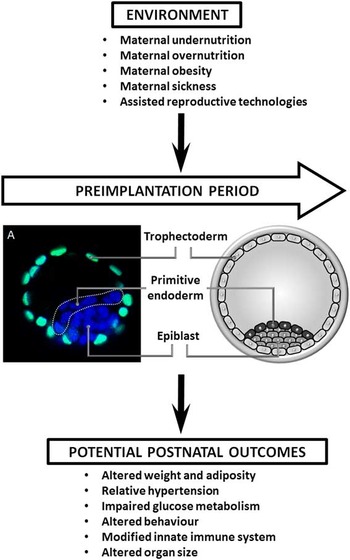
As discussed above, from both in vivo nutritional and in vitro ART-related studies, across animal and human data sets, there is consistent evidence that periconceptional environment is critical in the long-term setting of postnatal phenotype. Why might events around the time of conception be so pivotal in DOHaD? My (TPF) first discussion on this question was with David Barker back in the late 1990s. At the time, our research lab focused mainly on intrinsic developmental mechanisms of the early embryo leading to blastocyst morphogenesis and segregation of early embryonic and extra-embryonic cell lineages. David suggested to me that extrinsic factors were likely to be modulating these early inherent steps in embryogenesis with far greater impact on long-term potential. There are good reasons why these insightful comments might be true. The preimplantation period is characterized by diversification of two extraembryonic lineages, trophectoderm (TE) and primitive endoderm (PE), on the outside and inside, respectively, of the expanding blastocyst with the epiblast progenitor of the entire foetus located between them (Fig. 1). TE and PE subsequently construct the chorio-allantoic placenta and yolk sac placenta, respectively, with responsibility in provision of nutrients during post-implantation pregnancy. If early embryo environment can generate diverse adult phenotypes as reviewed above, perhaps the characteristics of nascent placental lineages may be subject to external cues to optimize their efficiency dependent upon nutrient availability – a concept commonly known today as developmental plasticity? Moreover, the close signalling mediated between maternal and embryonic cells to coordinate implantationReference Fritz, Jain and Armant 63 and the epigenetic restructuring of the chromatin occurring during preimplantation developmentReference Cantone and Fisher 64 provides a natural window when such plasticity could be induced in the embryo and propagated, through altered gene expression, into later pregnancy. David Barker’s comments led to new research investigating the relevance of periconceptional environment in developmental programming as a consequence.
Diverse environmental conditions during the preimplantation period can impact on the early embryo and affect cell lineages at the blastocyst stage with detrimental effects in postnatal health of the resultant offspring. (a) Mid-plane confocal microscopy section displaying Cdx2 staining in nuclei of trophectoderm cells (pale blue) from a mouse blastocyst. Cells of the epiblast and primitive endoderm (dotted white contour) were stained with DAPI (dark blue nuclei).

Maternal signalling, embryo sensing and lineage responses
If, as considered above, the early embryo constitutes a suitable window for in vivo maternal environmental information to influence and optimize the pattern of future development, such plasticity must comprise a series of mechanisms both to permit embryo sensing of the external milieu and to activate appropriate responses to the developmental programme. This dialogue between mother and early embryo has been a focus of our laboratory in recent years using the mouse Emb-LPD model.Reference Fleming, Watkins and Sun 3 We find, during the period of preimplantation development, that Emb-LPD is able to alter the metabolite composition of maternal serum, which in turn modifies the composition of the uterine lumen. Coupled with this, embryos at the blastocyst stage are equipped with signalling pathways that can ‘read’ these metabolic cues and then change their developmental trajectory as a result, most evident in the extra-embryonic lineages. These changes in developmental plan can best be described as compensatory, optimizing the nutrient provision from mother to embryo to protect growth. Most interesting is that this dialogue at least in mice has enduring consequences. It appears that some key decisions are made in developmental plasticity at this time and that they are sufficiently hard-wired to persist through the entire gestation period. We believe this dialogue to be the core component of embryo programming in this model leading to the adult onset disease phenotype described above. This is because the increased foetal growth response identified in Emb-LPD offspring is a biomarker of future disease – birthweight of Emb-LPD or sustained LPD throughout gestation is positively correlated with later adult weight, blood pressure and behavioural activity.Reference Watkins, Ursell and Panton 9 Moreover, the Emb-LPD adult metabolism is energy-storage in character with increased insulin receptor and IGF-1R expression in white adipose tissue,Reference Watkins, Lucas, Wilkins, Cagampang and Fleming 11 further stimulating weight increase and disease risk. We briefly summarize critical features in this maternal-embryonic dialogue below, a fuller account is reviewed elsewhere.Reference Fleming, Watkins and Sun 3
The protein composition of maternal diet, as would be anticipated, changes the metabolite composition of maternal serum, and, following Emb-LPD, amino acids (AAs) and insulin concentrations are reduced while glucose concentration rises; this is evident during the period of preimplantation development and particularly during blastocyst morphogenesis, and identified in ratReference Kwong, Wild, Roberts, Willis and Fleming 12 as well as mouseReference Eckert, Porter and Watkins 65 models. Embryo metabolism and development are sensitive to all of these metabolitesReference Lane and Gardner 66 – Reference Martin, Sutherland and Van Winkle 69 and therefore offers the potential for dietary composition to be sensed by embryos. Indeed, microanalysis of mouse Emb-LPD uterine fluid at the time of blastocyst formation shows a similar reduction in AA concentration as found in the serum, as well as attendant changes in the AA profile within the blastocysts.Reference Eckert, Porter and Watkins 65 Most relevant to the embryo sensing mechanism that may activate programming is that the concentration of the branched chain AAs (BCAAs), leucine, isoleucine and valine, are significantly depleted in Emb-LPD rat and mouse serum and mouse uterine fluid.Reference Kwong, Wild, Roberts, Willis and Fleming 12 , Reference Eckert, Porter and Watkins 65 That these metabolite changes are indeed sensed by mouse Emb-LPD blastocysts has been demonstrated by quantitative immunoblotting of blastocyst mTORC1 signalling.Reference Eckert, Porter and Watkins 65 This pathway is the major cellular mechanism of nutrient sensing to regulate growth rate, mediated through extracellular BCAA and insulin levels.Reference Wang and Proud 70 Thus, Emb-LPD blastocysts exhibit significantly depleted mTORC1 signalling compared with control blastocysts from NPD fed mothers.Reference Eckert, Porter and Watkins 65 This, we believe, comprises the Emb-LPD sensing mechanism required for induction of developmental plasticity in periconceptional nutritional programming.
The response mechanisms by mouse extra-embryonic lineages following Emb-LPD sensing are diverse and include increased proliferation and endocytosis in the TE as well as increased motility and invasiveness of trophoblast cells during the implantation process, evidenced in in vitro outgrowths.Reference Eckert, Porter and Watkins 65 , Reference Sun, Velazquez and Marfy-Smith 71 The stimulation in endocytosis activity and proliferation is also apparent in the Emb-LPD PE lineage, evaluated in embryoid bodies following embryonic stem cell derivation.Reference Sun, Velazquez and Marfy-Smith 71 , Reference Sun, Denisenko and Sheth 72 Such changes in cellular endocytosis are comprehensive, including increased uptake of extracellular ligands, increased numbers of lysosomes and increased expression and activity of the relevant endocytic receptor, megalin, brought about through Rho-A modulation of the actin cytoskeleton.Reference Sun, Velazquez and Marfy-Smith 71 These responses are compensatory, permitting increased uptake of nutrients in conditions of poor maternal diet and establishing more efficient chorio-allantoic and yolk sac placentas, evident throughout pregnancy to protect foetal growth.Reference Watkins, Ursell and Panton 9 , Reference Coan, Vaughan and McCarthy 73 The responses are regulated through the integration of epigenetic and cellular mechanisms. For example, the stimulated proliferation within the PE lineage is accompanied by reduced gene expression of the Gata6 transcription factor that acts to induce PE differentiation.Reference Sun, Denisenko and Sheth 72 Thus, the Gata6 promoter in the outer PE layer of Emb-LPD embryoid bodies exhibits histone H3 and H4 hypoacetylation and reduced RNA polymerase binding, characteristics that would suppress expression.Reference Sun, Denisenko and Sheth 72
That the induction and subsequent legacy of altered developmental plasticity derives from the maternal-embryonic dialogue can be demonstrated by embryo transfer of Emb-LPD blastocysts into control NPD recipients resulting in the stimulated foetal growth phenotype that leads to cardiometabolic disease in later life.Reference Watkins, Ursell and Panton 9 In a more refined in vitro model, we have now cultured embryos through cleavage in medium comprising low BCAA and insulin concentrations to mimic the Emb-LPD maternal environment and found, after transfer and gestation, offspring to exhibit the increased growth and relative hypertensive state typical of Emb-LPD progeny.Reference Velazquez, Sheth, Marfy-Smith, Eckert and Fleming 74
Conclusions
We have identified across different mammalian species including the human that periconceptional or preimplantation environment can alter the developmental programme and have long-lasting consequences for foetal growth and development and postnatal health and disease risk. There is also good evidence that the nature of the environmental condition can induce diverse changes affecting a range of physiological systems, for example the different legacies found from maternal dietary and sickness models. This indicates there is specificity in programming and that it is not merely a stress response with a single default consequence. While many examples of embryo programming are likely to be the result of a direct perturbation under extreme conditions, others can be viewed as true biological processes, conserved during evolution, to drive developmental plasticity and optimize offspring phenotype based upon cues acting in a ‘predictive’ manner. The temporal steps in programming of embryos through to adult disease are usually poorly understood and in only limited models do we have evidence of the sequence of events involved, such as the Emb-LPD model. This gap in our knowledge needs to be filled. Embryo programming should be considered an integrated phenomenon involving multiple biological components – for example, Emb-LPD programming involves physiological, epigenetic, cell biological and metabolic mechanisms. Epigenetic changes may facilitate the driving of cellular and physiological responses to environmental conditions by embryos to provide a coherent plan for developmental plasticity. Clearly, identifying the major inductive factors that may initiate adverse embryo programming (such as BCAAs and insulin in Emb-LPD) will permit a preventative strategy to protect future health, most important in human ART. Lastly, our thanks to David Barker for his wisdom in advising research into embryo developmental programming, his influence was pivotal in the progress made in this field.
Acknowledgements
This work was supported through awards from the Biotechnology and Biological Sciences Research Council [BB/I001840/1; BB/F007450/1], The Medical Research Council [G9800781], the NICHD National Cooperative Program [U01 HD044635] and the EU-FP7 EpiHealth and EpiHealthNet programmes to TPF.
Conflicts of Interest
None.
Ethical Standards
All cited research involving animals was conducted under UK Home Office project and personal licences and local ethical approval.