Patients with congenitally corrected transposition or intra-atrial baffle repair for the transposition of the great arteries function with a morphological right ventricle supporting the systemic circulation. In patients with congenitally corrected transposition, an excellent long-term survival was reported with most young adults remaining symptoms free.Reference Connelly, Liu, Williams, Webb, Robertson and McLaughlin1, Reference Graham, Bernard and Mellen2 However, systemic right ventricular dysfunction is common and increases with age, 32% in isolated lesion and 56% in associated lesions at age of 45 years.Reference Graham, Bernard and Mellen2 In patients with atrial correction for transposition, 14.6% develop systolic dysfunction of the systemic right ventricle up to a mean of 14 years after surgical repair,Reference Dos, Teruel and Ferreira3 and 40% of late deaths are related to right ventricular dysfunction.Reference Turina, Siebenmann, Von Segesser, Schönbeck and Senning4 Therapy with β-blockers, which is a standard treatment for cardiac failure, is frequently empirically initiated in patients with dysfunctional systemic right ventricle. The purpose of this study was to assess the efficacy of β-blockers in these patients.
Materials and methods
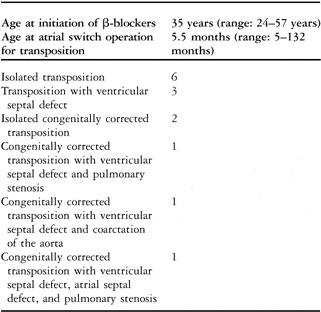
Fourteen patients, seven women and seven men, with systemic right ventricular dysfunction, with an ejection fraction of less than 50%, were included in this consecutive study between January, 2002 and June, 2008. Most of the patients were in chronic stable cardiac failure. The population study included five patients with congenitally corrected transposition and nine with transposition after the Mustard or Senning operations performed between 1971 and 1981 – six Mustard and three Senning. From the five patients who were followed up for congenitally corrected transposition, three of them had undergone previous palliative surgery – ventricular septal defect closure and pulmonary valvulotomy in two patients and ventricular septal defect closure and coarctation repair in one patient.
All patients but one were started on bisoprolol 1.25 milligram daily, which was increased successively to 2.50 milligrams, 3.75 milligrams, 5.00 milligrams, 7.50 milligrams, and 10.00 milligrams, according to clinical tolerance. One patient received carvedilol, which was started at 3.25 milligrams twice daily and increased to the maintenance dose of 12.5 milligrams twice daily. In addition, all patients already received angiotensin-converting enzyme inhibitors before the initiation of β-blockers. Diuretics and digitalis were used in 13 and two patients respectively, and not discontinued.
Quality of life, New York Heart Association functional class I–IV, aerobic capacity, and function of the systemic right ventricle were assessed before treatment with β-blockers and at the end of the follow-up period, which ranged from 3 to 36 months with a mean of 12.8 months. The current functional status was also studied using the Warnes–Somerville index as follows:Reference Graham, Bernard and Mellen2 grade 1: normal life; full-time work or school; can manage pregnancy; grade 2: able to do part-time work, life modified by symptoms; grade 3: unable to work, noticeable limitation in activities; and grade 4: extreme limitation, dependent, almost housebound. During the same time period, venous blood samples were obtained from all patients. Natraemia, creatininaemia, plasma haemoglobin, and brain natriuretic peptide levels were determined. Echocardiography was used in all patients for inclusion but not in the follow-up study because it is frequently considered a poor method for calculating precisely systemic right ventricular function.Reference Dos, Teruel and Ferreira3 In fact, the systemic right ventricular ejection fraction was assessed by radionuclide ventriculography and/or gadolinium cardiovascular magnetic resonance imaging before β-blockers were started and at the end of the follow-up period. At last, cardiopulmonary tests were performed on an ergometer cycle in all patients but two. Continuous measurements of expired gas values were analysed. The analyser was calibrated before tests using known values of oxygen and carbon dioxide. During the test, heart rate, blood pressure, and ventilation were measured continuously. All these data were analysed using SPSS version 13.0 for Windows. Data are presented as mean with standard deviations, median, and range. Variables were compared using Wilcoxon signed-rank test. A p-value of less than 0.05 was considered statistically significant.
Results
The median age of patients was 35 years with a range from 24 to 57 years. Median age at atrial switch operation for transposition was 5.5 months with a range from 5 to 132 months. Before inclusion, one patient was in atrial fibrillation associated with hyperthyroidism and was taking propranolol. This latter was switched to bisoprolol at the beginning of the study. Four more patients had undergone pacemaker implantation for post-operative atrioventricular block in three patients and post-atrioventricular node ablation in one patient with intractable atrial fibrillation. Table 1 shows patient data. Maintenance dose of bisoprolol varied between 2.5 and 10 milligrams daily. Nine patients received bisoprolol 10 milligrams daily. One patient underwent prophylactic implantable cardioverter-defibrillator during the study for syncope and ventricular tachycardia.
Clinical characteristics.

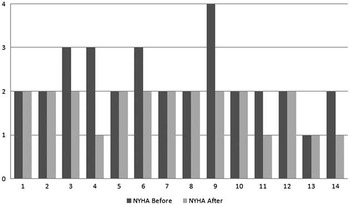
Before the initiation of β-blockers, 10 patients were in New York Heart Association functional class I–II and four patients were in New York Heart Association functional class III–IV. After completion of the titration phase and the follow-up period, four patients were in New York Heart Association functional class I and 10 patients were in New York Heart Association functional class II. Change in New York Heart Association class was significant (p = 0.016; Fig 1). In addition, quality of life obtained from the Ability Index improved significantly throughout the study from a median grade 2, with a range from 1 to 3, to a median grade 1 with a range from 1 to 2 (p = 0.008).
New York Heart Association-class before and after β-blockers therapy.

At baseline, the median maximum oxygen consumption was 16.90 millilitres per kilogram per minute, with a range from 14 to 28 millilitres per kilogram per minute. The median maximum oxygen consumption at the end of the follow-up period was 20.40 millilitres per kilogram per minute, with a range from 16 to 30 millilitres per kilogram per minute. The median maximum oxygen consumption tended to be higher at the end of follow-up period, but the difference did not reach a significant statistical level (p = 0.29). Table 2 shows biological results.
Biological results.

Eleven patients underwent magnetic resonance imaging before the administration of β-blockers and 10 at the end of follow-up. Eight patients underwent radionuclide ventriculography before the administration of β-blockers and 13 at the end of follow-up. Change in ejection fraction assessed by magnetic resonance imaging was not significant from a median of 29% (range: 12–47%) to 32% (range: 22–63%; p = 0.063). However, change in ejection fraction assessed by radionuclide ventriculography was significant from a median of 41% (range: 29–53%) to 49% (range: 29–62%; p = 0.031).
Discussion
Classically, β-blockers are a cornerstone in the management of left ventricular systolic dysfunction. They improve New York Heart Association class, quality of lifeReference Rickli, Steiner, Müller and Hess5 and increase left ventricular ejection fraction. The latter is due to a decrease in both end-systolic and end-diastolic left ventricular diametersReference Macdonald, Keogh, Aboyoun, Lund, Amor and McCaffrey6, Reference Arnold, Kotlyar, Hayward, Keogh and Macdonald7 and a decrease in heart rate.Reference Flannery, Gehrig-Mills, Billah and Krum8, Reference Thackray, Ghosh and Wright9 The increase in the left ventricular ejection fraction is correlated with baseline left ventricular inotropic reserve.Reference Ramahi, Longo and Cadariu10 Treatment with β-blockers reduces the incidence of the onset of atrial fibrillation, the incidence of ventricular tachycardia, and fibrillation,11, Reference Nasr, Bouzamondo, Hulot, Dubourg, Le Heuzey and Lechat12 the risk of all-cause mortality, cardiovascular deaths, sudden death, and admission to hospital for worsening cardiac failure.11, Reference Packer, Bristow and Cohn13, 14 According to such results, some authors have proposed similar therapy in patients with systemic right ventricular dysfunction.
Our study shows that β-blockers in patients with systemic right ventricular dysfunction are associated with significant improvement of New York Heart Association class, quality of life, and systemic ejection fraction assessed by radionuclide ventriculography.
In patients with congenitally corrected transposition or transposition after Mustard or Senning operation, ischaemic perfusion defects, together with chronic volume overload from tricuspid regurgitation and long-standing pressure overload, are the determining factors of right ventricular dysfunction.Reference Van der Zedde, Oosterhof, Tulevski, Vliegen and Mulder15–Reference Lubiszewska, Gosiewska and Hoffman18 Moreover, cardiopulmonary bypass with inflammatory mediators and hypothermic circulation arrest (often multiple exposure), tricuspid valve surgery, significant arrhythmia, and pacemaker therapy are well-known risk factors for systemic right ventricular dysfunction.Reference Graham, Bernard and Mellen2, Reference Trojnarska19
Interestingly, Doughan et alReference Doughan, McConnell and Book20 has also reported that β-blockers, carvedilol or metoprolol, in patients with transposition and systemic right ventricular dysfunction resulted in improvement of New York Heart Association functional class and such improvement was more important in patients with pacemakers who could receive higher maintenance doses of β-blockers. In addition, untreated patients showed increased right ventricular end-diastolic area and these authors suggested that β-blockers may prevent right ventricular remodelling.Reference Doughan, McConnell and Book20, Reference Giardini, Lovato and Donti21 In our study, 70% of the patients were on full dose of bisoprolol at the end of the study, which was similar but a little bit better than the 62% of target dose achieved in the pilot study of Giardini et al.Reference Giardini, Lovato and Donti21 However, the rate of β-blockers remains moderate and underused because of concerns that they will aggravate sinus bradycardia and atrioventricular block.Reference Doughan, McConnell and Book20 Such a phenomenon has also been mentioned in dedicated cardiac failure programmes focusing on the optimisation of medical therapy, and the doses reached are considerably lower than the guidelines’ targets. It seems realistic to think that better results could have been observed with higher doses of β-blockers in this study.
Giardini et alReference Giardini, Lovato and Donti21 has also observed improvement of the systemic right ventricular ejection fraction, end-systolic and end-diastolic volume indexes assessed by magnetic resonance imaging using carvedilol in a series of eight patients with transposition or congenitally corrected transposition.Reference Giardini, Lovato and Donti21 In this study, similarly significant results could be obtained for systemic ejection fraction calculated by radionuclide ventriculography but not with magnetic resonance imaging. It is worthwhile to notice that the mean ejection fraction obtained by radionuclide ventriculography at baseline in our study is very similar to that of 43% reported by Connelly et alReference Connelly, Liu, Williams, Webb, Robertson and McLaughlin1 in a group of 26 patients with congenitally corrected transposition and that of 36% found by Lubiszewska et alReference Lubiszewska, Gosiewska and Hoffman18 in a cohort of 61 patients after the Mustard or Senning operation. If nowadays magnetic resonance imaging appears as the ideal tool for measuring systemic left ventricular function, the particular geometry of the right ventricle may be a restrictive factor and accurate delineation of the right ventricular borders, especially in a systemic position, is sometimes difficult. This could also explain the discrepancies between results from magnetic resonance imaging and those obtained with radionuclide ventriculography. In addition, use of magnetic resonance imaging can also be limited by the presence of a permanent pacemaker, which is not so rare in these patients.
Winter et alReference Winter, Bouma and van Dijk22 has also mentioned another strategy of exercise training as a valuable therapeutic option for patients with systemic right ventricular dysfunction. Physical activity has been positively associated with maximal exercise capacity and quality of life. Such training is not routinely performed in our department but could probably be a good therapeutic option in combination with β-blockers and angiotensin-converting enzyme inhibitors in this population to postpone the failure of the systemic right ventricle.
This study has different limitations, including small number of patients, limiting data collection, non-randomised trial, and method used to assess right ventricular function. This is mainly related to the rarity of such diseases. It seems necessary in future to perform a prospective, randomised and collaborative study.
In conclusion, our study suggests that β-blockers may result in improvement in New York Heart Association functional class, quality of life, and ejection fraction in patients with systemic right ventricular dysfunction.