


Introduction
The burden of depression to patients, health-care systems, and society is well documented (Fostick, Silberman, Beckman, Spivak and Amital, Reference Fostick, Silberman, Beckman, Spivak and Amital2010; Judd et al., Reference Judd, Akiskal, Zeller, Paulus, Leon and Maser2000) and only a third of patients respond fully to antidepressants (Trivedi et al., Reference Trivedi, Rush, Wisniewski, Nierenberg, Warden and Ritz2006). Cognitive behaviour therapy (CBT) is one of the psychological treatments recommended in clinical guidelines (National Institute for Health and Clinical Excellence, 2009). Roughly two-thirds of people will no longer meet criteria for major depression following acute-phase CBT (Craighead, Sheets, Brosee and Ilardi, Reference Craighead, Sheets, Brosee, Ilardi, Nathan and Gorman2007). However, about half of patients with major depressive disorder who receive acute-phase CBT relapse within 2 years (Vittengl, Clark and Jarrett, Reference Vittengl, Clark and Jarrett2010). It is this highly recurrent and sometimes chronic nature of depression that prompted researchers to identify potential cognitive markers that may represent long-term vulnerability factors, in the hope of enhancing the efficacy of interventions such as CBT (Halvorsen, Wang, Eisemann and Waterloo, Reference Halvorsen, Wang, Eisemann and Waterloo2010; Jarrett, Vittengl, Doyle and Clark, Reference Jarrett, Vittengl, Doyle and Clark2007; Vittengl, Clark, Dunn and Jarrett, Reference Vittengl, Clark, Dunn and Jarrett2007; Paykel et al., Reference Paykel, Scott, Teasdale, Johnson, Garland and Moore1999).
According to Beck's cognitive theory of depression (Beck, Reference Beck1976; Beck, Rush, Shaw and Emery, Reference Beck, Rush, Shaw and Emery1979) dysfunctional schemas can represent a vulnerability factor for depression. Dysfunctional schemas consist of negative or unhelpful beliefs and attitudes about the self, the world and others, are generally culturally derived, and represent value judgments and standards. They can remain dormant and largely stable in non-depressed states, but may be triggered by a wide range of stressors or life events that are reminiscent of the early experiences that led to their development (Clark and Beck, Reference Clark and Beck1999). Later texts (Beck et al., Reference Beck and Freeman1990; Padesky, Reference Padesky1994) argue it is clinically useful to separate the concept of schemas into core beliefs and conditional beliefs (or dysfunctional assumptions), as they require different approaches and techniques in therapy.
Conditional beliefs, also known as “rules for living” (Fennell Reference Fennell1997), can be stated in an “If. . .then. . .” format consisting of a demand and a consequence. For example, “If I am nice to people then they will respect me”. This provides a testable statement that can be explored through the use of behavioural experiments (Mooney and Padesky, Reference Mooney and Padesky2000). CBT involves working collaboratively with patients to identify conditional beliefs, examine their negative effects, and test out alternative, more functional beliefs (Beck, Reference Beck1995; Fennell, Reference Fennell1997; Padesky, Reference Padesky1994).
Patients with TRD typically report a number of rigid conditional beliefs that govern and maintain unhelpful behaviour, influencing the interpretation of events (Mooney and Padesky, Reference Mooney and Padesky2000). Using the Dysfunctional Attitude Scale (DAS; Weissman, Reference Weissman1979), Riso et al. (Reference Riso, du Toit, Blandino, Penna, Dacey and Duin2003) found the highest levels of dysfunctional attitudes (conditional beliefs) in people with chronic depression, compared to a group with non-chronic depression and a never-depressed group. People with chronic and persistent depression may have beliefs reinforced over a long period of time, potentially making them more entrenched and difficult to modify. Although beliefs are often not articulated at the start of therapy, they may influence the therapy process (Moore and Garland, Reference Moore and Garland2003). For example, a belief “If I don't succeed, then I am worthless”, may lead someone to be critical of their progress in therapy and negatively affect their level of engagement. Identifying conditional beliefs early on in therapy may help address beliefs that could interfere with therapy and reduce drop-out.
It has also been suggested it is important for CBT to concentrate on conditional beliefs in order to achieve longer lasting change in patients with TRD, (Mooney and Padesky, Reference Mooney and Padesky2000; Moore and Garland, Reference Moore and Garland2003). Questionnaires such as the DAS (Weissman, Reference Weissman1979) and the Young Schema Questionnaire (YSQ; Young and Brown, Reference Young and Brown1990) have been developed to help capture the content and extent of patients' unhelpful beliefs. However, these require patients to rate existing statements, rather than formulating conditional beliefs using their own words and expressions. Such questionnaires can be long, detailed and, anecdotally, used more in research than clinical practice. The CoBalT trial provided a unique opportunity to systematically explore whether there were common themes in the conditional beliefs expressed during CBT by primary care patients with TRD. To the best of our knowledge, there are no other papers that have looked at this. Identifying common themes of conditional beliefs could be useful to CBT therapists in identifying and formulating unhelpful conditional beliefs in therapy.
Method
The CoBalT trial
The material analysed in this study came from CBT sessions with patients participating in the CoBalT trial (Wiles et al., Reference Wiles, Thomas, Abel, Ridgway, Turner and Campbell2013). CoBalT was a multi-centre randomized controlled trial investigating the effectiveness of CBT as an adjunct to usual care (including pharmacotherapy) for primary care patients with TRD. As there is no agreed definition of treatment resistance, the CoBalT trial used a definition of TRD that was inclusive and directly relevant to UK primary care (Wiles et al., Reference Wiles, Thomas, Abel, Ridgway, Turner and Campbell2013).
Eligible patients were aged 18–75 years and had TRD, defined as continuing to have significant depressive symptoms (Beck Depression Inventory (BDI-II; Beck, Steer and Brown, Reference Beck, Steer and Brown1996) with a score of 14 or more, and meeting ICD-10 criteria for a depressive episode assessed using the revised Clinical Interview Schedule (CIS-R; Lewis, Reference Lewis1994; Lewis, Pelosi, Araya and Dunn, Reference Lewis, Pelosi, Araya and Dunn1992) following treatment with an adequate dose of antidepressant medication for at least 6 weeks (Thomas et al., Reference Thomas, Abel, Ridgway, Peters, Kessler and Hollinghurst2012). Adherence to antidepressant medication was assessed using a self-report measure of adherence that has been validated against electronically monitoring medication bottles (Morisky, Green and Levine, Reference Morisky, Green and Levine1986, George, Peveler, Heiliger and Thompson, Reference George, Peveler, Heiliger and Thompson2000) and adequacy of dose of medication based on comparisons with recommended doses for depression in the British National Formulary (Wiles et al., Reference Wiles, Thomas, Abel, Ridgway, Turner and Campbell2013).
Patients in the CoBalT trial were randomized to either treatment as usual (GP care), or treatment as usual plus 12–18 sessions of individual CBT based on Beck et al. (Reference Beck, Rush, Shaw and Emery1979), with elaborations from Moore and Garland (Reference Moore and Garland2003). The latter included techniques that have been found helpful when working with avoidance and resistance, often found in patients with chronic and persistent depression. The treatment protocol for the CoBalT trial encompassed addressing and modifying conditional beliefs. The intervention was delivered by 11 part-time therapists in three sites (Bristol, Exeter and Glasgow) representative of those working in NHS psychological services, with one clinical supervisor per site (Thomas et al., Reference Thomas, Abel, Ridgway, Peters, Kessler and Hollinghurst2012). Therapists kept clinical therapy notes as they would do in usual NHS practice. Information on conditional beliefs was recorded by therapists in therapy notes, formulation diagrams, discharge letters and relapse prevention plans. This study was based on conditional beliefs extracted from a random sample of therapy notes.
Selection of therapy notes
In total, 234 patients were randomized to the intervention arm of the CoBalT trial. Of these, 152 (Bristol: n = 63; Exeter: n = 54; Glasgow: n = 35) completed a course of CBT and gave consent for both their therapy recordings and medical records to be used for research purposes. A random sample of 50 therapy notes (stratified by age [<50 years; ≥50 years] and gender) from the three research sites was selected for the purposes of this study (Bristol: n = 20, 5 per stratum; Exeter: n = 20, 5 per stratum; Glasgow: n = 10, 2 per stratum and 2 at random). An initial hypothesis was that there may be differences in the conditional beliefs of men and women, as well as between different age groups. Stratifying by age and gender allowed any differences to be explored. If there were no recorded conditional beliefs within a set of therapy notes, the next randomly generated patient within that stratum was used in order to ensure a final sample of n = 50. This replacement procedure was used on five occasions. If there was an insufficient number of patients within the relevant stratum (age/gender), the next patient was selected from a randomly generated alternative stratum. This procedure was used on three occasions.
Extraction of data from therapy notes
The selected therapy notes were examined thoroughly to extract recorded underlying conditional beliefs. The two researchers examining the notes (AB and SG) were CoBalT trial CBT therapists and therefore familiar with formulating conditional beliefs. Conditional beliefs were identified as extreme statements in the form of “If. . .then. . .”, “Unless. . .then. . .” and “I should/must/need. . .”. With all these, after data extraction, we imposed an “If. . .then. . .” format to simplify the analysis. The two researchers worked together at this stage of data extraction to ensure agreement about the data being collected. Conditional beliefs were typed verbatim into a spreadsheet, resulting in a long list of conditional beliefs, each marked with the unique patient ID number.
Data analysis
The list of extracted conditional beliefs was cut into strips so there was one conditional belief per strip. This allowed the beliefs to be manually sorted and grouped into themes. This process identified many beliefs started with the same “demand” but ended with a different “consequence”. For example: “If I don't do things perfectly, then I am a failure.” and “If I don't do things perfectly, then others will reject me.”
To capture these idiosyncrasies, and limit researcher interpretation, it was decided to cut the conditional beliefs in half, sorting the demands (Ifs) and the consequences (thens) separately. It was also decided that the two researchers would initially sort all the data independently before comparing groups and refining themes. This allowed the researchers to discuss each other's interpretations of the data and produce a more rigorous analysis. Overall, there was considerable agreement over the grouping of beliefs. Further discussion enabled greater refinement of the groups and agreement on theme labels.
An approach based on framework analysis (Ritchie and Spencer, Reference Ritchie, Spencer, Bryman and Burgess1994) was used to organize the data. Using this approach, data were placed into tables with patient ID numbers down the side and the labels of themes across the top. This provided an overview of the data, aiding the process of making comparisons across and within themes, leading to further refinement, and an initial exploration of any gender or age differences. Investigator triangulation was undertaken with a third researcher (GL) who examined the content and grouping of the emerging themes in order to comment on the face validity of the analysis.
Once final themes for the demands and consequences were agreed, the number of patients who held beliefs within each theme was counted. At this point it was possible to explore frequencies by age and gender. Themes of demands and consequences were cross-tabulated to link them together as complete conditional beliefs and derive frequencies for the various combinations. The majority of patients held more than one conditional belief and hence chi-squared tests were conducted for each of the possible combinations to identify any that occurred more frequently than expected by chance.
Results
Study participants
The final sample consisted of therapy notes relating to 29 women and 21 men with a mean age of 48.8 years (SD 12.5). The average number of CBT sessions attended was 14.3 (SD 3.5). All 11 CoBalT trial therapists were represented.
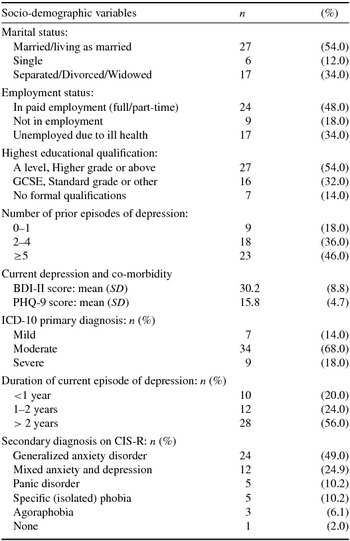
The characteristics of the patients whose notes were sampled reflected those of the main CoBalT trial (Wiles et al., Reference Wiles, Thomas, Abel, Ridgway, Turner and Campbell2013; see Table 1). Most participants reported severe (mean BDI-II score = 30.2) and chronic depression (56% reported their current episode of depression lasting more than 2 years). Many (n = 33, 66%) had been on their current antidepressants more than 12 months, with a minority (n = 7, 14%) having taken their medication for less than 6 months. Forty-six percent reported five or more episodes of depression. Most (n = 40, 80%) had previously been treated with antidepressants. All but one patient had a secondary diagnosis of an anxiety disorder on the CIS-R.
Characteristics of the 50 patients whose notes were examined

Conditional beliefs
A list of 284 conditional beliefs was generated by examining therapy notes. The number of beliefs found per patient varied from 1 to 19 (mean = 5.68, SD = 3.6). In many cases, the greater number of beliefs reflected the development and refining of conditional beliefs as therapy progressed, rather than lots of distinct beliefs.
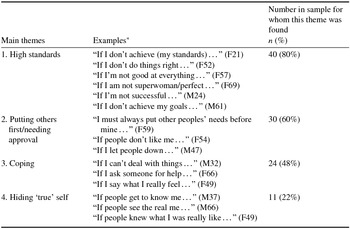
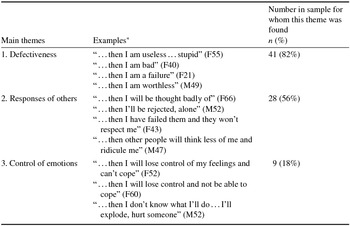
Four main themes emerged from the demands (Ifs) (see Table 2). Three main themes emerged from the consequences (thens) (see Table 3). Some of the main themes contained sub-themes, which are described below. The final column in Tables 2 and 3 show the number (and percentage) of patients for whom this theme was present.
Main themes to emerge from the demands: the “Ifs”

Note: Brackets after the quote give details of the gender and age of the participant
Main themes to emerge from the consequences: the “thens”

Note: Brackets after the quote give details of the gender and age of the participant
Themes to emerge from the demands (Ifs)
-
1. High standards. The most frequent theme to emerge from the first part of the conditional beliefs (found in 80% of notes examined) related to having “High standards”. Within this, three sub-themes were identified: “Working hard/keeping busy”, “Perfectionism”, and “Achieving goals”. The first of these statements concerned keeping busy and doing as much as possible, often to keep up with perceptions of others or trying to do as much as they believed they used to do before they became depressed, which for many was a number of years ago. The sub-theme of “Perfectionism” was based on statements that suggested they needed to do things “perfectly” or “just so”. The final sub-theme reflected statements that suggested the individual set themselves goals, which had to be achieved. These goals were usually unrealistic or extremely ambitious.
-
2. Putting others first/needing approval. The second most frequent” demand” theme to emerge (found in 60% of notes) included statements that reflected a strong sense of always putting others first, having to do what they believed was expected by others, not upsetting others, trying to be kind and considerate at all times and needing to gain the approval of others.
-
3. Coping. The third most frequent “demand” theme (found in 48% of notes) included statements about the importance of being strong, capable, and independent. There were three sub-themes within this main concept of Coping: “Not asking for help”; “I should be able to cope”; and “Not showing emotion”. The first of these reflected a desire not to rely on others or burden them in any way. The second often involved people comparing themselves to others or expecting themselves to manage just as well as they would have before experiencing depression. The third captured statements about hiding emotions from others and having to be in control of one's feelings at all times.
-
4. Hiding “true” self. The final theme to emerge from the “demands” (found in 22% of notes) included statements that referred to keeping others at a distance to prevent them seeing or finding out about the “real me”.
Themes to emerge from the consequences (thens)
-
1. Defectiveness. The most frequent theme to emerge from the second part of the conditional beliefs (found in 82% of notes examined) included statements about being defective in some way or a fear of becoming defective if conditions were not met or standards were not upheld. Six sub-themes emerged in the way that people described “defectiveness”. These sub-themes were “Stupid, useless, failure”, “Bad”, “Lazy”, “Selfish/burden to others”, “Weak/others can hurt me”, and “Worthless”. People also took these characteristics to mean it was their fault when things did not go “right”.
-
2. Responses of others. The second most frequent theme to emerge from the “consequences” (found in 56% of notes) included statements relating to fears about the reactions of others. There were two distinct sub-themes: “Others will think badly of me” and “Others will reject me”. The first of these highlighted fears that others would disapprove and lose respect for the person (whilst not necessarily showing this outwardly). The second sub-theme included statements that others would explicitly ridicule or reject them.
-
3. Control of emotions. The final theme to emerge from the “consequences” (found in 18% of notes) included statements reflecting fears about one's own emotions being overwhelming and the consequences of “losing control” either for themselves or for others.
Linking demands and consequences
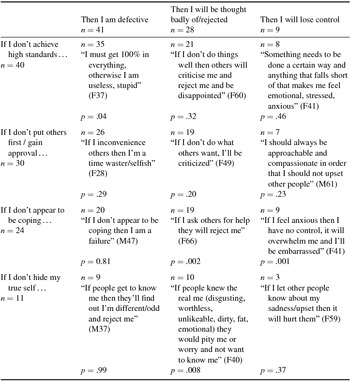
Table 4 shows how the main themes identified during the analysis can be linked back together in 12 possible combinations. An example quote is provided for each combination. The numbers show how many participants' therapy notes contained a belief that fitted within each theme. The most commonly held beliefs were around “achieving high standards” and “being defective”, and in 35 out of 50 people these were linked, e.g. “I must get 100% in everything, otherwise I am useless, stupid” (F37).
Frequencies of combinations of demands and consequences, with an example of a conditional belief including that combination. Individuals (N=50) could hold more than one belief

Note: Brackets after the quote give details of the gender and age of the participant
The majority of participants had more than one conditional belief. Therefore, the frequencies of demands and consequences were compared for each of the 12 combinations using chi-squared tests. Four combinations of demands and consequences were more common than would have been expected by chance: (1) “If I don't achieve high standards, then I am defective” (p = .04); (2) “If I don't appear to be coping, then I will be thought badly of/rejected” (p = .002); (3) “If I don't appear to be coping, then I will lose control” (p = .001); and (4) “If I don't hide my true self, then I will be ridiculed/rejected” (p = .008) (see Table 4).
Differences by age and gender
Examining frequencies by age and gender revealed few differences. The largest difference noted in the “demands” was around the theme of “Coping” where 33% of women under 50 held beliefs about coping compared with 71% of women over 50.
Within the “consequences”, some differences emerged in the theme “Responses of others”; 33% of women under 50 held beliefs that others would think badly of them or reject them, compared to 71% of women over 50. This age difference was reversed in men; 90% of men under 50 held these beliefs about others, compared to just 38% of men over 50.
Discussion
Many commentators have argued that a key aspect of CBT for TRD is identifying and reframing conditional beliefs because they maintain the disorder and, even when symptoms remit, the presence of dysfunctional conditional beliefs increases the risk of relapse (Kuyken, Padesky and Dudley, Reference Kuyken, Padesky and Dudley2009). This study developed following an observation in CBT supervision that common themes were being identified in the conditional beliefs of patients with TRD.
This study investigated the content of conditional beliefs that were recorded in the CBT notes for 50 patients with TRD, most of whom had chronic and persistent depression. Beliefs were explored by breaking them down into two constituent parts and looking at the links between these. Four overarching themes emerged from the “demand” section of the conditional beliefs (Ifs) and three from the “consequence” part (thens). The most commonly held beliefs were around a demand of having to achieve “high standards” and a consequence of being “defective”. Both of these themes were found in 80% or more of the sample. In 35 participants (70% of the sample) these were linked. The other themes found to link together more commonly than expected by chance were: “If I don't appear to be coping, then I will be thought badly of/rejected”; “If I don't appear to be coping, then I will lose control”, and “If I don't hide my true self, then I will be thought badly of/rejected”. However, caution is necessary in interpreting these findings due to the small numbers and multiple testing, which may have produced a significant result by chance.
Interestingly, this study only found minimal differences in the conditional beliefs of men and women, and those aged over and under 50 years old. The main differences found reflected a trend for older women to be more concerned than younger women about “Coping” and “Responses of others”. Younger men appeared to be more concerned about the “Responses of others” than older men.
Identifying themes of conditional beliefs that may interfere with engagement in therapy, e.g. having high standards or a sense of defectiveness, may be clinically beneficial in allowing the therapist to plan how to manage this during therapy. For example, patients who hold beliefs concerning “High standards” may have high expectations of therapy, the therapist, and/or themselves. The qualitative study of CoBalT trial participants found that a key factor in patients' dissatisfaction with therapy was having to undertake homework tasks and a fear of failing at these (Barnes et al., Reference Barnes, Sherlock, Thomas, Kessler, Kuyken and Owen-Smith2013). Some participants reported pressure to get therapy tasks “right”. Addressing unrealistic expectations of therapy and their own “performance” could be important to prevent disengagement or confirmation of unhelpful conditional beliefs, for example, being a failure. Currently there is a lack of research predicting patient drop-out from CBT for depression (Schindler, Hiller and Witthoft, Reference Schindler, Hiller and Witthoft2013), so the influence of conditional beliefs may be an important factor for future research to consider.
Limitations
A limitation of this study was the post-hoc design and reliance on information recorded during therapy. Data quality was therefore constrained by different styles of formulation and note-keeping. However, therapists were broadly representative of those working in the NHS and the clinical note-keeping was consistent with professional standards. Researchers (AB and SG) were confident that the data extracted from therapy notes reflected conditional beliefs as conceptualized in cognitive theories of depression. Where multiple conditional beliefs were recorded in a patient's notes, in some cases, this appeared to reflect the process of refining these over the course of therapy ensuring that the belief most accurately reflected that held by the patient. The variation in the number of conditional beliefs recorded may also reflect differences in note keeping or the focus of therapy sessions.
Caution should be exercised in generalizing these findings because participants reflected a population recruited in UK primary-care. It is possible that holding certain types of beliefs may discourage people from entering a research trial or completing therapy. Further, these findings may not be specific to patients with TRD. However, one of the strengths of this study is that the participants were recruited from primary-care and relate to a highly prevalent, difficult-to-treat group (Thomas et al., Reference Thomas, Kessler, Campbell, Morrison, Peters and Williams2013). The main themes that emerged reflected existing literature around conditional beliefs and TRD. For example, four of the main themes described in this study (“High standards”, “Putting others first/gaining approval”, “Coping” and “Control of emotions”) are similar to the “Achievement”, “Dependency” and “Self-control” dimensions in a factor analysis of the DAS by Power et al. (Reference Power, Katz, McGuffin, Duggan, Lam and Beck1994). Two 9-item versions of the DAS have also been designed to identify the central themes of “Perfectionism” and “Need for approval” (Beevers, Strong, Meyer, Pilkonis and Miller, Reference Beevers, Strong, Meyer, Pilkonis and Miller2007). In this study perfectionism (unlike ordinary striving for realistic goals) was a sub-theme of “High standards” and has previously been identified as a key variable to consider in CBT for chronic depression (Riso and Newman, Reference Riso and Newman2003).
In conclusion, this study found key themes in the conditional beliefs of primary-care patients with TRD. These add to the clinical understanding of this client group and provide useful information to facilitate the complex process of collaborative case conceptualization within CBT interventions for this client group. Future research is needed to investigate whether similar themes of conditional beliefs are also found within other clinical populations, e.g. acute first episode depression. If individuals with TRD are more likely to hold particular conditional beliefs, these may be important targets for earlier intervention in order to prevent the development of chronicity.
Acknowledgements
We are grateful to all the patients, practitioners and GP surgery staff who took part in this research. We acknowledge the additional support that was provided to the study by the Mental Health Research Network, Scottish Mental Health Research Network, Primary Care Research Network and Scottish Primary Care Research Network. We would also like to thank colleagues who have contributed to the CoBalT study, through recruitment and retention of patients, provision of administrative support, or delivery of therapy. We would like to acknowledge the contribution of John Campbell, Sandra Hollinghurst, David Kessler, Bill Jerrom, Jill Morrison, Tim Peters and Debbie Sharp who were co-applicants for the CoBalT trial but were not directly involved in this analysis. Finally, we would like to say a particular thank you to Anne Garland for her encouragement and ideas throughout this study.
Financial support: The CoBalT study was funded by the National Institute for Health Research Health Technology Assessment (NIHR HTA) programme (project number: 06/404/02). The views expressed in this publication are those of the authors and do not necessarily reflect those of the HTA programme, NIHR, NHS, or the Department of Health.
Ethical approval: Ethical approval for the study was given by West Midlands Multi-Centre Research Ethics Committee (NRES/07/H1208/60) and site-specific approvals were obtained from the relevant Local Research Ethics Committees (LRECs) and Primary Care Trusts (PCTs)/ Health Boards covering the three trial sites. The trial was registered under ISRCTN38231611.
Conflicts of interest: CW has been a past president of the British Association for Behavioural and Cognitive Psychotherapies (BABCP), a workshop leader and author of texts on depression and self-help resources and is a Director of a company that markets CBT self-help resources. WK is co-founder of the Mood Disorders Centre, teaches nationally and internationally on CBT and co-authored a cognitive therapy book (Collaborative Case Conceptualization, published by Guilford Press). The other authors have no conflicts to declare.



Comments
No Comments have been published for this article.