


Introduction
Social anxiety disorder (SAD) is a common mental disorder with high prevalence rates (Kessler et al., Reference Kessler, Berglund, Demler, Jin, Merikangas and Walters2005). The average course of SAD is approximately 20 years and only 25% of patients who suffer from SAD spontaneously remit (Schneier et al., Reference Schneier, Johnson, Hornig, Liebowitz and Weissman1992). Moreover, SAD causes severe damage to one’s academic performance, interpersonal relationships, and working career (Wittchen and Beloch, Reference Wittchen and Beloch1996).
There are many evidence-based treatments for SAD, for example cognitive behaviour therapy (CBT) and exposure therapy (Feske and Chambless, Reference Feske and Chambless1995; Haug et al., Reference Haug, Blomhoff, Hellstrøm, Holme, Humble, Madsbu and Wold2003; Parsons and Rizzo, Reference Parsons and Rizzo2008). A meta-analysis compared the efficacy of different psychological and pharmacological interventions for SAD; the result revealed that individual CBT had a greater effect than psychodynamic psychotherapy, interpersonal psychotherapy, mindfulness and supportive therapy, and was the only psychotherapy that had the same effects as pharmacological intervention (Mayo-Wilson et al., Reference Mayo-Wilson, Dias, Mavranezouli, Kew, Clark, Ades and Pilling2014). Even though exposure treatment often occurs within the context of CBT for SAD, a meta-analysis comparison of studies testing CBT (n = 12) and exposure treatment (n = 9) for SAD indicates that the treatment modalities are equally effective (Feske and Chambless, Reference Feske and Chambless1995).
Exposure therapy focuses on altering beliefs using behavioural strategies. Patients were repeatedly exposed to provoking stimuli and tried to break the pattern of escape that maintains the fear (Hafner and Marks, Reference Hafner and Marks1976). The traditional approaches of exposure were mostly in person or through the imagination. Virtual reality (VR) technology is a computer simulation system that can create a virtual visual world for people to experience. Virtual reality exposure therapy (VRET) is able to help individuals overcome the difficulty of imaging anxious stimuli and reduce the higher cost of time and money of exposure therapy. Five meta-analyses have examined the efficacy of VRET for anxiety disorders, including SAD. The meta-analyses results suggested that VRET has a moderate-to-large effect size for reducing SAD symptoms compared with the waiting-list (Kampmann et al., Reference Kampmann, Emmelkamp and Morina2016b; Parsons et al., Reference Parsons and Rizzo2008; Powers and Emmelkamp, Reference Powers and Emmelkamp2008). The results also showed non-significant differences in the size of the effects between VRET and traditional exposure approaches, indicating that VRET was equally as effective as traditional exposure approaches (Powers and Emmelkamp, Reference Powers and Emmelkamp2008; Opriş et al., Reference Opriş, Pintea, Garcí-Palacios, Botella, Szamosközi and David2012).
One critical part of a successful VRET is to expose patients to a painful but bearable social-threat feedback environment. Social-threat feedback is important in human interactions and can elicit anxious feelings, particularly for SAD patients. It is necessary to identify what kinds of stimuli in VR could provoke various amounts of anxiety. Several studies have investigated the socially related feedback in VR (Grillon et al., Reference Grillon, Riquier, Herbelin and Thalmann2006; Pertaub et al., Reference Pertaub, Slater and Barker2002; Schilbach et al., Reference Schilbach, Wohlschlaeger, Kraemer, Newen, Shah, Fink and Vogeley2006). For instance, Pertaub and colleagues compared the anxiety arousal of three types of audience feedback (negative, positive, neutral), using computer-simulation characters (Pertaub et al., Reference Pertaub, Slater and Barker2002). The negative and positive feedback were strong non-verbal affective reactions; that is, falling asleep or putting feet on the table for the negative feedback, nodding encouragingly or smiling frequently for the positive feedback. The neutral audience remained static throughout the talk. The results indicated that negative feedback provoked highest anxiety among the three conditions. However, most of the studies investigating the influences of virtual feedback, at the time of this study, used unselected samples. Consequently, the generalization of these results to social anxiety individuals was limited.
As mentioned above, the distinct social-threat feedback is the obvious target stimulus in VRET; however, the cognitive model suggested that ambiguous social feedback was also able to cause anxiety to SAD patients (Clark and Wells, Reference Clark and Wells1995). For example, previous studies have found that SAD patients tend to report more negative interpretations towards ambiguous feedback (Amin et al., Reference Amin, Foa and Coles1998; Amir et al., Reference Amir, Beard and Bower2005; Constans et al., Reference Constans, Penn, Ihen and Hope1999; Eysenck et al., Reference Eysenck, Mogg, May, Richards and Mathews1991; Kanai et al., Reference Kanai, Sasagawa, Chen, Shimada and Sakano2010). In one study using the speech task to elicit anxiety, the audience presented ambiguous gestures such as ‘scratching head’ or ‘crossing legs’. The researcher found that socially anxious individuals tend to interpret an ambiguous feedback environment as a more negative situation (Kanai et al., Reference Kanai, Sasagawa, Chen, Shimada and Sakano2010). This interpretation bias towards ambiguous social feedback was identified as one of the most important dysfunctional cognitive biases in SAD. Studies showed that targeting cognitive bias can facilitate and enhance the treatment of SAD (Beard et al., Reference Beard, Weisberg and Amir2011). To enhance the effects of VRET, researchers should not only focus on the emotional valence (positive or negative) of feedback but also consider the influences of ambiguous feedback.
However, few studies address this issue in VRET. In one study, Hartanto and colleagues investigated a series of affective verbal feedback (0∼100% negative dialogue style conditions) for higher and lower social anxiety individuals (Hartanto et al., Reference Hartanto, Kampmann, Morina, Emmelkamp, Neerincx and Brinkman2014). The results showed a significant interaction effect of group and feedback level, that is, the high social anxiety group reported higher levels of anxiety than the low social anxiety group in the 100% negative dialogue style condition, while the two groups showed no significant differences in the 0% negative dialogue style condition. However, the study did not report the post hoc test of the medium level (for example, 25%) of negative dialogue condition. Therefore, the study failed to clarify the role of ambiguous feedback in VRET.
The primary aim of the present study is to address the role of ambiguous feedback in the VR environment for SAD. Moreover, we evaluated the subjective and physiological responses of individuals with social anxiety after short-term exposure. In consideration of ecological validity, we decided that it is more appropriate to evaluate an ambiguous situation with or without negative feedback than under purely ambiguous and negative feedback conditions because most real human interactions often include a series of social feedback and many are ambiguous. Therefore, in the present study, we used a mildly ambiguous feedback condition and an intense negative feedback condition and compared a clinical sample of SAD with a health control sample. According to previous studies, SAD individuals are supposed to experience anxiety in both ambiguous and negative conditions, while the health control group only experience anxiety in a negative condition. Our hypotheses are: (a) SAD individuals will experience more anxious feelings than health control individuals; and (b) the between-group differences will be larger in the mild ambiguous condition than in the intense negative condition.
Method
Participants
All participants were recruited through advertisements posted on an online bulletin board system in three universities. For the social anxiety disorder group (SAG), the advertisement listed the difficulties that a social anxiety disorder patient might have and invited those who were facing the same problems to come to the study. A total of 36 participants showed interest and received a Chinese version of the Mini International Neuropsychiatric Interviews (MINI) (Si et al., Reference Si, Shu, Dang, Su, Chen, Dong and Zhang2009). Twenty-six of the participants (13 females, 13 males) that met the criteria for social anxiety disorder were recruited as the social anxiety disorder group (SAG) in the present study; the remainder were thanked for their interest. Exclusion criteria included: (a) under 18 years old; (b) inability to tolerate the virtual reality helmet/environment; (c) history of mania, schizophrenia or psychosis; (d) comorbidity with other mental disorders; and (e) concurrent psychotherapy for social anxiety disorder.
For the healthy control group (HCG), the advertisement invited participants to join a VR experiment. A total of 26 participants (12 females, 14 males) showed interest and were administered the same Mini International Neuropsychiatric Interviews. The inclusion criterion was no lifetime diagnosis of any mental disorders, while the exclusion criteria were the same as in the SAG. All the participants who showed interest fulfilled the criteria and no one was excluded.
The mean age of the SAG participants was 23.65±4.32 years, and the mean age of the HCG participants was 25.50±6.12 years. An independent t-test showed that there was no significant difference in age between the two groups, t(50) = −1.26, p = .22. The ethnicity of all participants was Han Chinese. Seventy-seven per cent of the SAG participants and 69% of the HCG participants had a college education, while the others had a graduate education. With respect to their marital status, 88% of the SAG participants and 81% of the HCG participants were single; the others were married. Chi-square tests indicated that the two groups did not differ significantly in education level and marital status.
The Social Interaction Anxiety Scale (SIAS), Social Phobia Scale (SPS) (Mattick and Clarke, Reference Mattick and Clarke1988; Ye et al., Reference Ye, Qian, Liu and Chen2007) and Beck Depression Inventory (BDI; Beck and Bearnesderfer, Reference Beck and Bearnesderfer1974; Zhang et al., Reference Zhang, Wang and Qian1990) were used as additional measures to characterize the two groups. In the case of the symptom measurements, the two groups were significantly different from each other on the baseline SIAS (t 50 = 6.626, p < .001, Cohen’s d = 1.84), SPS (t 50 = 6.259, p < .001, Cohen’s d = 1.74) and BDI (t 50 = 2.058, p = .045, Cohen’s d = 0.57).
Measures
The primary outcomes were measured using the SIAS, SPS and Fear of Negative Evaluation (FNE; Wang et al., Reference Wang, Wang and Ma2009a; Watson and Friend, Reference Watson and Friend1969). As secondary outcomes, we assessed depression symptoms by the BDI, overall subjective discomfort by the subjective units of discomfort (SUD), cognitive changes by the Personal Report of Confidence as a Speaker (PRCS; Wang et al., Reference Wang, Wang and Ma2009b; Lombardo, Reference Lombardo, Hersen and Bellack1988), and physical arousal by heart rate. We also adopted the translation versions of the simulator sickness questionnaire (Kennedy et al., Reference Kennedy, Lane, Berbaum and Lilienthal1993) and presence questionnaire (Witmer and Singer, Reference Witmer and Singer1998) to evaluate the experience of participants in the VR environment.
Virtual reality exposure
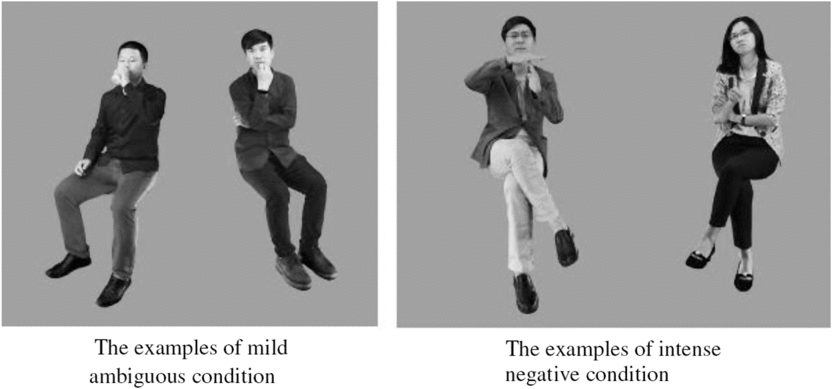
The virtual reality environment was a public speaking scenario in a conference room with six audience members. The entire scenario was created by Adai Technology Co., Ltd. Participants were asked to make a 3-minute speech on one of the given topics, including a self-introduction, the most memorable trip, a funny thing and a fable story. Participants were asked to choose a different topic during each exposure trial. We designed mild ambiguous and intense negative feedback exposure conditions for all participants. In the mild ambiguous condition, audience members would react by randomly nodding, looking at the speaker, drinking water, and folding their arms. In the intense negative feedback condition, the audience would exhibit both mild ambiguous reactions and intense negative reactions with the same probability. The intense negative reactions included looking at a cell phone, taking pictures, shaking one’s head, and making a stop sign with their hands (examples of social feedback behaviours are shown in Fig. 1). Forty-five undergraduate students who were blind to the study’s purpose rated the figures of the illustrating sample of social feedback behaviours on a scale ranging from 1 (it did not make me anxious at all if the audience showed this behaviour) to 5 (very anxious). The results showed that the behaviours of the mild ambiguous condition (mean = 1.90 ± 0.38) caused less anxiety than those of the intense negative feedback condition (mean = 2.80 ± 0.53), t (17) = −4.27, p = .001, d = 1.95.
Examples of social feedback behaviours.

The behaviours were displayed randomly by six virtual audience members during each 3-minute exposure trial, and each behaviour lasted 3–5 s. Participants were allowed to stop the exposure training if they found it unbearable. However, no participants left the exposure training in the present study.
All participants were exposed to a virtual reality environment using a VR helmet (Adai-OTO-VR1-T1). The HMD has a 2560×1440-pixel resolution with a 92-degree field of view and is equipped with a custom-built head-tracker using a triaxial gyroscope, an accelerometer and a compass sensor tracked at a 1 MHz update rate.
Procedure
This research was approved by the ethics committee of Peking University, Department of Psychology. Written consent forms were obtained from all participants. Participants were told that if they felt uncomfortable during the experiment, they could stop at any time. After signing the informed consent form, all participants received a Chinese version of the Mini International Neuropsychiatric Interviews (MINI) (Si et al., Reference Si, Shu, Dang, Su, Chen, Dong and Zhang2009) which was conducted in the laboratory by an experienced psychotherapist with a PhD in clinical psychology. Next, to compare the effects of different types of exposure conditions, the two groups of participants were exposed to the ambiguous and negative feedback conditions. Between exposures, no feedback was provided and the participants were instructed to take a 5-minute rest.
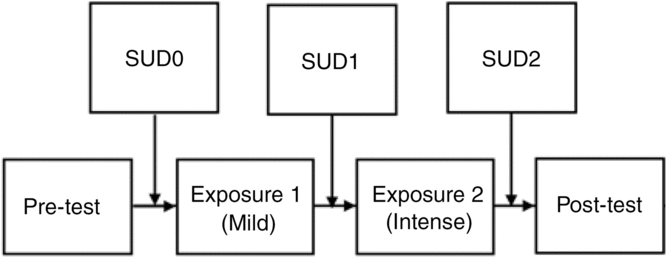
The pre-test and post-test were conducted before and 5 minutes after the VR exposure trials, including the SIAS, SPS, FNE, BDI and PRCS. The simulator sickness questionnaire (Kennedy et al., Reference Kennedy, Lane, Berbaum and Lilienthal1993) and presence questionnaire (Witmer and Singer, Reference Witmer and Singer1998) were measured at post-test. The SUDs were collected at baseline, after the mild ambiguous feedback trial and after the intense negative feedback trial. Heart rates were recorded at baseline and during each exposure trial. The experiment procedure flow chart is presented in Fig. 2.
Procedure flow chart.

After the experiment, the participants who met the criteria for SAD were informed about this status, and it was suggested they seek professional help. We provided information about local psychological health centres and told them that if they felt uncomfortable, we could help them schedule a counselling appointment. A 200-yuan gift card was given to participants following all the procedures as a payment reward.
Results
Presence and simulator sickness
An independent t-test was conducted in order to compare the feeling of presence experienced and unwanted negative side-effects between the social anxiety disorder group (SAG) and the health control group (HCG). The results showed that the two groups had no significant differences in Simulator Sickness Questionnaire scores (SAGmean = 5.08, SAGsd = 4.72; HCGmean = 5.23, HCGsd = 5.31; t (50) = −.110, p = .91, Cohen’s d = −.03) and Presence Questionnaire scores (SAGmean = 112.77, SAGsd = 22.58; HCGmean = 120.23, HCGsd = 25.86; t (50) = −1.110, p = .27, Cohen’s d = −.31).
Comparison of the SAG and HCG on the SUDs
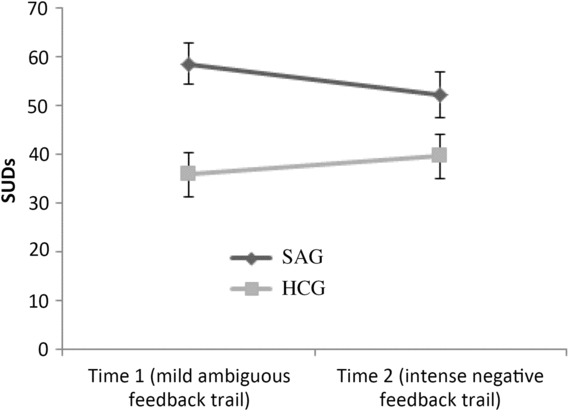
To examine the differences between the SAG and HCG on SUDs during VR-based public speaking exposure, a 2 (condition: ambiguous/negative) × 2 (groups: SAG/HCG) repeated-measures ANCOVA was conducted with the baseline of SUD controlled. The results showed that there was a significant interaction effect, F (1,49) = 7.020, p = .011, partial eta2 = .125. The main group effects were significant, F (1,49) = 4.843, p = .033, partial eta2 = .090. No main effect of condition (F (1,49) = 2.164, p = .148, partial eta2 = .042) was found. Post hoc tests indicated that in the mild ambiguous feedback condition (Time 1), after controlling the baseline of SUD, the SAG participants had higher levels of SUD than the participants of the health control group, F (1,49) = 9.067, p = .004, partial eta2 = .156. No significant differences were found in the intense negative feedback condition (Time 2) between the SAG and the HCG, F (1,49) = 1.207, p = .277, partial eta2 = .024. The results indicated that neither the SAG nor the HCG showed significantly different levels of SUDs between the mild ambiguous and the intense negative conditions (see Fig. 3 and Table 1).
Comparison of the SAG and HCG on SUDs.

Comparison of the SAG and HCG in terms of heart rate
To examine the differences between the SAG and the HCG in terms of heart rate during a VR-based public speaking exposure, a 2 (condition: ambiguous/negative) × 2 (groups: SAG/HCG) repeated-measures ANCOVA was conducted controlling for the baseline of heart rate. The results showed that the interaction effects were not significant, F (1,49) = 2.707, p = .106, partial eta2 = .025. No main effects of group (F (1,49)= 1.880, p = .177, partial eta2 = .037) or condition (F (1,49) = 2.203, p = .144, partial eta2 = .043) were found.
Comparison of the SAG and the HCG in terms of outcomes at post-test
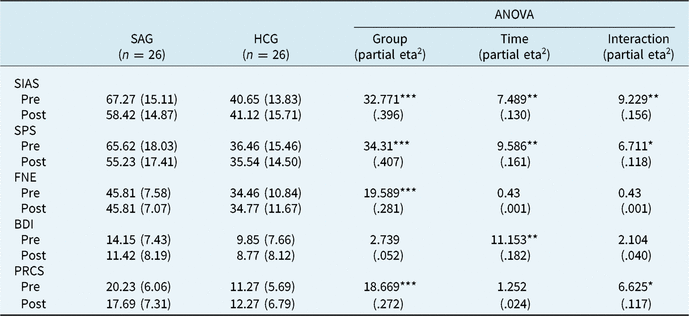
Repeated measurement analyses revealed statistically significant effects of time and group interaction on the SIAS, SPS and PRCS scores. Regarding the main effects, the results showed significant effects of the condition across all outcome measures except for the BDI and significant effects of time on the SIAS, SPS and BDI. Planned contrasts revealed significantly decreased SIAS scores (t (50) = 3.038, p = .004, Cohen’s d = .84), SPS scores (t (50) = 2.591, p = .013, Cohen’s d = .72) and PRCS (t (50) = 2.574, p = .013, Cohen’s d = .71) in the SAG compared with the HCG. There are no interaction effects or main effects of time on FNE. Outcomes are shown in Table 2.
Discussion
The present study showed that, in general, participants in the social anxiety disorder group had higher levels of anxiety than the healthy control group in a virtual public speaking environment. This finding is consistent with previous studies (Kim et al., Reference Kim, Hong, Kim, Jung, Kyeong and Kim2017; Owens and Beidel, Reference Owens and Beidel2015; Pan et al., Reference Pan, Gillies, Barker, Clark and Slater2012; Parrish et al., Reference Parrish, Oxhandler, Duron, Swank and Bordnick2016), wherein researchers found that participants with social anxiety disorders tended to respond to virtual social scenarios with higher levels of anxiety – similar to how they respond to real social scenarios. This finding makes it possible for virtual reality to be used as a treatment tool to reduce social anxiety.
Social-threat feedback plays a critical role in virtual reality exposure therapy for SAD. Almost all VR-based interventions included the manipulation of the virtual audiences’ feedback when the patients themselves were performing (Anderson et al., Reference Anderson, Price, Edwards, Obasaju, Schmertz, Zimand and Calamaras2013; James et al., Reference James, Lin, Steed, Swapp and Slater2003; Kampmann et al., Reference Kampmann, Emmelkamp, Hartanto, Brinkman, Zijlstra and Morina2016a; Robillard et al., Reference Robillard, Bouchard, Dumoulin, Guitard and Klinger2010). A few studies have examined the direct influences of that feedback (Grillon et al., Reference Grillon, Riquier, Herbelin and Thalmann2006; Pertaub et al., Reference Pertaub, Slater and Barker2002; Schilbach et al., Reference Schilbach, Wohlschlaeger, Kraemer, Newen, Shah, Fink and Vogeley2006). However, the researchers only focused on the feedback’s emotional valence (positive or negative) and did not take into account another important aspect, namely, the ambiguity of social feedback. According to the cognitive model of social anxiety disorder, one feature that distinguishes SAD patients from healthy individuals is that they exhibit a negative interpretation bias towards ambiguous social feedback (Amir et al., Reference Amir, Beard and Bower2005; Constans et al., Reference Constans, Penn, Ihen and Hope1999; Eysenck et al., Reference Eysenck, Mogg, May, Richards and Mathews1991). In other words, while negative social feedback elicits anxiety in all individuals, ambiguous feedback specifically elicits higher levels of anxiety in SAD patients than in the health control group. The present study scrutinized this assumption in a virtual reality environment, and the results are consistent with the cognitive model. Participants with SAD reported higher levels of subjective units of discomfort than those in the health control group in the mild ambiguous feedback condition, but not in the intense negative feedback condition. The results indicated that when the therapist is trying to design the VR exposure therapy, it is necessary not only to consider the valence (e.g. positive or negative) of the virtual stimuli but also other aspects, such as the ambiguity and uncertainty that the patients feel as a result of the stimuli.
In addition, the SAG appears to experience more subjective distress in the mild condition than in the negative condition, while the HCG showed an opposite pattern, although the within-group differences were not significant. The results may imply that an anxious response towards negative social feedback is universal, while the response towards ambiguous social feedback is SAD specific. The decrease in the negative condition for the SAG, although not statistically significant, may be caused by the pairing of ambiguous and negative cues during the negative condition. This pairing may have helped socially anxious participants to resolve ambiguity, and this resolution may have facilitated reductions in subjective distress.
Furthermore, the present study also examined the outcomes in post-treatment for the social anxiety disorder group and the health control group. After only one session of exposure therapy, significant decreases in the SIAS, SPS and PRCS scores were found in the social anxiety disorder group. This result supports VR’s utility as a tool for conducting exposure therapy and is consistent with previous studies (Anderson et al., Reference Anderson, Price, Edwards, Obasaju, Schmertz, Zimand and Calamaras2013; James et al., Reference James, Lin, Steed, Swapp and Slater2003; Kampmann et al., Reference Kampmann, Emmelkamp, Hartanto, Brinkman, Zijlstra and Morina2016a; Robillard et al., Reference Robillard, Bouchard, Dumoulin, Guitard and Klinger2010). The present study found no significant changes in the Fear of Negative Evaluation Scale (FNE). This finding may be related to the fact that, compared with other scales such as the SIAS, SPS or PRCS, the FNE evaluated the changes at the cognition level, not merely general distress or feelings. As cognition refers to one’s persistent way of perceiving things, one session of exposure therapy might not be enough to bring about changes at this level.
As for clinical implications, our results indicate that ambiguous social feedback should be included as a new type of social threat stimulus in VRET for SAD individuals. Since ambiguous feedback often elicits strongly anxious responses in SAD patients, the present study may help clinicians in planning more specific VRET intervention. In addition, adding ambiguous feedback will also make the virtual environment richer, enhance the ecological validity and increase a sense of presence.
The present study was also limited in some respects. First, the present study found no differences in physiological arousal among participants, which is inconsistent with the results of subjective reports. This finding may be related to the relatively small sample and large individual differences in terms of heart rate among participants. Further research using a larger sample is needed. Another limitation is that the virtual social feedback was randomly displayed during the exposure trial in the present study. Therefore, the virtual audiences’ feedback was not relevant to the participants’ real performance. This finding may reduce the sense of presence – a critical factor that influences the effectiveness of VRET (Ling et al., Reference Ling, Nefs, Morina, Heynderickx and Brinkman2014). Although none of the participants reported that they found feedback weird or unnatural, in the future it would be better to let the virtual audiences provide feedback on participants’ performance. The third limitation is the fact that no ratings on symptom measurements in between the two exposure tasks were collected in the present study. To further test the importance of ambiguous feedback for VRET, it would be worthwhile to examine the effects of each particular exposure in the future. The fourth limitation is that we are not able to completely rule out the order effects, as all participants completed the two feedback tasks in the same order. However, we found that the HCG showed no decrease regarding subjective distress in the second task, suggesting that the opposite pattern between the SAG and the HCG was not completely disguised by effects of task order. Studies with a randomly assigned order are needed in order to further investigate this issue.
Means and standard deviations of self-reported anxiety and heart rate for social anxiety disorder group and health control group

Outcomes in post-treatment for social anxiety disorder group and health control group

SAG, social anxiety disorder group; HCG, health control group; SIAS, Social Interaction Anxiety Scale; SPS, Social Phobia Scale; FNE, Fear of Negative Evaluation Scale; BDI, Beck Depression Inventory; PRCS, Personal Report of Confidence as a Speaker. *p < .05, **p < .01, ***p < .001.
Author ORCID
Xinfang Ding 0000-0002-7327-178X
Acknowledgements
We thank Dai Li, Yi Man, Zhiyong Peng, Simin Guo and Guodong Hao for their support in conducting this research.
Conflicts of interest
The authors have no conflicts of interest with respect to this publication.
Financial support
This study was supported by Capital Medical University (Xinfang Ding, grant number 2017SK05) and the Fundamental Research Funds for the Central Universities (Tomoko Kishimoto, grant number 63182070).
Ethical statement
This study was carried out in accordance with The Code of Ethics of the World Medical Association for experiments involving humans and was approved by the ethics board (reference number 20151020-4-H4).




Comments
No Comments have been published for this article.