

3. How should pain in farm animals be assessed?
To avoid pain, it is essential to identify and if possible to quantify it. In most cases humans can describe and assess their own pain and communicate about it with others. In the absence of verbal or written communication (in babies or non-verbal disabled people, for example), this self-assessment of pain is not possible and it is necessary to resort to behavioural or physiological criteria (hetero-evaluation). In animals, self-assessment is obviously not possible and the problem of evaluating pain is very complex. Numerous scientific reviews and guidelines on the assessment of pain have been published.
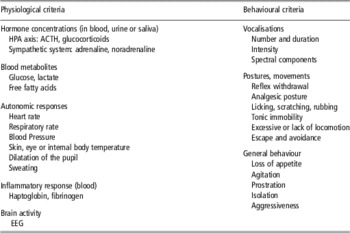
The discomfort of pain has a high biological value since it favours survival. It warns that tissue damage is taking place, is about to take place or has already occurred, enabling the individual to react in a manner to stop, prevent or reduce the damage that could endanger its health or survival. Most of the criteria for pain assessment correspond with physiological or behavioural changes, the function of which is precisely to stop the cause and/or reduce the effects of noxious stimuli that threaten the physical integrity of the individual (Table 1). These modifications can also be found in states of stress, anxiety or discomfort that do not necessarily involve a nociceptive component, so it is very difficult to identify criteria that indicate specifically the presence of pain. In addition, these alterations can be the cause of reduced animal performance. An approach based on tissue damage can be added to the physiological and behavioural assessment of pain. When tissue damage is identified it can be assumed that there are painful consequences.
Physiological and behavioural parameters that may be modified by pain in mammals (adapted from Mellor, 2000 and Prunier et al., 2002Footnote a)

HPA = hypothalamic–pituitary–adrenal axis; EEG = electroencephalogram.
a Mellor DJ, Cook CJ and Stafford KJ 2000. Quantifying some responses to pain as a stressor. In The Biology of Animal Stress: Basic Principles and Implications for Welfare. (ed. GP Moberg and JA Mench), 171–198. CAB International, Wallingford. Prunier A, Hay M and Servière J 2002. Evaluation et prévention de la douleur induite par les interventions de convenance chez le porcelet. Journées de la Recherche Porcine 34, 257–268
To identify and measure animal pain, one can rely on the monitoring of physiological parameters, observation of behavioural changes, clinical assessment of tissue damage, or reductions in animal performance. It must be borne in mind though that it is not possible to obtain a ‘pain score’ from a simple chemical or electro-physiological test and it is necessary to combine several types of criteria. In this assessment, the criteria for evaluating pain are described for each target species, first in ruminants (mainly cattle and sheep) and in pigs, and then in birds and fish. Although it is generally accepted that mammals and birds can feel pain it is clear that there is not the same degree of complexity in the emotional component of pain in all of the species studied. This emotional component implies that the animal is conscious, therefore it is accepted that pain is not felt under general anaesthesia. In fish, we refer to nociception, as the existence of pain in this class of vertebrates is controversial. However, in a following article the authors chose to refer to pain even for fish (Prunier et al., Reference Prunier, Mounier, Le Neindre, Leterrier, Morméde, Paulmier, Prunet, Terlouw and Guatteo2013). Very often, the criteria for assessing pain were defined in situations where pain was induced during common farm practices like, for example, castration in males. These farm interventions and the justification for them are not described in this article but are dealt with in article entitled, Sources of known and/or potential pain in farm animals.
In the particular context of slaughter, where pain is potentially acute and intense and where animals are usually stunned before bleeding/exsanguination, the approach to pain assessment differs according to the stage in the whole slaughter process. Before slaughter, it is essential to identify the situations that may cause pain (e.g. fights between animals, use of electric goads by the abattoir staff). During slaughter the stunning phase is distinguished from the bleeding phase and the assessment of pain is focused on the animal's level of consciousness, being the determining factor in its ability to feel pain, and behaviour, which allows the identification of possible signs of pain. After slaughter the carcass can be checked for the presence of lesions and injuries that may have been source of pain before death.
3.1. Measures based on tissue damage
Clinical examination of animals, necropsy or histopathological analysis can reveal tissue damage that may cause pain. Fractures, skin lesions, abscesses, inflammation and neuromas are likely to cause pain in mammals and birds, or nociception in fish.
In pigs and ruminants
In mammals in general, tissue innervations and pain mechanisms are similar to those observed in humans. Injuries and lesions that cause pain in humans are hence considered to have the same effects on non-human mammals.
Histopathological analysis was used to assess the long-term effects of teeth clipping and tail docking in pigs. Histological comparison of tooth sections at different ages shows many anomalies when the teeth are cut the day after birth: pulp cavity decay, dentine fracture, bleeding, pulpitis, abscesses and necrosis (see pages 319–332). This approach also was used to determine whether tail docking induces the development of scar neuromas (uncontrolled proliferation of glial cells or axons) known to cause painful phenomena in humans. In pigs, such cellular changes have been observed in histological sections of tail stumps, but their painful nature has not been demonstrated by other means (see pages 319–332).
A much more classic approach is to record injuries, bruises, abscesses and, in extreme cases, fractures. The number and severity of skin or hoof lesions/injuries are among the most frequently used criteria for all species, in addition to tail injuries specifically for pigs. Skin lesions are common when unfamiliar pigs are gathered in a pen/yard and tail biting reflects a form of cannibalism. Assessing the number and the seriousness of such lesions constitutes a measure for scoring the animal welfare status as determined by the Welfare Quality® programmeFootnote 1.
In birds
Pathological studies have been conducted in different contexts to cast light on the painful aspect of tissue damage in farmed species. This has been undertaken in studies on beak trimming, which consists of cutting off or otherwise removing the tip of the beak usually before 7 days of age. Examination of birds that have undergone late beak trimming reveals the formation of neuromas which are potentially painful (see pages 319–332).
Evaluation of the plumage condition and the wounds caused by pecking, common in a range of species, provides an indirect assessment of the seriousness of this abnormal behaviour. In a similar way, the scores used to measure the pododermatitis in chickens (skin lesions on the underneath of their feet) enable the discrimination between mere inflammation and secondarily infected ulcers. High scores are associated with withdrawal reactions triggered by touch, suggesting painful phenomena. As shown by this example, additional criteria, in particular behavioural responses, can be used to diagnose the painful nature of a lesion or injury.
In fish
Several types of tissue damage are found in farmed fish. The most frequently described are fin or skin erosion, and injuries to the eyes. Such tissue damage has multiple causes (infections, environmental factors, food, etc.) and affects the health of the animals concerned.
At slaughter
It is difficult to conduct routine reports on animal pain in slaughterhouses given the work constraints. In most cases, the measurements are performed postmortem on carcasses. The measures used to assess tissue damage are generally associated with factors that presumably involve intense pain (bruises, broken bones, etc.) arising before or during slaughter. Bruising is mainly due to agonistic interactions between animals (pigs, cattle), sexual behaviour (mounting between bulls) or knocks against the walls of restraining areas and transport trucks. In the case of cattle, sheep and pigs, leg fractures and dislocations occur when animals slip or fall, often due to slippery floors, or lose balance during transport. In poultry, leg and wing fractures or dislocations, as well as intramuscular bleeding, often occur when the animals are loaded onto trucks or shackled by their legs at the slaughterhouse.
Fractured vertebrae may be observed in pigs. This generally occurs during electrical stunning and is therefore only indicative of pain if the pigs were inadequately stunned. In ruminants, evaluation of the impact of the stunning bolt can indicate the degree of stunning achieved and, when there is failure to reach loss of consciousness, give insight into the reasons why (see pages 319–332).
Conclusion
Tissue damage is a key element in the identification of sources of pain in all farm animals. However, complementary observations are required to confirm the assessment of the wounds and lesions as having a painful or nociceptive nature, which often proves to be a difficult task.
3.2. Physiological responses
A painful stimulus activates structures of the nervous system directly involved in the perception of pain and emotion. This activation also triggers the pituitary-adrenal axis and sympathetic nervous system, which has numerous effects on the body (e.g. acceleration of heart rate and respiration rate, increase in body temperature, etc.), and on behaviours (Table 1). However, handling the animals or environmental disturbances (noise, general activity, etc.) can induce the same physiological phenomena in the absence of pain. Measurements of the activation of these systems must be conducted under perfectly controlled conditions so that the effects due to pain are not confounded with those caused by stress, environmental factors or by the procedure itself (e.g. stress due to restraining techniques or to the insertion of the needle during blood sampling). Behavioural or clinical observations must complement these physiological measurements to ensure correct interpretation.
In ruminants and pigs
Many studies have reported an increase in blood cortisol levels after a painful procedure in pigs (castration), calves (castration, dehorning) and lambs (castration, tail docking). The use of local or epidural anaesthesia reduces the amplitude and the duration of the peak of cortisol after surgery demonstrating the role of pain in the activation of the hypothalamic–pituitary–adrenal (HPA) axis. Several other experiments have also shown that the use of non-steroidal anti-inflammatory drugs (analgesics) before surgery can limit the increase in plasma cortisol after castration (calves) or after tail docking (lambs).
Measuring plasma ACTH concentration can also help evaluating the activation of the HPA axis even if it is used much less frequently than cortisol. ACTH increases very quickly and sharply after castration in pigs. ACTH levels give a more sensitive measure than cortisol levels after painful procedures but the concentrations are also more easily affected by the stress associated with handling or by environmental factors (i.e. lack of specificity).
To evaluate the response of the sympathetic system within minutes or hours after an intervention on an animal the blood concentrations of the catecholamines adrenaline and noradrenaline can be measured directly. It is also possible to measure the concentrations of the catecholamines or their metabolites in the urine to study changes over several hours or days. Several other measures can also be used to assess indirectly the activation of the sympathetic system since this system has many effects on the body. For example, respiratory rate, heart rate variability, pupil diameter, surface resistivity of the skin, blood pressure, body or eye temperatures, and plasma concentrations of several metabolites (glucose, lactate and free fatty acids) can be measured. It should be noted that some changes, such as heart rate variability, actually result from a change in the balance between the tonus of the sympathetic system and that of the parasympathetic system. In general, the sympathetic system is very sensitive to the effects of noxious stimuli and the response times are very brief, but it is also very sensitive to animal manipulation and environmental disturbances. One should therefore be even more cautious in interpreting these results than for the HPA axis. Nonetheless, some results clearly show increases in plasma catecholamines and/or lactate as well as heart rate, or a transient decrease in eye temperature after castration or dehorning and there is evidence that local anaesthesia may reduce or even eliminate the changes observed.
Other biological markers reflecting the activation of structures of the nervous system involved either in the detection and perception of pain or in the control of pain can be added to those described above. They include the expression of early gene activation such as for the c-fos gene in the dorsal horn of the spinal cord after castration in pigs. In response to pain the body releases endogenous opioids such as endorphins and enkephalins. Hence these can also be used as indicators of pain, as they have been for horses. Lastly, noxious stimuli modify the electrical activity of the brain. Graphical recordings (electroencephalograms (EEG)) obtained via electrodes placed on the skull can be used to analyse the changes in electrical potential that take place at the level of the cortex. The brain electrical activity is classified into four categories of wave frequencies: δ (<4 Hz), θ (4 to 7 Hz), α (8 to 13 Hz) and β (>13 Hz). In adult humans, α and β waves are characteristic of a state of wakefulness and δ waves are characteristic of sleep. β waves become more abundant under anaesthesia induced by pharmacological agents. Using this method, it has been possible to show in piglets anaesthetised with halothane (an anaesthetic gas that has no analgesic properties) that α and θ waves were less abundant in the minutes following surgical castration and that this effect was largely lost if the animals received local anaesthesia with lidocaine beforehand. Similar effects were observed after dehorning in calves.
In the same way that the approach based on tissue damage can reveal the origins of pain, detection of proteins during the acute inflammatory stage is an indirect indicator of pain since it reveals tissue inflammation and it is known that inflammation usually causes pain. The measurement of serum concentrations of certain proteins (haptoglobin, fibrinogen, ceruloplasmin, amyloid A serum) may be very useful for detecting subclinical inflammation.
In birds
The main physiological variables used as indirect criteria for the assessment of pain are cardiovascular changes, plasma corticosterone concentrations and EEG activity.
In most cases, exposure to an acute nociceptive stimulus triggers heart rate acceleration in birds. However, no work on heart rate variability during a painful episode has ever been published for poultry. Blood pressure increases after activation of the sympathetic system. This parameter, however, has very rarely been studied in birds because of technical difficulties in recording it without restraining the animals. Changes in the EEG does not seem relevant at the moment because the data available so far have shown similar changes in birds that were subjected to either a fearful situation (tonic immobility during a frightening situation) or to a noxious stimulus (pulling out feathers).
In fish
Most studies published so far deal with physiological responses of farmed fish exposed to stressful situations (endocrinological variables such as corticosteroids, or indirect criteria such as respiratory or cardio-vascular changes) and none of them addresses specifically the consequences of a noxious stimulus. It is known that applying a noxious stimulus alters the movement frequency of the gill plate which is an indirect indicator of gill ventilation and therefore of increased breathing rate. Further studies, including the response of the HPA axis to a noxious stimulus, would be very useful.
At slaughter
Most studies on the effectiveness of stunning and/or bleeding rely on measures reflecting the level of consciousness or the brain's ability to perceive stimuli from the environment. EEG analyses are also used to measure the brain activity, to characterise its responses to sensory stimuli, or understand the way the brain maintains reflex responses or vital functions in animals.
EEG analysis focuses on the type and intensity of the rhythmic electrical activity of the brain. The presence of δ waves, characteristic of sleep patterns in humans, suggests a reduced level of consciousness. A flat or nearly flat EEG indicates a state of deep anaesthesia, and ultimately brain death. Evoked potentials (EP) correspond to transient changes in the EEG when the animal is subjected to auditory, visual or somato-sensory stimuli. To identify the level of consciousness of an animal at slaughter, some authors refer to the presence of δ waves, others to a significant and sustained reduced brain activity, or to the impairment of EP. Some combine several criteria. In some cases, the different criteria may lead to divergent conclusions. This is partly due to the circumstances in slaughterhouses that make measurement very challenging: EEG recordings may show artefacts because of the difficulty in maintaining the electrodes in place and/or the existence of electrical interference. Furthermore, it should be kept in mind that although impairment of EP clearly indicates a loss in the brain's ability to integrate sensory information, the presence of EP only means that the integrity of the sensory pathways involved has been preserved but not necessarily the perception of stimuli and awareness.
The effectiveness of stunning can be assessed by other methods based on the measurement of blood pressure, the observation of postures (animal collapsing or not) and various reflexes (palpebral-ocular or respiratory reflexes, physical reactions to noxious stimulation, and righting reflex of the head or of the body). However, vestibulo-ocular and respiratory reflexes depend on the activity of the brainstem that may persist despite a state of unconsciousness. Therefore, a lack of reflexes indicates that the activity of the brain stem is profoundly disturbed and that the animal is unconscious while their presence does not necessarily mean that the animal is conscious.
Conclusion
Examining physiological criteria renders the identification of pain possible in many animals. The means are often invasive and are generally based on complex methodology. The results may be difficult to interpret since stressful situations void of any nociceptive component often lead to similar physiological changes. Hence, the experimental conditions required to ensure accurate identification of the presence of pain using physiological criteria render this tool impractical for use in situ on farms or in slaughterhouses. Physiological criteria remain nevertheless very useful, especially in mammals, for the identification of sources of pain and in the development and validation of protocols for pain management and of objective scoring systems for pain assessment.
3.3. Behavioural responses
Behaviour in animals and in humans denied of verbal or written communication may constitute valuable criteria for identifying and locating pain (Table 1). However, as is the case for other criteria, using behaviour as a tool has its limitations. The first one is the variability in behavioural expressions both between animal species and within each species, according to the context. Another limiting factor is that the interpretation of behaviours by the observers, whether breeders or veterinary surgeons, differs according to their knowledge of the behaviour of the species, of the individuals and their personal perception of pain. Some behaviours such as apathy, self isolation or anorexia may also be seen in situations of stress or discomfort without nociceptive components. In addition, the behavioural response to a noxious stimulation may vary over time, or be expressed differently by individuals of the same species or breed. Behavioural responses may be modulated by endogenous analgesic mechanisms that are triggered in response to pain. They may also be influenced by specific physiological states such as pregnancy and parturition in mammals or egg laying in birds. One must therefore remain cautious in the interpretation of behaviour even when it may be very evocative of pain.
Despite the limits mentioned above, observation of behavioural responses (vocalisations, activities and postures, facial expressions) is one of the methods most frequently used by scientists and veterinary practitioners to characterise animal pain. This method has significant advantages because it is generally non-invasive and is fairly sensitive. Methodological precautions must be taken in order to avoid problems of interpretation and to validate the criteria used. First an ethogram should be established to characterise the behavioural repertoire of the species and to define the conditions of expression of each relevant activity, its function, and the ontogenetic and phylogenetic changes.
Several behaviours can be distinguished: automatic behaviours to escape from the noxious stimulus (reflex withdrawal of a limb); behaviours to avoid the stimulation of the painful area (resting, analgesic postures such as limping); behaviours intended to signal the existence of pain to conspecifics and to encourage them to either avoid stimulating the painful area, or to lick, rub or scratch the area to relieve pain (this behaviour probably masks nociception through other sensory signals); behaviours that facilitate learning and thereby help the animal avoid subsequent noxious stimulation. It is important to conduct observations on animals subjected to a painful procedure, in association with an anaesthetic or analgesic treatment for some and without for others, in order to ensure that the criteria used do indeed reflect pain, and not just a stress response resulting from interactions with the operator.
In cattle and sheep, pain induced by numerous husbandry procedures has been analysed using this method. Most of the behavioural criteria chosen as indices have been validated by cross-comparison between responses and by comparing the responses of animals that were subjected to an intervention to those that did not, either in addition to receiving or not receiving an analgesic treatment for each group. This method has been partly validated for pigs and for birds for some painful situations, but hardly at all for fish exposed to nociceptive stimuli.
In ruminants and pigs
Behaviours to be taken into account are well described for a number of painful procedures (tail docking, castration and dehorning) according to the stages of the procedure and the techniques used (see pages 319–332 for details of these procedures). Some studies have compared different behavioural criteria for sensitivity (ability to identify a painful situation) and reproducibility of measurements. Comparisons with physiological criteria have also been conducted to estimate their sensitivity.
Vocalisations are frequently used as indicators of pain in mammals and several types of analyses can be undertaken. The number of vocalisations can simply be counted or the duration or intensity can be measured. The vocalisations can also be analysed by spectral analysis. Experiments during castration in pigs have shown an increase in the number and intensity of vocalisations, as well as changes in their spectral characteristics. All of these changes may be reduced or eliminated by local anaesthesia.
Reflex withdrawal responses are frequently observed in animals subjected to a noxious stimulation. These behaviours are used to measure the response to a controlled noxious stimulus in cattle or sheep. The measures include, for example, the latency to leg withdrawal or kicking when a limited area of the leg, shoulder or rump is subjected to a painful stimulus. Laser beams heating specific parts of the leg have thus been used to characterise the reaction of cattle to pain in certain contexts.
Defensive behaviours during painful procedures are also very common. Movements of legs and of the body during castration or teeth clipping in young piglets, jumping or kicking during hot-iron or liquid nitrogen branding in cattle are typical examples. During branding, the animals also push much more strongly onto the sides of their restraining cage than in simulated situations. Defensive behaviours (kicking for example) can also be observed when touching a painful area.
Certain other behaviours that are directly linked to a painful area are relatively easy to interpret. This is the case, for example, for licking, rubbing or scratching which may reduce the intensity of the nociceptive signals (see above). Avoidance behaviours and analgesic postures are observed in complement to behaviours stimulating the painful area. One typical example is limping. Lesions of the leg often lead to a reluctance or inability to bear weight on one or more limbs and to a high score for lameness in cattle. Objective scoring systems are available to quantify the degree of lameness (Table 2). That the scores are directly linked to the level of pain is evidenced by the fact that they are lowered when the animal receives analgesic treatment. Instead of conducting a visual observation of the animal, it is possible to determine the degree of lameness by measuring the weight the animal puts on each leg by using sensors, as it has been demonstrated in cattle for example.
Scoring for lameness in dairy cows (from Thomsen et al. 2008Footnote a)

a Thomsen PT, Munksgaard L and Togersen FA 2008. Evaluation of a lameness scoring system for dairy cows. Journal of Dairy Science 91 (1), 119–126.
b Uneven gait and short strides may be difficult to identify.
General behavioural disturbance such as reduced food intake, reduced mobility, a high level of agitation or, conversely, prostration, as well as changes in behaviour towards humans are often described after a painful procedure or during chronic pain, such as that associated with lameness.
In birds
As for mammals, flight or withdrawal reactions are observed when a painful area is stimulated. Defensive behaviours during painful procedures are also very common.
Vocalisations may be used to reveal the existence of pain in birds as in mammals. The calls emitted when an individual is being pecked by other birds are however described as being only moderately loud, softer than the distress calls emitted during capture. However, methods as elaborate as those used to characterise pig vocalisations during castration are not available for use with birds.
Birds inhibit some spontaneous movements and postures to avoid stimulating specific painful areas. As an illustration, late beak trimming of chickens and turkeys reduces pecking. Removing the end of the beak may temporarily reduce food intake, drinking and pruning. As in mammals, lameness is sometimes observed, with birds adopting a posture that allows them to avoid stimulating a painful area of a leg. In comparison to healthy animals, lame chickens spend less time walking, feed less frequently and are more often seen lying when they eat. The time spent lying or standing on one leg decreases after an analgesic treatment and the effect on behaviour is dose dependent.
It seems that after a while chickens that cannot escape from painful stimuli cease to show defensive or avoidance reactions. Feather-pecked chickens, for example, eventually adopt a lying posture with the head drawn into the body.
In fish
In very few studies has the relationship between behaviour and nociception in fish been analysed. In the studies that have been conducted, behavioural responses were not measured in a systematic and standardised manner. However, the results indicate that some fish are able to learn to avoid noxious stimuli. In studies on trout that were submitted to a noxious stimulus (subcutaneous injection of acetic acid) the fish displayed avoidance behaviour, stopped ingesting food and expressed behavioural changes, such as rubbing the injected area and body swaying. These behavioural changes could last for several hours but were diminished when an analgesic treatment (morphine) was given which shows that they were the direct consequence of the injection of acetic acid.
At slaughter
Numerous studies describe aggressive interactions (pigs, cattle), mounting behaviour (bulls), slipping and falling (all species) as possible sources of pain. Behavioural indicators (drooping posture, avoidance reactions, for example) can also be used to assess the level of consciousness.
Conclusion
Behavioural responses are very sensitive criteria for detecting pain and are suitable for observations on farm or in slaughterhouses. However, methodological precautions are required and the conditions of observation of the species as well as the animal's physiological state and experience must be taken into account in the interpretation. Observers should be sufficiently trained to identify and interpret the behavioural indicators of pain correctly.
3.4. Criteria related to livestock productivity
Pain may have detrimental effects on some behaviours, like feeding, and may stimulate the release of stress hormones that affect metabolism, immunity and reproductive function. A decrease in livestock productivity can be expected which is the case for growth rate (average daily weight gain), milk production, egg production and feed conversion ratio. However, as opposed to the behavioural and physiological impairments, these changes do not take place immediately. They appear at a later stage if the impairments persist for a length of time. They can still be useful criteria for alerting farmers, particularly when it is not possible to observe all animals individually. In addition, animal mortality can be used as an on-farm indicator of pain as it is likely that death is preceded by painful phenomena.
In pigs and ruminants
Assessing the direct impact of pain on cattle production has been the purpose of only a few studies. The adverse effects of pain are more commonly extracted from work investigating the impact of stress on economic criteria and on agricultural productivity or on health problems in cattle. Some studies do show that the use of local anaesthetics to reduce pain limits the weight loss that usually results from castration.
In cattle, stress has detrimental effects on the reproductive performance of males and females, due to interference with the secretion of sex hormones. In general, musculoskeletal disorders affect the reproductive performance in both sexes as well as milk production in cows, but whether this is due to a lower feed intake, the activation of the HPA axis or inflammatory processes is unknown. The economic impact of other diseases has been quantified in dairy cattle (e.g. mastitis) however, as in the case of lameness, what is attributable to the disease itself cannot be distinguished from what is due to pain. Nevertheless, studies comparing sick animals that either received or did not receive analgesic treatment suggest that pain plays a significant part in the economic loss. There are hardly any studies on beef cattle available.
In pigs, several authors have tried to characterise the impact of teeth clipping, tail docking and castration on the growth of piglets in experimental situations. These interventions do not seem to affect the growth rate, excepting when the intervention penalises the piglet's access to the teats of the highest milk-producing glands of the udder (as was the case in studies on selective teeth clipping where only some piglets in the litter had their teeth cut or in the case of castration performed on males before 3 days of age). Tail biting may cause reduced growth rate, increased morbidity and mortality, and any injured parts of the carcass may be seized at slaughter after inspection and removed from sale. Lameness may be the cause of reduced growth in young pigs, low reproductive performance in mature animals, and premature culling of sows and boars from the piggery.
In birds
In poultry, feather pecking can be a major welfare problem in laying hens since victims of repeated pecking show apathetic behaviour and reduced food intake leading to reduced egg laying. Beak trimming is carried out to alleviate this problem (see pages 319–332). It is known that lameness may result in reduced growth rates or even mortality but overall there is little data on the consequences of pain on animal production. As for mammals, pain is often associated with diseases that may themselves have a direct effect on the performance of the animals, in which case it is difficult to identify the part played by pain itself. In addition, because of bird density it is impossible to evaluate individual performances on a poultry farm, which makes the use of criteria based on animal productivity to identify pain difficult when only a small percentage of birds are affected.
In fish
In the only studies in which the negative consequences of exposing farmed fish to stress were investigated, the focus was on animal performance (growth, reproduction, immunity or adaptation). In none of these studies were the effects of noxious stimuli taken into account.
Conclusion
The direct impact of pain on livestock performance has been assessed in very few studies. Criteria based on livestock productivity are of little use in assessing pain and are most often used in addition to other criteria or as warning signals, especially when the observation of individual animals is impossible.
3.5. Multi-parametric scales for assessing pain
The physiological and behavioural responses to pain provide a clinical overview from which pain can be assessed in a reasonably objective manner. The simultaneous observation of several indices evocative of pain is indeed correlated with a higher probability that the animal in fact feels pain.
Furthermore, a multi-parametric approach is recommended in the assessment of pain in animals as it appears that pain intensity is usually proportional to the number and the severity of the indices observed.
Although each individual parameter cannot reflect the level of pain taken on its own, there is an overall relationship between all the clinical signs observed and the level of pain. This global view should enable the assessment of the intensity (low to high), the frequency (occasional to continuous), the duration (acute to chronic) and the type of pain (see classification of pain in article entitled, Pain: definitions, concepts and mechanisms in humans and farm animals). These scales should help in deciding whether or not to treat pain and in what manner, in assessing the effectiveness of a treatment, and monitoring pain over a given period of time.
In pigs and ruminants
There are no real multi-parametric pain scales for these species, but relatively simple scales for assessment are available to help detect locomotor problems, particularly in cattle (Table 2). These are only based on observation of animal postures and gait.
More complex evaluation scales ought to be developed for assessing pain on farm. Criteria based on tissue damage and behaviour could be used on farm for pigs and ruminants. The observations could be made by farmers, veterinary surgeons and technicians even though a training course might be necessary. One could add criteria based on livestock productivity knowing that they are generally less sensitive than behavioural criteria, as well as some basic physiological parameters like changes in respiratory rate. These evaluation scales could be designed using some of the measures that were selected for use in the Welfare Quality® project on the assessment of the welfare of farmed animals, such as those specific to tissue damage and health (lameness, coughing, diarrhoea). Any information gathered in slaughterhouses on carcasses being removed by an inspector because of health problems or cannibalism, should also be included.
In birds
No multi-parametric scales are available in poultry for the identification of pain or the measurement of pain intensity. The only scoring system available is based on observations of walking activity to measure the severity of locomotor abnormalities. Behavioural criteria are very rarely used given the difficulty posed by the huge numbers of animals raised together on poultry farms. In consequence, the assessment criteria could be based on tissue damage and livestock productivity instead.
Existing multi-parametric scales
Multi-parametric scoring systems are only available for rodents, dogs and cats (post-surgery care) and horses. They cannot be extrapolated directly to pigs, ruminants and poultry in on-farm situations but they will be mentioned as examples. These scoring systems have in common a strong emphasis on behavioural parameters. In most cases, the aim is to detect abnormal behaviours induced by pain. However, behaviours are specific to the species, the breed, the individual temperament and the context more than clinical and physiological variables are. In addition, the location and the type of pain, and its source, influence behavioural expression. It is therefore necessary to validate the behaviour displayed in a specific situation for each species and each physiological state.
In France, the most frequently used scoring system in veterinary medicine was developed by the Veterinary Association for Animal Anesthesia and Analgesia for the care of dogs after surgery. It takes into account a global subjective assessment of pain, the general demeanour of the dog, its interactions with the observer, its heart rate and its reaction to manipulation of the operated area.
This type of scoring system reduces the inter-observer variability. A score is assigned for each parameter. The total score provides information on pain intensity and is compared to the classification of the World Health Organisation so that the most appropriate treatment can be given if treatment is deemed necessary. Three levels of pain have been defined in this manner, corresponding to three types of treatments with increasing antalgic properties: NSAIDs (e.g. salicylic acid), weak opioids (e.g. codeine) in combination with NSAIDs, and strong opioids (e.g. butorphanol) given in combination with NSAIDs.
The decision to change from one level of pain treatment to the next is taken after the assessment of the pain experienced by the patient and the pain relief afforded by the existing treatment.
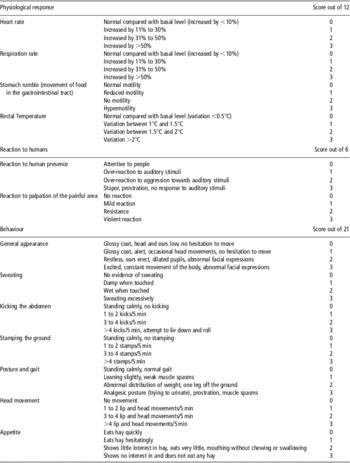
A multi-parametric scale has been developed recently for horses that were subjected to experimental orthopaedic pain (Table 3). This scale was evaluated by comparing animals receiving different types of painkillers. The results suggest that the behavioural responses, including posture and pawing, and the reactions to palpation, are the best criteria because they are reproducible, sensitive and specific.
Pain scoring system used in horses in an experimental situation of orthopaedic pain (from Bussières et al., 2008Footnote a)

a Bussières G, Jacques C, Lainay O, Beauchamp G, Leblond A, Cadoré JL, Desmaizières LM, Cuvelliez SG and Troncy E 2008. Development of a composite orthopaedic pain scale in horses. Research in Veterinary Science 85 (2), 294–306.
Conclusion
Whatever the level of sophistication of the scoring systems, pain can only be assessed correctly if the evaluator has been properly trained and if the scoring system is well adapted to the species and the situation encountered. In other words, the method of evaluation will be different for pain-related lameness in sows, mastitis in dairy cows and feather pecking in broilers. The considerable task of developing and validating scoring systems for assessing pain in farm livestock has yet to be undertaken.
3.6. Summary
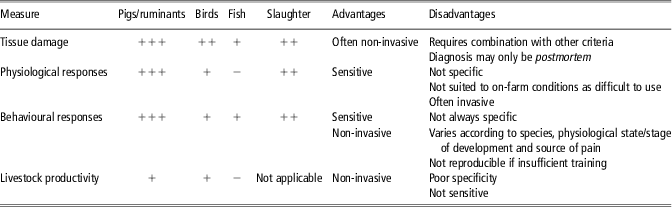
The various types of measures available for assessing pain can be combined to evaluate pain in farm animals as objectively as possible. The criteria for assessment are more or less detailed depending on the species considered (Table 4) with a much wider range of criteria for mammals than for birds, and even less for nociception in fish.
Development status for different types of measures used for assessing pain/nociception in various broad categories of livestock

(+++) numerous studies and measures already in use; (++) some studies; (+) preliminary data available but validation required before use; (−) no studies currently available.
The existing measures, whether they are based on tissue damage, physiological responses, behavioural responses or livestock productivity, are usually not sufficient to make a reliable diagnosis of pain in farm livestock when used individually. The solution therefore lies in the development and validation of multi-parametric scoring systems that are based on the combination of these criteria. Such methods have been developed in other species for post-operative care (dogs, horses) and should be adapted for use with farm animals. This will be challenging as these new scoring systems must be adapted for routine on-farm use within the constraints posed by the rearing conditions.
Given the progress in knowledge of farm animals, the requirements for future research on pain assessment differ according to the species. There is a need for developing and validating multi-parametric scoring systems for ruminants and pigs, identifying and validating criteria to characterise nociception in fish, and for research in all areas for farmed birds. Concerning slaughter, research is needed to clarify the relationship between physiological and behavioural indicators of consciousness, and between these criteria and the absence of pain.