Introduction
Suitably textured hydrophobic surfaces achieve superhydrophobicity, and the fabrication of superhydrophobic surfaces has been extensively studied.[Reference Quéré1–Reference Bird, Dhiman, Kwon and Varanasi6] Such surfaces have been used to improve performance in various applications, including drag reduction,[Reference Bocquet and Lauga4, Reference Srinivasan, Choi, Park, Chhatre, Cohen and McKinley7–Reference Shirtcliffe, McHale, Newton and Zhang10] anti-icing,[Reference Maitra, Tiwari, Antonini, Schoch, Jung, Eberle and Poulikakos11–Reference Jung, Dorrestijn, Raps, Das, Megaridis and Poulikakos18] and dropwise condensation.[Reference Torresin, Tiwari, Del Col and Poulikakos19–Reference Dorrer and Rühe26] In order to be widely applied to actual industrial processes, textured superhydrophobic surfaces have to be robust in harsh environments,[Reference Bocquet and Lauga4] but the robustness of these surfaces remains a challenge. One reason is that many textured superhydrophobic surfaces inevitably rely on hydrophobic modifiers,[Reference Verho, Bower, Andrew, Franssila, Ikkala and Ras27, Reference Liu and Jiang28] most of which are polymers that readily deteriorate under extreme conditions. Although it has been shown that some superhydrophobic surfaces can be created by directly texturing hydrophobic solids,[Reference Wagterveld, Berendsen, Bouaidat and Jonsmann29–Reference Shirtcliffe, Aqil, Evans, McHale, Newton, Perry and Roach31] the state-of-the-art hydrophobic solids are also limited to polymeric materials.[Reference Bocquet and Lauga4, Reference Liu and Jiang28] Common durable materials, such as metals and ceramics, are generally hydrophilic,[Reference Liu and Jiang28, Reference Drzymala32] and they can be rendered hydrophobic using polymeric modifiers.
Recently, we have shown that the class of ceramics comprising the entire rare-earth oxide (REO) series is hydrophobic and have demonstrated their robustness under various harsh conditions.[Reference Azimi, Dhiman, Kwon, Paxson and Varanasi33, Reference Tian and Jiang34] We explain that the hydrophobicity of REOs arises from the unique electronic structure of the metal atoms where the unfilled 4f orbitals are shielded from interactions with the surrounding environment by the full octet of electrons in the 5s 2p 6 outer shell. This shielding effect minimizes polar interactions, inhibits hydrogen bonding with interfacial water molecules and renders them hydrophobic. Although few other studies have also reported high contact angles of ceria and other REOs, the mechanism behind the hydrophobicity of REOs was not explained.[Reference Martínez, Román, de Segovia, Poupard, Creus and Pedraza35–Reference Gentleman, Ruud, Blohm and Manoharan38] We showed that REOs sustain their intrinsic hydrophobicity after exposure to harsh environments, such as high temperature, abrasive wear, and steam.[Reference Azimi, Dhiman, Kwon, Paxson and Varanasi33] Therefore, these ceramics can be used to fabricate durable superhydrophobic surfaces by incorporating proper micro and nanoscale surface textures. One possible method is to deposit a thin layer of hydrophobic REO ceramics onto conventionally made micro and nanoscale hierarchical textures.[Reference Azimi, Dhiman, Kwon, Paxson and Varanasi33] Another way is to directly texture the hydrophobic ceramic bodies, although this method can be difficult due to brittleness and hard nature of ceramics. Laser machining, which overcomes the difficulties of machining brittle and hard ceramics, is a promising way to create micro and nanoscale surface textures on ceramics.[Reference Wang, Shephard, Dear and Hand39–Reference Kietzig, Hatzikiriakos and Englezos41]
In this work, we fabricate a superhydrophobic surface by directly texturing a cerium oxide (ceria) ceramic pellet using laser ablation. Since the bulk of the ceria pellet is hydrophobic, creating micro/nano hierarchical textures on it results in superhydrophobicity and enables the further enhancement of water repellency from single scale textures. Here, we used a simple laser ablation process with a nano-second Nd:YAG laser and we irradiated the surface of the ceria pellet multiple times using 100 ns pulsed-laser irradiations. We show with water contact angle measurements that the textured ceria is superhydrophobic. We demonstrate its water repellency by showing that an impinging water droplet completely bounces off the surface. Examining the X-ray photoelectron spectroscopy (XPS) data confirms that the surface chemistry remains unchanged after the laser irradiation, as previously has been reported for different ceramics.[Reference Kim, Sohn and Jeong42]
Experimental section
Fabrication of ceria pellet
The ceria pellet was fabricated from raw powders of ceria (<5 µm, 99.9% from Sigma Aldrich) in the as-received conditions. The powders were dry-pressed using a cylindrical steel press mold (Carver 4533 press) into disc-shaped pellets (28.5 mm in diameter and ~2 mm thick) first under a pressure of 270 MPa for 3 min, followed by a second round of pressing at 350 MPa for 5 min. The green body was then sintered in a dry air environment (Airgas: Al D300: O2 = 20–22%; H2O < 7 ppm) inside a tube furnace (Carbolite CTF 18/300 furnace) at 1560 °C for 4 h. To obtain surface morphology and average grain size data, we performed microstructural characterization of the sintered pellets using scanning electron microscopy (SEM, JSM-6610LV). It was shown that the ceria pellet is densely sintered into a honeycomb structure with an average grain size of 15 ± 5 µm. The relative density of the sintered ceria was measured in water using Archimedes' principle and found to be 99.4% of its theoretical density, i.e., 7.21 g/cm3.
X-ray photoelectron spectroscopy
The XPS characterization was performed using a PHI 5600 ESCA multi-detection system with a base pressure of 1 × 10⁻¹⁰ Torr. The X-ray radiation was the monochromatic Al Kα line (1486.7 eV) and the X-ray spot size and the take-off angle were 0.8 mm and 45°, respectively. The sample was transferred to XPS facility using a portable vacuum transfer vessel to limit contamination of the sample. The survey spectrum of the surface was recorded with pass energy of 187.85 eV and an energy step of 0.8 eV. To obtain a good signal-to-noise ratio, at least four sweeps were performed for all surfaces. Data acquisition and processing were conducted using the AugerScan software (RBD Instruments, Inc.), and a Gaussian function for the fitting process was used. Before analyzing the XPS data, the contribution of Al Kα satellite lines was subtracted and the background was removed by a Shirley routine. The surface compositions were obtained by normalizing the area under the curve using the manufacturer's sensitivity factors.
Results and discussions
The ceria pellet was prepared first by compressing raw powders of ceria, followed by sintering at 1560 °C for 4 h. After sintering, the ceria pellet was polished to a mirror finish to minimize the effect of roughness on contact angle measurements (Fig. 1). After polishing, the sintered pellet had an advancing contact angle of 102 ± 3° [Fig. 1(a)] and a receding angle of 55 ± 3°. We then textured the surface of the ceria pellet with laser irradiation using Nd:YAG laser (1064 nm wavelength, 150 W maximum continuous output, 40 mJ maximum per 150 ns pulse, Electrox) at 20 kHz at 100 ns pulse in the air. Each beam was shot in a square array with the approximate size of 13 µm for the entire pellet, and the same irradiation was repeated 20 times. After the laser ablation process, the pellet was cleaned by rinsing with isopropyl alcohol, followed by ethanol and then acetone and finally extensive rinsing with DI water for 5 min. The cleaned sample was dried by blowing nitrogen gas and kept in a desiccator under vacuum prior to contact angle measurements.
Superhydrophobicity of laser-ablated ceria pellet. (a) Dyed water droplets on a ceria pellet (θ = 102° ± 3°). (b) SEM of ceria surface (average grain size: 15 ± 5 µm). (c) Dyed water droplets on the laser-ablated ceria pellet (θ = 160° ± 5°). (d) SEM of laser-ablated ceria ceramic. The inset shows a high magnification SEM image.

Texturing the ceria pellet reduced the contact angle hysteresis (CAH) and enhanced the mobility of water droplets: the advancing water contact angle was measured as 160 ± 5°, shown in Fig. 1(c), and the receding contact angle was 155 ± 5°. The reduction in CAH from the sintered ceria pellets [Reference Azimi, Dhiman, Kwon, Paxson and Varanasi33] is a result of the micro and nanoscale hierarchical textures that was created by multiple laser irradiations. The SEM images in Fig. 1(d) show the hierarchical textures, self-organized under multiple irradiations of laser beams. The textures consist of 5–15 µm mudcrack-like features, covered with ~50–100 nm protrusions (measured using a field-emission (JEOL 2010 FEG) analytical electron microscope). All of the complicated physical processes, such as melting, evaporation, plasma, resolidification, and redeposition, are responsible for the formation of micro and nanoscale structures.[Reference Wang, Shephard, Dear and Hand39, Reference Samant and Dahotre40, Reference Vorobyev and Guo43, Reference Ben-Yakar, Byer, Harkin, Ashmore, Stone, Shen and Mazur44] The localized laser irradiation melts a small area of the surface, and evaporates some portion of it at the top; and then as the material cools down, the micro and nanoscale structures are formed on the surface. The nano-scale columnar structures are created by different mechanisms, such as recrystallization of the melted surface, and deposition of evaporated material.[Reference Vorobyev and Guo43]
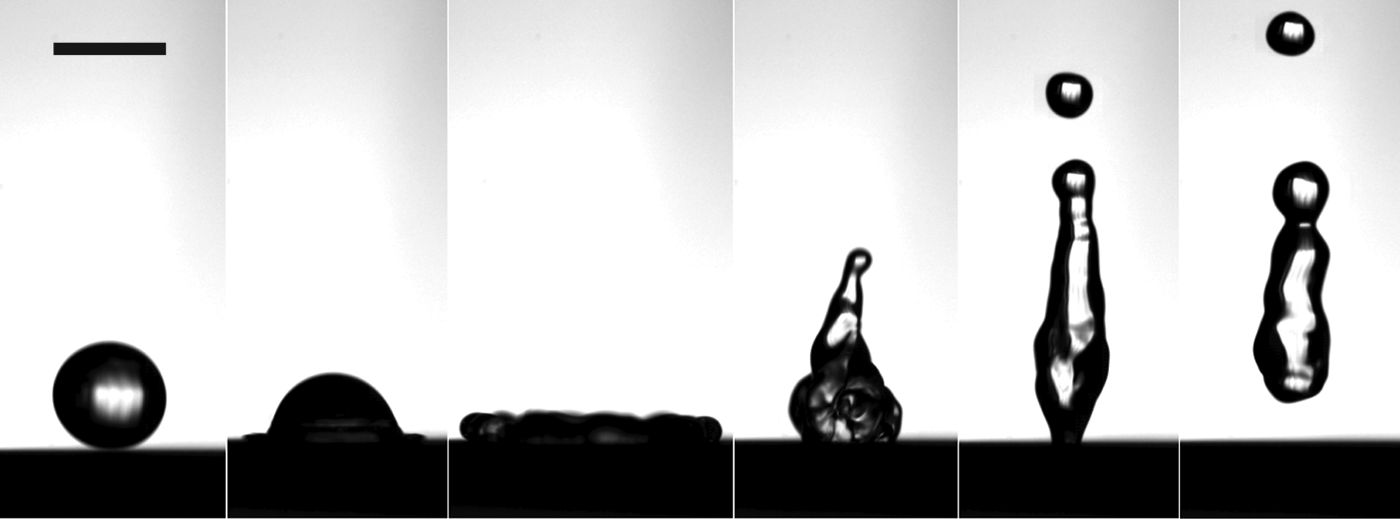
The enhanced water repellency is also shown by a drop impact experiment. A DI water droplet, with a radius of 2.5 mm, impacts the laser-textured ceria substrate with the velocity of 1.5 m/s, corresponding to the Weber number (We) of ~78. The drop impingement was captured by a high-speed camera, and Fig. 2 shows the sequential images of the experiment. As shown in the figure, the textured ceria surface completely repels the impacting droplet.
Water repellency of laser-ablated ceria sintered pellet. High-speed photography images of a water droplet bouncing off of the laser-ablated ceria sintered ceramic (impact velocity ~1.5 m/s); the scale bar is 2.5 mm.
To confirm the chemical composition at the surface after laser ablation, we characterized the surface chemistry by XPS. Figures 3(a) and 3(b) show the XPS spectra of the ceria pellet before and after laser ablation, respectively. XPS analysis found Ce, O, and C at these surfaces. As shown in the spectra, the laser-induced textured surface shows the similar chemical composition at the surface to the original ceria pellet. Before laser irradiation, the pellet consisted of about 30.5% Ce [Fig. 3(a)] and this value remained almost unchanged after laser ablation [Fig. 3(b)]. The atomic percent of O and C before laser ablation was about 60.0 and 9.5%, respectively. After the laser ablation, a small variation in O and C concentrations was observed: the concentration of O at the surface was reduced to 52.2% and C content was increased to about 16.4%. Such small variations can be due to the atmospheric contaminants that could have been introduced during sample handling in the laser ablation process and we expect these variations to not affect the contact angle measurements significantly.[Reference Kurokawa, Odaka, Azuma, Fujimoto and Kojima45, Reference Kim, Tai, Kim, Cho, Bae, Boo, Lee, Yang and Park46] Therefore, the observed superhydrophobicity on the laser-ablated ceria pellet is mainly due to the hierarchical structure that was introduced at the surface of the hydrophobic ceria pellet.
XPS spectra of the ceria pellet: (a) before and (b) after the laser ablation. The spectra verify that the surface chemistry remains unchanged after laser ablation process, and show that carbon contamination is negligible at the surface.
Conclusions
We texture a ceria ceramic pellet, as an example of robust hydrophobic ceramics made of REOs, with laser ablation and obtain a self-organized micro/nano two-length scale hierarchical structure. Since the bulk ceria is hydrophobic, the textured ceramic shows enhanced water repellency without the need for a hydrophobic modifier. The textured ceramic has a high advancing water contact angle, exhibits extreme water mobility due to low CAH (<5°), and repels impinging water droplets. This study extends the possibility of fabricating robust superhydrophobic REO ceramics with the benefit of using easily accessible nano-second laser techniques for industrial applications.[Reference Knowles, Rutterford, Karnakis and Ferguson47]
Acknowledgments
We thank Professor Tonio Buonassisi for the use of the laser equipment. We are grateful for support from MIT Energy Initiative and DARPA Young Faculty Award.