Introduction
Organic production is an increasing sector in US agriculture. To be certified as organic, a farm must follow the United States Department of Agriculture National Organic Program (NOP) guidelines. Conventional agriculture is dependent on synthetic nitrogen (N) fertilizers and herbicides for maximizing crop performanceReference Clark, Horwath, Shennan, Scow, Lantni and Ferris1. The NOP prohibits the use of synthetic herbicides and fertilizers2; therefore, alternative strategies for sufficient nutrient availability as well as for weed, insect and disease control are implemented in organic production.
Worldwide, 450 lupin species have been identified but only four species are used agronomicallyReference Dierauer, Böhler, Kranzler and Zollitsch3. White lupin (Lupinus albus L.) was first introduced into the southeastern USA in the 1930s and the production eclipsed 1 million ha in the early 1950s. Hectarage subsequently declined due to loss of government support, damage to seed nurseries because of mid-autumn freezes in two consecutive years and the increased availability of inorganic fertilizersReference Payne, Chen and Ball4–Reference Noffsinger and van Santen6. White lupin is of increasing interest in the southeastern USA because newly released cultivars exhibit vernalization requirements similar to wheat (Triticum aestivum L.). Winter-type cultivars offer an economic opportunity as an alternative legume cover crop, grain crop or forage. White lupin used in a winter cover crop rotation increased lint yield in cotton (Gossypium hirsutum L.) as compared to traditional rotationsReference Noffsinger and van Santen6. Furthermore, white lupin is attractive as mid-winter forage for ruminants due to a forage quality similar to that of alfalfa (Medicago sativa L.)Reference Noffsinger and van Santen6.
Lupinus spp. are poor weed competitors during early establishment and canopy development is slow. Slow canopy development facilitates light penetration, weed seed germination and subsequent yield loss due to competition. Lupins reach maximum vegetative growth and competitiveness during floweringReference Putnam, Oplinger, Hardman and Doll7. Weeds compete with lupin for water, nutrients and light; therefore, effective weed control, especially during early establishment, is necessary for the crop's successReference Putnam, Oplinger, Hardman and Doll7, Reference Poetsch8.
S-metolachlor, a chloroacetamide, is one of three active ingredients currently registered for use in US lupin production9. This pre-emergence (PRE)-applied herbicide provided good control of annual bluegrass (Poa annua L.), shepherd's purse (Capsella bursa-pastoris L.) and common chickweed (Stellaria media (L.) Vill.)Reference Mitich, Cassman, Larson and Smith10. S-metolachlor has been used for over a decade as a standard weed control program at Auburn UniversityReference Noffsinger11, Reference Noffsinger, Huyghe and van Santen12.
Mechanical and cultural weed control practices are important weed control alternatives in organic production. Hoeing is prohibitively expensive due to labor cost and hence is only used in high-value specialty crops or as supplement to other weed control practices. It is a successful weed control method for weed seedlings and annual/biennial weedsReference Anderson13. Lentil (Lens culinaris Med.) yield was found to be higher in hand-hoed plots than in plots in which herbicides such as linuron and metribuzin were appliedReference Sandhu, Dhingra, Bhandari and Gupta14.
Cover crops play a major role and are beneficial in any farming system such as conservation agriculture and organic farming. Some benefits include: reduction of soil erosion, reduction in pesticide use (herbicides, insecticides and fungicides), improved soil moisture, enhanced soil organic matter and breaking of pest cyclesReference Bowman, Shirley and Cramer15. As a weed management tool, living cover crops are used to out-compete (smother) weeds, whereas desiccated cover crops are used as mulch, and both methods can release allelopathic chemicalsReference Anderson13. Black oats (Avena strigosa Schreb.), a cool-season annual cereal, is a promising, relatively new cover crop in the southern USA and has been used successfully for many years as a cover crop for soybean [Glycine max (L.) Merr.] in BrazilReference Bowman, Shirley and Cramer15. Reasons for the success of this cover crop are its large biomass production and its exceptional allelopathic activityReference Price, Stoll, Bergtold, Arriaga, Balkcom, Kornecki and Raper16. Even though black oat is successfully used as a weed management tool in soybean, cotton shows sensitivity to its allelopathic activity17.
The specific objectives were to determine the effect of organic weed control practices such as cultivation and companion crops on weed control, injury to lupin, lupin density, lupin reproductive maturity and yield.
Materials and Methods
The experiment was conducted at two locations in October 2007 and 2008, respectively: the Alabama Agricultural Experiment Station E.V. Smith Research Center Field Crops Unit (FCU), near Shorter, AL (32.42N, 85.88W) on Compass loamy sand and at the E.V. Smith Research Center Plant Breeding Unit (PBU), near Tallassee, AL (32.49N, 85.89W) on Wickham sandy loam.
The experiment was a randomized complete block design (repeats=4) with a 2 (year)×2 (location)×3 (lupin cultivar)×5 (weed control) factorial treatment arrangement. Blocks were nested within year×location×cultivar combinations. The three lupin cultivars used were AU Homer (a high-alkaloid, indeterminate cover crop type), AU Alpha (a low-alkaloid, indeterminate forage type) and ABL 1082 (low-alkaloid, determinate grain-type experimental cultivar). The weed control factor had five levels: one pre-emergence (PRE)-applied herbicide (S-metolachlor), two mechanical (hand hoed) and two cultural (living mulch utilizing two black oat cultivars) weed control treatments. A non-treated control plot was also present.
Inoculated lupin were seeded in four rows with a John Deere® 1700 four row vacuum planter (Deere and Company, Moline, IL) with a row spacing of 90 cm at a depth of 1.25 cm in October 2007 and 2008. Smooth seed beds were prepared 2 weeks prior to planting in 2007. In 2008, raised beds were prepared with a KMC® four-row ripper/bedder (Kelley Manufacturing Company, Tifton, GA) due to concerns about waterlogging at both locations. The plot length was 6.0 or 7.5 m depending on location and year.
The conventional treatment S-metolachlor was applied at a rate of 1.12 kg a.i. ha−1 (one day after planting) with a compressed CO2 backpack sprayer delivering 140 liters ha−1 at 147 kPa. The cultural control treatments, cv. SoilSaver and As 033 (a selection from PI 436103) black oat (Avena strigosa Schreb.) were hand sown 1 (2007) or 7 days (2008) after seeding of the lupin crop. The mechanical weed control treatments, between-row only cultivations and between and within row cultivation treatments were accomplished twice per year at 4 (2007) or 6 (2008) weeks after planting and 18 to 20 weeks, respectively.
Weed control ratings were recorded at both locations on a scale from 0% (no weed control) to 100% (complete weed control). The non-treated control was used to estimate the level of control in the treated plots. Two weed control ratings per treatment/plot were taken in each study year. The first rating was taken 6 weeks after planting and PRE application in both years. The second rating was taken 22 or 26 weeks after planting in 2007/2008 and 2008/2009, respectively.
Crop injury ratings were taken on a scale from 0 (no injury/alive) to 10 (complete injury/dead). In 2007/2008, crop injury ratings were taken 3 weeks after planting and PRE application and 15 weeks after planting. In 2008/2009, injury ratings were taken 4 weeks after planting and PRE application and 18 weeks after planting.
Stand counts were taken in the two center rows of each four-row plot along a 3-m pole. In 2007/2008, the first, second and third counts were taken 6, 11 and 16 weeks after planting, respectively. In 2008/2009, two counts were taken 4 and 8 weeks after planting. Due to frequent rains in winter 2008/2009, plots were inaccessible for a third stand count.
Maturity ratings on a scale from 0 (not in bloom) to 100% (full bloom) were taken to determine whether any treatments delayed maturity. The rating was taken at the end of March at both locations in both years.
To determine the plot yield as influenced by weed management practice, the two center rows of each plot were harvested with a plot combine. Plot samples were dried to constant weight, weighed and a sample taken to determine test weight and mean seed mass on a plot basis.
Mixed model procedures as implemented in SAS® PROC GLIMMIX (SAS Institute Inc., Cary, NC) were used to analyze weed control, crop injury, plant density, maturity and yield. Cultivar, weed control treatment and their interaction were treated as fixed effects. Location, year and block (cultivar), their interaction with each other and fixed effects were considered to be random effects. All response variables, including weed control, were analyzed using the normal distribution function based on plots of standardized residuals. Occasionally, the GROUP option was employed to create variance groups for groups of treatments. Statistical significance was declared at Dunnett's P<0.1.
Results
Weed control
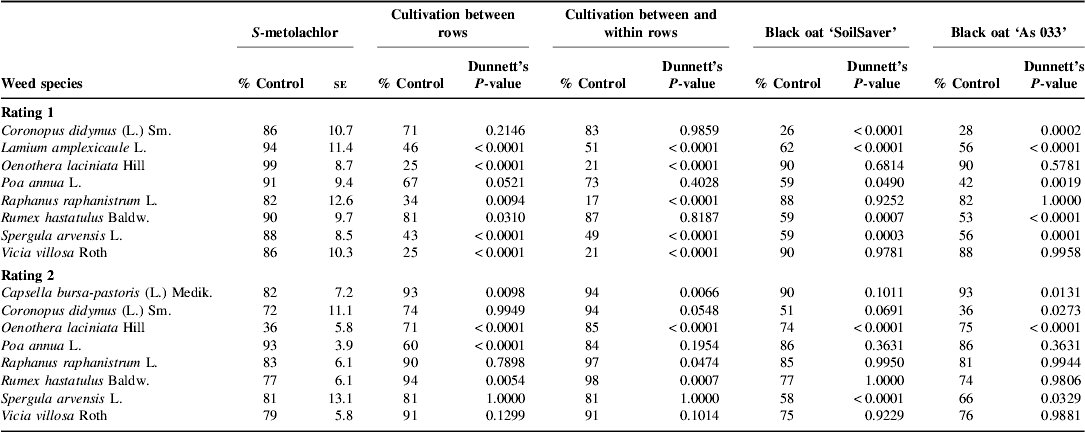
During the experiment 14 weed species were encountered. None of the interactions and treatment main effects were significant for Geranium carolinianum L., Trifolium incarnatum L. and Medicago lupulina L. Cultivar by treatment interaction was non-significant, but treatment main effects were significant for all other weed species mentioned in Table 1. At the first rating 6 weeks after planting in 2007 and 2008, lesser swinecress [Coronopus didymus (L.) Sm] was controlled by S-metolachlor to 86%. Both organic living mulch black oat treatments provided much lower control (⩽28%). S-metolachlor provided 94% control of henbit (Lamium amplexicaule L.). With less than 25% control by both cultivation treatments and less than 62% control by both black oat cultivars, the organic treatments were inferior to S-metolachlor. The continuous germination of henbitReference Murphy18 is likely the reason for poor control by organic treatments. Cutleaf-evening primrose (Oenothera laciniata Hill) was controlled to 99% by S-metolachlor and to 90% by both black oat cultivars. Both cultivation treatments provided much lower control (⩽25%). S-metolachlor controlled annual bluegrass (Poa annua L.) to 91%. With the exception of between–within row cultivation (73%), all of the remaining organic treatments provided lower control of this weed (⩽21%). Black oat cultivars SoilSaver (88%) and As 033 (82%) were as successful as S-metolachlor (82%) in controlling wild radish (Raphanus raphanistrum L.). With less than 35% control both cultivation treatments were inferior to S-metolachlor. Heartwing sorrel (Rumex hastatulus Baldw.) was controlled to 90% by S-metolachlor. With less than 60% control both black oat cultivars provided lower control than S-metolachlor. S-metolachlor provided 88% control of corn spurry (Spergula arvensis L.). The cultivation and companion crop treatments provided lower control than S-metolachlor. SoilSaver (90%) and As 033 (88%) were as successful as the conventional treatment (86%) in controlling winter vetch (Vicia villosa Roth).
Weed control as affected by treatment 6 (2007 and 2008), 22 (2007) or 26 (2008) weeks after planting. Dunnett's test was performed to compare cultivation treatments and companion black oat treatments to a conventionally grown crop treated with S-metolachlor. Each species was analyzed separately, hence the different standard errors.
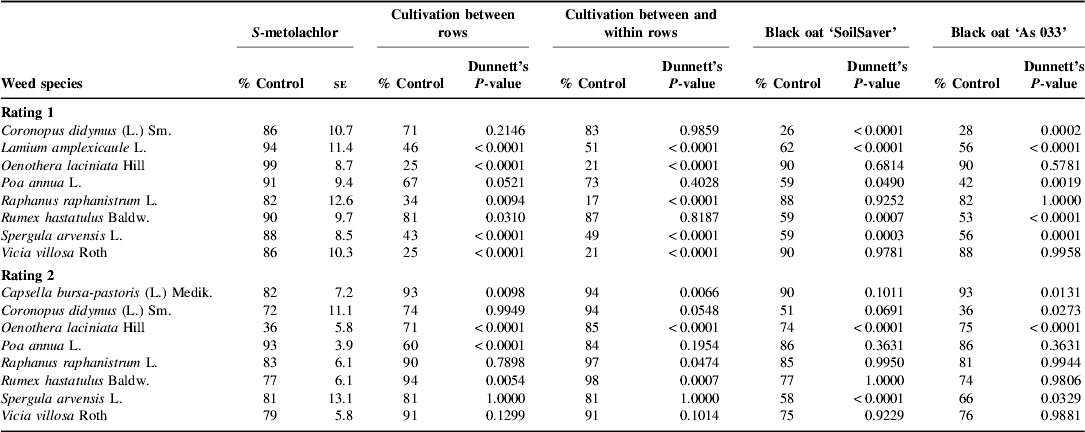
At the second rating 22 weeks and 26 weeks after planting in 2007 and 2008, respectively, henbit, a winter annual weed species, was not present since its growing season ended earlier. Shepherd's purse [Capsella bursa-pastoris (L.) Medik.] was better controlled by the cultivation (>93%) and black oat companion crops (>90%) than by S-metolachlor. Control of lesser swinecress by S-metolachlor was reduced to 72%. Between–within row cultivation (94%) provided better control than S-metolachlor. Providing less than 51% control, the black oat companion crops were inferior to S-metolachlor. Cutleaf-evening primrose control by S-metolachlor (36%) was inferior at the second rating as compared to the first rating. With more than 70% control both cultivation treatments and both black oat companions provided better control than S-metolachlor. Germination of this weed species continued after the first rating. Annual bluegrass control by S-metolachlor was 93%. Between-row cultivation (60%) provided lower control than S-metolachlor. S-metolachlor provided 86% wild radish control. Between–within row cultivation (97%) provided superior control. Heartwing sorrel control by S-metolachlor was 77%. Both cultivation treatments provided better control (>90%) than S-metolachlor. Corn spurry control by S-metolachlor was 81%. Both cultivation treatments performed as successfully as the conventional treatment. SoilSaver and As 033 provided 58% and 66% control, respectively. S-metolachlor provided 79% winter vetch control.
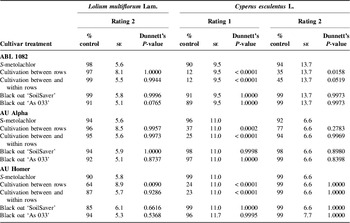
Cultivar by treatment interaction was significant for annual ryegrass (Lolium multiflorum Lam.) (Table 2). Annual ryegrass was present only at the second rating. Mean control of annual ryegrass in cultivar ABL 1082 was 98%. Black oat cultivar As 033 provided excellent control (91%), but this was lower than control by S-metolachlor. AU Alpha weed control treatments provided equivalent weed control. Annual ryegrass was controlled 90% by S-metolachlor. With the exception of between-row cultivation (64%), none of the organic treatments provided lower control than S-metolachlor in AU Homer.
Control of annual ryegrass (Lolium multiflorum Lam.) and yellow nutsedge (Cyperus esculentus L.) in L. albus L. cultivars as affected by treatment 6 (2007 and 2008), 22 (2007) or 26 (2008) weeks after planting. Dunnett's test was performed to compare cultivation treatments and companion black oat treatments to a conventionally grown crop treated with S-metolachlor. The group option was employed to account for heterogeneous variances among treatments, hence the varying standard errors.

Similarly, cultivar by treatment interaction also was significant for yellow nutsedge (Cyperus esculentus L.). At the first rating, yellow nutsedge was controlled to 90% by S-metolachlor in ABL 1082. Between-row and between–within row cultivation both provided 12% control. Similar results were observed in cultivars AU Alpha and AU Homer. S-metolachlor provided 96% and 99% control of yellow nutsedge in AU Alpha and AU Homer, respectively. Both cultivation treatments (<37% control) were significantly inferior in both cultivars.
At the second rating, S-metolachlor provided ⩾90% control of yellow nutsedge in all three cultivars. Between-row cultivation in ABL 1082 was the only treatment that provided lower control of yellow nutsedge than S-metolachlor. In AU Alpha the organic treatments controlled this weed to more than 77%. S-metolachlor and black oat companions each provided 99% control of yellow nutsedge at this rating.
Lupin injury
Treatment by cultivar interaction was non-significant at P=0.10. Treatment main effects were significant. At the first rating, both cultivation and black oat treatments reduced crop injury compared to the S-metolachlor treatment (0.97). Crop injury increased over time. At the second rating only between-row cultivation (1.04) and black oat cultivar As 033 (0.87) caused lower injury than the S-metolachlor treatment (1.61). Overall, crop injury was negligible and well below reported thresholds.
Lupin density
The interactions and treatment main effects were non-significant (P=0.10). Plant density of the cultivars decreased over time from rating 1 to 3. ABL 1082 plant density was 9.8, 9.1 and 8.8 plants m−2 for ratings 1, 2 and 3, respectively. Density of AU Alpha was 10.6, 9.5 and 7.6 plants m−2. AU Homer was 10.6, 9.6 and 9.3 plants m−2. The slight decrease in plant density may be related to plant death over time due to insects, deer browsing and disease.
Lupin maturity
The interactions and treatment main effects were non-significant (P=0.10). At the March rating it was observed that ABL 1082 is slightly later maturing because 82% of the plants were in full bloom as compared to 89% for AU Alpha and AU Homer. This is consistent with the breeding history of these cultivars (van Santen, 2006, unpublished results).
Lupin yield
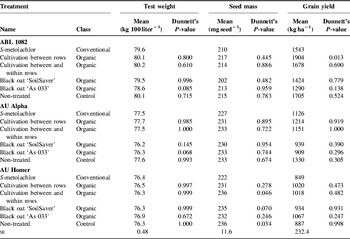
The treatment by cultivar interaction was significant for test weight and yield, but not for seed mass. Treatment main effects were significant for test weight, seed mass and yield. Plants of ABL 1082 treated with S-metolachlor had a test weight of 79.6 kg 100 liter−1. Only black oat As 033 (78.6 kg 100 liter−1) resulted in a lower test weight (Table 3). Neither cultivation nor black oat cultivar treatments altered the mean seed mass of ABL 1082 as compared to S-metolachlor (210 mg seed−1). ABL 1082 plants treated with the conventional treatment had a grain yield of 1540 kg ha−1. With the exception of between-row cultivation (1904 kg ha−1) none of the organic treatments significantly increased the yield of ABL 1082.
Test weight (kg 100 liter−1), seed mass (mg seed−1) and yield (kg ha−1) of L. albus L. as affected by treatment.

The test weight of AU Alpha treated with S-metolachlor was 77.5 kg 100 liter−1 (Table 3). Both black oat cultivars reduced the test weight (⩽76.3 kg 100 liter−1) compared to S-metolachlor. None of the organic treatments either increased or decreased mean seed mass in comparison to S-metolachlor (227 mg seed−1). AU Alpha treated with S-metolachlor yielded 1126 kg ha−1. Neither cultivation nor black oat cultivars influenced the test weight of AU Homer as compared to S-metolachlor (76.4 kg 100 liter−1) (Table 3). Plants treated with S-metolachlor resulted in a seed mass of 222 mg seed−1. Seed mass was higher in non-treated plants (236 mg seed−1), as compared to the seed mass of plants in which between–within row cultivation (236 mg seed−1) and black oat cultivar SoilSaver (235 mg seed−1) were used. None of the organic treatments reduced or increased the grain yield of AU Homer as compared to S-metolachlor (849 kg ha−1).
Discussion and Conclusion
Our results show that between and within row cultivation successfully reduced most weed species that were present in our experiment to more than 80%, including Shepherd's purse, annual ryegrass, winter vetch and heartwing sorrel. The cultivation treatments, between row and between–within row (hoeing) yielded as high or higher than the non-treated control and higher than S-metolachlor. This coincides with observations made in lentilReference Anderson13, in which hand-hoed plots yielded higher than chemical weed control. Test weight and seed mass were not reduced or increased by cultivation treatments. Yield potential may be higher in these treatments since crop injury was lower compared to the S-metolachlor treatment.
The two black oat cultivars provided very good control of annual ryegrass, shepherd's purse and yellow nutsedge (>90%), but were not successful in the control of other weed species, especially corn spurry (Spergula arvensis L.). Black oat can be grown as a companion crop in lupin, growing in the same field at the same time. In conventional farming systems, the black oat companion may be terminated by a selective grass herbicide (i.e. aryloxyphenoxy-propionates and/or cyclohexanediones) prior to lupin harvest. Black oat, especially SoilSaver, out-competes weeds by shading due to its large biomass productionReference Bowman, Shirley and Cramer15. Black oat also produces allelopathic compounds that inhibit weed growthReference Bowman, Shirley and Cramer15. This is particularly important since lupins have a slowly developing canopy during their early establishment which inhibits their ability to shade weeds themselves. Neither of the black oat cultivars resulted in crop injury. This may indicate that white lupin, unlike cottonReference Price, Stoll, Bergtold, Arriaga, Balkcom, Kornecki and Raper16, is not sensitive to the allelopathic activity of black oat. Neither of the black oat companions affected the yield of any lupin cultivar.
Stand count reductions appear more closely related to yield loss than other parameters, including crop injuryReference Taylor-Lovell, Wax and Nelson19. Based on previous research it was found that crop injury greater than 3 is unacceptable in white lupinReference Knott20.
We conclude that organic production of white lupin in the southeastern USA is possible. The cultivation treatments and companion crops used in this experiment provide satisfactory to excellent weed control without causing unacceptable crop injury. Plants treated with these organic methods yielded as high or higher than the chemical control, which makes the production of organic seed feasible.