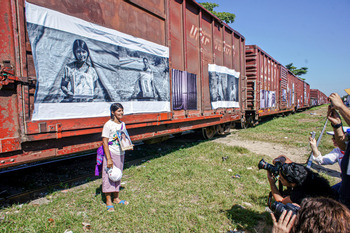
In response to requests from media photographers, in 2013 Lidia Diego Mateo posed in front of her own image taken the year before in 2012, when she travelled with the Caravana de Madres Centroamericanas (Caravan of Central American Mothers) through more than a dozen Mexican states to publicize the disappearance of her teenage undocumented-migrant daughter and search for evidence of what might have befallen her. Since the search proved unsuccessful, Diego Mateo was trying again the following year when photographers once again caught up with her. In 2012, Diego Mateo holds her daughter's photograph with both hands; in 2013, she wears a different top from the previous year, grasps the photograph with a single hand and holds a visor cap in the other. Yet her hair is parted in the same place, her bag strap hangs over her shoulder in the same way, her grim smile is almost identical, and the image of her daughter Nora hanging around her neck is identical: the girl smiles broadly, bangs falling over one eye, facing forward as if for a school photograph. Nora left their home in the Guatemalan municipality of Ixcán in 2007, at the age of sixteen, to work as a maid in a Mexican town bordering Guatemala, Benemérito de las Américas. After months of weekly phone calls, one day she simply stopped calling home. Diego Mateo said she feared that her daughter may have been forced into sex work.Footnote 2 As Diego Mateo poses for the photographers covering the caravana, she creates a doubled image: the new photograph incorporates the earlier photograph, like a visual echo.Footnote 3 Yet more importantly, the image provides evidence of the repetitiveness of her so far fruitless search, of her tenacity, her persistence and her motherly devotion to her absent daughter. The caravana provides a transnational stage-in-motion for women like Diego Mateo to perform devotional motherhood as they protest violence – both in space as they move around the country from stop to stop on the caravana's lengthy itinerary of some five thousand kilometres over a period of two to three weeks, and across time, as some of the women participate year after year (Fig. 1).
Lidia Diego Mateo poses for journalists in front of her own image taken the previous year. Palenque, Chiapas. Photograph by Ana Elena Puga.

The annual sojourn started as early as 2004 with the fledgling efforts of a few Honduran mothers to search for their offspring in the Mexican southern border state of Chiapas.Footnote 4 Since 2006 it has been organized by the Mexican non-profit Movimiento Migrante Mesoamericano (MMM), which has been able to garner more generous funding support and wider media coverage. The German organization Medico International donates funds to MMM to cover the cost of the caravana, about 800,000 Mexican pesos (about US$40,000) per year.Footnote 5 The mother–activists now regularly reach an international audience, claim a broad variety of public spaces, and intervene in political networks. Their activism serves both a practical purpose, to search for evidence of the fate of the disappeared, and a political goal, to publicize the violent disappearance of Central American migrants in Mexico to a global audience. Like earlier mother activism in Latin America, from the Argentine mothers of the Plaza de Mayo who began to protest in the 1970s to the Mexican mothers of murdered women in Ciudad Juárez who started their protests in the 1990s, this twenty-first-century protest strategically activates the traditional archetype of mothers as passive, pious, suffering victims whose self-abnegation forces them, almost against their will, out of their supposedly natural domestic space in the home and out into the public sphere.Footnote 6 I focus, however, on three elements that distinguish the mothers of the caravana from earlier activist mothers.
First, this protest involves crossing national borders, sometimes without official authorization, and touring far and wide in a rented bus accompanied by police escorts, as well as cars filled with members of the media, caravana organizers and supporters. While the Plaza de Mayo protests, for instance, are named for the location in which the mothers’ protests took place, a square in Buenos Aires surrounded by buildings housing national, municipal and ecclesiastical authorities, the Central American mothers associate their struggle with a form of protest: the caravana. The caravana as stage-in-motion functions as a transnational pilgrimage to the memory of the disappeared relative, whether it is undertaken only once or many years in a row. It temporarily spotlights and claims the spaces traversed by undocumented Central American migrants in Mexico, attempting to recast those migrants as victims of violence rather than as criminals.
Second, as scholars such as cultural studies critic Raúl Diego Rivera Hernández and sociologist Amarela Varela Huerta have noted, the caravana's mother-based activism de-normalizes the violence related to drugs and migration that claimed 34,579 deaths in 2019 alone, according to Mexican government estimates.Footnote 7 (Since the current ‘Drug War’ began in 2006, the Mexican government estimates that 61,637 people have violently disappeared.Footnote 8) In contrast to Rivera and Varela, however, I highlight how that de-normalization is accomplished through what I call performances of devotional motherhood and saintly motherhood.
Third, my study considers an aspect of the caravana that has not been closely analysed by other scholars: the performances of family reunification staged by the MMM organizers. These performances take place in the few cases in which MMM manages to locate family members who have not fallen prey to violence but have simply resettled in Mexico and abandoned or lost touch with their mothers and/or other family members such as spouses and children left behind in Central America. Perhaps neglected by scholars because their reliance on sentimentality and melodrama seems to undermine more attractive (to us scholars) defiant modes of mother-based protest against victimized children, I argue that these performances of family reunification serve important functions: they shift the performance of motherhood from devotion to saintly tolerance, patience and forgiveness – even toward prodigal offspring who were ‘lost’ for years; they provide a chance for other mothers to vicariously feel joy and hope that their children are still alive; they offer an example of world citizens taking matters into their own hands in the face of incompetence or indifference by nation state authorities; and they enact a symbolic unification of Central America and Mexico in defiance of contemporary nation state borders.
Caravanas
As a form of protest, the caravana has a long history in Mexican social movements. Though a comprehensive survey is not possible within the scope of this article, I will briefly mention just a few of the most prominent examples of Mexican caravanas in modern times. One of the best-known caravanas began in Mexico on 20 January 1951 as part of a labour uprising. Some five thousand striking miners set out on a Caravana del Hambre (Caravan of Hunger), a 1,500-kilometre march on foot from the northern state of Coahuila to Mexico City, where the miners arrived on 10 March to demand that the government of President Miguel Alemán attend to their demands. Alemán swiftly declared their strike illegal and promptly forced them to return to Coahuila by train.Footnote 9 Nevertheless, the caravana became an established strategy for resistance. Fifty years after the miners’ march, twenty-four leaders of the Ejército Zapatista de Liberación Nacional, also known as the Zapatistas, undertook a two-week Caravana por la Paz (Caravan for Peace) from the southern city of San Cristobal de las Casas, Chiapas through a dozen states culminating in a massive rally in Mexico City's central square, where they voiced their demands for indigenous rights before an audience of some 100,000 supporters. Though the demands of the caravana leaders and its masked spokesperson, Subcomandante Marcos, were taken seriously neither by the government nor by many on the left, other analysts, such as performance studies scholar Ana Martínez, note the Zapatista caravana's historic significance as a performative protest:
The march was an unprecedented opportunity to officially address Mexico's unfinished debt to its indigenous peoples, and while the government ultimately ignored the natives’ demands, the Zapatistas gained massive support in Mexico City from national and international civilians while capturing, visibly and physically, a place for marginalized indigeneity on the world stage.Footnote 10
A decade after the Zapatista caravana, in 2011, after the murder of his son and six of the son's friends by drug cartel hitmen, poet Javier Sicilia organized the Caravana por la Paz con Justicia y Dignidad (Caravan for Peace with Justice and Dignity). Touring both Mexico and the United States, Sicilia advocated for the legalization and regulation of drugs to end the violence unleashed by the drug war begun by President Felipe Calderón (2006–12). Once again, the policy impact of the caravana was minimal: drug-related assassinations and disappearances, often with the collusion of local authorities, have continued unchecked in Mexico through the administrations of Calderón and his successors, Enrique Peña Nieto (2012–18) and the current president Andrés Manuel López Obrador (2018–). Yet Sicilia's caravana and his accompanying movement did lead to increased awareness among many Mexicans of how the violence sweeping the country affects not only those involved in the drug trade but also many middle-class Mexican citizens.Footnote 11
More recently, thousands of migrants from the Central American countries known as the Northern Triangle – Honduras, El Salvador and Guatemala – have utilized caravanas as a form of travel en masse that provides a measure of protection from criminal assailants and corrupt authorities. Some scholars identify the origins of the large 2018 migrant caravans in a January 2011 march from Arriaga to Ixtepec, Oaxaca organized by religious leaders and human rights activists to highlight the abuses suffered by migrants in Mexico.Footnote 12 Others argue that the caravanas grew out of the Via Crucis, or Stations of the Cross, processions staged during Lent by migrant-rights activists in an attempt to associate migrants with Jesus in the popular imagination and draw attention to their mistreatment in Mexico.Footnote 13 The first of the Via Crucis was a march starting in Easter week of 2011 in Tecún Umán, Guatemala, and included stops in various towns that stood in for the stations of the cross, towns in which migrants usually faced shakedowns, robberies, assaults, rapes and other mistreatment. The march concluded in Ixtepec, Oaxaca on Good Friday. Some journalists have credited, the organization Pueblo Sin Fronteras with transforming the migrant Via Crucis into a mass movement northward in search of asylum and of dubbing the mass exodus of migrants a caravana.Footnote 14 Yet the term caravana was also used back in the 1980s to describe the underground movement of Central American refugees and their US guides in the Sanctuary Movement. The Sanctuary caravanas at times also had a public, performative-protest dimension, as the media and US authorities followed the movements of US Sanctuary activists who crossed into Mexico, picked up Central American refugees, then crossed back over into the United States to drop them off at a supportive church.Footnote 15
While the four separate migrant caravans of 2018 garnered extensive media attention, it is worth noting that one of the earliest migrant caravans set out three years earlier from the same city bus terminal in San Pedro Sula, Honduras, that later became the gathering point for the mass exodus of people from all over the region. In 2015, a caravana was formed by just seventeen men, returned Honduran migrants who had suffered amputations and were living with disabilities after accidents or assaults that occurred while riding freight trains through Mexico. Members of the Association of Returned Migrants with Disabilities (AMIREDIS) organized that caravana not only in response to the difficulty of earning a living as disabled men with limited education, but also to hold the governments of three nation states – Honduras, Mexico and the United States – accountable for creating the economic and sociopolitical conditions that forced the men to migrate in the first place.Footnote 16 The AMIREDIS protest caravan, not coincidentally, included migrants from the smaller nearby city of El Progreso, where Rosa Nelly Santos (one of the organizers of the earliest Caravana de Madres Centroamericanas) co-founded the Committee of Family Members of Disappeared Migrants from El Progreso, along with three other women, in 1999. Santos, whose nephew had disappeared in Mexico, and a few mothers from El Progreso made the earliest trips to Tapachula, Mexico, to search for disappeared relatives, yet their journeys gathered little or no media attention. While hopes of obtaining asylum or undocumented passage into the United States fuel the massive migrant caravanas, the mothers’ caravanas are circular and always return the women from Mexico to their home countries. Under the auspices of MMM, the mothers’ caravana has been expanded to about ten women (and the occasional man) from each of four countries: Honduras, El Salvador, Guatemala and Nicaragua. Though some of the caravana participants seek sisters, brothers, husbands or wives, they always fly under the flag of mother-based activism.
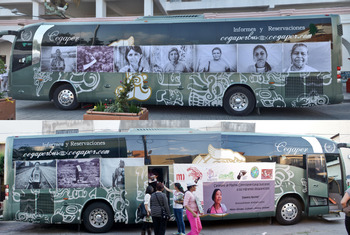
Protest caravanas can take many different forms and adopt a variety of structures, yet analysis of the performative elements of the mothers’ caravana yields certain definitional elements. The Columbia Encyclopedia defines ‘caravan’ as a ‘group of travelers or merchants banded together and organized for mutual assistance and defense while traveling through unsettled or hostile country’. The definition goes on to note that the caravan's primary adaptation from ancient times to modern times has been innovations in the form of transport, from camels to motor vehicles and aeroplanes.Footnote 17 These elements apply to the mothers’ caravana, as its forty or so women travel together in a contemporary bus through a region hostile to Central American migrants, Mexico, followed by vehicles with police escorts, media, scholars, organizers and other supporters. Besides these elements, I would add that caravanas are particularly well suited for protests involving migration because they imitate through their motion the action of the migrants who transport their bodies from one place to another. By contrast to other forms of protest such as the single-site rally, picket, vigil, occupation or march from a single starting point to a single end point, the motion of the mothers’ caravana is circular and involves multiple stops. This dynamism facilitates its function as a stage-in-motion, a space for touring performances of both ritualistic mourning and joyful reunification. Over the years the women have also used the caravana's dynamic flexibility to strengthen international alliances, for instance, taking advantage of the opportunity to participate in a Puerto Vallarta global forum on migration (2010), a coordinated caravana parallel to one taking place in Italy to protest against North African migrant disappearances (2014), and a Mexico City forum that brought together mother–activists from many other parts of the world (2018) (Fig. 2).
Caravana de Madres 2013, bus decorated on both sides with images of mothers and their disappeared adult children. Photographs by Víctor M. Espinosa.

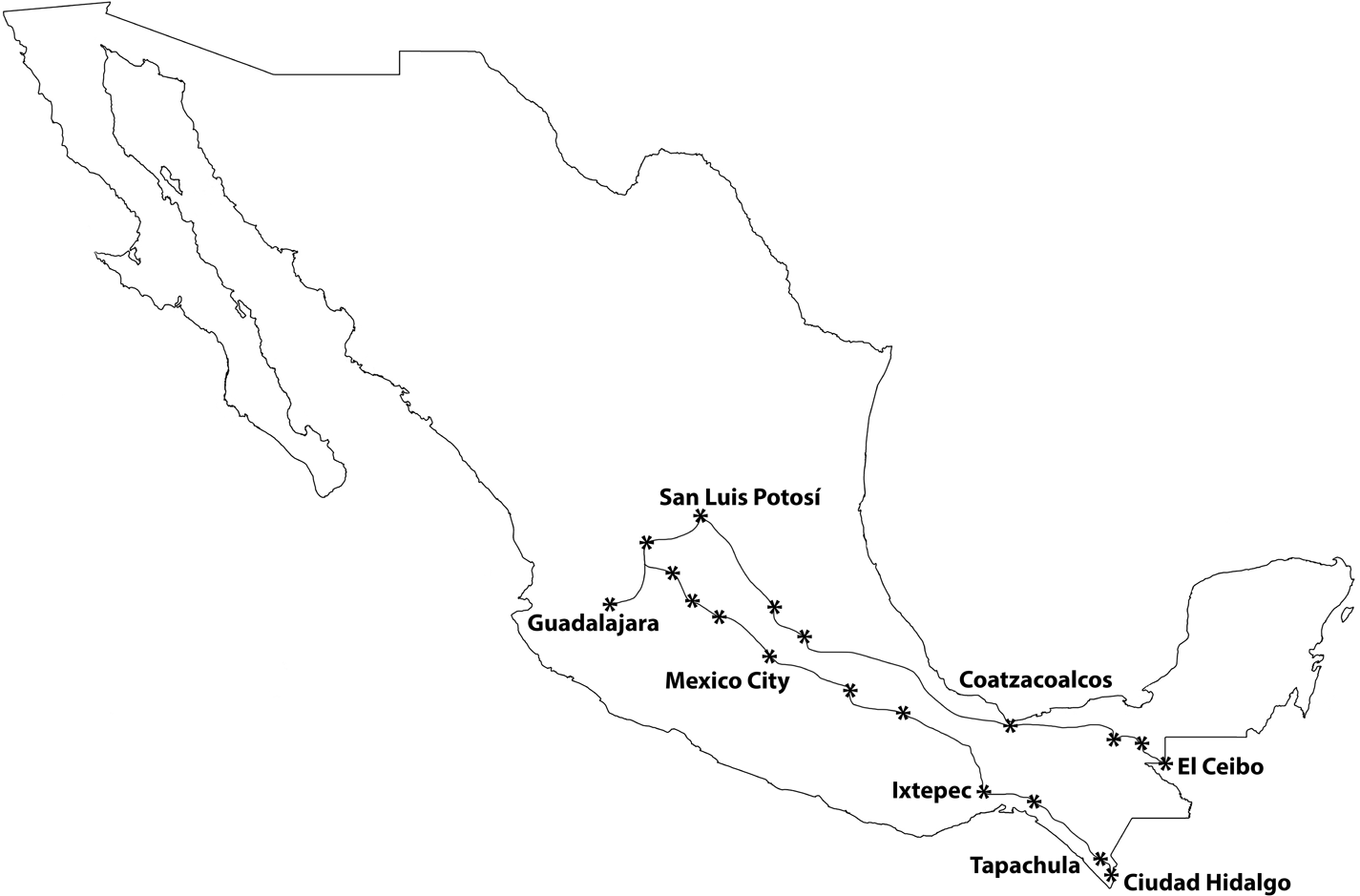
The 2–18 December 2013 caravana that I joined as a participant observer followed the same basic pattern established in 2008 and continued through 2019, with a few variations. The caravana enters Mexico by rented bus on the southern border, then works its way north to Veracruz, Mexico City and Guadalajara. Some years it continues all the way to Mexico's northern border cities before circling back around to the south again and departing through the southern state of Chiapas, yet in 2013 it only went as far north as the state of San Luis Potosí (Fig. 3).
Map of Mexico outlining the route travelled by the Caravana de Madres Centroamericanas in 2013. Map by Víctor M. Espinosa.

During seventeen days we made a total of twenty-two stops in fifteen different states, stopping in many smaller cities and towns, where the women protested in town squares, lobbied in government and non-governmental organization offices, and searched for traces of the disappeared in shelters for migrants, prisons, brothels, morgues and cemeteries. I rode in a car ahead of the bus along with several journalists, a fellow scholar and the Mexican organizer of the caravana, Marta Sánchez Soler, one of the founders and the president of MMM. Sánchez is the caravana lead organizer, press spokesperson and gatekeeper. It was she who determined, for instance, when and for how long scholars or journalists might ride on the bus together with the women, a coveted experience because of the access it allowed to the women, both as individuals and as members of the collective. The bus propelled the caravana-as-stage: for outside spectators the performance began when it rolled to a stop and the women disembarked, usually singing or chanting as they came down the stairs, carrying signs and wearing large photographs of their missing relatives on strings hanging from their necks, so that the faces of the disappeared seemed to look outward from their chests.
Devotional motherhood
The bus was decorated to advertise the mothers’ mission and announce their wholehearted devotion to the search for their relatives. Large black type proclaimed: ‘Caravana de Madres Centroamericanas buscando a sus migrantes desaparecidos’ (‘Caravan of Central American Mothers searching for their disappeared migrants’). The 2013 caravana was dedicated to the memory of Emeteria Martínez, one of the first mothers to make an annual journey from Honduras to Mexico to search for her daughter. Martínez had died in January 2013, at the age of seventy-four. Martínez was in a sense the posthumous star of the caravana performance: she was legendary for her repeated trips to Mexico until she successfully located her daughter in 2010, twenty-one years after she had last communicated with her. A larger-than-life-sized image of Emeteria fastened to the bus looked out at passers-by from under a knit cap: her face was deeply lined yet her eyes seemed to brim with hope and her lips hinted at a tiny smile. Under her image, black type announced her name, almost as if she were the lead act of a pop concert. Her tranquil visage epitomized the hopes of the other women that they too might one day be reunited with their loved ones.
The concept of devotional motherhood draws on what performance studies scholar Elaine A. Peña has called ‘devotional labor’ in the context of the worship of the Virgin of Guadalupe: ‘by offering the Virgin their devotional labor (e.g. pilgrimage, prayer, song, dance and shrine maintenance) adherants develop, preserve, sanctify and connect not only spaces but also histories and traditions across several boundaries: geopolitical, social, and institutional’.Footnote 18 While the geopolitical boundaries on which Peña focuses are those between Mexico and the United States, the geopolitical boundaries that the caravana crosses are those among the different Central American countries from which the participants hail and the boundaries between those countries and Mexico, which have become more fraught as the United States has pressured Mexico to discourage migration from Central America, militarize its southern border and step up deportations. Thus motherly devotional labour on the caravana includes chants that defend their migrant relatives against criminalization and try to recast them as productive members of a global economy: ‘Los migrantes no somos criminales, somos trabajadores internacionales’ (‘We migrants are not criminals, we are international workers’). Chants, songs and testimony, sometimes with prayer-like direct address to the missing relative, make the caravana into a pilgrimage to the memory of the disappeared. ‘¡Hijo escucha, tu madre está en la lucha!’ (‘Child, listen, your mother is in the fight!’) was a chant repeated at almost every stop on the itinerary, as if the disappeared might somehow perceive and appreciate the mothers’ adherence to the cause of migrant rights. While the chants, along with song and testimony, sometimes cast the women as classic melodrama mothers, pious women who suffer and sacrifice for their children, there is also an edge to their performance that slips them out of that archetype into a more defiant stance.
For instance, the unofficial anthem of the caravana is a Roman Catholic hymn, ‘Hoy he vuelto’, composed by Cesareo Gabaráin (1978), with its lachrymose refrain, ‘Una madre no se cansa de esperar’ (‘A mother never tires of waiting’). Yet the mothers sometimes altered the lyrics to ‘Una madre no se cansa de buscar’ (‘A mother never tires of seeking’). The substitution of ‘seeking’ for ‘waiting’ shifts their positionality from a passive to a more active subjectivity. The hymn fuses the image of the Virgin Mary with the image of a family's mother who sets the table and prepares warm food for her son: ‘En la mesa, la comida aún caliente y el mantel …’ (‘On the table, the food still warm and the tablecloth …’). Singing the hymn announces to listeners that the mothers are asexual, virginal women who deserve respect because of their long-suffering patience and domestic labour. Yet the lyric ‘I’ of the hymn is not the Virgin Mary; it is a lapsed Catholic/wayward son who has lost touch with the Virgin Mary/his mother yet returns to pray to her once more, to reaffirm his faith and love: ‘Hoy he vuelto, Madre, a recorder / Cuántas cosas dije ante tu altar …’ (‘I have returned today, Mother, to remember / So many things that I said before your altar …’). When they sing the hymn, the women thus assume the persona of their missing offspring and put themselves in the position of the migrant who is far from home. They superimpose the figures of the mother, the Virgin and the migrant to portray the disappeared as good, loving people worthy of concern, people who might still be alive and deserve to be looked for. As Rivera points out, the mothers make ‘absence visible’ and engage in a ‘politics of visibility’ that takes mourning out of private spaces and brings it into public view.Footnote 19
Devotional motherhood makes absence visible most obviously in how the caravana participants deploy photographs of the disappeared in public spaces. Part of their devotional tasks involves wearing a photograph of the missing person close to their bodies. Yet when they reach a town square or other site of protest, the task involves taking the photographs off and placing them on a group of tables, or on blankets on the ground, positioning the photographs close together to form a patchwork quilt of young faces. Presenting the photographs as an exhibit that includes many images highlights the communal nature of the loss of part of a generation of young people. When onlookers stop and look through the images, the mothers will often ask if they have seen any of the people in the photographs. In a few cases, the displays have led mothers to missing migrants. For instance, in 2011 in San Cristobal de las Casas, a policeman perusing the display of caravana photographs in the town square recognized a man that he knew was serving a ten-year sentence for murder in a local prison. Thus Olivia Orellano found her son after eight years of separation from Osman Lizandro Mejía Orellano.Footnote 20 The request that onlookers stop and look, moreover, has the additional effect of involving the spectator in the ethical responsibility for the fate of the disappeared, of suggesting that the spectator can also take some action, if only to reflect upon whether or not a face looks familiar.
On 11 December 2013 in Mexico City's central square, called the Zócalo, I watched as the mothers assembled a particularly creative display of photographs of the disappeared, fastening them to the side of a three-dimensional cardboard sculpture representing ‘La Bestia’, the nickname for the dangerous freight trains that carry many Central American migrants north. A papier mâché skeleton of a conductor drove the train. The skeleton was shaped as a glutton, with a big pot belly and a drumstick in one hand, as if to underscore the voracity with which the train chews up migrants. Migrant passengers were drawn as stick figures covered with dollar signs, a reminder of their value as commodities to kidnappers and corrupt officials. The remainder of the train was papered with photographs of disappeared children and husbands. Some onlookers seemed confused. ‘Does this have to do with the Metro?’ one woman asked, referring to the city's subway system. Other people walked past the mothers without stopping to look or to listen to their chants of ‘¡Vivos se los llevaron, vivos los queremos!’ (‘Alive they took them, alive we want them!’), a cry first heard under dictatorship in Argentina in the 1970s. Many visitors to the square had come to see the giant Coca-Cola-themed Christmas tree and other holiday decorations draped across the facades of the historic buildings. Yet a few Mexicans looked at the caravana display in horror and carefully studied the images of the disappeared. One man expressed incredulity that what had happened under dictatorships in South America in the 1970s and 1980s was now occurring in Mexico.
In smaller towns and villages, when the caravana participants do not have to compete with urban cacophony, a mother (or sister or wife, or in a few cases a father or brother) will use a microphone or a bullhorn to deliver a lengthy, detailed testimonio, a first-person account from the perspective of a witness that has a long tradition in Latin American social activism. The caravana participant tells the story of what their disappeared relative was like, why they decided to migrate, whether they left alone or with friends, how they travelled, how often they communicated during the journey, when and from where they last called home (especially if it was from that very town), and what was said during that last conversation. In some cases, the testimonio includes chilling accounts of how the final conversation was not with the disappeared themselves but with a kidnapper who demanded a ransom. For spectators, the testimonio builds a well-rounded human character that can be assigned to the face on the photograph; for the caravana participants, placing their bodies where the bodies of their missing relatives once were, or may have been, builds a sense of closeness to the missing and to the experience of the missing, an experience that they can never fully know. While they do not fully re-enact their relative's migration in the sense, for instance, that Civil War re-enactors studied by performance studies scholar Rebecca Schneider re-enact battles, they resemble re-enactors in their attempts to ‘replay the liveness of the dead’.Footnote 21 One extreme example of migrant re-enactment is the experience of a mother, interviewed by Gatopardo journalist Emiliano Ruiz Parra, who in order to infiltrate the bar where she thought her daughter had been forced into sex work, and attempt to learn her daughter's whereabouts, decided to work in the same bar herself as a sex worker.Footnote 22 Another mother traced her son to a small town in the state of Jalisco controlled by drug traffickers, yet was told by police that they considered the town too dangerous to enter and that she should not enter it either. She could not fully replay the liveness of the dead, if her son had indeed died, without risking her own life.Footnote 23 Even testimonio from relatively safe places where loved ones were last seen or heard from nevertheless breaks official silences surrounding disappearances and publicly confronts authorities with their inaction.
One of the most powerful ways in which the caravana draws attention to migrant disappearance in Mexico is by ritually commemorating victims of mass kidnappings and assassination. Media coverage of the caravana in 2011 focused on how the mothers travelled to San Fernando, Tamaulipas, where the year before the bodies of seventy-two massacred migrants from Central and South America had been discovered. On 2 November, the Day of Dead, when Mexican families celebrate their dead with prayer and rituals of remembrance such as visits to the cemetery and the building of altars, the mothers held a Mass for the murdered migrants on the site of the massacre, an abandoned warehouse in a remote rural settlement. MMM organizers brought a table, a tablecloth and bouquets of marigolds to the warehouse and built a small altar that incorporated some of the objects they found there that had belonged to the murdered migrants, including baseball caps and sneakers. The mothers were joined in prayer by one of the priests who runs a shelter for migrants in the south-western town of Arriaga, Chiapas, Rev. Heyman Vázquez, and a Franciscan friar, Fray Tomás González, who named his shelter for migrants in the south-eastern town of Tenosique, Tabasco ‘La 72’ after the massacred at San Fernando. As the mothers prayed and sang, their identification with migrants expanded to include victims that they did not personally know. They modelled concern, care and devotional labour for dead who were not their own relatives, setting an example for how, ideally, Mexicans would treat Central Americans.
Besides staging commemorations, caravana participants often use the media spotlight to pressure for progress into ongoing investigations and to stress the common plight of disappeared Mexicans and disappeared Central Americans. For example, in December 2015, one caravana participant denounced the Mexican government's stalled effort to identify the remains of the forty-nine people decapitated and mutilated in a 2012 massacre in Cadareyta, Nuevo Leon. As of 2015, only the remains of eight of the victims had been identified through DNA testing as Honduran migrants and were repatriated to the city of La Paz, Honduras. The sister of one of the victims, Lourdes María Suazo Mejía, participated in the caravana that year and told La Jornada, a Mexican national newspaper:
How is it possible that they did this? We are all children of God. They are hurting Mexico so much, a country that has lost prestige; look at those forty-three students (from Ayotzinapa) that were disappeared; [what happened to] those students hurt me too. They do horrible things, but we keep asking for justice. We want them to identify all of them, but they are going so slowly; it's not fair.Footnote 24
By equating the 2014 mass kidnapping and massacre of forty-three Mexicans from the rural teachers' college in Ayotzinapa with the violence perpetrated against Honduran migrants, and by publicly identifying with the pain of the families of the Mexican disappeared, Suazo Mejía created a community of moral concern that transcends national borders. Moreover, she implicitly paralleled the failure to adequately investigate either case, a failure that some scholars have interpreted as part of a performative strategy of ‘necropolitical governmentality’ that deploys spectacular displays of violence to discipline terrorized Mexican populations and discourage Central American migration.Footnote 25
Family reunification and performances of saintly motherhood
Every year, the MMM organizer dedicated to searching for the missing, Ruben Figueroa, locates a few family members who have not been killed or disappeared but who have been sentenced to prison terms, been forced into sex work, or simply resettled in Mexico and lost touch with their families. Some of the resettled migrants have abandoned children and spouses in their home country and started new families. About 90 per cent of the people in this category are men. In a few cases, women have also started second families in Mexico, or in other instances women who have survived sexual trafficking or rape feel ashamed or afraid to face their families for fear that they will be blamed for their own victimization. Despite occasional qualms, however, all of the 310 migrants that MMM has located up until now have agreed, sometimes after a little persuasion, to be reunited with their families.Footnote 26 This is a tiny percentage of the number of disappeared migrants in Mexico, which ranges between the Associated Press's conservative estimate of four thousand in the period between 2014 and 2018 and MMM's estimate of seventy thousand since the start of the Drug War in 2006. Though it would be possible for the reunifications to take place privately, MMM organizers make a practice of staging them publicly and purposely delay contact between family members until they can be brought together during one of the caravana stops, before an audience composed of media and other caravana mothers, as well as sometimes migrant-rights activists, human rights workers, religious leaders and other invited guests. The reunions are always staged as happy endings, complete with hugs and tears and giving thanks to the Lord. During one of several reunions I attended some observers wondered to each other in whispers how much of an effort a long-lost migrant son had really made to contact his mother. Yet those less savoury aspects of the separations are always avoided by MMM in favour of staging seemingly idyllic reunions in which prodigal sons or daughters often present their mother with a bouquet of flowers while photographers and videographers record the moment and the assembled crowd applauds and cheers.
If mothers harbour any resentment against adult children who have failed to communicate and sometimes left them to raise their grandchildren without any financial support sent from abroad, they do not say so publicly during the reunifications. On the contrary, in response to media questions they often say that they bear no ill will toward their children and ask nothing of them but a bit of contact. When mothers and their offspring are reunited, the mothers’ labour shifts from devotion to the saintly figure of the disappeared to a saintly tolerance, patience and forgiveness of the reappeared. The devoted mother becomes the self-sacrificing mother modelled on the Virgin Mary, the centre of countless Latin American novels, films and telenovelas, an archetype known as the madrecita.Footnote 27
Martínez may have set an example for the performance of saintly motherhood in 2010, when reporters concluded, either from Martínez's own words or from MMM organizers’ statements, that ‘Doña Emeteria doesn't care why her daughter kept silent throughout two decades. The only important thing to her is that they are together again.’Footnote 28 Media coverage of the family reunifications often stress the mothers’ extraordinary patience with their wayward adult children. For instance, an article by Israel Hernández posted to the MMM website recounts how Olga Romero Medina left her five children in the care of her mother Dilma Pilar Escobar when she left Honduras in hopes of migrating to the United States. She promised to return for the children when she could, yet never returned and after a while stopped calling home. Eight years later MMM organizers found the daughter living in Mexico with a husband and two younger children. They staged the reunification of the mother and daughter in a hotel banquet room during the caravana's stop in Villahermosa, Tabasco on 17 December 2017. Hernández's article details the abandonment yet focuses on the mother's presumed forgiveness of her daughter: ‘Far from complaints or pending accounts, after eight years what the Honduran mother missed was a hug.’ He concludes the article on an insistently positive note: ‘The journey had come to an end, but the hugs had barely started.’ Video of the reunification similarly focuses on the heightened emotion of the re-encounter: the mother and daughter embrace in a very long, very tight hug while weeping loudly as the crowd sings, ‘A mother never tires of waiting!’ (‘Una madre no se cansa de esperar’) and chants ‘We did it!’ (‘¡Sí se pudo!’).Footnote 29
During the reunifications that I witnessed in 2013, whether in Tapachula, Mexico City or Guadalajara, a similar scene was repeated several times with slight variations. The media stand to the side as Sánchez Soler leads the mother and her offspring into the same physical space, then steps back to the edge of the metaphorical playing area in order not to upstage the protagonists as they move toward each other, hug, and weep. In Mexico City, seventy-two-year-old Lucila discovers that her daughter Ana Julia did not die on the road to the United States some twenty years ago, but rather started a new life in Mexico, complete with a partner and three children. Lucila is reunited with her daughter and meets Ana Julia's nine-year-old daughter Alexa, a new granddaughter for Lucila to get to know. In Guadalajara, Narcisa, a Nicaraguan mother who has not heard from her son Eugenio since he left home ten years earlier at the age of sixteen, finds out that he has been alive and well and living in Tijuana. He presents her with a bouquet of white lilies and hugs her. The performance of reunification plays out once again in Tapachula, when Santos Rojas sinks to her knees to thank the Lord that her forty-two-year-old son Jorge Alberto Reyes Rojas is alive and working as a radio repairman. For media audiences, these scenes provide respite from the more frequent testimonials and protests of continued violence, loss and injustice. Moreover, they also show the mothers that years of searching do sometimes yield celebration and a sense of closure.
MMM coordinator Sánchez Soler expresses mixed feelings about the reunifications, or encuentros (encounters) as they call them in Spanish. She describes them as ‘a magical moment for the caravana’ that provides hope to the other mothers, yet alludes to their spectacular sentimentality by mentioning them in the same breath as a long-running television variety show, Sabado Gigante, and its host Don Francisco:
The encounter is an important part of the success that the caravanas can have. It is a very important event because it gives the mothers hope, and because, well, it's a magical moment for the caravana. That is the good part of the encounters.
The thing that I do not like about the encounters, that I do not like, do not like at all, is that it is very difficult to keep them from looking like a television show. In other words, you must give them a presence, you must publicize them … at the same time publicize them in a way that does not seem like Don Francisco on TV … There is no way out. We have tried a lot of things. Sometimes we have said, ‘Well, let them meet [privately] and then come out together to the press conference.’ But it is not the same; it is not the same. People want to see that they see each other and run and hug.Footnote 30
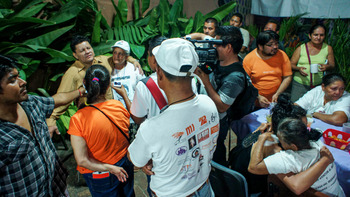
The mothers who assume the role of spectators to the mother and offspring celebrating a reunification respond with expressions of intense joy and collective solidarity. Yet the songs, chants, applause and cheers leave little room to express less celebratory emotions that mothers who have yet to re-encounter, and may never re-encounter, their children may be feeling: disappointment, sadness, envy, anger, even rage. The satisfaction that comes from witnessing the mother and adult child's joyous embrace recalls the satisfaction that spectators experience at the end of comic melodrama, when the world has been restored to order and everything falls into what feels like its proper place, if only for a moment. The comic respite and sense of resolution provides a moment in which spectator–mothers are encouraged to identify with a heroic mother figure whose quest has succeeded and try to share her happiness, though in fact an encuentro may never happen for them, no matter how tenaciously they persist in performing devotional motherhood. After the initial moment of reunification and celebration, while the press conduct interviews with the reunited mother and offspring, shifting attention away from the other mothers-as-appreciative-audience, some of them weep or try to hold back tears. It is difficult to say why the woman in the lower-right corner of Fig. 4 weeps; a mixture of emotions may be involved: joy for Santos Rojas as well as sadness and disappointment that her own child was not located.
Jorge Alberto Reyes Rojas reunites with his mother, Santos Rojas. The women on the lower right side of the photograph weep. Tapachula, Chiapas. Photograph by Víctor M. Espinosa.

Sociologist Deborah B. Gould argues that social movements authorize some selected feelings while downplaying or invalidating others in hopes of channelling certain emotions into productive activism.Footnote 31 The caravana's moments of joy tip the balance slightly away from the overwhelming sadness, anger and frustration experienced by many mothers of the disappeared, creating a space that encourages positive emotions. Those emotions, in turn, may energize the mothers as activists and provide affective fuel for them to continue the more confrontational or depressing aspects of their protests, such as demanding answers from the authorities; approaching strangers in public places; and searching in prisons, brothels, morgues and cemeteries. Yet for some relatives of the missing, despite the official celebratory script, sadness and despair continue to surface.
The performance of reunifications is staged as a happy ending not only for the mothers but also for the MMM organizers. While the more than 300 missing migrants they have located and put back in touch with their relatives is only a fraction of the thousands of disappeared, it does demonstrate that citizens can, to a limited extent, take matters into their own hands and partially fill the chasm left by governmental authorities who are unable or unwilling to locate the disappeared. In a short documentary about the MMM coordinator dedicated to searching for missing migrants, Ruben Figueroa, directed by Barbara Beltramello, Figueroa explains that far from welcoming his efforts, Mexican immigration police have threatened and beaten him:
We are working to defend human rights to defend the lives of these people, body-to-body, because the authorities do not respond in favor of the victims or in favor of those who defend human rights. Instead, it is always on the side of organized crime since the police authorities coordinate with it.Footnote 32
Performances of family reunification defy both immigration authorities and the networks of organized crime that traffic in migrants through kidnapping for ransom and forced sex work. Though the migrants that are found, in some cases, do not fit the mould of the deserving victim, because the most victimized have in many cases died, the survivors (regardless of whether they were unable to contact their families or intentionally abandoned them) symbolically represent the dead and the hope of finding traces of their fate.
Finally, on the level of national allegory, the reunifications bring together not only mothers with their offspring (or other separated family members), but also Mexican rescuers with Central Americans in need of assistance. In one way, this is problematic: a Mexican organization speaks for Central Americans and coordinates their stage-in-motion as it winds its way through Mexico. The dependence of the Central Americans on the Mexicans for financial and logistical support in some ways mirrors the economic dependency of Mexico and Central America on the United States, the very dependency that creates pressure to migrate and a need for remittances from richer to poorer countries. Yet on the other hand, the term ‘Mesoamerica’ in the name of an organization that calls itself a movement (Mesoamerican Migrant Movement) is both antiquated and utopic, harking back to an era before the land of Mexico and northern Central America was carved into separate nation states and looking forward to an era in which the region might once again be fused into a single entity, at least insofar as travel throughout the region might be allowed without the need for border controls. In fact, even though the United States cracked down on Mexico, first through the Plan Merida initiative that took effect in 2008 and then after the election of President Donald Trump in 2016, passage across the Suchiate river that divides Guatemala from Mexico is still relatively free, compared to crossing the Rio Grande from Mexico into the United States.
The final act of protest of the 2013 caravana capped seventeen days of travel around the country: a performance of peaceful nation state border crossing without the need for documents. To show how tranquil visa-free safe passage across nation state borders could be, the mothers crossed back across from the Mexican side of the Suchiate into Guatemala. Rather than cross at the official checkpoints on the bridge over the river, they scrambled onto the rafts known as pangas and gathered on the Guatemalan side of the river for a final press conference that combined elements of both their confrontative protests and their celebrations of family reunification. They demanded reparations for migrants killed in transit through Mexico as well as visa-free passage without harassment, extortion and assaults. At the same time, they boasted that a record of twelve people had been brought together with other family members during the caravana. After the press conference, however, the women boarded the rafts once again to cross back into Mexico and re-exit officially through the immigration posts on top of the bridge, the same way they entered, by showing their proper documentation. Thus utopian performance yielded to bureaucratic reality. MMM could not risk an illegal crossing that might lose the support of Mexican and Guatemalan governments, who over the years have come to tolerate and even provide a measure of protection for the caravana, perhaps viewing it as a harmless safety valve that allows them to demonstrate compassion toward grieving relatives of the Central American disappeared.
Conclusion: devotion/saintliness
This article has explored two related strands of performance by mother activists: the devotional and the saintly. While I have discussed devotional performance in relation to the search for the disappeared and saintly performance in relation to the reunions with the reappeared, in fact the two types of performance may overlap, depending on the circumstance. Moreover, one may demonstrate devotion to something or someone, yet devotion may also be one of the qualities of a saint. ‘Devotion’ and ‘devout’ share the same Latin root devovere, meaning to vow, offer, promise, or dedicate. In the Roman Catholic tradition, because saints are exceptionally devoted to God, they are acknowledged as worthy of veneration themselves. It seems appropriate that the caravana usually includes a stop at Mexico City's Basílica de Guadalupe, where the mothers, who hail from a wide variety of religious traditions, may nevertheless become associated with the Virgin of Guadalupe, through media coverage of their visit primarily for Mexican audiences. Devotion and miraculous appearance are central to the legend of the Virgin, who appeared four times to an indigenous man, Juan Diego Cuauhtlatoatzin, to repeatedly ask that a temple be built in her honour. In the end, the temple was built and the contemporary successor to that church, the basilica, attracts millions of believers and tourists every year. Perhaps just as much as her devotion and her saintliness, another of the Virgin's qualities may inspire some of the mothers to continue their searches, their activism and whatever performances are required of them to discover the fate of their missing children: her tenacity. Both performances, of devotion and of saintliness, require a steely persistence that undergirds the more obvious displays of sentiment.