INTRODUCTION
Marine flatworms are of moderate size, averaging from 2–3 mm in length, with a greatly flattened and more or less oval shape. The phylum Platyhelminthes embraces three classes of worms. Two of these are entirely parasitic; such as Trematoda and Cestoda. The third class, the Turbellaria, is free living and is considered to be the ancestors of the two parasitic classes (Barnes, Reference Barnes1980). The phylogenetic system of the Platyhelminthes proposed by Ehlers (Reference Ehlers1985) rejects the existence of a monophylum ‘Turbellaria’ based on the principles and methods of phylogenetic systematics and proposed a clade Rhabditophora for the free living polyclads. Even then the class Turbellaria is used widely for taxonomic purposes of polyclads by most of the workers. Previous to 1984, it was believed that the majority of conspicuous and flamboyantly coloured pseudocerotid flatworms belonged to the genus Pseudoceros Lang, 1884. However, Faubel (Reference Faubel1984) clearly separated the genus Pseudobiceros from Pseudoceros on the basis of its double male copulatory system. Pseudobiceros includes the biggest and often most colourful of the polyclad flatworms. These are the only polyclads which actively swim with exaggerated undulations of their ruffled margin (Newman & Cannon, Reference Newman and Cannon1997). Laidlaw (Reference Laidlaw1902) reported 13 polyclads of which ten are described up to species level from the Laccadive Islands, which is the first report on marine flatworms from India. Until then, no records have been available for these animals from Indian waters. In fact, little is known about the diversity and biology of free-living flatworms from this region. Although the Polycladida are prominent members of many reef communities, no comprehensive surveys exist for the Andaman waters of India.
The majority of species were found under boulders and corals in the reef crest and also in the intertidal region. The relatively large size, ostentatious colour and fluid motion of the ruffled undulating margin of Pseudobiceros makes them the more conspicuous and easily observed of the genera, so they easily get noticed in the intertidal region as well as in the reef. Animals were found generally active during the daytime.
MATERIALS AND METHODS
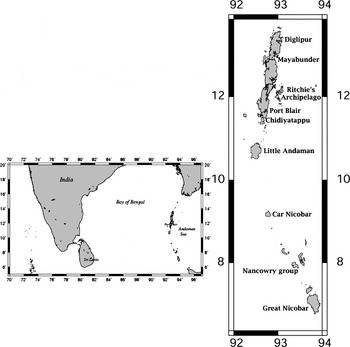
The Andaman and Nicobar group of islands consists of 572 islands, islets and rocky outcrops and have an aggregate coastline of 1962 km. The continental shelf area is very limited with an estimated area of 16,000 km2 and the sea is very deep within a few kilometres from the shore. Survey sites were chosen based on the habitat features and ease of accessibility (Figure 1). The reef areas were surveyed using SCUBA diving. Photographs were taken using a Sony Cybershot TSC900 camera with housing. Specimens were photographed in situ and were hand-collected for further taxonomic studies. In vitro photographs were also taken and the animals were preserved. The morphological features and measurements of the specimen were examined using the stereo-zoom microscope (Leica, DFC 500). The taxonomic identification was based on Newman & Cannon (Reference Newman and Cannon2003, Reference Newman and Cannon2005). No histological confirmation was made since within Pseudocerotidae species have been recognized solely on the basis of their colour patterns (Newman & Cannon, Reference Newman and Cannon1994, Reference Newman and Cannon1998). Reliability of the use of these colour patterns for species diagnosis has been confirmed with molecular data (Goggin & Newman, Reference Goggin and Newman1996; Litvaitis & Newman, Reference Litvaitis and Newman2001). All examined materials are deposited in the National Zoological Collections of the Zoological Survey of India, Andaman and Nicobar Regional Centre.
Map showing the areas surveyed.

SYSTEMATICS
Body oval or oblong, surface smooth or papillate, with prominent tentacles derived from margin, sucker central. Pharynx ruffled, anterior clearly ruffled in Pseudoceros and Pseudobiceros and not tubular as in many other families, gut anastomosing. Male copulatory complex (single or double) just behind pharynx, penis usually armed with stylet; female complex single, uterus may be greatly branched.
Flamboyantly or cryptically coloured. Body soft and delicate, raised medially, elongate oval, tapering posteriorly, margin with numerous deep ruffles. Pseudotentacles well developed. Cerebral eye spot small, horse-shoe shaped. Pharynx is generally relatively smaller, narrower and elongate-oval with ~10 to 20 shallow simple pharyngeal folds which do not divide. The symmetrical male pores are found posterior to the end of pharynx, and they are clearly separate. The female pore is clearly found between the male pores (after Newman & Cannon, Reference Newman and Cannon1994).
MATERIAL EXAMINED
One example sexually mature, size: 45 mm, date: 10 September 2010, coll. C.R. Sreeraj, registered no.: ZSI/ANRC5207.
KNOWN DISTRIBUTION
Australia, Indonesia, Micronesia, Marshall Islands, Papua New Guinea and South Africa.
NEW DISTRIBUTION
Harminder Bay (10°32.990′N 92°32.708′E), depth: intertidal, Little Andaman; Andaman and Nicobar Islands; India.
DESCRIPTION
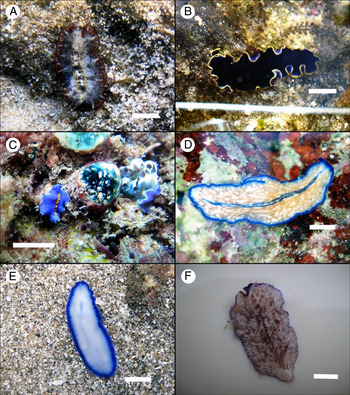
Body with thin black margin and wider orange margin crossed with white bars and tiny black spots (Figure 2A). Ventral side white with an orange margin and a black rim. Marginal band orange interrupted with white spots; narrow black rim. Cerebral eyespot small with ~50 eyes. Pseudotentacles square and ruffled.
(A) Pseudobiceros damawan; (B) Pseucobiceros flavocanthus; (C) Pseudoceros bifurcus; (D) Pseudoceros concinnus; (E) Pseudoceros gamblei; (F) Pseudoceros goslineri. Scale bar: 1 cm.

REMARKS
It is of interest to mention that P. damawan was observed to swim upside down in the field.
MATERIAL EXAMINED
One example sexually mature, size: 75 mm, date: 14 September 2010, coll. C. Raghunathan, registered no.: ZSI/ANRC5204. One example sexually mature, size: 68 mm, date: 12 September 2010, coll. C. Raghunathan, registered no.: ZSI/ANRC5205.
KNOWN DISTRIBUTION
Papua New Guinea.
NEW DISTRIBUTION
Joginder Nagar (06°56.384′N 93°54.608′E), depth: intertidal, Campbell Bay, Great Nicobar Island; B. Quarry (06°59.697′N 93°56.760′E), Campbell Bay, Great Nicobar Islands, depth: intertidal; Andaman and Nicobar Islands; India.
DESCRIPTION
Background thick black with two equal width marginal bands. Inner band bluish-white; outer band narrow, bright yellow (Figure 2B). Body margins are ruffled. Ventrally grey with same coloured marginal bands. Cerebral eyespot with ~30 eyes. Pseudotentacles small, square and slightly ruffled.
REMARKS
This species is reported to be rare by Newman & Cannon (Reference Newman and Cannon2005), but is relatively uncommon in the intertidal regions of South Andaman and Great Nicobar.
Combination of smooth dorsal surface, tentacles as folds of the anterior margin, and ruffled pharynx. Pharynx is round and oval with about seven complex pharyngeal lobes, each dividing and extending laterally. The single male pore is found between or just posterior to the last pair of pharyngeal folds and the female pore is clearly separated from the male pore (after Newman & Cannon, Reference Newman and Cannon1994).
MATERIAL EXAMINED
Two juvenile examples, size: 8–10 mm, date: 22 August 2010, coll. C.R. Sreeraj, four examples, one juvenile and three sexually mature, size: 8–10 mm, date: 11 September 2010, coll. C.R. Sreeraj.
KNOWN DISTRIBUTION
Australia, Indonesia, Japan, Madagascar, Papua New Guinea, Philippines and Thailand.
NEW DISTRIBUTION
Chidiyatappu (11°29′23.21″N 92°42′31.84″E), South Andaman, depth: 2 m; Patharnallah (10°32.935′N 92°32.673′E), Little Andaman, depth: 7 m; Andaman and Nicobar Islands; India.
DESCRIPTION
Animal blue in colour with a distinctive median stripe down the length of the body that is dark reddish-purple bordered with a white centre ending in a red tip at the front end. Lacks distinct marginal bands (Figure 2C). About 28 eyes in the cerebral eyespot and have few pre-cerebral eyespots. It has a pair of erect pseudotentacles.
REMARKS
This species was often observed feeding on colonial ascidians of the genus Eudistoma.
MATERIAL EXAMINED
One example sexually mature, size: 44 mm, date: 22 August 2010, coll. C.R. Sreeraj, registered no.: ZSI/ANRC5206. One example sexually mature, size: 65 mm, date: 12 September 2010, coll. C. Raghunathan, registered no.: ZSI/ANRC5208.
KNOWN DISTRIBUTION
Indonesia, Papua New Guinea and Philippines.
NEW DISTRIBUTION
Chidiyatappu (11°29′23.21″N 92°42′31.84″E), South Andaman, depth: 2 m; B. Quarry (06°59.697′N 93°56.760′E), Campbell Bay, Great Nicobar Island, depth: intertidal, Andaman and Nicobar Islands; India.
DESCRIPTION
Background cream to fleshy coloured, with an edging of blue all around, composed of small and larger spots running into one another. A similar blue streak runs along the median line from a little posterior to the head to some distance from the posterior (Figure 2D).
REMARKS
All the animals recorded had a white mottling pattern over the body; Newman & Cannon (Reference Newman and Cannon1994) included this species under the category with spots, dots and mottling but did not mention any mottling pattern in this species. The animal recorded was found resting on a yellow-coloured boring sponge.
MATERIAL EXAMINED
One example sexually mature, size: 40 mm, date: 16 November 2010, coll. S. Kumaralingam, registered no.: ZSI/ANRC5203.
KNOWN DISTRIBUTION
India (Arabian Sea) and Australia.
NEW DISTRIBUTION
Kalipur (13°13′26.9″N 93°02′42.0″E), Diglipur, North Andaman, depth: intertidal, Andaman and Nicobar Islands; India (Bay of Bengal).
DESCRIPTION
Background milky-white in colour with bright blue rim (Figure 2E). No spots and blotches on the body. Cerebral eyespot with ~30–35 eyes and there is a row of pre-cerebral eyes along the margin of the tentacles. This species was originally described from Minicoi, Laccadive Islands, India.
REMARKS
In the original description Laidlaw (Reference Laidlaw1902) mentions the colour as milky-white or transparent fleshy colour with purple or dark-blue colour. The animal reported by Litvaitis from Australia (http://www.discoverlife.org/mp/20q?search=Pseudoceros+gamblei) is flesh coloured where as the milky-white coloured animal is reported for the first time after its original description.
MATERIAL EXAMINED
One example sexually mature, size: 36 mm, date: 13 November 2010, coll. S. Kumaralingam, registered no.: ZSI/ANRC5202.
KNOWN DISTRIBUTION
Australia, Chagos, Indonesia, Maldives, Marshall Islands, Micronesia, Papua New Guinea, Red Sea, Somalia and Tanzania.
NEW DISTRIBUTION
Plastic Island (13°25′32.7″N 93°04′02.1″E), Diglipur, North Andaman, depth: 6 m, Andaman and Nicobar Islands; India.
DESCRIPTION
Background cream mottled with darker-brown (medially), pink and brick-red dots; concentrated brick-red dots medially appearing as irregular elongate blotches. Margin composed of blue and pink irregular dots and spots (Figure 2F). Marginal spots are numerous anteriorly across the pseudotentacles. Ventrally light violet. Cerebral eyespot with ~30 eyes. Pseudotentacles simple folds.
REMARKS
This species is relatively uncommon in these islands.
CONCLUSIONS
Pseudocerotids are thought to feed on sessile invertebrates, so the in situ study on the behaviour, feeding and habitat adds further information about them. During this work feeding observations were rare. Due to a focused and long term sampling effort, some of the highest diversity of polyclads (more than 600 species) has been recorded from the Great Barrier Reef and the Indo-Pacific (Newman & Cannon, Reference Newman and Cannon2003). In contrast, polyclad diversity in Indian waters has received no attention in the past with the exception of Laidlaw (Reference Laidlaw1902). Recently nine new pseudocerotid polyclads were recorded from Indian waters increasing the total number to 19 species (Sreeraj et al., personal communication). All species except Pseudoceros gamblei reported in this work are new to Indian waters, increasing the total number of species from India to 24.
ACKNOWLEDGEMENTS
The authors thank the Ministry of Environment and Forests, Government of India for providing the necessary facilities for carrying out the work. Our gratitude is also expressed to The Director, Zoological Survey of India for the support provided.