Introduction
Winter annual weed infestations in fields where corn (Zea mays L.), cotton (Gossypium hirsutum L.), or soybean [(Glycine max (L.) Merr.] will be planted in the spring can be troublesome for producers. Winter annual weeds compete for nutrients and water resources during the establishment of a summer crop (Bernards and Sandell Reference Bernards and Sandell2011). Stougaard et al. (Reference Stougaard, Kapusta and Roskamp1984) stated that if not controlled, winter weed vegetation following multiple months’ growth can reach heights up to 1 m. Although winter annual weeds can offer benefits such as erosion control, they can interfere with spring tillage or planting, delay soil warming in the spring, and provide a host for disease and insect pests. It has been documented that Lamium species such as henbit can serve as host for overwintering pests such as Pythium ultimum Trow, soybean cyst nematode (Heterodera glycines Ichinohe), and twospotted spider mite (Tetranychus urticae Koch) (Creech et al. Reference Creech, Webb, Young, Bond, Harrison, Ferris, Faghihi, Westpaul and Johnson2007; Kawate et al. Reference Kawate, Colwell, Ogg and Kraft1997; Smith et al. Reference Smith, Catchot, Musser and Gore2013; Venkatesh et al. Reference Venkatesh, Harrison and Riedel2000; Werle et al. Reference Werle, Bernards, Giesler and Lindquist2013).
Targeting winter weeds when small (less than 100 mm) with fall-applied herbicides provides greater control than spring applications (Hasty et al. Reference Hasty, Sprague and Hager2004; Young and Krausz Reference Young and Krausz2001). Fall-applied atrazine, rimsulfuron plus thifensulfuron, and simazine provided 93% control of mouseear chickweed [Cerastium fontanum Baumg. ssp. vulgare (Hartm.) Greuter & Burdet] and henbit prior to planting a spring annual crop (Krausz et al. Reference Krausz, Young and Matthews2003). Similarly, Monnig and Bradley (Reference Monnig and Bradley2007) reported 94% henbit control at soybean planting after application of chlorimuron plus sulfentrazone or tribenuron. Likewise, chlorimuron plus metribuzin or sulfentrazone, with or without glyphosate plus 2,4-D, applied in fall provided 99% control of purple deadnettle (Lamium purpureum L.) at soybean planting compared with 48% control following glyphosate plus 2,4-D applied 30 d before planting (Hasty et al. Reference Hasty, Sprague and Hager2004). Furthermore, winter weed management with fall-applied herbicides can reduce labor costs in the spring, aid in timely planting, and reduce vegetative cover that could lead to increased soil temperatures in the spring (Hasty et al. Reference Hasty, Sprague and Hager2004; Krausz et al. Reference Krausz, Young and Matthews2003).
Henbit is adapted to temperate areas and a wide variety of soils, where it is prevalent in more than 50 crops, roadsides, and field edges (Holm et al. Reference Holm, Doll, Holm, Poncho and Herberger1997). Roberts and Boddrell (Reference Roberts and Boddrell1983) found that 52% to 70% of henbit seed germination occurs within the first 18 mo after dispersal. Others have shown that henbit seed subjected to light for a 14-h photoperiod or complete darkness germinated at alternating temperatures of 15/6 C and 20/10 C (Baskin and Baskin Reference Baskin and Baskin1981, Reference Baskin and Baskin1984; Baskin et al. Reference Baskin, Baskin and Parr1986). Blackshaw et al. (Reference Blackshaw, Brandt and Entz2002) reported that decreasing soil temperature from 25 C to 5 C increased the time to reach 50% emergence by 13 to 16 d. Others (Roberts and Boddrell Reference Roberts and Boddrell1983; Baskin and Baskin Reference Baskin and Baskin1981, Reference Baskin and Baskin1984; Baskin et al. Reference Baskin, Baskin and Parr1986; Blackshaw et al. Reference Blackshaw, Brandt and Entz2002) have evaluated henbit emergence, but this was conducted in fields at northern latitudes, in a greenhouse, or in a growth chamber. Henbit emergence patterns have not been evaluated at southern latitudes or in warmer climates similar to those of Louisiana.
Webster (Reference Webster2013) reported that henbit is the fifth and sixth most troublesome weed in Louisiana cotton and soybean, respectively. Henbit’s troublesome nature in Louisiana crops may be due to warmer winter temperatures that promote increased emergence and growth leading to poor control following spring herbicide applications such as glyphosate plus 2,4-D. Although past research has shown the benefits of fall-applied herbicide applications, overall efficacy may be influenced by application date. Miller (Reference Miller1987) stated that timing or date of a plant species emergence is important in determining growth, performance, and survival of plants. Similar to previous research investigating henbit emergence, evaluation of control programs has been conducted in the midwestern United States, where environmental conditions do not match those in Louisiana, and henbit control data may not be applicable to locations with warmer climates. Determination of henbit’s emergence pattern would help in optimizing the date of herbicide application that would control henbit the following spring. Therefore, the objectives of this research were to survey the emergence pattern of henbit and to evaluate the effect of multiple fall application timings of residual herbicides for henbit control in Louisiana.
Materials and Methods
Henbit Emergence Survey
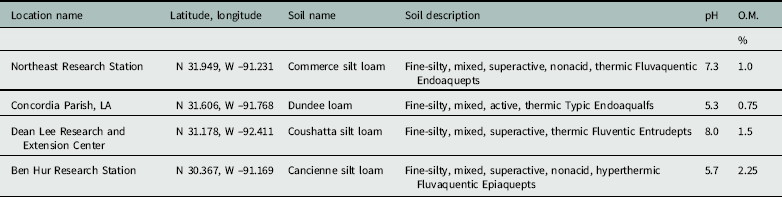
Seasonal emergence of henbit was observed in 2011–2012, 2012–2013, 2013–2014, and 2014–2015. Location name, latitude and longitude, soil name and description, soil pH, and organic matter where data were collected in all years are given in Table 1. These locations represent the primary crop production regions of Louisiana.
Name, latitude and longitude, soil name and description, soil pH, and organic matter (O.M.) at locations where seasonal emergence of henbit was evaluated.

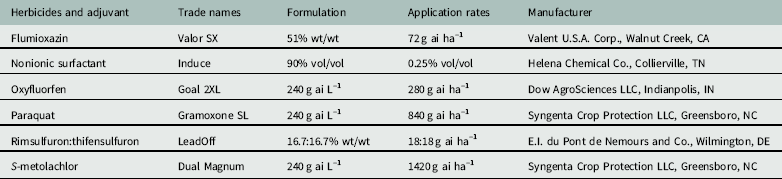
At each location, plots were established in mid-September each year in areas where corn, cotton, or soybean were produced the preceding growing season and henbit populations were known to be present. Each plot was 1 m2 replicated six times. Crop management practices prior to implementation were not considered a factor in the survey. Total number of emerged henbit seedlings were counted at weekly intervals from mid-September through late March. After each count, paraquat plus a nonionic surfactant (Table 2) was applied to remove all vegetation, so as to ensure that only newly emerged henbit seedlings were counted the following week.
Herbicide and adjuvant common and trade names, formulations, application rates, and manufacturer.

Henbit Control Programs
The study was conducted in 2012–2013, 2013–2014, and 2014–2015 at the Louisiana State University Agricultural Center Dean Lee Research and Extension Center near Alexandria, LA (31.178 N, 91.411 W). Soil was a Coushatta silt loam (fine-silty, mixed, superactive, thermic Fluventic Entrudept), with a pH of 8.0 and 1.5% organic matter.
The experimental design was a randomized complete block with 25 treatments in a two-factor factorial arrangement replicated four times. Factor one was application dates of October 15, November 1, November 15, December 1, and December 15 ± 3 d. Factor two was the residual herbicides flumioxazin, oxyfluorfen, rimsulfuron:thifensulfuron, S-metolachlor, and none. Paraquat plus a nonionic surfactant was co-applied with all residual-herbicide treatments for the control of emerged henbit at time of application and to allow for evaluation of residual-herbicide effects on henbit emergence. A nontreated plot was included for comparison in each year. Herbicide and adjuvant information and application rates are shown in Table 2. Plot size was 2 m wide by 9 m long. All herbicide treatments were applied with a CO2-pressurized sprayer calibrated to deliver 187 L ha–1 at 145 kPa using TeeJet 11002 flat-fan nozzles (Spraying Systems Co., P.O. Box 7900, Wheaton, IL 60189). Henbit density and height was 0 to 51 plants m–2 and 0 to 102 mm, respectively, at all application dates in all years.
Estimates of henbit control (0=no control; 100=henbit death or absence) were collected 50, 85, and 100 d after treatment (DAT). Evaluation dates of 50, 85, and 100 DAT correlate with winter to spring burndown application of herbicides occurring in Louisiana prior to seeding summer annual crops of corn and soybean. Henbit densities were recorded in three randomly selected 1-m2 areas in each plot 100 DAT. Heights of 10 henbit plants were collected in each plot 100 DAT. Density and height were collected to assess the influence of residual-herbicide treatments on henbit growth. Averaged across years, henbit density and height were 20 henbit m–2 and 142 mm, respectively, in the nontreated area 100 DAT. Henbit density and height data were converted to a percentage of the nontreated prior to analysis.
The MIXED procedure of SAS (release 9.4, SAS Institute, Cary, NC) was used for all analyses. Fixed effects for the model for henbit control were application date, residual herbicide, the repeated-measures effect of evaluation date, and all interactions. Random effects were year, replication, plot, and plot by evaluation date. Fixed effects for henbit density and height models were the same as henbit control, except that the repeated-measures effects for evaluation date did not apply. Random effects for the density and height models were year, replication, plot, and sample. Least-square means were calculated and separated using Tukey’s honest significant difference test (P ≤ 0.05).
Results and Discussion
Henbit Emergence Survey
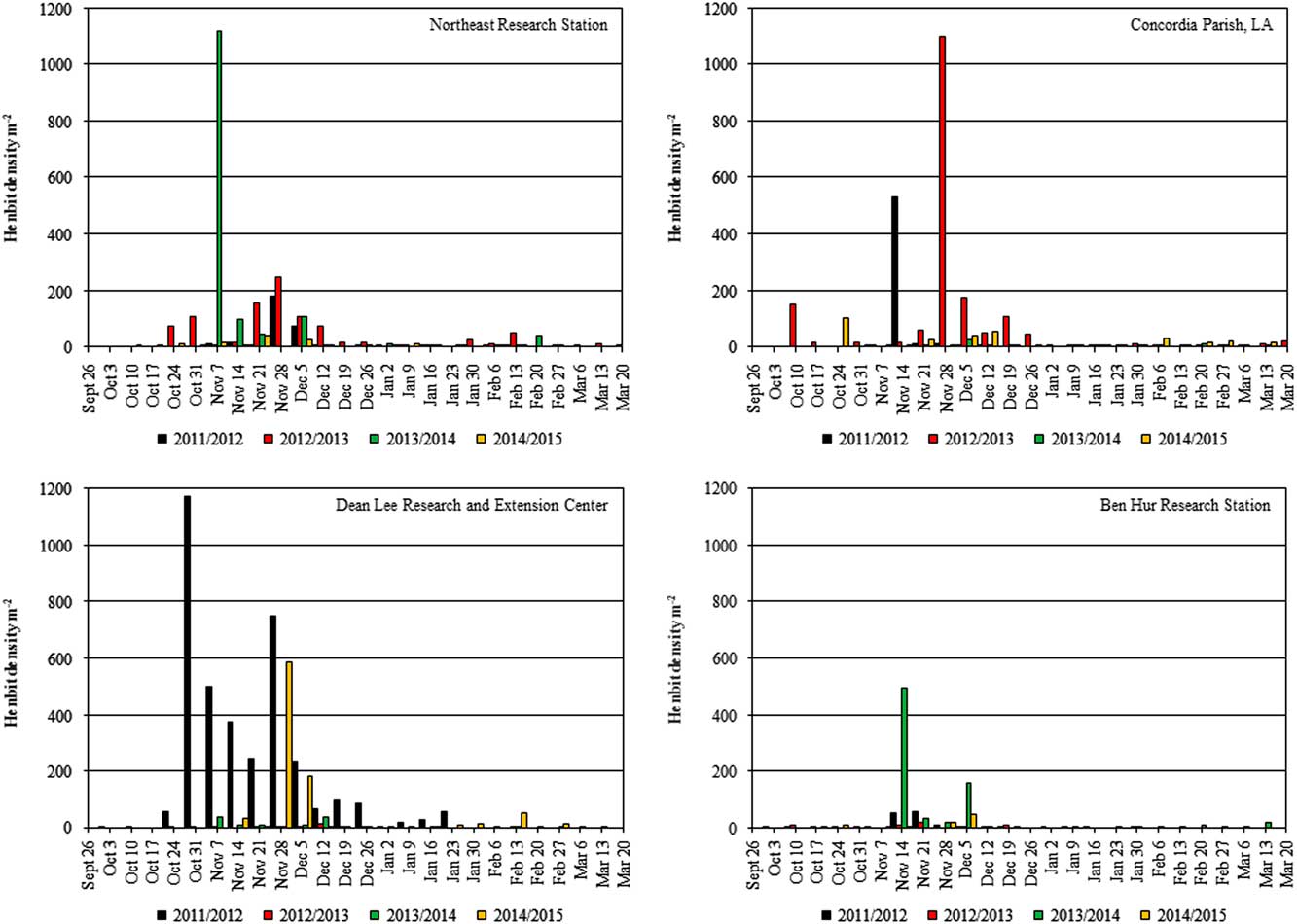
Henbit emergence occurred from September through March in Louisiana at all locations (Figure 1). Densities observed at each time of recording from September through mid-October and late December through March were typically no more than 200 henbit m–2. However, 85% to 94% of the henbit emerged between the last week of October through the first week of December at all locations. Although densities varied by year, counts during this period were as high as 1,180 henbit m–2. Also, henbit densities varied by location, with greater densities typically observed at the Northeast Research Station, Concordia Parish, LA, and Dean Lee Research and Extension Center in all years (Figure 1). A henbit management strategy should be implemented between the last week of October through the first week of December in Louisiana.
Henbit density per square meter at the Northeast Research Station, a producer field in Concordia Parish, Louisiana, Dean Lee Research and Extension Center, and the Ben Hur Research Station determined weekly from September 26 through March 20 in 2011–2012, 2012–2013, 2013–2014, and 2014–2015.

Herbicide Programs for Henbit Control
Comparison of the three-way interaction between residual-herbicide treatment, application date, and evaluation date is not of interest in this study. The focus for this research is the efficacy of four herbicide treatments and their residual activity, as assessed by evaluation date, following four application timings. Therefore, the three-way interaction (P=0.0001) is not presented. However, of great interest is the influence of application date and/or residual herbicide alone and over evaluation dates, which is shown by the two-way interactions. All two-way interactions for henbit control were significant (P=0.0001) and are presented (Tables 3, 4, and 5). The application date by residual-herbicide interaction was significant for henbit density (P=0.0001) and height (P=0.0001) as a percentage of the nontreated area. Due to high natural variability in henbit population density in the areas where the studies were conducted each year (0 to 51 henbit m–2), interpretation of the interaction for density did not correctly represent differences observed in the study. Therefore, the main effects of application date (P=0.0026) and residual herbicide (P=0.0001) for henbit density are presented.
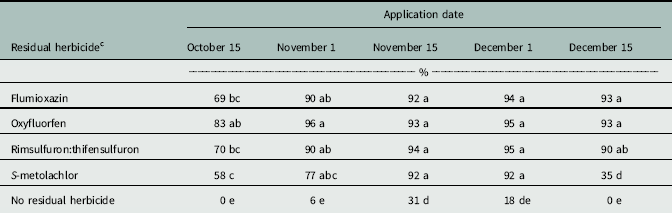
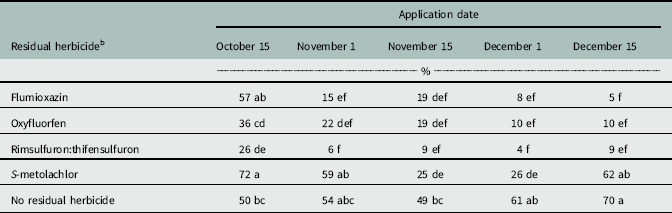
Henbit control as influenced by the interaction of residual herbicide and application date at Alexandria, LA in 2012–2013, 2013–2014, and 2014–2015 a , b .

a Data pooled over evaluation dates of 50, 85, and 100 d after treatment.
b Means followed by the same letter are not significantly different according to Tukey’s honest significant difference at P≤0.05.
c Paraquat at 840 g ai ha–1 plus a nonionic surfactant at 0.25% vol/vol was applied with all residual herbicides on all application dates.
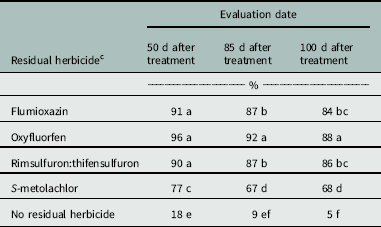
Henbit control as influenced by the interaction of residual herbicide and evaluation date at Alexandria, LA in 2012–2013, 2013–2014, and 2014–2015 a , b .

a Data pooled over application dates of October 15, November 1, November 15, December 1, and December 15.
b Means followed by the same letter are not significantly different according to Tukey’s honest significant difference at P≤0.05.
c Paraquat at 840 g ai ha–1 plus a nonionic surfactant at 0.25% vol/vol was applied with all residual herbicides on all application dates.
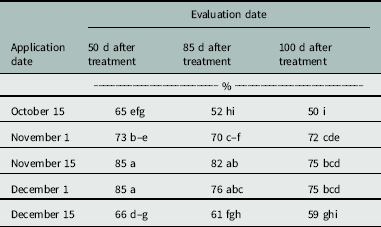
Henbit control as influenced by the interaction of application and evaluation dates at Alexandria, LA in 2012–2013, 2013–2014, and 2014–2015. a , b

a Data pooled over residual herbicides paraquat plus flumioxazin, oxyfluorfen, rimsulfuron:thifensulfuron, S-metolachlor, or no residual herbicide.
b Means followed by the same letter are not significantly different according to Tukey’s honest significant difference at P≤0.05.
Paraquat plus flumioxazin, oxyfluorfen, or rimsulfuron:thifensulfuron applied November 1 through December 15 provided 90% to 96% henbit control (Table 3). Applying S-metolachlor on November 15 or December 1 provided 92% henbit control, which was greater than control following both the October 15 and December 15 application dates and similar to flumioxazin, oxyfluorfen, and rimsulfuron:thifensulfuron (Table 3). Emergence survey results (Figure 1) support herbicide application dates of November 1 through December 15, because applications were made prior to or soon after henbit emergence. Weed control following herbicide applications is increased when applied to weeds 50 mm or less in height (Baldwin and Frans Reference Baldwin and Frans1972; Barrentine Reference Barrentine1989; DeFelice et al Reference DeFelice, Brown, Aldrich, Sims, Judy and Guetble1989). Krausz et al. (Reference Krausz, Young and Matthews2003) observed 93% henbit control prior to planting in the spring following a mid-November application of rimsulfuron plus thifensulfuron. Hasty et al. (Reference Hasty, Sprague and Hager2004) reported that chlorimuron plus metribuzin or sulfentrazone applied mid-November provided 99% control of purple deadnettle at soybean planting compared to 48% following glyphosate plus 2,4-D applied 30 d before planting.
Averaged across application date, henbit control by residual herbicide varied over evaluation date (Table 4). Flumioxazin, oxyfluorfen, and rimsulfuron:thifensulfuron provided 90% to 96% henbit control 50 DAT. However, henbit control following oxyfluorfen was greater than flumioxazin and rimsulfuron:thifensulfuron 85 and 100 DAT. Although oxyfluorfen control was greater 85 and 100 DAT, flumioxazin and rimsulfuron:thifensulfuron controlled henbit 84% to 87%, indicating that these treatments can effectively control henbit. S-metolachlor controlled henbit only 77%, 67%, and 68% at 50, 85, and 100 DAT, respectively (Table 4). S-metolachlor provided poor control following October 15 and December 15 application dates, with just 58% and 35% reductions in henbit emergence, respectively (Table 3).
When residual herbicides were applied November 15 and December 1, greater henbit control was observed 50 and 85 DAT compared to other application dates (Table 5). However, applying a residual herbicide November 1 provided control similar to the November 15 and December 1 application dates 100 DAT. This result is supported by the interaction of application date by residual herbicide (Table 3), where all residual herbicides reduced henbit emergence by 92% to 95% when applied November 15 or December 1. Similarly, Bond et al. (Reference Bond, Eubank, Bond, Golden and Edwards2014) observed greater glyphosate-resistant Italian ryegrass [Lolium perenne L. ssp. multiflorum (Lam.) Husnot] control following S-metolachlor application in November compared with a September or October application. These data indicate that paraquat plus flumioxazin, oxyfluorfen, or rimsulfuron:thifensulfuron applied November 1 through December 15 can be utilized by producers for henbit management.
Henbit density 100 DAT was 20% to 46% of the nontreated area for all application dates with differences between the November 1 (20%) and December 15 (46%) application timings (data not shown). High natural variation in henbit density each year (0 to 51 plants m–2 at all application timings) made it difficult to account for the variation with the experimental design. Such variability may explain why the application date main effect for henbit density data does not completely support henbit control and height data. Following flumioxazin, oxyfluorfen, rimsulfuron:thifensulfuron, S-metolachlor, and no residual herbicide, henbit density was 23%, 35%, 13%, 46%, and 49% of the nontreated, respectively, with only flumioxazin and rimsulfuron:thifensulfuron reducing henbit density more than S-metolachlor and no residual herbicide (data not shown). The 100 DAT evaluation date corresponds to spring burndown application prior to planting or soybean in Louisiana. Henbit density in the nontreated area was 20 henbit m–2 at 100 DAT, and application dates and residual-herbicide treatments reduced henbit density to 13% to 46% of the nontreated, which is equivalent 4 to 9 henbit plants m–2. This decrease in henbit densities may either eliminate the need or allow the producer to reduce herbicide inputs in a spring herbicide burndown application to achieve henbit control.
Henbit height ranged from 4% to 22% of the nontreated following flumioxazin, oxyfluorfen, and rimsulfuron:thifensulfuron at application timings of November 1 through December 15 (Table 6). S-metolachlor applied November 15 and December 1 resulted in henbit heights of 25% and 26% of the nontreated height, respectively. In the absence of a residual herbicide, henbit height was 49% to 70% of the nontreated, indicating that paraquat alone reduced henbit height. Henbit height data at 100 DAT may allow for estimation of henbit size prior to a spring herbicide burndown application. Others have reported that weed control is increased following herbicide application to weeds 50 mm or less in height (Baldwin and Frans Reference Baldwin and Frans1972; Barrentine Reference Barrentine1989; DeFelice et al Reference DeFelice, Brown, Aldrich, Sims, Judy and Guetble1989). Henbit height in the nontreated area was 142 mm at 100 DAT, and heights following residual-herbicide treatments were 4% to 26% of the nontreated area. This indicates that spring burndown herbicide applications would be applied to 6- to 37-mm-tall henbit, an intervention that could improve efficacy of the spring burndown herbicide application.
Henbit height as a percentage of the nontreated as influenced by application date and residual herbicide 100 d after treatment at Alexandria, LA in 2012–2013, 2013–2014, and 2014–2015. a

a Means followed by the same letter are not significantly different according to Tukey’s honest significant difference at P≤0.05.
b Paraquat at 840 g ai ha–1 plus a nonionic surfactant at 0.25% vol/vol was applied with all residual herbicides on all application dates.
Warmer climatic conditions in Louisiana allow fall-emerged henbit to continue growing throughout the winter into spring, potentially leading to poor henbit control following spring herbicide applications, such as glyphosate plus 2,4-D, before planting a summer crop. This research observed that the majority of henbit emerges from November 1 through December 15 in Louisiana; therefore, this would be the optimum time to apply paraquat plus a residual herbicide. Hasty et al. (Reference Hasty, Sprague and Hager2004) stated that fall applications for winter annual weed control were more effective, because the weeds are targeted at an earlier growth stage. Therefore, a co-application of paraquat plus flumioxazin or rimsulfuron:thifensulfuron will provide excellent residual control and reductions in density and height of henbit when applied November 1 through December 15 in Louisiana; however, oxyfluorfen will control henbit in the spring when applied October 15 through December 15. Considering that spring-applied herbicide applications do not provide acceptable control of fall-emerged henbit (70% or less), a fall-applied residual herbicide will provide crop producers an option for management of henbit.
Acknowledgments
The authors would like to thank the Louisiana Soybean and Feed Grain Research and Promotion Board for partially funding this research. In addition, we thank the support staff at the Louisiana State University Agricultural Center Dean Lee Research and Extension Center for their help with this research. No conflicts of interest have been declared. Approved for publication as journal article no. 2018-263-32046 of the Louisiana State University Agricultural Center.