Introduction
Insomnia is a common disorder. Studies in the general population indicate that one-third of adults in Western countries experience difficulty with sleep initiation or maintenance at least once a week and 6–15% are thought to meet criteria of insomnia in that they report sleep disturbance as well as significant daytime dysfunction (Leblanc et al. Reference Leblanc, Merette, Savard, Ivers, Baillaregeon and Morin2009; Sivertsen et al. Reference Sivertsen, Krokstad, Mykletun and Overland2009). Sleep problems are very common in anxiety and depressive disorders (Pearson et al. Reference Pearson, Johnson and Nahin2006). In DSM-5, the diagnosis of insomnia disorder has replaced the previous primary/secondary distinction in the classification of sleep disorders (APA, 2013) in part to reflect that insomnia is an independent risk factor for depressive and anxiety disorders (Baglioni et al. Reference Baglioni, Battagliese, Feige, Spiegelhalder, Nissen, Voderholzer, Lombardo and Riemann2011) as well as mental health disorders being a risk factor for insomnia.
The majority of insomnia patients are treated with pharmacotherapy for sleep (Sivertsen et al. Reference Sivertsen, Krokstad, Mykletun and Overland2009; Espie, Reference Espie2009). This is despite lack of evidence for long-term resolution of chronic sleep problems following either short-term or medium-term (up to 6 months) pharmacotherapy (National Institute of Health, 2005; Riemann & Perlis, Reference Riemann and Perlis2009). An alternative is cognitive behavioural therapy (CBT) for insomnia, the effectiveness of which is well established (Morin et al. Reference Morin, Hauri, Espie, Spielman, Buysse and Bootzin1999, Reference Morin, Bootzin, Buysse, Edinger, Espie and Lichstein2006; Wilson et al. Reference Wilson, Nutt, Alford, Argyropoulos, Baldwin, Bateson, Britton, Crowe, Dijk, Espie, Gringras, Hajak, Idzikowski, Krystal, Nash, Selsick, Sharpley and Wade2010) including over the longer term (National Institute of Health, 2005; Riemann & Perlis, Reference Riemann and Perlis2009). CBT for insomnia is rarely offered to patients in either mental health or primary-care services as a discrete treatment. Elements of CBT for insomnia are commonly delivered by CBT therapists and other mental health practitioners often as an adjunct to treatment of other common mental health disorders, but the effectiveness of this treatment compared to dedicated CBT for insomnia is unknown.
Cost-effective formats for delivering dedicated CBT for insomnia are available. These include internet-delivered formats (Ritterband et al. Reference Ritterband, Thorndike, Gonder-Frederick, Magee, Bailey, Saylor and Morin2009; Espie et al. Reference Espie, Kyle, Williams, Ong, Douglas, Hames and Brown2012; van Straten et al. Reference van Straten, Emmelkamp, de Wit, Lancee, Andersson, van Someren and Cuijpers2013) and short protocolized group treatments delivered by people without specialist training in CBT (Espie et al. Reference Espie, Inglis, Tessier and Harvey2001, Reference Espie, MacMahon, Kelly, Broomfield, Douglas, Engleman, McKinstry, Morin, Walker and Wilson2007, Reference Espie, Fleming, Cassidy, Samuel, Taylor, White, Douglas, Engleman, Kelly and Paul2008; Bothelius et al. Reference Bothelius, Kyhle, Espie and Broman2013). The latter have been found effective when delivered by nurses without mental health training, and are similar in format to psychoeducational groups for anxiety disorders and depression which paraprofessionals have been trained successfully to deliver (Cuipers et al. Reference Cuipers, Munoz, Clarke and Lewinsohn2009). Our study compared the effectiveness of brief groups for insomnia delivered by people without specialist training in CBT with treatment as usual (TAU) for insomnia delivered by mental health practitioners in a primary-care mental health service. In addition to evaluating the effects of treatment on sleep, the study also assessed the effects on symptoms of depression and anxiety.
Method
Design
This was a pragmatic parallel-group randomized controlled trial, comparing group CBT for insomnia with TAU for insomnia within a primary-care mental health service. The group CBT for insomnia was delivered by psychological wellbeing practitioners (graduates with limited mental health training and knowledge of CBT); the TAU for insomnia was delivered individually by the mental health worker routinely allocated to the patient in the primary-care mental health service. Allocation was on a 1:1 ratio. The study protocol and informed consent forms were reviewed and approved by the London – City Road & Hampstead Research Ethics Committee on 27 July 2011 (ethical approval reference number 11/LO/0989), and the trial was registered before starting recruitment (clinical trial registration ISRCTN17064995).
Participants
Participants were recruited from the primary-care-based Improving Access to Psychological Therapies (IAPT) services of two inner London boroughs, Camden and Islington. These services see 7000–8000 new patients a year with common mental health disorders referred by general medical practitioners together with some self-referrals. While some patients are referred to the services specifically for help with insomnia, this is a very small minority and most are referred for anxiety disorders and depression and identify insomnia as a problem at intake or in course of treatment. Participants were recruited into the study at different points in their pathway within the service – at intake, during treatment of co-morbid anxiety or depressive disorder or at conclusion of treatment of co-morbid problems – the timing of recruitment being when treatment of insomnia was being considered by participant and clinician.
Eligible participants were aged ⩾18 years and identified a concern about difficulty with sleep initiation and/or maintenance of at least 3 months’ duration. The difficulty with sleep could be the only problem for which they were seeking treatment in the service or, more commonly, was co-morbid with other common mental health problems for which they wanted treatment. Exclusion criteria were untreated major physical or mental illness or substance misuse, excessive daytime sleepiness suggestive of sleep apnoea, narcolepsy or other specific sleep disorder, or any contraindication to treatment in a group. Use of medication for sleep was not an exclusion criterion.
Interventions
Group CBT for insomnia
Group CBT for insomnia comprised attendance at five weekly 90-min group treatment sessions. Groups had 5–15 participants and were held in a local health centre or community location (e.g. town hall, library). The intervention followed a manualized treatment protocol used in three previous treatment trials (Espie et al. Reference Espie, Inglis, Tessier and Harvey2001, Reference Espie, MacMahon, Kelly, Broomfield, Douglas, Engleman, McKinstry, Morin, Walker and Wilson2007, Reference Espie, Fleming, Cassidy, Samuel, Taylor, White, Douglas, Engleman, Kelly and Paul2008), available upon request from the fourth author (C.A.E.). It included education about sleep and key CBT for insomnia components including relaxation training, stimulus control, sleep restriction, and cognitive strategies. Each group was facilitated by two IAPT psychological wellbeing practitioners, recent graduates, most but not all with psychology undergraduate degrees, who had undertaken a 1-year 1 day per week certificate course in low-intensity psychological interventions. This course provides brief training in the assessment of anxiety disorders and depression and in supporting people using self-help approaches (such as CBT-informed self-help books and online programmes) for such problems. In addition, for the study, they undertook brief specific training in group CBT for insomnia. For four workers this comprised eight web-delivered 90-min teaching sessions; three further workers attended a half-day teaching session. All workers received group monthly supervision on the CBT group treatment from a CBT therapist.
TAU
Participants allocated to TAU received individual advice and treatment for insomnia routinely provided within the IAPT primary-care mental health service. This could be from a trained CBT therapist or from a psychological wellbeing practitioner. Treatment for insomnia might involve advice about sleep hygiene, facilitation of the participant working through a booklet or book on CBT-based self-help strategies for insomnia, or individual CBT for insomnia.
As a pragmatic trial, the study interventions for insomnia were the only treatment provided by the service to some participants in both arms of the trial, while others received contemporaneous treatment within the service for other problems (depression, anxiety and psychosocial problems) or had preceding treatment for such problems within the IAPT service. Participants allocated to TAU received any contemporaneous treatment from the same worker as their TAU insomnia treatment; participants allocated to group CBT received any such contemporaneous treatment from a different worker to those delivering the group CBT. Information on treatment provided in the TAU arm, and on treatment other than group CBT in the intervention arm, was obtained retrospectively from the clinical database and electronic patient notes of the service.
Participants in both arms also received any sleep medication and advice provided by their general medical practitioners or other sources. This was not controlled for in the study. The setting for the study being the primary-care psychological therapy service, the TAU condition was treatment as usual in this service rather than treatment as usual by general medical practitioners.
Outcome measures
Participants were assessed at baseline (before randomization), at end of group treatment (for participants randomized to group CBT) or at 9 weeks post-baseline (for participants allocated to TAU), and after 20 weeks (both groups). The 9-week assessment for TAU participants was chosen as it was estimated that this would be the average time post-baseline that group CBT participants would complete their group treatment. Assessment on each occasion was by means of an online questionnaire covering all outcome measures. At baseline, the consent procedures and online questionnaire were administered either by the study workers who provided treatment in the group CBT arm or a research assistant. At the 9- and 20-week follow-ups, all participants were sent a link by a research assistant to complete the questionnaire. The research assistant was not blind to treatment allocation but their contact with most participants was limited to emailing them the link to the online questionnaire.
Sleep efficiency at end of treatment (9 weeks for TAU) was the primary outcome measure. This and other outcome measures are described below:
-
(a) Sleep efficiency. This is a standard outcome measure for insomnia, and has the advantage that it covers both sleep initiation and maintenance problems (Schutte-Rodin et al. Reference Schutte-Rodin, Broch, Buysse, Dorsey and Sateia2008). It is calculated as the percentage time in bed that is spent asleep [total sleep time/(time to get to sleep + wakeful time after sleep onset + total sleep time)].
-
(b) Sleep Condition Indicator (SCI). A brief (8-item, range 0–32), reliable (α = 0.83) patient-reported outcome measure for insomnia disorder based on DSM-5 (Espie et al. Reference Espie, Kyle, Hames, Gardani, Fleming and Cape2014). It also profiles daytime consequences of poor sleep and classifies clinical sleep status. Total SCI score and derived sleep status category scores (8–10 very good sleep, 6–8 good, 4–8 average, 2–4 poor, 0–2 very poor) give an overall measure of sleep. A modified 7-item version of the SCI, omitting the item on duration of sleep problems, was used in the outcome analyses.
-
(c) Patient Health Questionnaire-9 (PHQ-9). A 9-item self-completed scale to assess depression (Kroenke et al. Reference Kroenke, Spitzer and Williams2001; Gilbody et al. Reference Gilbody, Richards and Barkham2007).
-
(d) Generalized Anxiety Disorder-7 (GAD-7). A 7-item self-completed questionnaire to assess generalized anxiety (Spitzer et al. Reference Spitzer, Kroenke, Williams and Lowe2006; Kroenke et al. Reference Kroenke, Spitzer, Williams, Monahan and Lowe2007).
-
(e) Work and Social Adjustment Scale (WASAS). A 5-item self-completed questionnaire to assess the extent to which work and social adjustment are affected by the person's problems (Mundt et al. Reference Mundt, Marks, Shear and Greist2002).
-
(f) Client Satisfaction Questionnaire (CSQ): A measure of satisfaction with the treatment and service received for insomnia adapted from the CSQ-8 (Larsen et al. Reference Larsen, Attkisson, Hargreaves and Nguyen1979; Attkisson & Zwick, Reference Attkisson and Zwick2003) to make clear that the questionnaire items refer specifically to treatment of sleep problems. The CSQ was only administered at the post-treatment/9-week assessment point.
Sample size
We designed the study to have 80% power to detect a difference of 0.35 standard deviation units between treatments on sleep efficiency post-treatment at the 5% significance level (one-tailed test) with an anticipated attrition of 15% of patients between baseline and post-treatment. This required a sample size of 240 participants randomized at baseline. Meta-analysis of CBT for insomnia suggests an effect size of 0.50 for sleep efficiency (Irwin et al. Reference Irwin, Cole and Nicassio2006). With the pragmatic nature of the trial, the contrast being with insomnia TAU rather than no treatment, and the CBT for insomnia treatment being carried out by non-specialists, we powered for a more conservative effect size.
Randomization
Participants were allocated at random to either the intervention group receiving group CBT for insomnia or the control group receiving TAU for insomnia. Randomization was carried out through the online randomization service of the Clinical Trials Unit, Institute of Psychiatry, King's College London. Computer-generated stratified block randomization with randomly varying block sizes was used to create equal proportions between arms while stratifying according to type of presentation so that each arm had approximately equal numbers of participants who identified insomnia as the only problem for which they were seeking treatment and of participants for whom insomnia was only one of their problems for which they are seeking help in the service. The worker or researcher who administered the baseline measures entered relevant participant details into the online randomization service and informed participants of the condition to which they were assigned by the service.
Analysis
The primary outcome of sleep efficiency post-treatment was analysed by an independent data analyst blind to treatment allocation using between-groups analysis of covariance with baseline sleep efficiency score and time to assessment as the covariates. All other clinical outcome variables were analysed as secondary variables in the same way, using least squares or ordered logistic regression as appropriate (as at 20 weeks follow-up there was very little variation between groups in time between baseline and follow-up assessment, this variable was dropped as a covariate). All analyses were conducted using Stata/IC 12.1 for Mac. Adjusted means and standard errors from the ANCOVA models were used to estimate effect sizes (Hedges’ g) calculated as standardized mean differences. We checked for prognostic imbalance at baseline by examining the between group difference and associated 95% confidence intervals (CI) of each demographic and clinical variable. Sensitivity analyses were used to examine the impact of any variables with important differences by including them as covariates in the model. We investigated the effects of missing data using multiple imputation (using Stata mi impute) and applied CONSORT standards for pragmatic trials (Zwarenstein et al. Reference Zwarenstein, Treweek, Gagnier, Altman, Tunis, Haynes, Oxman and Moher2008) in data reporting. After primary and secondary outcomes had been analysed, the data analyst was unblinded to allow descriptive data about treatment received to be produced.
Results
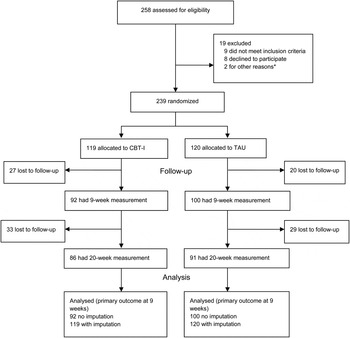
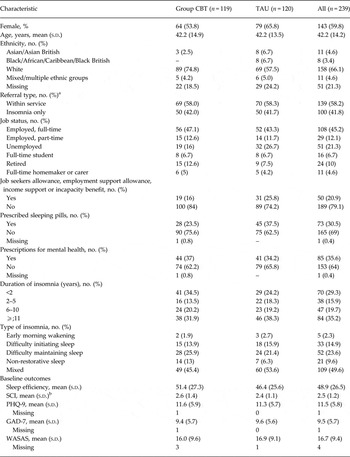
Recruitment took place between September 2011 and June 2013, ending when the planned study sample size was reached. The CONSORT diagram (Fig. 1) shows the flow of participants through the study. Of the 239 participants eligible for randomization, we obtained primary outcome data post-treatment on 192 (80%) and followed up 177 (74%) at 20 weeks. Baseline characteristics of participants in each treatment group are reported in Table 1. The two groups were well matched for age, referral type, and common mental health problems (i.e. symptoms of depression and anxiety, prescriptions for mental health problems, and work and social adjustment problems). However, there appeared to be some difference between groups in several other characteristics: participants allocated to TAU (n = 120) were more likely to be female, non-white, and to be unemployed and on welfare benefits than participants allocated to group CBT (n = 119). In terms of sleep, TAU participants had slightly poorer baseline sleep on both the primary outcome measure (sleep efficiency) and on the SCI, were more likely to be taking sleeping medication for insomnia and to have had insomnia for longer.
Flow and randomization of participants. CBT-I, Group cognitive behaviour therapy for insomnia; TAU, treatment as usual. *One person was incorrectly randomized before eligibility was properly assessed and baseline data collected. This person was excluded from all analyses.

Demographic and clinical characteristics of participants (n = 239)

TAU, Treatment as usual; GAD-7, Generalized Anxiety Disorder Scale-7; PHQ-9, Patient Health Questionnaire-9; SCI, Sleep Condition Indicator; WASAS, Work and Social Adjustment Scale.
a Stratification factor in the randomization routine.
b Eight-item version.
Outcomes
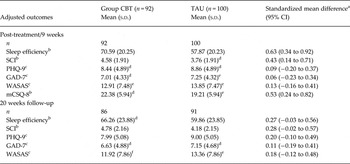
On the primary outcome (sleep efficiency), there was a medium sized effect in favour of group CBT compared to TAU at post-treatment (Table 2). On the secondary sleep outcome (SCI), there was a similar, albeit smaller, effect at post-treatment. At 20 weeks, both outcomes demonstrated small effects in favour of the intervention, but CIs were wide and included a null effect. There were no important differences between groups at either time period on depression, anxiety or work and social adjustment outcomes. At post-treatment, group CBT participants were more satisfied with their treatment as measured by the adapted CSQ-8.
Sleep and mental health adjusted outcomes at primary and secondary end-points

TAU, treatment as usual; CI, confidence interval; SCI, Sleep Condition Indicator, PHQ-9, Patient Health Questionnaire-9; GAD-7, Generalized Anxiety Disorder Scale-7; WASAS, Work and Social Adjustment Scale; mCSQ-8, modified Client Satisfaction Questionnaire-8.
a Positive values favour the intervention.
b Higher scores show better outcomes.
c Lower scores show better outcomes.
d One participant had missing data.
e Two participants had missing data.
f Three participants had missing data.
The planned sensitivity analysis using multiple imputation to calculate missing data gave similar results to the primary analysis (Supplementary Table S1), but at 20 weeks the mean adjusted difference between groups on sleep efficiency of 0.27 (95% CI 0.02–0.53) and on the SCI of 0.35 (95% CI 0.09–0.62) were now statistically significant because of the narrower CIs. Again there were no differences between groups on depression and anxiety outcomes. The planned sensitivity analysis controlling for baseline group differences in characteristics of participants with post-treatment outcome data (gender, ethnicity, sleeping medication) also gave similar results to the primary analysis (Supplementary data 1).
An unplanned sensitivity analysis, suggested by reviewers, to evaluate whether there was any difference in treatment effect between participants who identified insomnia as the only problem for which they were seeking treatment and participants who had primarily sought treatment for mental health problems, found no significant interaction between type of presentation and intervention arm on either sleep or mental health outcomes (Supplementary data 2). However, it should be noted that the study was not powered to detect such an interaction.
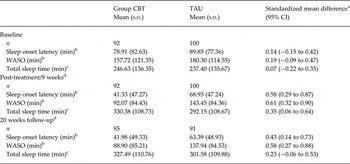
A further unplanned sensitivity analysis on the component measures that were used to calculate the primary outcome measure of sleep efficiency – time to get to sleep, wakeful time after sleep onset and total sleep time – found that effects in favour of the intervention were common to all three sleep components (Table 3).
Outcomes on sleep components used in calculation of primary outcome measure of sleep efficiency

TAU, Treatment as usual; CI, confidence interval; WASO, Wakeful time after sleep onset.
a Positive values favour the intervention.
b Lower scores show better outcomes.
c Higher scores show better outcomes.
d Means adjusted for baseline score and time to assessment.
Treatment received
In the CBT group, 32 (26.9%) participants did not attend any insomnia group CBT session. Of those who did attend, median attendance was four out of the five group sessions. Over the 20 weeks they were in the study, 48 (40.3%) group CBT participants had one or more individual psychological treatment session within the service in addition to group CBT for insomnia. In 63.9% (108/169) of these individual sessions, problems other than insomnia were the focus of treatment.
In the TAU group, 98 (81.7%) of participants had at least one individual psychological treatment session and 88 (73.3%) had at least one treatment session in which insomnia was the focus of treatment. CBT-based facilitated self-help was the most common treatment provided to TAU participants, with 89 (74.2%) receiving a mean of 2.9 facilitated self-help sessions (each session lasting 20–45 min). Thirteen (10.8%) TAU participants were treated in individual CBT.
Overall, group CBT participants received a mean of one additional treatment session (including their group CBT sessions) than TAU participants (3.9 v. 2.9 sessions) and a mean of one additional treatment session (including their group CBT sessions) with a focus on insomnia (3.0 v. 2.0 sessions) over the 20 weeks they were in the study. However, as the group CBT sessions were 90 min and the majority of TAU sessions were no more than half this length, minutes in treatment for group CBT participants over the study period was over double that of TAU participants.
Discussion
CBT for insomnia is recognized as being effective, but is seldom offered as a discrete treatment in routine mental health treatment. This trial found that a five-session group CBT treatment provided by mental health workers without specialist CBT training improved sleep post-treatment more than routine advice and CBT-based self-help for insomnia provided as an adjunct to other treatment by mental health workers. Participants were also more satisfied with the group CBT treatment. The differential benefits on sleep were maintained at 20 weeks follow-up, albeit with smaller effect size and only statistically significant on the intention-to-treat analysis.
To our knowledge, this is the first randomized comparison of a cognitive-behavioural treatment of insomnia with TAU for insomnia delivered by mental health workers. The number of treatment sessions provided was similar, with group CBT participants receiving an average of only one session more than TAU participants, although the group CBT sessions were longer than the TAU sessions. While we did not undertake a formal cost-effectiveness analysis, with the CBT treatment being provided in groups compared to the TAU being provided individually, provision of the dedicated group CBT for insomnia is likely to have been cost neutral as well as more effective.
There were no important differences between groups in depression and anxiety scores post-treatment or at follow-up. Improvements in depression following CBT for insomnia have commonly been reported (e.g. Manber et al. Reference Manber, Edinger, Gress, San Pedro-Salcedo, Kuo and Kalista2008). In this pragmatic study, embedded in a primary-care mental health service primarily focused on treatment of depression and anxiety disorders, any short-term impact of insomnia treatment on symptoms of depression and anxiety is likely to be outweighed by the concurrent direct treatment being provided for depression and anxiety. The reliable improvement in depression and anxiety symptom scores in both arms is consistent with this.
The study also contributes to the literature that people without a specialist training in CBT can successfully provide brief group CBT for insomnia (Espie et al. Reference Espie, Inglis, Tessier and Harvey2001, Reference Espie, MacMahon, Kelly, Broomfield, Douglas, Engleman, McKinstry, Morin, Walker and Wilson2007, 2008; Bothelius et al. Reference Bothelius, Kyhle, Espie and Broman2013). Others studies have trained nurses; we trained graduate paraprofessionals with a limited basic mental health training.
Strengths and limitations
The strengths and limitations of our trial are those common to pragmatic studies. A strength was that it recruited a representative population with insomnia attending a primary-care mental health service. Very few people referred to the study were excluded. The corresponding weakness is that it was consequently a very mixed population. For some participants insomnia was the only problem for which they were seeking treatment, but for the majority insomnia treatment was just one aspect of their treatment for co-morbid mental health problems. In terms of duration of insomnia, there was a wide range with a significant minority reporting less than 2 years of sleep problems but the majority having insomnia for over 5 years.
A further strength of the study is that treatment provided in the TAU arm and treatment provided in the service in addition to group CBT were recorded. Number of treatment sessions, type of treatment in each session and whether insomnia was the focus of treatment were obtained. Commonly there is no record in trials of the TAU treatment that was provided in either TAU or intervention arms.
A limitation is that the primary outcome measure, sleep efficiency, was calculated from retrospective estimates by participants of their sleep over the previous 2-week period rather than from daily sleep diary records. Retrospective estimation is likely to be less accurate than daily sleep diaries. This retrospective method was chosen as less intrusive for participants for the purposes of keeping the pragmatic trial as close to usual practice as possible. Although this and other outcome measures were obtained through participants completing an online questionnaire, the research assistants who emailed links to the questionnaire for participants to complete were not blinded to participant condition. This is a further weakness. Attrition at 20-week follow-up was high, with loss of a quarter of participants, although balanced between the study arms. However, higher attrition rates are not uncommon in pragmatic trials. The lack of cost-effectiveness analysis means it is not possible to be sure that the intervention is cost-effective compared to TAU, bearing in mind that participants in the group CBT condition had more minutes of treatment (albeit delivered in group rather than individually) than TAU participants.
While the findings are likely generalizable to similar UK primary-care psychological therapy services for common mental health problems, generalizability to other primary or secondary mental healthcare contexts is uncertain. While it is possible that dedicated CBT for insomnia delivered by non-specialists will be more effective than TAU by mental health professionals in other settings, differences in the skills of those trained to provide the group CBT, in the comparative skills of those providing the insomnia TAU and/or in the service context could result in a different balance of effectiveness and costs. Those providing the group CBT for insomnia in this study had some prior knowledge of CBT principles, but this may not be critical as the same CBT for insomnia group treatment protocol was used successfully by nurses without any prior knowledge of CBT or background in mental health in three studies (Espie et al. Reference Espie, Inglis, Tessier and Harvey2001, Reference Espie, MacMahon, Kelly, Broomfield, Douglas, Engleman, McKinstry, Morin, Walker and Wilson2007, Reference Espie, Fleming, Cassidy, Samuel, Taylor, White, Douglas, Engleman, Kelly and Paul2008). In terms of service context, as the context was a primary-care mental health service and most participants had insomnia co-morbid with anxiety disorders and depression, this will be a different population than those presenting with insomnia to GPs in routine primary care.
Clinical implications
Elements of CBT for insomnia, sometimes in the form of sleep hygiene advice, are commonly delivered by mental health practitioners as an adjunct to other treatments. But these often lack key elements and are variably implemented and so are likely to be of variable effectiveness. The relevance of this study is that it provides first direct evidence that a discrete CBT group intervention can improve sleep outcomes more than this sleep advice and TAU by mental health workers. As staff from different backgrounds can be trained briefly to deliver the group protocol, this is also an approach to clinical delivery for insomnia that is practical for mental health services to provide. With it requiring limited additional patient contact, and less individual contact, it is also an approach that is likely to be cost-effective.
The clinical significance of the improvements in sleep was not trivial. Post-treatment, CBT group participants got to sleep a mean of 27 min earlier, had 51 min less wakeful minutes after first sleep onset and slept 38 min longer compared to TAU participants. Their mean post treatment sleep was in the average range of the SCI while the TAU participants mean post treatment SCI, while improved, remained in the poor sleep range.
While there was no clear evidence in the study of a differential impact of the group CBT for insomnia in the short term on concurrent symptoms of depression and anxiety, as sleep problems are a risk factor for relapse in both depression and anxiety disorders, such an intervention may also contribute to reduced risk of relapse in these disorders (Baglioni et al. Reference Baglioni, Battagliese, Feige, Spiegelhalder, Nissen, Voderholzer, Lombardo and Riemann2011). For mental health services, where insomnia disorders, despite the evidence for their significant burden (Daley et al. Reference Daley, Morin, LeBlanc, Grégoire and Savard2009), are generally of lesser priority than depressive disorders, the potential that dedicated group CBT for insomnia might reduce risk of relapse for depression would be an important bonus.
Future research
Pragmatic studies in other mental health service contexts are needed to evaluate the robustness and generalizability of the finding that dedicated group CBT for insomnia is more effective than TAU for insomnia by mental health workers. These should evaluate cost-effectiveness as well as clinical effectiveness. There is also a need for pragmatic studies of other cost-effective CBT for insomnia treatments (e.g. online treatments) compared to TAU. Embedded within such studies, there are also opportunities for studies of mechanisms. Specifically, if discrete treatments are more effective than providing insomnia advice and treatment as part of other mental health treatment, is this because the quality of the CBT intervention is better when provided discretely or is this because patients are more motivated, concentrate better, and/or are more likely implement CBT advice when this is separate rather than when combined with advice/treatment for other mental health problems?
Evaluation of outcomes in pragmatic studies over a longer term would determine if improved sleep outcomes compared to TAU are maintained over the longer term. Maintenance of sleep gains is generally found in CBT for insomnia treatment (Wilson et al. Reference Wilson, Nutt, Alford, Argyropoulos, Baldwin, Bateson, Britton, Crowe, Dijk, Espie, Gringras, Hajak, Idzikowski, Krystal, Nash, Selsick, Sharpley and Wade2010), but has to be demonstrated against TAU. Longer term studies would also be able to clarify if effective discrete insomnia treatment is associated in pragmatic studies with reduced residual depressive symptoms and reduced risk of relapse in depression.
Supplementary material
For supplementary material accompanying this paper visit http://dx.doi.org/10.1017/S0033291715002561.
Acknowledgements
The study was sponsored and supported by Camden and Islington NHS Foundation Trust with research assistant support from the Centre for Outcomes Research and Effectiveness, University College London. The authors thank the IAPT staff who recruited the participants and delivered the interventions.
Declaration of Interest
None.