Introduction
Rape, Brassica napus (L.), is a widely grown cash crop in both the smallholder and large-scale commercial farming sectors of Zimbabwe (Turner and Chivinge, Reference Turner and Chivinge1999). Rape provides household nutritional security, since it is rich in vitamins A, B and C, minerals and roughage (Nyakudya et al., Reference Nyakudya, Jimu, Marashe and Katsvanga2010). The rape aphid, Brevicoryne brassicae L., is one of the major insect pests of leafy vegetables that reduces profitability of the crop and causes yield losses of up to 50% if not properly managed (Dube et al., Reference Dube, Gova, Makaya, Mutimutema and Turner1998). This aphid causes both direct and indirect qualitative and quantitative losses (Dobson et al., Reference Dobson, Cooper, Manyangariwa, Karuma and Chiimba2002). The variegated ladybird beetle, Hippodamia variegata (Goeze), is an active predator and voracious feeder (Sarwar, Reference Sarwar2016) and could be an effective biocontrol agent of aphids. It develops successfully to the adult stage at all prey densities (Dehkordi et al., Reference Dehkordi, Sahragard and Hajizadeh2013) and is therefore an important bio-agent in the regulation of aphid populations.
Most farmers depend on synthetic pesticides to prevent crop damage and to maintain aphid populations below the economic threshold (Kumral et al., Reference Kumral, Sultan and Yalcin2009). However, widespread and indiscriminate use of pesticides causes ecological problems, such as negative impacts on non-target organisms and bio-agents and detrimental effects on the environment (Okwute, Reference Okwute and Soundararajan2012; Kumral et al., Reference Kumral, Sultan and Yalcin2013) and threatens human health. In addition, some researchers have noted increased occurrence of resistance to existing pesticides, even those with different chemical structures (Kumral et al., Reference Kumral, Sultan and Yalcin2009). The aforementioned problems have necessitated the search for alternative and effective but biodegradable insecticides. Crude plant extracts consisting of complex mixtures of active compounds may serve as an ecofriendly option. The use of plant products with pesticidal properties is convenient, less expensive, effective and safer for humans and the environment (Peet, Reference Peet1996; Katsvanga and Chigwaza, Reference Katsvanga and Chigwaza2004; Adeyemi et al., Reference Adeyemi, Adebote, Amupitan, Oyewale and Agbaji2010; Gandhi and Pillai, Reference Gandhi and Pillai2011). The use of complex mixtures as pest control agents shows greater bioactivity compared with the individual constituents, which leads to slower resistance development (Roy et al., Reference Roy, Gurusubramanian and Nachimuthu2011; Stevenson et al., Reference Stevenson, Nyirenda, Mvumi, Sola, Kamanula, Sileshi, Belmain, Koul, Dhaliwal, Khokhar and Singh2012). Available evidence suggests that plant products have a shorter half-life in the environment compared to synthetic pesticides (Duke, Reference Duke, Janick and Sim1990; Stevenson et al., Reference Stevenson, Nyirenda, Mvumi, Sola, Kamanula, Sileshi, Belmain, Koul, Dhaliwal, Khokhar and Singh2012).
Plant products are usually inherently less toxic to humans than conventional pesticides (Sharma and Malik, Reference Sharma and Malik2012) and are regarded as compatible with biocontrol agents, as they tend to be relatively harmless to parasitoids and predators (Charleston et al., Reference Charleston, Gols, Hordijk, Kfir, Vet and Dicke2006). This may not necessarily be true as some studies found that natural organic substances and some plant extracts may have negative effects on bio-agents compared to chemical synthetic pesticides. Bahlai et al. (Reference Bahlai, Xue, McCreary, Schaafsma and Hallett2010) found that organics such as Beauveria bassiana (Balsamo) Vuillemin were as effective as synthetic pesticides against aphids but had a similar or greater negative impact on the harlequin ladybird beetle, Harmonia axyridis (Pallas). Biondi et al. (Reference Biondi, Desneux, Siscaro and Zappalà2012) also found that some organic substances such as borax plus citrus oil were toxic to the generalist predator, Orius laevigatus (Fieber). Hence it is important to investigate the impact of plant extracts on natural enemy fauna. There is need to evaluate and develop effective control options such as the use of crude plant extracts, which are readily available and affordable to resource-poor smallholder farmers (Katsvanga and Chigwaza, Reference Katsvanga and Chigwaza2004; Munyima et al., Reference Munyima, Nziweni and Mabinya2004; Mwale et al., Reference Mwale, Bhebhe, Chimonyo and Halimani2005; Fening et al., Reference Fening, Adama and Tegbe2014). Such plant extracts are often assumed to be relatively safer to natural enemies, consumers and workers than synthetic pesticides. A study was therefore, conducted to investigate the effects of crude aqueous extracts of the indigenous pesticidal plants, Datura stramonium L., Solanum delagoense L. and Bobgunnia madagascariensis (Desv.) J. H. Kirkbr. & Wiersema on ladybird beetles H. variegata.
Materials and methods
Study site
Laboratory bioassays were conducted in the Entomology Laboratory of the Department of Crop Science at the University of Zimbabwe between August 2012 and July 2013. The findings from the laboratory bioassays were used to select the treatments used for on-station plot experiments that were carried out at the Department's field plots (17°46′51″S; 31°02′37″E; altitude 1516 m). The site average annual rainfall is above 1000 mm and the mean annual temperature ranges from 15 °C in winter to 30 °C in summer.
Experimental design and treatment preparation
Laboratory bioassays
Twenty pots (20 cm × 20 cm × 20 cm) were filled with 5.E. fersiallitic soil of 32% clay, 17% silt and 51% sand (clay loam) (Nyamapfene, Reference Nyamapfene1986) texture and planted to rape, B. napus. Rape seedlings were planted in the pots to raise aphids. The infested rape leaves were later used for laboratory bioassays. Ladybird beetles were collected from the rape plants in plots from an on-station experiment and multiplied in six wooden cages measuring 60 cm long × 50 cm wide × 50 cm high. Four pots with rape plants artificially infested with aphids using a size 5 soft camel hair brush were placed in cages. The cages were covered with net (40% shade cloth) to prevent entry or exit of pests and predators. Direct topical and residual spray bioassay methods were used simultaneously but separately.
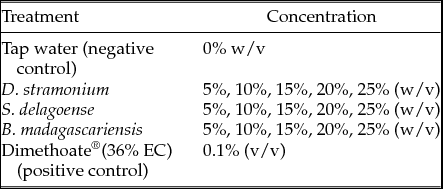
The study used a completely randomized design (CRD) with 21 treatments replicated three times. Crude extracts from D. stramonium fresh leaves, S. delagoense fresh fruits and B. madagascariensis dried pods were pounded separately, using a pestle and mortar and then homogenized. The crude plant extracts were mixed separately with tap water and left to stand for 24 h at room temperature (26 ± 1°C) (Muzemu et al., Reference Muzemu, Mvumi, Nyirenda, Sileshi, Sola, Kamanula, Belmain and Stevenson2011). The plant mixtures were sieved using nested laboratory sieves of aperture sizes 710, 500 and 250 μm. Liquid soap (Sunlight® produced by Unilever Pvt Ltd) was added at 1% w/v as a surfactant at the point of treatment application to produce a spray solution. The synthetic pesticide was prepared at spraying time and applied at the manufacturer's recommended application rate of 0.1% v/v. The crude plant extract application rates used (Table 1) were adapted from Muzemu et al. (Reference Muzemu, Mvumi, Nyirenda, Sileshi, Sola, Kamanula, Belmain and Stevenson2011) and applied using direct topical spray or residual spray method.
Treatments and concentrations used in laboratory bioassays

For the direct topical spray method, a rape leaf, cut to fit in a Petri dish (9 cm diameter), was infested with 300 aphids of mixed ages. Six adult ladybird beetles were placed in the Petri dish using a soft brush (camel hair brush size 5). A single ladybird can consume 10–100 aphids per day (Hukusima and Kamei, Reference Hukusima and Kamei1970) or approximately 200–300 aphids over 1–3 months (Verkerk, Reference Verkerk2001). The beetles were allowed to adapt to the conditions for 1 h after which the respective treatments (Table 1) were applied separately, to the rape leaf using a small 1 L knapsack sprayer until runoff (Amoabeng et al., Reference Amoabeng, Gurr, Gitau, Nicol, Munyakazi and Stevenson2013).
In the residual spray method, also referred to as the ‘leaf dipping technique’, rape leaves were cut to fit into the 9 cm diameter-Petri dish. The leaves were then dipped into the respective treatments for 10 s and were placed in Petri dishes with their underside facing upwards. The same insect-handling techniques and aphid:ladybird ratio as in the topical spray method were used. Mortalities caused by different treatments were observed and recorded at 24, 48 and 72 h post-exposure.
On station plot experiments
Cultural activities
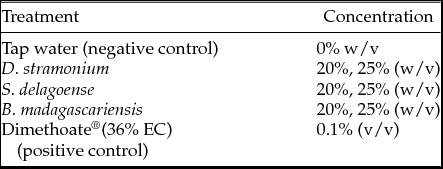
The experiments were conducted over two seasons: in summer (September–December 2012) and in winter (April–July 2013). A randomized complete block design (RCBD) with eight treatments and four blocks (replicates) was used (Table 2). Land was cleared of weeds after which raised beds were prepared. Rape seedlings, variety English Giant, were grown by Brookfield Nurseries in Harare, Zimbabwe, from certified seed. Standard agronomic practices such as weed control and watering were employed throughout the experiment. Plots measuring 250 cm × 100 cm were prepared with an inter-plot unplanted alley 100 cm wide to minimize spray drift between adjacent plots. Blocks were 100 cm away from each other. Rape seedlings were planted with an inter-row and in-row spacing of 30 cm and 20 cm, respectively, resulting in 30 plants per plot. The outer rows were considered as guard rows. Basal compound D fertilizer (7% N: 14% P2O5: 7% K2O) was applied at 5 g per rape seedling (Agritex, 2011) during transplanting. Ammonium nitrate (34.5% N) was applied at 5 g per plant as top dressing fertilizer three weeks post-transplanting (Agritex, 2011). The plants were irrigated and care was taken to avoid washing off pests and pesticides from the leaves. Aqueous crude plant extracts were prepared as explained in the laboratory bioassay. Aphids and natural enemies were allowed to infest the plants naturally. Weekly scouting for natural enemies was conducted.
Treatments and concentrations used in on-station experiments

Experimental procedures
Application of treatments commenced 28 days after transplanting. A separate 2.5 L capacity knapsack sprayer fitted with a hollow cone spray nozzle was used to apply each of the treatment spray solutions to the point of runoff (Amoabeng et al., Reference Amoabeng, Gurr, Gitau, Nicol, Munyakazi and Stevenson2013), including the underside of the leaves. Spraying was conducted in non-windy conditions and spraying height above the ground was maintained below 30 cm to minimize spray drift. Spraying was done once per fortnight and natural enemy counts assessed at 0 (before treatment application), 1, 7 and 14 days post-application. Three spraying cycles (spraying cycle constituted 14 days) were conducted in both winter and summer seasons. The entire rape plot was physically assessed to observe the number of natural enemies present per plot. The results of the spray efficacy against aphids are reported separately elsewhere.
Data analysis
Microsoft Excel was used for data capturing, storage, exploration and management. All analyses were carried out in Genstat version 14. The Shapiro–Wilk test was used to test for normality of H. variegata % mortality data. The data were found normally distributed and then subjected to Analysis of Variance (ANOVA) to test for significant differences among treatments. For on-station experiment data, covariate analysis in ANOVA was conducted to take account of the repeated measurements. Differences between treatment means were declared significant at P < 0.05 and treatment means found to be significantly different were further separated using Tukey's test at the 5% level. Laboratory bioassay mortality data for H. variegata were further subjected to probit analysis (Finney, Reference Finney1952) to calculate LD50 values.
Results
Laboratory bioassays
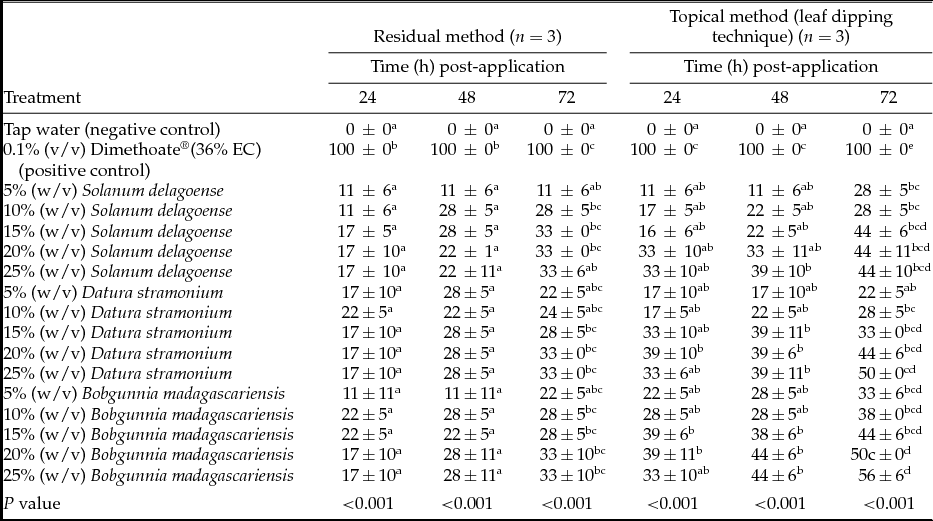
The mortality data from the residual spray method, ranged from 11% to 33% for the plant extracts compared with 0% for the negative and 100% for the positive control (Table 3). Aqueous plant extracts were effective in protecting the H. variegata on rape compared to the synthetic pesticide, which differed significantly (P < 0.05) from the plant extracts throughout the sampling time (Table 3). There were no significant differences (P > 0.05) in mortality between the negative control and pesticidal plant extracts at 24 and 48 h after application using the residual method. At 72 h post-application S. delagoense 5% (w/v) differed significantly (P<0.05) from B. madagascariensis 5% (w/v), D. stramonium 5% (w/v) and D. stramonium 10% (w/v), which also differed significantly (P<0.05) from all other plant extract treatments (Table 3). Ladybird beetle mortality from plant extract treatments increased with increasing concentration and time of exposure.
The mean % mortality (±SEM) of Hippodamia variegata in laboratory bioassays when exposed to aqueous pesticidal plant extracts using two different methods

Means within a column followed by different letters are significantly different from each other based on Tukey's test at P = 0.05.
With regard to the topical spray method, B. madagascariensis 15% and 20% (w/v), D. stramonium 25% (w/v), and S. delagoense 15% (w/v) differed significantly (P < 0.05) from the rest of the plant extract treatments 24 h after application (Table 3). Highest mortality from pesticidal plants using the topical method was recorded with B. madagascariensis 25% (w/v) 72 h post-application, which differed significantly from the other plant extract treatments (Table 3). Generally, the lower application rates of 5% and 10% (w/v) recorded less mortality compared to higher application rates for both residual and topical spray application methods (Table 3). Higher mortality rates were recorded in the topical spray method compared to the residual spray method. With both methods, B. madagascariensis at 25% (w/v) gave the highest mortality of H. variegata, whereas S. delagoense at 5% (w/v) gave the lowest (Table 3).
Probit analysis was conducted using data from the topical application method to establish the LD50 of pesticidal plants, since this method was more lethal than the residual spray method. After 24 h, S. delagoense was least toxic with an LD50 value of 49% w/v, followed by D. stramonium (34% w/v) and B. madagascariensis (30% w/v) (Table 4). After 48 h of exposure, a similar trend was observed for the aqueous extracts with regards to S. delagoense (LD50, 25% w/v), D. stramonium (LD50, 17% w/v) and B. madagascariensis (LD50, 15% w/v) (Table 5).
Laboratory bioassay (topical method) LD50 values from probit analysis for effects of pesticidal plants against ladybeetles after 24 h exposure (n = 3)

Laboratory bioassay (topical method) LD50 values from probit analysis for effects of pesticidal plants against ladybeetles after 48 h exposure (n = 3)

On-station plot experiment
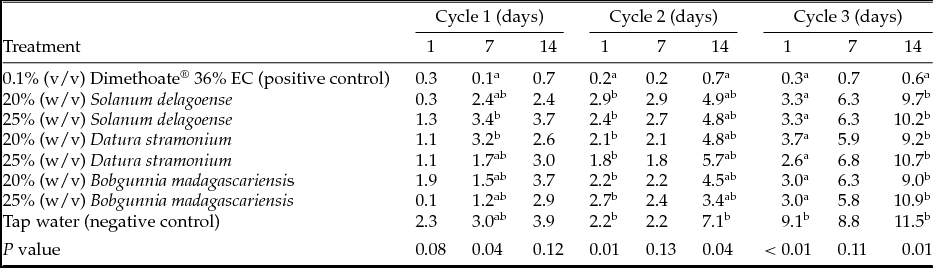
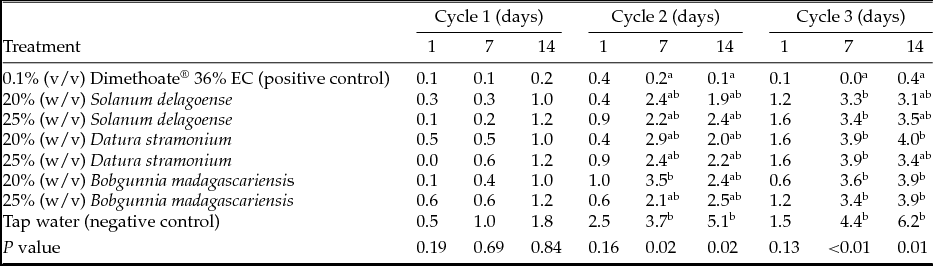
In summer, there were significant differences (P ≤ 0.04) among treatments in cycle 2 at 1 day and 14 days post-treatment; and in cycle 3 at 1 day and 14 days post-treatment (Table 6). There were significantly fewer H. variegata in Dimethoate® (36% EC) treatment than in 25% w/v S. delagoense and 20% w/v D. stramonium treatments (Table 6). There were no significant differences (P > 0.05) amongst pesticidal plant treatments throughout the spraying period (Table 6). The performance of pesticidal plant extracts was similar to that of the negative control except in cycle 3, 1 day post-exposure (Table 6). In winter, there were significant differences (P ≤ 0.02) among the treatments at cycle 2, 7 days and 14 days post-treatment and at the same intervals in cycle 3 (Table 7). The rest of the treatments showed no significant differences at 0.84 ≥ P ≥ 0.13. The pesticidal plant extracts showed no significant differences amongst themselves and where treatment differences were found, it was the dimethoate® (36% EC) treatment that had significantly lower H. variegata beetles. Numbers of surviving H. variegata beetles were higher in summer compared to winter and increased with time for all the treatments reaching the peak at cycle 3 (Tables 6 and 7), 14 days post-application.
Effects of pesticidal plant extracts on Hippodamia variegata adult counts in the on-station experiment during summer season (September to December 2012) at University of Zimbabwe (n = 4). Each cycle was 14 days long

Means within a column followed by the same letter are not significantly different from each other based on Tukey's test at P = 0.05.
Effects of pesticidal plant extracts on mean Hippodamia variegata adult count in the on-station experiment during winter season (April to July 2013) at University of Zimbabwe (n = 4). Each cycle was 14 days long

Means within a column followed by the same letter are not significantly different from each other based on Tukey's test at P = 0.05.
Discussion
In the laboratory bioassay, significantly higher ladybird beetle mortality rates from B. madagascariensis compared to D. stramonium and S. delagoense may have been due to the presence of saponins in B. madagascariensis and other antifeedant compounds such as quercetin (Stevenson et al., Reference Stevenson, Nyirenda and Veitch2010). The probit analysis also confirmed this trend based on the LD50 values of the plant extracts. Generally, the pesticidal plant extracts showed low toxicities, since they had higher LD50 values compared to the synthetic pesticide. This concurs with Charleston et al. (Reference Charleston, Gols, Hordijk, Kfir, Vet and Dicke2006) who found that Melia azedarach L. extracts and commercial formulations from the neem tree Azadirachta indica L., Neemix 4.5 did not cause mortality of the two parasitoids, Cotesia plutellae (Kurdjumov) and Diadromus collaris (Gravenhorst). This means that plant extracts or botanical pesticides may be used as substitutes for synthetic chemical pesticides in pest management programmes. When used as a component of integrated pest management (IPM) programmes, plant extracts can decrease the use of synthetic chemicals (Sharma and Malik, Reference Sharma and Malik2012). Although the two bioassay methods showed a similar trend, the topical spray method was more lethal than the residual method. The application method could determine the magnitude of direct or indirect effects on natural enemies as well as the mode of action of the pesticide (Cloyd, Reference Cloyd and Soundararajan2012).
In on-station plot experiments, the ladybird beetle population decreased 24 h post-treatment but increased as time increased reaching a peak on day 14; this may be due to rapid degradation of pesticidal plant constituents. Plant extracts are relatively unstable and breakdown significantly faster than synthetic pesticides when exposed to environmental elements such as light, high temperature and air (Sharma and Malik, Reference Sharma and Malik2012; Miresmailli and Isman, Reference Miresmailli and Isman2014) and so do not persist in the environment. The on-station plot experiments showed that the population of H. variegata was higher in summer than in the winter season. This suggests that the higher summer temperatures encouraged the growth and development of both the ladybirds and aphids. Wang et al. (Reference Wang, Tan, Guo and Zang2013) observed that ladybird beetle prey consumption by fourth instar larvae and adult females increased as the temperature and photoperiod increased. Higher temperatures (30 °C) shortened the duration of copulation and pre-oviposition and prolonged the duration of oviposition (Wang et al., Reference Wang, Tan, Guo and Zang2013). The increase in aphid population means more food for the beetles and resultant ladybird beetle population increases.
Any integrated approach to pest management must also conserve natural enemies. This was evidenced by the presence of ladybird beetles in plots treated with pesticidal plant extracts. Spollem and Isman (Reference Spollen and Isman1996) found that the reproduction of the green peach aphid, Myzus persicae (Sulzer)'s natural enemy, Aphidoletes aphidimyza (Rondani) was not directly affected by exposure to azadirachtin. However, other studies provided evidence that some botanicals are harmful to natural enemies. Castagnoli et al. (Reference Castagnoli, Luguori, Simoni and Duso2005) found that rotenone was harmful to Neoseiulus californicus (McGregor), a predator of Tetranychus urticae Koch. Similarly, Saber et al. (Reference Saber, Hejazi and Hassan2006) found that azadirachtin (Neemazal) affected life table parameters of Trichogramma cacoeciae Marchal. Hence, pesticidal plants are not necessarily safe to natural enemies. However, in-vivo studies are rare as most studies are in-vitro.
Laboratory bioassays showed that the pesticidal plant crude extracts were less lethal on ladybird beetles compared to Dimethoate® (36% EC), which caused 100% mortality. In a similar study, Amoabeng et al. (Reference Amoabeng, Gurr, Gitau, Nicol, Munyakazi and Stevenson2013) showed that Attack® (a synthetic chemical pesticide) caused a significant reduction in the numbers of ladybirds, hoverflies and spiders on cabbages. The ability of pesticidal plant extracts to conserve natural enemies is due to their ability to rapidly degrade into harmless substances (Endersby and Morgan, Reference Endersby and Morgan1991) and hence, they have no persistent detrimental effects on the environment.
Although, the integration of biological control agents and chemical control is most effective, chemical pesticides must be compatible with other pest management agents (Talebi et al., Reference Talebi, Kavousi and Sabahi2008). The current study showed that Dimethoate® (36% EC) was not compatible with ladybird beetles, an observation also made by Sigsgaard (Reference Sigsgaard2009) who demonstrated that synthetic chemical insecticides had a negative effect on populations of Cheiracanthium inornatum Koch; a predator of Helicoverpa armigera (Hübner). Natural enemies tend to be mobile on sprayed surfaces in search of prey or host and are therefore exposed to more chemical. Due to natural enemies’ susceptibility to pesticides, the use of broad-spectrum compounds harms natural enemies more than pests. This study adds to a growing body of research findings that on-farm biodiversity can improve agro-ecosystem functioning by strengthening biological control. However, some more work is required to optimize the pesticidal plant extracts’ use, so that the current application rates (20 and 25 w/v) can be reduced to more environmentally-sustainable application levels.
Conclusion
The study provides evidence that pesticidal plants conserve natural enemies and hence, can be used in IPM programmes. Farmers can use D. stramonium, S. delagoense and B. madagascariensis at the application rate of 20% w/v extracts without detrimental effects on natural enemies. However, B. madagascariensis at 25% w/v was relatively lethal to H. variegata indicating that it should not be promoted for use in IPM at this rate. The study could be the basis for prioritizing plant species in IPM. However, the 20% pesticidal plant application rate is on the high side for sustainable harvesting and use, hence further studies are needed to optimize the use of the pesticidal plants.
Acknowledgements
The authors are grateful for the funding support provided by the Organic Network Forum of Zimbabwe and the University of Zimbabwe Research Board. We are also thankful to the field staff in the Department of Crop Science, University of Zimbabwe for technical support in conducting the on-station experiment. The late Dr. David Icishahayo, Department of Crop Science, University of Zimbabwe is acknowledged for providing statistical advice.