

INTRODUCTION
In his Almagest, Ptolemy describes his planetary models and states that the apparent irregular motions of the five planets can be represented by a combination of uniform circular motions. In all his models he tries to produce these irregular motions through the use of epicycles and eccentric deferents. But as these epicycle-deferent models cannot do justice to some observations, he tries to solve the problem by developing a new geometrical device: the equant point, i.e. a point located at double distance from the center of the universe, relative to the distance of the deferent. This interesting device continued to play its role in Hellenistic and Islamic astronomy. But what was Ptolemy's reason to propose this point?
To find the eccentricities of the deferent and the equant point for the models of each of the inner planets, Ptolemy presents different arguments. In Almagest 10.3,Footnote 1 he puts forward his arguments for both eccentricities of the planet Venus. Given two greatest observed elongations of Venus at apogee and perigee, Ptolemy calculates the eccentricity of Venus's deferent (e′) and, given two observations of the greatest elongations of Venus at 90 degrees from the apogee, he calculates the eccentricity (e) of the point about which the epicycle has its uniform motion: the equant point. Then he concludes that numerical values of the two eccentricities are not exactly the same, rather e = 2e′ approximately.
Since the greatest elongation doesn't occur in outer planets, for the simple reason that they can be found at any angular distance from the Sun, their eccentricities cannot be calculated by this method. So, to calculate the eccentricity of the center of their uniform motion, Ptolemy uses another phenomenon, i.e. the oppositions. But he doesn't present any argument for the way he has found the eccentricity of the deferent. In Almagest 10.6 he just says:
For the other three, Mars, Jupiter and Saturn, the hypothesis which we find for their motion is the same and like that established for the planet Venus, namely one in which the eccenter on which the epicycle center is always carried is described on a center which is the point bisecting the line joining the center of the ecliptic and the point about which the epicycle has its uniform motion; for the case of each of these planets too, using rough estimation, the eccentricity one finds from the greatest equation of ecliptic anomaly turns out to be about twice that derived from the size of retrograde arcs at greatest and least distances of the epicycle.Footnote 2
The phrase the point about which the epicycle has its uniform motion designates the equant point. Ptolemy denotes two eccentricities which can be obtained by calculation: the eccentricity one finds from the greatest equation of ecliptic anomaly and the eccentricity derived from the size of retrograde arcs at greatest and least distances of the epicycle, the first one being twice as much as the second.
Of these two methods, the first one is used in the next chapter, Almagest 10.7, first for Mars and then for the other outer planets. To find the eccentricities of each of the outer planets, Ptolemy puts forward an argument based on three observed oppositions of them.Footnote 3 But he doesn't present the second method which he claims to produce the deferent eccentricity as one half of the eccentricity of the equant point. He gives no hint about how it has to be calculated or the way the retrograde arcs of the planets are related to the second eccentricity. Obviously this method is not the same as the one with Venus, because the arguments for the eccentricities of the Venus are based on the greatest elongations, something which is never produced in the case of the outer planets. Instead, we are faced with an argument based on the sizes of retrograde arcs.
It seems that what is at stake is not so much the origin of the eccentricity of the equant point as that of the deferent, and since Ptolemy's argument for the eccentricity of the equant point, which is based on three oppositions, is already known, the question is why he displaces the center of the deferent from the center of the uniform motion. We think that the main reason for presenting a separated center for uniform motion different from the deferent center is the difference of the results of these two arguments concerning eccentricities. For, if the results of these two arguments were equal, there would be no need to displace the center of the deferent from the center of the uniform motion, and these two points would be one and the same. Thus, as a result of this difference, Ptolemy attributes the first eccentricity to the center of the uniform motion (equant point), and the second one to the center of the constant distance (deferent center). So he displaces the center of deferent from the center of equant point and bisects the eccentricity. The origin of this point as a point separated from the center of the constant distance is somehow hidden behind the argument for the eccentricity of this very point (deferent center). In other words, the question is why Ptolemy chooses another point as the center of the deferent, instead of the center of the uniform motion itself. So we have to search for his argument for the eccentricity of the deferent.
RECENT WORKS ON PTOLEMY'S ARGUMENT FOR THE ECCENTRICITY OF THE DEFERENT
In recent decades historians of science have been interested in Ptolemy's second argument. Pedersen, Swerdlow, Evans and Jones,Footnote 4 have separately written about the subject, putting forward possible scenarios and motivations for the discovery of the equant point by Ptolemy.
Pedersen analyzes the problem and divides it into two questions. First, why does Ptolemy add the equant point to the simple epicycle-deferent model? What was his observational evidence? Second, why was the eccentricity of the deferent chosen as precisely one half of the eccentricity of the equant? As these two questions are related to each other but not the same, an answer to the second one may be an answer to the first one. Even if we find an argument for the calculation of the eccentricities of the deferent center and equant point, we would not be sure that it is the very argument which Ptolemy used to “discover” the equant point.Footnote 5
In Pedersen's view, the Almagest gives no explicit answer to the first question. But if we look for the observable consequences of the choice between the first model without the equant and the second one with the equant, it is obvious that the apparent size of the epicycle would be different in the two models and this difference would influence several phenomena: the length of the retrograde arcs, the latitude of the planet, and the distance of the planet from the observer; the latter affecting the apparent velocity of the planet in different parts of its path, particularly at the oppositions.
Swerdlow and Evans are interested in the first observational phenomenon, i.e., retrograde arcs. To them it seems the most plausible candidate for the basis of Ptolemy's calculation of deferent eccentricity, because Ptolemy himself, in the text already quoted, mentions his use of retrograde arcs to find the eccentricity of the deferent. Swerdlow provides a detailed calculation to find the eccentricity of the deferent given one half of the retrograde arcs and one half of the time of the retrograde motion at both the apogee and the perigee. These data have been extracted from the results obtained by Ptolemy in Almagest 12.6 and have been checked against observations.Footnote 6
By contrast, to find the deferent eccentricity, Jones takes into consideration the apparent velocity of the planet. In any retrogradation, the planet passes three times through the middle point of the retrograde arc. Given the time intervals and the longitude of the oppositions, Jones calculates the eccentricities of the deferent and the equant points.
THE MARĀGHA SCHOOL AND THE EQUANT POINT
As it is well-known, the question of the foundations of Ptolemaic models was discussed in Islamic astronomy at least from the 10th–11th centuries onwards. These debates resulted in the invention of non-Ptolemaic models in the 13th century by a group of astronomers known as the School of Marāgha. Al-ʿUrḍī (d. 1266 AD), al-Ṭūsī (d. 1276 AD), al-Shīrāzī (d. 1311 AD) and Ibn al-Shāṭir (d. 1375 AD), among others, are the most famous figures of this school, so called mainly because of the association of the first three with the observatory built by the Īlkhānīd monarch Hulāgū in the city of Marāgha in northwest Iran in 1259 AD.
In these astronomers' critique of Ptolemaic models, the equant point played a crucial role, because its existence seemed to contradict some principles of the Aristotelian physics, especially that of uniform circular motion. Astronomers of Marāgha devised new models to avoid non-uniform motions, without putting into doubt Ptolemy's observational data.Footnote 7 In their effort to get rid of all non-uniform motions, while preserving the equant point, it was only too natural for the Astronomers of the Marāgha School to be interested in the origin of this point.
AL-SHĪRĀZĪ AND THE EQUANT POINT
Quṭb al-Dīn al-Shīrāzī presents his astronomical theories in his three main works: Nihāyat al-Idrāk fī dirāyat al-aflāk and al-Tuḥfa al-shāhiyya in Arabic and Ikhtiyārāt-i Muẓaffarī in Persian.
Of course al-Shīrāzī was not a historian of science, but as an astronomer of the Marāgha School, for whom the non-uniform motion of the spheres was a serious problem, he was interested in the empirical origin of the introduction of the equant point in Ptolemaic models and the way through which Ptolemy had devised this theoretical device. In his book Nihāyat al-Idrāk fī dirāyat al-aflāk, he introduces his predecessors' non-Ptolemaic planetary models and remarks his objections. In Book II, Chapter 8 of Nihāya, entitled “About the Spheres of the Superior Planets and Venus and their Motions in Longitude”, he presents a model for the outer planets which he calls “Aṣl al-ḥāfiẓa wa-al-mudīr” (The Principle of the Keeper and the Director) which is, as Saliba has shown, the very model developed by al-ʿUrḍī.Footnote 8 Al-Shīrāzī's criticism of this model is based on the idea that the place of the deferent center must coincide with the point already obtained by Ptolemy, whereas in this model the deferent center is displaced to a new point, midway between the old deferent center and the equant point. Like the modern historians mentioned above, al-Shīrāzī believes that the position of the deferent center was not arbitrarily chosen by Ptolemy, so the fact that he does not present an argument for his choice doesn't mean that there is none. Then he goes on to present his suggestion and justify it by an argument.
Of the view of the problem of the origin of the equant prevailing among his contemporaries, al-Shīrāzī writes at the beginning of his text:
It is well-known among the practitioners of this art that Ptolemy placed the deferent center between the center of the universe and the equant point only by conjecture; namely he placed it between them, and built [his calculations] upon it and when his calculation accorded well with what he observed, he became sure about it.
This is exactly the view expressed by al-Ṭūsī in the eleventh chapter of his Taḥrīr al-Majisṭī (The Recension of Almagest), entitled “On the Values of the Eccentricities of the Superior Planets and the Positions of their Apogees”:
[…] I say: the way we intend to follow serves for the determination of the place of the apogee as well as the value of the eccentricity of the equant. As to the value of the eccentricity of the deferent, he found it by placing it between the two centers (as it is the case with Venus); as if he took it for premise, and built [his calculations] upon it. And when his calculated value accorded well with what he observed, he became sure about it.Footnote 9
Against this opinion, al-Shīrāzī suggests a method based on the concept of “retrograde arc”, a concept which designates by the term “the value of retrogradation” (miqdār al-rujūʿ). As far as we know, this term has been introduced in this context by al-Shīrāzī himself. It has no equivalent in the Arabic versions of Almagest,Footnote 10 and neither al-Ṭūsī in his Taḥrīr, nor his contemporary, al-ʿUrḍī, in his Kitāb al-Hayʾa, mention it. The latter writes:
He [Ptolemy] compared the mean circular motion of the stars with the real motions – I mean the observations – but when he calculated the detailed motions based on [the assumption] that the circular motion of the epicycle is relative to the equant point, […] the calculated value accorded well with observation. And when he repeated his comparisons and found it in a fixed form, he became sure about his conjecture […].Footnote 11
Again, in this quotation, there is no mention of “the value of retrogradation”. Indeed, the two authors, al-Ṭūsī and al-ʿUrḍī, may refer to Almagest 12.6, in which Ptolemy calculates the retrograde arcs of the planets on the basis of the eccentricities of each of them and states that “the amounts [of the retrogradation] we have demonstrated agree very closely, with those derived from the actual phenomena associated with each planet.”Footnote 12 Even if Ptolemy does not explicitly present this as a proof of his conjecture for the eccentricity of the deferent, probably al-Ṭūsī and al-ʿUrḍī considered it as a plausible proof of Ptolemy's conjecture.
AL-SHĪRĀZĪ'S ARGUMENTS FOR THE ECCENTRICITIES OF THE DEFERENT AND THE EQUANT POINTS
Eccentricity of the deferent
Al-Shīrāzī not only suggests an empirical origin for Ptolemy's choice of the deferent on the basis of “retrograde arc”, but also provides an argument for the eccentricity of the equant point. His argument for the eccentricity of the deferent is, in this case, similar to the one Swerdlow and Evans suggest. To calculate the size of the epicycle, he uses two separate observations of retrograde arcs at the apogee and the perigee. Then, by comparing the results, he calculates the difference between the distances of apogee and perigee to the center of the universe. Thereupon he obtains the eccentricity of the deferent.
Although the Almagest already contains an argument for the eccentricity of the equant point, al-Shīrāzī continues to develop a different method. It is based on of the eccentricity of the deferent, which has already been calculated through the previous argument, as well as on an observation made of a special opposition. The calculations have not been checked against observational numerical values. Here we first present these arguments and, in the case of the eccentricity of the deferent, we check them against the numerical values of the Almagest.
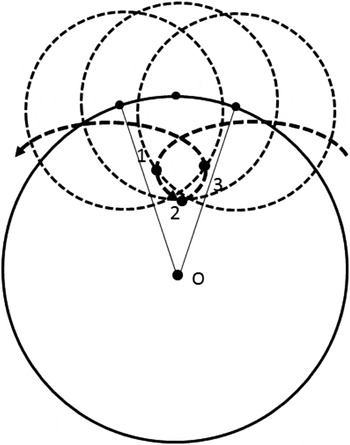
In Fig. 1 three steps of a retrogradation are represented by the points 1, 2 and 3. These points show the first station, the opposition and the second station of the retrogradation. Following the standard Ptolemaic practice in Almagest 12.2,Footnote 13 al-Shīrāzī shows these three steps on one and the same epicycle as shown on Fig. 2.
Fig. 1.

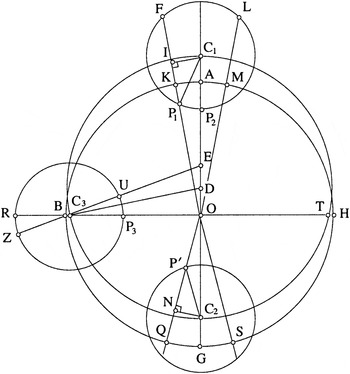
Fig. 2.

In Fig. 2, two epicycles at points C1 and C2 can be seen, each of them showing these three steps on one circle. Of these two circles, one is centered on the apogee (C1) and the other is centered on the perigee (C2). With O and D as center, we draw two circles. The point O is the center of ecliptic (circle ABG), the point D is the center of the deferent (circle C1C2) and E is the equant point. The planet is in the station at P1 and in the opposition, when the center of the epicycle is at the apogee, at P2. Moreover, when the center of the epicycle is close to the perigee, the planet is at the station at P′. If the center of the epicycle is considered to be fixed, these two angles P1OC1 and P′OC2 would represent the halves of the apparent distances covered by the planet on its epicycle. Unfortunately al-Shīrāzī presents these two angles as the halves of the retrograde arcs; which is obviously wrong.Footnote 14 We will discuss the consequences of this mistake in detail later.
Al-Shīrāzī continues: we drop a perpendicular from C1 to the line OP1 which crosses it at the midpoint I (Fig. 2). According to the theorem of Apollonius,Footnote 15 when the planet is at the stationary point, we have:
 $$\displaystyle{{{\rm IP}_1 } \over {{\rm P}_1 {\rm O}}}=\displaystyle{{{\rm v}_{\rm c} } \over {{\rm v}_{\rm p} }}$$
where vp is the angular velocity of the planet on the epicycle and vc is the uniform angular velocity of the center of the epicycle. Al-Shīrāzī concludes:
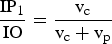 $$\displaystyle{{{\rm IP}_1 } \over {{\rm IO}}}=\displaystyle{{{\rm v}_{\rm c} } \over {{\rm v}_{\rm c}+{\rm v}_{\rm p} }}$$
In the next step we have,
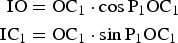 $$\eqalign {{\rm IO}&={\rm OC}_1 \cdot \cos {\rm P}_1{\rm OC}_1\cr \quad {\rm IC}_1&={\rm OC}_1 \cdot \sin {\rm P}_1{\rm OC}_1}$$
where OC1 = 60.Footnote 16
So, given the retrograde arc at the apogee, al-Shīrāzī concludes that we can calculate the radius of the epicycle:
 $${\rm r}_1={\rm C}_1{\rm P}_1=\sqrt {{\rm IP}_1^2+{\rm IC}_1^2}.$$
Similarly, it is possible to calculate the radius of the epicycle on the basis of the retrograde arc at the perigee:
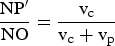 $$\displaystyle{{{\rm NP}^{\prime}} \over {{\rm NO}}}=\displaystyle{{{\rm v}_{\rm c} } \over {{\rm v}_{\rm c}+{\rm v}_{\rm p}}}$$
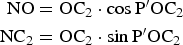 $$\eqalign {{\rm NO}&={\rm OC}_2 \cdot \cos {\rm P}^{\prime}{\rm OC}_2\cr \quad {\rm NC}_2&={\rm OC}_2 \cdot \sin {\rm P}^{\prime}{\rm OC}_2}$$
where OC2 = 60. Then
 $${\rm r}_2={\rm C}_2{\rm P}^{\prime}=\sqrt {{\rm NP}^{\prime 2}+{\rm NC}_2^2 }.$$
Now we have two values for the radius of the epicycle, the first one is in the units where C1O = 60 and the second one is in the units where OC2 = 60. But these two values refer to one and the same thing, i.e. the radius of the epicycle; so we can calculate OC2 where C1O = 60:
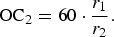 $${\rm OC}_2=60 \cdot \displaystyle{{r_1 } \over {r_2 }}.$$
Thereupon OD, the eccentricity of the deferent, is known;
 $${\rm OD}=1/2\;({\rm OC}_1 - {\rm OC}_2).$$
The eccentricity of the equant point
Now we go on to discuss al-Shīrāzī's own method for the calculation of the eccentricity of the equant point. One can suppose an opposition with the Sun at H, 270 degrees from the planet's apogee, while the center of the epicycle is at C3 (90° from its apogee) and the planet is at P3 (Fig. 2). One can find the mean motion (angle C1EC3) of the planet from the astronomical tables. Now, if one subtracts the mean motion of the planet from the mean motion of the sun, the remainder is the mean anomaly of the planet (ZC3P3)
 $${\rm ZC}_3{\rm P}_3={\rm C}_1{\rm OH} - {\rm C}_1{\rm EC}_3$$
and the greatest equation (EC3P3) of the planet is:Footnote 17
 $${\rm EC}_3{\rm P}_3=180 - {\rm ZC}_3{\rm P}_3$$
where ZC3P3 is the mean anomaly (the distance covered by the planet on the epicycle, measured from the mean apogee), C1OH is the mean motion of the Sun (= 270°) and UC3P3 is the greatest equation of the planet. Thus one can find the line segments EO* and OC*3 where EC3 = 60.
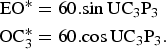 $$\eqalign{{\rm EO}^{\ast}&=60.{\rm sin}\,{\rm UC}_3{\rm P}_3\cr \quad {\rm OC}^{\ast}_3&=60.{\rm cos}\,{\rm UC}_3{\rm P}_3.}$$
Then it is possible to obtain OC3, where OC1 = 60. OD and DC3 (DC1 = OC1 – OD) are related through the following formula:
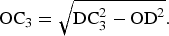 $${\rm OC}_3 =\sqrt {{\rm DC}_3^2 - {\rm OD}^2 }.$$
Then one can find OE where OC1 = 60,
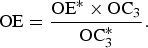 $${\rm OE}=\displaystyle{{{\rm OE}^{\ast} \times {\rm OC}_3 } \over {{\rm OC}_3^{\ast} }}.$$
These two arguments can be summarized as follows:
1. Given the retrograde arcs in the perigee and the apogee, we obtain the epicycle radius and, given the epicycle radius, we obtain the deferent eccentricity.
2. Given the mean motion of the planet in opposition, a quadrant from the apogee, and the eccentricity of the deferent, we obtain the equant eccentricity.
Al-Shīrāzī believes that if one applies these calculations, the numerical value of the equant eccentricity becomes twice as much as the numerical value of the deferent eccentricity.
NUMERICAL CALCULATIONS
In what follows, we use observations of the retrograde arcs of MarsFootnote 18 to calculate the eccentricity of the deferent by the method al-Shīrāzī suggests. We have:
Maximum retrograde arc at the apogee: 20° in 80 days;
Minimum retrograde arc at the perigee: 12° in 64 days.
Angular Velocity of the center of the epicycle (vc): 0;31 minutes per day;
Angular Velocity of the planet (vp): 0;27 minutes per day.
If one ascribes (as al-Shīrāzī wrongly suggests) halves of the observed retrograde arcs at apogee and perigee (10° and 6°) to P1OC1 and P′OC2, not only the final value for the eccentricity of the deferent (OD) would be negative (!) and far from the expected value (ePtolemy = 6) but also the calculated values for the radius of the epicycle (r1 and r2) would not be in a good agreement with the Ptolemaic value (rPtolemy = 39;30). Table 1 shows the results obtained by calculation according to the method of al-Shīrāzī.

In fact halves of retrograde arcs (λa and λp) are related to the angles P1OC1 and P′OC2 through the following formulas:
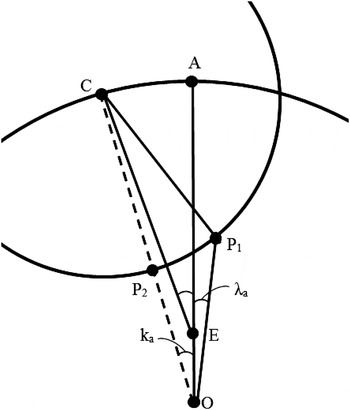
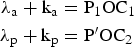 $$\eqalign{\lambda_{\rm a}+{\rm k}_{\rm a} & ={\rm P}_1{\rm OC}_1\cr \quad \lambda_{\rm p} + {\rm k}_{\rm p} & ={\rm P}^{\prime}{\rm OC}_2}$$
where ka is the eccentric anomaly when the planet is at the station near the apogee, and kp is the eccentric anomaly when the planet is at the station near the perigee. Angles λa and λp are halves of the retrograde arcs at the apogee and the perigee; they can be obtained through observation (Fig. 3).Footnote 19 But, as was mentioned before, al-Shīrāzī doesn't take into account these relations and wrongly presents angles P1OC1 and P′OC2 as the retrograde arcs.
Fig. 3.

To find the true values of P1OC1 and P′OC2, one has to know eccentric anomalies (ka and kp) of the planet, when the planet is at the station near the apogee and the perigee. But to know these values, one needs to know the distances of the apogee and the perigee to the observer, i.e. the eccentricity of the deferent.
THE EFFECT OF THE EQUANT POINT ON RETROGRADE ARCS
As Evans has shown,Footnote 20 in a simple eccentric model the apparent size of a retrograde arc at the perigee is larger than the same arc at the apogee. Since the planet is closer to the observer at perigee, it makes a bigger apparent arc in the sky. But the observations show the contrary, namely the retrograde arcs attain their greatest value at the apogee and their least value at the perigee. For example, the retrograde arcs of Mars are as follows:
Maximum at apogee: 20° in 80 days;
Minimum at perigee: 12° in 64 days.
So Ptolemy finds a new eccentricity on the basis of these observations and presents it as the eccentricity of the deferent, but keeps the previous eccentricity for the center of the uniform motion (the equant point). In this new model we have two eccentricities, the first for the equant point and the second for the deferent center. Thereupon the equant point affects the velocity of the center of the epicycle, so that it rotates faster at the perigee and slower at the apogee. In this manner the planet retrogrades in a longer path at the apogee and a shorter path at the perigee, and produces larger and smaller arcs in the sky, as the observations show. This variation in the retrograde arcs is the result of the non-uniform motion of the center of the epicycle with respect to the center of the deferent.
Swerdlow considers these parameters and obtains a very good agreement with Ptolemy's values.Footnote 21 But in taking the angles P1OC1 and P′OC2 as the retrograde arcs, al-Shīrāzī ignores the main property of the equant point. In fact the equant point affects the velocity of the center of the epicycle which determines the angles ka and kp, the angles that is ignored by al-Shīrāzī.
CONCLUDING REMARKS
Ptolemy provides an argument for the eccentricity of the superior planets. He ascribes this eccentricity to the center of the uniform motion (equant point) and, without any argument, considers that the eccentricity of the deferent is half of the former. This argument plays a key role in finding out why Ptolemy displaces the deferent center from the equant point. Although Ptolemy mentions “retrograde arcs” as the empirical origin of this unknown argument, neither the Arabic versions of Almagest, nor the works of al-Shīrāzī's contemporaries mention these arcs explicitly. Al-Shīrāzī in his Nihāya not only suggests the “retrograde arcs” as the empirical origin of the eccentricity of the deferent but also provides an argument based on the observed values of these arcs to calculate this eccentricity.
Although al-Shīrāzī's argument is not without difficulty, his suggestion is in line with the suggestions of the historians of science in recent decades, and shows his interest, as an astronomer, in the empirical origin of this geometric device, i.e. equant point, in the mathematical astronomy of his time.
More research is needed to decide whether al-Shīrāzī is the first scholar, in Islamic period, to have found the empirical origin of the equant point. A point to be noted is that, apart the manuscripts of al-Shīrāzī's Nihāya, this text also exists as a fragment added at the end of the Astan Quds's manuscript of al-Ṭūsī's Taḥrīr al-Majisṭī by an unknown copyist. This fragment is the same as the text we find in Nihāya, but the copyist doesn't present it as such, rather he thinks it may belong to Thābit Ibn Qurra (d. 901). We couldn't find anything related to this subject in the extant works of Thābit Ibn Qurra.Footnote 22 Further studies may reveal the connection between this fragment of Nihāya and Thābit.
This quotation at the end of a copy of al-Ṭūsī's Taḥrīr al-Majisṭī by a probable informed copyist shows that the problem remained important for the scholars from the time of al-Shīrāzī to the time of this copy of Taḥrīr, i.e. 1092 AH/1681 AD.
Acknowledgments
The research leading to this paper was supported by a grant from the Iranian Institute of Philosophy. We thank the Research Council of this Institute.
TEXT AND TRANSLATION
The text presented here is based upon two manuscripts of Nihāya, and a fragment added at the end of the Astan Quds's manuscript of al-Ṭūsī's Taḥrīr al-Majisṭī by an unknown copyist.
[ت] Nihāyat al-Idrāk, Library of Tehran University, Tehran, MS 7070, ff. 82v–83r
[م] Nihāyat al-Idrāk, Malek Library, Tehran, MS 3506, fols. 85v–86v
[ق] Taḥrīr al-Majisṭī, Astan Quds Library, Meshed, MS 5452, fols. 100v–101v
English Translation
[…] It is well-known among the practitioners of this art that Ptolemy placed the deferent center between the center of the universe and the equant point by conjecture; namely he placed it between them, and built [his calculations] upon it, and when his calculation accorded well with what he observed, he became sure about it, but what he did had not a demonstrative basis. However, what they have guessed is not true. In fact the location of the equant point is determined through observations and geometrical arguments. The same is true of the center of the deferent; even if its argument is not mentioned in Almagest and is not so well-known. That is why the people were misled. Since this is the case for this argument and there is no definite place to mention it, it is better to mention it here. We say – and our success depends on God:Footnote 23
Ptolemy observed the values of retrogradations over successive years, until he found the least and the greatest retrogradations. [By retrogradation] I mean the degrees covered by each planet in its retrograde motion in the ecliptic from the first station to the second. He inferred that the least value corresponds to the position in which the center of epicycle is on the apogee at the mid-time of retrogradation, and the greatest value corresponds to the position in which the center of epicycle is on the perigee [at the mid-time of retrogradation]. In this way, if the planet inclines a little bit from the exact position, in one sense or other, at this time, this would not result in a sensible error. Knowing these two values he then passed on to the calculation of the required [eccentricity] by the way I will go through.
Let [the circle] ABGH about point O be the paraecliptic, C1C3C2T about point D the deferent, AG the apsidal line and BC3OTH the perpendicular to it. We assume E as the equant point and we draw an epicycle about each one of [the points] C1, C2 and C3. We take the arcs KM and QS as the least and the greatest values found for the retrogradations respectively. We join OML, OP1F, OS, OQ, DC3 and EC3Z. Since, at the mid-time of the retrogradation the center of the epicycle is on C1, [the arcs] AK and AM are equal and so are the angles AOK and AOM. Then angle C1OK is half of the retrograde arc and P1 is the position of the first station. We draw C1P1 and C2P′, each equal to the half of the diameter of the epicycle, and we drop [lines] C1I and C2N perpendicular to [lines] OF and OQ. Since the ratio of [lines] IP1 to P1O is equal to the ratio of the motion of the center or the epicycle to the motion of the planet, the ratio of [lines] IP1 to IO is equal to the ratio of the motion of the center or the epicycle to the sum of the motions. This amount (the ratio of the motions) is given, because Ptolemy took the two motions from the ancients' tables without correcting it, since this does not introduce any great error in the ratio. Thus the ratio of [lines] IP1 to IO is given, the angle IOC1 is given by observation and the I is a right angle. Thus each one of [lines] C1I and IO is given, according to the value by which C1O is sixty. So we multiply IP1, according to the first value, by IO, according to the second value, and divide the product by IO, according to the first value, and the result will be IP1, according to the second value, that is according to the value by which IC1 is sixty and I is a right angle. Thereupon C1P1 – half of the diameter [of the epicycle] – will be known, according to the value by which OC1 is sixty.
Since the arc GQ or the angle C2OQ – that is, half of the retrograde arc when the center [of the epicycle] is at the perigee – is given by observation, [the point] P′ is the position of the second station and the ratio of NP′ to NO is given, therefore C2P′ – half of the diameter of the epicycle – is given, according to the value by which OC2 is sixty. OC2 will be known, according to the value by which OC1 is sixty, by multiplying the first [value of] C2P′ – that is, half of the diameter of the epicycle, according to the value by which OC1 is sixty – to OC2 [which is] sixty and dividing the product by the second value of C2P′ – which is half of the diameter of the epicycle, according to the value by which OC2 is sixty, then the result will be OC2, according to the value by which OC1 is sixty. Then we add it to the latter and divide it by two. Therefore each one of [lines] DC1 and DC2 will be known and OC2 will be known, thereupon OD will be known owing to the retrogradations.
Therefore we follow the way he (Ptolemy) observed the sun when its distance from the apogee of the planet – which is obtainable from the ancients' calculations – was two hundred and seventy degrees on its path from the opposition with the planet. So that when the sun is at H, the planet is at P3 and the center [of epicycle] is at C3, and all of them are on the line perpendicular to AG. Then he took the mean motion of the planet from the ancients' tables, subtracted it from the mean motion of the sun and what remained was the mean anomaly, which is the arc ZP3 – distance of the planet from the mean apogee Z. Then he subtracted it from 180 and the result was the arc UP3, in this way he found the angle EC3O which is the first equation, i.e. the equation of the center and anomaly. Since the epicycle center is at the mid-distance according to the motion, this equation is the greatest one. O is a right angle and each one of the [lines] OE and OC3 will be known according to the value by which EC3 is sixty. Since each one of OD and DC3 is known, where OC1 is sixty, then the line OC3 is known in this units, and OE is known by multiplying OC3 – where OC1 is sixty – by OE – where EC3 is sixty – and divide the product by OC3 – where EC3 is sixty. The result is OE, where OC1 is sixty. This size is twice OD which is known in this unit.
Since he took the motions and the above ratio out of ancients' tables without correction, he said in his book (Almagest) that he found that this line (OE) is approximately twice that line (OD).Footnote 24 So it was thought that he has found it by guess and conjecture, without any demonstrative base. This being the case, it is not allowed to change the distance of the equant point from the center of the universe as it is not allowed to change the distance of the center of the deferent from the position at which Ptolemy located it, because both of them are based on demonstration, as we showed. We say, as an answer to his (al-ʿUrḍī's) argument, that the demonstration shows that the distance between the center of the universe and the middle of the line joining the nearest and the farthest positions of the center of the epicycle (namely the center of the deferent) is half of the distance between the center of the universe and the equant point […].
Arabic Text
[...] وإن اشتهر في لسان أهل الصناعة أن بطلميوس إنما حکم بکون مرکز الحامل بين مرکزي العالم والمعدل ظنًا منه، بأن فرَضه بينهما وبنی عليه، فلمّا وافق محسوبُه المرصود اطمأن إلی ذلك ولم يکن مستنده في ذلك برهانيًا، فليس الأمر کما ظنوا بل إن مرکز معدل المسير عيّنه الأرصاد والبراهين الخطوطية. کذلك مرکز الحامل، إلا أن برهانه لم يذکر في المجسطي ولم يشتهر اشتهار غيره. فلذلك وقع الناس فيما  . وإذا كان حال هذا البرهان هذه وليس له موضع معين يحيل عليه، فالأولی أن نذکره ههنا، فنقول -
 التوفيق:Footnote 25
إن بطلميوس أخذ بالرصد في سنين متوالية مقدار الرجوع، أعني الدرج التي يرجع فيها الکوکب من الفلك البروج، من الوقوف الأول إلی الوقوف الثاني. حتی وجدمن مقادير الرجوعات أصغر ما يکون وأعظم ما يکون. فاستدل بالأصغر علی کون مرکز التدوير في الأوج في وسط زمان الرجوع وبالأعظم علی کونه في الحضيض. کذلك علی أنه لو  عن حاقّ البعد إلی الجانبين في ذلك الوقت أدنی زوال لم يقع في الحساب من قبل ذلك غلط محسوس. ثم صار من معرفة هذين المقدارين إلی وجود المطلوب بالطريق الذي أسلکُه.Footnote 26
فليکن  علی مرکز ه الممثل و
 علی مرکز ل الخارج
 القطر ﺍلمار بالمرکزين و
 القائم عليه علی قوائم ونفرض م مرکز معدل المسيروندير علی کل واحدة من
 تدويرا ونعمل علی أن قوس
 أصغرما وجد من مقادير الرجوعات
 أعظم ما يکون منها. ونخرج

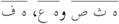 و
 . فلأن مرکز التدوير يکون عند
 في وسط زمان الرجوع، يتساوي
 وکذا زاويتا
 فزاوية
 نصف مقدار الرجوع و
 موضع الوقوف الأول. ونخرج
 نصفي قطري التدوير وعمودي
 علی
 . فلأن نسبة
 إلی
 کنسبة حرکة المرکز إلی حرکة الکوکب، فنسبة ذث إلی ذه تکون کنسبة حرکة المرکز إلی مجموع الحرکتين. وهي معلومة علی أخذ بطلميوسFootnote 27 الحرکتين من جداول القدماء قبل أن يصححها إذ لم يقع في النسبة کثير خطاءٍ. فنسبة
 إلی
 معلومة وزاوية
 معلومة بالرصد وزاوية ذ قائمة فکل واحد من
 معلوم بالمقدار الذي به
 ستون. فنضرب
 بالمقدار الأول في
 بالمقدار الثاني ونقسم الحاصل علی بالمقدار الأول فنخرج بالمقدار الثاني، وهو الذي به ستون وزاويه ذ قائم. فـ
 نصف القطر معلوم بما به
 ستون.
ولأن قوس بل زاوية
 نصف مقدار الرجوع إذا کان المرکز في الحضيض معلومة بالرصد وخ موضع الوقوف الثاني ونسبة
 إلی
 معلومة، يصير
 نصف قطر التدوير بما به
 ستون معلوما. ويصير بما به
 ستون معلوما بأن نضرب الأول وهو نصف قطر التدوير بما به
 ستون في
 الستين ونقسم الحاصل علی
 الثاني وهو نصف قطر التدوير بما به
 ستون، فنخرج بما به
 ستون ونزيد عليه وننصفه فيکون کل واحد من
 معلومًا و
 معلوم، فـ
 يصير معلومًا من قِبل الرجوع.
ثم نعمل علی أنه رصد الشمس حين بعد من أوج الکوکب المستخرج بحساب القدماءوهومأتين وسبعين جزءً لمسيرها المعدل عند مقابلتها للکوکب، حتی يکون الشمسعند د والکوکب علی ظ والمرکز علی  جميعها علی الخط القائم علی
 .ثمأخذ وسط الکوکب من جداول القدماء فَنَقَصه من وسط الشمس بقيت الخاصةالوسطی وهي قوس
 بعد الکوکب من الذروة الوسطی وهي ت. ثم أخذمابقي إلی قف وکان قوس ط غ، فعلم زاوية
 وهي التعديل الأول أعني تعديل المرکز والخاصة. ولکون مرکز التدوير في البعد الأوسط بحسب الحرکة يکون هذا التعديل أعظم ما يکون وزاوية ه قائمة وصار کل واحد من
 معلوما بما به
 ستون. ولأن کلاً من
 معلوم بما به
 ستون، يصير
 معلوما بذلك المقدار، وکذا
 بأن نضرب
 بما به ستون في بما به
 ستون ونقسم ما بلغ علی
 بما به Footnote 28 ستون فنخرج
 بما به
 ستون ويکون ضعفًا ﻟ
 المعلوم بهذا المقدار.
ولأنه استخرج الحرکات والنسبة المذکورة في جداول القدماء قبل التصحيح، قال في کتابه إنه وجد هذا الخط ضعف ذلك الخط بالتقريب. فظُنّ به أنه أخذه حدسا وتخمينا من غير مستند برهاني. واذا کان کذلك، فکما أنه لا يجوز تغيير بعد مرکز معدل المسير عن مرکز العالم، کذلك لايجوز تغيير بعد مرکز الحامل عما وضعه بطلميوس لأن مستند کل منها برهاني کما بيّنّا. قلنا الجواب عنه، هو أن البرهان إنما دلّ علی أن بعد منتصف البعدين الأبعد والأقرب لمرکز التدوير عن مرکز العالم هو نصف البعد الذي بين مرکز العالم ومرکز المعدل المسير [...].
 and by al-Ḥajjāj (MS Leiden, Or. 680, f. 156v) as:
 So, in both translations the term has been rendered by a paraphrase.
 [م] – 4 و
 : + و [م] – 5 واحدة: واحد [م] / أن: + النا [م] – 7
 [ق] – 8 وکذا: کذلك [ت] – 9
 [ق] – 10 قطري: قطر [ت] نصف قطر [ق] /
 : ث ن ه [م]
 ستون: ناقصة [ق] – 13
 : ناقصة [م] – 14 الرجوع: + ”حيث علم التعديل الاول منفردا عن الثاني ان قدمنا ؟؟ ينفرد اذا کان المرکز في الاوج والحضيض“ (مخدوش) [ق] – 16 لمسيرها: لمسيره [ت] بمسيرها [ق] / عند: عن [ق]
 : + الذي هو [ق] /
 ستون: ناقصة [ق] – 8 المعلوم: المقدم [م] – 9 النسبة: النسب [ق] – 10 ذلك: هذه هذا [ق] / بالتقريب: + ”لا بالتحقيق وهو أعلم بالسرائر“؛ ههنا نهاية نسخة [ق] – 13–14 إنما دلّ علی أن: ناقصة [ت]