


Introduction
Problematic dietary behaviours have become increasingly common particularly in Western societies in the fields of both obesity [WHO, 2004; Information Centre for Health and Social Care (ICHSC) NHS, 2013] and eating disorders such as anorexia nervosa, bulimia nervosa, and eating disorder not otherwise specified [National Collaborating Centre for Mental Health (NCCMH), 2004]. Both obesity and eating disorders are associated with physical problems as described elsewhere (NCCMH, 2004), and psychological distress including: depression, anxiety, low self-esteem, emotional eating, and body dissatisfaction (Johnson & Wardle, Reference Johnson and Wardle2005; Neumark-Sztainer et al. Reference Neumark-Sztainer, Paxton, Hannan, Haines and Story2006).
Eating disorders are frequently treated using cognitive behavioural therapy or interpersonal psychotherapy (NCCMH, 2004) and obesity often through low-calorie diets, exercise, and behavioural modification (NICE, 2006). Although these interventions have resulted in some recovery with respect to obesity (Shaw et al. Reference Shaw, O'Rourke, Del Mar and Kenardy2006) and eating disorders (Pike et al. Reference Pike, Walsh, Vitousek, Wilson and Bauer2003; Murphy et al. Reference Murphy, Straebler, Cooper and Fairburn2010); relapse is common in both (Carter et al. Reference Carter, Blackmore, Sutandar-Pinnock and Woodside2004; Tsai & Wadden, Reference Tsai and Wadden2005).
A review by Elfhag & Rössner (Reference Elfhag and Rössner2005) suggested that long-term weight maintenance is associated with: achievement of weight goals, monitoring of dietary behaviours, employing problem-solving strategies, social support, and self-efficacy. Similarly, relapse is related to: not achieving weight goals, little vigilance over body weight, employing escape-avoidance strategies, using food to regulate mood, little social support, and using body weight for self-evaluation. Other research also indicates that motivational interviewing is helpful for facilitating weight management in overweight and obesity (West et al. Reference West, DiLillo, Bursac, Gore and Greene2007; Pollak et al. Reference Pollak, Alexander, Coffman, Tulsky, Lyna, Dolor and Ostbye2010) and recovery in anorexia nervosa and bulimia nervosa (Killick & Allen, Reference Killick and Allen1998; Kaplan, Reference Kaplan2002; Price-Evans & Treasure, Reference Price-Evans and Treasure2011). Although these predictors have been identified, how people psychologically change in order to achieve and maintain their weight is unclear.
In moving towards maintaining a personally comfortable body weight, people may change their weight and dietary behaviours, or their perception of their body weight, or both. This change can occur in recovery from anorexia nervosa or from overweight and obesity. The present study aimed to explore the phenomenon of change in achieving and maintaining a comfortable body weight, and the psychological mechanism underlying how this change occurs. We aim to describe the process of change, particularly the specific moment of change, as well as how this was maintained over time. The change in this study refers to:
Recovery from a state where participants experienced distress relating to their body weight to a state where participants felt more comfortable with their body weight and their body weight caused them less distress. This may involve change in body weight, perception of body weight, or both.
In this study we examined the mechanism of psychological change in those who recovered from overweight and obesity as well as under-eating and excessive exercise leading to underweight. There are similarities and differences when comparing losing weight from overweight and gaining weight from underweight. Based on these one may assume that the populations are comparable or not. Evidence that suggest there are similarities between these populations include: low self-esteem, mood intolerance, high stress levels, escape-avoidance strategies, problems with social support, issues around perceived control over body weight and eating, dichotomous thinking styles, and food misuse (Byrne et al. Reference Byrne, Cooper and Fairburn2003; NCCMH, 2004; Elfhag & Rössner, Reference Elfhag and Rössner2005; Day et al. Reference Day, Ternouth and Collier2009). Differences between the populations have been supported by the argument that overweight is common in the general population (ICHSC NHS, 2013) and it is generally present in the absence of psychopathology (Grilo et al. Reference Grilo, Masheb and White2010) although obesity may be apparent in people with binge-eating disorder (NCCMH, 2004). Conversely, anorexia nervosa and bulimia nervosa are unusual and are classed as psychological disorders (APA, 2000). Furthermore, physical recovery in overweight and obese individuals includes weight loss and weight management (WHO, 2000) whereas recovery in anorexia nervosa includes weight gain (NCCMH, 2004). This study is based on the assumption that there will be some relevant similarities across the groups with regards to psychological processes underlying change.
Qualitative methods were considered most suitable to achieve the aim of the study. Successful change appears to be a complex process of which little is known and qualitative methods are appropriate for discovery-oriented research (Ratner, Reference Ratner1997). Furthermore, qualitative methods have successfully allowed other studies to examine weight management (e.g. Byrne et al. Reference Byrne, Cooper and Fairburn2003) and how change occurs (e.g. Higginson & Mansell, Reference Higginson and Mansell2008).
The qualitative method, interpretative phenomenological analysis (IPA; Smith, Reference Smith1996) aims to understand how an individual makes sense of their personal experiences. IPA was employed first, because change is a private experience and therefore should be examined from a personal perspective, consistent with the focus of IPA. Second, IPA does not aim to examine a predetermined hypothesis, in keeping with the exploratory nature of this study. Finally, IPA has previously allowed the process of psychological change to be inferred (e.g. Higginson & Mansell, Reference Higginson and Mansell2008).
Method
Materials
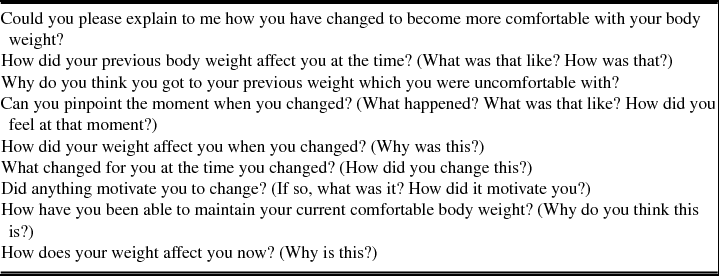
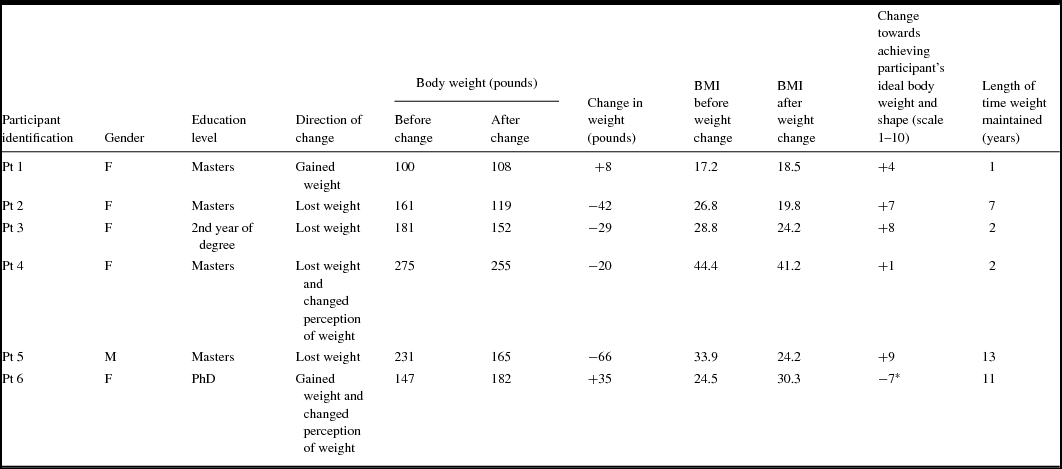
A semi-structured interview schedule which aimed to explore participants’ experiences of change was developed. The questions examined the specific moment of change, how participants changed, what changed for them, what influenced their change, and the importance of their weight before, during, and after the change. The target questions are given in Table 1. The interview schedule was used flexibly as questions were removed if the topic had been discussed and questions were added to further explore novel topics. Participants were also given a short questionnaire to quantify their weight change, examine the direction of their weight change and the extent to which they had reached their ‘ideal’ body weight. This was used to approximate how comfortable they became with their body weight. This rating scale was from 0 to 10 with the higher the rated number, the closer participants became to their ‘ideal’ body weight. Participants’ responses to this questionnaire are included in Table 2.
Semi-structured interview questions targeting particular areas of change

Participant characteristics and basic information
BMI, Body mass index.
* Pt 6 stated that she had changed becoming further away from her ‘ideal’ body weight. This participant reported this was because it became more important for her to engage in healthy dietary behaviours than to achieve her ‘ideal’ body weight which consequently led to her weight gain. This participant was deemed suitable for recruitment because she reported that her body weight and shape caused her less distress than previously and that she changed in order to achieve and maintain a more personally comfortable weight.
Participants
Six students from the University of Manchester who identified themselves as having changed to achieve and maintain a personally comfortable weight for a minimum of 1 year were recruited. The length of 1 year was chosen because this is defined as being successful weight maintenance by the Institute of Medicine (1995). Participants could have changed by: losing weight, gaining weight, changing their perception of their weight, or a combination of these. Although the direction and amount of body weight change differed across this sample, all participants felt they changed in order to achieve and maintain a personally comfortable weight for the minimum of 1 year, consistent with the requirements of IPA for having a relatively homogenous sample (Smith & Obsborn, Reference Smith, Osborn and Smith2003).
Procedure
Participants were first asked to complete the short questionnaire and were subsequently interviewed. The interviews were audio-recorded and later transcribed verbatim.
Analyses
Each interview was analysed using IPA in accordance with the step-by-step guidelines outlined by Smith & Osborn (Reference Smith, Osborn and Smith2003). This analysis involved continuous review of the transcripts to ensure the themes generated were grounded within the text. Each transcript was analysed separately, acknowledging that repeated and new themes from previously analysed transcripts could emerge. Themes were chosen based on their importance in the process of participants’ change rather than their frequency and themes poor in evidence were abandoned.
To validate the themes generated, an inter-rater reliability test was conducted (Marques & McCall, Reference Marques and McCall2005). Twenty-one excerpts were selected at random which represented each of the themes. Two independent researchers were asked to match each excerpt to the theme to which they believed the theme corresponded. These matches were then compared against the results of the analysis and an average was calculated from both raters, resulting in an agreement of 81%.
Results
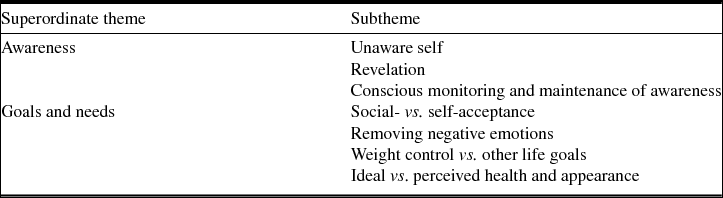
Two superordinate themes emerged using IPA: ‘awareness’ and ‘goals and needs’. Each of these superordinate themes consisted of a cluster of subthemes which are described below along with representative excerpts. The themes are presented in Table 3.
Superordinate themes and their subthemes
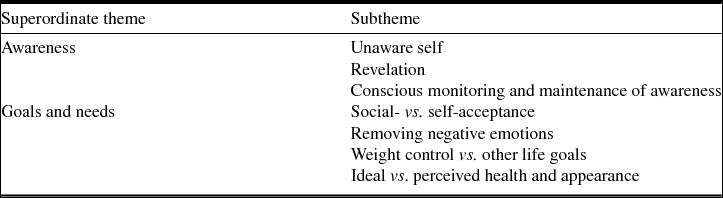
Awareness
This superordinate theme addresses participants’ experiences of how they changed to achieve and maintain their personally comfortable weight. ‘Awareness’ relates to how conscious participants were of their body weight and shape and of the consequences that their dietary behaviours had on their overall wellbeing. Awareness levels fluctuated reflecting the process of change from their previous unhealthy dietary behaviours; the moment of change; and the maintenance of change.
Unaware self
This subtheme aims to capture participants’ experiences of their body weight and dietary behaviours before their change. When asked to discuss their previous weight, four participants reported that they had little awareness of their actual body weight and size at the time:
I actually didn't even realize, how stupid but I didn't realize I put on so much weight. (Pt 2)
The other two participants reported some awareness of their body weight and shape at the time of their previous uncomfortable body weight. This awareness, however, appeared to be shallow as they did not fully appreciate the effect of their body weight on their overall physical and psychological wellbeing (further discussed under the subordinate theme ‘Revelation’). This type of awareness was accompanied with avoidance of their body weight. The participants’ responses appeared to convey uncertainty over why they did not take action to change having had some awareness of their uncomfortable body weight as this did not seem logical when describing their experiences retrospectively:
I was buying clothes going up 2 dress sizes that's because I gained weight not because my bones are growing, I put on more weight and it's just fat . . . You know in the back of your mind but you don't want to admit it to yourself. I don't know why I didn't look at my own weight. (Pt 3)
All participants described that they became aware of their actual body weight because of others’ comments, causing them to see their body from a different viewpoint. Scrutiny towards one's body transpired with this increased awareness:
It was my mum who commented on my legs, my bones at the top . . . I hadn't really noticed it before . . . I didn't know how bad it was; you become more critical when you're looking at yourself. (Pt 1)
Revelation
This subtheme is concerned with participants’ experiences of the moment they changed. In all participants, change appeared to be elicited by becoming able to see their body from a new viewpoint, in a way that they had not previously seen themselves. During this moment, participants appeared to become aware of the extremity of their weight and shape and explained that this caused them to change:
It was only when I came home and people noticed [I gained weight] because we haven't seen each other in a while and like ‘oh you've put on weight’ and I have. I seen a photograph of myself and I actually didn't recognize myself because that's how much weight I put on and it got pointed at and someone said, ‘isn't that you?’ and I said, ‘oh, yeah, it is’ and that spurred on the whole losing weight. (Pt 2)
When asked to describe the moment of change, participants explained that they experienced a sudden shift of awareness where they became able to recognize that change was necessary in order to resolve their weight-related problems (these weight-related problems are further discussed under the superordinate theme ‘Goals and needs’). This moment was described to be significant in their change as the solutions to their weight-related problems appeared to ‘click into place’. Participants’ accounts conveyed a sense of determination for change and involved feelings of ‘elation’ (Pt 4):
It was just like that [snaps fingers]. I'm doing it, that's it. It wasn't a concerted decision like how I'm building up to this . . . just do it on a whim and that's how I did it, and I've stuck with it . . . That was the only way I could motivate myself, I was like right I'm doing it and this is going to happen. I'm not going to take no for an answer, so I made myself do things I wouldn't have necessarily have done a few months earlier but it was the only way I was going to get healthy . . . It was something like a switch, just went on in my head and that was it. It's like I had this epiphany and that was it. (Pt 5)
In addition to experiencing this sudden change, most participants explained that they changed in a gradual way, planning how they would change their behaviours in order to achieve a more personally comfortable body weight. This appeared to include consideration of other important factors in the participants’ lives that could influence their ability to change, including relationships, social support, and work commitments.
It took me three months till February for me to actually do anything about it. I ate better [at first] but I didn't commit to losing weight until February and that's when I joined the gym and [my partner] was on his way to the jungle and I thought this gives me the opportunity I'm not going to see him . . . I haven't got an excuse now, I haven't got anything else to do, so I signed up to the gym with my best friend and she encouraged me. (Pt 3)
All participants suggested that accepting themselves and their body weight-related problems enabled them to change their behaviours and attitudes towards their body weight and shape in order to achieve a personally comfortable body weight:
I started to pay attention to what I ate and how much I ate . . . Probably because I finally started accepting what was going on and being more comfortable in the state I was in. (Pt 4)
Change appeared dependent on the shift of awareness involved in this revelatory moment as participants stated that their weight would have continued to be problematic had they not become aware of the underlying problem:
[Seeing my bones] made me more aware and I suppose I could have just carried on losing weight and not really thinking about it because I hadn't thought about doing it so I must have been doing something wrong and not known. (Pt 1)
For most participants to change, it appeared that they had to accept that they felt so negatively about themselves, conveying a sense of ‘hitting rock bottom’. Without this, participants explained that they would have not been able to change:
Hated feeling like that, but it took that to feel that low and that shit to do something about it, if I was still like it's alright then I probably would have left it a bit longer. So, I think you definitely have to get to that point where you feel crap and hated looking at yourself to do it. (Pt 3)
Conscious monitoring and maintenance of awareness
All participants explained that when they began to engage in the healthier dietary behaviours, they vigilantly monitored their body weight and diet to ensure that they were pursuing the desired change. As participants began to feel comfortable with their body weight, they became less vigilant about their weight and dietary behaviours:
[When I was losing weight] I was eating really healthily so I didn't have bread and chocolate and crisps and all but that's come back into my diet now . . . [when I was losing weight] every morning I'd weigh myself and then I'd go to the gym . . . I stopped weighing myself as much when I started feeling better. (Pt 3)
Participants reported that although they were less vigilant over their body weight, they found it essential to retain some awareness over their body weight and dietary behaviours to maintain the change:
I've got a picture of me when I was fat on my fridge so you have to look at it every time you go to the fridge gives you a hint of who you want to be . . . It's not so much in the front of my mind but it's always there that I don't put on weight. I think if you forget about it then you get back into your habits. (Pt 3)
Participants explained that retaining awareness over their body weight and dietary behaviours allowed them to achieve other weight-related goals that they were pursuing; for example, improving their physical health (further details are described under superordinate theme ‘Goals and needs’):
I have to remind myself actually I do need to do this. I need to lose weight just to help ease the pressure off my back and not rely so much on painkillers. (Pt 2)
Goals and needs
This superordinate theme aims to address participants’ experiences of what changed when they changed to achieve and maintain their personally comfortable weight. Participants appeared to pursue several ‘goals’ that were related to their body weight and these goals were associated with various behaviours, cognitions, and emotions. ‘Needs’ refer to how essential the goal was perceived to be for the participants. The way participants pursued their goals changed as they changed to achieve and maintain their personally comfortable weight.
Social- vs. self-acceptance
Before the change, while participants engaged in their unhealthy dietary behaviours, participants described that they aimed to be socially accepted by everyone. The participants’ accounts emphasized the importance of their body weight and shape for whether they would be socially accepted, believing that they were scrutinized based on their weight which made them feel inadequate:
I haven't got the confidence to walk around in a dress like that and not give a crap about what other people think about me and think, ‘oh god she's too big to be in that dress’. (Pt 3)
Participants appeared to believe that they needed to be of a certain body weight to gain social acceptance and deviating from this implied that they would be rejected:
. . . they were like ‘oh you've put on weight’ as in it was a bad thing and really you should be a certain size. (Pt 2)
It appeared that participants believed their self-worth largely depended on whether other people approved of their body weight. Participants, however, perceived social rejection based on their body weight which negatively influenced their self-esteem:
I was bigger than the rest of the kids . . . so they figured why not pick on her for the most dumbest thing which was my body . . . I felt less than human, I didn't belong. (Pt 4)
All participants described that being socially accepted and utilizing available social support facilitated their change:
My mum's helped me to get to this point that I'm able to sit back to think about things and say OK I'm going to actually get up and start to lose weight . . . It was her basic care and consideration of my feelings. (Pt 4)
When participants reached a body weight that they were more comfortable with, they placed less importance on their body weight for how they would be evaluated. They came to believe that they did not need to be of a certain body weight to be socially accepted:
I can connect to [others] on a higher state than just body, how you look and how you dress and how big or how small you are. It's gone beyond the physicality of it all. (Pt 4)
Participants also reported that how they felt about their own body became more important than the opinions of others. This appeared to be associated with feeling more positively about the self and self-acceptance:
Before I wanted everyone to think I looked nice and it was about what everyone thought . . . [If someone said] ‘you looked really rats’ to be fair I would have probably broken down but now I would think oh whatever. I don't care because I'm happier. (Pt 3)
Removing negative emotions
Participants described that before the change, perceiving social rejection based on their body weight caused negative emotions. Most participants attempted to remove the negative emotions of not gaining social acceptance that they would get if they were slim by over-eating. The need to remove negative emotions was reflected in the intensity of the behaviour:
I was an endless pit, I could go to a Chinese buffet and eat 4, 5, and 6 plates of food . . . I didn't even need to eat but I kept eating because it was the only sort of comfort I ever had. (Pt 4)
One participant conversely removed negative emotions by restricting her eating. She described that although she lost weight because she was unhappy; she gained a beneficial ‘side-effect’ from the weight loss which was reinforced by others:
It was quite an ego boost from people at work noticed I lost a lot of weight and comment on it saying, ‘you look really well’ . . . Nobody needed to know how miserable I was but that was why I didn't eat anything so then it just looked like I was quite successful in losing weight. (Pt 6)
Most participants also described that they continued to remove negative emotions using food despite knowing this method had negative consequences and, through a vicious cycle, caused further negative emotions:
I knew that what I was doing wasn't helping . . . it was a comfort thing because food has that doesn't it? because you feel good for a while but then after it you think shit I shouldn't have eaten that . . . I ate it and then I felt crap so to make myself feel better I ate even more crap. (Pt 3)
Participants described that during their ‘revelation moment’ (see subtheme ‘Revelation’ above), they realized that the way in which they removed negative emotions was ineffective as this did not allow them to successfully their remove negative emotions. Participants explained that this realization allowed them to gain insight into how they would be able to remove negative emotions in a more effective way through utilizing social support rather than food. Furthermore, because participants experienced social acceptance from certain others (see subtheme above), they no longer experienced negative emotions caused by not gaining social acceptance:
. . . it's a waste of money to take me to a buffet at this stage but I think that's because I found comfort within myself, that finding that comfort in myself because I have found friends. (Pt 4)
Weight control vs. other life goals
The participants’ accounts appeared to involve a ‘seesaw’ like relationship between the importance of controlling their weight and pursuing other life goals including focusing on their career or education, and spending time with their friends and family. Two participants described that they previously engaged in unhealthy dietary behaviours because they felt that pursuing other life goals was more important than their weight, consequently neglecting their weight:
My weight that wasn't important enough, what was important was uni, work, having enough money. (Pt 2)
Other participants indicated that their body weight was important because it negatively affected other aspects of their life. Perhaps incongruously, this was accompanied with little effort to change their weight in order to improve other life aspects:
Every aspect of my life in a way was affected by what I felt about my body. If someone asked if I wanted to go out I'd have to buy a new outfit that I felt confident in . . . Every time I was eating even when I was eating something bad I knew I shouldn't be eating it but I'd still be eating it. (Pt 3)
One participant conversely described a loss of control over other life aspects which resulted in the belief that weight can be controlled successfully in spite of failure in other areas of life:
I was out of control at home . . . work was horribly stressful so I was kind of not in control there and it's something you can control isn't it. You can make it your little project or think no matter all this rubbish I can still stick to my diet. (Pt 6)
As participants changed, they noted the importance of their body weight in terms of the role that it had in their life. This influenced the direction of and the reason for change:
I knew [my weight] was putting a strain on [our relationship] because I got insecure thinking he'd get someone better than me so I wanted to do it for me, do it for us, just lose weight. (Pt 3)
After the change, participants suggested that their weight was less important than it was before or during the change. Most participants described that this was because they were able to control their weight by integrating the relevant dietary behaviours permanently into their lifestyle:
[Other things are now] more important because I can control my weight. For me exercise is just a part of a daily routine just like eating and sleeping. (Pt 5)
As participants reached a personally comfortable body weight, participants felt able to control their weight flexibly, varying according to their lifestyle:
It's not the end of the world if I put a bit of weight on now and then because I probably will lose it in a few weeks . . . It's not a big deal if you put it in context with other things in your life. (Pt 2)
Ideal vs. perceived health and appearance
Before participants changed they all experienced their appearance in a negative way and it appeared that they felt their appearance was discrepant to how they would like to look ideally:
I was really unhappy with my body, I suppose everyone has the perfect woman of what they want to look like and I looked nothing like it. I hated my thighs and my arms . . . I just thought you shouldn't be like that. (Pt 3)
Some participants described that they were also unhappy with their health because it negatively affected their quality of life:
[My weight] was really hard work because it was just constant pain even sitting or standing and there are only so many painkillers you can take. (Pt 2)
All participants experienced negativity towards their body weight in terms of their health and appearance, stating that this influenced their need to change their dietary behaviours in order to improve their appearance and health. A sense of disgust towards their body weight and urgency to change transpired:
It looks horrible. You see people who are really, really thin and ergh I really didn't like it, I didn't want to lose any more weight and be like that . . . Thought I had to do something. (Pt 1)
Participants explained that this need for improving their health and appearance subsequently led to them changing their dietary behaviours. The extremity and rigidity of the dietary behaviours reflected the intensity of the participants’ desire to change. Participants employed these extreme and rigid dietary behaviours until they reached a more personally comfortable weight:
[My regime] was far too long. You're supposed to exercise for about an hour normally at the gym but at home I was doing stupid hours, 5–6 hours . . . I stuck to lean chicken, fish, pasta, basically food that didn't taste of very much just to get this crap off. (Pt 5)
When participants had achieved a personally more comfortable weight, their attitude towards their weight changed as they described wanting to maintain a ‘middle-range’ healthy weight:
I didn't want to be really big but I didn't want to be supper skinny, I wanted to be in the middle. (Pt 2)
Aiming for a middle-range weight was characterized by flexible dietary behaviours which appeared to facilitate weight maintenance:
I maintain [my weight] by eating stuff that I like but still exercising . . . instead of saying that I can't have anything I say that I can have everything in moderation. (Pt 3)
Discussion
Summary of aims and results
This study aimed to investigate how people change to achieve and maintain a personally comfortable weight for the minimum of 1 year and what changed for them. Semi-structured interviews were conducted with six students who changed either by losing weight, gaining weight, and/or changing their perception of their weight. The interviews were analysed using IPA and two main clusters of themes emerged: ‘awareness’ and ‘goals and needs’. The process of change has been inferred from these themes. Although the participants changed in different ways (e.g. amount and direction of body weight), there were psychological similarities across the sample which appeared to underlie the change. Initially, all participants felt that their weight was problematic and it was negatively associated with their social and professional lives. Participants were unable to resolve the problems associated with their weight, causing the problems to escalate until they reached ‘rock bottom’. Participants described experiencing a ‘revelatory moment’ where they gained insight into and faced the problems associated with their weight. This allowed them to resolve their problems in an adaptive manner; changing to achieve and maintain a comfortable weight.
Linking findings to existing literature
The themes which emerged in this study regarding weight change and maintenance appear consistent with existing literature as discussed below.
Social acceptance and feelings about the self
The belief that one needs to be of a certain body weight to gain social acceptance is supported by other research. Women with bulimia nervosa have been found to often believe that others would find them more attractive if they were thin and that they would be disliked if they were overweight (Van den Broucke et al. Reference Van den Broucke, Vandereycken and Norré1997). Eating disorders have been associated with unrealistic standards for physical attractiveness which are suggested to make the individual feel inadequate by comparison, causing social anxiety and low self-esteem (Heatherton & Baumeister, Reference Heatherton and Baumeister1991). Social support on the other hand has been linked with long-term recovery of problematic dietary behaviours (Elfhag & Rössner, Reference Elfhag and Rössner2005).
Self-dislike and removing negative emotions about the self
It has been noted that eating disorders are related to low levels of self-esteem (Bruch, Reference Bruch1973). A cognitive model of anorexia nervosa (Fairburn et al. Reference Fairburn, Shafran and Cooper1998) and a transdiagnostic cognitive approach to eating disorders and their treatment (Fairburn et al. Reference Fairburn, Cooper and Shafran2003) indicate that low self-esteem is involved in developing and maintaining the eating disorder. Similarly, according to the Escape Theory (Heatherton & Baumeister, Reference Heatherton and Baumeister1991), low self-esteem is associated with disinhibited eating patterns. The individual is said to be motivated to escape aversive self-awareness by directing attention towards the concrete behaviour of binge eating, i.e. to engage in avoidance-escape coping strategies. Conversely, direct problem-solving strategies have been associated with weight maintenance (Kayman et al. Reference Kayman, Bruvold and Stern1990).
Other life goals and weight control
Healthy diet, exercise, and monitoring of weight have been recommended for weight loss (WHO, 2004). However, having an ‘all or nothing’ approach has been linked to relapse whereas flexible weight management has been associated with weight maintenance (Elfhag & Rössner, Reference Elfhag and Rössner2005). Furthermore, integrating healthy dietary behaviours into daily life has been suggested to facilitate successful weight management (NICE, 2006).
Working towards goals
Self-Determination Theory (SDT; Ryan & Deci, Reference Ryan and Deci2000) describes different forms of intrinsic and extrinsic sources of motivation which cause an individual to act towards their human basic needs or goals including competence, autonomy, and relatedness. For example, external motivators may reflect an individual's drive ‘to avoid criticism from others’ or ‘to be accepted by others’ and internal motivators may be ‘to achieve better health’. A review examining SDT with regard to weight management supports the notion that feeling autonomous and competent about reaching certain goals is more likely to result in longer-term weight control (Teixeira et al. Reference Teixeira, Silva, Mata, Palmeira and Markland2012).
Personal Construct Theory (Kelly, Reference Kelly1955) posits that people formulate the world and test out ‘constructs’. If there is an error between what is anticipated and the environment, reformulation of the construct system occurs in people who are functioning optimally. Eating disorders are said to occur if an individual's construct system is constricted so that food and body weight are prioritized and other areas of construing become less important (Winter & Button, Reference Winter, Button, Sassaroli and Ruggiero2010). It is hypothesized that if the self is rigidly construed the eating disorder is more likely to be maintained whereas increasing positive self-construing is likely to lead to recovery (Winter & Button, Reference Winter, Button, Sassaroli and Ruggiero2010).
Conflict between goals, beliefs and behaviours transpired in the results. The theory of Cognitive Dissonance (Festinger, Reference Festinger1957) suggests that people aim to ensure that all of their attitudes, beliefs and behaviours are compatible. If these are inconsistent or conflicting, an aversive state results and the individual becomes motivated to reduce this inconsistency and restore cognitive consonance. This is often by changing their beliefs or behaviours to be more compatible. Living with incompatible beliefs and behaviours are said to lead to problems including eating disorders, while recovery involves change in these.
Awareness
The differences in awareness levels before, during and after the change appeared consistent with weight-related research. Those who engage in problematic dietary behaviours are unlikely to monitor their eating habits while those who maintain their weight change generally engage in self-monitoring behaviours (Elfhag & Rössner, Reference Elfhag and Rössner2005).
Other non-weight-related research suggests that avoidance of a problem is associated with distress while acceptance of the problem may facilitate recovery (Hayes et al. Reference Hayes, Strosahl, Wilson, Bissett, Pistorello, Toarmino and McCurry2004). Similarly, in the current study avoiding problems associated with weight caused further distress while acceptance facilitated change.
In line with the results of this study, other studies which examined how psychological recovery occurs reported that change involves both sudden and gradual elements (Higginson & Mansell, Reference Higginson and Mansell2008; Gianakis & Carey, Reference Gianakis and Carey2011). A period of negativity followed by gaining insight into the problem was also found important for resolving the problem satisfactorily. The insight literature supports the sudden moment of change as people who experience psychological change have a sudden understanding of how to solve the problem (Bowden et al. Reference Bowden, Jung-Beeman, Fleck and Kounios2005).
Problems with the literature
The results of the study appear to support the existing literature on what changes for people who successfully recover from problematic dietary behaviours and maintain these changes. However, the literature provides little explanation as to how psychological change occurs.
Within other domains of psychology, a small number of studies have examined how people change in the form of recovery from psychological distress (Carey et al. Reference Carey, Carey, Stalker, Mullan, Murray and Spratt2007; Higginson & Mansell, Reference Higginson and Mansell2008; Gianakis & Carey, Reference Gianakis and Carey2011). These studies used Perceptual Control Theory (PCT; Powers, Reference Powers2005) to explain their results. Although these studies examined the recovery from psychological problems such as depression rather than problematic dietary behaviours, the process of change may be inferred in this study since the principles of PCT are transdiagnostic (Carey, Reference Carey2008). Therefore PCT is used in this study as a potential explanation for how the participants changed in order to achieve and maintain their weight. Note that the explanation provided is not a definitive model rather a hypothetical one.
A PCT approach
According to PCT people have internal goals and aim to control their perceptual experiences by making them match these goals (Powers, Reference Powers2005). If a discrepancy is detected between the two, the individual behaves in a way in order to reduce this discrepancy. The notion of reducing inconsistencies between goals is similar to that described in the theory of Cognitive Dissonance (Festinger, Reference Festinger1957). Within PCT, keeping current perceptual experiences close to internal goals is known as a control system and people are said to pursue many control systems. These control systems are hierarchically arranged whereby in a chain lower-level systems need to be achieved in order to attain the higher-level system. Because people attempt to control multiple perceptual experiences, some systems are likely to conflict with one another.
Chronic unresolved conflict between control systems is said to result in psychological problems including eating disorders. Conflict involves the minimum of three levels of the hierarchy (Carey, Reference Carey2008). The highest-level system sets incompatible reference signals at the middle-level systems where conflict is expressed. Problematic symptoms are consequently experienced at the lowest level. When conflicted, satisfying one system increases the error for another and therefore both cannot be successfully achieved simultaneously.
According to PCT, conflict is resolved through the process of reorganization whereby the features of the conflicting control systems are altered until the conflict is eliminated (Powers, Reference Powers2005). Reorganization is said to occur at the place in the hierarchy of which the individual is aware. For successful reorganization, awareness is required at the highest level of the hierarchy where conflict is created. Arbitrary control which blocks awareness from this location is said to maintain conflict.
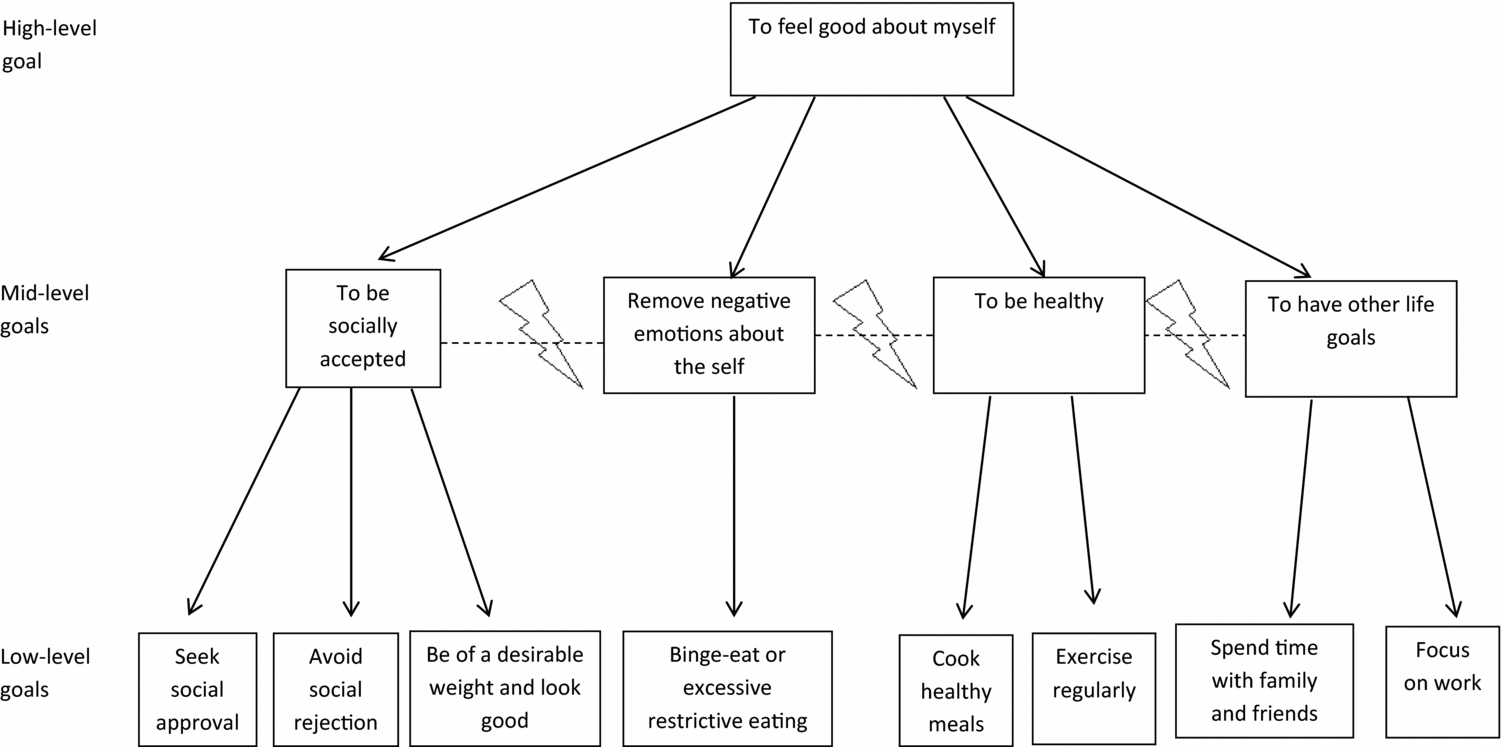
In this study, the highest control system appeared to be ‘to feel good about myself’ because participants appeared to pursue various lower-level goals in order to achieve this higher-level system. The analysis suggests that the highest-level system set the mid-level systems: ‘to be socially accepted’, ‘to remove negative emotions about myself’, ‘to be healthy’, and ‘to have other life goals’. Before change, these mid-level systems appeared to conflict because pursuing one meant that another could not be achieved. A representation of the hierarchical structure involving all the conflicting systems is presented in Figure 1. Details of these conflicts and their resolutions are discussed further in this paper.
An overall goal structure representing the conflicting control systems at the three levels of hierarchy. Conflict is present between the goals at the middle level. The lightning bolts represent conflict between the goals.
In this study, arbitrary control may have maintained the conflict between the systems for the participants. Escape-avoidance strategies were often implemented, preventing awareness from focusing on the origin of the conflict, thus maintaining the underlying conflict. For example, participants described a discrepancy between their perceived weight and their desired weight required for social acceptance. This resulted in negative emotions towards the self. In order to avoid this negative experience, participants used food (a low-level behaviour). As a consequence of binge eating, participants gained weight and received negative comments from others. This maintained discrepancy between their perceived and desired body weight and therefore the conflict between these systems.
Reorganization may be used to explain how participants changed to achieve their personally comfortable weight and resolve the associated distress experienced. During the ‘revelatory moment’, participants were able to see their body weight and dietary behaviours in a new light. Participants became aware of the negative effects of their problematic dietary behaviours and that they were ineffectively pursuing certain important goals (e.g. removing negative emotions). Changing the features of the control systems may have allowed the conflict to be resolved and participants’ to successfully pursue and achieve their goals. Furthermore, successful reorganization is said to occur suddenly and involve strong emotions (Powers, Reference Powers2005), which may reflect the sudden moment change in this study.
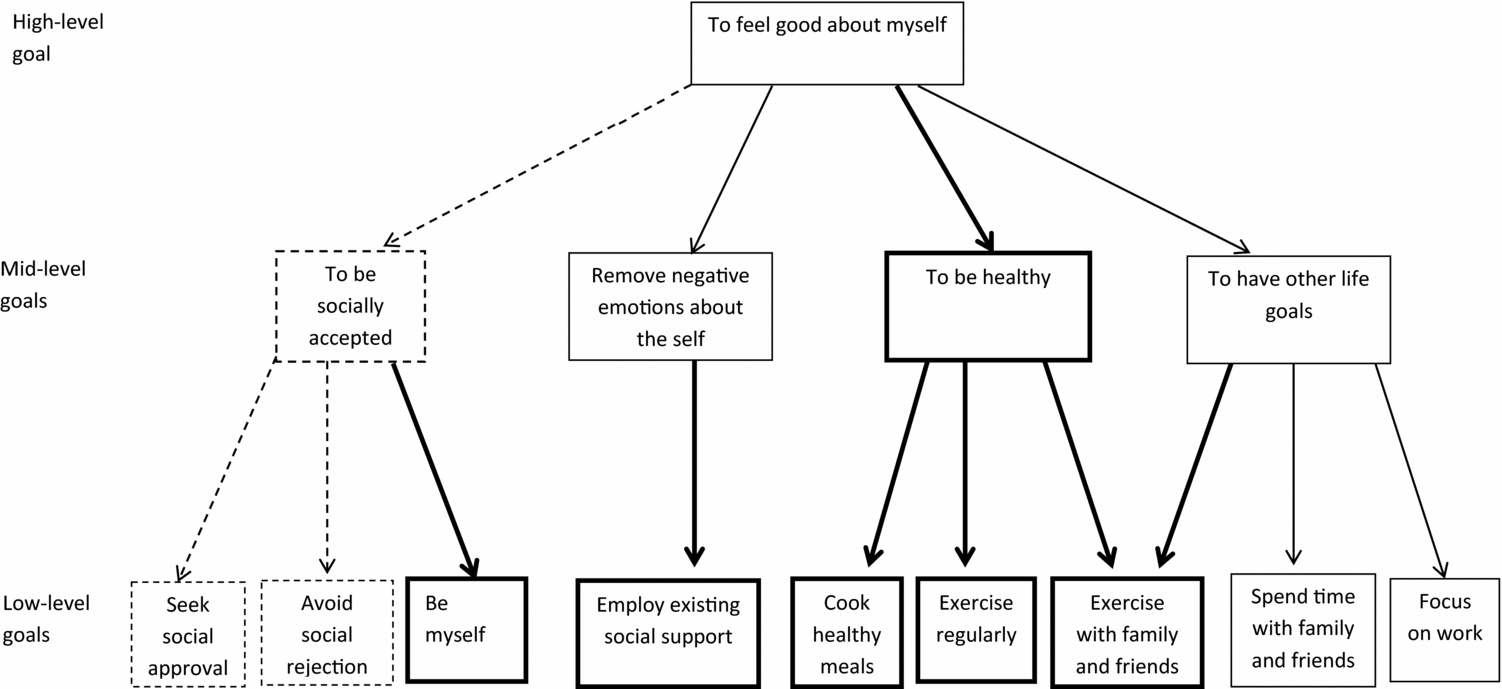
A representation of the reorganized systems is shown in Figure 2. Here, the conflicts are resolved in different ways that are behaviourally compatible with maintaining a comfortable weight as well as consistent with pursuing other goals participants wished to achieve. The following paragraphs describe a hypothetical model of how the goals conflicted and how they were resolved.
An overall goal structure representing the changed control systems at the three levels of hierarchy. Changing the reference values and signals eliminated the conflict between the goals which allowed the mid-level and high-level goals to be achieved satisfactorily. The bold arrows and the boxes represent either an increase in the goals’ level of importance, or goals which are new. The dashed arrows and boxes represent goals which have become less important for achieving the highest-level goal.
In the model, the highest-level system ‘to feel good about myself’ appeared to set incompatible reference signals for the two mid-level systems ‘to gain social acceptance’ and ‘to remove negative emotions about myself’. These appeared to be incompatible because they set further conflict at the lowest level. Gaining social acceptance set the lower-level goal ‘to be of a desirable weight and look good’ while food was used, either by binging or excessively restricting, to remove negative emotions about the self. The variable controlled in opposite directions here is the amount of food consumption. Conflict manifested at the lowest level because using food to remove negative emotions (i.e. binge eating) meant that participants could not attain the desired weight (i.e. by losing weight) required to gain social acceptance. Similarly, by attempting to lose weight to gain social acceptance, participants would have lost their strategy for coping with negative emotions.
The properties of the mid-level goal, removing negative emotions, changed and food was no longer used and participants began ‘employing existing social support’ as represented by the bold lines in Figure 2. This no longer conflicted the mid-level goal ‘to gain social acceptance’ as participants became able to change their weight without losing their strategies for coping with negative emotions. Furthermore, the reference value ‘I must gain social acceptance from everyone in order to feel good about myself’ became less rigid as participants felt that maintaining relationships with a few people who provided social support was more important. This is represented by the dashed lines in Figure 2. In addition, the reference value required for social acceptance changed as participants realized that ‘I need to be slim to be accepted’ was inaccurate and that they could receive acceptance by ‘being themselves’.
The mid-level systems ‘to be healthy’ and ‘to remove negative emotions about the self’ were incompatible before the change as they caused conflict at the lowest level. At the lowest level, participants engaged in ‘binge eating or excessively restrictive eating’ in order to remove negative emotions. This conflicted with ‘cooking healthy meals’ and ‘exercising regularly’ required for achieving their goal of being healthy. Therefore, by binge eating or restricting eating, participants could not achieve their goal of being healthy. Similarly, by engaging in healthy dietary behaviours, participants would have lost their strategy of removing negative emotions. As participants felt that it was more important to remove negative emotions, their health was often neglected.
The conflict between the described mid-level goals was resolved as participants became aware that the way in which they removed negative emotions was arbitrary as it caused further negative emotions and it prevented them from being healthy. As described above, participants ‘employed existing social support’ rather than using food to remove negative emotions. Employing existing social support allowed participants to appropriately cope with negative emotions without having a negative consequence on their health. Furthermore, the importance of pursuing the mid-level system ‘to be healthy’ increased as participants realized that it was significant for achieving the highest-level system.
The mid-level systems ‘to be healthy’ and ‘to have other life goals’ appeared incompatible before the change. Having other life goals set the low-level system of ‘focusing on work’ and ‘spending time with family and friends’ both of which consumed a lot of their time. This conflicted with the participant's desire of being healthy as this would have also involved a lot of time ‘cooking healthy meals’ and ‘exercising regularly’. The variable controlled here in opposite directions was time. As participants believed it was more important to fulfil their other life goals than to be healthy, more time was devoted to achieve this and their health was consequently neglected.
This conflict was resolved as participants became aware that pursuing their other life goals to high standards caused them to neglect their health. In addition, participants became aware that their health was more important than previously thought for achieving their highest-level goal of feeling good about themselves. Realizing the discrepancy between their perceived and desired health, participants dedicated more time to cooking healthy meals and exercising. Furthermore, participants were able to achieve both mid-level goals by ‘exercising with friends and family’.
Limitations
There are several limitations to consider in this study. Although the sample displayed some clinical symptoms of eating disorders and obesity, diagnostic assessments were not conducted and therefore the eating-disorder diagnostic status of the participants cannot be determined. It is consequently difficult to make strong implications from these results to clinical populations. A small number of students were interviewed and therefore the process of change may not be applicable to a different sample. Participants spoke about their experiences of change retrospectively which may not have accurately captured their experiences of change as they were actually occurring. Similarly, the amount of change in body weight was retrospectively self-reported rather than being objectively verified and therefore the quantity of change may not be accurate. Although 1 year is commonly used to describe weight maintenance, this is still a short period of time. Three of the participants had maintained their new body weight between 1 and 2 years and it is possible that relapse may occur after this time period. This study would have benefited from a comparison group to suggest whether the same changes would also be present in those who relapse after change. Furthermore, since the data involves subjective accounts of how the participants have changed, it is possible that the participants have changed in other ways for other reasons that were outside of their awareness. Finally, despite some emerging literature identifying similarities across obesity and eating disorders, this is still not widely recognized and these are often treated differently.
The findings of the current study indicate that raising awareness of conflicted goals could be crucial for the process of recovery from problematic eating. Further research can examine the importance of raising awareness in the recovery of problematic dietary behaviours.
Conclusions
The present study explored how people change to achieve and maintain their body weight. The results indicated that the process of reorganization proposed in PCT may provide a theoretical account for how people recover from problematic dietary behaviours. This study has provided support for other studies which have examined the process of psychological change; however, it is novel in that change was explored with regards to dietary behaviours. Understanding how people recover from problematic dietary behaviours is important in order to improve the effectiveness of dietary interventions.
Summary
• Successful maintenance of body weight change was found to be associated with: social support, adaptive coping methods for negative moods, and integration of a healthy diet and exercise within an individual's lifestyle. In contrast distress associated with body weight is associated with: over-estimating the importance of body weight for social acceptance; using food to cope with negative emotions; and experiencing an uneven balance between an individual's social and professional life, and dietary behaviours.
• The process of recovery appears similar across both binge eating and restrictive eating. This supports the transdiagnostic approach for explaining how people change and what changes when they achieve and maintain a personally comfortable body weight.
• The process of reorganization described in PCT may be used to explain how the participants in this study changed to recover from problematic dietary behaviours. This supports other studies that have looked at the process of psychological change.
• Acceptance rather than avoidance of the distress caused by the problematic dietary behaviours appears to facilitate psychological change and recovery, supporting literature around acceptance and commitment therapy.
Declaration of Interest
None.
Reading this paper will allow people to:
(1) Identify psychological predictors of successful weight maintenance.
(2) Understand how PCT can account for the process underlying how people change.



Comments
No Comments have been published for this article.