Introduction
Rhinosinusitis, as defined by the 2005 European Academy of Allergy and Clinical Immunology (EAACI) position paper, is mainly diagnosed by careful history-taking and examination.Reference Fokkens, Lund, Bachert, Clement, Hellings and Holmstrom1 Unlike other types of pathology, such as otological disease, it has no objective measure, such as a hearing test. This has resulted in the development of validated outcome measures to assess the benefit of various rhinosinusitis treatments.
Validated outcomes research uses expanded measures of outcome, such as quality of life and health perception, rather than traditional clinical endpoints such as survival or complication rates.Reference Stewart2
In 1992, Dr Paul Ellwood described outcomes management as a ‘technology of patient experience’, predicting that medicine would move toward systematic assessment of patients' experience of the health care system and their perception of treatment outcomes.Reference Ellwood3
Outcomes research requires identification and clear definition of the disease, as well as a clear staging system for disease severity. One must acknowledge co-morbid conditions and establish the outcomes to be measured – disease-related and/or patient-related. Finally, instruments for measuring those outcomes must be tested for reliability, validity and responsiveness, using psychometric statistics.
There are many different validated outcome measures for rhinosinusitis.Reference Lund and Mackay4–Reference Morley and Sharp7 However, many are too time-consuming to complete in a busy out-patient clinic, and are mainly used as research tools. In 2004, Paul White described the rhinogram, a non-validated outcome measure.Reference White8 The rhinogram was intended as a standardised, disease-specific outcome measure which could be easily used in the clinic, providing immediate assessment of treatment benefits.
The current study comprised a prospective, comparative assessment of pre- and post-surgical rhinosinusitis, in which two validated outcome measures, the Health-Rated Quality of Life questionnaire and the Sino-Nasal Outcome Test-20, were compared with the rhinogram, a non-validated outcome measure.Reference White8–Reference Hopkins, Browne, Slack, Lund, Topham and Reeves10 The null hypothesis proposed no difference between the three outcome measures as regards reliability, validity and responsiveness to change.
Methods
A prospective, comparative, cohort study was planned. Patients with a diagnosis of rhinosinusitis who had failed medical therapy and had clear radiological disease where enrolled. A questionnaire plus covering letter was distributed to 51 consecutive patients in the pre-assessment clinic, one week prior to their elective endoscopic sinus surgery. The questionnaires included the validated Sino-Nasal Outcome Test-20, the validated Heath-Related Quality of Life questionnaire and the rhinogram. Three months after their operation, all patients were given the same questionnaires in the out-patient clinic, or by post. Of the 51 patients enrolled in the study, 50 completed both the pre- and post-operative questionnaires.
Heath-Related Quality of Life questionnaire
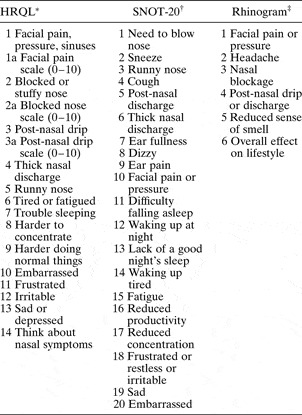
This questionnaire assessed recent sinus and nasal symptoms within the previous week. It consisted of 14 questions (See Table I), with symptom prevalence ranked as: none of the time; a little of the time; some of the time; most of the time; and, finally, all of the time (scored zero to four). The first three questions were further subdivided to indicate how much patients were bothered by their symptoms, on a zero to 10 scale.
Question items: comparison of the three questionnaires

Scored: *0–4; †0–10; ‡1–10. HRQL = Health-Related Quality of Life questionnaire; SNOT-20 = Sino-Nasal Outcomes Test-20
Sino-Nasal Outcome Test-20
This test assessed recent nose and sinus problems within the past two weeks, and considered the severity and frequency of each. It consisted of 20 questions (see Table I), with symptoms ranked as: no problem; very mild problem; mild or slight problem; moderate problem; severe problem; and, finally, problem as bad as it could be (scored zero to five).
Rhinogram
The rhinogram questionnaire assessed how nose and sinus problems had affected patients over the previous two weeks. It consisted of six questions (see Table I), with responses ranked from ‘no problem’ to ‘severe problem’ on a scale from one to 10.
Diagnosis of rhinosinusitis
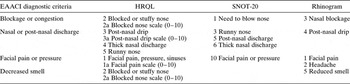
The EAACI position paper on rhinosinusitis and nasal polyps set out diagnostic criteria for rhinosinusitis. Rhinosinusitis was clinically defined as: inflammation of the nose and the paranasal sinuses characterised by two or more symptoms (i.e. blockage or congestion, discharge (anterior or post-nasal drip), facial pain or pressure, and/or reduction or loss of smell) and endoscopic signs (i.e. polyps, mucopurulent discharge from the middle meatus, and/or oedema or mucosal obstruction primarily in the middle meatus) and/or computed tomography changes (i.e. mucosal changes within the ostiomeatal complex and/or sinuses).
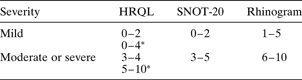
Rhinosinusitis can be further divided into mild, or moderate or severe, disease. This is based on a 10-mm visual analogue scale (VAS), where 0–4 mm = mild disease, and 5–10 mm = moderate or severe disease. Our questionnaire results were used to determine the number of patients with clinically defined rhinosinusitis, both pre- and post-operatively. The values were then subdivided into mild disease or moderate or severe disease, by allocating similar values to the VAS within each question (see Tables IIa and IIb).
EAACI diagnostic criteria for rhinosinusitis, and corresponding questionnaire items

EAACI = European Academy of Allergy and Clinical Immunology; HRQL = Health-Related Quality of Life questionnaire; SNOT-20 = Sino-Nasal Outcome Test-20
EAACI diagnostic criteria for rhinosinusitis, severity scales

Data represent visual analog scores. *On scale of 0–10. HRQL = Health-Related Quality of Life questionnaire; SNOT-20 = Sino-Nasal Outcome Test-20
Statistics
A power calculation was performed to enable recruitment of enough patients to ensure a power of 80 per cent (acceptable type two error) with a significance level of 5 per cent (acceptable type one error). All information was then entered into an Excel spreadsheet. Similar variables in the two validated questionnaires and the non-validated rhinogram were compared against each other using Spearman's rank correlation statistical analysis for non-parametric ordinal data. Diagnostic criteria were tabulated and analysed using the chi-square test.
Results
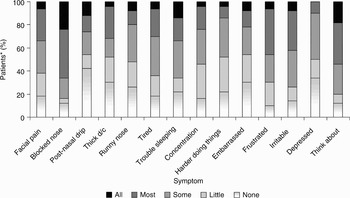
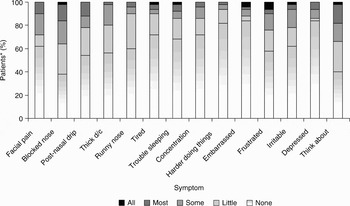
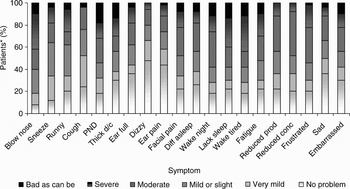
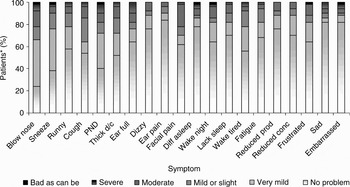
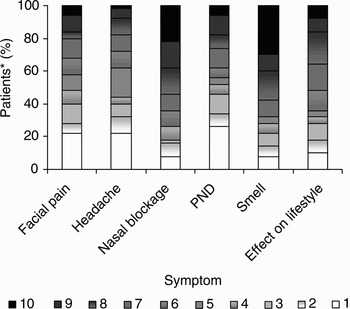
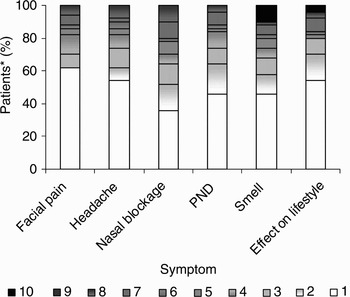
Fifty-one patients were enrolled into the study, comprising 22 men and 29 women, with a mean age range of 55 years (range 27–78 years). Fifty patients completed the study and provided full data sets for all three questionnaires on two separate occasions (see Figures 1 to 6).
Heath-Related Quality of Life questionnaire: pre-operative results. *n = 50. D/c = discharge

Heath-Related Quality of Life questionnaire: post-operative results. *n = 50. D/c = discharge

Sino-Nasal Outcome Test-20: pre-operative results. *n = 50. PND = post-nasal discharge; d/c = discharge; full = fullness; diff = difficulty; prod = productivity; conc = concentration

Sino-Nasal Outcome Test-20: post-operative results. *n = 50. PND = post-nasal discharge; d/c = discharge; full = fullness; diff = difficulty; prod = productivity; conc = concentration

Rhinogram: pre-operative results. *n = 50. PND = post-nasal discharge

Rhinogram: post-operative results. *n = 50. PND = post-nasal discharge

Questionnaire correlations
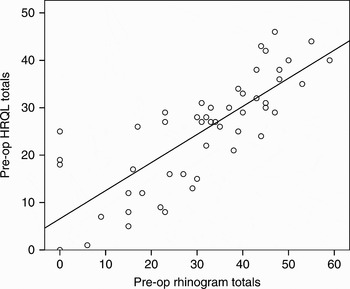
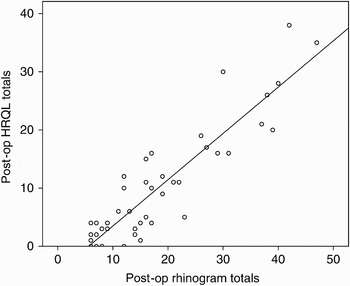
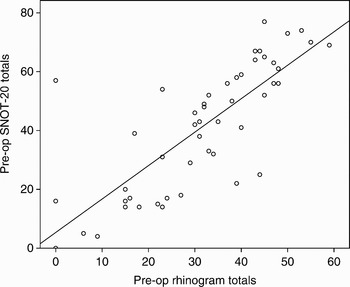
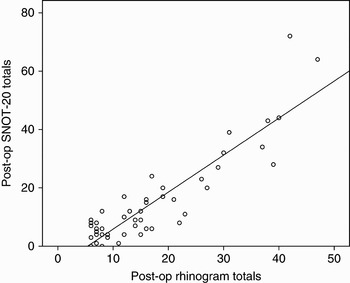
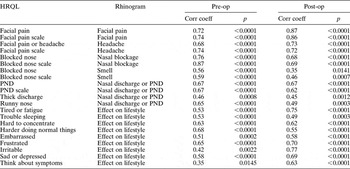
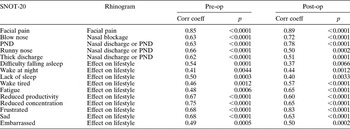
Rhinogram outcomes were compared with similar outcomes in the Heath-Related Quality of Life and Sino-Nasal Outcome Test-20 questionnaires, as shown in Tables III and IV, respectively. Good correlation was found between the rhinogram and both the Heath-Related Quality of Life questionnaire and the Sino-Nasal Outcome Test-20. Figures 7 to 10 give examples of this correlation, for one of the variables tested.
Pre-operative (pre-op) total outcome scores (on the questionnaires): correlation between Health-Related Quality of Life questionnaire (HRQL) and rhinogram. R sq linear = 0.623.

Post-operative (post-op) total outcome scores (on the questionnaires): correlation between Heath-Related Quality of Life questionnaire (HRQL) and rhinogram. R sq linear = 0.836.

Pre-operative (pre-op) total outcome scores (on the questionnaires): correlation between Sino-Nasal Outcome Test-20 (SNOT-20) and rhinogram. R sq linear = 0.628.

Post-operative (post-op) total outcome scores (on the questionnaires): correlation between Sino-Nasal Outcome Test-20 (SNOT-20) and rhinogram. R sq linear = 0.808.

Heath-related quality of life questionnaire vs rhinogram

HRQL = Health-Related Quality of Life questionnaire; pre-op = pre-operative; post-op = post-operative; corr coeff = correlation coefficient; PND = post-nasal discharge
Sino-Nasal Outcome Test-20 vs rhinogram

SNOT-20 = Sino-Nasal Outcome Test-20; pre-op = pre-operative; post-op = post-operative; corr coeff = correlation coefficient; PND = post-nasal discharge
Rhinosinusitis diagnosis
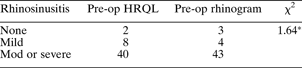
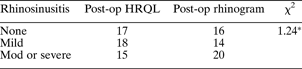
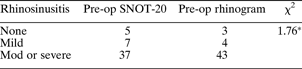
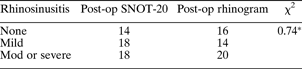
The presence of two or more symptoms (as determined by each questionnaire) as well as clinical findings was diagnostic of rhinosinusitis, as shown in Tables IIa and IIb. Rhinosinusitis diagnostic results are shown in Tables V to VIII. The data for each of the three questionnaires appeared very similar, with no significant differences between the data sets (chi-square test). This suggests that the data generated by the three questionnaires did not differ significantly, when the same diagnostic criteria were applied to each questionnaire.
Rhinosinusitis diagnostic results: pre-op HRQL vs rhinogram

Data represent the outcome questionnaire scores unless otherwise stated. *For significance at 0.05 level, chi-square should be ≥5.99. Pre-op = pre-operative; HRQL = Health-Related Quality of Life questionnaire; mod = moderate
Rhinosinusitis diagnostic results: post-op HRQL vs rhinogram

Data represent the outcome questionnaire scores unless otherwise stated. *For significance at 0.05 level, chi-square should be ≥5.99. Post-op = post-operative; HRQL = Health-Related Quality of Life questionnaire; mod = moderate
Rhinosinusitis diagnostic results: pre-op SNOT-20 vs rhinogram

Data represent the outcome questionnaire scores unless otherwise stated. *For significance at 0.05 level, chi-square should be ≥5.99. Pre-op = pre-operative; SNOT-20 = Sino-Nasal Outcome Test-20; mod = moderate
Rhinosinusitis diagnostic results: post-op SNOT-20 vs rhinogram

Data represent the outcome questionnaire scores unless otherwise stated. *For significance at 0.05 level, chi-square should be ≥5.99. Post-op = post-operative; SNOT-20 = Sino-Nasal Outcome Test-20; mod = moderate
Discussion
Chronic rhinosinusitis can significantly affect patients' quality of life.Reference Fokkens, Lund, Bachert, Clement, Hellings and Holmstrom1 Numerous sinonasal outcome scoring systems exist, indicating the lack of a single, accepted system for the evaluation of chronic rhinosinusitis outcomes.Reference Lund and Mackay4–Reference Morley and Sharp7 Some outcome questionnaires contain numerous items and may take significant time to complete, precluding routine clinical use. Extraction of data from VAS assessments may also be problematic.
The Sino-Nasal Outcome Test-20 was based on the Sino-Nasal Outcome Test-16. One of the faults in this outcome measure is that it does not query loss of smell. The EAACI position paper on rhinosinusitis has suggested that this symptom be assessed when diagnosing rhinosinusitis (and it is thus included in the rhinogram). However, the Sino-Nasal Outcome Test-20 is nevertheless a validated outcome measure, and was used in the National Comparative Audit of Surgery for Nasal Polyposis and Chronic Rhinosinusitis.Reference Hopkins, Browne, Slack, Lund, Topham and Reeves10 It has been described as easy to use, and as reliable, valid and responsive.
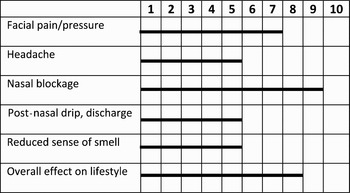
In contrast, the non-validated rhinogram questionnaire was created with the aim of providing a quick assessment of chronic rhinosinusitis suitable for clinic use. It uses a pre-printed sheet (analogous to the pro forma used for pure tone audiograms) which is retained in patients' medical records (see Figure 11). The rhinogram can be administered on subsequent clinic visits and simple comparisons made. Allowing the patient to compare successive rhinograms may also be helpful in demonstrating clinical improvement.
Sample completed rhinogram.

The rhinogram is a concise method for recording disease progression and response to treatment. It concentrates on symptomatology, although it briefly addresses quality of life issues in one question. It does not allow the addition of supplementary items felt by the patient to be important, as do quality of life measures.Reference Atlas, Gallagher, Wu, Singer, Gliklich and Metson9 There are numerous robust sinonasal-specific outcome measures which address such questions, but at the expense of increased questionnaire completion time. Our aim was to validate a straightforward, concise rhinosinusitis outcome measure which could be easily recorded and referred to within the patient's medical notes.
Patients attending a busy out-patient clinic often do not have time to fill out lengthy questionnaires. The rhinogram removes this problem. On average, the Sino-Nasal Outcome Test-20 and the Heath-Related Quality of Life questionnaires require over 5 minutes each for completion, compared with under a minute for the rhinogram. The rhinogram has the added benefit that it can be completed in the clinic room with the doctor, rather than in the waiting room. This would reduce the burden on the nursing staff and the patient prior to the consultation.
• Rhinosinusitis, as defined by the 2005 EAACI position paper, is mainly diagnosed by careful history-taking and examination
• Unlike other types of pathology, such as otological disease, rhinosinusitis does not have an objective measure, such as a hearing test; thus, validated outcome measures are used to assess treatment benefits
• This paper assessed the validity, reliability and responsiveness of the rhinogram compared with two validated outcome measures: the Sino-Nasal Outcome Test-20 and the Heath-Related Quality of Life questionnaire
• The rhinogram is a reliable, valid and responsive rhinosinusitis outcome measure which can assist patient diagnosis and management in the clinical setting
Rhinosinusitis may be managed conservatively as well as surgically. This study compared the results of the Sino-Nasal Outcome Test-20 and the HRQL, both of which have been validated, against the rhinogram. The study could be critised on the grounds that the Heath-Related Quality of Life questionnaire has previously been validated only in medically managed patients, and that, while our rhinogram results correlated significantly with our Health-Related Quality of Life results, we examined only patients undergoing surgical treatment. Therefore, we cannot conclude that the rhinogram is valid in medically managed patients.
Conclusion
This study was performed prospectively to evaluate the reliability, validity and responsiveness of the rhinogram compared with two other, known, validated outcome measures, through direct correlation of results. Our findings show that the rhinogram is statistically acceptable for use as a disease-specific outcome measure for patients with rhinosinusitis. Our initial null hypothesis was proven. Hopefully, these results will facilitate the routine clinical use of the rhinogram when managing chronic rhinosinusitis patients.