About one in three older adults in the community and 60 per cent of older adults in long-term care fall at least once annually (Public Health Agency of Canada, 2014). Falls are the leading cause of injury requiring hospitalization in Canadian older adults and carry both a high personal and health care cost. The highest incidence of injury sustained as a result of a fall is in the upper body (arms, head, torso; Public Health Agency of Canada, 2014). The most common fracture across the lifespan as a result of a fall is at the distal radius (wrist), accounting for one sixth of all fractures, with a much higher incidence in women (16% lifetime risk for women vs. 2.5% for men; Beil et al., Reference Beil, Barvencik, Gebauer, Mumme, Beil and Pogoda2011; Brogren, Hofer, Petranek, Dahlin, & Atroshi, Reference Brogren, Hofer, Petranek, Dahlin and Atroshi2012). The primary mechanism of injury resulting in wrist fracture is falling forward while walking, often occurring due to landing onto one or both outstretched hands (Beil et al., Reference Beil, Barvencik, Gebauer, Mumme, Beil and Pogoda2011; Orces & Martinez, Reference Orces and Martinez2011). Experiencing a wrist fracture is known to significantly increase the risk of a future fragility fracture, increasing steadily with time, reaching 55 per cent by 10 years and 84 per cent by 20 years post-wrist fracture (Orces & Martinez, Reference Orces and Martinez2011).
Women demonstrate a rising incidence of wrist fracture after age 50 years (Cuddihy, Gabriel, Crowson, O’Fallon, & Melton, Reference Cuddihy, Gabriel, Crowson, O’Fallon and Melton1999) with the number of wrist fractures treated in hospital emergency departments increasing dramatically between ages 45 and 64 years (Orces & Martinez, Reference Orces and Martinez2011). Compared to women older than 65 years, post-menopausal women in their 50s and early 60s who fracture their wrists are less likely to have compounding co-morbid conditions, which are known to increase with age and can contribute to further increased risk of falling (World Health Organization, 2003). Women in their early post-menopausal years do not present with the same risk factors for falls such as decreased gait velocity, balance, and strength; and they have higher levels of physical activity (Brogren et al., Reference Brogren, Hofer, Petranek, Dahlin and Atroshi2012). Cho, Gong, Song, Lee, and Baek (Reference Cho, Gong, Song, Lee and Baek2014) suggested that the increased risk of wrist fractures in this age group may be the combination of maintained levels of physical activity thus exposing individuals to riskier activity combined with subtle declines in physical performance. This is supported by findings whereby women who walk regularly have a higher risk of wrist fractures, compared to those who do not walk regularly (Silman, Reference Silman2003). This brings into question the utility of commonly used fall risk screening tools focusing on changes in gait speed and balance (Panel on Prevention of Falls in Older Persons, 2011) to identify women at risk of fractures and falls.
In addition to wrist fracture, a second outcome of falling on outstretched hands is trauma to the head. This is of concern particularly in higher momentum falls such as those occurring when walking; the protective arm response may be inadequate to prevent head impact (Schonnop et al., Reference Schonnop, Yang, Feldman, Robinson, Loughin and Robinovitch2013). Fall-related head injuries are among the most common injuries reported in emergency departments (Sattin et al., Reference Sattin, Lambert Huber, DeVito, Rodriguez, Ros, Bacchelli and Waxweiler1990). Falling is the leading cause of traumatic brain injury in older adults (Harvey & Close, Reference Harvey and Close2012), with 60 per cent of in-hospital deaths from traumatic brain injury occurring in the elderly population (Canadian Institute of Health Information, 2007; Stevens, Corso, Finkelstein, & Miller, Reference Stevens, Corso, Finkelstein and Miller2006).
The causes and factors related to fall-related upper body injury (wrist fracture, spinal injury, and head injury) have received little research attention despite accounting for more than 50 per cent of all fall-related injuries (Public Health Agency of Canada, 2014). Fall risk screening tools are targeted for adults over the age of 65 years, despite a higher incidence of wrist fracture in women younger than age 65 (Orces & Martinez, Reference Orces and Martinez2011). Understanding the circumstances of the fall resulting in wrist fracture and other potentially serious and related injuries such as head injury can help to drive future research and determine screening and preventive measures. Against this backdrop, we established the purposes of this study which were twofold: (1) determine the internal and environmental fall-related circumstances resulting in a wrist fracture, and (2) examine the relationship of functional status to these circumstances.
Methods
This cross-sectional study combined data from two studies evaluating fall history and fall risk factors within one year of a fall-related wrist fracture injury in women aged 50 and older. Data collection for both studies occurred during approximately the same time span (2011–2013) and took place in the same community: Saskatoon, Saskatchewan. Study 1 (n = 72) included women who had recently sustained a wrist fracture within one week of the event and were recruited from a distal radial fracture clinic as part of an intervention study (Magnus et al., Reference Magnus, Arnold, Johnston, Dal-Bello Haas, Basran, Krentz and Farthing2013). Exclusion criteria included any prior upper body injury or joint problem interfering with daily life, any history of neurological conditions or other balance problems (i.e., stroke, multiple sclerosis, Parkinson’s disease, vestibular disorders), as well as other conditions affecting the upper extremity such as reflex neuropathy. Participants were also excluded if the fracture was greater than two weeks old at the time of the first visit to the clinic; if there was a history of multiple wrist fractures in the adult years; or if they had a positive score on the Mini Cognitive Assessment for Dementia (Borson, Scalan, Brush, Vitaliano, & Dokmak, Reference Borson, Scanlan, Brush, Vitaliano and Dokmak2000).
An additional 27 women aged 50 and older who had sustained a wrist fracture within the past year were recruited from a larger study (Study 2; Crockett et al., Reference Crockett, Arnold, Farthing, Chilibeck, Bath, Baxter-Jones and Kontulainen2015) comparing fall risk and bone properties between women with and without a history of recent fracture. For these 27 women, an additional exclusion criterion included being on a bone-altering medication in the past year since one of the outcome variables, bone properties, would be influenced by recent use of bone-altering medication. In total, we interviewed 99 women from both studies for fall history using the same standard questionnaire which included a detailed history of the circumstances related to the fall resulting in wrist fracture. The 72 participants from Study 1 also underwent an assessment of fall risk factors within three weeks of the fall occurrence. Ethics approval was received for both studies independently as well as additional ethics approval for this cross-sectional study from the institution’s Biomedical Ethics Review Board. The measures described in the following paragraphs were what we used to determine details of the fall, physical activity and balance confidence status, and physical performance.
1. Circumstances and Nature of the Fall Resulting in Wrist Fracture
The fall history questionnaire, designed by the researchers, was a self-report questionnaire administered by a research assistant for both studies. Respondents reported if they had fallen in the past year and the frequency of falls. A fall was defined as “coming to rest on the ground or at another lower level with or without loss of consciousness or injury” (World Health Organization, 2003). All participants reported a fall as the cause of their wrist fracture injury. Detailed questions about the fall included the following: (1) time of day; (2) footwear at the time of the fall; (3) location; (4) activity; (5) reason for the fall; (6) symptoms after the fall; and (7) injuries sustained.
Other functional status measures in 72 of the participants within three weeks of the fall included physical activity level (Physical Activity Scale for the Elderly [PASE]), Activities-specific Balance Confidence (ABC) Scale, sit-to-stand performance in 30 seconds (STS), usual and fast gait speed over 50 feet with a turn-around (Gait_usual and Gait_fast), grip strength (Grip), and the modified Berg Balance Scale (BBSm).
2. Physical Activity Status and Balance Confidence
The PASE is a self-report questionnaire designed to assess current level of activity (occupational, household, and leisure) of community-dwelling older persons, based on the one-week period previous to the date of administration. This is a valid measure of physical activity levels in older adults correlated with other functional and health status measures such as balance, peak oxygen uptake, resting heart rate, and blood pressure (Washburn, McAuley, Katula, Mihalko, & Boileau, Reference Washburn, McAuley, Katula, Mihalko and Boileau1999). The ABC Scale is a reliable self-report questionnaire designed to measure confidence in performing daily activities and is closely associated with changes in function, balance, strength, and a recent history of falling. The ABC has been found to have 84 per cent sensitivity and 87 per cent specificity in correctly classifying fallers and non-fallers (Hill, Reference Hill2005; Myers et al., Reference Myers, Powell, Maki, Holliday, Brawley and Sherk1996).
3. Lower and Upper Extremity Strength
The 30-second chair sit-to-stand (STS) is a valid and reliable test for older adults aged 50 and older and measures the number of full sit-to-stand repetitions that can be performed in 30 seconds without the use of the arms. It is primarily a measure of lower extremity strength and is associated with fall risk (Jones, Rikli, & Beam, Reference Jones, Rikli and Beam1999). Grip strength was evaluated with a Jamar hand-held dynamometer (Patterson Medical Holdings, Inc., Bolingbrook, IL) or a Baseline hand dynamometer (Baseline Hydraulic Hand Dynamometer, White Plains, NY) to assess isometric strength of forearm muscles on the non-injured arm using the highest measure of three trials. Grip strength has been used as an assessment of total body capacity for muscular force generation because of its ability to correlate well with force generation of other muscle groups and their associated functional tasks (Rantanen et al., Reference Rantanen, Volpato, Ferrucci, Heikkinen, Fried and Guralnik2003) and is an independent predictor of future fragility fracture (Albrand, Munoz, Sornay-Rendu, Duboeuf, & Delmas, Reference Albrand, Munoz, Sornay-Rendu, Duboeuf and Delmas2003).
4. Gait Speed and Balance
The timed 50-foot walk test is an independent component of the Physical Performance Test, a performance-based measure designed to identify risk of recurrent falls (VanSwearingen & Brach, Reference VanSwearingen and Brach2001). The 50-foot walk test has been used to validate other functional and health status instruments and as an outcome measure for comparison of balance intervention programs in community-dwelling older adults (Hinman, Reference Hinman2002). The test consists of a person’s making a 50-foot walk at usual pace, walking 25 meters, turning, walking 25 meters back to the start line, and then repeating the same walk at their fastest pace, without running. The Berg Balance Scale, a predictor of fall risk in older adults, includes 14 items assessing functional balance and consists of day-to-day tasks such as picking up an object from the floor, turning in a circle, reaching, and balancing on one leg (Berg, Wood-Dauphinee, Williams, & Gayton, Reference Berg, Wood-Dauphinee, Williams and Gayton1989). The modified BBS (BBSm), featuring the more challenging nine tasks with a maximum score of 36, was what our study used, due to the higher functioning status of this population (Rose, Reference Rose2010).
Testing adhered to the published standard protocols for each measure. All testers were trained in using the standard protocol. Data were analysed using IBM SPSS software version 22. Responses to the fall history questionnaire were categorized and expressed as a percentage of responses. Means and standard deviations were calculated to summarize descriptive data for questionnaires and physical performance measures. The most frequent responses for circumstances of the fall were then dichotomized in order to determine the association of physical performance, physical activity, and balance confidence to the primary fall circumstances occurring with a wrist fracture injury. These associations were measured using point biserial correlations – for each of the physical performance measures – to the cause (other causes versus slips and trips), location (indoors versus outdoors), and injuries (no other injuries versus other injuries reported). Age was also categorized as under age 65 and age 65 and older in order to determine the association of age to physical performance factors and fall circumstances. A p value of < .05 was used for acceptance of significance for all statistical tests.
Results
Participants
Ninety-nine women, aged 50 to 94 (mean age: 63.8 ± 8.7 years), sustained a wrist fracture as a result of a fall occurring in the past year. Thirty-nine were aged 50–59, 38 were aged 60–69 (39%), 15 were aged 70–-79, and 7 were aged 80 or older. Fifty-six per cent of fractures sustained were in the dominant arm. There was no correlation between age and fracture arm (point biserial correlation = –.007). Eighty per cent of participants resided in a predominantly urban location compared to 20 per cent reported from rural or a smaller community outside of city limits. Participants living in rural areas tended to be younger (mean age: 60.3 ± 8.1 years) compared to those residing in urban locations (mean age: 64.2 ± 8.4 years), although this was not significantly different (p = 0.11). The range of number of falls reported in the past year was 1 to 12 with 61 per cent reporting only one fall, 39 per cent reported two or more falls, and 16 per cent reported three or more falls in the past year. There was no correlation (Pearson r correlation = .013) of age to number of falls reported. We were only able to report nutritional and medication information from 67 per cent of the sample due to differences in data collection between the two studies; however, from the 66 respondents, 41 per cent reported using regular calcium supplements and 52 per cent reported taking vitamin D supplements. On average, participants were on 1.9 prescription medications, with a range of 0–8 medications, which was significantly correlated with age (Pearson r correlation = 0.35).
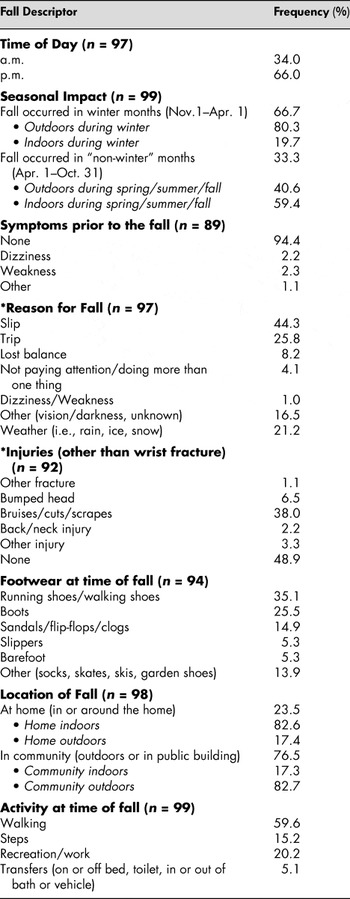
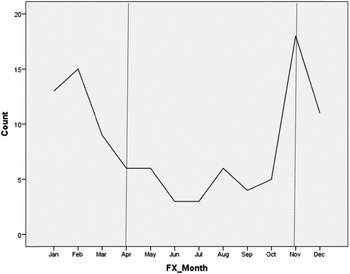
Table 1 provides an overview of the fall history data, and Figure 1 portrays seasonal variation in fall occurrence. Outdoor location during walking activities in the winter months (defined as November 1 to April 30) were the predominant circumstances for falls resulting in wrist fracture for this sample of women aged 50 or older. The majority of falls occurred outdoors in the community and during the winter months. The majority of winter falls (approximately 80%) happened outdoors in contrast to 40 per cent of spring, summer, or autumn falls (refer to Table 1). Eighty-eight per cent of falls occurring during the winter months were reported due to slipping, whereas tripping as the reason for the fall was more equally dispersed between winter and other months (44% during winter months compared to 56% during spring, autumn, or summer defined as May 1–October 31). Despite the high percentage of outdoor falls, with slipping as a primary cause, close to 80 per cent of respondents did not indicate weather as one of the contributing causes for the fall. Examples of weather as defined in the questionnaire were “rain, ice, or snow”. The primary circumstances identified to explain why they fell included tripping and slipping (70%), lost balance (8%), and unknown or other reasons including limited vision and darkness (16%; refer to Table 1). Half of the respondents reported other injuries sustained from the fall beyond the wrist fracture. Most other injuries sustained were reported as minor such as bruises, scrapes, or cuts; however, close to 10 per cent also sustained additional upper body injuries such as head impact or back and neck injuries.
Fall circumstances reported for the fall in the past year resulting in wrist fracture

* Respondents report all that apply
Seasonal variation of falls resulting in wrist fracture (Winter months included November to April for the study location. Fx = fracture; Count = number of falls reported)

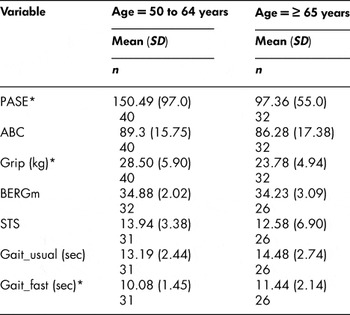
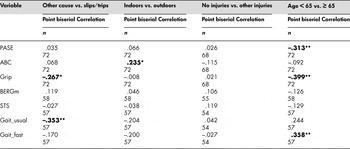
Seventy-two women (73%) had physical performance measures within three weeks of the fracture date. Table 2 outlines the mean values for these measures, and Table 3 provides the point biserial correlation values and significance for the relationship of physical performance measures to the circumstances surrounding the fall. Being aged 65 years and older was correlated with slower fast-paced gait lower levels of physical activity as measured by the PASE, and lower grip strength; however, age was not significantly correlated to any of the fall circumstances or risk of other injuries. Lower grip strength was significantly associated with slips and trips as the cause for the fall resulting in wrist fracture. A higher (indicating more confidence) ABC score was associated with outdoor falls, and faster usual gait speed was associated with slips and trips.
Descriptive statistics for physical performance measures within 3 weeks post-fracture for participants between the ages of 50 and 64 and 65 years and older

* Significant difference p < .01, independent t-test
ABC = Activities and Balance Confidence Scale
BERGm = modified (last 9 items) of the Berg Balance Scale
Gait_fast = fast gait speed for a 50 meter walk with turn
Gait_usual = usual gait speed for a 50 meter walk with turn
Grip = Grip strength
PASE = Physical Activity Scale for the Elderly
STS = 30-second sit-to-stand test
Point biserial correlation values for the relationship of physical performance measures to fall circumstances and age

* p < .05; ** p < .01
ABC = Activities and Balance Confidence Scale
BERGm = modified (last 9 items) of the Berg Balance Scale
Gait_fast = fast gait speed for a 50-meter walk with turn
Gait_usual = usual gait speed for a 50-meter walk with turn
Grip = Grip Strength
PASE = Physical Activity Scale for the Elderly
STS = 30 second sit-to-stand test
Discussion
This study examined the nature and circumstances of the fall resulting in a wrist fracture in women aged 50 years and older who sustained a fracture in the past year, and further determined the association of demographic and functional status with the primary circumstances of the fall and resultant injuries. Despite current knowledge that the majority of falls in community-dwelling adults over age 65 occur most often in the home across all seasons (Public Health Agency of Canada, 2014), we found falls that resulted in wrist fracture in women aged 50 and older occurred more frequently outdoors in the community (over 60% of all falls), in the winter months, typically during the afternoon or evening while walking. Slips and trips represented approximately 70 per cent of the reported causes of the falls, and despite the high number of falls occurring outdoors in the winter, 80 per cent of participants did not attribute the weather as a cause. Faster walking pace, higher levels of confidence, and weaker grip strength were found to be associated with these fall circumstances.
Wrist fractures typically occur when an individual reaches out the arm/arms in a protective response in order to avoid injury to the torso and head (Silman, Reference Silman2003). Women are more prone to wrist fracture likely due to a combination of lower forearm and wrist bone strength, muscle density, and muscle strength (Crockett et al., Reference Crockett, Arnold, Farthing, Chilibeck, Bath, Baxter-Jones and Kontulainen2015). Other reasons may include delays in reaction time and limited mobility resulting in less than ideal positioning of the shoulder, elbow, and wrist to absorb the energy of the fall descent (Lattimer et al., Reference Lattimer, Lanovaz, Farthing, Kim, Madill, Robinovitch and Arnold2014; Sran, Stotz, Normandin, & Robinovitch, Reference Sran, Stotz, Normandin and Robinovitch2010). Similar to findings in epidemiological studies (Cummings & Melton, Reference Cummings and Melton2002; Orces & Martinez, Reference Orces and Martinez2011), most wrist fractures occur in the early post-menopausal years during the 5th to 6th decades. This presents challenges to determining appropriate screening and prevention measures, as this cohort does not present with the same fall risk factors nor the usual fall circumstances as with women over the age of 65 years (Cho et al., Reference Cho, Gong, Song, Lee and Baek2014; Panel on Prevention of Falls in Older Persons, 2011). The mean age of the participants in this study was 64 years, with 77 per cent of women who sustained a wrist fracture in the past year being under the age of 70. The mean scores for physical performance measures also reflect a relatively active female sample with high levels of balance confidence. As well, mean scores for lower and upper extremity strength, gait speed, and balance were above cut-off scores for fall risk (Berg et al., Reference Berg, Wood-Dauphinee, Williams and Gayton1989; Jones et al., Reference Jones, Rikli and Beam1999; Quach et al., Reference Quach, Galica, Jones, Proctor-Gray, Manor, Hannan and Lipsitz2011). Although women over the age of 65 in this study tended to have lower levels of physical activity as well as lower gait speed and grip strength, there was no association between age and history of previous falls, or the fall-related circumstances that resulted in the wrist fracture.
This study took place in Saskatoon, Saskatchewan, and surrounding areas, a location with about 50 per cent sun (% sun is the usual percentage of daylight hours with bright sunshine; Environment Canada, 2016). Somewhat surprisingly, given the potential risk of lower bone density in this population, less than half of the women reported taking calcium supplementation prior to the fracture, and only half reported consumption of vitamin D supplements. This highlights recommendations from recent guidelines that most women over the age of 50 do not receive adequate calcium and vitamin D intakes to prevent bone loss during the crucial early post-menopausal years (Papaioannou et al., Reference Papaioannou, Morin, Cheung, Atkinson, Brown and Feldman2010).
Wrist fractures occur more commonly outdoors and during the winter, not only in Canada, but also in other countries where snow and ice add to the risk of falls (Graafmans, Ooms, Bezemer, Bouter, & Lips, Reference Graafmans, Ooms, Bezemer, Bouter and Lips1996; Public Health Agency of Canada, 2014). Little is known about the profile of when, how, and why wrist fractures occur. The fact that the majority of fractures in the current study occurred during a slip or trip while walking is not surprising. Other studies support walking as the most common activity resulting in a fall (O’Neill et al., Reference O’Neill, Varlow, Silman, Reeve, Reid, Todd and Woolf1994; Robinovitch et al., Reference Robinovitch, Feldman, Yang, Schonnop, Leung, Sarraf and Loughin2013), and forward falls with hand or arm impact are two common fall directions and impact sites for both men and women (O’Neill et al., Reference O’Neill, Varlow, Silman, Reeve, Reid, Todd and Woolf1994; Schonnop et al., Reference Schonnop, Yang, Feldman, Robinson, Loughin and Robinovitch2013). Thus, the risk of wrist fracture is high, particularly in women who also may have compromised bone strength.
The participants in this study presented as relatively healthy women, with normal if not high levels of physical activity, balance, walking speed, sit-to-stand, and grip strength scores (Berg et al., Reference Berg, Wood-Dauphinee, Williams and Gayton1989; Jones et al., Reference Jones, Rikli and Beam1999; Quach et al., Reference Quach, Galica, Jones, Proctor-Gray, Manor, Hannan and Lipsitz2011; Washburn et al., Reference Washburn, McAuley, Katula, Mihalko and Boileau1999). Interestingly, 39 per cent did report a previous fall in the past year other than the fall that caused the wrist fracture, and 16 per cent reported three or more falls in the past year. The number of falls reported was not correlated with age. This seemingly fall-risk-free cohort as determined by measures such as balance confidence, physical activity, and gait speed may actually have subtle fall-risk physical performance indicators that were not captured in this study. A second explanation could be that women who are more active take a higher degree of risk in their day-to-day activities. Cho et al. (Reference Cho, Gong, Song, Lee and Baek2014) also found that falls resulting in wrist fracture are related to maintained levels of physical activity with subtle declines in physical performance.
Other studies have also found that signs of usual fall risk such as lower muscle strength, slower gait speed, and lower levels of activity do not predict fall risk in this population (Cho et al., Reference Cho, Gong, Song, Lee and Baek2014; Graafmans et al., Reference Graafmans, Ooms, Bezemer, Bouter and Lips1996; Kelsey, Browner, Seeley, Nevitt, & Cummings, Reference Kelsey, Browner, Seeley, Nevitt and Cummings1992; Nellans, Kowalski, & Chung, Reference Nellans, Kowalski and Chung2012). Instead, a faster gait speed and higher levels of physical activity are more important predictors of wrist fracture risk (Silman, Reference Silman2003). On the other hand, engagement in physical activity is also known to maintain bone health in early post-menopausal women, thus reducing the risk of wrist fracture (Qu et al., Reference Qu, Zhang, Zhai, Li, Liu, Liu and Dai2014). It is important to consider possible preventive measures within the context of these findings. Physical activity is important to prevent bone loss, and improve strength and balance in both early post-menopausal women and older women beyond age 65. Physical activity may also assist to improve response time, a better predictor of ability to avoid a fall after a trip than slowing walking speed (van den Bogart, Pavol, & Grabiner, Reference van den Bogert, Pavol and Grabiner2002). However, cautionary measures such as slowing walking speed particularly in riskier environmental conditions such as ice and snow may be prudent educational tools to provide in exercise programs for this population. Indeed, both high and low walking speeds have been found to be predictors of fall risk (Quach et al., Reference Quach, Galica, Jones, Proctor-Gray, Manor, Hannan and Lipsitz2011).
Another contradictory finding to usual fall risk factors in the population over age 65 was an increased balance confidence (or less fear of falling) associated with outdoor falls resulting in wrist fracture. This again may suggest advice to err on the side of caution particularly when engaging in outdoor activities during the winter months for females in their 50s and 60s who are active and balance confident. Although confidence was measured almost immediately after the fall event resulting in fracture, the majority of this sample did not have low balance confidence scores. This also alludes to the possibility that early post-menopausal women’s balance confidence (or perception of confidence in preventing a fall) remains relatively high even after a fall event resulting in a fracture. Other studies have observed an increase in fear of falling 3 months after the fall-related wrist fracture in women over age 50 despite interventions during the rehabilitation phase designed to decrease this fear (Rucker et al., Reference Rucker, Rowe, Johnson, Steiner, Russell, Hanley and Majumdar2006). Based on their findings, it is possible there may be a delayed increase in fear of future falls following the traumatic fracture event.
Both high and low levels of balance confidence may influence future fall risk. Women with higher levels of confidence, who are engaged in a healthy lifestyle, may not perceive any future risk, despite a serious injury recently having occurred that should alert both health practitioners and patients of a substantially increased risk of future falls and fracture. On the other hand, low levels of confidence may reduce involvement in physical and recreational activity focused on reducing fall risk (Dalbaere, Crombez, Vanderstraeten, Willems, & Cambier, Reference Dalbaere, Crombez, Vanderstraeten, Willems and Cambier2004).
Grip strength was the only physical performance measure where a lower score was significantly associated with the most likely cause of the fall and fracture, slips, and trips (Table 3). Grip strength is increasingly becoming known as an important marker for overall muscle strength and fragility in a variety of patient populations (Chung et al., Reference Chung, Wu, Jones, Tomoko, Tien, Givens and Schultz2014). We have found grip strength significantly lower in women with a history of wrist fracture and associated with fracture risk and bone strength compared to age-matched controls (Crockett et al., Reference Crockett, Arnold, Farthing, Chilibeck, Bath, Baxter-Jones and Kontulainen2015). Grip strength may be a simple and easy screening tool to determine fall and fracture risk in this population, but further research is needed to determine meaningful fall risk cut-off scores. A higher usual gait speed was also associated with slips and trips (Table 3). Other studies have found similar results where engagement in walking activity increased risk for falls (Silman, Reference Silman2003) and wrist fracture (Giangregorio et al., Reference Giangregorio, Papaioannou, Macintyre, Ashe, Heinonen, Shipp and Cheung2014). Measurement of walking speed may also be a helpful screening tool to identify not only slower speeds posing fall risk but potentially riskier fast walking paces (Quach et al., Reference Quach, Galica, Jones, Proctor-Gray, Manor, Hannan and Lipsitz2011). Similar to grip strength, a cut-off score for fast gait speed predicting fall risk is not known.
Despite the majority of falls occurring outdoors during the winter months, 80 per cent of women did not indicate weather as a contributing factor. This is an interesting finding not reported previously in the literature. It is difficult to interpret this finding, as the data collection methods did not allow for delving further into what participants deemed as “weather” – that is, they referred to temperature as opposed to other risky conditions such as slush, mud, melting snow, underlying ice, and so on. It is possible that more extreme weather conditions, such as the weather experienced in January in central Saskatchewan where temperatures can drop to minus 40 degrees Celsius with wind chill, tend to keep people indoors and thus do not pose any substantial risk for falls. On the other hand, warmer winter temperatures may actually present riskier conditions because of recurring melting and freezing. One may not attribute weather as a factor in these types of conditions because it is not deemed as extreme cold or ice of the colder winter months. A second explanation could be that women tend to blame internal factors. We found that reasons such as “lost balance” and “slipped or tripped” were more readily identified as the cause of the fall. There is evidence that women tend to engage in more self-blame behavior in a variety of trauma-related circumstances than men, and this might extend to perception of fall-related causal factors (Shaver & Drown, Reference Shaver and Drown1986). Further qualitative research should explore this phenomenon and investigate gender differences in the perception of internal versus external causes of falls.
Close to half of all reported falls resulted in other injuries beyond the wrist fracture. Most of these were considered minor such as bruises, scrapes, and cuts; however, approximately one quarter of these injuries were more serious, including other fractures, head impact, spine, or other musculoskeletal injuries. It is important to note that 10 per cent of these injuries were reported to the head, neck, or spine. Falls are the leading cause of head injury in older adults (Canadian Institute of Health Information, 2007); but they may often be undetected or not reported, possibly particularly when another major injury, such as wrist fracture, has been sustained. The presence of a fracture then becomes the focus of self-reported injury and post-fall health care. This would suggest head impact may be even more common with forward falls on the outstretched hands. Indeed, research investigating real-time video analysis of actual falls has found that head impact occurred in 40 per cent of all falls, and hand impact occurred in close to 75 per cent; however, hand impact had no significant effect on whether head impact occurred or not (Schonnop et al., Reference Schonnop, Yang, Feldman, Robinson, Loughin and Robinovitch2013).
Further, despite evidence that older adults will utilize a protective response to reach arms out to break a fall (DeGoede & Ashton-Miller, Reference DeGoede and Ashton-Miller2003; Hsiao & Robinovitch, Reference Hsiao and Robinovitch1998), there may be inadequate neuromuscular control of the arms to prevent head impact, particularly for older women (Lattimer et al., Reference Lattimer, Lanovaz, Farthing, Kim, Madill, Robinovitch and Arnold2014; Sran et al., Reference Sran, Stotz, Normandin and Robinovitch2010). This may be an even greater risk for head injury in higher momentum forward falls with faster gait speed and for women with diminished arm strength. Given that both a higher gait speed and a lower grip strength were found to be associated with slips and trips resulting in wrist fracture (Table 3), these two physical performance markers may be important assessment tools to further investigate.
There are several limitations of this study to note. First, the nature and circumstances of the fall relied solely on self-report. For 72 of the participants this was within one week of the fall, so accuracy is likely to be higher. However, for the other participants reporting within one year of the event, some details may not have been remembered as accurately. Second, this study merged data from two studies and although all testing procedures were consistent with similar trained personnel conducting the study, one study recruited participants from a clinic where women were referred from their family physicians, whereas the other recruited via advertisement. Women attending a clinic may present with different characteristics such as the presence of other complications, possibly higher motivation to attend to their health as compared to those who respond to an advertisement. The reverse could also be true, although we found no significant difference in age, number of falls, or other physical and demographic factors between the two recruited cohorts.
Even with this merged sample, the sample size is still small and may not necessarily reflect the scope and age range of women who sustain a distal radial fracture in the community. There also were differences in our not being able to obtain the same amount of medical history and demographic information for Study 1 as compared to Study 2. Finally, we conducted the physical performance measures only on a proportion (75%) of the total sample, and these women were tested immediately following the fall, which may not necessarily be reflective of performance prior to the fall.
In conclusion, falls resulting in wrist fracture in older women happen across the older adult lifespan, but are particularly common in the 5th and 6th decades when women tend to be more physically active, with no other fall risk indicators. Falls resulting in wrist fracture occur primarily outdoors due to slips and trips, with faster gait speed and lower grip strength associated as contributing factors. Adjusting walking speed under riskier environmental conditions, improving arm strength, and addressing environmental safety in communities, may help to diminish the risk of wrist fracture and other serious consequences such as head injury in older women. More research is needed to investigate potential fall risk and injury screening tools in this population.