Introduction
Contemporary gerontology has highlighted not only the value of participation by older people in a variety of creative activities, but also the role of the arts in constructing, perpetuating or challenging stereotypes of older people and models of the ageing process (e.g. Basting Reference Basting1998; Cole Reference Cole2008; Cole and Gadow Reference Cole and Gadow1986; Cole, Kastenbaum and Ray Reference Cole, Kastenbaum and Ray2000; Johnson Reference Johnson2004). Simultaneously, literary and cultural scholars have become increasingly interested in representations of ageing and the artistic output of older people (e.g. Cohen-Shalev Reference Cohen-Shalev2008; Jansohn Reference Jansohn2004; King Reference King2013; Martin Reference Martin2012; McMullan Reference McMullan2007; Small Reference Small2007; Worsfold and Kirkwood Reference Worsfold and Kirkwood2005). Though still somewhat limited in the United Kingdom (UK), the existing international academic research base enables us to begin to draw certain conclusions about the value of participation in creative and meaning-generating activities for older people in general and, in the context of this paper, about their participation in theatre and drama more specifically.
In North America, for example, the late Gene Cohen (Reference Cohen2006) was a pioneer in the arts and health field. He undertook ground-breaking research on the physiological and psychological benefits of arts participation on older people (Cohen Reference Cohen2009). He also focused our attention on the potential (as opposed to the problem) of ageing in relation to creativity (Cohen Reference Cohen2006: 14), demonstrating how older people as participants in the arts enable us to challenge a deficit model of later life. Our paper extends these findings on participation, creativity and late-life potential in relation to a new and in some respects wider range of materials and contexts, including the intersection between institutional and personal archives (by which we mean the territory of reminiscence shared between the theatre's assemblage of its own historical past and subjective collections of souvenirs and mementos). We focus on the place of the Victoria/New Victoria Theatre in the lives of older people in North Staffordshire, England and, in particular, on one distinctive aspect of its first 50 years of artistic output: the pioneering ‘documentary dramas’ for which it became internationally recognised. In so doing, this paper aims to show how our multi-disciplinary or ‘layered’ analytical approach to distinct bodies of material comprising the theatre's own recorded history of its relationship with the community, enables us to connect practices of dramatic representation, reminiscence and archival materials (institutional and personal) with new creative practices that enable meaningful participation among older people.
Older people and arts participation
Arts participation by older people has demonstrable benefits for the individuals concerned. In Australia, Hays and Minichiello (Reference Hays and Minichiello2005) explored the meaning, importance and function of music in later life for building confidence and self-esteem. Other research looking at (social) dance and at singing (Cooper and Thomas Reference Cooper and Thomas2002; Hillman Reference Hillman2002; Nadasen Reference Nadasen2007; Trinity Laban Conservatoire of Music and Dance 2010) shows how participation can help people deal with important periods of transition and loss such as retirement and widowhood, as well as having positive effects on physical and social wellbeing through, for example, increased levels of daily activity (Staricoff Reference Staricoff2004).
At a community level, arts participation by older people can help contribute to building stronger and more cohesive communities through what Cooper and Thomas (Reference Cooper and Thomas2002: 689) term ‘a welcome sense of community spirit’. Hillman's (Reference Hillman2002) study in Glasgow also showed that participatory singing was making a contribution to the cultural economy and fabric of the city by generating social capital (Better Together 2000). In her study, Reynolds (Reference Reynolds2011) investigated the nature of arts-generated social capital amongst older people and found that not only do many group arts activities involve intrinsic mutual support, but that practical and emotional mutual supports also stem from people's arts engagement (see also Bungay and Skingley Reference Bungay and Skingley2008; Clift et al. Reference Clift, Hancox, Morrison, Hess, Stewart and Kreutz2008; Paulson Reference Paulson2011). Such involvement can, in turn, contribute to wider goals around challenging age-related stigma and discrimination (Cohen Reference Cohen2006; Fisher and Specht Reference Fisher and Specht1999).
The growing interest in arts participation and ageing amongst UK gerontologists is further exemplified by a number of key research-related developments and reports. For example, the comprehensive Ageing Artfully (Cutler Reference Cutler2009) report draws attention to how intergenerational approaches to arts programming can lead to improved relationships and understanding between generations. As well as recommending more tailored policy interventions, the scaling up of activity, and increased networking and partnerships between organisations, the report also called for more UK research ‘into the effects of the arts on personal and community relations’ (Cutler Reference Cutler2009: 28). One response to this can be seen in the variety of research funded under the UK's national New Dynamics of Ageing (NDA) programme (www.newdynamics.group.shef.ac.uk/). The programme has included, for example, studies relating to identity and the visual arts (Goulding and Newman Reference Goulding and Newman2012); to the role of music in people's lives and the impact of participation in music-making (Hallam et al. Reference Hallam, Creech, Pincas, Varvarigou, McQueen and Gaunt2011), and to the role of arts and cultural activities in connecting older people in rural and urban communities (Hennessy et al. Reference Hennessy2012; Murray and Crummett Reference Murray and Crummett2010). Concurrently with the NDA programme, the Baring Foundation commissioned the Mental Health Foundation to undertake an evidence review of the new and emerging research field of participatory art. The resulting report (Mental Health Foundation 2011) calls too for increased awareness and investment in participatory arts by policy makers, health and social care providers, and funders.
Theatre, drama and older people
Turning specifically to theatre and drama, it is pertinent to note that the recent Mental Health Foundation (2011) review included evidence from just four studies reporting on older people's participation as performers, actors and co-creators of performance pieces (Hafford-Letchfield et al. Reference Hafford-Letchfield, Couchman, Webster and Avery2010; Johnson Reference Johnson2011; Noice and Noice Reference Noice and Noice2008; Pyman and Rugg Reference Pyman and Rugg2006). Whilst echoing some of the general findings about the value of arts engagement for older people, these studies also show that drama activities enhance intergenerational learning, enabling (young) participants to think outside their established views of older people (Hafford-Letchfield et al. Reference Hafford-Letchfield, Couchman, Webster and Avery2010). Similarly, the evaluation of ‘On Ageing’ (performed at the Young Vic in 2011) highlights the value of an intergenerationally devised piece in creating positive impressions of older people as active and fun amongst the children (Johnson Reference Johnson2011).
Taking part in drama activities can also improve older people's cognitive skills because drama requires participants to be active rather than passive, to engage mentally, physically and emotionally at a high level, and to engage in problem solving (Noice and Noice Reference Noice and Noice2008). From the Pyman and Rugg (Reference Pyman and Rugg2006) study – the only one to include interviews with both performers and production crew – there is additional evidence that older people's theatre and drama engagement results in increased skills, confidence and social connections, a sense of individual and collective achievement, and ‘community spirit’. For recently bereaved people, having ‘a reason to go out and a welcome when you arrived’ (Pyman and Rugg Reference Pyman and Rugg2006: 568) was particularly valued, and performing a role on stage could provide a temporary distraction from grief. In addition, the audience's appreciation reinforces positive impacts for participants.
Internationally too, there is growing interest in what is sometimes referred to as research-based community theatre (Basting Reference Basting1998; Feldman et al. Reference Feldman, Radermacher, Lorains and Haines2011; Mitchell, Jonas-Simpson and Ivanoffski Reference Mitchell, Jonas-Simpson and Ivanoffski2006). In Australia, Feldman et al. (Reference Feldman, Radermacher, Lorains and Haines2011) show how a theatre performance about widowhood can become a medium for humorously challenging negative stereotypes and facilitating older people's engagement with key life events. The play, Wicked Widows, was written by playwright Alan Hopgood and is based on Feldman's PhD thesis. Since 2006, it has been staged in more than 40 locations across the state of Victoria and attended by over 6,000 people. The researchers found research-based community theatre to be a valuable means ‘to convey research findings and key psychosocial health and wellbeing messages in an entertaining, safe, and supportive environment’ (Feldman et al. Reference Feldman, Radermacher, Lorains and Haines2011: 896), as well as a way of engaging older people in meaningful discussions about their own lives.
Growing older, ageing research and disciplinary traditions
Whilst various forms of community or participatory theatre have long been used to address issues affecting marginalised or excluded groups (Kaptani and Yuval-Davis Reference Kaptani and Yuval-Davis2008), Feldman et al. (Reference Feldman, Radermacher, Lorains and Haines2011) suggest that it is a presently under-utilised medium for conveying positive messages about growing older. This kind of approach also resonates with recent developments in performative social science (Denzin Reference Denzin2001; Jones Reference Jones2006). Here, social scientists look to tools more commonly associated with the arts and humanities (e.g. performance, poetry, film, video, audio, graphic arts and new media) not only to disseminate research findings but also to co-operate and co-create outputs with others and provide a bridge between different disciplinary traditions (Roberts Reference Roberts2008).
Paradoxically though, whilst the current research and funding environment in the UK and elsewhere actively promotes inter- and multi-disciplinary working in order to address ‘big issues’ such as ageing (Bruun et al. Reference Bruun, Hukkinen, Huutoniemi and Klein2005; Eales, Means and Keating Reference Eales, Means and Keating2013; Griffin, Medhurst and Green Reference Griffin, Medhurst and Green2006; Hennessy and Walker Reference Hennessy and Walker2011; Klein Reference Klein2008), many established academic outlets work unconsciously against this goal as they tend to encourage discipline-specific and tightly focused submissions. Consequently, rather than initially separating out our project and its varied findings into distinctive disciplinary-specific papers (although we have chapters and articles of this nature in press and in progress), we build here on developments within interdisciplinary research into arts and ageing through a focused case study (Yin Reference Yin2013) that has advantageously enabled us to generate multiple ‘layers’ of analysis.
These layers are reflected in our aims for this paper, which are threefold: (a) to explore the history of older people's varied forms of participation in the life of the Victoria/New Vic theatres, and the consequences of that variety for the theatre's continually evolving practices of documentary representation; (b) to assess, from an emotional and affective point of view, the impact that participation in community-based theatre has had on the lives of people as they have grown older; (c) to assess the practical social impact of participation on older people's resources of creativity, in particular as that participation shapes meanings associated with life transitions and milestones such as: bereavement and retirement; new life challenges; and intergenerational relations. While we present a case study of the Victoria/New Victoria Theatre, we demonstrate that our ‘layered’ approach to interdisciplinary enquiry has generated findings that will be of importance not only to the communities participating in the New Victoria Theatre and its traditions, but also for others who are researching and shaping policy about ageing and the participatory arts; especially at the increasingly urgent interface between the humanities and social sciences.
Ages and Stages: setting the scene
Ages and Stages – an initial three-year partnership (2009–2012) between Keele University and the New Vic Theatre, Newcastle-under-Lyme – is an interdisciplinary project exploring representations, lived experiences, and performances of ageing and later life within a particular theatrical, geographical, historical and social context. Led by a social gerontologist, the research team included members with academic backgrounds in theatre studies, cultural theory and history, social and health psychology, and social anthropology, as well as a theatre practitioner and educator. Team members also had particular expertise in undertaking ethnography, documentary research in archives and qualitative research – notably narrative and biographical interviewing and analysis.
Theoretically and conceptually, what drew our varied backgrounds and experiences together was a shared commitment to critical gerontology: an approach which acknowledges the wider social and cultural contexts of ageing; engages with new theorising and new methodologies which cut across the social sciences and the humanities; and which recognises the skills, abilities and contributions of older people rather than automatically framing ageing as problematic (Bernard and Scharf Reference Bernard and Scharf2007; Estes, Biggs and Phillipson Reference Estes, Biggs and Phillipson2003; Grenier Reference Grenier2012). Wider developments in cultural and humanistic gerontology noted at the start of this paper also informed our approach, emphasising as they do the possibilities associated with later life and the interpretation and articulation of meaning (Baars et al. Reference Baars, Dohmen, Grenier and Phillipson2013; Cole, Kastenbaum and Ray Reference Cole, Kastenbaum and Ray2000; Cole, Ray and Kastenbaum Reference Cole, Ray and Kastenbaum2010).
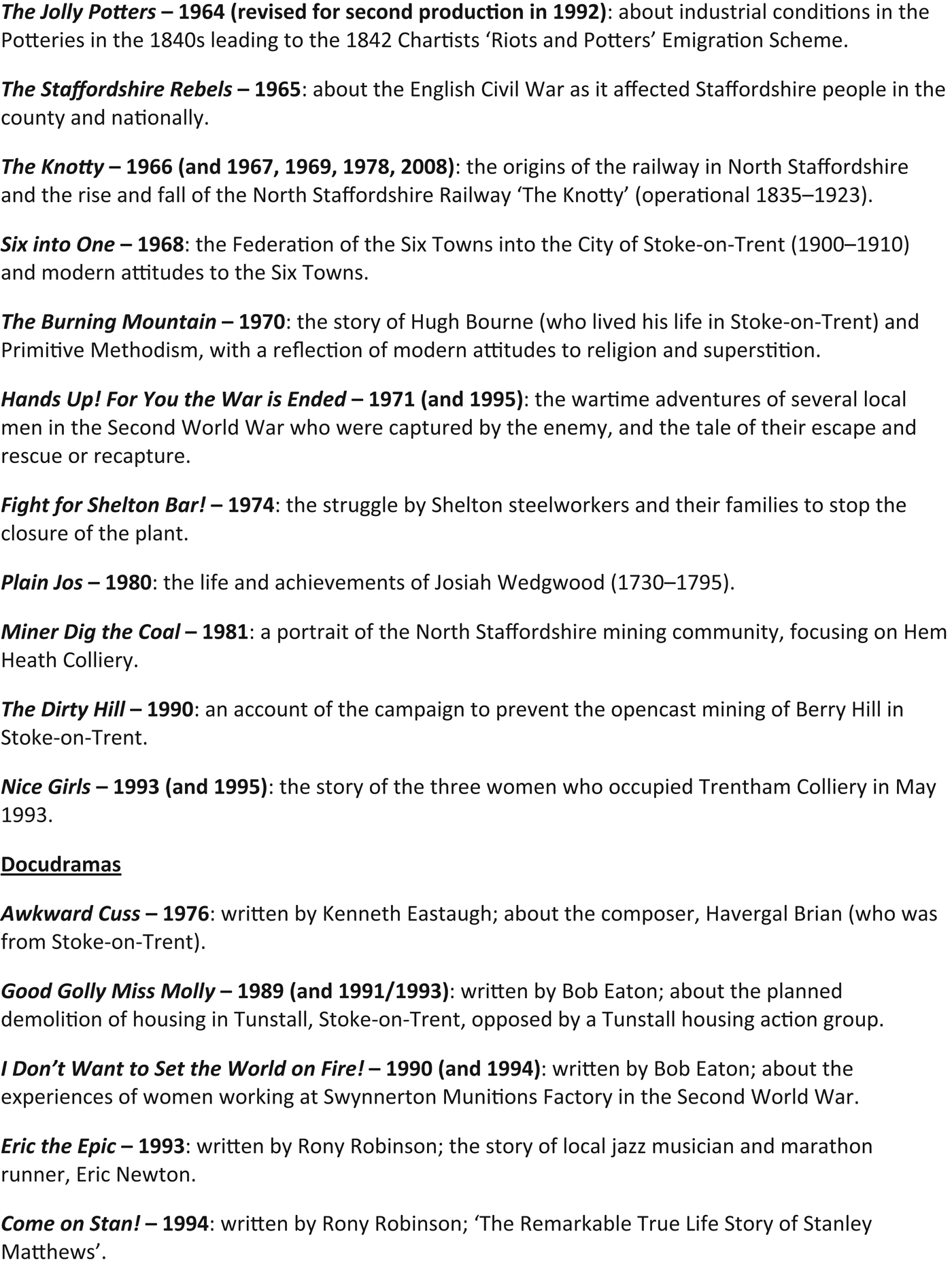
Located in ‘the Potteries’ in North Staffordshire, England, the Victoria Theatre (subsequently the New Vic Theatre) pioneered a distinctive form of social documentary theatre between 1964 and 1993, under artistic director Peter Cheeseman (Elvgren Reference Elvgren1974; Rowell and Jackson Reference Rowell and Jackson1984; Schweitzer Reference Schweitzer2007). Print, manuscript and oral source materials were combined in dramatic works developed by the theatre company in collaboration with the local community, and their subject matter was taken from the community's history, or from contemporary issues and disputes. A total of 16 social documentaries and docu-dramas were developed, some of which were revived at different points in the theatre's history (see Figure 1). Between them, they chart social, economic and political changes in the Potteries, reflect the community's self-image at various points in recent history and, by drawing on the testimony of local people, illustrate the roles and positions of different generations within the community. It is also important to note here that, since its inception, the Vic has been a theatre-in-the-round and, when it moved in 1986 to new premises, it was Europe's first purpose-built theatre-in-the-round.
The documentaries.

As well as investigating the social documentaries and exploring the theatre's archive held at Staffordshire University, the project was also designed to uncover the varied relationships older people had – and still have – with the theatre as audience members, volunteers, employees and documentary sources. This included examining the theatre's role in continuing social engagement in later life and its part in fostering intergenerational understanding within the community. Practically therefore, the project combines literary and cultural analyses with qualitative interview work, ethnography and research-led performance. In this sense, one way of viewing our multi-method project is as a case study which, in order to do intellectual justice to the material, its setting and our research focus, required the collaborative efforts of a wide variety of expertise from diverse academic disciplines. It is precisely the interdisciplinary framework in which the ‘case study’ came to be investigated which provides it with a wider purchase and indeed resonance for those researchers and policy makers who are already actively engaged in arts, community and ageing research.
Methods
In terms of research methods, we sought to address the three main aims noted earlier in the following ways.
Documentary representation and older people's participation in the life of the theatre
First, our exploration of representations of age and ageing in the documentaries began with archival research at the Victoria Theatre Collection held at Staffordshire University. The archive includes not only performance materials (scripts, programmes, photographs, audio recordings, correspondence, etc.) and an extensive collection of reviews and press cuttings, but also the research materials on which the 11 documentaries and five docu-dramas (see Figure 1) were based, including newspaper reports and a remarkable collection of interviews with members of the community, themselves a valuable source of oral history.
Working in pairs, team members read through all 16 documentaries, drawing out key topics of representation from the scripts such as ‘images of ageing’, ‘attitudes to ageing’, ‘family’ or ‘intergenerational relationships’. Where possible, we also watched film or video of particular productions, noting how age was represented and performed on stage. This was supplemented by listening to original interviews and by examination of earlier drafts of scripts to see some of the choices which had been made about what to include, and what to leave out, in the final versions. In undertaking this aspect of the research, we were particularly interested in the testimony recorded from older informants – older age and longevity of memory being, often, the reason for their recruitment by the original researchers compiling the documentaries. In addition, we were interested in those researchers and their own implicit attitudes to ageing.
The impact of community-based theatre on the lives of older people
In order to address our second aim of examining what part the documentaries and the theatre has played in the emotional and affective lives of older people, we undertook a series of new qualitative interviews. Seventy-nine individual or couple interviews (93 people in total) were conducted with four constituencies of older people in North Staffordshire who are, or have been, involved with the theatre as: (a) long-standing audience members (N=29); (b) current or former theatre volunteers (N=26)Footnote 1 ; (c) current or former theatre employees and actors who continue to live in the area (N=23); and (d) sources for the documentaries (N=15).
Interviewees were recruited through leaflets placed at the New Vic Theatre and at other community and arts venues in North Staffordshire, through snowballing via people's social networks (e.g. former and current colleagues, friends and family), by word-of-mouth, and following appeals on local radio and in local media. Most interviews took place in participants' own homes, with a few at the New Vic Theatre and/or at Keele University, when this was preferred by interviewees. The interviews lasted for between one and two hours on average and all were digitally recorded and transcribed. Using a loosely constructed interview schedule, participants were encouraged to tell their stories (Andrews, Squire and Tamboukou Reference Andrews, Squire and Tamboukou2008; McAdams Reference McAdams1997) about how they had become involved with the theatre, the role it has played through their lives and their recollections of the documentaries. They were asked to reflect on the place of the theatre within the wider community, how this has changed over time, and on their own current and imagined future role within the life of the theatre. In the reporting of our findings, pseudonyms have been given to all participants.
At the close of their individual interviews, participants were asked if they would be willing to take part in a small group discussion at a later date. The intention had been to try to hold four group interviews to bring together audience members, volunteers, employees and sources. In the event, such was the level of interest that we held ten group interviews either at the New Vic Theatre or at Keele University: three each with volunteers and employees, and two each with audience members and sources, involving 51 people in total. Using quotations taken from the individual interviews to stimulate discussion, the core of these interviews was focused around three themes: ageing; intergenerational relationships; and sense of place. Depending on which group we were working with, there were also questions pertinent to their particular experiences. Sources, for example, were asked what it was like to participate in the documentaries in this way and to see themselves or friends and colleagues depicted on stage; and whether and how older people were involved. As with the individual interviews, these group discussions lasted for up to two hours and were digitally recorded and transcribed. After anonymising, all the interview material was entered into Nvivo 8 and subjected to thematic analysis by our Research Associate (Bazeley and Jackson Reference Bazeley and Jackson2013).
Participation, life transitions and continued creativity
The individual and group interviews were also important in helping address our third aim of trying to elucidate the relationship between older people's practical involvement with the theatre and continued social and creative engagement in later life, as milestones and major transitions were encountered. However, we also explored this aspect through additional means. Alongside the interviews, our Research Associate undertook participant observation with New Vic volunteers for several months and her notes also formed part of the thematic analysis.
Furthermore, in keeping with the performative research-led practice element, individual interviewees had also been asked whether they might be interested in taking part in the next stage of the project in which we were hoping to put together a new documentary performance piece. Sixteen of our interviewees (aged 59–92) volunteered to get involved; a couple were former actors at the Victoria and New Victoria Theatres, but the majority had no acting experience. From September 2011 to May 2012, they came together with nine ‘senior’ members of the New Vic Youth Theatre (aged 16–19) in weekly workshops. Using and discussing findings from the interviews and from archival analyses and materials, the group devised an hour-long verbatim documentary, Our Age, Our Stage (Rezzano Reference Rezzano2012). The piece played to over 700 people at schools, colleges, retirement communities, local councils and in front of a capacity audience on the theatre's main stage in July 2012. An associated Ages and Stages exhibition, charting and celebrating the theatre's 50-year history from 1962 to 2012, was mounted at the theatre. Each workshop session was video-recorded and one member of the research team also made contemporaneous notes. Some of our participants chose to keep diaries of their experiences over this period, and some of this material was published on a project blog. At the very end of the project, we held a group feedback and evaluation session which was digitally recorded and transcribed.
This case study of the place of a particular theatre in representations and recollections of ageing was, therefore, a complex multi-method undertaking which brought together archival and documentary material, qualitative interviews (individual, group and evaluative) and ethnographic data (notes, video and diaries). In keeping with good ethical practice, ethical permission for the various phases of the project was sought, and given, by the University's Research Ethics Committee. All participants were sent personal invitations to participate; were provided with detailed information about the project; and signed consent forms giving permission for interviews to be recorded, for the data to be used in the production of the documentary performance, and for further research. Consent was checked and re-checked with participants at various junctures, particularly when filming or taking photographs.
In terms of our approach to analysis, we held monthly research meetings throughout the project involving the whole team. Working within and across our disciplines, all team members prepared by reading and separately beginning to draw out themes and issues from the different data sources (from the archival/documentary material and interview transcripts). Each half-day meeting was then led by one or two team members and we would collectively discuss the emerging analyses and debate the findings arising from our data. These discussions were, in turn, digitally recorded and transcribed so that we had an ongoing and iterative record of the analysis and interpretation process. Drawing on these analyses, the remainder of this paper addresses each of our three aims in turn, illustrating them with material drawn from our interviews, observations and archival work.
Findings
Older people and the Vic: representation and participation
From early in its history, the Victoria Theatre sought to involve older people. Although the theatre was a ‘young’ institution in the 1960s, newly founded, with an artistic director in his thirties and resident company in their twenties and thirties, it rhetorically adopted the place of older people within the locality. Peter Cheeseman himself commented that his theatre had a responsibility to take the place of ‘old men’ as preservers and purveyors of community memory. ‘Our obligation’, he said in an interview in the early 1970s, ‘is to show people the past of their community in a way which will give them a sense of their past, in the knowledge that they stand not alone in the present but are part of a historical perspective’ (interview quoted by Elvgren Reference Elvgren1974). Cheeseman (Reference Cheeseman1970: xv) also wanted the documentaries to represent a ‘multiplicity of voices … to preserve the contradiction of viewpoint inherent in every historical event’.
Interviews with older people, which were first used during the preparation of The Knotty in 1966, became a central part of the process of researching the documentaries, and the voices of historical residents of the Potteries – often those of older people – were incorporated through the use of written sources such as diaries, letters, memoirs, ballads and songs, newspaper reports and municipal records. The words of both interviewees and sources encountered in document-form were spoken on stage by the young actors, creating a dynamic relationship between the different generations, and the voices of living informants were often heard in voice-over within the theatre.
An illustration of the way in which representations of the history of people's experiences of being ‘old’ was integrated into the documentaries can be found in the very first documentary, The Jolly Potters (1964). Focusing on the early nineteenth-century ceramics industry, which effectively named and bestowed an identity (‘The Potteries’) on the entire region, the production opened with the ‘Song’ of the Jolly Potters:
The song ends with a stark reflection on the ageing process under industrial production: the young will effectively be made ‘old’ by working conditions and exposure to toxins. This image of rapid ageing was selected and expanded into a later song, ‘An Old Potter’, staged about halfway through the original production; the second verse, recorded in the archive in an autograph manuscript, runs:
While the sense of hardship is deeply affecting and shocking, to focus on these experiences also has the effect of making the ageing process a social and contextual phenomenon, rather than a ‘given’: it seems to be not just a physical process but something which is also imposed upon, and socially constructed by, others who ‘say I'm too old’.
The songs of The Jolly Potters seek to represent an archetypal ‘potter’ and the impact of his profession on his physical and psychological experience of ageing. To some extent, even though they foreground the social construction of age, they also risk endorsing the decline and deficit narratives that have been so effectively scrutinised by critical gerontology. Other aspects of older peoples' involvement with the theatre, however, had the effect of challenging the assumptions of not only audiences but also the company itself. As noted above, the process of devising the original documentaries often involved young actors interviewing older people and gathering their own memories and their accounts of the experiences of their parents and grandparents. For instance, during research for The Burning Mountain, a documentary about the development of Primitive Methodism in the Potteries first performed in January 1970, numerous interviews were conducted to collect views about the place of religion in people's lives. Encounters with older interviewees could yield surprises, especially for interviewers who tacitly assumed that ageing might result in a ‘hardened’ attachment to religious dogmas. For example, on 28 October 1969, Brian Young, an actor who would appear in the production, was interviewing Mr Finney, styled in the interview abstract as ‘Biddulph Moor's oldest resident (90)’. Young summarises his own attitudes thus:
Repeats lack of belief in religion, but says that if a man is true and just, that should be his religion. I found it interesting that one so old should have such a strong practical viewpoint and seemed not to have any ‘old age’ converted religion. (Tape P2 Red Leader: Annotated Tape Abstracts and Summaries, The Burning Mountain, Box 1)
As this suggests, the Victoria Theatre's archive is a repository for not only the views and attitudes of older people in the Potteries between the 1960s and the 1990s, but also the ways in which they challenged the assumptions of the younger people with whom they came into contact. In addition, such intergenerational exchanges and ‘surprises’ were formalised in the performances (where young actors played both older people and younger versions of them), and the ‘passing down’ of the productions through revivals and the evolving theatre archive.
Audiences too have the power to influence and shape the output of all theatres, but the connection between the New Victoria Theatre and its audience is especially strong, and constitutes a form of participation in its own right. This tendency was noted in the old Victoria Theatre: Peter Brook (Reference Brook1968: 129) remarks of a performance of George Bernard Shaw's Pygmalion, ‘The combination of lively actors, lively building, lively audience, brought out the most sparkling elements of the play. It “went” marvellously. The audience participated fully’. Our interviews with long-time audience members suggest that older people often feel this strong connection with a performance:
I think the important thing to me was one felt involved in the production, in the play, and rather than viewing it as something going on somewhere else or having gone on, you became part of the performance, part of the activity and it became less of a performance and more of a personal involvement. (Richard Parker, audience member)
As Richard's comments suggest, a sense of participation and ‘personal involvement’ has been created, encouraged by both the company's presentation of local stories, and the use of theatre-in-the-round, a format that encourages intimacy and a direct connection between actors and spectators. Older people may thus gain emotionally and psychologically from taking on a role – that of spectator – that is often seen merely as passive.
The theatre's employees also found that their involvement with it continued over many years. Some worked there continuously, such as John Carter, who arrived as an actor in 1974 and only left in the late 1990s, when Peter Cheeseman himself retired; others, such as William Bates and Thomas Cook, worked there for shorter periods, often leaving to work elsewhere and then returning. The Victoria/New Victoria Theatres are perceived by those who worked there as being unusual in this respect. In a group interview, Jack Fowler commented:
It is quite unusual the effect that this particular theatre has had on people's lives. It's not typical that theatre people are like this. Normally theatre people don't live these kinds of lives. As Tom says, you could have had a whole career in the one theatre. That's unheard of anywhere else!
Other members of the theatre's workforce also stayed with it as they aged. As Thomas Cook commented in the same group interview, this sense of continuity was established in part because Cheeseman himself remained as artistic director for such a long period:
His 30-odd years of his life, he was about 30 I think when he first came, until his mid-sixties, he was here all the time … he was the sense I suppose of permanence, for this, for this to be able to happen. And people, like, I'm thinking of the designer, Kathleen over there who works here and does still, and Daniel Barker and people who've, who've been here solidly all the way through, and go back. So they have grown, literally grown up here, haven't they?
The theatre has thus structured the lives of these people as they have grown older, to potentially positive or negative effect; their experiences have shaped it, and it has shaped them.
Within our project, the recollections and opinions of those who have grown older with the theatre were presented in the new documentary, Our Age, Our Stage. As one of our interviewees, Marie Evans, a former designer at the Victoria Theatre, suggested, this brought the process through which older people were originally involved with the theatre full circle:
They were older people, like we are now, who were sort of giving their reminiscences, like we are now, and to have involved them, and think ‘Yeah, the job I did was important, people are interested in what I did’ … this is kind of full circle, us as older people being interviewed. (our emphasis)
Tightening this circle yet further, Marie's words found their way into the concluding scene of Our Age, Our Stage (Rezzano Reference Rezzano2012, 36), in which the older actors – some of them former employees, others audience members and volunteers – and members of the youth theatre address the spectators:
AS THE MUSIC PLAYS, THE GROUP MOVE THE HAMPERS ASIDE AND FORM A CIRCLE FACING OUTWARDS. THE FILM [OF IMAGES FROM STOKE'S HISTORY FROM 1962] PLAYS.
[JULIA NIXON]: And this is full circle…
[THOMAS SALT]: They were older people, like we are now, who were giving their reminiscences, as we are now…
[WILLIAM BATES]: It's lots of circles in history, you're part of a family that stretches decades.
SPOKEN BY YOUTH THEATRE MEMBERS, WHO NOW APPEAR TO BE REMEMBERING AND TELLING OTHERS.
[ADAM BROWN]: On the corner…
[CHARLIE ROBINSON]: In the street…
[OLIVIA WOOD]: Down the road…
ALL: Doors were opened.
When Marie's words about the process of our research creating a ‘full circle’ were spoken in performance, they took on added depth from the New Victoria Theatre's circular auditorium and its theatre-in-the-round format. In a self-reflexive gesture, our archival and interview research mirrored the processes used by the companies at the Victoria and New Victoria Theatres, and it also created its own circular narrative representation as we turned our attention to the role of the theatre itself within the local community. Our Age, Our Stage represented the various ways in which older people had participated in the life of the theatre, making visible narratives about ageing and the lifecourse which were often submerged within the original documentaries.
Emotional and affective connections
Turning to the second aim of this paper, our findings also suggest that involvement with the theatre encouraged informants to forge emotional and affective connections with it. These connections are facilitated by the location of the Victoria Theatre's tradition of social documentary at the intersection between individual, family and community histories, and the trajectories of changing, threatened and declining local industries. The experience of seeing his or her story represented on a stage could also be an emotional one for interviewees. Thomas Cook, an actor with the company, described playing a young man based on Harry Sharratt, an older man who had been interviewed for The Knotty:
I remember the first night, remember so clearly as if I'm walking about the stage now, and you could always see the audience in the old theatre, you could see their faces, and I could see Harry Sharratt sitting there, and I'm being him … and I looked out and caught him and he had tears pouring down his face, just pouring down his face with his complete, going into some extraordinary, remembering state, you know, going through this thing.
The emotional reaction of the interviewee, which so struck Thomas Cook when he was a young actor, has stayed with him as he himself has grown older.
In our interviews, sources for the documentaries talked about feeling ‘part of’ the old theatre, and the importance of being recognised and welcomed when they visited. This was captured in a conversation between two former sources during a group interview:
Eric Walker: And that's a big thing in the theatre, isn't it? You feel a part of it – after being in a documentary, I got really involved.
Bill Stephenson: Well you'd always be welcomed here, Eric, wouldn't you?
Eric Walker: Oh yeah, without a doubt.
Bill Stephenson: They recognised you as well.
Linked to this sense of belonging were commonly used metaphors of the theatre as ‘home’ or ‘family’. Interviewees from all four sub-groups described both the old and new theatre as ‘homely’, ‘like a home from home’, ‘like going home’ and ‘feeling like home’. The metaphor of ‘family’ was used particularly by former employees, many of whom had moved to the Potteries from other areas as young people and very much relied on the theatre for social and moral support. A former stage manager, Karen Barker, told us:
Lots of personal relationships obviously grew … I remember a couple of times there were emotional times for a couple of the actors but there was no question, ‘you go and heal yourself and come back when you're ready’ – we'll work it out between us because we were a family.
Former employees also felt that this family feeling crossed generations, providing an ‘imagined community’ (Anderson Reference Anderson1991) of employees, past and present:
You're a family, you were part of a family that stretched decades, but you feel as though you're [still] part of it. Anybody who says ‘oh I worked at the Vic’, ‘ah, right’, you've already got a bond that's there. (John Carter, former actor)
Though audience members and current volunteers used the family metaphor less, they too talked frequently about their sense of belonging in relation to the theatre and its importance as a social ritual. They referred to the sense of ‘social occasion’ offered by the Vic, as well as the ‘comfortable’ atmosphere that gives a feeling of being involved even when people visit the theatre on their own:
It is a social occasion when you go to the Victoria Theatre. This is one of the things that matters, and it matters to older people because some people can spend a day without seeing anybody … and usually if you are on your own, which I do do occasionally, you find that somebody will speak to you, you know it's a very relaxed atmosphere I think and that's important as you get older. (Emily Richardson, audience member)
Interviewees also felt that the intimacy of the staging in the theatre-in-the-round format symbolised a broader sense of togetherness and being part of the theatre:
You know you've got the round and you've got the encircling thing … and it's funny really because it's all there in the building itself. There's this sort of sense that you are all coming in here together and you are all part of the same thing. (Michael Hall, audience member and former volunteer)
Expansive metaphors of ‘challenge’, about ‘broadening horizons’, ‘widening outlooks’ and ‘entering new worlds’, were frequently used within the individual and group interviews. The Vic thus provides an intimate public space and a place where public and private domains intersect, and where different forms of participation equally provide emotional stimulus and, in many cases, comfort.
Social connections, creativity and life transitions
Addressing our third and final aim, it is evident that emotional connections with the theatre both structure and help to shape our interviewees' practical connections with the Victoria and New Victoria Theatre. Many told us about the theatre's role in key transitions in their lives. Widowhood, for example, was an important reference point, particularly for female volunteers. Several said that their bereavement was the main reason they started volunteering: it offered a new beginning during this period of transition, and an important way of reconnecting and re-engaging following bereavement. Here, a volunteer who had gone to the theatre with her husband in the past is talking about how her involvement changed and deepened after her bereavement, and how volunteering has given her the confidence to visit other theatres alone:
I used to go to the theatre with my husband 20 something years ago and we continued to go on an irregular basis. Then after he died I missed going to the theatre and to places. I actually had a lady working for me who was a volunteer at the New Vic and she said to me about going … That gave me more confidence to go to other theatres on my own, which I perhaps wouldn't have gone to on my own. Probably now people don't find it the same, but I found it a bit awkward going to these places on my own. I suppose it's always when you've gone with somebody, you don't really like going on your own and now I wouldn't think twice about it. (Anna Green, volunteer)
For women such as Anna, contributing to the activities of the New Victoria Theatre allows them to forge new connections with other people, and it facilitates their engagement with other cultural and social institutions. Widows also value being part of an established social group at the Vic, and the friendship, security and sense of belonging this can provide:
I've made some wonderful friends and I love the camaraderie that we have there. It's a very nice place to be and work and as I say people are there year in year out … we don't lose a lot of people and I like that sort of steadfastness that it has … People don't move on, and I like that sense of security that it gives me. (Charlotte Hargreaves, volunteer)
As a new or evolving interest, volunteering enables widows to negotiate their shifting identities, giving them the opportunity to pursue their interests on their own, while developing and broadening their social networks.
Retirement can also offer a ‘new beginning’ in relation to involvement with the theatre, inspiring some long-standing audience members to start volunteering or increasingly participate in the educational and social life of the Vic. As well as offering new opportunities, theatre involvement also provided a sense of continuity, of connectivity and of maintaining social networks developed over the course of people's lives. As one retired head teacher put it:
I like to be active and to be involved … and meeting people. It's amazing, there are very few times when I am vollingFootnote 2 when I don't see somebody in the audience that I don't know through connections from wherever in my life or whatever, and I love that. (Diana Holmes, volunteer)
In addition to working as Front of House volunteers as Diana does, others are engaged as audio-describersFootnote 3 and educational chaperones. During one of the group interviews with volunteers, one audio-describer talked about the challenges of developing this new skill and the sense of satisfaction it gives her:
I think that's one of the things that the theatre does, not just for the young people but for us. It's still developing us, and that's what's so great. (Alice Hancock, audio-describer)
Volunteering in an intimate yet public environment such as the theatre thus enables older people to forge new connections, to maintain earlier relationships with other members of their community and to develop new skills. It also provides a sense of continuing activity, self-worth and value, as these group interviewees explain:
Mary Harding: I think it gives you a role again.
Anna Green: It does.
Mary Harding: Because when you've been working most of your life you've got a role and in lots of cases you were quite an important person. And then when you retire, after a while, you've been talking about …
Victoria Mason: Being invisible?
Mary Harding: Being invisible. You're nearly disappearing. So coming to somewhere like this you feel, yes, yes.
Anna Green: Yes, because the people that come to the theatre, they treat you as if like this is a really important, well it is an important job … they treat you as if you're important, you know, as if you have got a really good role in the theatre. Yes.
Older people – and older women in particular – frequently speak about feeling ‘invisible’ as a result of retirement or increasing age. Indeed, the signature song of GeriActors and Friends (http://geriactors.ualberta.ca/), an intergenerational theatre company based in Edmonton, Canada, is called ‘Invisible’; sung to the tune of the First World War song ‘We're Here, Because We're Here’, it concludes with the line ‘We're here, because we're here, because we are NOT invisible!’ In a similar, albeit quieter fashion, involvement with the Vic as a volunteer can combat this tendency and enable older people to recover a sense of renewed purpose and visibility.
Yet, retirement also presents a particularly complex picture of older peoples' engagement and disengagement with the theatre. A couple of audience-member interviewees talked about becoming more involved in amateur theatre work in later life, when retirement had given them the opportunity to devote more time to a lifelong passion. More commonly though, interviewees had stopped being involved in creative theatre work and they sometimes used age-related stereotypes to explain this, for example being ‘too long in the tooth’ or ‘past it’. Former professional and amateur actors, directors, stage managers and designers also felt that the physical and cognitive demands of theatre work became more challenging with age, particularly in relation to learning lines and the energy required for intensive rehearsal and performance periods. One former amateur director explained his reason for withdrawing from directing, incorporating both age-related stereotypes and concern about declining capacities:
But I think the theatre moves on and I think oldies standing in the way, not a good idea. So you back out and you watch things from a distance, and if you don't like what you see and hear, shut up! … I gave up directing because I realised that age was, you know, you'd got to be really on top and I couldn't fool myself any longer that I'd got a grip on everything that you need to do as a director. (Terry Rogers, audience member and former amateur theatre director)
For Terry, theatre is a site almost of intergenerational struggle, with ‘oldies’ potentially blocking the path of younger people and their ideas. However, not all older people share this view and, for many, the chance to collaborate with younger people has been a key factor in their new, continuing or renewed engagement with the theatre. Indeed, as the Ages and Stages project progressed, we became increasingly aware of the importance of the intergenerational engagement and exchange that theatre can potentially foster. For one long-standing audience member, seeing plays is in itself a form of intergenerational exchange:
On my own ageing, I've found it very much more difficult to contact, to feel involved in new cultures, different cultures … the new culture of the young … and the theatre, not obviously not all but, in quite a number of plays, has been able to bring that to me in a way in which I couldn't have got otherwise. (Richard Parker, audience member)
The opinion that theatre is an important way of bringing together older and younger people came through very strongly in the final group discussion and evaluation session at the end of the project. Those who had participated in the development and presentation of the exhibition and the performance piece identified many benefits to their engagement, including the acquisition of new skills; the development of new friendships; increased confidence, intergenerational communication and understanding; the discovery of shared passions, perceptions and experiences across generations; and more positive perceptions of ageing and later life for both the younger and older people involved. One Youth Theatre member summed up the feelings of the group when she said:
Having the chance to work with people from both generations, I have been able to build strong relationships and make valuable friendships that I hope will last. There are different personalities and interests within the group; however, we all share one common passion, for theatre and the all-important connection with the New Vic. (Beth Thompson, New Vic Youth Theatre member)
This ‘all-important connection’ can also arise from much earlier experiences as this former stage manager, who recently started an MA in Creative Writing (decades after leaving the theatre), explains:
I was only there for 18 months but, looking back on my life, it forms a disproportionately huge part of it. It was so intense, so exciting for me, it's as if I've been there for half of my life. It is just that it expanded my outlook and everything … it's opened up a pathway for me for the rest of my life. (James Bailey, former stage manager)
Similarly, a former costume designer talked about being introduced to a ‘creative world’ that she has continued to remain part of:
I think that's probably one of the absolutely most positive things that came out of it all, that you come out and … you belong to a creative world, you're in a creative world and that's, you know, that's so important. That's so important, it's so important to people's health and wellbeing. (Elizabeth Carpenter, former costume designer)
In key ways then, these experiences of association and involvement with the theatre directly challenge the historically situated representations of ageing and retirement as loss that certain of the documentary productions projected. For example, in Joyce Cheeseman's early drafts of material for Plain Jos (August 1980), a documentary about the life of Josiah Wedgwood, ageing Josiah's difficulties in passing over his business to his reluctant sons is compounded by Erasmus Darwin's observations:
In respect of your breath being less free when walking up hill, I ascribe to the distant approach of age and not Asthma. You know how unwilling we all are to grow old. (Plain Jos: Retirement and Death: Early Draft, File 4, Box 4)
These comments, taken from an original letter, suggest a historical picture of the experience of ageing as it affected particular individuals. In contrast, Ages and Stages' interviewees recalled much more willing experiences of ageing and retirement, and talked about becoming ‘entangled’ or ‘caught up’ in the life of the theatre, as they join education and Friends groups, pursuing and developing what has often been a lifelong interest in theatre and the arts. Interviewees who had become more involved with the theatre in later life talked about the challenges and new knowledge this engagement provided: the theatre not only provides emotional support for older people; it can lead them into developing new skills in a new environment. The Vic thus had – and still has – an important place in many people's lives: creatively, socially, professionally, during times of transition, and in respect of helping mould and reformulate people's sense of identity in later life.
Discussion and conclusion
The archive and the social documentaries, together with the interviews and ethnographic work, have provided a valuable opportunity to begin to chart a ‘timescape’ of ageing and theatre (Bytheway Reference Bytheway2011): enabling us to articulate its place in how ageing is experienced, and the shifting relationships between generations and between a community and its older members. By bringing the documentaries and the contemporary narratives and experiences of older people into one field of engagement, we have also begun to demonstrate some of the ways in which representations and discourses of ageing are embedded within changing social, historical and cultural contexts: the theatre's pioneering documentary work not only took on the role of ‘telling stories’ about the Potteries and North Staffordshire, but also provided a dynamic forum for the past, present and future of local communities to be performed and debated. Theatre, in this respect, can be provocative and transformative (Kaptani and Yuval-Davis Reference Kaptani and Yuval-Davis2008); but it also reflects the historically situated received wisdom of the times in which it was created, as demonstrated in the decline and deficit notions of ageing and old age in some of the documentaries.
Positively, and in ways that go beyond the existing literature on artistic engagement among older people, our research develops a strong rationale for the importance of archival and broadly historical research in assessing the significance of creative engagement to the study of ageing (Baars et al. Reference Baars, Dohmen, Grenier and Phillipson2013; Cole, Ray and Kastenbaum Reference Cole, Ray and Kastenbaum2010). To take the example of the timescape we have recovered from the archive of the Victoria Theatre, older members of the community were an important source for the theatre's documentaries: their testimonies and life-stories were woven into broader narratives, and preserved in the archive. Our interdisciplinary analysis of the archival materials explores the ways in which the opinions and experiences of older people were represented and performed, often with music, on the stage; how contemporary representations and later testimony were transformed into theatrical narrative; and how both the archive and the documentaries invoke intergenerational exchanges of meanings. The archive valuably multiplies the range of ‘older’ voices and representations that can now be reassessed, some of which were not heard or were marginalised in the original productions. Therefore, the archive was not only a source, but also a vital, critical ‘informant’ in our enquiry into participation in creativity.
The theatre's archive was thus one very important ‘layer’ in our analysis of ageing through the focus on the Victoria/New Victoria Theatre. Another layer was formed by the interviews and ethnography. Set against the negative social expectations and representations of ageing, our interviews with older people, and our observations, reaffirm the continuing need to challenge stereotypes that the capacity for creativity and participation in later life unavoidably and inevitably declines (Basting Reference Basting1998; Cohen Reference Cohen2006; Schweitzer Reference Schweitzer2007). Involvement with the theatre – as audience members, volunteers, employees and sources for the documentaries – has provided opportunities for social interaction and a sense of doing something valued and valuable. The interviews also demonstrate the complex interconnections between identity, belonging, wellbeing, self-esteem and self-confidence, and how these can be enhanced by participation in theatre and drama (Pyman and Rugg Reference Pyman and Rugg2006; Noice and Noice Reference Noice and Noice2008). The theatre provides this sense of belonging and, from that position of security, can help older people build confidence, develop new skills and take risks, especially through involvement in the production of new theatrical art. The fact that the Vic is a ‘comfortable’ place to visit alone was also something valued, particularly by older women and, as we have seen, this involvement was especially important in helping people negotiate difficult life transitions such as retirement and bereavement (Feldman et al. Reference Feldman, Radermacher, Lorains and Haines2011; Pyman and Rugg Reference Pyman and Rugg2006).
It is evident too that the theatre has played – or has come to play – a key role in people's lives. It is remembered, and experienced, as a secure and intimate place which also provides the basis for new and challenging encounters. Alongside this, the sense of pride in the collective and innovative nature of the theatre comes through very strongly: it was something that had defined and shaped people's lives in different ways even though some people may have only been involved with the theatre for a short period. The theatre's place in North Staffordshire, which as a declining industrial area has quite a negative public image, has also been important in challenging that image, in affirming connections between people and where they live, and in bringing the generations together to watch the plays and learn more about their history and heritage. The older people with whom we worked throughout the Ages and Stages project were proud that they had participated – and were still participating – in this broader cultural challenge. Indeed, our research leads us to conclude that drama, as a form of creative engagement, is distinctively placed to play a key role in enabling people from across the generations to explore this broader cultural challenge. Drama depends, in its essence, on the dialogical creation and exchange of meanings; it is a performative art that engages and integrates voice, body and imagination.
That said, it is also important to acknowledge that our research focused specifically on people who had a long-standing relationship and involvement with the New Vic Theatre. Our exploration of the personal and social benefits of participation was from the perspective of those who were already intimately invested in the Vic. Further research could therefore focus on older people who have not traditionally been involved with the theatre or those who only start visiting later in life. This would help build up a more complex picture of the role of theatre in local communities, as well as helping to further articulate some of the barriers and exclusions, as well as the benefits and potential, of theatre's engagement with older people.
Beyond this point, we return then, finally, to the issue of the ‘case study’. Some of our interviewees stress the atypical nature of the New Vic Theatre: the only theatre, for example, where an actor could have a career in the same place. In light of this, how valuable, how widely applicable, is our research? We conclude by suggesting that the value of wider applicability resides in part in our methodological innovativeness in bringing together a variety of research expertise from multiple disciplines in the humanities and social sciences that aimed to do justice to the complex, evolving layers of social and representational activity over time that our research investigated. These layers, to a greater or lesser extent, will be present in all creative initiatives addressing the needs of communities and the older people who have the potential to play such a vital role in them.
Acknowledgements
The original ‘Ages and Stages’ project (2009-12) which forms the basis of this article, was funded under the national New Dynamics of Ageing programme (project number RES- 356-25-0005). We are grateful to everyone who took part in the project and so generously shared their views and experiences with us, and for the help and support of our Advisory Group. We thank the two anonymous referees for their comments on an earlier draft.