Introduction
The 22.23508 GHz (1.35 cm) water maser transition occurs between the rotational levels (616-523) at 643 K above the zero point energy level and may be inverted under particular physical conditions. It has been a well-known emission line in Astrophysics since its discovery in 1968 (Cheung et al. Reference Cheung, Rank, Townes, Thornton and Welch1969); it has been detected in many galactic and extragalactic interstellar clouds and also in comets (Cosmovici et al. Reference Cosmovici, Pluchino, Montebugnoli and Pogrebenko2014) and in the Saturnian system (Pogrebenko et al. Reference Pogrebenko, Gurvits, Elitzur, Cosmovici, Wagner and Uunila2009). The possibility of natural Lasers and Masers detection in our solar system has been carefully investigated by Mumma (Reference Mumma2005) but the first experimental evidence was given during the impact of Comet Shoemaker/Levy 9 with Jupiter in July 1994 (Cosmovici et al. Reference Cosmovici, Montebugnoli, Orfei, Pogrebenko and Colom1996). In that particular case, the very narrow line width (40 KHz) and the high brightness temperature (20 000 K) of the water emission could not be explained in terms of the usual thermal emission when taking into account thermal and/or collisional broadening, and it was shown that only a maser effect could explain the observed values. From this first detection in the Solar System, we deduced that, under particular physical conditions, maser emission can be detected from exoplanetary atmospheres and that the water line could be used as a powerful diagnostic tool for planetary search outside the solar system where cometary bombardments may occur today as they occurred on our planet 4 billion years ago. Furthermore, assuming that a sufficient amount of water may be present in the upper layers of a planetary atmosphere, it is possible to show that masing conditions may apply for a planet independently of cometary bombardment.
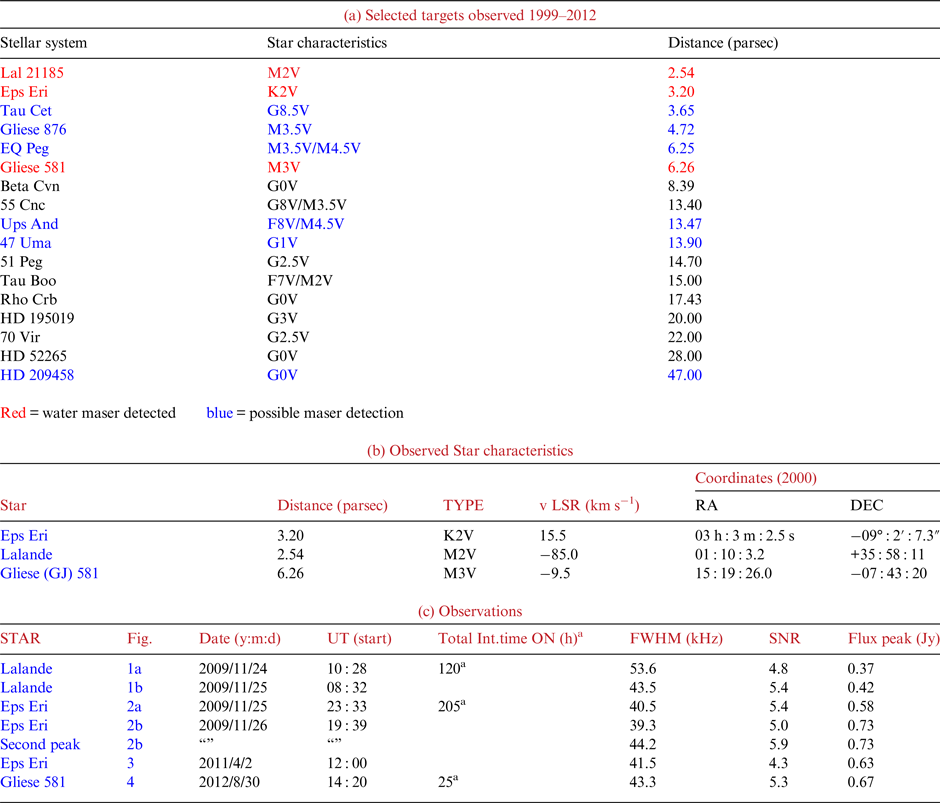
For example, if we consider a layer with a thickness of about 1000 km, a number density of about 109 molecules cm−3, it would be transparent to IR radiation in the radial direction and not thermalized; on the other hand it would be pumped by both its interaction with the stellar wind and the IR radiation from the host star. Thus, along the tangential direction it can provide enough optical thickness to achieve the maser amplification. At a given volume density the optical thickness in the radial direction is <1, while in a tangential direction it can be as high as – 10, −20, under the proper pumping conditions; thus the brightness temperature of a 22 GHz maser can reach the level of 109–1013 K. Host stars of the spectral class K, M are preferable because of lower UV radiation. See for example the planetary system HD 189733 (star K1–K2), where water was detected in the infrared by Tinetti et al. (Reference Tinetti2007) with the Spitzer space telescope, as a demonstration of its detection feasibility by orbiting telescopes and of the presence of water vapour in some exoplanetary atmospheres. The calculations of the feasibility of the maser detection are reported by: (Strelnitski Reference Strelnitski, Cosmovici, Bowyer and Werthimer1997; Cosmovici et al. Reference Cosmovici, Pogrebenko, Montebugnoli, Maccaferri, Lemarchand and Meech2000; Minier & Lineweaver Reference Minier and Lineweaver2006). The applied model predicts a mean flux density in the masing line of about 100 mJy, within 10 ly of the Sun. The mean values obtained with the 32 m Italian telescopes are given in Table 1c.

a Total integration time in the period 1999–2012. Average integration time for a single observation: 200 min.
FWHM, full width half maximum – SNR, signal to noise ratio – Jy, Jansky – LSR, local standard of rest, – Conversion factor 0.11 K Jy−1 – 37% antenna efficiency – 8192 frequency channels in a 8 MHz bandwidth.
Calibrators (flux and frequency): dr21, w3oh, w51, 3c286, 3c123, 3c353, s231.
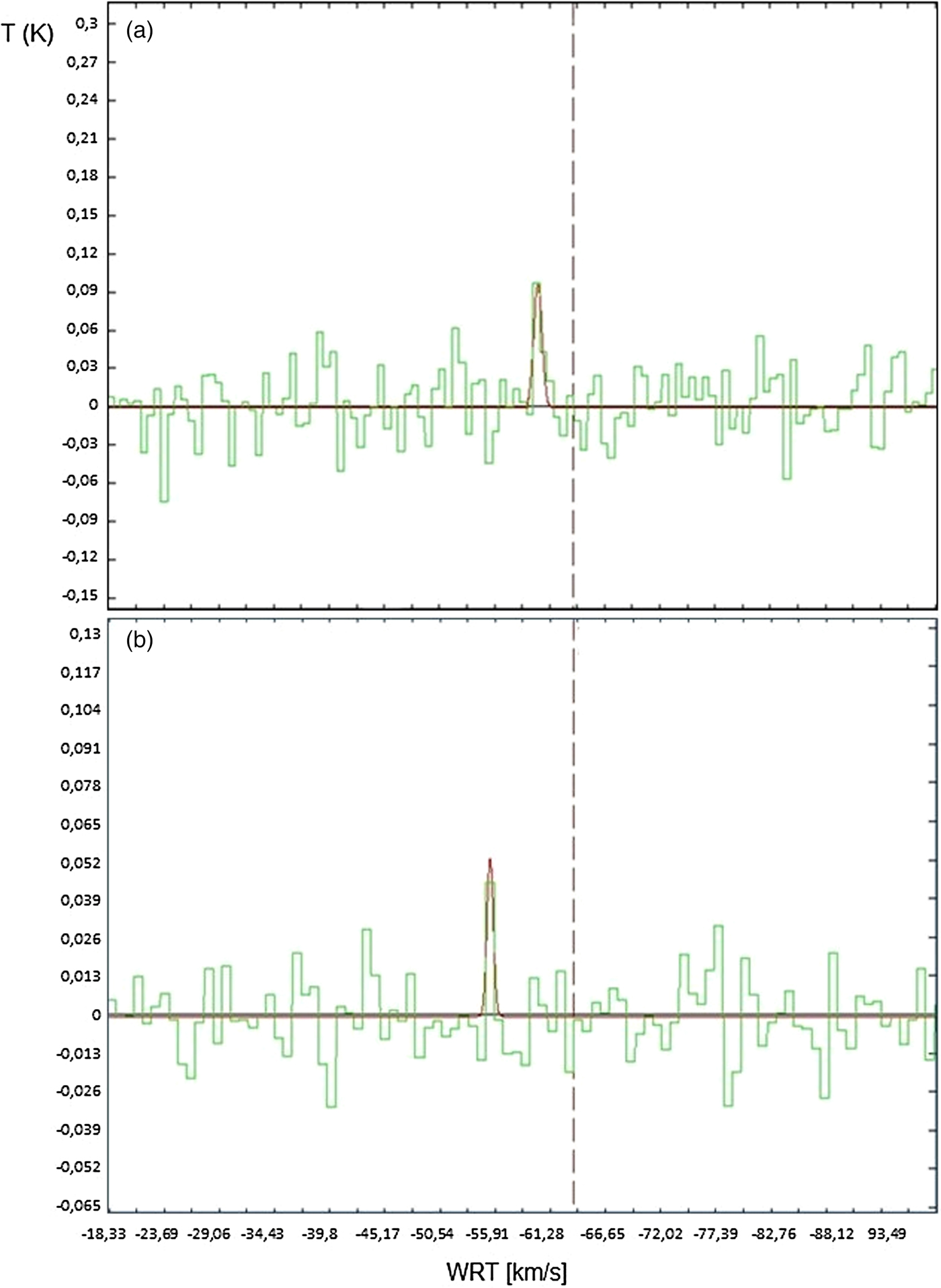
T (K) = antenna temperature WRT = with respect to target.
At the conference held in Graz (Cosmovici et al. Reference Cosmovici, Teodorani, Montebugnoli and Maccaferri2002) we announced the first ‘possible’ detection of the 22 GHz water maser emission originating in the stellar systems Eps Eri, Ups And, 47 UMa. Looking for confirmation the following groups searched for the water maser line for very short periods reporting no detection: Greenhill (Reference Greenhill2002), Butler et al. (Reference Butler, Chandler, Claussen and Greenhill2003) and Minier & Lineweaver (Reference Minier and Lineweaver2006) (only one possible weak water maser detection on HD 47536). In the following years no further attempts were made by other observers, thus we had no opportunity for data comparison.
Our experience on observations carried out in Italy during a non-continuous period of 13 years helps to explain the non-detections obtained elsewhere with short trials. From our measurements we can assume that the Maser emission indicates a transient nature of the amount of water. Six factors could affect the observability of the maser emission: pumping conditions, beaming geometry, rotation and orbital motion of the planet around the star, non-continuous cometary bombardment or localized maser spots in the atmosphere of the exoplanet.
Observations and results
We used the 32 m dishes of the Medicina and Noto Radiotelescopes (Italy) for observations up to 50 light years from the Sun of main sequence stars (dwarfs) where either cometary clouds have been discovered, or planetary systems have been detected. For this purpose, and considering also the limited observing time available (the radiotelescope was off duty for about 3 years) very sophisticated instrumentation and software had to be developed taking into account the unknown doppler shifts of possible planets due to both rotation and orbital velocities. In the period 1999–2006 we used the Fast Fourier Spectrometer (FFT) named MSPEC0 developed for the observations of the impact of comet SL/9 with Jupiter, (Montebugnoli et al. Reference Montebugnoli, Bortolotti, Buttaccio, Cattani, D'Amico, Maccaferri, Orfei, Roma, Tuccari and Tugnoli1996). The very high frequency and time resolution Fourier Transform Spectrometer uses an extremely powerful DSP (Digital Signal Processor) engine optimized for the FFT computations and it is able to perform transforms in a very short time. Starting in 2005 a completely new and challenging fast spectrometer named SPECTRA-2 was developed. It is based on FPGA (Field Programmable Gate Arrays) technology and allows real-time elaboration of two simultaneous analogue inputs, performing fine channelization by using polyphaser filter-banks to isolate with high rejection of the different sub-bands. A new post processing software named ASTRA (Pluchino Reference Pluchino2008) was also developed, which performs an accurate and rigorous analysis of spectral data. The data processing ‘core’ of this software tool is the ‘de-Doppler engine module’ which takes into account the known Doppler shift of the target: the radial component of its velocity makes the necessary correction and accumulates the final spectrum. Here we report only on three objects with a signal to noise (SNR) level >4, as other possible candidates (see Table 1) with weaker signals need a longer dedicated investigation for validation. We selected the most significant results from among those with a distance from the Sun <20 ly where planets or cometary belts have been discovered around main sequence stars.
The targets (Figs. 1–4)
Lalande 21185: is one of the closest stars at 8.3 ly from the Sun. It is a small red dwarf (M2V) about 10 billion years old and it is believed to be surrounded by three giant planets. One at a distance of 2.2 AU from the star was tentatively astrometrically detected in 1996 (Gatewood Reference Gatewood1996) but this possible discovery needs to be confirmed.
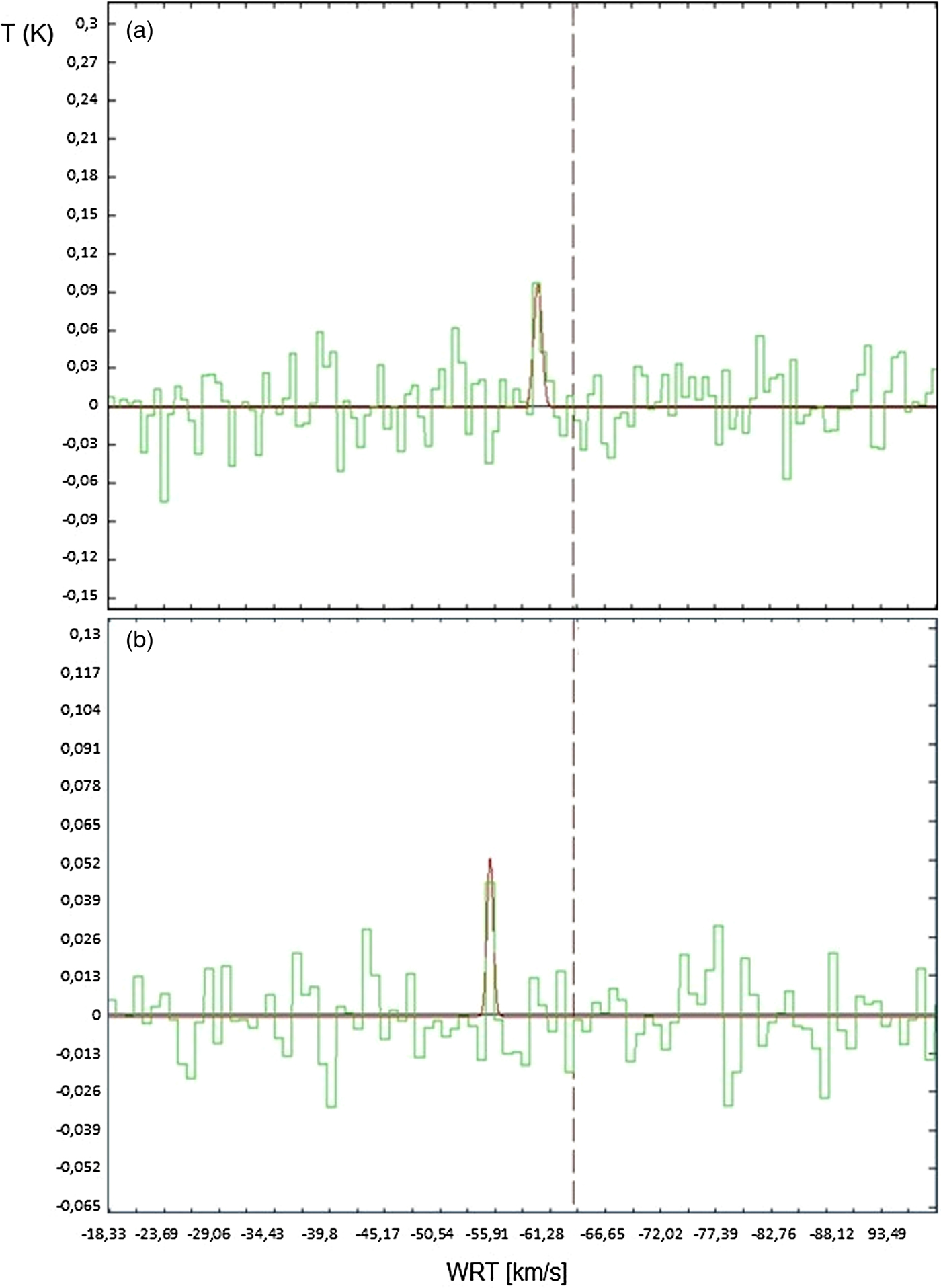
(a) Spectrum of Lalande 21185 obtained 24 November 2009 with the Medicina 32 m radiotelescope; 200 min integration time (ON). The observational data are summarized in Table 1c. The background subtraction (ON-OFF) was done moving the telescope by 1° in a region not contaminated by interstellar maser-lines. The line shows a doppler shift WRT (with respect to the target) by 3.2 km s−1. (b) The spectrum of Lalande 1 day later, 25 November 2009. The line is shifted by 8.1 km s−1, i.e. 4.9 km s−1 with respect to the previous day: The two images were chosen to prove the detection of the maser line on moving objects around the star.
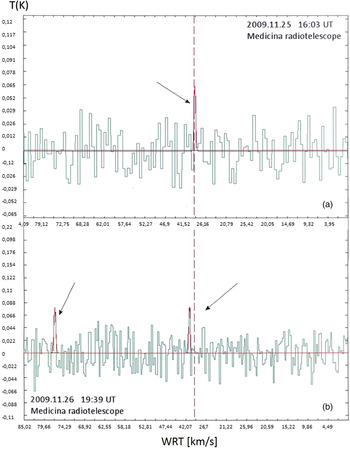
(a) Spectrum of Epsilon Eridani obtained 25 November 2009 with the Medicina 32 m antenna; 200 min integration (ON); box-car smoothing, observational data summarized in Table 1c. The line shows a weak shift of 0.21 km s−1 WRT (with respect to the target). (b) Spectrum of Eps Eri 1 day later, 26 November 2009, same integration time, box-car smoothing. The shift of the line increased to 1.23 km s−1. We note here (excluding experimental errors) the presence of a new second line shifted by 37 km s−1 WRT (with respect to the target); as it is not present the day before and the day after, this peculiar detection could represent a transient phenomenon generated by cometary impacts.

Eps Eri comparison.
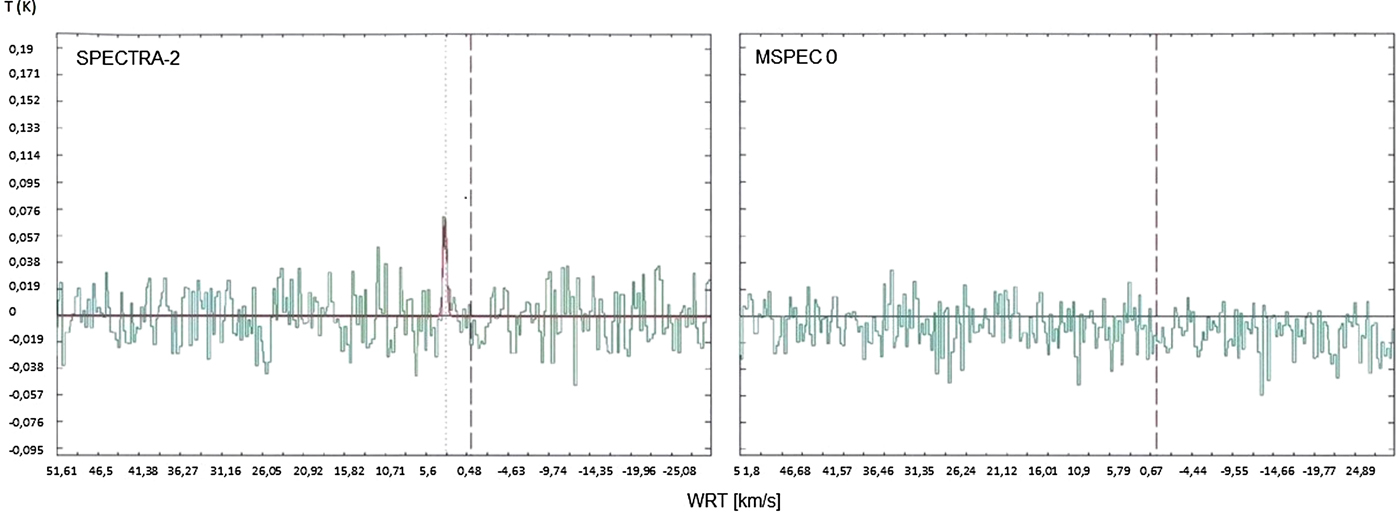
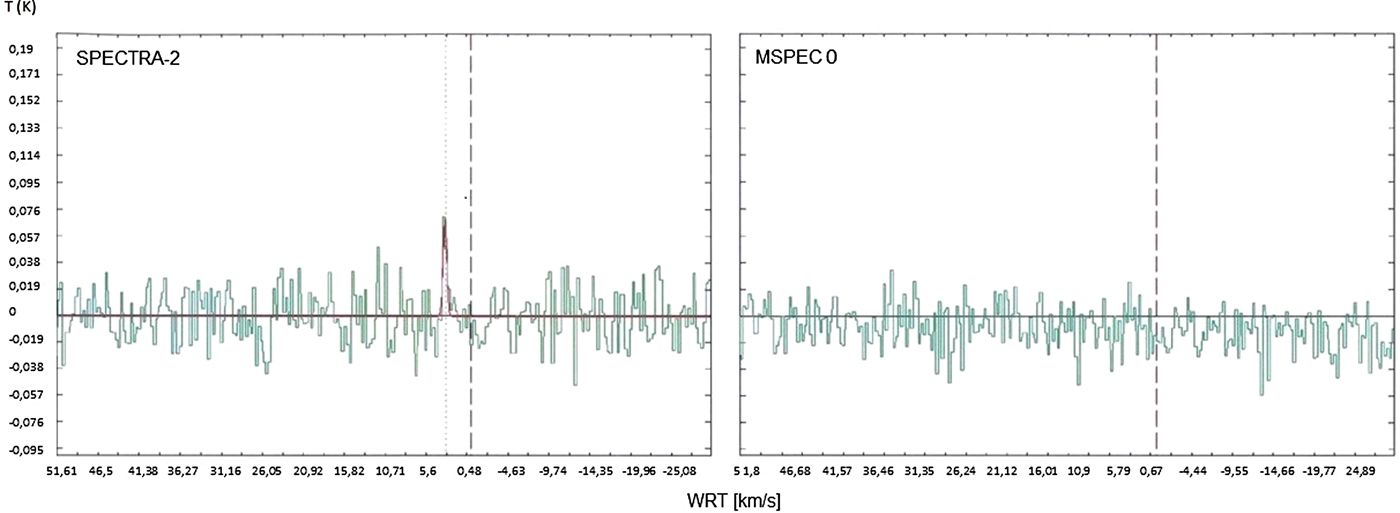
We made the following test on 2 April 2011 on Eps Eri to prove the real detection of the maser line and the performance of the new spectrometer SPECTRA-2: on the left hand the spectrum acquired with SPECTRA-2 shows a clear detection with SNR 4.3 and shift WRT of 3.2 km s−1; on the right hand the same target was simultaneously acquired with the old FFT spectrometer MSPEC0 used in the period 1994–2007. Both spectra were obtained by means of a similar instrumental and antenna setup. It should be remarked that MSPEC0 was not able to detect any visible feature.
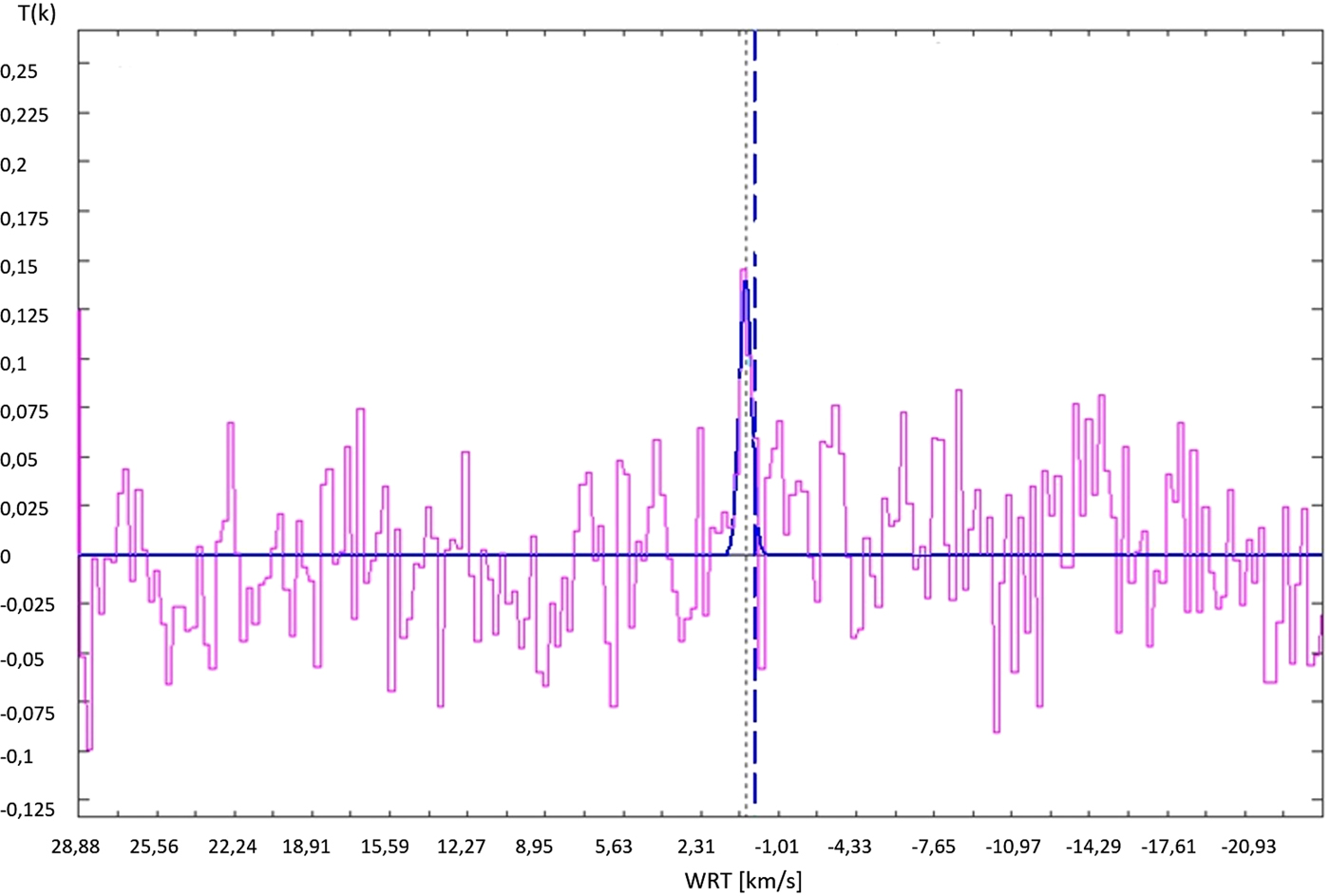
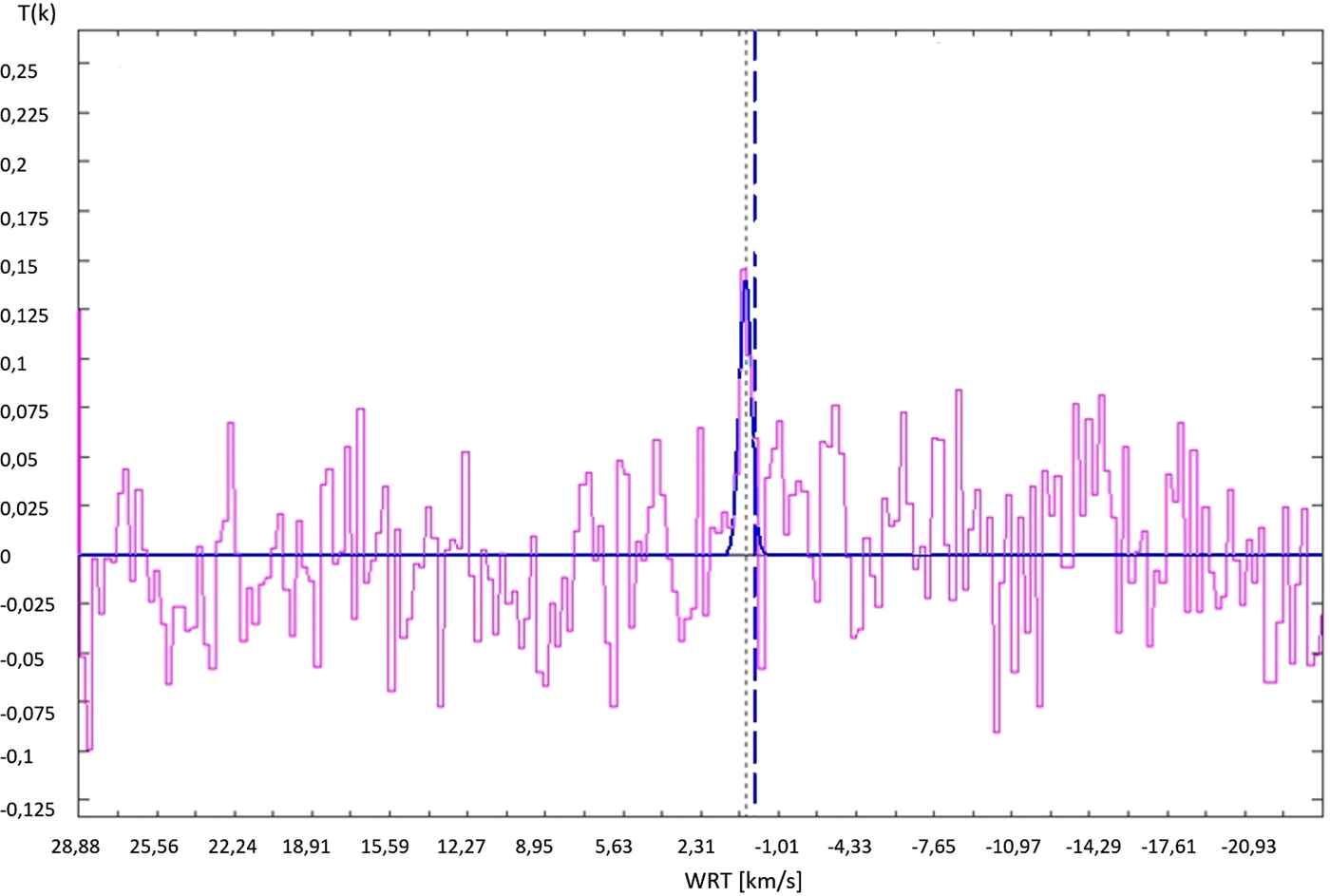
Spectrum of Gliese 581 obtained 30 August 2012 with the Noto 32 m dish in Sicily. It is one of the most reliable during 13 years of observations.
The Doppler shift of 0.4 km s−1 shows a source very close to the star moving inside the FOV of the exoplanetary system.
This detection is particularly interesting as obtained on a target surrounded by 3–5 planets and suitable for habitability. This object should be studied in detail in the future also with higher spatial resolution in order to state the origin of the maser emission.
Epsilon Eridani: a K2V star, only 10.8 ly away and among the 10 star systems closest to Earth, seemed to be the most interesting candidate in our target list. It is also of historical relevance as one of Drake's two candidates during his first SETI search in 1960 (Cocconi & Morrrison Reference Cocconi and Morrison1959). Recently a ring of dust or cometary belt has been detected around it in the submillimeter region by the James Clerk Maxwell Telescope (Greaves et al. Reference Greaves1998). Planetary formation around the star is probably complete since the stellar age is around 0.5–1.0 Gyr, and Earth-like planets are believed to form within 0.1 Gyr (Hatzes et al. Reference Hatzes2000). This target is extremely interesting for Bioastronomy as it represents the terrestrial condition about 4 Gyr ago when cometary bombardment is supposed to have ended and life started. Melnick et al. (Reference Melnick, Neufeld, Saavik, Ford, Hollenbach and Ashby2001), discovered water vapour around IRC + 10216 due to vaporization of a collection of orbiting comets because of the dramatic increase of the star activity. Their line, detected at 556.936 GHz using the SWAS satellite, is very broad, showing the difference between a cometary impact with the atmosphere of a planet (bandwidth ~40 KHz) (Cosmovici et al. Reference Cosmovici, Montebugnoli, Orfei, Pogrebenko and Colom1996) and the evaporation of comets due to stellar radiation (bandwidth ~1 MHz).
Gliese 581: (GJ 581), 20.4 ly from the Sun, a red dwarf M3V. From recent observations it seems that the star has a planetary system consisting of 3 or 5 planets, GJ 581 b, c, d (the newly discovered e and g are yet to be confirmed). The system GJ 581 is one of the most attractive from the point of view of possible habitability. In 2012 the space telescope Herschel observed a comet belt extending from 25 to 60 AU around the star. The calculations show that the belt should have at least 10 times as many comets as does our Solar System. This seems to rule out Saturn-mass planets beyond 0.75 AU (Lestrade et al. Reference Lestrade, Matthews, Sibthorpe, Kennedy, Wyatt and Bryden2012).
Discussion and conclusions
The main purpose of our work was to prove that the water maser line may be detected in exoplanetary systems given appropriately powerful radiotelescopes and spectrometers as FFT devices, able to follow fast-moving objects for long periods. The significance of the maser search is due to the fact that exoplanetary water is detectable from the ground only in the radio region, just as the thermal emission in the infrared is observable only from space. As our FOV (Field Of View) (2 arcmin) covers a typical exoplanetary system, we were not able to quantify the distance of the emitting planet from the star and its orbit. The use of a FOV of few sec of arc is suitable only if one knows the position of the planet with respect to the star. It is evident from our spectra that the detected velocity shifts are clearly of a different nature from all other objects that emit water maser radiation and therefore it is highly likely that we have detected water masers associated with planets or planetary formation. The line-band width (see Table 1c) and intensity are similar to those observed during the Jupiter/Comet collision (Cosmovici et al. Reference Cosmovici, Montebugnoli, Orfei, Pogrebenko and Colom1996). In the case of a young star like Epsilon Eridani we suppose that the water emission is probably a consequence of a shower of cometary impacts as the star is surrounded by a cometary belt (Greaves et al. Reference Greaves1998). For the older stars, where planetary systems may be more stable, the most promising hypothesis is that the masers are emitted from water-rich atmospheres where the necessary maser pump is provided by photo-deposited energy, which can affect the level populations. Maser emission from the chromosphere of solar-type stars is not expected. As we observed over a period of 13 years that the maser emission is a transient phenomenon due to rotation and orbital motion of the planet(s) or to localized cometary impacts, future search for exoplanetary masers should be organized with dedicated powerful radio-telescopes for a survey up to 100 ly from the Sun to check for other candidates and to confirm and state the origin of the lines, the position and orbits of the emitting planets and the amount of water present in the planetary atmospheres.
This was a pioneering work as the observations of exoplanetary systems are at the very early stages of exploring our Galaxy. We wanted to demonstrate that water maser emission may be detected from the ground in the radio region as a powerful diagnostic tool for Astrobiology- and Bioastronomy- programs. We plan to continue our observations of water as the main candidate for life evolution and also of important masing prebiotic molecules like CH3OH (methanol), taking advantage of contemporary research and the new Sardinia (SRT) 64 m dish in Italy.
Acknowledgements
This enterprise would not have been possible without the encouraging interest and scientific support of Charles Townes (1915–2015), Frank Drake and Christian de Duve (1917–2013). Special thanks are due also to the following Institutions and people: Italian Space Agency (ASI) and its representative Enrico Flamini for ensuring the necessary budget and the INAF (IRA-IAPS) for the continuous support during the observations. The IRA staff and especially Massimo Teodorani and Simona Righini, for the untiring collaboration during the observations in the period 1999–2007, Stelio Montebugnoli for important advice on technological support, Giuseppe Maccaferri for securing observations since 1999 and Andrea Orlati for software assistance. Salvo Pluchino who developed the ASTRA software and was responsible together with Francesco Schillirò for the observations in the period 2007–2012. Marco Bartolini developed, with Stelio Montebugnoli and Germano Bianchi, the new radiospectrometer SPECTRA-2. Christian Henkel, Jim Braatz. Juan Orò (1923–2004), Vincent Minier, Michael Mumma, Philip Diamond, Leonid Gurvits and Vladimir Strelnitski for valuable discussions. Erina Pizzi (IAPS) for help in the article editing.