Introduction
To effectively conserve germplasm in a seed bank, it is necessary to maintain the viability and quality of the seeds during storage. The germplasm collection of the T.T. Chang Genetic Resources Center holds more than 120,000 accessions of cultivated rice, primarily Asian rice, Oryza sativa L. The broad morphological and ecogeographical variation of this germplasm provides an important source of genetic diversity for breeders and researchers throughout the world to develop varieties with improved yield and desirable traits. Seed longevity during storage is largely determined by the storage conditions (seed moisture content and temperature) and the initial quality of the seeds when they are first placed into storage (Ellis and Roberts, Reference Ellis and Roberts1980). The initial quality of the seeds can depend on pre-storage factors such as the seed production environment, maturity at harvest and post-harvest processing methods (Hay and Probert, Reference Hay and Probert1995, Reference Hay and Probert2013; Kameswara Rao and Jackson, Reference Kameswara Rao and Jackson1996a; Sinniah et al., Reference Sinniah, Ellis and John1998; Probert et al., Reference Probert, Adams, Coneybeer, Crawford and Hay2007).
Timely harvest of seeds is extremely important to obtain seeds of high quality with maximum potential longevity (Hay and Probert, Reference Hay and Probert2013 and references therein). Immature seeds may not be fully desiccation tolerant, leading to poor germination following the drying process required to reduce the moisture content of the seeds for long-term storage. Furthermore, even if prematurely harvested seeds are desiccation tolerant, they may lose viability faster than more mature seeds in the same storage environment. While it is recommended that seeds of wild species are collected when they are on the verge of being dispersed (Hay and Smith, Reference Hay, Smith, Smith, Dickie, Linington, Pritchard and Probert2003; Hay and Probert, Reference Hay and Probert2013), many crop species, including rice, are shatter-resistant; if the seeds are not harvested at peak physiological maturity (or ‘storage maturity’; Kameswara Rao and Jackson, Reference Kameswara Rao and Jackson1996a), there may be ageing and declines in seed quality in the field (TeKrony et al., Reference TeKrony, Egli and Phillips1980; Ellis et al., Reference Ellis, Hong and Roberts1987; Kameswara Rao and Jackson, Reference Kameswara Rao and Jackson1996a). It would, therefore, be useful to have an effective and reliable method for identifying ‘storage maturity’, the stage during seed development when seed quality, including longevity, peaks and before significant levels of ageing occur.
Seed moisture content or, for a non-destructive test, equilibrium relative humidity (eRH) may be used as indicators of seed maturity, since seeds of many species lose moisture during the final stage of seed development, as they equilibrate with ambient conditions (Ellis et al., Reference Ellis, Hong and Roberts1987; Hay and Probert, Reference Hay, Probert, Guarino, Ramanatha Rao and Goldberg2011). In rice, however, declines in seed moisture content may be limited, since rice is often grown in very humid environments and supposedly ‘mature’ seeds are often harvested with moisture contents ≥ 18% (85–90% eRH). Field markers, such as changes in fruit or seed colour, are often used as an indicator of seed maturity (Hay and Smith, Reference Hay, Smith, Smith, Dickie, Linington, Pritchard and Probert2003). For some species the seed coat or, in the case of rice, the hull changes from green to another colour in a process known as ‘degreening’. This degreening is caused by the breakdown of chlorophyll during the later stages of the seed ripening process (Ward et al., Reference Ward, Scarth, Daun and McVetty1992). While much of this degreening process may be apparent to the human eye, loss of chlorophyll may continue beyond the point where ‘greenness’ is apparent. However, small differences in the amount of chlorophyll can be detected using chlorophyll fluorescence (CF) analysis, which has been proposed as a non-destructive method to determine the relative maturity of seeds (Jalink et al., Reference Jalink, Frandas, van der Schoor and Bino1998a, Reference Jalink, van der Schoor, Frandas, van Pijlen and Binob). CF analysis of seeds of Brassica oleracea L. showed that germination increased as CF decreased (Jalink et al., Reference Jalink, Frandas, van der Schoor and Bino1998a, Reference Jalink, van der Schoor, Frandas, van Pijlen and Binob). Ooms and Destain (Reference Ooms and Destain2011) showed a similar relationship for chicory (Cicorium intybus L.). CF analysis is now used to improve overall seed lot quality for a range of species, by removing individual seeds that are less mature (Nijënstein, Reference Nijënstein2014 and references therein). The aim of this work was to see whether CF could be used to identify the point when rice seeds, being produced for long-term storage in the genebank, reach storage maturity. We also wanted to consider whether it would be useful to sort seeds based on CF when processing a diverse range of rice germplasm.
Materials and methods
Seed lots
Seeds of 20 O. sativa accessions held in the T.T. Chang Genetic Resources Center (IRGC 117264–IRGC 117283), representing aus, aromatic, indica, temperate japonica and tropical japonica variety groups (McNally et al., Reference McNally, Child, Bohnert, Davidson, Zhao, Ulat, Zeller, Clark, Hoen, Bureau, Stokowski, Ballinger, Frazer, Cox, Padhukasahasram, Bustamante, Weigel, Mackill, Bruskiewich, Rätsch, Buell, Leung and Leach2009), were placed at 50°C for 5 d to break dormancy before sowing for 2013 dry-season seed production at the Experimental Station of the International Rice Research Institute. Normal cultivation practices were followed. Seeds were harvested at 24, 31, 38 and 45 d after peak flowering (DAF), threshed and immediately placed in the genebank drying room at 15% relative humidity (RH) and 15°C. Half of each seed lot was hand-sorted by genebank staff as per normal procedures prior to genebank storage, discarding any seeds that appeared to be broken, diseased, obviously immature (green) or off-types.
Chlorophyll content of the seeds
CF of samples of hand-sorted and non-sorted seeds was measured using the SeedAnalyser (model SA-10, Fytagoras, Leiden, The Netherlands). The technology used in this apparatus is described by Jalink et al. Reference Jalink, Frandas, van der Schoor and Bino(1998a) and the measurements of the chlorophyll content of the seeds were performed according to the manufacturer's instructions. In short, the SeedAnalyser facilitates an automated detection of the chlorophyll content within the seed coat. Seeds were placed in a 90-mm-diameter glass Petri dish in such an amount that the bottom of the dish was completely covered by the seeds. In the SA-10 a laser beam with a wavelength of 670 nm is directed to the bottom of the seed-filled dish. The laser light electronically excites the chlorophyll present in the seed coat. After absorbing this energy the chlorophyll returns to its ground state by emitting light with a wavelength of about 720 nm (fluorescence). The CF light is captured by a photodiode configured with specific filters to block the light of the laser while passing the emitted light of chlorophyll. Different intensities of CF result in different currents from the photodiode to the lock-in amplifier in the device. The lock-in amplifier increases the signal, to proportional currents, that gives the final distribution of the currents. The different currents represent different intensities of fluorescence and, thereby, different amounts of chlorophyll. For each seed sample in this study, between 3239 and 3471 individual CF measurements were made on different spots in each Petri dish filled with seeds. This results in a chlorophyll content (measured as current) distribution histogram for each seed sample tested.
Experimental storage
Storage experiments were not carried out on non-sorted seeds since the genebank only stores seeds that have been sorted. For each of the hand-sorted seed lots, 30 samples of 100 seeds each were taken at random and placed in individual 50-mm-diameter Petri dishes. The moisture content of the samples was adjusted to 10.9% (fresh weight basis) by placing them over a non-saturated lithium chloride solution in a sealed, 600 × 300 × 132 mm (L × W × D), electrical enclosure box (Ensto, Finland) to generate a relative humidity of 60% (Hay et al., Reference Hay, Adams, Manger and Probert2008). The RH created by the lithium chloride solution was checked by pipetting a sample of the solution into a 3.2-ml sample holder inserted in the measuring chamber of an AW-D10 water activity station (Rotronic South East Asia Pte. Ltd., Singapore). The solution was adjusted if necessary by adding distilled water. After equilibration for 7 d, each sample of seeds was heat-sealed inside a 120 × 90 mm (L × W) aluminium foil packet and placed at 45°C. One packet for each seed lot was taken out of the oven every 3 d for up to 60 d for germination testing. Seeds were set to germinate on two layers of Whatman no. 1 paper wetted with 7.5 ml distilled water in 90-mm-diameter Petri dishes. The seeds were incubated at 30°C with a 12-h photoperiod and scored for germination 2, 3, 4, 5, 7 and 14 d after sowing. Any non-germinated seeds on day 14 were dehulled and returned to the same germination conditions for 7 d before taking the last count of germinated seeds. Three additional packets were removed from storage after 0 (i.e. at the start of storage), 30 and 60 d for moisture content determination. Seed moisture content was determined gravimetrically, weighing the seeds before and after drying the ground samples at 130°C for 2 h followed by cooling for 1 h.
Data analysis
All analyses were carried out using GenStat for Windows, Version 15 (VSN International Ltd., Oxford, UK), except for the reduced major-axis regression parameter estimation (Sokal and Rohlf, Reference Sokal and Rohlf1995), which was done in Excel. Skewness, kurtosis and mode of the CF histograms were determined, and mean CF of the seed lot assessed by multiplying the current by the number of observations recording that current, divided by the total number of observations. For the experimental storage data, seed survival curves were fitted according to the equation:
 $$ \nu = K _{i} - ( p / \sigma ) $$
where v is the viability in normal equivalent deviates (NED) of a seed lot stored for a period, p (days); K i is the initial viability (in NED) and σ is the standard deviation of the normal distribution of seed deaths in time (Ellis and Roberts, Reference Ellis and Roberts1980). Probit analysis was carried out for all seed lots within an accession simultaneously and, where possible [i.e. if it didn't give rise to a significant (P< 0.05) increase in residual deviance], constrained to a common estimate for σ. For those accessions showing an afterripening response, the FITNONLINEAR directive was used to fit a probit dormancy loss and ageing model, according to the equation:
 $$ g = ( K _{d} + \beta _{1} p )\times ( K _{i} - ( p / \sigma )) $$
where g= germination in NED of a seed lot stored for period, p (days); K d is the initial proportion of non-dormant seeds in NED, β1 is the standard deviation of the normal distribution of loss of dormancy (attainment of ability to germinate) over time (Kebreab and Murdoch, Reference Kebreab and Murdoch1999) and K i and σ are as for equation (1). The fitted models were used to estimate the period of time before viability was reduced to 50% (p 50) and correlation analyses of p 50 with CF histogram parameters and DAF were performed.
Results
CF analysis
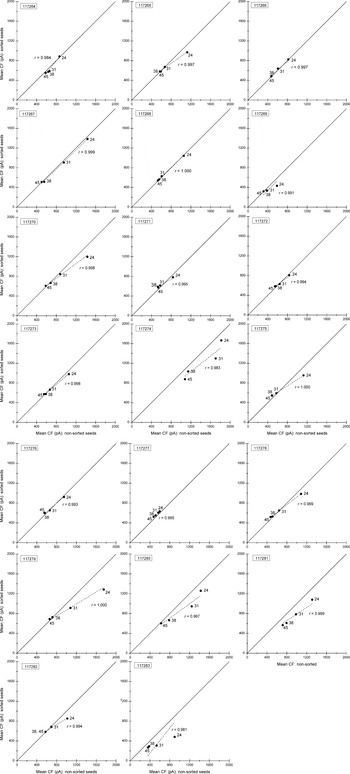
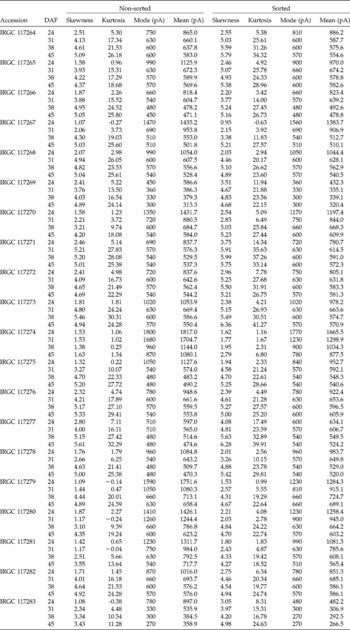
The CF distributions were not symmetrical (see supplementary Fig. S1), showing, in general, both positive skewness (indicating the asymmetry of a distribution; range 0.949 to 6.362) and kurtosis (indicating the ‘peakedness’; range − 0.63 to 41.27) (Table 1). Skewness and kurtosis tended to be higher for sorted than for non-sorted seed lots and also increased with seed maturity, at least until 38 DAF. The mode of the CF distributions (i.e. the position of the peak) varied between accessions, with maturity of the seeds, and depending on whether or not the sample had been sorted. It was always highest for the least mature seeds (seeds harvested at 24 DAF) and decreased as maturity increased. For some accessions, there was little difference in the mode of seeds harvested at 38 and 45 DAF (e.g. IRGC 117265, IRGC 117271). Comparing accessions, the mode of the CF distributions for sorted seeds harvested at 45 DAF ranged from 270 pA (IRGC 117283) to 780 pA (IRGC 117274). Mean CF was generally highest in the least mature seeds and lowest in the most mature seeds (Fig. 1, Table 1). For sorted seeds harvested at 45 DAF, the mean CF was highest for accession IRGC 117274 (877.5 pA) and lowest for accession IRGC 117283 (266.5 pA). It was also generally higher for non-sorted compared with sorted seeds, although the difference was only noteworthy for some accessions (e.g. IRGC 117274, IRGC 117281) or for the least mature seeds of an accession (e.g. IRGC 117270), and the correlation coefficients between the mean CF of sorted seeds and that of non-sorted seeds were generally high (0.967–1.000; Fig. 1).
Mean chlorophyll fluorescence (CF) of sorted and non-sorted seeds of 20 rice accessions (the number on each graph refers to the IRGC accession number) harvested at 24, 31, 38 and 45 d after peak flowering (numbers shown next to the data points). The solid line is where mean CF would be equal for sorted and non-sorted seeds. The dashed line is the result of reduced major-axis regression (Sokal and Rohlf, Reference Sokal and Rohlf1995). Also shown is the correlation coefficient, r. The significance of each correlation is not given since n= 4.

Descriptive statistics of chlorophyll fluorescence (CF) histograms for seeds of 20 accessions of Oryza sativa harvested at 24, 31, 38 and 45 d after peak flowering (DAF). The original histograms are shown in supplementary Fig. S1

Experimental storage
Mean seed moisture content during experimental storage was 10.9 ± 0.4% (fresh weight basis ± SD) across all seed lots (data not shown). There were no consistent trends depending on maturity, and although the four seed lots of some accessions were typically higher or lower than the overall mean, the differences were only slight.
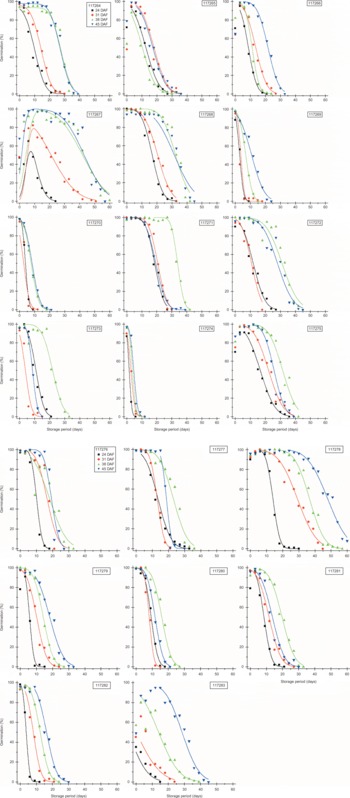
Seed longevity varied between accessions but generally increased during seed development, reaching a maximum at 38 DAF (e.g. IRGC 117273, IRGC 117280) or 45 DAF (e.g. IRGC 117269, IRGC 117283; Fig. 2). For some accessions where the greatest longevity was observed for seeds harvested at 38 DAF, there was a subsequent decline in longevity (e.g. IRGC 117280), while for others there was very little difference in the survival curves for seeds harvested at 38 or 45 DAF (e.g. IRGC 117270). The p 50 ranged from 1.5 d (IRGC 117274 seeds harvested at 24 DAF) to 48.0 d (IRGC 117278 seeds harvested at 45 DAF). The increase in p 50 from 24 DAF to either 38 or 45 DAF (depending on which gave the greatest p 50) ranged from 36.6 to 348.6%.
Seed survival curves of hand-sorted seed lots of 20 rice accessions harvested at 24, 31, 38 and 45 d after peak flowering (DAF). The number on each graph refers to the IRGC accession number.

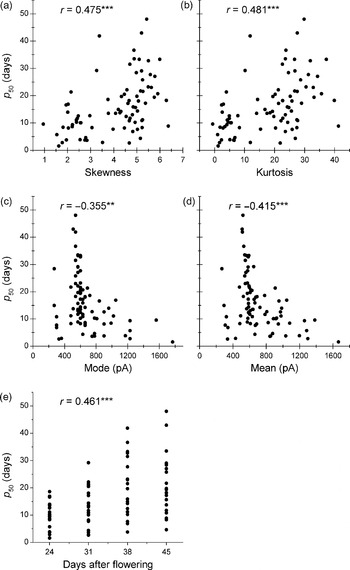
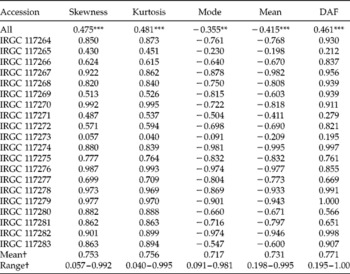
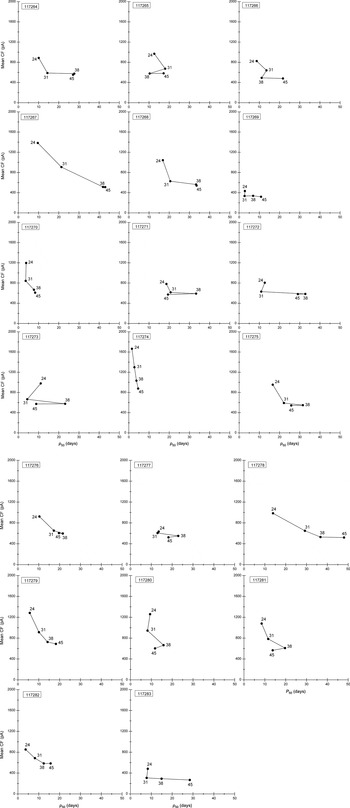
There were significant correlations between p 50 and the skewness, kurtosis, mode or mean of the CF distributions when the data for sorted seeds of all accessions were considered together [P< 0.01 (correlation between p 50 and the mode) or P< 0.001 (other correlations)] (Table 2, Fig. 3a–d). However, the correlation coefficients were relatively low (absolute values 0.355–0.481), even when the logarithm (base 10) of p 50 was considered for the correlations with the mode and the mean (r= –0.422 and − 0.467, respectively; not shown). They did improve for some accessions where there was a decline in p 50 at the last harvest, if the data for this harvest were excluded from the analysis (results not shown). When the data for all accessions were considered together, the correlation between p 50 and DAF was significant (P< 0.001), but the correlation coefficient was also low (0.461; Table 2, Fig. 3e). There was wide variation in the coefficients between p 50 and the CF distribution parameters or DAF when the data for sorted seeds for individual accessions were considered, although the means of these coefficients (absolute values) were similar (Table 2). Regarding the CF distribution parameters, the range was least for the correlations between p 50 and the mean CF, and hence the relationship between p 50 and this parameter was explored further. The increase in p 50 between 24 and 31 DAF observed for most accessions coincided with a decrease in mean CF (Fig. 4). For some accessions this negative relationship continued until 45 DAF (e.g. IRGC 117274), for others, as mean CF reached a minimum, typically by 38 DAF, there was either little/no difference in p 50 (e.g. IRGC 117264, IRGC 117267) or p 50 declined (e.g. IRGC 117273, IRGC 117275).
Scatter plots of longevity [time for viability to fall to 50% (p 50)] versus (a) skewness, (b) kurtosis, (c) mode and (d) mean of the chlorophyll fluorescence histograms (see supplementary Fig. S1), and (e) days after peak flowering (DAF) for sorted seeds of 20 rice accessions harvested at 24, 31, 38 and 45 DAF. Seeds were placed into experimental storage at 10.9% moisture content and 45°C to determine p 50. Correlation coefficients (r) were significant at P< 0.01 (**) or P< 0.001 (***).

Correlation coefficients between p 50 and the skewness, kurtosis, mode and mean values for the chlorophyll fluorescence distributions (see supplementary Fig. S1), and days after peak flowering (DAF), for seeds of 20 accessions of Oryza sativa harvested at 24, 31, 38 and 45 DAF. Coefficients are given for all accessions combined (see Fig. 3) and for individual accessions
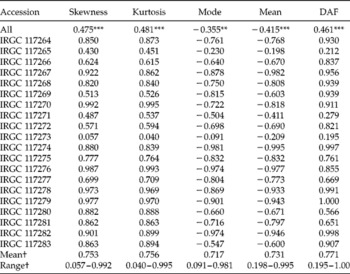
*** Significant at P < 0.001; **, significant at P < 0.01. Within-accession correlation coefficients are shown to give an indication of the correlation between parameters; however, significance is not given since n= 4.
† The mean and range are given for absolute values of the correlation coefficients for individual accessions.
The relationship between mean chlorophyll fluorescence (CF) and longevity [time for viability to fall to 50% (p 50)] of sorted seeds of 20 rice accessions (the number on each graph refers to the IRGC accession number) harvested at 24, 31, 38 and 45 d after peak flowering (the numbers indicated by the symbols). Seeds were placed into experimental storage at 10.9% moisture content and 45°C to determine p 50.

Discussion
Ideally, seeds intended for storage for any length of time, and particularly seeds that are destined for storage in a genebank, should be harvested when they reach storage maturity. Indeed, since seed longevity in storage is correlated with other seed vigour parameters, it is desirable to harvest all seeds at this stage and before declines in quality and viability occur in the field, regardless of whether or not the seeds will be stored. However, knowing when seeds reach this stage can be subjective, often involving knowledge of the crop that has been accrued over many years and/or following recommendations from other, very limited studies on a few genotypes and/or in a few environments/seasons. In the case of rice, Kameswara Rao and Jackson Reference Kameswara Rao and Jackson(1996b) recommended that seeds for long-term storage should be harvested at 35 d after flowering, although that study, involving just four varieties, also reported variation in the timing of maximum storage potential between the varieties and depending on the time of sowing, ranging between 25.3 and 36.6 DAF. Variation in the timing of maximum longevity (p 50) was also observed in our study on 20 diverse rice accessions (Figs 2 and 4). While for many accessions 38 DAF [i.e. close to the 35 DAF recommended by Kameswara Rao and Jackson Reference Kameswara Rao and Jackson(1996b)] was the first harvest time when maximum longevity was observed, for others it was observed at 45 DAF. The difference in p 50 between 38 and 45 DAF ranged between − 61.7% (IRGC 117273) and +94.8 % (IRGC 117266). The magnitude of these differences in p 50 emphasizes the importance of harvesting when seed longevity is maximal. In relation to management of genebank accessions, harvesting too early or too late would result in potentially earlier and more frequent regeneration of accessions than would otherwise be necessary and hence greater risk of genetic drift. Having a marker to identify when seeds have acquired maximum longevity, be that physical or biochemical, would therefore be highly valuable.
Chlorophyll fluorescence analysis has been proposed as a non-destructive method to determine the relative maturity of seeds (Jalink et al., Reference Jalink, Frandas, van der Schoor and Bino1998a, Reference Jalink, van der Schoor, Frandas, van Pijlen and Binob). Allocating individual seeds to different sub-groups based on their CF, it has been demonstrated that removing seeds with the highest CF increases the quality (e.g. rate of germination, proportion of normal seedlings) of the resulting seed lot (Jalink et al., Reference Jalink, Frandas, van der Schoor and Bino1998a; Cicero et al., Reference Cicero, van der Schoor and Jalink2009; Kenanoglu et al., Reference Kenanoglu, Demir and Jalink2013). Similarly, it is demonstrated here that hand-sorting seeds, which is expected to remove individual seeds which visually appear to be less mature (based on size or greenness) as well as broken, diseased and off-type seeds, reduced the number of measurements giving high CF, as indicated by, in general, an increase in the kurtosis of the CF distributions and a reduction in the mode and mean, particularly for the earliest-harvested seeds (see Fig. 1, supplementary Fig. S1, Table 1). Since storage experiments were not carried out on non-sorted seeds, we cannot determine how the sorting improved seed quality (longevity). For our purposes, however, to see if CF can be used as an in-field tool to decide when to harvest seeds, since the correlation coefficients of mean CF between sorted and non-sorted seeds were high (0.967–1.000; Fig. 1), the mean CF of sorted seeds giving greatest longevity may be used to estimate the in-field mean CF when seeds should be harvested, if indeed mean CF is a potentially useful marker (see below).
Seed longevity (p 50) was significantly correlated with the skewness, kurtosis, mode and mean of the CF histograms, and with DAF when the data for all the accessions at every harvest stage was considered together; however, none of the parameters stood out as being particularly informative, with r values ≤ 0.481 (Fig. 3, Table 2). Within accessions, there was wide variation in the correlation coefficients, although the range was least for correlations of p 50 with the mean of the CF histograms. None of the parameters was consistently better or worse than that between p 50 and DAF (comparing absolute correlation coefficients). Plotting mean CF against p 50 it is clear that, while for some accessions CF analysis may give an indication that the seeds have reached storage maturity [for example, accession IRGC 117274 in which both mean CF and p 50 were at the minimum and maximum observed values, respectively, at the same harvest time (although this does not rule out further changes in either parameter)], for other accessions it would not be possible to identify a mean CF when the seeds should be harvested, since p 50 continued to increase without any further decrease in the mean CF (e.g. IRGC 117278, IRGC 117283; Fig. 4). Similarly, Ooms and Destain (Reference Ooms and Destain2011) found that very late in seed development, the germination rate of chicory (Cichorium intybus L.) seeds still increased while CF did not change (correlation coefficients for germination rate and CF were − 0.844 and − 0.689 when CF was measured for pappus and pericarp, respectively). Furthermore, the mean CF of seeds which gave the greatest p 50 varied between accessions, ranging from 266.5 (IRGC 117283) to 877.5 (IRGC 117274). Hence, it does not seem possible that any single value of mean CF could be used to guide harvest time across diverse accessions. Conversely, identifying the optimum mean CF for thousands of accessions would be practically impossible and, in theory, might change from season to season or depending on other environmental factors, such as plant nutrition.
CF analysis is now being incorporated into advanced seed-sorting machines. However, again, based on our data on rice seeds, it does not seem that any single value could be used for sorting seeds of diverse accessions for subsequent genebank storage. While it would always be possible to test a sample of seeds for CF and then remove a proportion based on their CF, there would be a risk of rejecting seeds unnecessarily, or of actually obtaining a seed lot with impaired longevity, since some of the seeds with the lowest CF might have already aged in the field if harvesting was very late and/or if there is a lot of variation in the maturity of individual seeds.
To conclude, while CF analysis may be useful to identify when to harvest rice seeds with maximum storage potential for some genotypes, in which case more detailed experiments (e.g. with more frequent harvests) would be required, for a genebank it is unlikely to be a useful tool, since many diverse accessions have to be regenerated each year (in the case of the T.T. Chang Genetic Resources Center, thousands of accessions are regenerated annually) and it is clear that the relationship between longevity and CF can vary between accessions.
Supplementary material
To view supplementary material for this article, please visit http://dx.doi.org/10.1017/S0960258515000082
Acknowledgements
We would like to thank Reaño Renato, Nora Kuroda and Rene M. van der Meulen for their assistance in the field and laboratory.
Financial support
The Global Crop Diversity Trust provides financial support towards the maintenance of the rice collections in the T.T. Chang Genetic Resources Center.
Conflicts of interest
None.