Gardner, Ryan, and Snoeyink (Reference Gardner, Ryan and Snoeyink2018) provided an excellent and much-needed analysis of the status of women in industrial and organizational (I-O) psychology. Although others have produced overall assessments of the status of women in psychology (Eagly & Riger, Reference Eagly and Riger2014; Kite et al., Reference Kite, Russo, Brehm, Fouad, Hall, Hyde and Keita2001), these are not sufficient to identify conditions within the subfields of psychology. As shown by statistics on the divisions of the American Psychological Association (http://www.apa.org/about/division/officers/services/profiles.aspx), the subfields differ greatly in their gender balance, with some being male dominated (e.g., experimental and cognitive science), others female dominated (e.g., developmental psychology), and still others representing women and men more equally (e.g., social and personality psychology). I-O psychology is among the more gender-balanced fields, with an increasing proportion of women over time. It would seem that I-O's gradual inclusion of more women should have changed aspects of research and discourse in this field. In this comment, we argue that these women have produced impressive changes.
Before launching into this matter of women's contributions, we acknowledge Gardner and colleagues’ findings indicating that men in I-O, compared to the women, have enjoyed greater income, faculty rank in universities, numbers of publications, leadership roles, and recognition for accomplishments. Yet, as in psychology as a whole, women have gradually gained status in terms of such indicators (Eagly & Miller, Reference Eagly and Miller2016).
We maintain that women's contributions go beyond their status and recognition: Women have made a difference by introducing new topics into I-O psychology and expanding the scope of some established topics. Expansion of the scope of knowledge is not normally assessed, but it is not only important but essential to the success of any academic field. Indeed, specialists in science, engineering, and technology have recognized the importance of not only increasing the representation and career success of women and underrepresented minorities but also increasing knowledge about sex and gender and their impact on scientific knowledge (Schiebinger, Reference Schiebinger2000, Reference Schiebinger2014). For example, recent neuroscience research has discovered sex differences in the neuronal pathways between stress and alcohol consumption that are relevant to treatment programs (Logrip, Milivojevic, Bertholomey. & Torregrossa, in press). In addition, prior exclusions of women from major studies of cardiovascular disease led to male-centric understanding of symptoms that resulted in suboptimal diagnosis and treatment for women (Rosser, Reference Rosser1994; Schiebinger, Reference Schiebinger2000). By extension, we ask how well I-O psychologists have represented gender in their research and how the inclusion of gender has enhanced the knowledge base in this field.
With this commentary, we assert the following: (a) the number of gender-related articles published in mainstream I-O journals has increased over the past several decades; (b) women predominantly authored those publications; (c) gender research in I-O has had an important impact in broadening knowledge of core areas of our science, which we illustrate with examples from leadership and sexual harassment; and (d) gender research in I-O is not a career killer, and no one should suggest that it is.
To illustrate these themes, we provide some insights into how gender has been represented in mainstream I-O research over the past several decades. To analyze the representation of sex and gender topics in I-O science, we first document the prevalence of sex- or gender-related research published in mainstream I-O journals since the 1960s. Second, we show that women are more likely than men to have produced this research. Third, we list the most frequent topics appearing in these mainstream journals that were indexed as sex or gender related. Finally, we briefly discuss two areas of I-O research, leadership and sexual harassment, in which a focus on gender has been particularly influential.
Methods and Analysis
Using APA's PsycINFO database, we searched from 1960 to the present for all articles published in leading journals in which I-O psychologists and professionals in closely related business and management disciplines most frequently publish.Footnote 1 In PsycINFO, psychology journals are typically indexed cover to cover, and articles in journals from neighboring fields such as management and sociology are indexed if deemed to have psychological relevance or importance. We recognize that I-O sex and gender researchers also publish in gender-specialty journals such as Sex Roles, as well as in social psychology and general psychology journals. However, we focused our inquiry on I-O and related management journals to document representation in I-O's mainstream.
Within these journals, we identified articles using PsycINFO thesaurus index terms, which are applied by professional indexers because of their greater consistency in identifying articles’ major themes compared with authors’ own keywords and titles. The following index terms identified research related to sex or gender: human sex differences, sex discrimination, sexual harassment, sex role attitudes, sex roles, sexism, gender identity, femininity, masculinity, androgyny, working women, female attitudes, feminism, feminist psychology, mothers, expectant mothers, pregnancy, or fathers. In addition, we coded the articles for the sex of the first author. We then used appropriate index terms to determine which topics were most frequently studied in I-O psychology within this body of sex and gender research. Counting the total number of articles published regardless of topic also allowed us to report the percentage of articles pertaining to sex and gender topics.
Prevalence of Sex- or Gender-Related Publications and Sex of First Author
We located 1,283 peer-reviewed journal articles fitting our sex and gender criteria out of a population of 19,109 articles, indicating that 6.7% of research published in these mainstream I-O journal articles pertained to this research topic. Women were the first author of 54.4% of these articles, and men of 43.9%, with five authors of unknown sex.
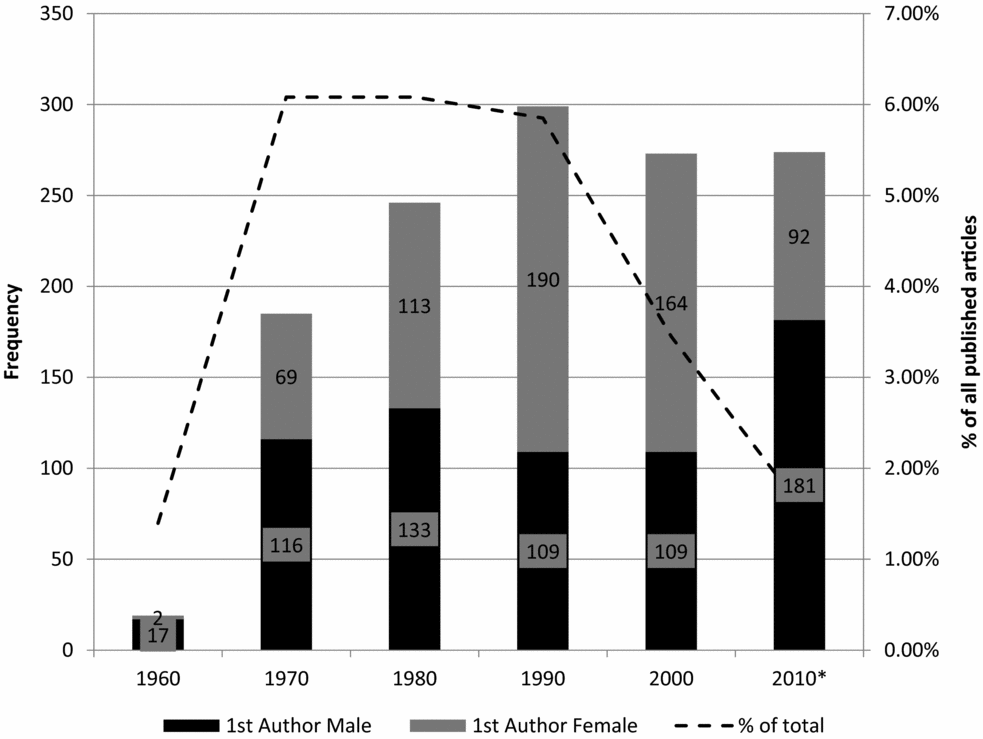
Figure 1 depicts the frequency and percentage of sex and gender research by decade and author sex. Because data for the 2010s are understandably incomplete, we estimated the values for 2018 and 2019. This procedure was an interpolation based on the prior trend of the number of publications having women or men in the first author position as well as the total number of articles.
Figure 1.Number and percent of sex- or gender-based articles published in mainstream I-O journals, 1960–2019, by gender of first author. Note: Numbers for 2018–2019 are estimated. Frequencies appear within each bar for authors of each sex.
Overall, these data show that the frequency of sex- or gender-related articles increased dramatically from the 1960s to the 1970s, with another substantial increase in the 1990s, with subsequent stability. However, the percentage rate of sex- and gender-related articles in mainstream I-O journals has been falling since the 1990s. This shift may reflect the rise of other topics within I-O as well as the growth of specialized journals related to sex and gender (e.g., Sex Roles; Psychology of Women Quarterly; Gender, Work, and Organizations; Gender in Management).
Whereas men were more likely than women to be first authors of gender research in I-O journals in the 1960s through the 1970s, women substantially surpassed men as first authors of such research from the 1990s forward (see Figure 1). The percentage of publications by male and female first authors is likely a function of the number of men and women in I-O psychology and related disciplines. Although we do not have ready access to data on the proportion of I-O psychologists in academic positions, data from SIOP's salary surveys dating back to 1982 (http://my.siop.org/Membership/Surveys), which approximately mirror the gender representation of SIOP members, indicate that women were more likely to be first authors of sex- and gender-related articles than their representation in SIOP would predict. In the 1980s, women comprised approximately 16–21% of SIOP members yet published about 46% of gender research, and in the 1990s these statistics changed to 29–30% women in I-O publishing about 63% of gender research. Similarly in the 2000s, women comprised approximately 42–46% of SIOP members, yet they published 59% of gender research, and in 2010s, these statistics change to 45–49% (to 2015) women in I-O publishing about 67% of gender research. Hence, women are more likely than men to be the lead authors of gender-based research in mainstream I-O-related journals, both in terms of sheer numbers as well as proportionately in relation to their membership in SIOP.
Topics
Using APA PsycNET staff members’ indexing of publications by specific topics, within our sample of I-O articles pertaining to sex and gender, we counted the number of articles indexed by specific I-O topics. The most frequent topics were (a) employee attitudes (including attitudes toward work, job satisfaction, organizational commitment, job involvement, and occupational attitudes): 162 articles; (b) sexual harassment (including harassment): 119 articles; (c) leadership (including leadership style and leadership qualities): 108 articles; (d) working conditions: 80 articles; and (e) job performance: 54 articles. Somewhat less frequent topics were (a) family–work relationships: 66 articles; (b) mothers or pregnancy: 47 articles; (c) sex discrimination: 40 articles; (d) stereotyped attitudes: 32 articles; and (e) diversity: 27 articles.
The Cases of Leadership and Sexual Harassment
Women-led innovations include new insights pertaining to the venerable topic of leadership style. After applied psychologists initiated the systematic study of leadership in the 1940s (see Lord, Day, Vaccaro, Avolio, & Eagly, Reference Lord, Day, Zaccaro, Avolio and Eagly2017), they quickly turned to studying leader behavior and the dimensions—or leadership styles—that underlie these behaviors. Although this endeavor was especially popular in the 1950s, attention had waned in the core of I-O psychology by the 1970s. Part of the revival of interest in leadership style in the 1980s and 1990s consisted of debates concerning whether women lead differently, or better, than men.
The effects of gender on leadership first received attention from prescient writers of managerial trade books. Written from a feminist perspective, these female authors maintained that women often have an effective relational leadership style that differs from the command-and-control styles more often favored by men (Loden, Reference Loden1985; Sargent, Reference Sargent1981). Even though additional female writers offered similar conclusions in the 1990s (Helgesen, Reference Helgesen1990; Rosener, Reference Rosener1990), these claims failed to impress mainstream I-O psychologists and academic specialists in management. These experts quite emphatically stated that there was no evidence of sex differences in leadership style (e.g., Bass, Reference Bass1981; Kanter, Reference Kanter1977).
Eagly and Johnson's (Reference Eagly and Johnson1990) meta-analysis of leadership styles vindicated the main emphasis of trade book authors by finding that there was indeed was a tendency for women to adopt more democratic and participative styles than their male counterparts. This generalization was further confirmed by research that accumulated later on transformational and transactional leadership. As summarized in Eagly, Johannesen-Schmidt, and van Engen's (Reference Eagly, Johannesen-Schmidt and van Engen2003) meta-analysis, women leaders proved to be somewhat more transformational than male leaders, especially in building supportive relationships with followers. In comparison with men, women were also more transactional in their greater use of rewards as incentives. Although leadership researchers focused on gender have moved on to study many others issues (see Eagly & Heilman, Reference Eagly and Heilman2016), leadership style was a breakthrough project that convinced many I-O psychologists that gender should be taken seriously in analyses of organizational behavior.
I-O psychologists have also been key contributors to research on sexual harassment. Although scholars from many disciplines have also contributed, sexual harassment has been a popular topic in mainstream I-O journals. Women have led many of these research projects, often in collaboration with male colleagues.
SIOP Fellow Barbara Gutek (Reference Gutek1985) was an early contributor to the analysis of gender issues in the workplace. Her work stimulated theories of how organizational structures and conditions, such as male-dominated and sexualized work environments, can foster sexually harassing conduct and influence the interpretations of this conduct (e.g., Konrad & Gutek, Reference Konrad and Gutek1986; Offermann & Malamut, Reference Offermann and Malamut2002). SIOP Fellow Louise Fitzgerald collaborated with I-O faculty and students at the University of Illinois to produce a highly productive and influential body of research demonstrating that, for example, organizational climates tolerating sexual harassment harm people who work in those environments (Fitzgerald, Drasgow, Hulin, Gelfand, & Magley, Reference Fitzgerald, Drasgow, Hulin, Gelfand and Magley1997; Glomb, Richman, Hulin, Drasgow, Schneider & Fitzgerald, Reference Glomb, Richman, Hulin, Drasgow, Schneider and Fitzgerald1997). I-O research on sexual harassment has also substantially influenced broader inquiries on workplace misconduct, incivility, and other forms of discrimination (e.g., Buchanan & Fitzgerald, Reference Buchanan and Fitzgerald2008; Miner-Rubino & Cortina, Reference Miner-Rubino and Cortina2004).
Conclusions
Our review demonstrates that the increase of women in I-O psychology is associated with the growth of research on sex and gender issues. Of course, women in I-O have contributed to many topics, not just those related to sex and gender. Nonetheless, without these women whose presence is reflected by their growing numbers in SIOP's membership rolls, understanding of sex and gender issues in workplaces would have been greatly diminished.
Our comment should dispel the belief that gender research is a career killer for women. The placement of research on sex and gender in top journals in I-O psychology and management testifies to its legitimacy and centrality to theory and research. However, it was not long ago that many graduate students and early professionals pursuing a research career in I-O psychology were told directly or indirectly to not pursue gender research because it would not be published in top-tier journals.Footnote 2 Fortunately, such advice was misguided. To exclude this research area would have put I-O psychology on the wrong side of history in psychology and the social sciences. The growth of gender research is impressive within psychology in general (Eagly, Eaton, Rose, Riger, & McHugh, Reference Eagly, Eaton, Rose, Riger and McHugh2012) and is remarkable in most academic fields.
The base of knowledge that has accumulated allows I-O psychologists to have an important voice on many public issues. For example, the possibility of a woman president of the United States sparked interest in whether she would likely lead differently from a man. The large body of work on gender and leadership allowed some answers to such questions (Eagly, Reference Eagly2016). Similarly, the quick rise in attention to sexual harassment with the #MeToo movement creates an opening to bring to the fore the large body of existing research on sexual harassment that is relevant to this social movement (see for example interviews on sexual harassment with SIOP Fellows such as L. Cortina and M. Stockdale, e.g., Paquette, Reference Paquette2017; Reuters, 2017). In contrast to the mid-20th century, I-O research allows evidence-based discussions of these and many other social issues related to sex and gender.




 You have
Access
Gardner, Ryan, and Snoeyink (Reference Gardner, Ryan and Snoeyink2018) provided an excellent and much-needed analysis of the status of women in industrial and organizational (I-O) psychology. Although others have produced overall assessments of the status of women in psychology (Eagly & Riger, Reference Eagly and Riger2014; Kite et al., Reference Kite, Russo, Brehm, Fouad, Hall, Hyde and Keita2001), these are not sufficient to identify conditions within the subfields of psychology. As shown by statistics on the divisions of the American Psychological Association (http://www.apa.org/about/division/officers/services/profiles.aspx), the subfields differ greatly in their gender balance, with some being male dominated (e.g., experimental and cognitive science), others female dominated (e.g., developmental psychology), and still others representing women and men more equally (e.g., social and personality psychology). I-O psychology is among the more gender-balanced fields, with an increasing proportion of women over time. It would seem that I-O's gradual inclusion of more women should have changed aspects of research and discourse in this field. In this comment, we argue that these women have produced impressive changes.
Before launching into this matter of women's contributions, we acknowledge Gardner and colleagues’ findings indicating that men in I-O, compared to the women, have enjoyed greater income, faculty rank in universities, numbers of publications, leadership roles, and recognition for accomplishments. Yet, as in psychology as a whole, women have gradually gained status in terms of such indicators (Eagly & Miller, Reference Eagly and Miller2016).
We maintain that women's contributions go beyond their status and recognition: Women have made a difference by introducing new topics into I-O psychology and expanding the scope of some established topics. Expansion of the scope of knowledge is not normally assessed, but it is not only important but essential to the success of any academic field. Indeed, specialists in science, engineering, and technology have recognized the importance of not only increasing the representation and career success of women and underrepresented minorities but also increasing knowledge about sex and gender and their impact on scientific knowledge (Schiebinger, Reference Schiebinger2000, Reference Schiebinger2014). For example, recent neuroscience research has discovered sex differences in the neuronal pathways between stress and alcohol consumption that are relevant to treatment programs (Logrip, Milivojevic, Bertholomey. & Torregrossa, in press). In addition, prior exclusions of women from major studies of cardiovascular disease led to male-centric understanding of symptoms that resulted in suboptimal diagnosis and treatment for women (Rosser, Reference Rosser1994; Schiebinger, Reference Schiebinger2000). By extension, we ask how well I-O psychologists have represented gender in their research and how the inclusion of gender has enhanced the knowledge base in this field.
With this commentary, we assert the following: (a) the number of gender-related articles published in mainstream I-O journals has increased over the past several decades; (b) women predominantly authored those publications; (c) gender research in I-O has had an important impact in broadening knowledge of core areas of our science, which we illustrate with examples from leadership and sexual harassment; and (d) gender research in I-O is not a career killer, and no one should suggest that it is.
To illustrate these themes, we provide some insights into how gender has been represented in mainstream I-O research over the past several decades. To analyze the representation of sex and gender topics in I-O science, we first document the prevalence of sex- or gender-related research published in mainstream I-O journals since the 1960s. Second, we show that women are more likely than men to have produced this research. Third, we list the most frequent topics appearing in these mainstream journals that were indexed as sex or gender related. Finally, we briefly discuss two areas of I-O research, leadership and sexual harassment, in which a focus on gender has been particularly influential.
Methods and Analysis
Using APA's PsycINFO database, we searched from 1960 to the present for all articles published in leading journals in which I-O psychologists and professionals in closely related business and management disciplines most frequently publish.Footnote 1 In PsycINFO, psychology journals are typically indexed cover to cover, and articles in journals from neighboring fields such as management and sociology are indexed if deemed to have psychological relevance or importance. We recognize that I-O sex and gender researchers also publish in gender-specialty journals such as Sex Roles, as well as in social psychology and general psychology journals. However, we focused our inquiry on I-O and related management journals to document representation in I-O's mainstream.
Within these journals, we identified articles using PsycINFO thesaurus index terms, which are applied by professional indexers because of their greater consistency in identifying articles’ major themes compared with authors’ own keywords and titles. The following index terms identified research related to sex or gender: human sex differences, sex discrimination, sexual harassment, sex role attitudes, sex roles, sexism, gender identity, femininity, masculinity, androgyny, working women, female attitudes, feminism, feminist psychology, mothers, expectant mothers, pregnancy, or fathers. In addition, we coded the articles for the sex of the first author. We then used appropriate index terms to determine which topics were most frequently studied in I-O psychology within this body of sex and gender research. Counting the total number of articles published regardless of topic also allowed us to report the percentage of articles pertaining to sex and gender topics.
Prevalence of Sex- or Gender-Related Publications and Sex of First Author
We located 1,283 peer-reviewed journal articles fitting our sex and gender criteria out of a population of 19,109 articles, indicating that 6.7% of research published in these mainstream I-O journal articles pertained to this research topic. Women were the first author of 54.4% of these articles, and men of 43.9%, with five authors of unknown sex.
Figure 1 depicts the frequency and percentage of sex and gender research by decade and author sex. Because data for the 2010s are understandably incomplete, we estimated the values for 2018 and 2019. This procedure was an interpolation based on the prior trend of the number of publications having women or men in the first author position as well as the total number of articles.
Number and percent of sex- or gender-based articles published in mainstream I-O journals, 1960–2019, by gender of first author. Note: Numbers for 2018–2019 are estimated. Frequencies appear within each bar for authors of each sex.
Overall, these data show that the frequency of sex- or gender-related articles increased dramatically from the 1960s to the 1970s, with another substantial increase in the 1990s, with subsequent stability. However, the percentage rate of sex- and gender-related articles in mainstream I-O journals has been falling since the 1990s. This shift may reflect the rise of other topics within I-O as well as the growth of specialized journals related to sex and gender (e.g., Sex Roles; Psychology of Women Quarterly; Gender, Work, and Organizations; Gender in Management).
Whereas men were more likely than women to be first authors of gender research in I-O journals in the 1960s through the 1970s, women substantially surpassed men as first authors of such research from the 1990s forward (see Figure 1). The percentage of publications by male and female first authors is likely a function of the number of men and women in I-O psychology and related disciplines. Although we do not have ready access to data on the proportion of I-O psychologists in academic positions, data from SIOP's salary surveys dating back to 1982 (http://my.siop.org/Membership/Surveys), which approximately mirror the gender representation of SIOP members, indicate that women were more likely to be first authors of sex- and gender-related articles than their representation in SIOP would predict. In the 1980s, women comprised approximately 16–21% of SIOP members yet published about 46% of gender research, and in the 1990s these statistics changed to 29–30% women in I-O publishing about 63% of gender research. Similarly in the 2000s, women comprised approximately 42–46% of SIOP members, yet they published 59% of gender research, and in 2010s, these statistics change to 45–49% (to 2015) women in I-O publishing about 67% of gender research. Hence, women are more likely than men to be the lead authors of gender-based research in mainstream I-O-related journals, both in terms of sheer numbers as well as proportionately in relation to their membership in SIOP.
Topics
Using APA PsycNET staff members’ indexing of publications by specific topics, within our sample of I-O articles pertaining to sex and gender, we counted the number of articles indexed by specific I-O topics. The most frequent topics were (a) employee attitudes (including attitudes toward work, job satisfaction, organizational commitment, job involvement, and occupational attitudes): 162 articles; (b) sexual harassment (including harassment): 119 articles; (c) leadership (including leadership style and leadership qualities): 108 articles; (d) working conditions: 80 articles; and (e) job performance: 54 articles. Somewhat less frequent topics were (a) family–work relationships: 66 articles; (b) mothers or pregnancy: 47 articles; (c) sex discrimination: 40 articles; (d) stereotyped attitudes: 32 articles; and (e) diversity: 27 articles.
The Cases of Leadership and Sexual Harassment
Women-led innovations include new insights pertaining to the venerable topic of leadership style. After applied psychologists initiated the systematic study of leadership in the 1940s (see Lord, Day, Vaccaro, Avolio, & Eagly, Reference Lord, Day, Zaccaro, Avolio and Eagly2017), they quickly turned to studying leader behavior and the dimensions—or leadership styles—that underlie these behaviors. Although this endeavor was especially popular in the 1950s, attention had waned in the core of I-O psychology by the 1970s. Part of the revival of interest in leadership style in the 1980s and 1990s consisted of debates concerning whether women lead differently, or better, than men.
The effects of gender on leadership first received attention from prescient writers of managerial trade books. Written from a feminist perspective, these female authors maintained that women often have an effective relational leadership style that differs from the command-and-control styles more often favored by men (Loden, Reference Loden1985; Sargent, Reference Sargent1981). Even though additional female writers offered similar conclusions in the 1990s (Helgesen, Reference Helgesen1990; Rosener, Reference Rosener1990), these claims failed to impress mainstream I-O psychologists and academic specialists in management. These experts quite emphatically stated that there was no evidence of sex differences in leadership style (e.g., Bass, Reference Bass1981; Kanter, Reference Kanter1977).
Eagly and Johnson's (Reference Eagly and Johnson1990) meta-analysis of leadership styles vindicated the main emphasis of trade book authors by finding that there was indeed was a tendency for women to adopt more democratic and participative styles than their male counterparts. This generalization was further confirmed by research that accumulated later on transformational and transactional leadership. As summarized in Eagly, Johannesen-Schmidt, and van Engen's (Reference Eagly, Johannesen-Schmidt and van Engen2003) meta-analysis, women leaders proved to be somewhat more transformational than male leaders, especially in building supportive relationships with followers. In comparison with men, women were also more transactional in their greater use of rewards as incentives. Although leadership researchers focused on gender have moved on to study many others issues (see Eagly & Heilman, Reference Eagly and Heilman2016), leadership style was a breakthrough project that convinced many I-O psychologists that gender should be taken seriously in analyses of organizational behavior.
I-O psychologists have also been key contributors to research on sexual harassment. Although scholars from many disciplines have also contributed, sexual harassment has been a popular topic in mainstream I-O journals. Women have led many of these research projects, often in collaboration with male colleagues.
SIOP Fellow Barbara Gutek (Reference Gutek1985) was an early contributor to the analysis of gender issues in the workplace. Her work stimulated theories of how organizational structures and conditions, such as male-dominated and sexualized work environments, can foster sexually harassing conduct and influence the interpretations of this conduct (e.g., Konrad & Gutek, Reference Konrad and Gutek1986; Offermann & Malamut, Reference Offermann and Malamut2002). SIOP Fellow Louise Fitzgerald collaborated with I-O faculty and students at the University of Illinois to produce a highly productive and influential body of research demonstrating that, for example, organizational climates tolerating sexual harassment harm people who work in those environments (Fitzgerald, Drasgow, Hulin, Gelfand, & Magley, Reference Fitzgerald, Drasgow, Hulin, Gelfand and Magley1997; Glomb, Richman, Hulin, Drasgow, Schneider & Fitzgerald, Reference Glomb, Richman, Hulin, Drasgow, Schneider and Fitzgerald1997). I-O research on sexual harassment has also substantially influenced broader inquiries on workplace misconduct, incivility, and other forms of discrimination (e.g., Buchanan & Fitzgerald, Reference Buchanan and Fitzgerald2008; Miner-Rubino & Cortina, Reference Miner-Rubino and Cortina2004).
Conclusions
Our review demonstrates that the increase of women in I-O psychology is associated with the growth of research on sex and gender issues. Of course, women in I-O have contributed to many topics, not just those related to sex and gender. Nonetheless, without these women whose presence is reflected by their growing numbers in SIOP's membership rolls, understanding of sex and gender issues in workplaces would have been greatly diminished.
Our comment should dispel the belief that gender research is a career killer for women. The placement of research on sex and gender in top journals in I-O psychology and management testifies to its legitimacy and centrality to theory and research. However, it was not long ago that many graduate students and early professionals pursuing a research career in I-O psychology were told directly or indirectly to not pursue gender research because it would not be published in top-tier journals.Footnote 2 Fortunately, such advice was misguided. To exclude this research area would have put I-O psychology on the wrong side of history in psychology and the social sciences. The growth of gender research is impressive within psychology in general (Eagly, Eaton, Rose, Riger, & McHugh, Reference Eagly, Eaton, Rose, Riger and McHugh2012) and is remarkable in most academic fields.
The base of knowledge that has accumulated allows I-O psychologists to have an important voice on many public issues. For example, the possibility of a woman president of the United States sparked interest in whether she would likely lead differently from a man. The large body of work on gender and leadership allowed some answers to such questions (Eagly, Reference Eagly2016). Similarly, the quick rise in attention to sexual harassment with the #MeToo movement creates an opening to bring to the fore the large body of existing research on sexual harassment that is relevant to this social movement (see for example interviews on sexual harassment with SIOP Fellows such as L. Cortina and M. Stockdale, e.g., Paquette, Reference Paquette2017; Reuters, 2017). In contrast to the mid-20th century, I-O research allows evidence-based discussions of these and many other social issues related to sex and gender.