

Introduction
Tea is one of the most popular and inexpensive beverages in the world. Tea is prepared from the tender leaves and buds of Camellia sinensis (L.) (Theaceae), a woody perennial plantation crop cultivated as monoculture on large and small holdings. At present, the tea crop is being grown in more than 50 countries around the world extending from Georgia (43°N) to Nelson (New Zealand, South Island; 42°S) and from sea level to 2300 m above sea level.
Mites as a group are the most serious and persistent pests of tea in almost all tea-producing countries (Reference CranhamCranham, 1966a ,Reference Cranham b ; Hazarika et al., Reference Hazarika, Bhuyan and Hazarika2009; Roy et al., Reference Roy, Muraleedharan and Mukhopadhyay2014a ). More than 12 species of tea attacking mites have been reported from Bangladesh, China, India, Indonesia, Japan, Malaysia, Sri Lanka, Taiwan and former USSR (Muraleedharan, Reference Muraleedharan, Wilson and Clifford1992). Perhaps, the most serious mite pest is the red spider mite, O. coffeae Nietner (Acari: Tetranychidae), which is distributed in almost all tea-growing countries and has received considerable attention (study) by entomologists and acarologists. Nymphs and adults of O. coffeae lacerate cells, producing minute characteristic reddish-brown marks on the upper surface of mature leaves (that reduce the photosynthetic capacity of leaves), which turn red in severe cases of infestation, resulting in crop losses of 17 to 46% (Das, Reference Das1959; Muraleedharan, Reference Muraleedharan2006; Roy et al., Reference Roy, Mukhopadhyay and Gurusubramanian2010a ).
Various synthetic pesticides are used for management of red spider mite. However, the indiscriminate use of these chemicals has given rise to a number of problems, including the resurgence of primary pests (Hazarika et al., Reference Hazarika, Bhuyan and Hazarika2009), secondary pest outbreaks (Reference CranhamCranham, 1966b ), resistance development (Roy et al., Reference Roy, Mukhopadhyay and Gurusubramanian2010a ; Reference Roy, Mukhopadhyay and Gurusubramanian2012), health hazards (to warm-blooded animals) (Moses, Reference Moses1989; Mobed et al., Reference Mobed, Gold and Schenker1992), environmental contamination (Painuly and Dev, Reference Painuly and Dev1998) and increased costs of application, which cause a serious drain on the fragile economies of developing countries (Pimental et al., Reference Pimental, Acquay, Biltonen, Rice, Silva, Nelson, Lipner, Giordano, Horowitz and D'Amore1992). As tea is an economically important export commodity, tea production has to comply with international regulations on pesticide residues. These problems have necessitated the search for alternative and effective biodegradable pesticides that have greater acceptability among consumers. Discovery of novel toxins and/or antifeedants from plant extracts is now being emphasized as a potential method for the development of ‘ecologically safe pesticides’ (Wheeler et al., Reference Wheeler, Isman, Sanchez-Vindas and Arnason2001).
Crude plant extracts often consist of complex mixtures of active compounds. Synergism among natural mixtures of compounds could be an advantage in using complex mixtures in pest control (Berenbaum, Reference Berenbaum, Cooper Driver and Swain1985; Berenbaum et al., Reference Berenbaum, Nitao and Zangerl1991; Chen et al., Reference Chen, Isman and Chiu1995), and insect resistance is much less likely to develop with mixtures (Feng and Isman, Reference Feng and Isman1995). These reasons support the use of crude, chemically unrefined plant extracts, containing mixtures of bioactive plant compounds rather than the use of the pure individual compounds. Also, the unrefined plant extracts will be simpler and cheaper to prepare if the plant materials are locally available.
Fortunately, India has an array of herbal plants with medicinal and/or pesticide properties that can be harnessed for the production of biopesticides, helping resource-limited farmers to adopt an ecofriendly and economic method of pest management.
Neem, in various formulations is recommended against mite pests (Das, Reference Das1965; Muraleedharan, Reference Muraleedharan2006) of tea. Other than neem, most information on botanicals is restricted to laboratory studies (Bora et al., Reference Bora, Hazarika, Dutta, Agnihotri, Walia and Gajbhiye1998; Hazarika et al., Reference Hazarika, Barua, Kalita, Gogoi, Ignacimuthu and Jayraj2008).
In India, there is a dearth of information, especially in tea plantations, on the use of plant extracts or products such as biopesticides at the field level (Hazarika et al., Reference Hazarika, Bhuyan and Hazarika2009). Duranta repens L. (Verbenaceae) is a species of flowering shrub native to Mexico, South America and the Caribbean. It is widely grown as hedges and ornamental plants in tropical and subtropical gardens throughout the world, and has become naturalized in places such as India. It is available in the vicinity of the tea growing areas of Northeast India. The present investigation was initiated to study the acaricidal activity of crude aqueous extracts of D. repens against the red spider mite under laboratory and field conditions. Akhtar and Isman (Reference Akhtar and Isman2004) stressed the need for conducting multiple types of bioassays when screening potential botanical pesticides. Therefore, in the current investigation, we evaluated multiple types of effects including adult mortality, viability of eggs and oviposition deterrence. To the best of our knowledge, this is the first report on acaricidal activity of the aqueous extract of D. repens against the tea red spider mite, O. coffeae.
Materials and methods
Maintenance of O. coffeae
The mites were collected from the tea fields of Tocklai Tea Research Institute, Jorhat, Assam, India. A culture of red spider mite was maintained in the laboratory following the detached leaf culture method of Roy et al. (Reference Roy, Mukhopadhyay and Gurusubramanian2010a). From the stock, adult mites were transferred onto fresh tea leaves (6 cm2) placed on moistened cotton pads (ca 1.5 cm thick) in plastic trays (42 × 30 × 6.5 cm). Rearing trays were kept under controlled conditions of 25 ± 2 °C temperature, 75 ± 5% RH and 16L:8D photoperiod. Withered leaves were replaced with new ones at 4-day intervals.
Collection and preparation of extract
Leaves and succulent stems of D. repens were collected from adjoining areas of the Tocklai Tea Research Institute, Assam, India. All the collected plant materials were dried under shade for 20–30 days, ground into powder using an electric grinder, passed through a 20 mesh sieve and kept in a 1 kg capacity polypropylene bag. The aqueous extract of D. repens was prepared by following the method of Roy et al. (Reference Roy, Mukhopadhyay and Gurusubramanian2010b). Different quantities (20, 40, 60, 80 and 100 g) of the D. repens powder were weighed separately into plastic buckets (2 l capacity) containing 1 l of distilled water to make 2, 4, 6, 8 and 10 g/l concentrations, respectively, shaken for 8 h in a mechanical shaker and then kept for 24 h. Each concentration of the crude aqueous extract was separated using a double-folded muslin cloth and further filtered using a vacuum filter. All the spray fluids (treatment and control) were mixed with TeepolAG® (National Organic Chemical Industries Limited, Mumbai, India) as an emulsifier and adhesive at 0.003 ml or three drops from a needle tip per litre. The extracts were then labelled, ready to be applied.
Effect of aqueous extract of D. repens against red spider mite
To evaluate the acaricidal effect of the aqueous extract of D. repens in the laboratory, 30 to 40 healthy adult red spider mites (24 h old) were introduced from the stock culture on mature tea leaves of TV1 clone, a popular and widely grown tea cultivar. The mature leaves were padded with water-soaked cotton and placed on moistened cotton pads (ca 1.5 cm thick) in Petri dishes. A final count of the mite population was taken after proper settlement of mites for 4 hr. A direct spraying technique was used to evaluate the efficacy of different concentrations of D. repens aqueous extracts on adult mites. Each Petri dish containing leaf discs was sprayed with the same amount (1.2 ml over 5 s) of aqueous extract of D. repens at 2, 4, 6, 8 and 10 g/l using a manual glass atomizer (Vensil 50 ml: constant pressure 35 p.s.i.). Leaf discs sprayed with distilled water mixed with Teepol were kept as controls and along with azadirachtin-0.03% EC (neem oil based EC: Multineem®, Multiplex India Ltd, at the recommended dose of 1%) as check. The numbers of live mites were counted 24, 48 and 72 h after treatment. The O. coffeae adults were considered dead if no movement was apparent by probing with the tip of a fine brush which was assessed visually with the help of a stereomicroscope. Each treatment and control was replicated five times. The data were expressed as percent mortality of mites after correction for mortality in the untreated control using Abbott's formula (Abbott, Reference Abbott1925).
Effect of aqueous extract of D. repens on red spider mite eggs
To assess the ovicidal property of the extract, 15 gravid females were released on a TV1 mature leaf (fourth leaf from the top of tea plant) for 12 h for oviposition. In each leaf, 30 eggs were selected for treatment and were sprayed as above. Hatchability was determined for both treated and control batches of eggs for a period of 12 days after oviposition. Those eggs that did not hatch after this period were regarded as non-viable (Das, Reference Das1959). Each treatment was replicated five times and in all cases, a control that received distilled water spray and azadirachtin 0.03EC (at 1%) was maintained. From the observations, percent mortality of eggs was calculated after correction for mortality in the untreated control using Abbott's formula (Abbott, Reference Abbott1925).
Bioassay on repellence and ovipositional deterrence
The ovipositional deterrent and repellent effect of D. repens extracts was tested according to the choice tests method described by Roh et al. (Reference Roh, Park and Park2012; Reference Roh, Lee and Park2013) with slight modification. Tea leaf discs (mature TV1) were placed with the adaxial surface facing upwards in a Petri dish lined with moist cotton wool. Half of the mature leaf (lamina/blade on one side of mid-rib) was painted with one of the four concentrations of D. repens (2, 4, 6, 8 and 10 g/l) with a camel pointed brush and after drying, the other half of the leaf was painted with water, which served as a control.
Twenty gravid females of O. coffeae were placed in the centre, i.e. on the midrib of each leaf. Each treatment comprised five replicates, and each replicate contained 10 females. The observations on repellence (mites which had left the treated portion were considered as repelled) were taken after 24 h and the numbers of eggs laid on each half were recorded after 3 days.
Field evaluation of aqueous extract of D. repens
The field trials were conducted in the Borbhetta Experimental Estate (26.72 ºN latitude, 94.195 ºE longitude) in the months of October to November 2013 to evaluate the efficacy of aqueous extracts of D. repens (4, 6, 8 and 10g/l) along with propargite 57 EC (organosulfur: Allmite®, EID Parry India Ltd, at the Tea Research Institute at a recommended dose of 1:400), and untreated control (water spray with Teepol) against the red spider mite. Mixed Assam tea clones TV1, -9, -24, -29 and -30 (100 × 65 cm space) were chosen for the field trials following a randomized block design (RBD) with three plots per treatment. Each plot in the experiment was separated by two buffer rows of nonexperimental tea. There were 50 bushes per plot for the chosen test substances including the untreated control. Infestation of red spider mite varied from plot to plot. Hence, after selection of the plots, a pretreatment count was taken in the respective plots. After that, two rounds of application of test substances (D. repens extract, propargite and water spray) were imposed at fortnightly intervals with a high volume, hand-operated calibrated knapsack sprayer (hollow cone NMD 60450 nozzle, droplet diameter 1.6 mm, droplet size 140 ml, discharge 450 ml/min at 40 p.s.i. pressure and distance between nozzle and target 30–45 cm) at 400 l/ha. Posttreatment observations were taken for 2 weeks after each treatment. Observations on mite population were made on both adaxial and abaxial surfaces of 30 randomly collected mature leaves per 50 bushes for each test substance in each plot (Das, Reference Das1960; Roy et al., Reference Roy, Mukhopadhyay and Gurusubramanian2010b ). Mean population reduction of mites per treatment was calculated using the following formula: mite population reduction = [(pretreatment population count–posttreatment population count)/pretreatment population count] × 100. The data thus obtained were subjected to analysis of variance (ANOVA) following RBD and critical difference (CD; P = 0.05) was calculated (Snedecor and Cochran, Reference Snedecor and Cochran1989).
Phytotoxic effect
A score method was followed to assess the phytotoxic effect of the test substances, and was observed in the field trials of the red spider mite at weekly intervals after spraying, and continued for 63 days (Roy et al., Reference Roy, Mukhopadhyay and Gurusubramanian2010b ).

Weekly observations of the phytotoxic symptoms in each plot and their corresponding scores were pooled and compared with the untreated control. Finally, the phytoxic effect of D. repens extract was graded as per the following:

Tainting and organoleptic test
A field experiment was conducted to determine whether aqueous extracts of D. repens imparted any taint to black tea. There were five treatments, namely four concentrations of D. repens (4, 6, 8 and 10 g/l) along with the untreated control (water spray). Spraying was carried out with a hand-operated knapsack sprayer using a spray volume of 400 l/ha. Tea shoots were harvested on the 7th and 14th day after spraying and processed separately in a mini CTC machine. The samples were forwarded to a tea taster for assessment of taint as positive or negative, and for organoleptic testing. Leaf infusions and liquor strength were considered for the organoleptic test and a score was given as 1–2 being poor, 3–5 being moderate, 6–8 being good and 10 being very good.
Results and Discussion
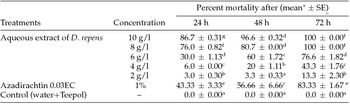
The adults of O. coffeae were exposed to different concentrations of aqueous extract of D. repens (2, 4, 6, 8 and 10 g/l) to determine the percent mortality (Table 1) and observations taken at different intervals (24, 48 and 72 h). The acaricidal activity of the extract was dependent on concentration and time, i.e. mortality percentages increased with increasing concentration of extract and with time. After treatment, percent adult mortality of 30–86.67% was observed at 6, 8 and 10 g/l concentration of the extract after 24 h of exposure and this increased significantly to 76–100% after 72 h. At 2 and 4 g/l concentration, mortality was observed to be in the range of 3–6% and 13–43% after 24 h and 72 h exposure, respectively. Fetoh and Al-Shammery (Reference Fetoh and Al-Shammery2011) made similar observations when leaf extracts of another species, Duranta plumeria (Verbenaceae) were sprayed against the spider mite, Oligonychus afrasiaticus. Mortality was found to be dose dependent and least mortality was observed at 10 p.p.m. (33.33%) and highest mortality was exhibited at 100,000 p.p.m. (69%). Within the same family, Verbenaceae, Sarmah et al. (Reference Sarmah, Rahman, Phukan and Gurusubramanian2009) highlighted that aqueous plant extracts of Clerodendron infortunatum (Gaertn) demonstrated more than 50% mortality of red spider mite at higher concentrations (5 and 10%), which is similar to the findings observed in the case of D. repens, where maximum mortality (76.6–100%) was observed at higher concentrations (6, 8 and 10%). Roobakkumar et al. (Reference Roobakkumar, Subramaniam, Babu and Muraleedharan2010) reported equivalent findings with other aqueous extracts of plants, and observed 48–84% mortality in adults of O. coffeae sprayed with 5% neem kernel aqueous extract, within 96 h after treatment under laboratory conditions. More recently, Roy and Mukhopadhyay (Reference Roy and Mukhopadhyay2012) and Roy et al. (Reference Roy, Rahman, Phukan and Muraleedharan2014b ) also observed significant adult mortality at 6, 8 and 10% concentrations of aqueous seed extract of Melia azedarach and aqueous extract of the dry pericarp of the fruits of Terminalia chebula after 24 h of exposure, which increased significantly to 90–100% after 1 week of exposure under laboratory conditions.
Toxicity of aqueous extract of Duranta repens on adults of Oligonychus coffeae compared to control and recommended check botanical pesticide (azadirachtin)

*Mean of five observations. The difference among doses at the same time is grouped in same column with small letters. Means followed by the same letter do not differ significantly at P = 0.05 according to Tukey's multiple comparison test.
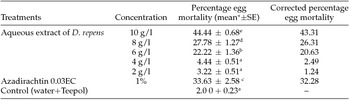
The eggs of red spider mite, which were sprayed at different concentrations of aqueous extract of D. repens (2, 4, 6, 8 and 10 g/l), and their influence on percent hatchability are shown in Table 2. Duranta repens affected the hatchability of red spider mite eggs in comparison to the control. The highest egg mortality (44.44%) was observed when the eggs were treated with higher concentrations (10 g/l) of the extract. Concentrations of 8 and 6 g/l achieved 27.78 and 22.22% of egg mortality, respectively. No significant egg mortality was registered at lower concentrations (2 and 4 g/l) compared to the control treatment. Ovicidal action of D. repens was found to be superior, i.e. 43.31% at a higher concentration of 10 g/l when compared to C. infortunatum, i.e. 20.58% at 10% concentration (Sarmah et al., Reference Sarmah, Rahman, Phukan and Gurusubramanian2009). In contrast, it was found to be significantly less if compared to D. plumeria (Fetoh and Al-Shammery, Reference Fetoh and Al-Shammery2011). Our findings are also in agreement with the result of Roy and Mukhopadhyay (Reference Roy and Mukhopadhyay2012) and Roy et al. (Reference Roy, Rahman, Phukan and Muraleedharan2014b ) who observed significant ovicidal activity when aqueous extracts of T. chebula and M. azedarach at higher concentrations (such as 6 and 10% concentrations) were sprayed on the eggs of the tea spider mite. The chemical substance present in the botanical products blocks the micropyle region of the egg, thereby preventing gaseous exchange, and killing the embryo during the egg stage (Sarmah et al., Reference Sarmah, Rahman, Phukan and Gurusubramanian2009).
Effect of aqueous extract of Duranta repens on viability of eggs of Oligonychus coffeae compared to control and recommended check botanical pesticide (azadirachtin)

*Mean of five replications; means followed by the same letter in a column do not differ significantly at P = 0.05 according to Tukey's multiple comparison test.
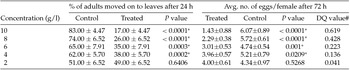
The repellent test in the choice bioassay showed that aqueous extract of D. repens had significant effects on the activity of the mites at 4, 6, 8 and 10 g/l concentrations (Table 3). Similarly, the total number of eggs laid was significantly lower on the side of the leaf surface where 4, 6, 8 and 10 g/l of the extract was applied than on the control side (Table 3). Similar repellent activity has also been observed for D. plumeria against O. afrasiaticus, where the repellent index varied from 95.5 to 84.4% from 24 to 72 h of treatment. The discrimination quotient (DQ), which has a range from 0 to 1, is an index for determining the effect of chemicals on the ovipositional deterrence of insects/mites. When the leaves sprayed with test solutions were provided for egg laying, adult mites showed some discrimination among the treated leaves with respect to the number of eggs laid. In the present study, the DQ value was high at higher concentrations, i.e. 10 g/extract (0.619) followed by 8 g/l, 6 g/l and 4 g/l extract (0.428, 0.223 and 0.136, respectively), and last by lower concentration, i.e. 2 g/l extract (0.041). Our findings conform to the results of Roobakkumar et al. (Reference Roobakkumar, Subramaniam, Babu and Muraleedharan2010), Roy and Mukhopadhyay (Reference Roy and Mukhopadhyay2012) and Roy et al. (Reference Roy, Rahman, Phukan and Muraleedharan2014b ) against tea red spider mite.
The numbers of female Oligonychus coffeae attracted to, and the numbers of eggs oviposited on, the tea leaves treated or untreated with aqueous extract of Duranta repens in choice tests

*Means are significantly different between treated and untreated by t-test (mean ± S.D., P ≤ 0.05).
The discrimination quotient (DQ) was calculated using the following formula (after Roobakkumar et al., Reference Roobakkumar, Subramaniam, Babu and Muraleedharan2010; Roy and Mukhopadhyay, Reference Roy and Mukhopadhyay2012): DQ = [(C–T)/(C+T)] where C = number of eggs on control leaves; T = number of eggs on treated leaves.
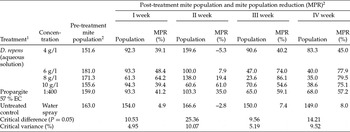
Data on the bioefficacy of aqueous extract of D. repens under field conditions against O. coffeae are summarized in Table 4. Concentrations of 4 and 6 g/l of aqueous extract of D. repens reduced mite incidence to the tune of 39.1–45.0% and 48.4–77.9%, respectively whereas at 8 and 10% it was 64.2–79.5% and 39.4–75.1%, respectively. Aqueous extract of leaves of D. repens was equivalent to propargite (41.2–57.2) in field trials (Table 4). Under field conditions, at a higher concentration of 10%, C. infortunatum exhibited maximum reduction in mite population after the second spray (Sarmah et al., Reference Sarmah, Rahman, Phukan and Gurusubramanian2009), which was at par with the mortality observed in the case of D. repens.
Bioefficacy of aqueous extract of Duranta repens against red spider mite (Oligonychus coffeae) in field condition (Oct–Nov 2013)

1 All the spray fluid mixed with Teepol (0.1%).
2 Mean value of three observations (30 leaves per observation).
The four concentrations of D. repens extracts caused various degrees of reduction in the number of O. coffeae, and offered various levels of protection to tea in sprayed plots throughout the period, compared to the unsprayed control plots and check plots sprayed with conventional chemical pesticides. Reduction in the populations of the pest in the field may be due to collective acaricidal, ovicidal and ovipositional deterrent effects of the extract. The negative control plots, where only solvent (water + Teepol) was sprayed, had fluctuations also in the population of red spider mite (after 14 days of 1st spray) due to the physical action of washing or drowning of the pest in the water spray. No phytotoxic symptoms were observed up to 63 days after spraying of aqueous seed extract of D. repens (4, 6, 8 and 10 g/l score 0–5%; grade 1) under field conditions. Further, tea samples prepared after treatment had no taint and achieved an organoleptic score of 6.5–7.0, indicating good liquor, strength, colour and quality.
Duranta repens is reported to have larvicidal, antifeedant and insecticidal properties against Culex quinquefasciatus (Nikkon et al., Reference Nikkon, Habib, Karim, Hossain, Mosaddik and Haque2008a ,Reference Nikkon, Hasan, Rahman, Hoque, Mosaddik and Haque b ; Reference Nikkon, Saud, Hossain, Parvin and Haque2009; Reference Nikkon, Salam, Yeasmin, Mosaddik, Khondkar and Haque2010), Musca domestica (El-Naggar and Mosallam, Reference El-Naggar and Mosallam1987), Plutella xylostella (Torres et al., Reference Torres, Barros and de Oliveira2001) and Tribolium castaneum (El-Naggar and Mosallam, Reference El-Naggar and Mosallam1987). Nikkon et al. (Reference Nikkon, Saud, Hossain, Parvin and Haque2009) found that the crude extracts (both stem and fruits), their fractions, and fresh fruit juice of D. repens were effective larvicidal agents against I, II, III and IV instar larvae of the mosquito C. quinquefasciatus. Also, Fetoh and Al-Shammery (Reference Fetoh and Al-Shammery2011) reported the acaricidal, ovicidal and repellent activities of ethanolic extracts of D. plumeria against O. afrasiaticus. The phytoconstituents present in D. repens consist of some steroids, triterpenes, iridoids, diterpenoids, flavonoids, triterpene saponins and saponins (Anis et al., Reference Anis, Anis, Ahmed, Mustafa, Malik, Amtul and Rahman2001; Reference Anis, Ahmed, Malik, Yasin and Choudary2002), which may have an insecticidal effect. Nikkon et al. (Reference Nikkon, Salam, Yeasmin, Mosaddik, Khondkar and Haque2010) isolated two triterpenes, beta-amyrin and 12-oleanene 3beta, and 21beta-diol, from the chloroform soluble fraction of an ethanol extract of D. repens stem. The mixture of these two triterpenes was effective against the larvae of the mosquito as a mosquitocide. It is, therefore, possible that olfactory, gustatory or contact response of adults of O. coffeae to D. repens extract could lead to suppression in hatchability of eggs, feeding and population size. Reduction in the populations of the pest in the field may be due to collective acaricidal, ovicidal and ovipositional deterrent effects of the extract.
Duranta repens finds various medicinal uses in many indigenous systems of medicine. Tribal practitioners as well as mainstream Kavirajes report that D. repens is able to treat malaria, itches, infertility, fever and pneumonia (Shahat et al., Reference Shahat, Nazif, Abousetta, Ibrahim, Cos, Van Miert, Pieters and Vlietinck2005; Ijaz et al., Reference Ijaz, Ahmad, Ahmad, ul Haq and Wang2010; Rahmatullah et al., Reference Rahmatullah, Jahan, Azam, Hossan, Mollik and Rahman2011); thus, preparations made from this material are unlikely to pose any health hazard to humans and livestock. The procedure adopted in this study for the preparation of water extract from D. repens is one of the easiest methods and may serve the purpose of the end user. The present study suggests that the aqueous extract of D. repens should be further investigated to establish its standard chemical composition and identify the acaricidal components, to develop potential botanical acaricides for use in pest control programmes in tea. Duranta repens is abundant in and around the vicinity of the tea garden (Gogoi et al., Reference Gogoi, Choudhury, Sharma, Rahman and Borthakur2012), and could be utilised in the IPM programme.
Acknowledgements
This research was partially supported by the Department of Science and Technology (SYST 105). We thank our colleagues from Tocklai Tea Research Institute who provided insight and expertise that greatly assisted the research and conclusions of this paper.