INTRODUCTION
The developmental trajectory of relative clauses has received extensive attention in the literature on child language over the last several decades. Because relative clauses (RCs) draw deeply on a language's syntactic resources, the study of how they emerge in the first years of life holds the promise of insights into the nature of learning and development. To date, most work on this topic has focused on subject and direct object RCs. We seek here to broaden the field of inquiry by investigating other RC types, drawing on data from two languages that differ from each other in ways that are particularly relevant to the issues at hand.
We start with a brief overview of previous work on the acquisition of relative clauses, outlining the obstacles that research of this type has encountered. We then report on the results of a series of elicited production studies that we conducted with children learning English and Korean, focusing on indirect object and oblique relative clauses in addition to their subject and direct object counterparts. These studies point to the existence of robust asymmetries in the difficulty of particular RC types in children, for which we then consider a variety of possible explanations.
BACKGROUND
An intriguing result of early research on the acquisition of RCs was the finding that subject RCs such as (1a) are easier to produce and understand than direct object RCs such as (1b) (e.g. Diessel & Tomasello, Reference Diessel and Tomasello2005; Friedmann, Belletti & Rizzi, Reference Friedmann, Belletti and Rizzi2009; Kidd, Brandt, Lieven & Tomasello, Reference Kidd, Brandt, Lieven and Tomasello2007; O'Grady, Reference O'Grady1997, p. 174; and the many references cited therein).
-
(1)
-
a. Subject relative clause
the boy [that _ hugged the girl]
-
b. Direct object relative clause
the boy [that the girl hugged _]
-
Initially, this contrast was interpreted as a syntactic effect: something about the internal structure of subject relative clauses makes them easier than their direct object counterparts (e.g. O'Grady, Reference O'Grady1997, p. 174, and the references cited there). However, this conclusion was subsequently challenged by an important observation about the test items used in early studies of RC development. As noted by Kidd et al. (Reference Kidd, Brandt, Lieven and Tomasello2007), patterns such as (1b), with an animate head such as boy, are rare in the speech of children and their caregivers, whose direct object RCs almost always occur with an inanimate head, as exemplified in (2).
-
(2) the apple [(that) she ate]
Kidd et al. go on to document that three- to four-year-old English- and German-speaking children find direct object RCs with inanimate heads no more difficult than subject RCs on an imitation task. Brandt, Kidd, Lieven, and Tomasello (Reference Brandt, Kidd, Lieven and Tomasello2009) report a similar finding for comprehension. Comparable results have been obtained for processing difficulty in adult native speakers as well: the widely reported direct object disadvantage disappears in patterns where the head noun is inanimate (Arnon, 2005; Gennari & MacDonald, Reference Gennari and MacDonald2008; Roland, Mauner, O'Meara & Yun, Reference Roland, Mauner, O'Meara and Yun2012, p. 480; Traxler, Morris & Seely, Reference Traxler, Morris and Seely2002).
But now another problem arises, since the finding that children do well on patterns such as (2) does not bear on the question of a possible syntactic asymmetry in the difficulty of relative clauses. Because direct object RCs with an inanimate head noun are not semantically reversible (a person can eat an apple, but not vice versa), they can be interpreted without the need for full recourse to syntactic processing.
We are thus at an impasse. If we compare subject RCs with direct object RCs that have an animate head, as in (1), we come up against the naturalness confound noted by Kidd at al. On the one hand, if we focus on direct object RCs with an inanimate head, as in (2), we find ourselves dealing with patterns that do not draw fully on the language's syntactic resources – a confound of a different sort.
One way out of this impasse is to abandon the traditional focus on the contrast between subject and direct object RCs in favor of contrasts involving patterns that do not present the confounds that have undermined previous research efforts. We focus our attention in this paper on the two contrasts illustrated below.
-
(3)
-
a. Subject RC
the boy [that _ is giving a bag to a girl]
-
b. Indirect object RC
the boy [that a girl is giving a bag to _]
-
-
(4)
-
a. Direct object RC
the book [that a boy is putting _ on a box]
-
b. Oblique RC
the book [that the boy is putting a box on _]
-
Because subject and indirect objects typically have an animate referent by virtue of being agents and recipients, respectively, their animacy is fully natural. Moreover, the contrast in (3) is fully semantically reversible – it is just as plausible for a boy to give a bag to a girl, as it is for a girl to give a bag to a boy. Likewise, because direct objects and locative obliques typically have inanimate referents, they too are equally natural. In addition, the patterns in (4) manifest the desired semantic reversibility – it is just as possible to place a book on a box as it is to place a box on a book. (The issue of possible frequency effects remains, however, as subject and direct object RCs are more common than indirect object and oblique RCs; see ‘Frequency effects’.)
We study these contrasts with the help of an elicited production task that compels the speaker to design and build relative clauses ‘from scratch’, creating heavy demands on their syntactic resources. Moreover, as noted by Zukowski (Reference Zukowski2009, p. 4), properly designed production tasks do more than just elicit the use of particular patterns in situations that resemble those found in naturalistic speech. They also provide children with the opportunity to produce alternative constructions – grammatical or ungrammatical – that may shed further light on underlying problems and preferences. As we will see in due course, children's attempts to comply with the demands of elicited production turn out to be crucial to understanding the challenges associated with the formation of relative clauses.
We report next on two production experiments designed to test for syntactic asymmetries in the development of relative clause patterns, the first involving the contrast between subject and indirect object RCs and the second focusing on direct object and oblique RCs.
SUBJECT VERSUS INDIRECT OBJECT RCs
METHOD
Participants
Twenty-one children aged 5;0 to 6;10 (mean age = 6;3), all monolingual learners of English as a first language, and twenty-seven adult native speakers of English (mean age = 21) participated in this experiment.
Materials and procedure
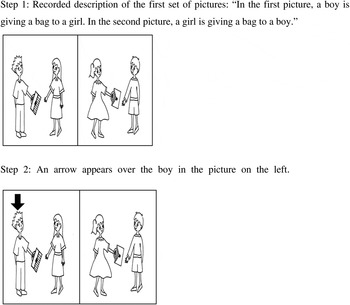
Subject and indirect object RCs were elicited with the help of a production task based on the one employed in various forms by Cho (Reference Cho1999), Goodluck and Stojanovic (Reference Goodluck and Stojanovic1996), Hsu, Hermon, and Zukowski (Reference Hsu, Hermon and Zukowski2009), and Zukowski (Reference Zukowski2009). In our version of this design, participants were told that they were going to see a series of pictures on a computer screen and that a (prerecorded) woman's voice was going to describe each picture. They then heard the following instructions:
“After listening to what [the woman] says, you will hear a beep sound and see an arrow mark. I would like you to describe the person (or thing) that has the arrow mark. Can you do it?”
Figure 1 shows the protocol used to elicit a subject RC such as the boy [that _ is giving a bag to the girl].
Sample protocol used to elicit a subject RC. Targeted response: “the boy [that _ is giving a bag to the girl].”

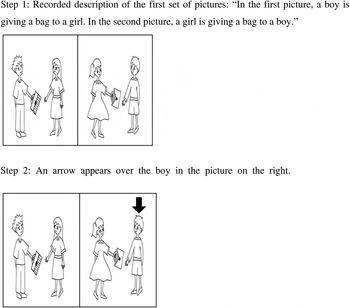
The elicitation of an indirect object RC (e.g. the boy [that the girl is giving a bag to _]) proceeded in a parallel way: the participant saw the same initial pair of pictures and heard the same background description. This time, though, an arrow (with an accompanying beep) appeared over the boy on the right in the second set of pictures (see Figure 2).
Sample protocol used to elicit an indirect object RC. Targeted response: “the boy [that the girl is give a bag to _].”

As just illustrated, we employed two conditions, one designed to elicit subject RCs and the other designed to encourage production of indirect object RCs. Each condition consisted of a block of five randomly ordered items. The order of presentation of the two blocks was counterbalanced across participants, so that half the participants were exposed to subject RCs first while the other half encountered indirect object RCs first.
A brief instructional session, including three practice items, took place before the actual task to help participants understand what was expected of them. The first and second practice items elicited NPs that were modified by an adjective, the big cat and the short man. The final practice item was the boy who is sleeping, which contained a very simple RC built around an intransitive verb. See full list of test items in the ‘Appendix’.
It took approximately ten minutes to finish the entire task. All responses were recorded for subsequent analysis.
RESULTS
The data were recorded in Audacity, carefully transcribed by one of authors, with the assistance of a native English speaker, and entered onto a spreadsheet for coding and analysis. Following Hsu et al. (Reference Hsu, Hermon and Zukowski2009, p. 336), if more than one answer was given for a particular test item, only the first answer uttered is reported.
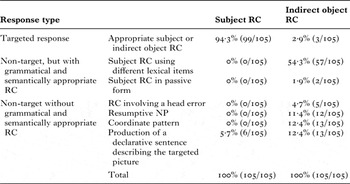
The twenty-one child participants produced a total of 210 responses – 105 for the subject RC condition and 105 for the indirect object RC condition. Table 1 summarizes our results; all data were included in the statistical analysis.
Child responses (percentages) for patterns designed to elicit subject and indirect object relative clauses

The children responded with a high level of success on test items that offered the opportunity to produce a subject RC – 94·3% of the responses were well-formed structures of this type, some of which are exemplified in (5).
-
(5) Sample subject RCs
-
a. the boy [who _ is giving a bag to the girl]
-
b. the boy [who _ gave a bag to the girl]
-
c. the boy [who_ is showing a bag to the girl]
-
In contrast, contexts offering the opportunity to produce an indirect object RC yielded a structure of that type a mere 2·9% of the time.
-
(6) Sample indirect object RCs
-
a. the boy [who the girl is giving a bag to _]
-
b. the boy [that the girl is showing a bag to _]
-
In more than half the items targeting an indirect object RC (54·3%), the children modified the lexical items in the experimenter's lead-in sentences in ways that allowed the production of a subject RC instead, as illustrated in Table 2.
Examples of lexical modifications to allow the production of a subject RC

It is difficult to see any semantic motivation for these substitutions: get–from and catch–from patterns are surely no more natural than give–to and throw–to patterns, which have the additional advantage of having been primed in the lead-in sentences. (In fact, if anything, catch–from is less natural than throw–to.) Even more telling is the fact that lexical substitutions of this sort never occur in contexts that call for a subject RC: test items targeting subject RCs, e.g. the boy who gave a bag to the girl, didn't elicit responses such as the boy who the girl got a bag from. This points to a genuine preference for subject relative clauses over their indirect object counterparts.
A variety of other response types occurred in the indirect object condition with substantially less frequency; they are exemplified in Table 3.
Non-target responses

Like the lexical substitution strategy, these response types offer ways to avoid producing a canonical indirect object RC: the coordination strategy circumvents an RC altogether, the resumptive NP strategy eliminates the gap that is characteristic of English indirect object RCs, and the head error and passive response types result in the production of subject RCs rather than the targeted indirect object pattern. The use of resumptive NPs has also been reported for children learning English by Zukowski (Reference Zukowski2009), as well as for learners of Mandarin (Hsu et al., Reference Hsu, Hermon and Zukowski2009) and Italian (Contemori & Belletti, Reference Contemori and Belletti2014).
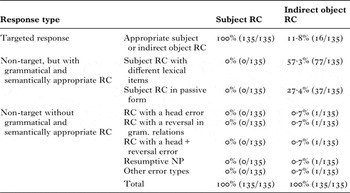
Responses by the twenty-seven adult participants also showed signs of a strong subject preference, as revealed by the data summarized in Table 4.
Adult responses (percentages) for patterns designed to elicit subject and indirect object relative clauses

Whereas the adult participants responded with subject RCs in each and every situation designed to elicit that pattern, they produced indirect object RCs only 11·8% of the time in the situations calling for that construction. The majority of the other responses (57·3%) involved the selection of lexical items that permitted production of a subject RC instead, as illustrated in Table 5.
Examples of lexical modifications to allow the production of a subject RC

The only other major response type, manifested 27·4% of the time, involved the use of passivization to create a subject RC, avoiding the need for an indirect object RC.
-
(7) The use of passivization to avoid an indirect object RC
-
a. the boy [that_ is being handed a cup by the girl]
-
b. the girl [that_ is being brought a chair]
-
c. the girl [who _ is being passed the box by the boy]
-
DISCUSSION
In sum, we find a striking asymmetry in the production of semantically reversible relative clauses in which the two potential targets for relativization (the subject and the indirect object) are prototypically animate: subject RCs are favored by a very wide margin. Not only do both children and adults produce subject RCs in the situations calling for them, they go to considerable lengths, through the use of lexical substitution and (in the case of adults) passivization, to avoid producing indirect object relative clauses. The asymmetry seems to turn entirely on RC type, as the pictures and discourse contexts used to elicit the two patterns were identical in every respect.
We turn next to a parallel experiment that calls for the production of direct object and oblique RCs.
DIRECT OBJECT VERSUS OBLIQUE RCs
METHOD
Participants
The twenty-one children from the previous experiment also participated in this experiment. In addition, there was a control group of twenty-eight adult native speakers of English, twenty-five of whom had participated in the previous experiment. There was a one-week interval between the two experiments.
Materials and procedure
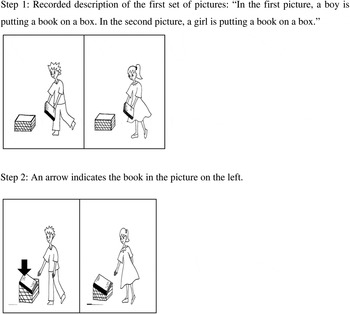
The same procedure used in the previous experiment was employed: after a brief practice session and instructions, the experimenter presented the series of prompts designed to elicit RC patterns. Figure 3 illustrates a prompt intended to elicit a direct object relative clauses such as the book [that the boy put _ on a box].
Sample protocol used to elicit a direct object RC. Targeted response: “the book [that the boy put _ on a box].”

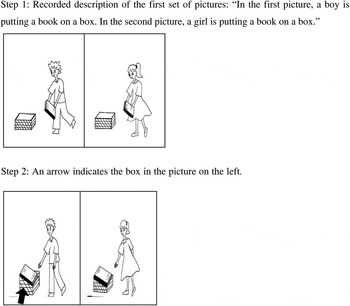
The elicitation of oblique RCs (e.g. the box [that the boy put a book on _]) proceeded in a parallel way, except that this time the arrow picked out one of the boxes, as illustrated in Figure 4.
Sample protocol used to elicit an oblique RC. Targeted response: “the box [that the boy put a book on _].”

As in the previous experiment, there was a total of thirteen test items (three warm-ups, plus ten critical items). As illustrated above, we had two conditions, one designed to elicit direct object RCs and the other designed to encourage production of oblique RCs. Each condition consisted of a block of five randomly ordered items. The order of presentation of the two blocks was counterbalanced across participants, so that half the participants were exposed to direct object RCs first while the other half encountered oblique RCs first. See full list of test items in the ‘Appendix’.
The same procedure employed in the previous experiment was used. It took approximately ten minutes to finish the entire task.
RESULTS
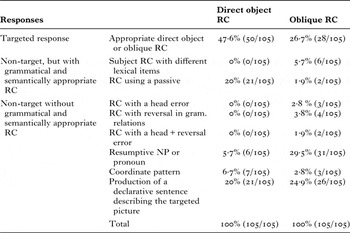
Data were coded using the same procedure employed in the previous experiment. Table 6 summarizes our results.
Child responses (percentages) for patterns designed to elicit direct object and oblique relative clauses

Children produced direct object RCs at a rate almost twice that for oblique RCs (47·6% vs. 26·7%); the difference is statistically significant (t(20) = 2·076, p < ·05). Moreover, no child did better on test items targeting oblique RC than on those that called for a direct object RC. Samples of both patterns follow.
-
(8) Sample direct object RCs
-
a. the book [that the boy put _ on the box]
-
b. the sweater [that the boy laid _ on the blanket]
-
c. the couch [that the boy is pushing _ toward the table]
-
-
(9) Sample oblique RCs
-
a. the box [that the boy put the book on _]
-
b. the blanket [that the boy laid the sweater on _]
-
c. the table [that the boy pushed the couch toward _]
-
In the case of direct object RCs, the single most common alternative response (20%) involved the use of passivization to produce a subject RC.
-
(10) Subject RCs using a passive structure
-
a. the book [that _ was put on the box]
-
b. the sweater [that _ is being laid on the blanket]
-
c. the couch [that _ is being pushed toward the table]
-
The other two moderately common non-target response types involved use of a coordinate structure that begins with a subject RC (6·7%) and use of a resumptive NP or pronoun (5·7%).
-
(11) Coordinate pattern (with accompanying subject RC)
-
a. that book [that _ is on the box and that the boy put it]
-
b. the hat [that _ is onto the cushion and that the boy tossed]
-
c. the bag [that _ is landed on the cushion and that the boy throwing it]
-
-
(12) Resumptive pronouns and NPs
-
a. the book [that the boy put it on the box]
-
b. the book [that the boy put the book on the box]
-
c. the couch [that the boy pushed the couch toward the table]
-
d. the bag [that the girl placed it on the notebook]
-
In the case of oblique RCs, in contrast, the single most common alternative to the target pattern (29·5%) involved a resumptive NP or pronoun.
-
(13)
-
a. Resumptive pronoun: the box [that the boy put the book on it]
Resumptive NP: the box [that the boy put the book on the box]
-
b. Resumptive pronoun: the couch [that the boy pushed the table toward it]
Resumptive NP: the couch [that the boy pushed the table toward the couch]
-
c. Resumptive pronoun: the letter [that the girl is hiding the photo under it]
Resumptive NP: the letter [that the girl is hiding the photo under the letter]
-
A further common strategy (24·9% of all responses) involved the complete avoidance of an RC pattern through the use of a declarative sentence to describe the picture (e.g. The girl is hiding the letter under the photo). The only other single error type that exceeded 5% of all responses on the oblique RC condition involved the use of lexical substitutions to permit the formation of a subject RC (5·7% of the time), as exemplified in (14).
-
(14) the box [that _ got the book from the boy]
(target: the box [that the boy put the book on _])
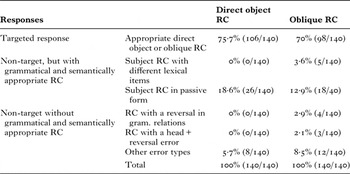
In contrast to children, adults produced the targeted direct object and oblique RCs at a mean rate of at least 70%. Table 7 reports their performance. The difference in the rate of targeted responses for the two RC types is small and not statistically significant (t(27) = 0·826, p = ·416).
Adult responses (percentages) for patterns designed to elicit direct object and oblique relative clauses

The predominant alternative response from adults involved restructuring the target clause as a subject RC. In situations that called for a direct object RC, this strategy (18·6% of all responses) invariably made use of passivization, as exemplified in (15). Gennari, Mirković, and MacDonald (Reference Gennari, Mirković and MacDonald2012, p. 150) report an even higher passivization rate of 44% among adult participants in a similar elicited production task that targeted direct object RCs with an animate agent and an inanimate theme argument (corresponding to the head of the RC); see Contemori and Belletti (Reference Contemori and Belletti2014) for a comparable report for Italian.
-
(15)
-
a. water [that _is being poured into juice by the boy]
(target: the water [that the boy is pouring _ into the juice]
-
b. the table [that _is being pushed toward the couch by the boy]
(target: the table [that the boy is pushing _ toward the couch])
-
c. the hat [that _ is thrown onto a cushion by the boy]
(target: the hat [that the boy is throwing _ onto a cushion])
-
In situations that invited the production of an oblique RC, passivization was attempted in 12·9% of all responses. In another 3·6% of responses, lexical substitution was used to create a subject RC. Thus a total of 16·5% of the responses produced in lieu of the targeted oblique RC were subject RCs – very close to the 18·6% of such responses (all passives) that occurred when a direct object RC was targeted.
DISCUSSION
Our results suggest that children (but not adults) find it difficult to produce direct object and oblique RCs, with the latter pattern proving significantly more challenging (26·7% versus 47·6%). A point of particular interest in this regard was the frequent recourse (29·5% of all responses) to resumptive NPs and pronouns (e.g. the box that the boy put the book on the box / it ) on test items calling for oblique RCs. The fact that children produce such patterns as frequently as they do, despite their unacceptability in English and their general absence from the input, helps confirm the difficulty of oblique RCs.
RELATIVE CLAUSE ASYMMETRIES IN KOREAN
We have thus far focused on two comparisons in English – one between subject and indirect object RCs, and the other between direct object and oblique RCs. Our elicited production task identified two highly significant asymmetries in these patterns: children are more likely to produce subject RCs than indirect object RCs, and more likely to produce direct object RCs than oblique RCs.
-
(16)
-
a. subject > indirect object
-
b. direct object > oblique
-
A question that arises at this point has to do with whether these asymmetries are peculiar to English. One way to address this issue is to consider contrasts in a language whose RCs differ in fundamental ways from those of English. Korean is a case in point: its basic word order is SOV rather than SVO; it has case marking on its NPs; and it places relative clauses to the left of the head noun, rather than to the right. The patterns in (17) and (18) exemplify the relevant RC patterns in Korean.
-
(17)
-
a. Subject RC
[_ sonye-eykey kapang-ul cwu-koiss-nun] sonyen
girl-dat bag-acc give-Asp-rc.Prs boy
‘the boy that _ is giving a bag to the girl’
-
b. Indirect object RC
[sonye-ka _ kapang-ul cwu-koiss-nun] sonyen
girl-nom bag-acc give-Asp-rc.Prs boy
‘the boy that the girl is giving a bag to _’
-
-
(18)
-
a. Direct object RC
[sonyen-i sangca-ey _ noh-un] chayk
boy-nom box-on put-Asp-rc.Prs book
‘the book that the boy is putting _ on the box’
-
b. Oblique RC
[sonyen-i _ chayk-ul noh-un] sangca
boy-nom book-acc put-Asp-rc.Prs box
‘the box that the boy is putting the book on _’
-
We report next on the results of two experiments that we conducted in order to document possible asymmetries in the production of these patterns by children learning Korean as a first language.
SUBJECT RCs VERSUS INDIRECT OBJECT RCs IN KOREAN
Participants
Twenty-five children aged 5;0 to 6;7 (mean age = 5;9), all monolingual learners of Korean as a first language, and twenty-one adult native speakers of Korean (mean age = 21·5) participated in this experiment. All the participants were living in Seoul at the time of the experiment.
Materials and procedure
The same materials and procedure employed for the experiment on subject and indirect object RCs in English (see ‘Subject versus indirect object RCs’ above) were used for the Korean experiment.
RESULTS
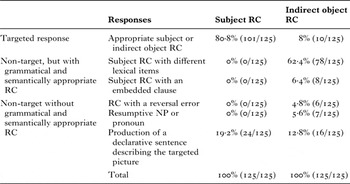
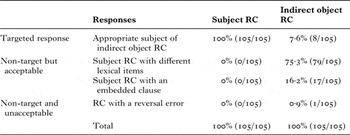
Data were coded using the same procedure employed in the English version of the experiment. Tables 8 and 9 report our results.
Child responses (percentages) for patterns designed to elicit subject and indirect object relative clauses in Korean

Adult responses (percentages) for patterns designed to elicit subject and indirect object relative clauses

DISCUSSION
The key observation here is straightforward: for both Korean-speaking children and adults, production of the targeted pattern was far more successful in the case of subject RCs, where even the children were successful 80.8% of time, than indirect object RCs, where the rate of production for both groups was less than 10%. This contrast parallels the asymmetry observed for English. Moreover, as in the case of English, the dominant alternative response for indirect object RCs is a subject RC (68·8% of children's responses and 91·5% of adult responses).
DIRECT OBJECT RCs VERSUS OBLIQUE RCs
Participants
The twenty-five children from the previous experiment also participated in this experiment, as did the control group of twenty-one adult native speakers of Korean. There was a one-week interval between the two experiments.
Materials and procedure
The same materials and procedure employed for the experiment on direct object and oblique RCs in English (see ‘Direct object versus oblique RCs’ above) were used for the Korean experiment.
RESULTS
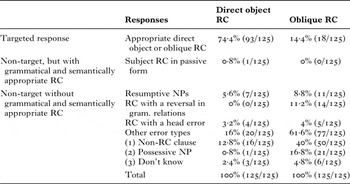
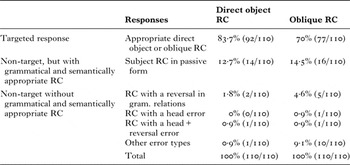
Data were coded using the same procedure employed in the English version of the experiment. Our results are summarized in Tables 10 and 11.
Child responses (percentages) for patterns designed to elicit direct object and oblique relative clauses in Korean

Adult responses (percentages) for patterns designed to elicit direct object and oblique relative clauses

DISCUSSION
Korean children manifest a sharply better performance on direct object RCs than on oblique RCs (74·4% vs. 14·4%); this difference is statistically significant (t(24) = 10·663, p < 0·001). In contrast, Korean adults do well on the production of both direct object and oblique RCs, with a rate of success of at least 70% on both patterns.
Unlike their English-speaking counterparts, Korean children rarely produce passives in situations calling for direct object and oblique RCs, probably because passives in Korean tend to have an animate subject. However, their alternative strategies are otherwise similar to those of English-speaking children, including their reluctance to produce an RC of any type (61·6% of all responses in the oblique RC condition) and occasional recourse to unacceptable resumptive NP patterns.
In sum, despite very obvious structural differences between English and Korean (one has SVO order with postnominal RCs, and the other SOV order with prenominal RCs), children learning each language manifest the same asymmetries in their production of relative clauses: subject RCs are preferred to their indirect object counterparts, and direct object RCs are favored over their oblique counterparts.
-
(19)
-
a. subject > indirect object
-
b. direct object > oblique
-
We turn next to the relevance of these findings for a broader understanding of relative clauses in child language.
GENERAL DISCUSSION
The finding that there are robust asymmetries in children's production of RC types in English and Korean raises at least two fundamental questions, one having to do with the generality of the asymmetries and the other having to do with how they might be explained. We will consider each question in turn.
RC asymmetries in elicited versus spontaneous production
The asymmetries uncovered in our elicited production task are similar in key respects to developmental trends that have been observed in the spontaneous speech of English-speaking children. (The corpus for Korean available in the CHILDES database is too small to permit a comparable analysis for that language.) Diessel and Tomasello's (Reference Diessel and Tomasello2000) study of relative clauses in the speech of four children (1;9 to 5;2) revealed that 53% of their RCs were of the subject type, 32·6% of the direct object type, and only 14·4% of the oblique type. Moreover, the first ten RCs produced by each child were mostly of the subject type (72·5%). Still, these are strong tendencies at best, and it is worth noting that only two of the four children produced subject RCs before direct object RCs (Diessel, no date, p. 6). It is therefore fair to ask why, if the asymmetries reported here are real, we do not routinely find corresponding developmental stages in children's spontaneous speech. The answer is twofold.
First, as noted by Hawkins (Reference Hawkins2007, p. 341), the hierarchy effect underlying a subject > indirect object or direct object > oblique asymmetry predicts only that a less demanding RC type will emerge in the course of development before or simultaneously with its more difficult counterparts. This prediction can be falsified only by finding that an ‘easier’ pattern systematically emerges after a more ‘difficult’ counterpart – as would be the case if, for example, subject RCs did not appear until after indirect object RCs had been acquired. To our knowledge, no such finding has ever been reported.
Second, the comparisons in the experiments conducted here were based on RC types that contained three lexical NP arguments (a subject, and direct object, and an indirect object or oblique), with canonical correspondences between grammatical relations and animacy (hence animate subjects and indirect objects, and inanimate direct objects and obliques).
-
(20) The subject–indirect object contrast (animate subject and indirect object)
-
a. Subject RC
the boy [that _ is giving a bag to a girl]
-
b. Indirect object RC
the boy [that a girl is giving a bag to _]
-
-
(21) The direct object–oblique contrast (inanimate direct object and oblique)
-
a. Direct object RC
the book [that a boy is putting _ on a box]
-
b. Oblique RC
the book [that the boy is putting a box on _]
-
Patterns of this type constituted appropriate responses for the contexts that we created: without multiple lexical arguments, the relative clauses would not have narrowed the reference of the head noun in accordance with communicative demands of our task. The child participants clearly realized this and did not hesitate to use multiple lexical arguments in their responses, even when they avoided the targeted RC type.
That said, the particular patterns that we elicited are unlikely to be common in spontaneous speech, where, as noted by Kidd et al. (Reference Kidd, Brandt, Lieven and Tomasello2007), we typically find transitive RCs with just two arguments – one animate and the other inanimate. The following examples are from Diessel and Tomasello (Reference Diessel and Tomasello2000, pp. 135, 138).
-
(22)
-
a. the chairs [a Peter's got _] (Peter 2;5)
-
b. dat train [Ursula bought _] (Adam 2;10)
-
c. everything [I like _] (Adam 3;5)
-
d. the first thing [we have to do _] (Adam 3;11)
-
Moreover, typical oblique RC patterns such as the following, from Diessel and Tomasello (Reference Diessel and Tomasello2000, p. 135), contain an animate subject, an inanimate oblique (the head noun), and no direct object at all.
-
(23)
-
a. the one [you went to _ last night] (Peter 2;10)
-
b. this toy [I am playing with _] (Peter 3;1)
-
c. my place [where I used to sit _] (Sarah 4;6)
-
d. those little things [that you play with _] (Adam 4;10)
-
Comparable trends have been reported in Ozeki and Shirai's (Reference Ozeki, Shirai, Matsumoto, Oshima, Robinson and Sells2007) study of relative clauses in the spontaneous speech of five Japanese children, who produced RCs of all types in roughly equal proportion from early in their development. (Japanese relative clauses are typologically similar to those of Korean; they have SOV order, make crucial use of case marking, and appear before the noun they modify.)
-
(24)
-
a. Subject RC (Taa 2;2, cited by Ozeki & Shirai, Reference Ozeki, Shirai, Matsumoto, Oshima, Robinson and Sells2007, p. 264)
[kimono kita] obake
kimono wear ghost
‘the ghost who is wearing a kimono’
-
b. Direct object RC (Ryo 2;11 cited by Ozeki & Shirai, Reference Ozeki and Shirai2010, p. 205)
[papa kara moratta] yatu
father from received one
‘the one I received from father’
-
c. Oblique RCs
[yakyuu suru] mono (Ryo 2;7, cited by Ozeki & Shirai, Reference Ozeki and Shirai2010, p. 204)
baseball do thing
‘the thing with which one plays baseball’
[ame-o kau] okane (Sumi 2;7, cited by Ozeki & Shirai, Reference Ozeki, Shirai, Matsumoto, Oshima, Robinson and Sells2007, p. 261)
candy buy money
‘money to buy candy’
[pan-o kau] toko (Sumi 2;11, cited by Ozeki & Shirai, Reference Ozeki, Shirai, Matsumoto, Oshima, Robinson and Sells2007, p. 253
bread buy place
‘a place to buy bread’
-
These examples from English and Japanese show that children produce direct object and oblique RCs at a very young age. But this fact does not bear on the issue of whether one pattern might be more difficult than another. That question can only be addressed if two conditions are met. First, the patterns in question must be fully comparable with regard to the number and type of arguments that they contain. Second, the patterns must draw on the language's full syntactic resources – their meaning should not be evident solely from the meaning of their component words, without the need for syntactic processing.
The contrasts exemplified in (22)–(24) fail to meet these criteria: the various RC types involve different verbs, they contain different types of arguments, and they lack semantic reversibility, thereby avoiding the need for full syntactic processing (e.g. Ursula can buy a train, but not vice versa; money can be used to buy candy, but not vice versa; and so on). Indeed, this is why the study of syntactic asymmetries in the emergence of relative clauses requires the experimental investigation of patterns that are designed to eliminate the confounds that undermine key comparisons.
Explaining the asymmetries
Given that the asymmetries we have been considering are real, an obvious question arises as to their source. Over the years, a series of proposals have been put forward to explain previously observed contrasts in the difficulty of relative clause patterns, especially those involving subject and direct object RCs. These proposals have typically focused on the possible effect of five factors: canonical word order, frequency, the length of the filler–gap dependency, the depth of the gap, and the place of the relativized element in a hierarchy of grammatical relations commonly employed in work on syntactic typology. As we will see next, only one of these proposals offers a possible general explanation for the results of our elicited production tasks.
Canonical word order effects
As noted by Diessel and Tomasello (Reference Diessel and Tomasello2000, Reference Diessel and Tomasello2005), Kidd et al. (Reference Kidd, Brandt, Lieven and Tomasello2007), and MacDonald and Christiansen (Reference MacDonald and Christiansen2002, p. 40), word order provides a possible insight into the oft-reported subject RC advantage in English.
-
(25) The Canonical Word Order Hypothesis
Canonical word order facilitates the production and comprehension of relative clauses.
As the examples below illustrate, subject RCs differ from direct object and indirect object RCs in maintaining the canonical subject–verb–complement order of English.
-
(26)
-
a. Subject RC
the boy [that _ is hugging a girl]
subj verb do
-
b. Direct object RC
the boy [that a girl is hugging _]
do subj verb
-
-
(27)
-
a. Subject RC
the boy [that _ is giving a bag to a girl]
subj verb do io
-
b. Indirect object RC
the boy [that a girl is giving a bag to _]
io subj verb do
-
However, the Canonical Word Order Hypothesis fails to predict the asymmetry between direct object and oblique RCs in English, both of which exhibit non-canonical order.
-
(28)
-
a. Direct object RC
the book [that a boy is putting _ on a box]
do subj verb obl
-
b. Oblique RC
the book [that the boy is putting a box on _]
obl subj verb do
-
Moreover, canonical order offers no account for asymmetries in Korean. Because Korean is a verb-final language, no RC type manifests canonical order, as illustrated in the following examples of a subject RC and its indirect object counterpart.
-
(29)
-
a. Subject RC
[_ sonye-eykey kapang-ul cwu-koiss-nun] sonyen
girl-dat bag-acc give-Asp-rc.Prs boy
ind obj dir obj verb subj
‘the boy that _ is giving a bag to the girl’
-
b. Indirect object RC
[sonye-ka _ kapang-ul cwu-koiss-nun] sonyen
girl-nom bag-acc give-Asp-rc.Prs boy
subj dir obj verb ind obj
‘the boy that the girl is giving a bag to _’
-
Yet, as we have seen, there is nonetheless an RC asymmetry in Korean: children are far more likely to produce well-formed subject RCs than indirect object RCs.
In sum, the facts from English and Korean suggest that word order canonicity cannot offer a general account of the asymmetries observed in the emergence of relative clauses.
Frequency effects
It is well known that the frequency with which particular patterns occur in the input often correlates with ease of production, comprehension, and acquisition (see Ambridge and Kidd, Reference Ambridge and Kidd2015, for a general review), arguably because previous experience creates weighted expectations about how particular construction types should unfold (e.g. Hale, Reference Hale2001; Levy, Reference Levy2008). Extending this correlation to relative clauses, we arrive at the following hypothesis.
-
(30) The Frequency Hypothesis
Frequency of occurrence is relevant to the difficulty of relative clauses.
Diessel (Reference Diessel, Givón and Shibatani2009, p. 258) reports that subject and direct object RCs are far more common than any other type of relative clause in maternal speech – an asymmetry that aligns perfectly with our finding that subject RCs enjoy an advantage over their indirect object counterparts and that children are more likely to produce direct object RCs than oblique RCs. Nonetheless, at least two considerations suggest that the Frequency Hypothesis may not offer a general explanation for the performance of the children in our study.
First, a full account of RCs needs to explain not only why certain relative clause types are easier than others, but also why learners resort to the particular avoidance strategies that we have observed. One such strategy, frequently encountered in our study and in other work, involves passivization. In our production task, for instance, English-speaking children responded to 20% of the test items that targeted a direct object RC by passivizing the verb, thereby creating a subject RC.
-
(31)
-
a. Target direct object RC
the book [that the girl put _ on the box]
-
b. Actual response after passivization
the book [that _ was put on the box]
-
Although subject RCs are of course common in the input, passive subject relative clauses are not. No numbers are available for caregiver speech, but the Switchboard corpus, as analyzed by Roland, Dick, and Elman (Reference Roland, Dick and Elman2007, p. 355), contains just twenty-four examples of passive finite RCs, compared to 477 direct object RCs. It is difficult to see how input frequency would push children to avoid direct object RCs in favor of passives, which are twenty times less common. Evidently, then, some other factor must underlie their avoidance of direct object RCs; we return to this matter in ‘Hierarchy effects’ below.
Second, the success of the frequency account for RC preferences in languages other than English has yet to be demonstrated. Although no corpus studies are available for Korean, one does exist for Japanese. Ozeki and Shirai (Reference Ozeki, Shirai, Matsumoto, Oshima, Robinson and Sells2007, p. 262) report an essential parity in the frequency of subject, direct object, and oblique RCs in the speech of a Japanese mother over a three-year period (beginning when her child was eleven months old). It is tempting to think that if the RCs asymmetries reported for Korean were replicated in Japanese (or if the parity in the frequency of RC types reported for Japanese existed in Korean), then we could conclude that frequency is not responsible for the contrasts we have been considering. However, matters are not so simple. As an anonymous referee notes, our study focuses on a very particular subtype of RC in which the verb takes three lexical arguments (for the reasons already noted). It is therefore important to ask whether RCs of this sort occur in the input in quantities and proportions that might shape the preferences we have reported. Ozeki and Shirai mention no such patterns, but their study involves a single mother–child dyad. Clearly, more work is called for once larger databases for Japanese and Korean become available.
Regardless of the outcome of this work, it is important to bear in mind the difficulty of establishing a causal relationship between input effects and the course of development, especially when processing cost is involved. It is quite possible that the very factors that make particular RCs difficult for children also impede their production in adult speech, creating input asymmetries that parallel developmental asymmetries but do not shape them. See O'Grady (Reference O'Grady2015) for some comments on this matter.
Distance effects
It is commonly suggested that the distance between a gap and its filler contributes to the difficulty of particular RCs, consistent with the familiar fact that filler–gap dependencies place a burden on processing resources (e.g. Goodall, Reference Goodall, Chand, Kelleher, Rodrígues and Schmeiser2004, p. 102, Hawkins Reference Hawkins2004, p. 173; among many others).
-
(32) The Distance Hypothesis
The length of the filler–gap dependency is relevant to the difficulty of relative clauses.
According to one well-known calculus, the processing burden increases with the number of elements with discourse referents (essentially, nouns and verbs) that intervene between the filler and the gap (e.g. Gibson, Reference Gibson1998, Reference Gibson, Miyashita, Marantz and O'Neil2000; Grodner & Gibson, Reference Grodner and Gibson2005, p. 262, Lewis, Vasishth & Van Dyke, Reference Lewis, Vasishth and Van Dyke2006; Warren & Gibson, Reference Warren and Gibson2002).
-
(33)
-
a. Subject relative clause
the student [that _ met the teacher]
| 0 |
-
b. Direct object relative clause
the student [that the teacher met _]
| 1 2 |
-
On this view, the filler–gap dependency in the subject RC can be resolved at minimal cost to working memory, as there is just one intervening element (the complementizer that), which does not have a discourse referent. In contrast, two elements with discourse referents (the NP the teacher and the verb meet) intervene between the filler and the gap in the direct object relative clause, predicting that it should be more difficult to process. By this same reasoning, subject RCs should also be easier than indirect object RCs, and direct object RCs should be easier than their oblique counterparts – just what we found.
-
(34)
-
a. Subject RC
the boy [that _ is giving a bag to a girl]
| 0 |
-
b. Indirect object RC
the boy [that a girl is giving a bag to _]
| 1 2 3 |
-
-
(35)
-
a. Direct object RC
the book [that a boy is putting _ on a box]
| 1 2 |
-
b. Oblique RC
the book [that the boy is putting a box on _]
| 1 2 3 |
-
Although the predictions of the Distance Hypothesis appear to be borne out in the case of English, they are less successful in Korean, where the filler–gap dependency appears to be longer in subject RCs than in indirect object RCs.
-
(36)
-
a. Subject RC
[_ sonye-eykey kapang-ul cwu-koiss-nun] sonyen
_ girl-dat bag-acc give-Asp-rc.Prs boy
| 1 2 3 |
-
b. Indirect object RC
[sonye-ka _ kapang-ul cwu-koiss-nun] sonyen
girl-nom _ bag-acc give-Asp-rc.Prs boy
| 1 2 |
-
There are different ways to calculate the effect of distance in such cases, as noted by Gibson and Wu (Reference Gibson and Wu2013, p. 132). If one simply counts the number of items that intervene between the gap and the head of the RC in (36a) and (36b), subject RCs should be more difficult than their indirect object counterparts. On the other hand, if one focuses on the point at which the gap is integrated with the verb, there should be no difference between the two patterns, as integration of both subject and indirect object gaps takes place at the end of the relative clause, where the verb is located (see also O'Grady, Reference O'Grady and Kidd2011, pp. 27ff.). Contrary to both predictions, however, Korean children were far more successful producing subject RCs than indirect object RCs (80·8 % vs. 8%).
An additional consideration is worth noting here. Recent work (Friedmann et al., Reference Friedmann, Belletti and Rizzi2009; Lee, Lee, Gordon & Hendrick, Reference Lee, Lee, Gordon and Hendrick2010; Lewis et al., Reference Lewis, Vasishth and Van Dyke2006, p. 449) suggests that distance-type effects are compounded when the gap is separated from the filler by an NP with the same structural and semantic properties – e.g. a lexical NP with the same animacy features, as happens in indirect object RCs such as (34b), in which an animate subject intervenes between the indirect object gap and its animate filler (the boy). A similar effect involving an inanimate intervener (direct object) and an inanimate head occurs in the oblique RC in (35b). However, the results for Korean subject and indirect object RCs remain problematic, as the subject does not intervene between the filler and gap in indirect object RCs such as (36b), despite the difficulty of this pattern.
Depth effects
Another idea focuses on the depth of filler–gap dependencies rather than on their length per se (e.g. Hawkins, Reference Hawkins2004, p. 177; O'Grady, Reference O'Grady1997, p. 135).
-
(37) The Depth Hypothesis
The depth of the filler–gap dependency is relevant to the difficulty of relative clauses.
According to traditional assumptions about English phrase structure, subjects are higher than direct and indirect objects, while direct objects are higher than indirect objects and obliques, as depicted below.
-
(38) Structural asymmetries in the position of arguments within RCs


A common implementation of this idea in the contemporary literature on formal syntax (e.g. Carnie, Reference Carnie2013) makes use of the more abstract representation depicted in simplified form below, but nothing turns on this possibility here.
-
(39) Alternative view of asymmetries in the position of arguments within RCs

The depth account neatly accommodates the English facts, correctly predicting that subject RCs (i.e. RCs with subject gaps) should be easier than indirect object RCs, and that direct object gaps should be easier than oblique RCs. However, it fares less well for SOV languages such as Korean, for which the widely assumed canonical structure has the indirect object and the oblique in a higher position than the direct object (e.g. Aoshima, Phillips & Weinberg, Reference Aoshima, Phillips and Weinberg2004, p. 26, and the references cited there).
-
(40) Widely accepted structural template for SOV languages

The depth account correctly predicts that subject RCs will be easier than indirect object RCs in Korean (an advantage over the distance account, which make the opposite prediction). However, it wrongly predicts that oblique RCs should have an advantage over direct object RCs: the Korean children in our study performed far better on test items that called for a direct object RC (74·4% vs. 14·4%).
Hierarchy effects
A striking feature of the asymmetries that emerge from our two studies is their resemblance to the accessibility hierarchy first proposed by Keenan and Comrie (Reference Keenan and Comrie1977) and stated here in the revised format adopted by Hawkins (Reference Hawkins2004, p. 117).
-
(41) subject > direct object > indirect object/oblique
Although we have directly studied only two of the contrasts predicted by the hierarchy (subject > indirect object) and (direct object > oblique), it is probably safe at this point to also accept the disputed contrast between subject and direct object relative clauses (subject > direct object), which has been documented using techniques similar to ours for both English (e.g. Zukowski, Reference Zukowski2009) and Korean (Cho, Reference Cho1999).
-
(42)
-
a. Subject relative clause
the boy [that _ hugged the girl]
-
b. Direct object relative clause
the boy [that the girl hugged _]
-
We cannot (and do not want to) rule out the possibility that the animacy of the head noun contributes to the difficulty of the direct object RC in these cases, as Kidd et al. (Reference Kidd, Brandt, Lieven and Tomasello2007) propose. However, the strength of the subject preference in the contrast between subject and indirect object RCs points toward the existence of an independent subject advantage in the contrast between subject and direct object RCs as well.
The ‘Keenan–Comrie hierarchy’ was initially put forward as a typological generalization: languages that allow direct object RCs must also allow subject RCs, and languages that allow indirect object or oblique RCs must also allow subject and direct object RCs. Although not unproblematic, the generalization has proven to be remarkably robust, and developmental parallels have been noted by many researchers, including both Keenan (Keenan & Hawkins, Reference Keenan, Hawkins and Keenan1987) and Hawkins (Reference Hawkins2007). Our results clearly point in this direction as well.
Why should such parallels exist? A number of proposals make reference to processing considerations (e.g. Chater & Christiansen, Reference Chater and Christiansen2010; Filipović & Hawkins, Reference Filipović and Hawkins2013; O'Grady, Reference O'Grady and Kidd2011): if indirect object RCs occur in fewer languages than subject RCs and are more difficult for children to master, it is because they are harder to process. The challenge for this sort of explanation is to identify the factors that underlie the inferred processing difficulty – a problem first noted by Keenan and Comrie themselves (Reference Keenan and Comrie1977, pp. 92–93). If the findings reported here stand up, those factors must involve something other than canonical word order, frequency, linear distance, or depth of embedding, for the reasons that we have already seen. But what then is responsible for the asymmetries?
It has long been understood that the mapping of referents onto grammatical relations reflects something important about the organization and distribution of information in sentences. A sentence such as (43a), which encodes the recipient as subject, highlights Jerry in a way that is not possible in (43b), where he is encoded as indirect object.
-
(43)
-
a. Jerry was handed a pencil by Bob.
-
b. Bob handed a pencil to Jerry.
-
Similarly, a sentence such as (44a), which encodes the locative as direct object, brings the wagon to the fore in a way that does not happen in (44b), where it is encoded as an oblique.
-
(44)
-
a. We loaded the wagon with hay.
-
b. We loaded hay onto the wagon.
-
Over the years, a wide range of related notions have been used to describe the sort of contrasts that are in play here, including topicality, perspective, salience, given information, thematic prominence, profiling, center of attention, and empathy. It remains unclear how to choose among these notions (and, in some cases, how to define the notions precisely enough to test them). However, the outlines of an account of how they might contribute to an understanding of hierarchy effects in relative clauses can perhaps be discerned. Two quite widely held assumptions are of particular relevance:
-
1. Relative clauses must be about the referent of their head noun (e.g. Kuno, Reference Kuno and Li1976; MacWhinney, Reference MacWhinney, Pecher and Zwann2005): the RC in the man who likes green apples describes a property of the head of the relative clause: it attributes to a particular man the property of liking green apples.
-
2. A clause's subject is the default topic – what the sentence is most easily construed as being about (Aissen, Reference Aissen1999; Lambrecht, Reference Lambrecht1994, p. 136), while its direct object constitutes a sort of less prominent secondary topic (e.g. Givón, Reference Givón1984, pp. 138, 170–171).
Taken together, these assumptions have led to the suggestion that less effort is required to construe a relative clause as being about its default topic (the subject) than to construe it as being about some other item (e.g. Hsu et al., Reference Hsu, Hermon and Zukowski2009, pp. 350–351; MacWhinney, Reference MacWhinney, Pecher and Zwann2005; Mak, Vonk & Schriefers, Reference Mak, Vonk and Schriefers2006, Reference Mak, Vonk and Schriefers2008; O'Grady Reference O'Grady and Kidd2011, p. 20; Zukowski Reference Hsu, Hermon and Zukowski2009, p. 34). Hence, all other things being equal, a subject RC should be easiest of all, and a direct object RC should be easier than an indirect object or oblique RC – just the asymmetries predicted in the hierarchy account.
Although we stop short of making a commitment to this explanation, we do consider it to be a promising approach to the challenge at hand. Given the apparent role of hierarchy effects in shaping the difficulty (and hence development) of relative clauses, the search for a deeper explanation for why this should be so deserves careful attention.
CONCLUSION
The study of the production, comprehension, and acquisition of relative clauses over the past quarter century has revealed a broad range of facts and effects, for which there is unlikely to be a single explanation (Diessel, no date; Gennari & MacDonald, Reference Gennari and MacDonald2008; Hawkins, Reference Hawkins2007; Kidd et al., Reference Kidd, Brandt, Lieven and Tomasello2007). However, that does not mean that specific effects cannot be isolated and associated with particular factors.
The results that we have reported suggest that under the tightly controlled conditions of an elicited production task, major asymmetries can be discerned in the difficulty of RC types: child learners of English and Korean find it easier to produce subject RCs than indirect object RCs, and they are more adept at forming direct object RCs than oblique RCs. Moreover, by taking into account the structural differences between English and Korean, it is possible to associate these asymmetries with an independently motivated syntactic hierarchy: subject > direct object > indirect object/oblique.
This finding raises a series of new questions. On the one hand, it is important to determine whether the asymmetries manifested in English and Korean are universal. Of special interest in this regard are languages for which a non-subject advantage has been reported for acquisition – e.g. Basque (Gutierrez-Mangado, Reference Gutierrez-Mangado2011), Cantonese (Chan, Matthews & Yip, Reference Chan, Matthews, Yip and Kidd2011), and Japanese (Ozeki & Shirai, Reference Ozeki, Shirai, Matsumoto, Oshima, Robinson and Sells2007), none of which used an elicited production task. On the other hand, it is also important to investigate the source of hierarchy effects, as well as the nature of the relationship between typological asymmetries and linguistic development (see Hawkins, Reference Hawkins2004, and O'Grady, Reference O'Grady and Kidd2011, for a processing-based approach to these issues). It seems safe to assume that further exploration of these matters will shed new light on the factors that facilitate and impede the acquisition of relative clauses.
APPENDIX
Experiment 1
-
1. In the first picture, a boy is giving a bag to a girl. In the second picture, a girl is giving a bag to a boy.
-
2. In the first picture, a boy is showing a hat to a girl. In the second picture, a girl is showing a hat to a boy.
-
3. In the first picture, a boy is throwing a ball to a girl. In the second picture, a girl is throwing a ball to a boy.
-
4. In the first picture, a boy is passing a box to a girl. In the second picture, a girl is passing a box to a boy.
-
5. In the first picture, a boy is handing a cup to a girl. In the second picture, a girl is handing a cup to a boy.
-
6. In the first picture, a girl is bringing a chair to a boy. In the second picture, a boy is bringing a chair to a girl.
-
7. In the first picture, a girl is reading a book to a boy. In the second picture, a boy is reading a book to a girl.
-
8. In the first picture, a girl is pushing a bicycle to a boy. In the second picture, a boy is pushing a bicycle to a girl.
-
9. In the first picture, a girl is lending an umbrella to a boy. In the second picture, a boy is lending an umbrella to a girl.
-
10. In the first picture, a girl is kicking a ball to a boy. In the second picture, a boy is kicking a ball to a girl.
Experiment 2
-
1. In the first picture, a boy is putting a book on a box. In the second picture, a girl is putting a book on a box.
-
2. In the first picture, a boy is dropping a sock into a basket. In the second picture, a girl is dropping a sock into a basket.
-
3. In the first picture, a boy is placing a bag on a notebook. In the second picture, a girl is placing a bag on a notebook.
-
4. In the first picture, a boy is setting a napkin on a dish. In the second picture, a girl is setting a napkin on a dish.
-
5. In the first picture, a boy is laying a sweater on a blanket. In the second picture, a girl is laying a sweater on a blanket.
-
6. In the first picture, a boy is throwing a bag onto a cushion. In the second picture, a girl is throwing a bag onto a cushion.
-
7. In the first picture, a boy is pouring water into juice. In the second picture, a girl is pouring water into juice.
-
8. In the first picture, a boy is pushing a table toward a couch. In the second picture, a girl is pushing a table toward a couch.
-
9. In the first picture, a boy is hiding a photo under a letter. In the second picture, a girl is hiding a photo under a letter.
-
10. In the first picture, a boy is tossing a hat onto a cushion. In the second picture, a girl is tossing a hat onto a cushion.