Williams syndrome (WS) is a neurodevelopmental disorder caused by the deletion of approximately 26 to 28 genes on the long arm of chromosome 7 at 7q11.23 (Ewart et al., Reference Ewart, Morris, Atkinson, Jin, Sternes, Spallone and Keating1993). The estimated prevalence rate of WS is approximately 1 per 7,500 (Strømme, Bjømstad, & Ramstad, Reference Strømme, Bjømstad and Ramstad2002). Alongside an intellectual impairment, typically in the mild to moderate range (Martens, Wilson, & Reutens, Reference Martens, Wilson and Reutens2008), one of the cardinal features of WS is a unique social phenotype, with affected individuals displaying hypersocial behavior and a drive for social engagement and interaction, both with familiar others and with strangers (Bellugi, Adolphs, Cassady, & Chiles, Reference Bellugi, Adolphs, Cassady and Chiles1999; Doyle, Bellugi, Korenberg, & Graham, Reference Doyle, Bellugi, Korenberg and Graham2004; Jones et al., Reference Jones, Bellugi, Lai, Chiles, Reilly, Lincoln and Adolphs2000; Thurman & Fisher, Reference Thurman and Fisher2015). In addition to this hypersociability, empirically, individuals with WS generally display a striking bias toward positive social stimuli, particularly happy facial expressions, which has been demonstrated across neurological (Haas et al., Reference Haas, Mills, Yam, Hoeft, Bellugi and Reiss2009; Haas & Reiss, Reference Haas and Reiss2012), physiological (Jarvinen et al., Reference Jarvinen, Ng, Crivelli, Arnold, Woo-VonHoogenstyn and Bellugi2015; Plesa Skwerer et al., Reference Plesa Skwerer, Borum, Verbalis, Schofield, Crawford, Ciciolla and Tager-Flusberg2009), and attentional (Dodd & Porter, Reference Dodd and Porter2010; Goldman, Shulman, Bar-Haim, Abend, & Burack, Reference Goldman, Shulman, Bar-Haim, Abend and Burack2017) measures. This strong positive bias is thought to at least partially underlie the heightened and indiscriminate social approach (Jarvinen, Korenberg, & Bellugi, Reference Jarvinen, Korenberg and Bellugi2013) and social trust (Riby, Kirk, Hanley, & Riby, Reference Riby, Kirk, Hanley and Riby2014) reported in this population.
A Neurological Basis to the Positive Social Bias
Abnormal structure (Reiss et al., Reference Reiss, Eckert, Rose, Karchemskiy, Kesler, Chang and Galaburda2004) and function (Meyer-Lindenberg et al., Reference Meyer-Lindenberg, Hariri, Munoz, Mervis, Mattay, Morris and Berman2005) of the amygdala, alongside dysfunction in frontostriatal regions (Mimura et al., Reference Mimura, Hoeft, Kato, Kobayashi, Sheau, Piggot and Reiss2010), have been implicated in the atypical positive social bias observed in WS. Meyer-Lindenberg et al. (Reference Meyer-Lindenberg, Hariri, Munoz, Mervis, Mattay, Morris and Berman2005) found that WS individuals displayed decreased amygdala reactivity in response to threatening (angry and fearful) faces, relative to neurotypical controls. Likewise, compared to chronological-age matched controls, a lack of activation in the orbitofrontal cortex was observed in WS participants in response to threatening faces. The authors proposed that these atypical brain responses reflected a neurological basis for the hypersociablity and a lack of awareness of social cues often seen in this population. However, only WS individuals whose IQ scores were within the normal range were included in this study, limiting the generalizability of these findings. Moreover, the authors did not explore amygdala or frontal reactivity to happy faces (Meyer-Lindenberg et al., Reference Meyer-Lindenberg, Hariri, Munoz, Mervis, Mattay, Morris and Berman2005).
Using event-related potentials and functional magnetic resonance imaging, Haas et al. (Reference Haas, Mills, Yam, Hoeft, Bellugi and Reiss2009) demonstrated abnormal amygdala reactivity to both threatening (fearful) and positive (happy) emotional facial expressions in a cohort of WS individuals with an overall level of intellectual impairment within the mild range. Compared to both neurotypical individuals matched on chronological age and individuals with nonspecific developmental disabilities, WS individuals displayed increased amygdala reactivity to happy faces, alongside attenuated amygdala activity to fearful faces. In line with Meyer-Lindenberg et al. (Reference Meyer-Lindenberg, Hariri, Munoz, Mervis, Mattay, Morris and Berman2005), the authors suggested that atypical amygdala function may contribute to the WS social phenotype, by increasing arousal to positive expressions and decreasing arousal to threatening expressions.
Mimura et al. (Reference Mimura, Hoeft, Kato, Kobayashi, Sheau, Piggot and Reiss2010) looked at amygdala reactivity to happy and angry faces. Consistent with both Meyer-Lindenberg et al. (Reference Meyer-Lindenberg, Hariri, Munoz, Mervis, Mattay, Morris and Berman2005) and Haas et al. (Reference Haas, Mills, Yam, Hoeft, Bellugi and Reiss2009), Mimura et al. (Reference Mimura, Hoeft, Kato, Kobayashi, Sheau, Piggot and Reiss2010) found decreased amygdala reactivity to angry faces in WS individuals relative to a group of neurotypical individuals matched on chronological age. Extending the initial findings of Meyer-Lindenberg et al. (Reference Meyer-Lindenberg, Hariri, Munoz, Mervis, Mattay, Morris and Berman2005), where WS individuals displayed decreased orbitofrontal cortex reactivity to angry and fearful faces relative to controls, Mimura et al. reported a unique pattern of reactivity to happy and angry faces in WS individuals when looking at the lateral and medial portions of the orbitofrontal cortex separately. Relative to chronological age-matched controls, WS individuals displayed decreased reactivity to angry faces in the lateral portion of the orbitofrontal cortex. The opposite pattern was observed in the medial portion of the orbitofrontal cortex, with increased reactivity in response to angry faces seen in WS individuals compared to controls. Further, reactivity to happy faces was similar in both the lateral and medial portions of the orbitofrontal cortex in WS individuals, whereas controls displayed increased reactivity to happy faces in the medial portion of the orbitofrontal cortex compared to the lateral portion, suggesting that happy faces differentially activated the lateral and medial portions of the orbitofrontal cortex in neurotypical individuals, but not in WS individuals. The authors noted that activity in the lateral orbitofrontal cortex is related to the evaluation of punishment value, while activity in the medial orbitofrontal cortex is related to the learning and memory of reward. Given these separable roles, Mimura et al. (Reference Mimura, Hoeft, Kato, Kobayashi, Sheau, Piggot and Reiss2010) proposed that angry faces were processed as both less punishing and more rewarding by WS individuals relative to controls. Likewise, while the increased reactivity to happy faces in the medial orbitofrontal cortex indicated that happy faces were processed as more rewarding in the control group, the WS group showed similar reactivity to happy faces in both the lateral and medial portions of the orbitofrontal cortex, suggesting abnormalities when processing happy faces.
A Physiological Basis for the Positive Social Bias
A growing body of research has utilized various physiological indices, such as heart rate, skin conductance, and pupil size during social processing tasks in WS (see Jarvinen & Bellugi, Reference Jarvinen and Bellugi2013, for a review). Results in this field are largely convergent, with hypoarousal to negative stimuli reported across the majority of studies regardless of measurement indices. Relative to age-matched neurotypical individuals and IQ-matched individuals with nonspecific developmental disabilities, WS individuals display reduced skin conductance amplitudes and increased heart rate deceleration in response to angry faces (Plesa Skwerer et al., Reference Plesa Skwerer, Borum, Verbalis, Schofield, Crawford, Ciciolla and Tager-Flusberg2009). Similarly, when presented with images portraying negative social scenarios, WS individuals show smaller differences in pupil dilation, compared to neurotypical controls matched on chronological age (Plesa Skwerer et al., Reference Plesa Skwerer, Ammerman, Andre, Ciciolla, Fine and Tager-Flusberg2011). Plesa-Skwerer et al. interpret these findings as evidence of decreased threat detection for negative social images. Physiological studies align with the aforementioned findings of attenuated amygdala reactivity to angry and fearful faces.
Using skin conductance response measures, Jarvinen et al. (Reference Jarvinen, Ng, Crivelli, Arnold, Woo-VonHoogenstyn and Bellugi2015) found that WS individuals exhibited a lack of habituation for happy faces, relative to controls matched on chronological age. This finding was paired with decreased arousal for fearful faces in the WS group, relative to controls. The authors interpreted the lack of habituation for happy faces as a physiological manifestation of amygdala dysfunction, in particular, hypervigilance of the amygdala for happy faces. Taken together, these physiological findings mirror those observed at the neurological level, where amygdala activity is atypical and mediated by face valence (Haas et al., Reference Haas, Mills, Yam, Hoeft, Bellugi and Reiss2009; Meyer-Lindenberg et al., Reference Meyer-Lindenberg, Hariri, Munoz, Mervis, Mattay, Morris and Berman2005), and suggest that atypical amygdala reactivity to angry and happy faces may have cascading effects on physiological arousal in WS individuals.
An Attentional Basis for the Positive Social Bias
In other attempts to explain the hypersociability seen in WS, this time at an attentional level, research has explored whether social stimuli, particularly faces, capture the attention of WS individuals (Goldman et al., Reference Goldman, Shulman, Bar-Haim, Abend and Burack2017), or whether WS individuals have difficulty disengaging attention from faces (Riby & Hancock, Reference Riby and Hancock2009). Results in this area have been mixed, which may reflect differences in the methodologies used across studies, the clinical variability in WS (Brawn & Porter, Reference Brawn and Porter2018), or both.
Research exploring attention to faces in WS using eye tracking suggests that WS individuals experience difficulty disengaging their attention from faces, spending more time looking at faces as a result (Porter, Shaw, & Marsh, Reference Porter, Shaw and Marsh2010; Riby & Hancock, Reference Riby and Hancock2009). Of note and in contrast to findings in the neurological and physiological literature, these disengagement difficulties do not appear to be mediated by the emotional valence of the face, with WS individuals spending more time looking at both happy and angry facial expressions relative to neurotypical controls matched on mental age (Porter et al., Reference Porter, Shaw and Marsh2010). Despite the heightened social drive and extreme interest in faces seen in WS, faces do not seem to preferentially capture the attention of these individuals; that is, the time taken to make an initial fixation on a face does not differ between WS individuals and mental age-matched controls (Porter et al., Reference Porter, Shaw and Marsh2010; Riby & Hancock, Reference Riby and Hancock2009). Riby et al. (Reference Riby, Jones, Brown, Robinson, Langton, Bruce and Riby2011) suggested that the social salience of faces is overpowering for WS individuals, and it is this salience that holds their attention, with individuals taking more time to disengage from faces compared to objects, relative to neurotypical controls matched on chronological or mental age (Riby & Hancock, Reference Riby and Hancock2009; Riby et al., Reference Riby, Jones, Brown, Robinson, Langton, Bruce and Riby2011).
Research comparing patterns of attention allocation for emotional facial expressions in WS have also utilized alternate modalities such as the dot-probe task. Despite the use of similar paradigms and stimuli, some dot-probe studies have reported evidence of disengagement difficulties in response to happy faces (Dodd & Porter, Reference Dodd and Porter2010; McGrath et al., Reference McGrath, Oates, Dai, Dodd, Waxler, Clements and Smoller2016), while others have found evidence to suggest that happy faces capture the attention of WS individuals (Goldman et al., Reference Goldman, Shulman, Bar-Haim, Abend and Burack2017). It is possible that these discrepant findings are the result of sampling differences, with demographics such as chronological age and IQ varying across studies, or they may possibly reflect the general clinical variability seen in WS (Rossi, Moretti-Ferreira, & Giacheti, Reference Rossi, Moretti-Ferreira and Giacheti2006). Despite the discrepant findings, the majority of prior research looking at attention allocation using the dot-probe task suggests that the valence of the face is important, with WS individuals displaying a clear attention bias toward happy faces (whether via attention capture or disengagement), but not angry faces (Dodd & Porter, Reference Dodd and Porter2010; Goldman et al., Reference Goldman, Shulman, Bar-Haim, Abend and Burack2017). These findings align with neurological and physiological findings, and suggest that the bias for positive social stimuli characteristic of WS is also observed at the attentional level.
Building on existing research in the area of attention allocation, McGrath et al. (Reference McGrath, Oates, Dai, Dodd, Waxler, Clements and Smoller2016) found that the positive bias in WS appeared to be mediated by anxiety and level of IQ. Utilising a dot-probe task in a large sample of WS individuals (n = 46), the authors found that a bias toward happy faces was only observed in WS individuals who displayed lower levels of overall anxiety on the parent-report form of the Spence Children's Anxiety Scale (Spence, Reference Spence1998), and decreased verbal IQ, measured using the Kaufman Brief Intelligence Test—Second Edition (Kaufman & Kaufman, Reference Kaufman and Kaufman2004). In contrast, McGrath et al. (Reference McGrath, Oates, Dai, Dodd, Waxler, Clements and Smoller2016) found that a bias toward angry faces was significantly and positively correlated with both anxiety and verbal IQ. Verbal IQ was selected as the primary index of cognitive functioning; however, the authors noted that results were comparable when nonverbal IQ was used. This study suggests that the positive social bias often reported in WS may be influenced to some degree by cognitive and psychological factors.
While the dot-probe task has been used extensively within the WS literature and is commonly used to assess attentional bias to threat in other populations, such as anxiety disorders (Bar-Haim, Lamy, Pergamin, Bakermans-Kranenburg, & van IJzendoorn, Reference Bar-Haim, Lamy, Pergamin, Bakermans-Kranenburg and van IJzendoorn2007), there is some debate regarding the reliability and interpretability of this measure when assessing attentional biases. Looking at a sample of neurotypical individuals with elevated anxiety, Waechter, Nelson, Wright, Hyatt, and Oakman (Reference Waechter, Nelson, Wright, Hyatt and Oakman2013) found that attention bias indices from the dot-probe task showed low reliability. The authors suggested that these low reliability estimates may explain the contradictory findings within the anxiety literature when attention to threat is measured using dot-probe paradigms (see Bantin, Stevens, Gerlach, & Hermann, Reference Bantin, Stevens, Gerlach and Hermann2016, for a meta-analysis of studies using the dot-probe paradigm in social anxiety). It is possible that some of the concerns around the reliability of the dot-probe task and the contradictory findings arising from this paradigm noted by Waechter et al. (Reference Waechter, Nelson, Wright, Hyatt and Oakman2013) may occur as a result of sampling inconsistencies (Bantin et al., Reference Bantin, Stevens, Gerlach and Hermann2016). Moreover, while there has been some contention within the WS literature as to which component of attention the dot-probe task is measuring (attentional capture or attentional disengagement), the net findings across studies and samples have been the same, whereby WS individuals tend to display an attention bias toward happy faces. While the potential limitations of the dot-probe paradigm should not be disregarded, when used with WS individuals, this paradigm appears to be a useful measure of attention bias and has provided valuable evidence for an attentional component for the positive social bias seen in this population.
Research on social processing in WS to date has focused on responses to social-perceptual stimuli, utilizing face stimuli displaying various emotional expressions. While social-perceptual stimuli such as facial emotional expressions are important in helping us navigate the social world, they are just one feature that we use when making decisions about whether to engage in or avoid social interactions (McCarthy & Skowronski, Reference McCarthy and Skowronski2011). For example, there are often top-down biographical details and schemas that help inform us about who we want to look at, attend to, and interact with socially. While we cannot perceive this information directly from the face, the salient biographical information we know about a person (e.g., are they a friend or an adversary) can critically inform our evaluations and social decisions (e.g., whether to approach or avoid; Cassidy & Gutchess, Reference Cassidy and Gutchess2015). This information can even affect our neurological responses, with neutral faces paired with positive or negative biographical information found to elicit differential neural reactivity in brain regions generally associated with emotion and social processing, such as the amygdala (Abdel Rahman, Reference Abdel Rahman2011; Baron, Gobbini, Engell, & Todorov, Reference Baron, Gobbini, Engell and Todorov2011; Charmet-Mougey, Rich, & Williams, Reference Charmet-Mougey, Rich and Williams2012).
Investigating the Positive Social Bias in WS and Going Beyond Social-Perceptual Information
The primary aim of the current study was to investigate the influence of top-down biographical information on attention bias in WS and in neurotypical controls matched on chronological or mental age, using a dot-probe task. While prior research has explored attention bias in WS when faces are manipulated perceptually (different emotional expressions; Dodd & Porter, Reference Dodd and Porter2010; McGrath et al., Reference McGrath, Oates, Dai, Dodd, Waxler, Clements and Smoller2016), the present study required participants to use top-down processing (learned biographical information) rather than bottom-up (perceptual) processing. We explored within- and between-group differences in attention biases to trustworthy characters (perceptually neutral face stimuli paired with trustworthy [positive] biographical information) and untrustworthy characters (perceptually neutral face stimuli paired with untrustworthy [negative] biographical information).
Based on the research outlined above, it was hypothesized that WS participants would display an attention bias toward trustworthy characters but not untrustworthy characters. No within-group attention bias was anticipated in either control group. Our second hypothesis was that the WS group would display a larger attention bias toward trustworthy characters compared to both control groups. In contrast, no between-group differences were hypothesized for untrustworthy characters. In line with the disengagement account of social attention in WS (Riby et al., Reference Riby, Jones, Brown, Robinson, Langton, Bruce and Riby2011) and the findings of Dodd and Porter (Reference Dodd and Porter2010), we hypothesized that the attention bias toward trustworthy characters in WS would be driven by difficulties in disengaging attention, rather than attention capture. This was explored by including a neutral condition in which face stimuli paired with neutral biographical information were presented, to distinguish between capture and disengagement effects. To control for group differences in recognition ability, a recognition task for the faces that had been paired with biographical information was conducted following completion of the dot-probe task. No specific hypotheses were made with respect to recognition ability, given that a task of this nature has not previously been used in WS.
A secondary aim of the current study was to explore the relationship between attention bias and IQ or anxiety, respectively, in the WS group. In line with McGrath et al. (Reference McGrath, Oates, Dai, Dodd, Waxler, Clements and Smoller2016), we hypothesized that WS individuals with lower IQ would display a larger attention bias toward trustworthy characters relative to those with higher IQ. Similarly, we predicted a larger attention bias toward trustworthy characters in WS individuals with lower levels of anxiety, compared to those with higher levels of anxiety.
Method
Participants
The study involved 42 participants: 14 participants with WS and 28 neurotypical participants. Demographic information for each group is shown in Table 1.
Mean characteristics for all groups

Note: Data expressed as mean (standard deviation) range. WS, Williams syndrome. CA, chronological age. MA, mental age.
Williams syndrome group
Fourteen WS participants (7 male) were recruited through Williams Syndrome Australia Limited. All participants with WS had a positive fluorescent in situ hybridization test showing deletion of the elastin gene at 7q11.23 (Fryssira et al., Reference Fryssira, Palmer, Hallidie-Smith, Taylor, Donnai and Reardon1997). Mental age and IQ were determined using the Woodcock–Johnson Tests of Cognitive Ability—Third Edition (WJ-III COG; Woodcock, McGrew, & Mather, Reference Woodcock, McGrew and Mather2001).
Mental age (MA) comparison group
Fourteen neurotypical children (9 male) were recruited through the Macquarie University Neuronauts Brain Science Club, a register of children and adolescents who elect to take part in research projects at Macquarie University. Children were screened via a clinical interview, and exclusion criteria included a history of developmental delay, intellectual impairment, learning difficulties, neurological illness or impairment, or a clinical diagnosis (such as a psychological condition or sensory impairment). No participants met exclusionary criteria. In addition, all control participants were considered to be typically developing by their primary caregivers. IQ and mental age for the MA comparison group was established using the WJ-III COG (Woodcock et al., 2001). The MA group were closely matched to the WS group on mental age (see Table 1). Further, a paired-samples t test was conducted to compare the difference in the chronological age and mental age (derived from WJ-III COG) of the MA group. No significant difference was observed, t (13) = –0.120, p = .906.
Chronological age (CA) comparison group
Fourteen neurotypical participants (5 male) matched to the WS group on CA were recruited through the Macquarie University Neuronauts Brain Science Club or through the Macquarie University undergraduate psychology participation pool, a register of university students who participate in research in return for course credit. The same exclusion criteria were used as for the MA-matched controls. No participants met exclusionary criteria. All participants were neurotypical.
Measures
WJ-III COG (Woodcock et al., 2001)
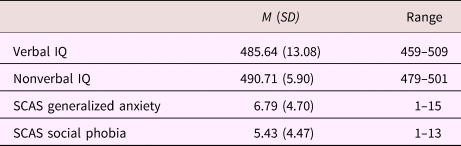
The WJ-III COG provides an estimate of verbal IQ, nonverbal IQ, and full-scale IQ. Raw scores on the WJ-III COG can be converted into W scores (centered on a value of 500), the initial metric for all derived scores available for the WJ-III COG, as well as standard scores (with population M = 100, SD = 15). It has been noted that W scores are more sensitive to an individual's level of ability and performance on a given task relative to standard scores, due to their equal-interval scale (Jaffe, Reference Jaffe2009). As such, W scores were used to investigate associations between IQ and attentional biases. Estimates of verbal and nonverbal IQ are shown in Table 2.
Descriptive statistics for WS group—IQ and anxiety

Note: Verbal and nonverbal IQ reported as W scores, an equal-interval scale centered on a value of 500.
The Spence Children's Anxiety Scale (SCAS; Spence, Reference Spence1998)
The SCAS was administered to parents of WS individuals (Nauta et al., Reference Nauta, Scholing, Rapee, Abbott, Spence and Waters2004; Spence, Reference Spence1998). Previous studies have successfully used this scale with children, adolescents, and adults with WS (Dodd, Schniering, & Porter, Reference Dodd, Schniering and Porter2009; McGrath et al., Reference McGrath, Oates, Dai, Dodd, Waxler, Clements and Smoller2016). The SCAS contains 38 items in total, with six subscales, evaluating symptoms on differing domains of anxiety (Nauta et al., Reference Nauta, Scholing, Rapee, Abbott, Spence and Waters2004). Following from the findings of McGrath et al. (Reference McGrath, Oates, Dai, Dodd, Waxler, Clements and Smoller2016), we looked solely at the generalized anxiety (GAD) and social phobia subscales of the SCAS. These data are displayed in Table 2.
Biographical learning task
The current study adapted a biographical face learning paradigm developed by Charmet-Mougey et al. (Reference Charmet-Mougey, Rich and Williams2012). The initial paradigm was developed to explore the effect of semantic information on perceptual stimuli and required participants to memorize salient biographical vignettes paired with neutral faces. The vignettes described the faces as benevolent, neutral, or malevolent characters. A key caveat to the original paradigm was its relative complexity, as the task required requisite skills in memory that are compromised in WS, and are not mature or fully developed in neurotypical children.
In line with the original paradigm, 24 faces were used to present biographical information; however, two key modifications were made to account for the compromised and underdeveloped memory skills in our populations of interest. The modified paradigm presented 3 biographical vignettes, as opposed to the 24 vignettes in the original paradigm. Images from 24 different actors (12 male, 12 female) displaying neutral expressions were taken from the NimStim standardized face set (Tottenham et al., Reference Tottenham, Tanaka, Leon, McCarry, Nurse, Hare and Nelson2009). The 24 faces were divided into three blocks: trustworthy characters, where the characters were described as trustworthy or “good”; neutral characters, where the characters were described as neutral, or “neither good nor bad”; and untrustworthy characters, where the characters were described as untrustworthy or “bad.” For the full content of these vignettes, see Appendix A.
There were four male and four female faces in each block, and the character types corresponding to each block were counterbalanced across participants to control for any biases in responding. The modified version of the biographical learning task presented each block of faces with a color tint during the training phase to facilitate learning. When learning which character types the neutral faces belonged to, each block was tinted blue, purple, or orange, using LunaPic online picture editing software (www.lunapic.com). These colors were selected as they were considered to be relatively neutral and unlikely to be implicitly associated with emotionally salient information. The color tints corresponding to character types were counterbalanced across participants. Once participants were able to correctly label the character type of each face at an accuracy level of at least 80%, the dot-probe and character recognition tasks were conducted using the faces in grayscale. Participants typically required two to six learning trials in order to achieve this level of accuracy. Based on our qualitative observations during the biographical face learning task, while the CA control group tended to learn which faces belonged to each character type more quickly than both the WS and MA control groups, the WS group experienced fewer difficulties when learning biographical faces compared to the MA control group.
Dot probe task
The dot-probe task used in the current study was adapted from prior tasks used with WS individuals (Dodd & Porter, Reference Dodd and Porter2010) and involved the simultaneous presentation of a biographically neutral stimulus and a biographically salient stimulus (trustworthy or untrustworthy), followed by the presentation of a probe in the same location as either the neutral or the salient stimulus, which participants were instructed to respond to as quickly as possible. Both within-subject and between-subject attention biases were investigated. A within-subject bias is reported when responses to the probe are significantly faster following a salient stimulus (congruent trial) as opposed to a neutral stimulus (incongruent trial). When significant differences in the size of the bias (congruent trials–incongruent trials) are found between multiple groups, a between-subject bias is reported. While the utility and interpretability of the dot-probe task has been somewhat disputed (Waechter et al., Reference Waechter, Nelson, Wright, Hyatt and Oakman2013), this task has provided valuable insight into the link between mechanisms of attention and observable social behaviors in WS (Dodd & Porter, Reference Dodd and Porter2010; Goldman et al., Reference Goldman, Shulman, Bar-Haim, Abend and Burack2017).
In line with Dodd and Porter (Reference Dodd and Porter2010), the dot-probe task in the current study included a total of 288 experimental trials divided into 12 blocks, each composed of 24 trials. There were 16 critical trials incorporated in each block: 8 in which a trustworthy character was presented side by side with a neutral character and 8 in which an untrustworthy character was presented side by side with a neutral character. In addition to the critical trials, each block also included 8 neutral trials, with two neutral characters being presented side by side, to provide a baseline for participants’ reaction time (RT) when the character manipulation was not presented. Further, the inclusion of a neutral condition allowed us to distinguish between attentional capture and disengage effects. A significant different between neutral trials and congruent trials would represent a capture effect, suggesting that the salient biographical stimulus is capturing the attention of the participant. In contrast, a significant difference between neutral and incongruent trials would represent a disengagement effect, suggesting that participants are experiencing difficulties disengaging their attention from the salient biographical stimulus to respond to the probe in another location. Character manipulation (trustworthy/untrustworthy), character position (left/right), and probe position (left/right) were ordered such that each block included 4 trustworthy-congruent trials, 4 trustworthy-incongruent trials, 4 untrustworthy-congruent trials, and 4 untrustworthy-incongruent trials. Trials were randomized within blocks for each participant. The position of the character manipulation and probe were counterbalanced within conditions. The position of the probe throughout the 8 neutral trials was also counterbalanced. The dot-probe task was programmed using DMDX (Forster & Forster, Reference Forster and Forster2003) and presented on a Samsung 27-inch LED monitor.
Procedure
The study was approved by the Macquarie University Human Research Ethics Committee. Informed consent was obtained from the participants or their parents/caregivers, as appropriate. WS and MA-matched controls were provided with an explanation of the study that was commensurate with their level of understanding and were asked if they would like to participate. Participants were tested in a quiet room at Macquarie University. Participants sat approximately 60 cm away from the computer screen. The cognitive assessment and biographical learning task took approximately 90 min to complete. Following this, participants completed the dot-probe and character recognition tasks, which took approximately 25 min to complete. Breaks were provided throughout the session as necessary. A probe-detection task was chosen over a probe-classification task (where participants are required to classify the type of probe from two options rather than simply detecting the probe), to keep the attention task as simple as possible.
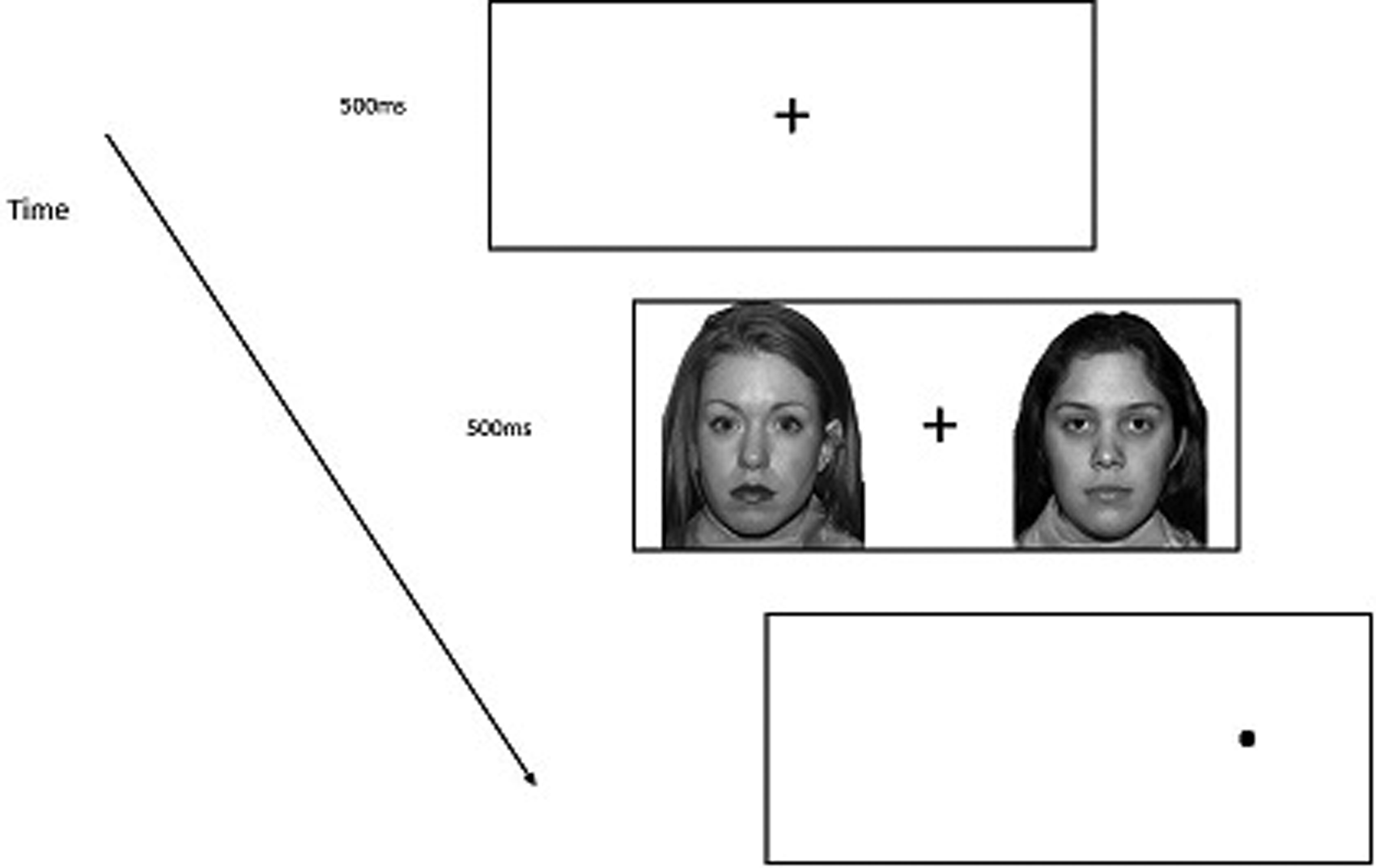
The procedure for the dot-probe task was based on that used in previous studies with WS individuals (Dodd & Porter, Reference Dodd and Porter2010). Each trial began with a black fixation cross in the center of a white background for 500 ms followed by presentation of the two images on the left and right sides of the fixation cross for 500 ms. The inner edge of each image was 1.6 cm away from the fixation cross and each image was 13.44 cm (506 pixels) wide by 16.35 cm (618 pixels) high with a visual angle of 12.78 degrees. The two images were followed immediately by a probe presented in the center of the space occupied by one of the two previous images. The probe was a black dot measuring 0.4 cm, and was presented 4.4 cm away from the fixation cross. The sequence of events on a trial is described in Figure 1. Participants were provided with a parallel input/output interface with custom button box, which had a center button, a button on the left, and a button on the right, and were told to press the button that corresponded to the side the probe was on as quickly as possible. The probe remained on the screen until a response had been made, or until 10 s had passed. Participants’ response to the probe, or the timeout of the probe was followed by a 100-tick (approximately 1672 ms) intertrial interval. The experiment ran through blocks continuously. Participants were told that they could take a break at the end of each block and were instructed to press the center button of the button box when they were ready to continue. The fixation cross remained on the screen throughout each block. Six practice trials were completed at the start of the experiment, and participants were given an opportunity to ask any questions before the experimental trials began. Accuracy and RT data were recorded for all trials.
Sequence of events in dot-probe task.

Character recognition task
To ensure that participants were able to correctly match the faces presented during the dot-probe task with the biographical information taught at the beginning of the session, they completed a task following the dot-probe task where they were asked to match each face with its corresponding character type. This task also allowed for identification of any group differences in character recognition ability. In the character recognition task, all 24 faces were presented for 500 ms, and participants were instructed to identify (from a list of written options) each face as trustworthy, neutral, or untrustworthy, based on the biographical information they had been taught about each character. To ensure that WS and MA participants were able to identify each face to the best of their ability, participants were provided with written options of “good,” “neither good nor bad,” and “bad” in addition to the options of trustworthy, neutral, and untrustworthy, to match the written descriptors provided when learning about the characters. Each trial was manually initiated by the experimenter. The character recognition task was always completed immediately after the dot-probe task to control for the possibility that it may affect attention allocation. The order of images was randomized across participants. Participants received a score out of eight (converted to a percentage) for each of the three categories used in the dot-probe task (trustworthy, neutral, and untrustworthy).
Results
Character recognition task
The character recognition task was conducted to check that participants were able to match each of the faces with the correct biographical information. Although not entirely necessary, as the dot-probe is an implicit task, we looked at character type recognition ability for comprehensiveness and also to determine whether the biographical information paired with each face stimulus was retained explicitly following the learning task. In addition, as this paradigm has only been used in neurotypical adults to date, the character recognition task was deemed important to determine how WS individuals compared to neurotypical controls matched on chronological or mental age.
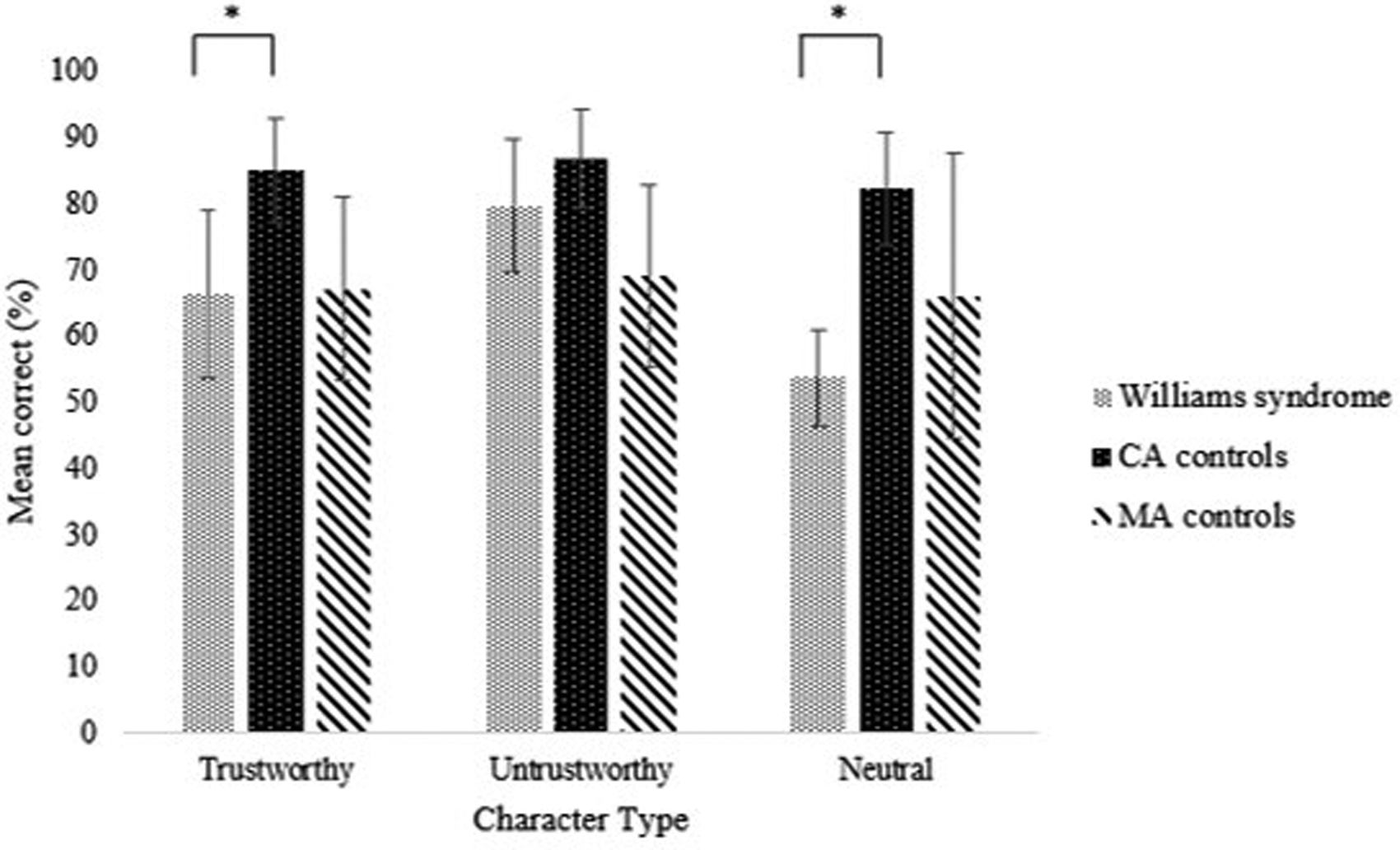
The average percentage of faces correctly identified for each character type are displayed separately for each group in Figure 2. Performance was significantly above chance level (33.33%) for all stimuli (p < .0001), with the exception of the WS group when identifying neutral characters (p = .060). A repeated-measures analysis of variance was conducted with character type (trustworthy, untrustworthy, and neutral) as a within-subject factor and group (WS, CA, and MA) as a between-subject factor. The results indicated a significant main effect of group, F (2, 39) = 5.230, p = .010, partial η2 = .211, and a significant main effect of character type recognition ability, F (2, 39) = 5.230, p = .048, partial η2 = .075, but no significant Group × Character Type interaction, F (2, 39) = 1.430, p = .232, partial η2 = .068. Follow-up analyses were conducted between and within groups to explore these main effects. For all following analyses, the Bonferroni correction for multiple comparisons was applied where appropriate. P values that were statistically significant at p < .05 but failed to reach significance at the corrected p value are described as marginally significant. Cohen's d effect size estimates are reported for each pairwise comparison.
Mean percentage correct on character recognition task for Williams syndrome group, chronological-age matched control group, and mental-aged matched control group. Error bars represent ±2 SEM.

T tests were conducted to determine whether character type recognition ability differed significantly between groups. An adjusted p value of .025 (.05/2) was used to indicate statistical significance. Compared to CA-matched controls, WS participants were significantly less accurate at identifying trustworthy characters, t (21.767) = 2.526, p = .019 (d = 0.95), and neutral characters, t (17.681) = 2.653, p = .016 (d = 1.01), but not untrustworthy characters, t (26) = 1.128, p = .269 (d = 0.43). Compared to MA-matched controls, WS participants displayed no significant difference in their ability to identify trustworthy (p = .924), untrustworthy (p = .219), or neutral characters (p = .309). To ensure any trustworthy bias observed in the WS group was not reflective of their impaired recognition of these characters relative to CA-matched controls, we ran the main analyses both with and without trustworthy character recognition ability as a covariate. No differences in results were observed; therefore, all further results are presented without the inclusion of this covariate.
T tests were conducted to examine within-group differences in character type recognition ability. An adjusted p value of .017 (.05/3) was used to indicate statistical significance. The WS group displayed lower accuracy when identifying trustworthy characters compared to untrustworthy characters, t (13) = –2.323, p = .037 (d = 0.63), and neutral characters compared to untrustworthy characters, t (13) = 2.548, p = .024 (d = 0.89); however, these effects were only marginally significant. The WS group showed no significant difference in their ability to identify trustworthy characters and neutral characters, t (13) = 1.789, p = .097 (d = 0.40). No significant differences in character type recognition ability were observed in the CA or MA controls (p > .2).
Given that performance on the character recognition task was significantly lower in the WS group relative to the CA control group for trustworthy and neutral characters, Pearson correlation coefficients were used to investigate the relationship between accuracy rates for trustworthy and neutral characters, chronological age, verbal IQ, and nonverbal IQ within the WS group. Within WS individuals, accuracy rates for trustworthy characters were not significantly related to chronological age (r = .325, p = .257), verbal IQ (r = .270, p = .351), or nonverbal IQ (r = –.022, p = .940). Similarly, accuracy rates for neutral characters were not significantly related to chronological age (r = –.024, p = .936), verbal IQ (r = .097, p =.742), or nonverbal IQ (r = –.023, p =.937), within the WS group.
Data preparation: Dot-probe task
Following previous studies (e.g., see Dodd & Porter, Reference Dodd and Porter2010), trials with timing errors (trials with RTs of <200 ms or >3000 ms) and incorrect trials were removed, and a mean and standard deviation were calculated for each participant. Further, in accordance with previous work (e.g., see McGrath et al., Reference McGrath, Oates, Dai, Dodd, Waxler, Clements and Smoller2016) RTs more than 2 SD above each participant's mean were removed. The percentage of trials removed due to timing errors and incorrect responses were 4.24% (WS group), 2.93% (CA group), and 8.83% (MA group), while the percentage of trials removed due to RTs more than 2 SD above each participant's mean were 2.88% (WS group), 5.78% (CA group), and 3.22% (MA group). The WS group did not differ from the CA group in the overall amount of RT data removed, t (13) = –0.683, p = .506, nor did they differ from the MA group, t (13) = –1.744, p = .105.
Dot-probe task
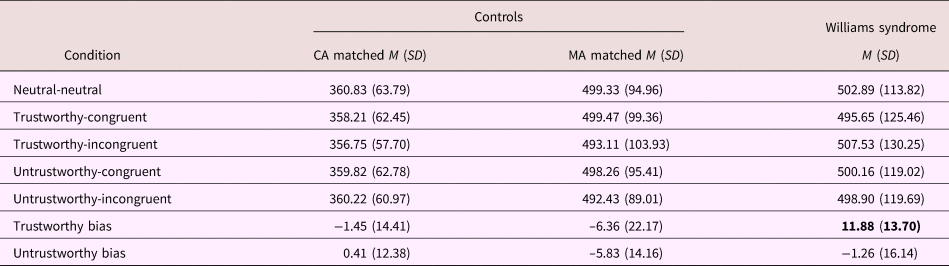
Table 3 shows the mean and standard deviation of RTs for each group (WS, CA, or MA) on neutral, trustworthy-congruent, trustworthy-incongruent, untrustworthy-congruent, and untrustworthy-incongruent trials. A congruent trial was identified as one in which the probe was located in the same position as the biographically salient stimuli (e.g., trustworthy or untrustworthy character), and an incongruent trial was identified as one in which the probe was located in the same position as the neutral stimuli. The mean and standard deviation for trustworthy and untrustworthy biases are also shown in Table 3. Trustworthy biases were calculated by subtracting the RTs for congruent trials from incongruent trials for trustworthy characters, and untrustworthy biases were calculated by subtracting the RTs for congruent trials from incongruent trials for untrustworthy characters. A positive score indicates a faster RT for congruent trials, suggesting a positive bias for those characters, while a negative score indicates a faster RT for incongruent trials, suggesting a negative bias for those characters.
Mean (standard deviation) of reaction times (ms) across groups on the dot-probe task

Note: Bold values indicate significant bias between and within groups.
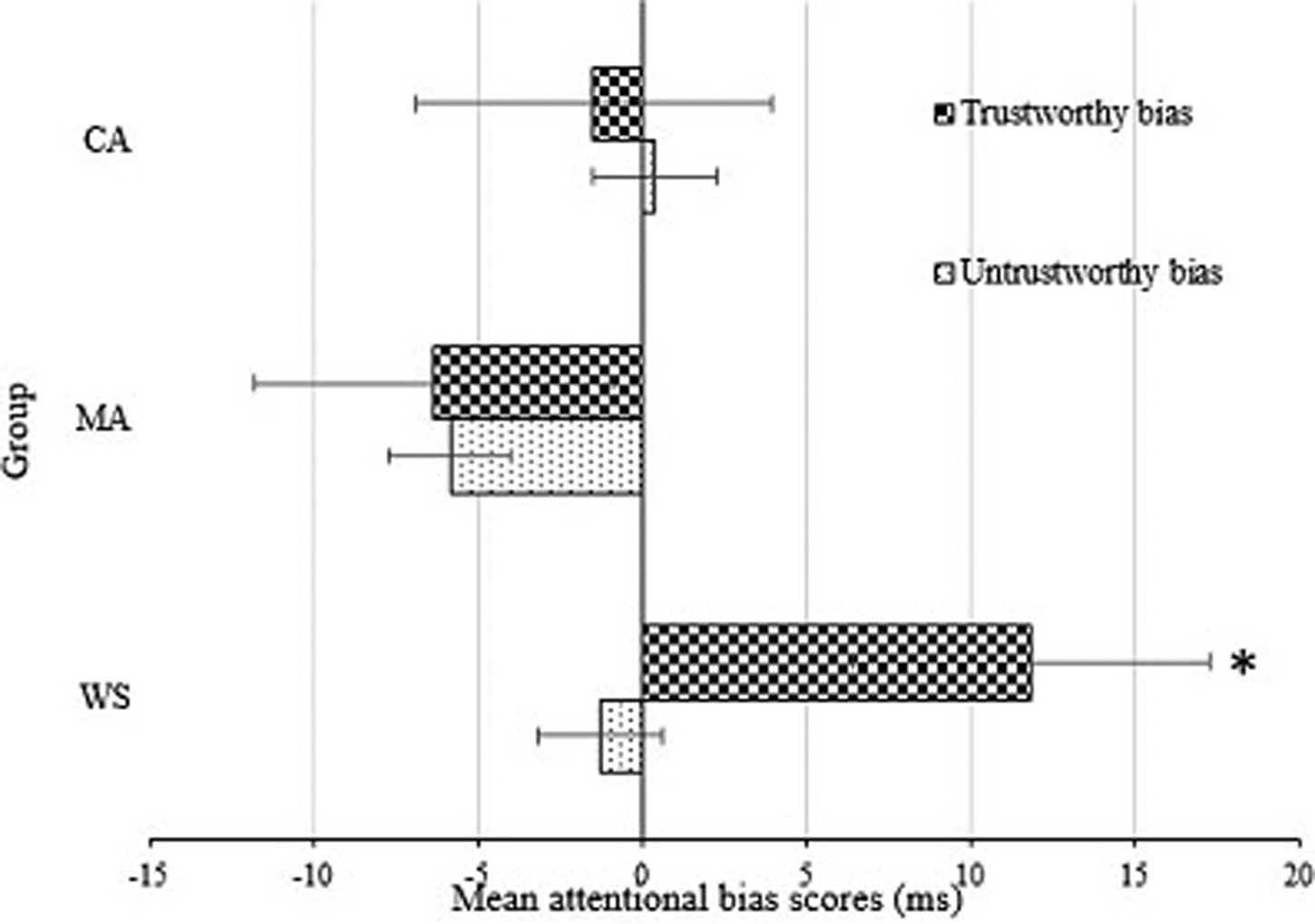
Univariate analyses of variance were used to compare groups on mean bias scores. The mean RT for all trials was entered into analyses as a covariate due to a significant group difference on overall RT, F (2, 39) = 9.901, p < .0001, with the CA group displaying faster RTs compared to the WS (p = .001) and MA (p < .001) groups. No significant differences in overall RT were observed in the WS and MA groups (p = .914). Similarly, mental age was entered into analyses as a covariate, due to a significant negative relationship between overall trustworthy bias and mental age in the WS group only (r = –.643, p = .013). No significant effects of mental or chronological age on bias scores were found in either control group (p > .1). Likewise, no significant effects of gender on bias scores were found for the entire sample or for any group in isolation (p > .1). For the sample as a whole and each group in isolation, no significant correlations between trustworthy or untrustworthy bias scores and character type recognition ability were found (p > .1). Overall bias scores for each group are displayed in Figure 3.
Demonstration of significant attention bias to trustworthy characters in Williams syndrome group. Error bars represent ±2 SEM. *Indicates between- and within-group significance at the p < .05 level.

Untrustworthy bias
When the mean attention bias scores for untrustworthy characters were compared between the WS, CA, and MA groups, no difference was observed, F (2, 37) = 0.695, p = .505, partial η2 = .036. One sample t tests indicated that the untrustworthy bias did not differ from zero for the participants in the WS group (M = –1.26 ms), t (13) = –0.293, p = .774, those in the CA group (M = 0.41 ms), t (13) = 0.123, p = .904, or those in the MA group (M = –5.83 ms), t (13) = –1.541, p = .147. Further, there was no evidence of a bias either toward or away from untrustworthy characters for any group, χ2 (2) = 0.571, p = .751.
Trustworthy bias
A comparison of the WS, CA, and MA groups revealed a significant difference in mean attention bias toward trustworthy characters, F (2, 37) = 4.080, p = .025, partial η2 = 0.181. Post hoc pairwise comparisons were conducted to compare the WS group to both control groups on bias toward trustworthy characters. An adjusted p value of .025 (.05/2) was used to indicate statistical significance. Results indicated that WS participants displayed a significantly greater bias toward trustworthy characters compared to both CA, t (26) = –2.509, p = .019 (d = 0.95), and MA controls, t (26) = –2.618, p = .015 (d = 0.99). One-sample t tests suggested that the trustworthy bias for the WS group (M = 11.88 ms) differed significantly from zero, t (13) = 3.245, p = .006, indicating that WS individuals displayed a clear attention preference for trustworthy characters. The avoidance bias for trustworthy characters observed in both the CA (M = –1.45 ms) and MA (M = –6.36 ms) groups did not differ from zero (p > .303), indicating a lack of attentional avoidance for trustworthy characters in both control groups. In addition, comparing the number of participants in each group who displayed a bias toward or away from trustworthy characters revealed that only 3 of the 14 participants in the WS group exhibited a bias away from trustworthy faces, whereas 8 participants within the CA group and 9 participants within the MA group displayed this bias, χ2 (2) = 5.918, p = .052.
Trustworthy bias: Relationship with IQ
To explore whether the bias for trustworthy characters in the WS group was related to IQ, Pearson correlation coefficients were calculated. Following McGrath et al. (Reference McGrath, Oates, Dai, Dodd, Waxler, Clements and Smoller2016), we looked at verbal and nonverbal IQ separately. Following inspection of the scatterplots, data for one WS participant was removed, as they appeared to be an outlier with respect to verbal IQ, displaying substantially increased scores relative to the rest of the WS sample. See Appendix B for the graphical display of this relationship, both before and after removal of this participant. Following removal of this outlier, a moderate, marginally significant relationship between overall trustworthy bias and verbal IQ was observed, r = –.531, p = .062, indicating that a larger bias for trustworthy characters was associated with lower verbal ability. This pattern was not observed for nonverbal IQ, with no apparent relationship between overall trustworthy bias and nonverbal IQ, r = –.242, p = .425.
Trustworthy bias: Relationship with anxiety
To explore whether the bias for trustworthy characters in the WS group was related to anxiety levels, as measured by scores on the GAD and social phobia subscales of the SCAS, Pearson correlation coefficients were calculated. No significant correlations between trustworthy bias scores and either GAD (r = .150, p = .609) or social phobia (r = –.001, p = .998) scores were found, indicating that there was no relationship between the trustworthy bias and anxiety symptoms in this WS sample.
Trustworthy bias: Capture versus disengage effects
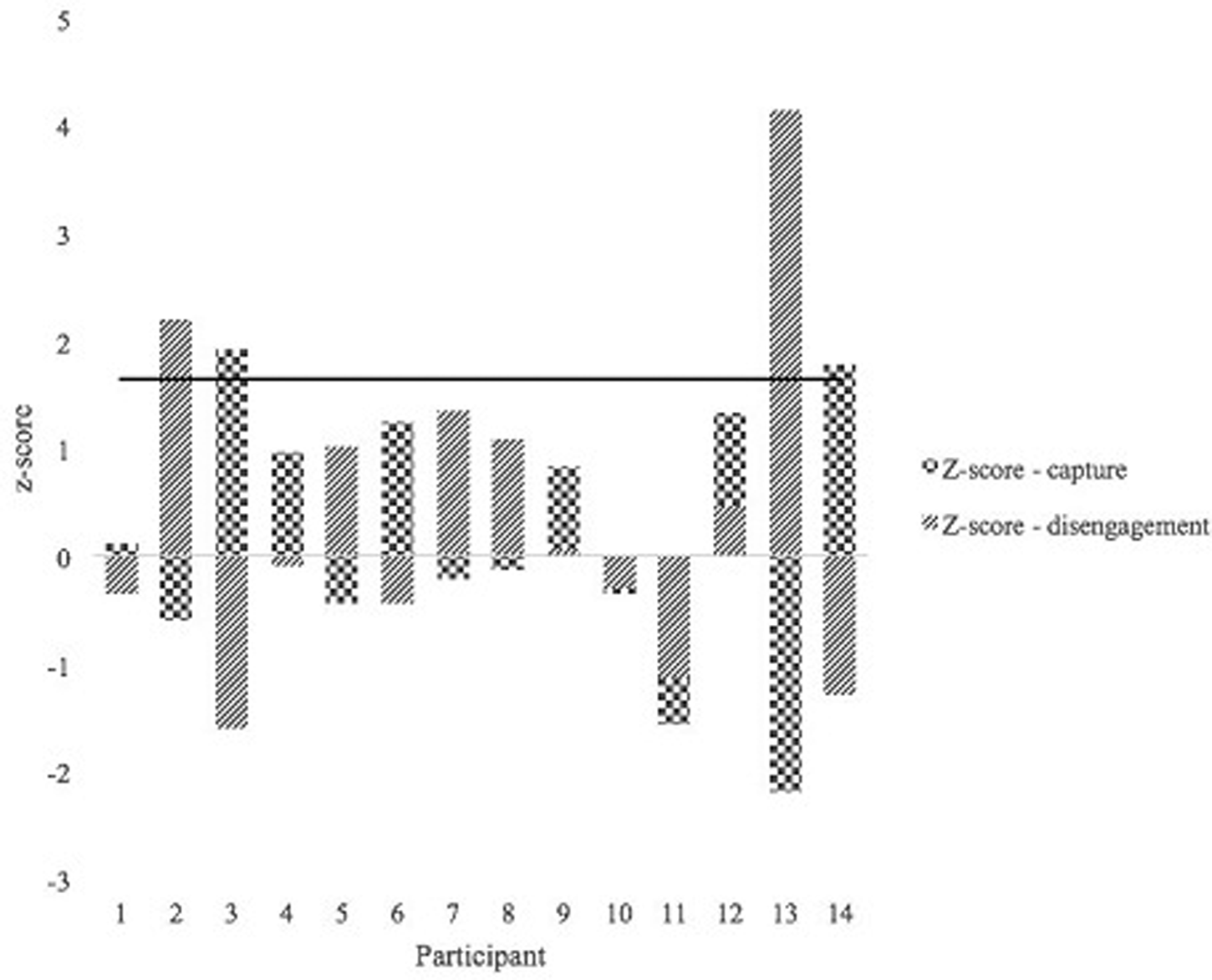
These findings suggest an attention bias toward trustworthy characters in the WS group. Following Dodd and Porter (Reference Dodd and Porter2010), further t tests were conducted to explore whether this bias was due to attention capture or attention disengagement by comparing the neutral condition with the congruent and incongruent conditions. A significant difference between RTs on neutral trials and congruent trials indicates a capture effect, suggesting that the trustworthy character is capturing attention. In contrast, a significant difference between RTs on neutral trials and incongruent trials indicates a disengagement effect, suggesting difficulties in disengaging attention from the trustworthy character to respond to a probe in a different location. This analysis revealed a mean score of 7.24 ms (SD = 19.00) for attention capture and a mean score of –4.64 ms (SD = 21.76) for attention disengagement. One sample t tests indicated that the capture score did not differ from zero, t (13) = 1.426, p = .177, nor did the disengagement score, t (13) = –0.798, p = .439. To examine whether there was any evidence of capture or disengagement effects in the typically developing control groups, these analyses were conducted for the MA and CA groups independently. None of the scores differed significantly from zero (p > .189).
To investigate within-syndrome variability in the trustworthy bias, z scores were computed for the capture and disengagement raw scores. We were interested in the degree to which WS individuals displayed capture or disengage effects relative to the overall control sample. Raw scores from both control groups were pooled to calculate a population mean and standard deviation, which were then used to calculate individual capture and disengagement z scores for the WS group. This calculation was similar to that performed by Krishnan, Bergstrom, Alcock, Dick, and Karmiloff-Smith (Reference Krishnan, Bergstrom, Alcock, Dick and Karmiloff-Smith2015). A z score of ≥1.645 represented a substantial effect of either attentional capture or disengagement for a WS individual. The cutoff of 1.645 was chosen as it corresponds to a one-tailed α level of .05. This was deemed suitable, as we were only looking at positive z scores (i.e., indicating that WS individuals were displaying larger effects relative to controls). Capture and disengagement z scores for each WS participant are displayed in Figure 4. Results indicated capture effects for two WS individuals (14% of WS sample), with z scores of 1.92 and 1.78, respectively, indicating that trustworthy characters were capturing the attention of these individuals. Disengagement effects were observed for two WS individuals (14% of WS sample), with z scores of 2.19 and 4.14, respectively, suggesting difficulties in disengaging attention from trustworthy characters in these individuals. There was no overlap in these scores, indicating a pattern of attention allocation that was specific to individuals. Exploring these effects at the individual level indicates that 28% of the WS sample in this study displayed abnormalities in attention allocation for trustworthy characters, relative to both CA- and MA-matched controls. This individual variability may explain the lack of evidence observed for either capture or disengage effects at the group level.
Capture and disengagement z scores in Williams syndrome individuals.

Trustworthy capture and disengagement effects: Relationship with anxiety and IQ
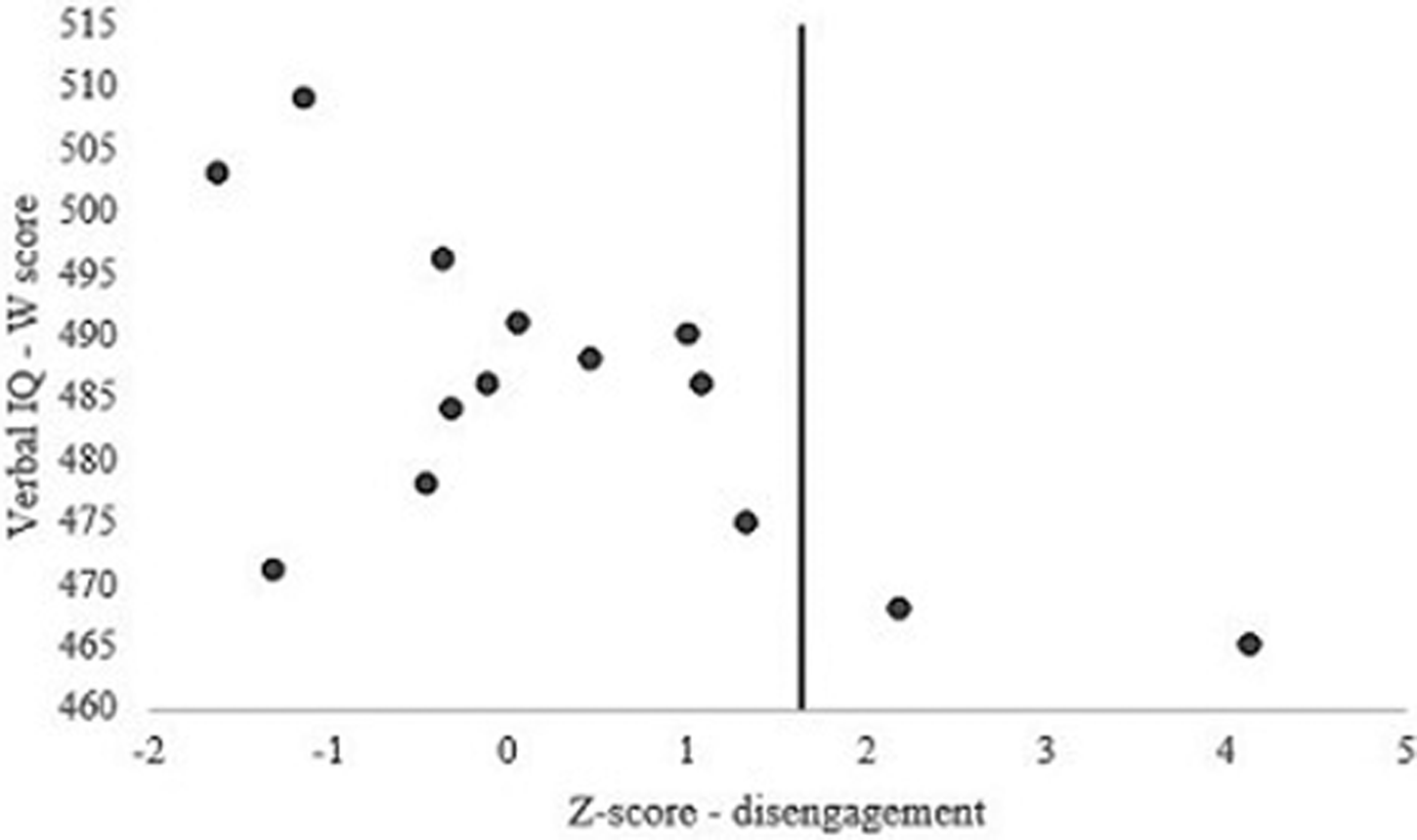
In addition to exploring individual differences in capture and disengagement effects for trustworthy characters within the WS group, we were also interested in whether individuals who displayed strong capture or disengagement effects (denoted by a z score ≥ 1.645) exhibited individual differences in their anxiety or IQ profile, relative to the rest of the WS group. Given the small number of WS individuals who displayed capture or disengagement effects, we limited these results to a visual inspection of the scatterplots.
Following visual inspection of the scatterplots, there was no apparent relationship between strong capture or disengagement effects and social phobia symptoms or GAD symptoms. While we found no evidence of a relationship between capture effects and verbal IQ, the WS individuals who demonstrated disengagement effects also displayed a lower verbal IQ, relative to the remainder of the WS cohort (see Figure 5). There was no apparent relationship between strong capture or disengagement effect and nonverbal IQ.
Relationship between disengagement effects and verbal IQ in Williams syndrome individuals. Reference line is set at 1.645.

Discussion
The present study investigated allocation of attention to perceptually neutral faces that had been paired with positive (trustworthy) or negative (untrustworthy) biographical information in individuals with WS, as well as CA- and MA-matched neurotypical controls. As predicted, a within-group attention bias for trustworthy characters was observed in the WS group, but not in either control group. In addition, in line with our hypothesis, compared to both control groups, the WS individuals displayed a specific attention bias toward trustworthy characters, on average. These findings were supported by large effect size estimates. As predicted, there was no evidence of a within-group attention bias for untrustworthy characters in any of the groups, nor was there evidence for a between-group bias for untrustworthy characters.
The finding of a significant trustworthy bias in the WS group is consistent with prior accounts of a bias toward positive (happy) faces in WS individuals when using a dot-probe task, compared to CA- and MA-matched neurotypical controls (Dodd & Porter, Reference Dodd and Porter2010). However, when considering the mechanisms underlying this bias, our findings did not suggest that the WS group on the whole experienced difficulties disengaging attention from trustworthy characters. This finding does not align with the argument presented by Riby et al. (Reference Riby, Jones, Brown, Robinson, Langton, Bruce and Riby2011) where it was suggested that WS individuals experience difficulty in shifting their attention away from faces, rather than faces capturing the attention of these individuals. Exploring the mechanisms driving the trustworthy bias at the individual level revealed some evidence of within-syndrome heterogeneity. While some WS individuals experienced difficulties disengaging attention from trustworthy characters, as originally anticipated, others appeared to show the opposite effect, with the trustworthy characters capturing the attention of those WS individuals.
Following from the recent findings of McGrath et al. (Reference McGrath, Oates, Dai, Dodd, Waxler, Clements and Smoller2016), where a positive attention bias was mediated by anxiety and level of IQ in a large cohort of WS individuals, a secondary aim of this study was to investigate the relationship between the trustworthy bias, IQ, and anxiety in the WS group. Given the small sample size, caution is required when interpreting these results. However, despite the small sample size, it should be noted that the verbal IQ, nonverbal IQ, and anxiety results reported here are largely consistent with previous findings. Verbal IQ scores were within the mild to moderate impairment range, and while the nonverbal IQ results reported here may appear higher than one would expect given the general WS cognitive profile, this is likely due to the absence of a construction component in the subtest used to attain an estimate of nonverbal IQ. Performance on the equivalent version of this subtest in the WJ-III COG has been found to be a cognitive strength in some WS individuals (Porter & Coltheart, Reference Porter and Coltheart2005). Similarly, anxiety scores in this study are largely consistent with previous research on anxiety in WS where the SCAS has been used (Dodd et al., Reference Dodd, Schniering and Porter2009; McGrath et al., Reference McGrath, Oates, Dai, Dodd, Waxler, Clements and Smoller2016), with WS individuals displaying higher scores on the GAD subscale relative to the social phobia subscale, suggesting a representative WS sample in terms of anxiety.
While we found evidence of a moderate, negative relationship between trustworthy bias and verbal IQ, such that WS individuals who displayed a larger trustworthy bias tended to also have a lower verbal IQ, no associations were observed between trustworthy bias and nonverbal IQ or anxiety symptoms. It is possible that the lack of a relationship between trustworthy bias and nonverbal IQ in the current study may be explained by the task used to assess nonverbal IQ. Where McGrath et al. (Reference McGrath, Oates, Dai, Dodd, Waxler, Clements and Smoller2016) used a task of nonverbal reasoning to measure nonverbal IQ, a matrices subtest from the Kaufman Brief Intelligence Test—Second Edition (Kaufman & Kaufman, Reference Kaufman and Kaufman2004), the nonverbal task used in the current study measured visual–spatial thinking. It may be that higher order (executive functioning) abilities are related to the attention bias for positive social stimuli in WS, rather than purely visual–spatial skills.
Moreover, strong capture and disengagement effects were found to be differentially related to verbal IQ. While no relationship between attention capture and verbal IQ was observed, these preliminary results suggest that there may be a link between difficulties disengaging attention from positive social stimuli and verbal IQ, with the WS individuals who displayed strong disengagement effects also displaying lower verbal IQ, relative to the rest of the WS cohort. Given the small number of WS individuals who displayed large capture or disengagement effects (28% of WS sample), no formal statistical analyses were conducted on this data, with relationships inferred following visual inspection of scatterplots. Overall, these findings align with those of McGrath et al. (Reference McGrath, Oates, Dai, Dodd, Waxler, Clements and Smoller2016), suggesting that the attention bias for positive faces is related, in some capacity, to intellectual ability. Given these preliminary findings, and their concordance with McGrath et al. (Reference McGrath, Oates, Dai, Dodd, Waxler, Clements and Smoller2016), further investigation of attention patterns to positive social stimuli in WS, with an emphasis on individual differences in attention capture and disengagement, and their relationship to IQ and anxiety in a larger sample of WS individuals is warranted.
While findings from the character recognition task suggest that WS individuals were less accurate at identifying trustworthy and neutral characters relative to CA-matched neurotypical controls, it is worthwhile noting that these responses do not correspond to accuracy rates during the biographical face learning task, where all WS participants were able to identify biographical faces at a level of at least 80% accuracy. A possible explanation for this finding may lie in the attentional demands of the character recognition task. During this task faces were only presented for 500 ms, to match the presentation duration of stimuli during the dot-probe task. Although no inattention was observed in WS individuals during this task, it was completed immediately after the dot-probe task, and as such, it is possible that this finding reflects attention difficulties within the WS group, rather than impairments in learning the biographical faces. However, a more likely possibility is the rapid presentation of stimuli, which would be difficult for the WS individuals to process given their slower processing speed and intellectual disability.
Overall, the current findings are consistent with previous results using positive social-perceptual stimuli (Dodd & Porter, Reference Dodd and Porter2010; Goldman et al., Reference Goldman, Shulman, Bar-Haim, Abend and Burack2017), indicating that the positive bias in WS is more pervasive than initially thought, and continues to operate when top-down processing is used. Taken in conjunction with the findings of Godbee and Porter (Reference Godbee and Porter2013), these results provide evidence for the presence of a top-down positive bias in WS, as well as the bottom-up positive bias that has been found using perceptual stimuli. Godbee and Porter (Reference Godbee and Porter2013) explored the extent to which WS individuals made negative attributions of intention when presented with ambiguous social scenarios. Comparing WS individuals to typically developing controls matched on either chronological age or developmental age, the authors found that WS individuals were less likely to attribute negative intentions to these scenarios when compared to their same-age peers. Taken together, these findings suggest that the positive bias in WS appears to apply to face stimuli that are paired with positive biographical information, despite being perceptually neutral, in addition to social scenarios that are ambiguous and could be interpreted in a number of ways. This positive bias could be instrumental in the development of the hypersociability seen in WS, and could help explain their atypical daily social behaviors. These findings also suggest that both bottom-up and top-down processes may be at play in the development of the WS social phenotype.
It is plausible that the attention bias for trustworthy characters displayed by WS individuals is a consequence of neurological dysfunction. To date, one study has used this biographical learning paradigm when looking at amygdala reactivity to faces in neurotypical adults (Charmet-Mougey et al., Reference Charmet-Mougey, Rich and Williams2012). The authors found that the biographical knowledge associated with the faces influenced amygdala reactivity, suggesting that the amygdala may be affected by emotional memory in neurotypical adults. While brain activity was not recorded in the current study, these results do show similarities with prior neuroimaging findings, where atypical amygdala and frontal reactivity has been observed in response to positive social-perceptual faces (Haas et al., Reference Haas, Mills, Yam, Hoeft, Bellugi and Reiss2009; Meyer-Lindenberg et al., Reference Meyer-Lindenberg, Hariri, Munoz, Mervis, Mattay, Morris and Berman2005). Commenting on the role of the central nucleus of the amygdala in attention processing, Haas et al. (Reference Haas, Mills, Yam, Hoeft, Bellugi and Reiss2009) suggested that the increased reactivity in this region in WS individuals might represent a neural substrate for the increased attention to social stimuli. Likewise, given the evidence of abnormal frontal lobe reactivity in response to social stimuli (Mimura et al., Reference Mimura, Hoeft, Kato, Kobayashi, Sheau, Piggot and Reiss2010), recent research has proposed that this area represents an additional neurological substrate of the WS social phenotype (Little et al., Reference Little, Riby, Janes, Clark, Fleck and Rodgers2013). Given previous findings that support a positive attention bias in WS when social-perceptual stimuli are used and bottom-up processing is employed (Dodd & Porter, Reference Dodd and Porter2010; Goldman et al., Reference Goldman, Shulman, Bar-Haim, Abend and Burack2017), coupled with the current findings suggesting that this positive attention bias continues to occur when stimuli are biographically salient and top-down processing is used, it is plausible that both amygdala and frontal lobe dysfunction have cascading effects on attention allocation, consequently contributing to the social phenotype of WS.
Limitations and future directions
While these results provide evidence that the attention bias for positive social stimuli in WS extends beyond social-perceptual stimuli, certain limitations must be addressed. Although the WS sample recruited for the current study is equivalent in size to other studies in this area (e.g., see Dodd & Porter, Reference Dodd and Porter2010; Goldman et al., Reference Goldman, Shulman, Bar-Haim, Abend and Burack2017), it is still a relatively small sample, and did not allow for a comprehensive investigation of within-syndrome heterogeneity, as seen in McGrath et al. (Reference McGrath, Oates, Dai, Dodd, Waxler, Clements and Smoller2016). Administering the dot-probe task using the face stimuli developed for this task to a larger number of WS participants would enable us to further investigate how attention to these stimuli may systematically vary as a result of cognitive ability and anxiety symptomatology. A larger sample would also help to delineate the nature of the positive attention bias in this population, and would assist in determining whether this bias is due to positive stimuli capturing the attention of WS individuals, as opposed to difficulties disengaging with positive stimuli, or whether the nature of the bias differs between individuals. However, it is worth noting that even with a smaller sample, large effect sizes were observed (Cohen, Reference Cohen1992), highlighting the practical and clinical significance of the current findings.
Future studies would benefit from an investigation of the neurological and physiological responses to the biographical face stimuli used here, to further our understanding of the WS positive bias. Such research would extend existing findings (Haas et al., Reference Haas, Mills, Yam, Hoeft, Bellugi and Reiss2009; Jarvinen et al., Reference Jarvinen, Ng, Crivelli, Arnold, Woo-VonHoogenstyn and Bellugi2015) and would indicate whether the bias for positive biographical faces reported here at the attentional level is replicated at the neural level, via amygdala and frontal lobe dysfunction, and the physiological level, via a lack of habituation to biographically trustworthy faces. Similarly, future research exploring the attentional processes underlying the WS positive bias would benefit from the simultaneous measurement of eye movements while conducting a dot-probe task. This would allow for a more comprehensive investigation of online attention patterns when looking at social stimuli in WS, and may address some of the criticisms inherent in the dot-probe task (Waechter et al., Reference Waechter, Nelson, Wright, Hyatt and Oakman2013). Our research team is currently using functional magnetic resonance imaging and eye tracking to further explore neurological and attentional responses to these biographical face stimuli in WS individuals.
Future research in this field should utilise cross-syndrome comparisons. Exploring attention patterns using stimuli that are biographically salient, as opposed to perceptually salient, in disorders where increased social approach is typical and where social avoidance is common and an increased vigilance to threat is observed, would provide a valuable insight into the attentional mechanisms employed when processing perceptually neutral, but semantically salient faces. This would also contribute to our understanding of how attention is allocated and modulated in disorders with contrasting social phenotypes.
Practical implications
The current findings have practical implications for the development of interventions for WS individuals. Intense eye gaze toward faces has been observed anecdotally in WS (Mervis et al., Reference Mervis, Morris, Klein-Tasman, Bertrand, Kwitny, Appelbaum and Rice2003). This increased eye gaze can be disconcerting, and may contribute to the social isolation WS individuals experience, as reported by parents and caregivers (Davies, Udwin, & Howlin, Reference Davies, Udwin and Howlin1998). The current findings suggest that some WS individuals experience difficulties when disengaging their attention from faces. For those individuals, intervention programs designed to assist in disengaging attention from faces and eyes may be an effective intervention strategy, and may improve the day-to-day social functioning of WS individuals with attention disengagement difficulties.
Further, the current findings suggest that WS individuals are able to use semantic (top-down) processing when automatically allocating their attention to faces. Future interventions focused on stranger danger training may benefit from teaching WS individuals negative schematic or biographical information about strangers, to help discourage approach behaviors in daily life. When considering stranger danger awareness in WS individuals, Riby et al. (Reference Riby, Kirk, Hanley and Riby2014) found that young individuals with WS displayed a decreased awareness of stranger danger, relative to neurotypical controls matched on developmental age. In addition, the authors reported that WS individuals explicitly stated that they would approach and engage in interactions with strangers (Riby et al., Reference Riby, Kirk, Hanley and Riby2014), highlighting the importance of effective interventions in this area.
Finally, the individual variability observed in the current study highlights the importance of developing individually tailored interventions for use in WS. Given the current findings, alongside previous findings of heterogeneity in attention bias (McGrath et al., Reference McGrath, Oates, Dai, Dodd, Waxler, Clements and Smoller2016), cognitive abilities (Porter & Coltheart, Reference Porter and Coltheart2005), and psychopathology (Porter, Dodd, & Cairns, Reference Porter, Dodd and Cairns2009) in WS, the importance of individually tailored interventions cannot be overemphasized. Such heterogeneity indicates that it is important to obtain each WS individual's social profile prior to an intervention, to better understand individual patterns and to identify the areas to target for optimal treatment. Further, a multidisciplinary approach toward intervention is likely to be of benefit to WS individuals, with an understanding of the cognitive and psychological profile of an individual likely to bolster the effectiveness of treatments for social dysfunction. An individually tailored, multidisciplinary approach toward interventions would enable WS individuals experiencing social difficulties to receive a holistic intervention that is designed to treat their unique pattern of strengths and impairments, thereby maximizing the likelihood of success and overall improvement in their day-to-day social functioning.
Conclusion
The present research provides evidence that the positive attention bias for happy faces seen in WS extends beyond social-perceptual stimuli. The results from this study indicate that WS individuals preferentially allocate their attention toward faces that they have previously learned to associate with positive biographical information, even when the faces are perceptually neutral. This finding suggests that WS individuals are able to learn important information about faces, and show a tendency to apply this information in an implicit attention task, displaying similar biases in attention to those observed when social-perceptual faces are presented. This study provides support for the idea that the positive prosocial bias often seen and commented on in WS is more widespread than previously anticipated, and is not limited to a social-perceptual context. It is argued that both bottom-up (e.g., perception of facial expressions) and top-down (e.g., biographical information) processes drive the atypical positive attention bias in WS.
Supplementary material
The supplementary material for this article can be found at https://doi.org/10.1017/S0954579418001712
Acknowledgments
The authors thank all of the individuals and their families who participated, Dr. Jon Brock for his statistical advice, and Michaela Flynn for her assistance with data collection.
Financial support
This research was funded by Australian Rotary Health and Williams Syndrome Australia Limited.