1. The social relevance of the pianola phenomenon: a brief contextual introduction
The pianolaFootnote 1 was a social, economic and cultural phenomenon that between 1900 and 1930 represented the first great focus of mass diffusion of a musical product. At the very beginning of the century, the pianola rapidly expanded into a global market, with a major impact in the United States and a significant part of Europe. This article deals with two important technologies associated with the pianola phenomenon: the player piano and the reproducing piano. ‘Player piano’ is technically the most appropriate term one can use when referring to the pianola: a piano that contained an interior mechanism designed to make it play in a semi-autonomous manner. Its mechanism was based on a pneumatic system that operated the piano action via a roll of paper with perforations representing the musical code. As each perforation allowed the movement of air into the mechanism, the change in air pressure within the instrument resulted in the hammers being activated automatically. By means of a series of controls found in front of the keyboard, the player piano permitted the user to intervene in such fundamental parameters as the tempo and intensity of the reproduction of the piece. The reproducing piano, on the other hand, was not intended to work this way and was designed to reproduce recordings by the great pianists of the era using the same format (rolls of perforated paper). This difference proved to be decisive in establishing the different marketing strategies associated with the advertising of the instrument.
Although it is often difficult to obtain completely reliable data on the pianola industry, the following information gives an idea of the size of the phenomenon: in 1914, 244,000 pianos and 80,000 pianolas were manufactured in the United States. This figure grew dramatically, and in the space of only two years pianolas represented more than half of annual piano sales (Gaddis Reference Gaddis and Tabbi2002; Ospina Romero Reference Ospina Romero2019). In 1920, 70% of the 364,000 pianos sold were pianolas (Ord-Hume Reference Ord-Hume2004). Despite the fact that sales progressively decreased throughout the 1920s, 1923 saw the manufacture of 170,500 pianolas, 12,600 upright reproducing pianos and 5,300 reproducing grand pianos (Muns Reference Muns2005). Two and a half million pianolas were sold in the United States between 1900 and 1930, while it is believed that over a million were sold in the same period in the UK (Hamer Reference Hamer1984). The average annual volume of sales worldwide between 1900 and 1930 hovers around the 200,000 mark for pianolas and the 5 million mark for rolls. During this period, the pianola industry generated a mean annual profit of 100 million dollars (Dolan Reference Dolan2009). This brief statistical aside confirms the tremendous relevance of the pianola phenomenon, one that went far beyond both the musical and the economic sphere, which depicts it quantitatively.
2. The advertising discourses in the pianola phenomena
Both in the United States and Europe, dissemination of the pianola focused around two main channels: the press – with publicity in the form of adverts, and also gained through articles and concert reviews – and advertising posters. The discourse of the latter tended to take a different slant that often had little to do with that found in the daily press. It is worth bearing in mind that the pianola phenomenon came into being soon after the emergence of a generation of graphic artists that took the concept of the advertising poster to a new level.
Despite the fact that the advertising poster was first used many centuries ago, it is in 19th century France where one can begin to find evidence of a style that would eventually evolve towards the model of graphic advertising that can be seen today. The best techniques in lithographic printing as applied by Jules Chéret (1836–1933) are, without a doubt, a key aspect in the development of a type of advertising with certain defining characteristics. Chéret's style and technique – in 1889 he designed the posters for the inauguration of the Moulin Rouge – was the starting point for an aesthetic explosion that rapidly expanded to other continents, peaking with the Art Nouveau movement (Barnicoat Reference Barnicoat1973). In Chéret's hands, the female form takes on a tremendous erotic charge and the image of the woman – stylised and beautiful – is used as an advertising device. This has often been considered to be a clear indicator of the birth of the modern advertising poster.
The poster began to be seen as an optimal new language to convey messages and ideas in a simple and direct form with persuasive techniques that permit many possible communicative and consequently also ideological nuances. The poster allowed links to be forged with the consumer as a result of specific stimuli that were subject to the social and aesthetic conventions of the times. Many of the posters of this period tend to express the so-called ‘spirit of the turn of the century’ by means of symbolic and allegorical representations. In most of the posters, the idea of modernity – so characteristic of the times – operates implicitly on two different axes: one the one hand, the interaction between the user and the instrument and, on the other hand, the possibility of enjoying the automatic reproduction of music. We can relate these two axes – interpretation and passive listening – directly to the two major existing types of pianola: the player piano and the reproducing piano. Of course, these two concepts do not have to be understood as a dichotomy, because both were in some way present on all models. Even so, the discourse of the advertisements for each type of instrument conceals various sub-plots with meanings that might be interesting to analyse.
It is important to bear in mind that at a time in history when mass communication was taking its first tentative steps, this process of meaning was entirely linked to the medium and format used to communicate the message. As such, as Marshall McLuhan would point out half a century later, the platform used to convey a discourse has a tremendous influence on how a given message is perceived. Approaching the advertising of the pianola from this perspective allows us to identify certain hidden intentions in this commercial discourse at the same time as helping us to better understand the thought process of society during that period, which was the target of said discourse. The marketing strategies of the major players share certain traits, in terms of both graphics and slogans that often communicate above and beyond what is immediately visible at first glance. To reach this level of interpretation, which from an anthropological and ethno-musical perspective we shall place on the so-called ‘dense description’ plane, a simple critical interpretation is not enough. We must resort to a quantitative analysis that allows us to demonstrate these connotations through the recurrence of presented cases.
3. Analytical synthesis of the most common recurring themes in ads studied
In order to conduct the aforementioned analysis, we worked on a selection of 200 ads that led us to clearly isolate the following clichés and situations:Footnote 2
(1) woman playing with people listening to her;
(2) woman playing alone;
(3) man playing with people listening to him;
(4) man playing alone;
(5) war theme;
(6) children;
(7) passive listening;
(8) instrument;
(9) composers;
(10) others.
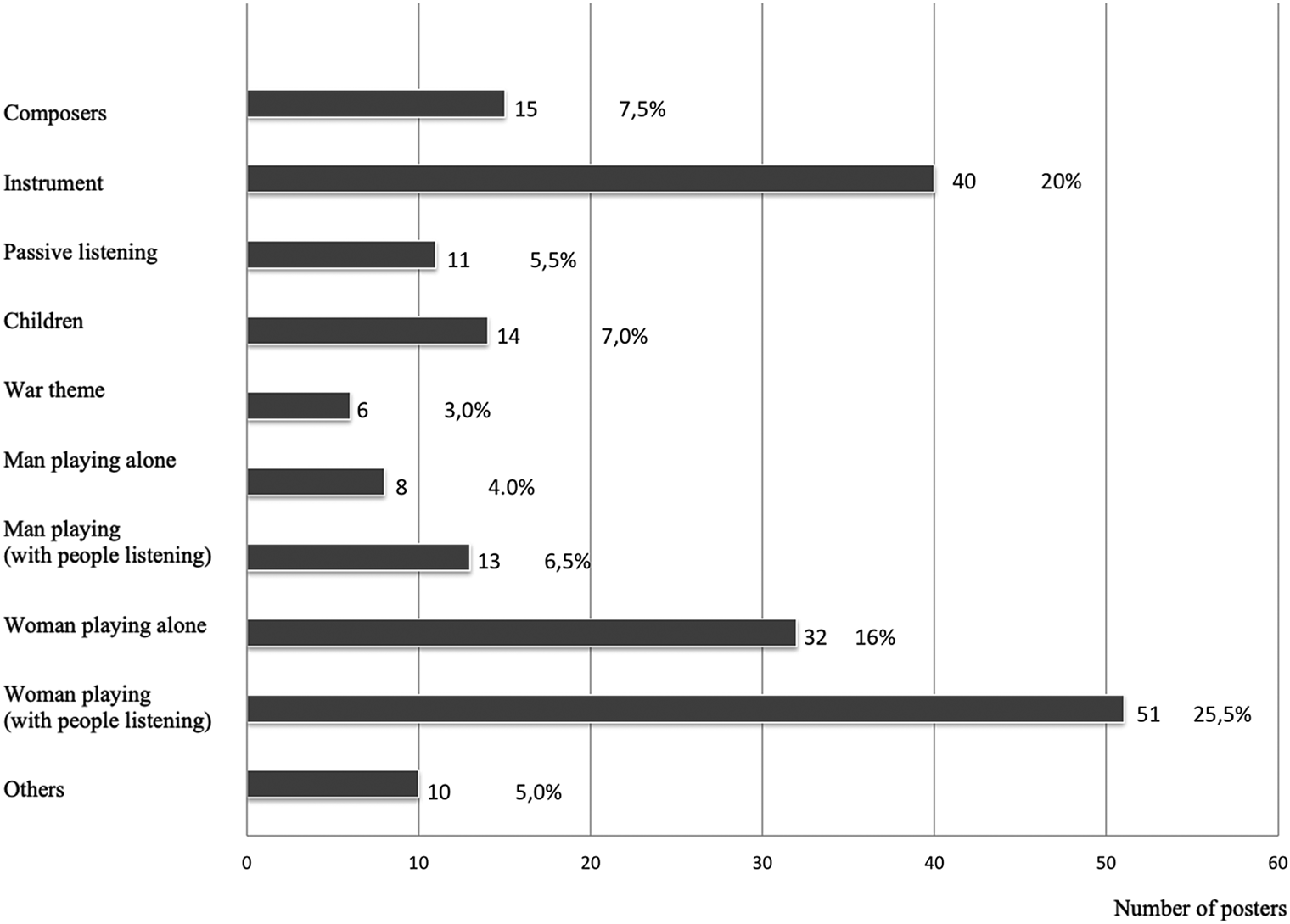
Once these situations were established, a graph was generated that allowed us to see their prevalence. As can be seen in Figure 1, some of these themes are particularly recurring.
Recurring situations in pianola advertising.

We can observe that the three most represented situations are:
(1) Woman playing with listeners where the woman almost always appears in a middle-class domestic setting. This situation appears in 51 of the 200 studied advertisements, representing 25.5% of the total.
(2) Some 20.2% of the advertisements belong to the Instrument category where the instrument is the main focus. Forty of the posters feature this situation as an advertisement image.
(3) The representation of the Woman playing alone appears in 32 of the advertisements – 16% of the total.
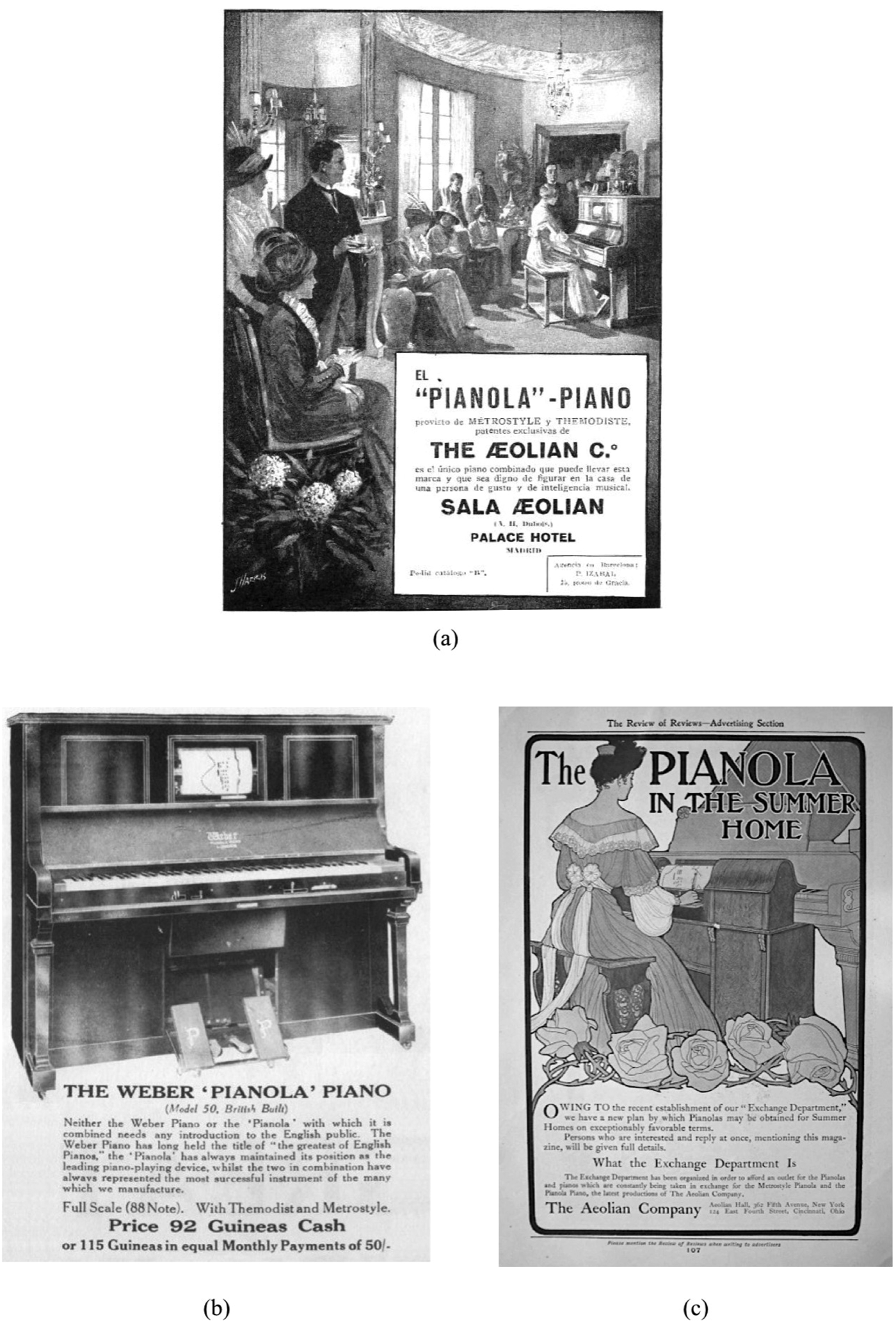
Following these three main groups are the images of the composer, of the child and of the man playing to an audience, these last three with far lower percentages of the total than the first three. Then follow passive listening (in other words, the theme of the reproducing piano), the man playing alone and war themes, these being at the bottom of the list of the 200 advertisements. The other situations have been grouped into a category we have called ‘Others’ that only represents 5% of the total, thereby denoting a significant concentration of certain situational topics. It is worth mentioning that two of the three most prevalent categories employ the female form as an advertising device. In fact, if we add together the categories (a) Woman playing with listeners and (c) Woman playing alone we find that in 41.5% of cases a woman is the main protagonist. The pianola phenomenon is very much linked to middle-class domestic entertainment, so it is not surprising to find the female gender exercising her role as a housewife dedicated to watching over the welfare of her family. The examples in Figure 2a–c show these three main categories: woman playing to an audience, exhibited instrument and woman playing alone.
Examples of woman playing to an audience, exhibited instrument and woman playing alone. (a) Pianola piano by Aeolian Co. Spanish branch. Circa 1920. Source: Todocoleccion.net. (b) Pianola piano by Weber Co. Source: A. Ord-Hume, Automatic Pianos. A Collector's Guide to the Pianola, Barrel Piano and Aeolian Orchestrelle (Surrey, Schiffer Publishing, 2004), p. 389. (c) Pianola (original push up) by Aeolian Co. Source: [Ebay.com] The Review of Reviews (American version), p. 107. Unknown date.

Within category (a) we find two sub-groups that are of particular interest for the aspects they bring to light: on the one hand the dancing and party scenes where the woman is playing surrounded by people in a festive and often immoderate atmosphere and, on the other hand, those where despite the context being clearly potentially festive, the people shown are immobile as if they are listening to a concert. In some cases this potential festivity might represent an interesting marketing strategy, insinuating that the party is to follow. The neat and tidy domestic middle-class context potentially suggests that the party that will follow what is being depicted in the poster is more than evident in the mind of the potential buyer.
The female form as an advertising device
In this association of ideas that forms part of the marketing strategy, pianola advertisements make use of the female form as the main vehicle to suggest – to connote – all that might take place above and beyond socially established norms. However, the use of the female form transcends its mere use as a visual device as it also confirms the condition of domination by the male, a male who obtains his social entertainment through her and who, moreover, is capable of converting that social entertainment into the kind of pastime most desired by the ideal wife. It is important to take note of this relationship between male and female that is present in a very high percentage of the advertisements: when the woman is accompanied by the man he always takes on an authoritative role, leaning up against the pianola or standing behind it, gesturing his approval at the tunes being played by the woman (see the examples in Figure 3a and b).
Aeolian and Kranich & Bach posters showing a very common situation in this type of advertising. (a) Pianola piano by Aeolian Co. Spanish branch, circa 1920. Source: Todocoleccion.net. (b) Kranich & Bach player piano. Source: Ebay.com.

This submissive relationship is therefore more than clear and responds faithfully to a series of stereotypical characteristics that show the man as being active, courageous, rational, self-reliant, with a great capacity for abstraction and creativity, and the female as being passive, feeble, sensitive and dependant (Vayreda Reference Vayreda2014). In fact, authors such as Susan McClary (Reference McClary1991), Nicholas Cook (1998) and Josep Martí (Reference Martí2000) have reminded us on various occasions of how some of these attributes still operate within the academic lexicon of high-brow Western music. This is the case with masculine endings (in strong tempo, conclusive) and in feminine endings (in a weak tempo, suspensive), terms still in use today in the academic tradition.
These topics are also a reflection of what society understands to be the roles for each of the sexes, showing the supposed suitability of men to the public domain and of women to the private domain. Within the private domain, the pianola ads reserve for women an environment of ‘controlled exhibition’, the exhibition of a woman playing the piano for her guests, an image very much of the 19th century (Ogren Reference Ogren1989, pp. 88–9). The pianola enables this model of middle-class entertainment to reach new heights thanks to the ease with which music can be played that vastly exceeds the modest aspirations of a housewife. We often come across advertisements where women are portrayed stereotypically as the perfect performer who, without needing any musical background, can satisfy the wishes of her husband. Anything from a prelude by Chopin to the latest ragtime piece; the pianola's vast repertoire represents a menu where – if we may use a culinary comparison – the woman's function is to cook the musical entertainment of a middle-class family.
As a counterpoint, Brian Dolan (Reference Dolan2009, p. 18) proposes that we understand male interest in the pianola in view of what he terms the ‘masculinity of mechanisation’ via which a man can also show interest in music thanks to the link between this new artefact and mechanics and the latest technology. The fact that 45.1% of the ads starring women are exclusively player piano advertisements and that the female figure has no presence at all in those for reproducing pianos directly tells us how the industry (and society) used gender stereotypes in regard to the social use of music. As Alison Wente notes, some of these advertisements promote player pianos as a ‘labor saving replacement for women's labor at the keyboard’ while others ‘act as a device that stores and reproduces musical labor as a stockpile-able commodity’ (Reference Wente2016, p. 11).
The objectivisation of music
With regard to the second most represented situation (the one in which the instrument itself is the publicity device) we must distinguish between those advertisements where the instrument is portrayed as if in a catalogue and those where the instrument is placed in a context of passive listening – in other words, as a reproducer of music. The latter case clearly refers to the realm of the reproducing piano and is in a category of its own.
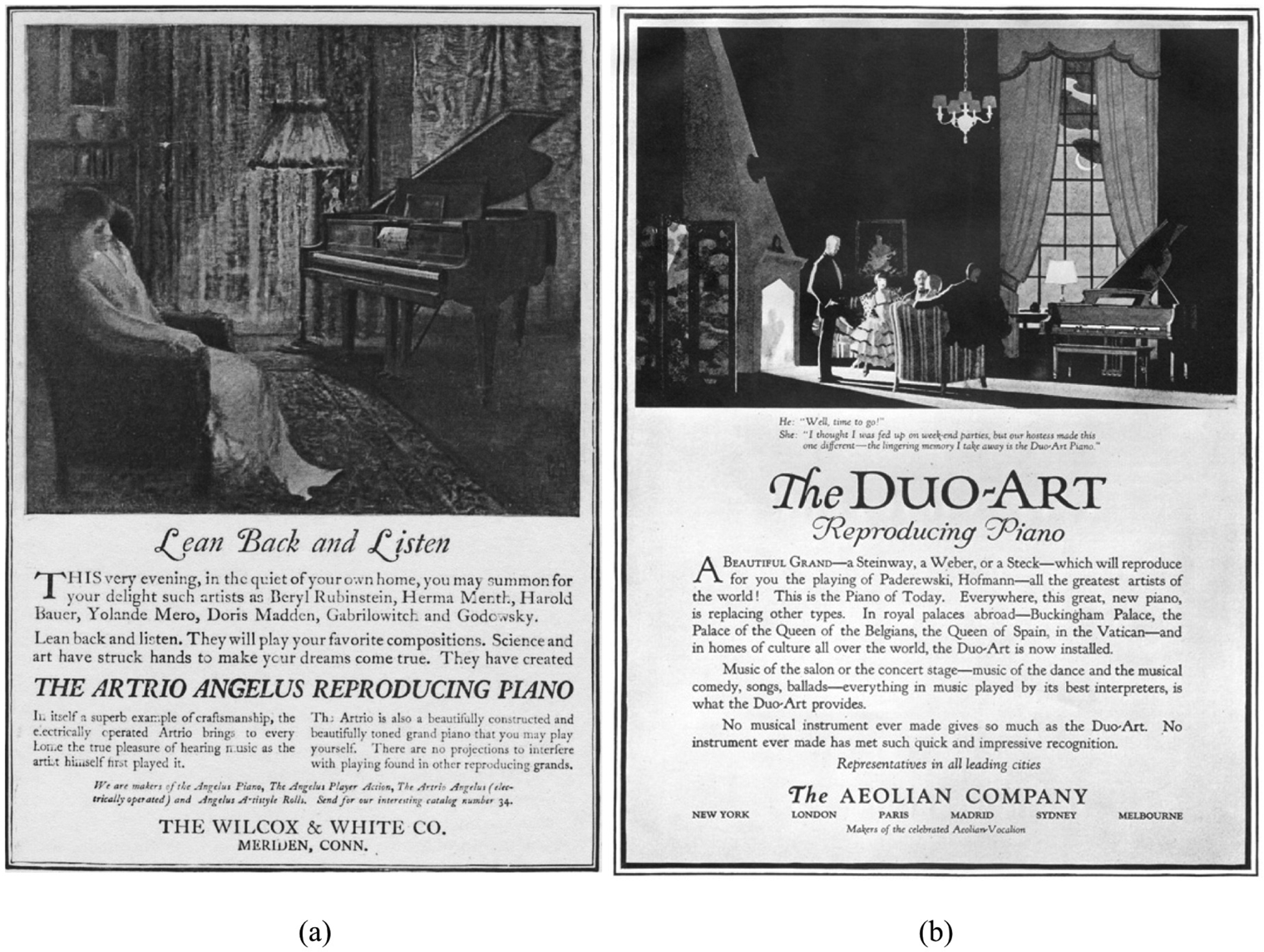
Analysing the differences between advertisements for the player piano and those for the reproducing piano is also interesting if we take into account the relationships that can be deduced between commercial discourse, use and function. Paying attention to the dates that figure on the majority of the ads studied, one can appreciate a diachrony where performance loses ground in favour of passive listening. As of the 1920s one can see an increase in advertisements – especially in Europe – where instead of drawing one's attention to technique and the interaction of the instrument, we are being asked to focus on the music itself. We find many advertisements where we are shown the instrument playing by itself with the listener or listeners enjoying the music being played automatically. The slogans we can see in Figure 4a and b are quite eloquent. In the first instance, a suggestive ‘Lean back and listen’ accompanies the image of a woman calmly listening to automatically reproduced music. In the second instance, the reproducing piano is presented as the new fashion for middle-class parties to the detriment of traditional dancing. Both ads employ a marketing model and strategy that is quite common, based on the combined interaction of three elements: an image, a slogan and an explanatory text that links the former two elements, seeking to maximise their connotational potential. The first instance seems to reach the very heights of the individualised passive listening model that for a century deployed the Romantic stance (Cook Reference Cook2001): that of the concert hall with its individualised audience that closes its eyes, each in their own seat, in a posture of voluntary isolation. In Figure 4a the woman seems to be in a state of direct communion with an alternate reality, in touch with the spiritual world of music, the music of the great composers, those timeless geniuses and authors of equally timeless creations, all of which are now within her grasp!
The Wilcox & White Co. and Aeolian reproducing pianos. (a) Artrio Angelus reproducing piano by Aeolian Co. Source: T.D. Taylor, ‘The commodification of music at the dawn of the era of mechanical music’, Ethnomusicology, Spring 2007, 15/2, p. 294. (b) Duo Art reproducing piano by Wilcox & White. Source: A. Ord-Hume, Automatic Pianos. A Collector's Guide to the Pianola, Barrel Piano and Aeolian Orchestrelle (Surrey, Schiffer Publishing, 2004), p. 240.

Some authors have suggested that the progressive rise in popularity of the reproducing piano led to a decrease in the activity of pianola players. This might also suggest that the pianola market was reflecting an increased objectivisation of music: those people who previously purchased an instrument in order to perform music were now purchasing music that the instrument was able to play automatically (Taylor Reference Taylor2007). The main reason for this objectivisation of musical activity was the fixation with sound reproduction and, as such, above and beyond the pianola, we must contextualise it within a much broader scope that encompasses the four great sound reproducing devices of the times: the phonograph, the pianola, the gramophone and the radio.
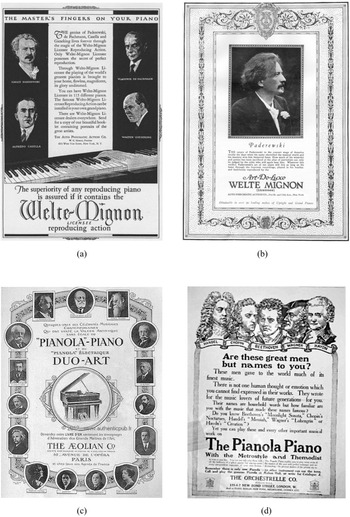
The other major strategy employed was that of using the composer as a commercial device. Depending on the manufacturer or the type of technology on offer, these characters were either pianists and composers of the time (a strategy much employed by Welte; see examples in Figure 5a and b) or else dead composers from the European musical tradition, with Handel being the oldest representative (see examples in Figure 5c and d).
Pianists and composers. (a) Welte Mignon reproducing piano. Source: T. D. Taylor, ‘The commodification of music at the dawn of the era of mechanical music’, Ethnomusicology, Spring 2007, 15/2, p. 300. (b) Paderewski on Welte Mignon system. American Branch. Source: Spanish National Library. (c) Duo Art pianola piano by Aeolian. French branch. Source: Spanish National Library. (d) Pianola piano by The Orchestrelle Co. Aeolian English branch. Source: Ebay.com.

As a kind of sanctuary of the most venerated spirits, these advertisements allow us to understand the canon of prestige at the time within the social sphere of the middle class and how the commercial strategies related to this prestige were articulated. A case in point is that of Welte, as the German manufacturer only dealt in recordings for the reproducing piano and its marketing strategy was based on the reputation of the pianists that perforated the master copies of its rolls. This business scenario permitted a relationship of endorsement between manufacturer and artist that would only gain in strength as the 20th century progressed.Footnote 3
These contracts represented mutual promotion with an unprecedented media reach for the artist that therefore made them very hard to resist. Saint-Saëns, Busoni, Fauré, Paderewski, Lhévinne, Hofmann, Ganz, Horowitz, de Pachmann and Casella are some of the pianists who most often feature in these ads, and in some cases their image is accompanied by some favourable comment about the recording system (see Figure 5b). The fact that they worked exclusively with recorded rolls meant that Welte's advertisements had some characteristic elements to them: when a pair of hands is shown playing, for example, they are always depicted in a hazy fashion – a device used to denote that the rolls are destined for automatic reproduction (see Figure 5a).
The formula of the diffuse image – which other companies used in order to revive the great composers of the past as phantasmagorical apparitions – had for Welte a double publicity meaning as it hybridises the human element (the rolls are strict interpretations) with the automatisation of sound reproduction (the capturing of a real performance on a medium that reproduces sound with unprecedented fidelity).Footnote 4 In the case of Aeolian, on the other hand, their strategy took on a dual character as the American manufacturer sold many more rolls for the player piano than it did for the reproducing piano. Nevertheless, the device of the composer and his testimonial is very much present in most of their advertisements. Having an enormous catalogue of compositions from all epochs at their disposal resulted in Aeolian working as much with the device of the pianist in vogue (Moszkowski, Humperdinck, Sauer, Carreño, or Busoni and Paderewski, who had also been recorded by Welte) as with other historical composers (see Figure 5c and d). In other instances, the recurring presence of Beethoven in ads by various different companies seems to confirm the iconic media status that the composer from Bonn enjoyed at the beginning of the 20th century. In the pianola advertisements, the Beethoven cult – fuel for countless academic papers of varying aesthetic and ideological slants – comes to us by means of representations that are highly infused with symbolic components.
The allegory of Beethoven's ghost
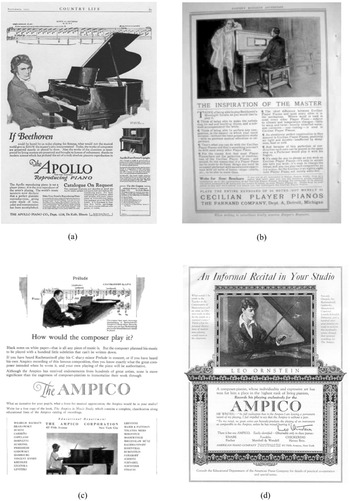
There are numerous advertisements that feature a phantasmagorical Beethoven – semi-transparent, a spirit from beyond the grave that appears next to the instrument to communicate a forceful message to us. This is a message that the text of the Apollo Piano Company (see Figure 6a) synthesises to perfection with the question ‘were it possible today to listen to Beethoven himself playing his sonatas, what would we not do to hear the Master's own interpretation?’ Over and above the iconic value of Beethoven's image, the intention of the question is none other than to raise awareness of the tremendous advantages of the novel device, namely the preservation of personal performances by the great composers of the time. As such, the image of Beethoven is a pretext for advertising the value of the artefact, juxtaposing what we will never be able to have (Beethoven's personal performances) with what the reproducing piano will permit us to have (to at the very least enjoy interpretations of his work by contemporary pianists and composers).
The ‘allegory of Beethoven's ghost’ (a, b) and some other strategies used by Ampico (c, d). (a) Apollo reproducing piano by The Apollo Piano Co. Source: T.D. Taylor, ‘The commodification of music at the dawn of the era of mechanical music’, Ethnomusicology, Spring 2007, 15/2, p. 299. (b) Cecilian player piano by The Farrand Co. Source: Todocoleccion.net. (c) Ampico reproducing piano. Source: Ebay.com. (d) Ampico reproducing piano. Source: Todocoleccion.net.

In another apparition of Beethoven's ghost (in this case for the Farrand Company, see Figure 6b) the composer is shown leaning on the instrument, listening anxiously as if preparing to deliver a verdict on the performance of the pianola player. It is doubtless the great composer's verdict that represents maximum aesthetic authority. This is an idea inherited from the 19th century – let us not forget that Brahms spoke of the ‘footsteps of a giant’ behind him (Cook Reference Cook2001 p. 36)Footnote 5 – and one that can be confirmed from a new perspective at the start of the 20th century, the same as that being offered by the pianola advertisement. In addition to the figure of Beethoven, there are many other protagonists that reinforce the character of the media icon via the pianola poster. Companies such as Ampico – that seemed to be particularly fond of this sort of thing – habitually showed the faces of contemporary composers of the likes of Rachmaninov, Stravinsky, Ornstein or Godowsky (see Figure 6c and d) accompanied by the usual sorts of comments regarding the excellence of the product.
The text that accompanies the poster in Figure 6c tells us that the reproducing piano allows us to enjoy ‘subtleties that cannot de notated’, reminding us that, in a score, the amount of ‘music’ that is written is reduced to a few graphic elements that, in order to become real sound, need to be interpreted by a good musician. The reproducing piano can capture all of the magic of the best performers (everything that is absent from the score) and reproduce it with exactitude. The unrepeatable magic of a sound that happens only once can now be captured and domesticated. In the advertisement for the player piano that same discourse alluding to the great masters often comes into conflict with another classic argument put forward by the industry: that of ‘perfection without practise’ (Ogren Reference Ogren1989, p. 88), which tells us that practice is no longer necessary for a good performance. This sort of discourse is often found in these advertisements that have opted to employ the figure of a child – and to a lesser degree the elderly – as a publicity device together with a slogan alluding to increased ease of performance. In some cases, such as in the Ampico poster (see Figure 6c), we see hybrid strategies that, as they introduce a pedagogical slant, insinuate that the best way to learn to play the piano is by using rolls containing works perforated by great composers and pianists.
The pianola in times of war
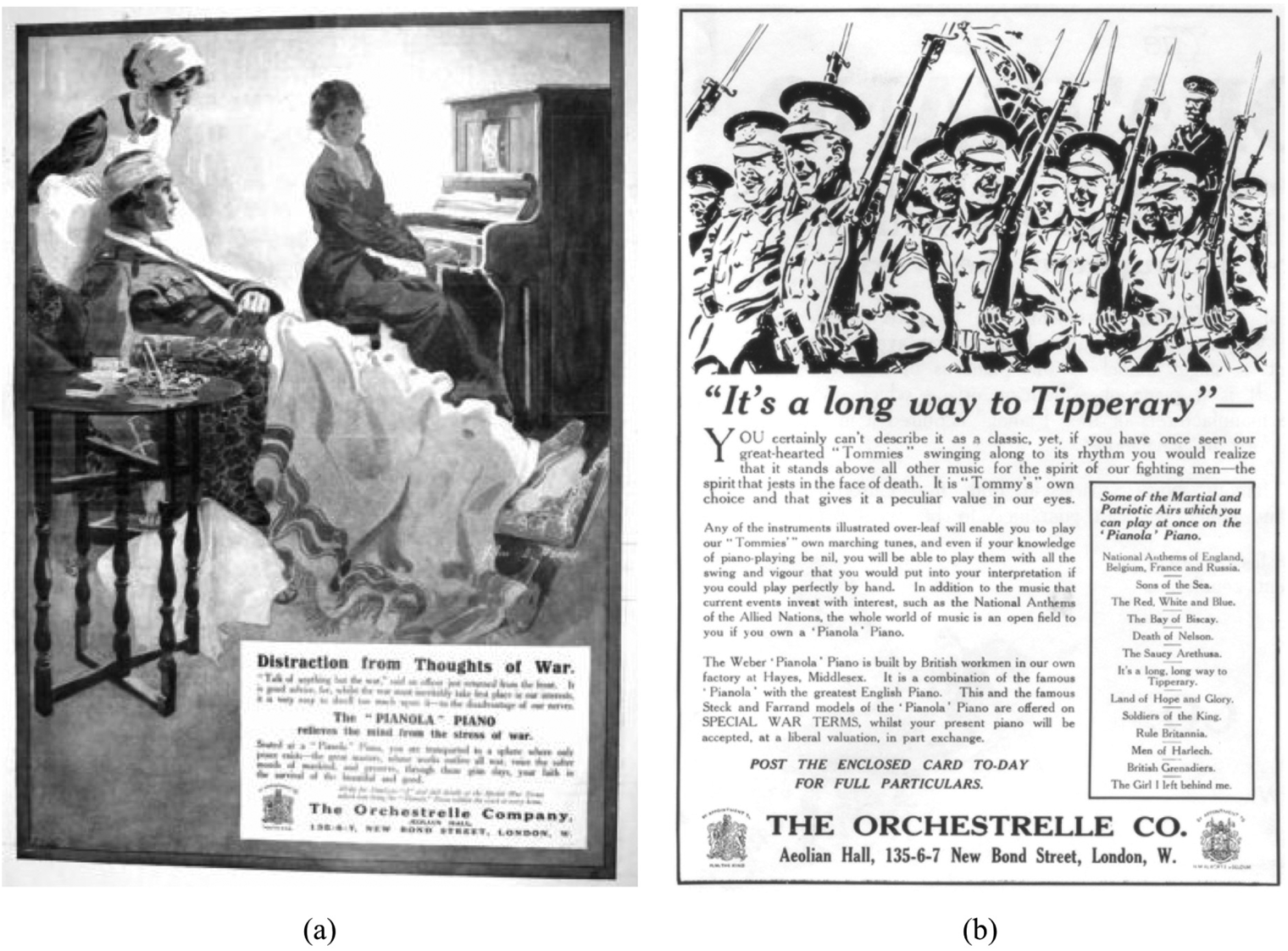
Finally, there is a last group of advertisements that, despite being almost incidental owing to their scarcity (a mere 3% of the total), is also of interest from an analytical point of view: the war-themed poster. With the outbreak of the First World War, and especially once the United States had entered the conflict, the pianola also became an instrument placed at the service of patriotic sentiment in times of war. In these ads, the publicists promoting the pianola began to appeal to the collective sentiment in such a way that once again music was to become very effective fuel to power feelings of nationalism. Soldiers – the apparent main protagonists in the conflict – as well as the hundreds of thousands of citizens witnessing the conflict from afar, all felt cheered on by the military melodies that the pianola could reproduce: Sons of the Sea, Soldiers of the King, etc.Footnote 6 Slogans, hymns and patriotic chants that show us that, even if indirectly, the business of war was also business for the music industry (see Figure 7a and b). Other images in this category allude to the fact that, in times of war, to have music at one's disposal with the help of this device would keep the family entertained while they waited for their father or husband to return home from performing their duty as a defender of the fatherland. The last image that we see in this category is one of a woman playing to the wounded (see Figure 7a), once again reinforcing the prototypical social functions of both sexes.
Two examples of war-themed posters. (a) Pianola piano by The Orchestrelle Co. Aeolian English branch. Source: Ebay.com. (b) Pianola piano by The Orchestrelle Co. Aeolian English branch. Source: A. Ord-Hume, Automatic Pianos. A Collector's Guide to the Pianola, Barrel Piano and Aeolian Orchestrelle (Surrey, Schiffer, 2004), p. 399.

According to Timothy D. Taylor (Reference Taylor2007), the US Navy supplied 128 of its warships with pianolas. Other sources claim this to be 80 ships and state that the supply of pianolas to ships might actually go back to seven years prior to the conflict (Howe Reference Howe1991). In fact, in one of his expeditions to the North Pole, Robert Peary thought it indispensable to have a pianola available, stating that ‘it is an essential piece of kit to our teams. Men feel lonely at the North Pole, they become vulnerable and their depressions are dissipated by the marvellous music’ (Taylor Reference Taylor2007, p. 288). All of this is further proof that permits us to reflect again on the uses and functions of musical activity, activity that modern Western societies have understood to be merely entertainment but that in reality can come to fulfil other aims that are vastly more complex. The purpose of a pianola on a warship might have been simply to entertain, but its ultimate aim may well have been much more valuable than simple entertainment.
4. Conclusions
The pianola was the first system to permit the mass dissemination of music and one of the first artefacts conceived for the commercialisation of a recorded sound medium. Its tremendous social relevance can be studied from various different perspectives but its promotion through advertisements is one that cannot be avoided. The analysis of the advertising discourse of these posters has allowed us to confirm how the instrument, in each of its variants, articulated particular functions in the areas of the reception and consumption of music of the epoch. The study of the processes through which music reconstituted itself as a commodity with mass appeal shows us the capacity of the media to generate signifiers and construct social realities. These signifiers, on the one hand, can be of tremendous interest from a perspective of gender studies, for which the result of this process of meaning – cryptic although operative – is evident: the pianola phenomenon, furnished with a powerful propaganda tool, contributed to the objectivisation of women, something that occurred at a key moment in the modern advertising market. This objectivisation of women is perfectly traceable from the posters of the beginning of the 20th century right the way through to our current discourses. Finally, and drawing on the previous argument, it seems indispensable to put forward one last argument: the advertising mechanism of the pianola, with its ability to sell a product from the point of view of new marketing strategies, not only contributed to the media objectivisation of women but also to the objectivisation of music itself, turning it, for the first time in recorded history, into a physical object of mass consumption. From this perspective it is important to remember the implications of technical reproducibility over general perceptions of music – something that Walter Benjamin would bring up decades later – and that implied a profound change in listening habits, in consumption and, as such, in the very conceptualisation of music itself.