Introduction
Traumatic events are common, with 50–70% of individuals experiencing at least one trauma in their lifetimes (Benjet et al., Reference Benjet, Bromet, Karam, Kessler, McLaughlin, Ruscio and Koenen2016). Posttraumatic Stress Disorder (PTSD), the signature trauma-related disorder (Breslau, Reference Breslau2009), is associated with increased alcohol consumption (Vlahov et al., Reference Vlahov, Galea, Resnick, Ahern, Boscarino, Bucuvales and Kilpatrick2002) and alcohol use disorder (AUD) (Jakupcak et al., Reference Jakupcak, Tull, McDermott, Kaysen, Hunt and Simpson2010). Twin studies (Heath, Jardine, & Martin, Reference Heath, Jardine and Martin1989; Kaprio et al., Reference Kaprio, Koskenvuo, Langinvainio, Romanov, Sarna and Rose1987; Knopik et al., Reference Knopik, Heath, Madden, Bucholz, Slutske, Nelson and Martin2004; Stein et al., Reference Stein, Jang, Taylor, Vernon and Livesley2002) and genome-wide association studies (GWAS) (Clarke et al., Reference Clarke, Adams, Davies, Howard, Hall, Padmanabhan and McIntosh2017; Stein et al., Reference Stein, Chen, Ursano, Cai, Gelernter, Heeringa and Smoller2016) find that PTSD and these alcohol phenotypes are moderately heritable, with 36–60% of the variance explained by genetic effects. Additional work using twin studies has demonstrated 30% genetic overlap between PTSD and AUD (McLeod et al., Reference McLeod, Koenen, Meyer, Lyons, Eisen, True and Goldberg2001; Xian et al., Reference Xian, Chantarujikapong, Scherrer, Eisen, Lyons, Goldberg and True2000). In general, most of the comorbidity research has focused on PTSD-AUD, and has neglected the association between PTSD-alcohol consumption. As increased alcohol consumption is associated with AUD (Moos, Schutte, Brennan, & Moos, Reference Moos, Schutte, Brennan and Moos2004; Sanchez-Roige et al., Reference Sanchez-Roige, Palmer, Fontanillas, Elson, Adams, Howard and Clarke2019b), genetic research is needed to test whether the same genetic influences underlying PTSD-AUD are those underlying PTSD and alcohol consumption.
Large scale GWAS have identified significant hits for PTSD phenotypes (e.g. Nievergelt et al., Reference Nievergelt, Maihofer, Klengel, Atkinson, Chen, Choi and Koenen2019), problematic alcohol use (PAU) (Zhou et al., Reference Zhou, Rentsch, Cheng, Kember, Nunez, Sherva and Polimanti2020a), (e.g. alcohol dependence; Walters et al., Reference Walters, Polimanti, Johnson, McClintick, Adams, Adkins and Agrawal2018), and alcohol consumption (Clarke et al. Reference Clarke, Adams, Davies, Howard, Hall, Padmanabhan and McIntosh2017). Recent analyses have allowed for examination of genetic associations across alcohol consumption (Kranzler et al., Reference Kranzler, Zhou, Kember, Vickers Smith, Justice, Damrauer and Gelernter2019; Liu et al., Reference Liu, Jiang, Wedow, Li, Brazel, Chen and Vrieze2019; Sanchez-Roige et al., Reference Sanchez-Roige, Palmer, Fontanillas, Elson, Adams, Howard and Clarke2019b), PAU (Gelernter et al., Reference Gelernter, Sun, Polimanti, Pietrzak, Levey, Lu and Stein2019a; Sanchez-Roige et al., Reference Sanchez-Roige, Fontanillas, Elson, Team, Gray, de Wit and Palmer2019a; Walters et al., Reference Walters, Polimanti, Johnson, McClintick, Adams, Adkins and Agrawal2018; Zhou et al., Reference Zhou, Sealock, Sanchez-Roige, Clarke, Levey, Cheng and Gelernter2020b), as well as PTSD and re-experiencing symptoms (Gelernter et al., Reference Gelernter, Sun, Polimanti, Pietrzak, Levey, Bryois and Stein2019b; Nievergelt et al., Reference Nievergelt, Maihofer, Klengel, Atkinson, Chen, Choi and Koenen2019). Single nucleotide polymorphism (SNP) -based heritability of PTSD suggests modest to moderate heritability (~15%), with these estimates larger in women than men (i.e. 36% v. 5%; Duncan et al., Reference Duncan, Ratanatharathorn, Aiello, Almli, Amstadter, Ashley-Koch and Koenen2017). SNP-based heritability of problem alcohol phenotypes suggests modest heritability, ranging from 5.6–9.4% for AD (h2 = 0.090, s.e. = 0.019; Walters et al., Reference Walters, Polimanti, Johnson, McClintick, Adams, Adkins and Agrawal2018), AUD (Kranzler et al. Reference Kranzler, Zhou, Kember, Vickers Smith, Justice, Damrauer and Gelernter2019: h2 = 0.056, s.e. = 0.004; Zhou et al. Reference Zhou, Rentsch, Cheng, Kember, Nunez, Sherva and Polimanti2020a: h2 = 0.094, s.e. = 0.005), and PAU (h2 = 0.068, s.e. = 0.004; Zhou et al., Reference Zhou, Rentsch, Cheng, Kember, Nunez, Sherva and Polimanti2020a).
Few have investigated the genetic association between PTSD and alcohol-related problems phenotypes using genetic techniques such as linkage disequilibrium score regression (Bulik-Sullivan et al., Reference Bulik-Sullivan, Loh, Finucane, Ripke, Yang, Patterson and Neale2015b), but work by our group found a significant correlation between PTSD and alcohol dependence (AD; rG = 0.35; Sheerin et al., Reference Sheerin, Bountress, Meyers, Saenz de Viteri, Shen, Maihofer and Amstadter2020) (rG = 0.28; Bountress et al., Reference Bountress, Wendt, Bustamante, Agrawal, Webb, Gillespie and Amstadter2021) for those of European Ancestry. However, this effect was driven by women, for whom the genetic correlation was moderate and significant, but not for men (Sheerin et al., Reference Sheerin, Bountress, Meyers, Saenz de Viteri, Shen, Maihofer and Amstadter2020). Genetic correlation analyses between PTSD and alcohol consumption were also conducted by our group, finding a non-significant association (rG = −0.07; Bountress et al., Reference Bountress, Wendt, Bustamante, Agrawal, Webb, Gillespie and Amstadter2021); another group found near zero genetic correlation between PTSD and the Alcohol Use Disorders Identification Test (AUDIT) consumption score subscale (AUDIT-C) (Mallard et al., Reference Mallard, Savage, Johnson, Huang, Edwards, Hottenga and Anokhin2021). Work by our group also found that beyond genetic correlations, using Mendelian Randomization, PTSD exerted a causal effect on AUD, but not alcohol consumption, but that neither alcohol phenotype exerted a causal influence on PTSD (Bountress et al., Reference Bountress, Wendt, Bustamante, Agrawal, Webb, Gillespie and Amstadter2021). Additionally, genetic correlations between consumption and problems phenotypes vary. One group found correlations between alcohol consumption and AUD ranging from small to moderate (e.g. ~rG = 0.2–0.3; Sanchez-Roige et al., Reference Sanchez-Roige, Palmer, Fontanillas, Elson, Adams, Howard and Clarke2019b). Another found large associations between AUDIT-C and AUDIT-P and AD (~ rG = 0.70; Mallard et al., Reference Mallard, Savage, Johnson, Huang, Edwards, Hottenga and Anokhin2021) once the association between the frequency item and SES was taken into account. Together these findings suggest the genetic risk for consumption and problematic phenotypes are correlated but distinct.
The question of whether the genetic associations between PTSD and alcohol consumption differs compared to alcohol-related problems phenotypes has not been explicitly studied, to our knowledge. However, work on other psychiatric phenotypes suggests that for some, like smoking behaviors, the genetic correlations between mild and more problematic versions of the phenotype [e.g. cigarettes per day (CPD), nicotine dependence (ND)] are strongly positively correlated with each other (rG = 0.95; Quach et al., Reference Quach, Bray, Gaddis, Liu, Palviainen, Minica and Nothnagel2020). Additionally, their correlations with other disorders (e.g. schizophrenia) are in the same direction (e.g. both positive) but of varying sizes (Hartz et al., Reference Hartz, Horton, Hancock, Baker, Caporaso, Chen and McNeil2018). Research on major depression, which is closely related to PTSD, found positive genetic correlations between major depression and AD and alcohol quantity, but negative genetic correlations between major depression and alcohol frequency (Polimanti et al., Reference Polimanti, Peterson, Ong, MacGregor, Edwards, Clarke and Derks2019). Thus, we aim to test whether using alcohol consumption -related phenotypes yields similar estimates to problem alcohol-related phenotypes.
The current study adds to this literature by estimating genetic correlations from GWASs summary statistics for PTSD (as well as re-experiencing symptoms), and a range of alcohol phenotypes. The latter include drinks per week (DPW), AUDIT-C (alcohol frequency, quantity, and frequency of 6 + drinks), problems (P) score from the AUDIT (AUDIT-P; including 7 items assessing problems; e.g. unable to stop drinking once you started), as well as total score (AUDIT-T; comprised of AUDIT-C and -P), maximum alcohol intake (typical habitual daily maximum usage), AUD (using DSM-5 diagnosis; American Psychiatric Association, 2013) and AD (using DSM-IV diagnosis; American Psychiatric Association, 1994). In so doing, it adds to previous work by examining not only the genetic association between PTSD and alcohol-related problems outcomes, but also PTSD and other alcohol consumption phenotypes including more normative use, which has been generally neglected in the PTSD-alcohol comorbidity literature with few exceptions (Mallard et al., Reference Mallard, Savage, Johnson, Huang, Edwards, Hottenga and Anokhin2021). Finally, this study attempts to examine whether findings are consistent between those of European Ancestry (EA) and African Ancestry (AA) individuals – the latter of which is particularly important given the lack of diversity in genomic studies (Bentley, Callier, & Rotimi, Reference Bentley, Callier and Rotimi2017; Peterson et al., Reference Peterson, Kuchenbaecker, Walters, Chen, Popejoy, Periyasamy and Duncan2019; Sirugo, Williams, & Tishkoff, Reference Sirugo, Williams and Tishkoff2019). This study leverages large-scale GWASs summary statistics from a number of consortia [i.e. Psychiatric Genomics Consortium (PGC)-PTSD and Substance Use Disorder (SUD)-AD, United Kingdom Biobank (UKB), Million Veterans Program (MVP), 23andMe, and GWAS & Sequencing Consortia of Alcohol and Nicotine Use (GSCAN)].
Methods
Samples
PTSD samples and phenotypes
PTSD case/control status came from the PGC-PTSD Freeze 2 dataset (PTSD), which consists of over 50 separate datasets plus the UKB (Nievergelt et al., Reference Nievergelt, Maihofer, Klengel, Atkinson, Chen, Choi and Koenen2019). In analyses utilizing alcohol use data from the UKB, PGC-PTSD PTSD case status reflects primarily lifetime PTSD diagnosis, but also includes current diagnosis when lifetime was not available (30 of 57 cohorts in Freeze 2 provided lifetime data). PGC-PTSD case/control status data were available for both EA and AA samples. PGC-PTSD Freeze 2 were used instead of Freeze 1.5 because of the increase in sample size and inclusion of AA individuals (EA: Total PTSDf1.5 N = 48 471; PTSDf2.0 N = 174 659; AA: Total PTSDf2.0 N = 15 339) (Nievergelt et al., Reference Nievergelt, Maihofer, Klengel, Atkinson, Chen, Choi and Koenen2019).
Two PTSD-related variables were used: DSM-based PTSD and a PTSD re-experiencing score. PTSD re-experiencing symptoms (PTSD Re-Exp) came from an assessment of the PTSD Checklist (PCL) DSM-IV (American Psychiatric Association, 1994) version (Wilkins, Lang, & Norman, Reference Wilkins, Lang and Norman2011) in the MVP (Gelernter et al., Reference Gelernter, Sun, Polimanti, Pietrzak, Levey, Bryois and Stein2019b), selected as it is the symptom cluster most distinctive for PTSD compared to other disorders. This sample and phenotype contributed to both EA (N = 146 660) and AA (N = 19 983) analyses.
Alcohol samples and phenotypes
AUD and AD GWAS summary statistics were available in two datasets. AD case/control data came from the PGC-SUD (Walters et al., Reference Walters, Polimanti, Johnson, McClintick, Adams, Adkins and Agrawal2018). Cases were defined as meeting criteria for a DSM-IV (American Psychiatric Association, 1994) [DSM-III-R (American Psychiatric Association, 1987) for one study] diagnosis of AD and all controls were alcohol exposed. The PGC-SUD AD phenotype contributed to both EA (N = 46 568) and AA (N = 6280) analyses. AUD case/control status was used from the MVP dataset, defined as ICD-9 or ICD-10 codes for dependence or abuse as obtained from the Veteran's Affairs electronic health records (EHR); participants with at least one inpatient or two outpatient alcohol-related ICD-9/10 codes (from 2000–2018) were considered AUD cases (Kranzler et al., Reference Kranzler, Zhou, Kember, Vickers Smith, Justice, Damrauer and Gelernter2019). AUD case/control status in MVP is available for EA (N = 267 391) and AA (N = 56 648) samples.
Alcohol consumption-related GWASs summary statistics were available for a number of phenotypes. Specifically, a measure of average DPW came from the GSCAN consortium and the UKB (Liu et al., Reference Liu, Jiang, Wedow, Li, Brazel, Chen and Vrieze2019) available in EA samples only. DPW was defined as the average number of drinks a participant reported drinking each week, aggregated across all types of alcohol. In studies that reported binned response ranges (e.g. 1–4 drinks), the midpoint of the range was used (Liu et al., Reference Liu, Jiang, Wedow, Li, Brazel, Chen and Vrieze2019). Summary statistics for DPW within UKB and GSCAN were examined combined (N = 941 280) as well as separately (GSCAN: N = 526 937; UKB: N = 414 343). The AUDIT (Saunders, Aasland, Babor, De la Fuente, & Grant, Reference Saunders, Aasland, Babor, De la Fuente and Grant1993) was available in multiple forms and studies. General consumption was measured using the AUDIT-C subscale, which consists of the first three items of the AUDIT and measures past-year typical quantity and frequency of drinking as well as one item measuring frequency of heavy/binge drinking (Bush, Kivlahan, McDonell, Fihn, & Bradley, Reference Bush, Kivlahan, McDonell, Fihn and Bradley1998). AUDIT-C data were available in two datasets, from the EHR data of the annual AUDIT-C assessment in MVP from 2007–2017 (Kranzler et al., Reference Kranzler, Zhou, Kember, Vickers Smith, Justice, Damrauer and Gelernter2019) and as part of the full AUDIT assessment in an online follow-up of the UKB (Sanchez-Roige et al., Reference Sanchez-Roige, Fontanillas, Elson, Team, Gray, de Wit and Palmer2019a). AUDIT-C data were available in MVP for both EA (206 254) and AA (56 495) ancestries and EA only in UKB (N = 121 604). The full AUDIT score (i.e. AUDIT-T) was also available in the 23andMe and UKB datasets (Sanchez-Roige et al., Reference Sanchez-Roige, Fontanillas, Elson, Team, Gray, de Wit and Palmer2019b) in EA samples (23andMe: N = 20 328; UKB: N = 121 604). The AUDIT-P scale, the score on items 4–10 of the AUDIT, which focuses on the problematic consequences of drinking, was used from the UKB in EA samples (N = 121 604). Finally, in the MVP data, a quantitative measure of maximum habitual alcohol consumption in a typical month (Max. Alc.; Gelernter et al., Reference Gelernter, Sun, Polimanti, Pietrzak, Levey, Lu and Stein2019a) was used as a measure of more problematic consumption, to reflect typical/habitual maximum usage as opposed to maximum on a single occasion (N = 126 936 for EA, and N = 17 029 for AA).
Case/control designs
Unbalanced ascertainment in case/control designs can introduce bias in studies using meta-analytic data. Effective sample sizes (Neffs) can help to reduce potential bias in this situation. In this study, we used $N_{{\rm eff}} = {4 \over {( ( 1/n_{{\rm case}}) + ( 1/n_{{\rm control}}) ) }}$ to calculate the Neff for each phenotype, and used the per-SNP Neffs when available in the summary statistics (e.g. PTSD). This approach takes in account the impact of potential bias and reduced power introduced by unbalanced ascertainment of the number of cases and controls across cohorts analyzed under a liability scale (e.g. Walters et al., Reference Walters, Polimanti, Johnson, McClintick, Adams, Adkins and Agrawal2018; Zhou et al., Reference Zhou, Rentsch, Cheng, Kember, Nunez, Sherva and Polimanti2020a).
Genotyping, quality control, and imputation
The existing summary statistics used in the present analyses have previously gone through quality-control pipelines used for the specific consortia (e.g. PGC quality control pipeline including filtering to remove SNPs with imputation information value < 0.90 and MAF < 0.01; Sullivan, Reference Sullivan2010). The analytic pipeline for the present analyses incorporates further filtering processes including removal of SNPs based on a minimum Neff and per-SNP sample variation (e.g. SNP filtering keeping variants within at least 80% of the total Neff) and variants that are either not SNPs or are strand-ambiguous.
SNP heritability and genetic correlation analysis
Analyses of SNP-based heritability (h 2SNP) and genetic correlation (r G) were conducted using the cross-trait linkage disequilibrium (LD) score regression approach and LD score regression software (LDSC) (Bulik-Sullivan et al., Reference Bulik-Sullivan, Loh, Finucane, Ripke, Yang, Patterson and Neale2015b; open-source LDSC pipeline, version 1.0.1, github.com/bulik/ldsc) which requires GWAS summary statistics in samples of unrelated individuals. The approach estimates r Gs by replacing the χ2 with the z scores from both studies and the genetic covariance is then estimated using the slope from the regression of both z scores on LD scores. Normalizing genetic covariance by h 2SNP yields the genetic correlation. Multiple testing was adjusted using false discovery rate (FDR) correction.
Because LDSC requires single ancestry summary statistics as input, analyses were conducted separately for EA and AA samples (see online Supplementary Table S1). For the EA samples, precomputed LD scores came from the 1000 Genomes Project Europeans (https://data.broadinstitute.org/alkesgroup/LDSCORE/eur_w_ld_chr.tar.bz2). For the AA samples, the AA specific LD scores (subset under UKBB.AFR prefix) from the UKB pan-ancestry LD scores (Pan-UKB team; https://pan.ukbb.broadinstitute.org, 2020) were used.
Tissue enrichment analysis
At the tissue level, data from 53 human tissues [Genotype-Tissue Expression (GTEx; https://gtexportal.org/home/) project, version 7] (Lonsdale et al., Reference Lonsdale, Thomas, Salvatore, Phillips, Lo, Shad and Young2013) were used. Post hoc analyses were performed using the partitioned LD score regression software at the default settings (tissues were provided to GTEx by LDSC software).
Results
Heritability
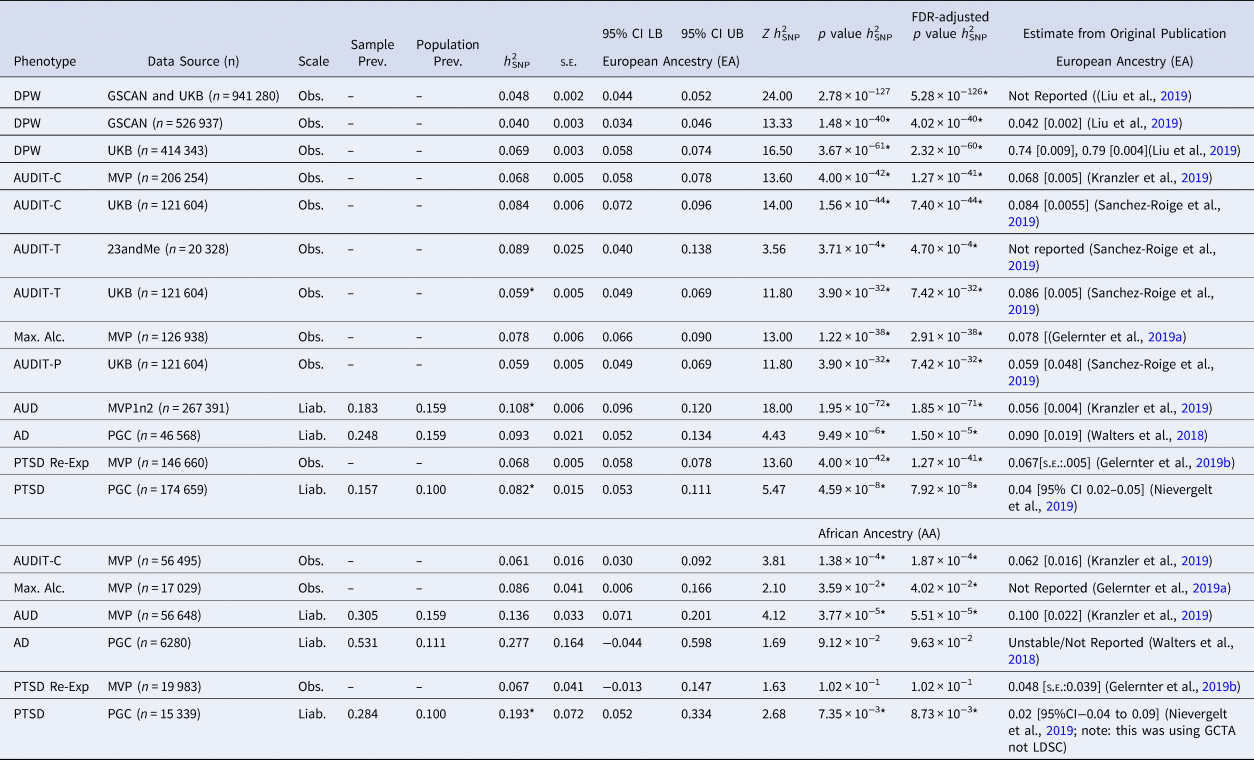
Liability scale h 2SNP statistics were estimated for case/control phenotypes (i.e. PTSDf2, AUD and AD) and observed scale h 2SNP statistics were estimated for the non-case/control phenotypes, in EA and AA summary statistics. Table 1 shows the computed h 2SNP estimates for those of EA and AA from GWASs used for the analyses below. Notably, prior work suggests a general Z score cut off of 4 for heritabilities to determine that traits are appropriate for genetic correlation (Bulik-Sullivan et al., Reference Bulik-Sullivan, Finucane, Anttila, Gusev, Day, Loh and Neale2015a). Estimates within Table 1 with Z scores below 4 are shaded, and should be interpreted with caution. Online Supplementary Fig. S1 depicts the h 2 SNP Z scores for all included samples. All but one of the Z scores in EA samples is above 4. In contrast, only 1 of the Z scores is greater than 4 in AA samples suggesting these estimates are not robust.
Computed SNP-based Heritability of PTSD and Alcohol Phenotypes – EA and AA

Note: SNP, Single Nucleotide Polymorphism; PTSD, Posttraumatic Stress Disorder; EA, European ancestry; AA, African ancestry; h 2, Heritability; s.e., standard error; CIs, confidence intervals; LB, lower bound; UB, upper bound; Z, z-score; Re-Exp, reexperiencing; MVP, Million Veteran Program; AD, Alcohol Dependence; AUD, Alcohol Use Disorder; Max. Alc., Maximum Alcohol Intake; AUDIT, Alcohol Use Disorder Identification Test; T, total; P, problems; C, consumption; DPW, Drinks per Week; UKB, UK Biobank; GSCAN, GWAS & Sequencing Consortium of Alcohol and Nicotine Use; PGC, Psychiatric Genomics Consortium; Liab., Liability; Obs., Observed; Prev., Prevalence. Sample and population prevalence were used for analyses including binary traits to correct for ascertainment bias. h 2SNP estimates in this study were computed using LDSC software and the corresponding GWAS summary statistics. For estimates from the original publications, s.e.s are included when provided in text and when unavailable, 95% CIs were included. When neither was provided in the original manuscript, neither is presented in the table. Four h 2SNP estimates (noted with an asterisk) are different than those from the original publications. The differences are likely due to additional filtering (see Method section), in addition to effective sample sizes calculations (see Method section) that take in account differences in ascertainment of unbalanced cohorts in the case of the three h 2SNP estimates under the liability scale with an asterisk. Estimates of h 2SNP with z-scores less than 4 are noted with shading. Unadjusted and false-discovery rate (FDR) adjusted p values < 0.05 are noted by one asterisk on their corresponding columns.
Genetic correlations
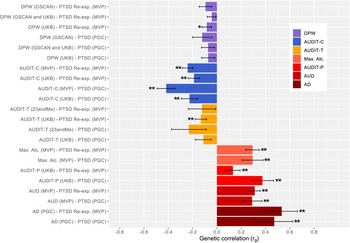
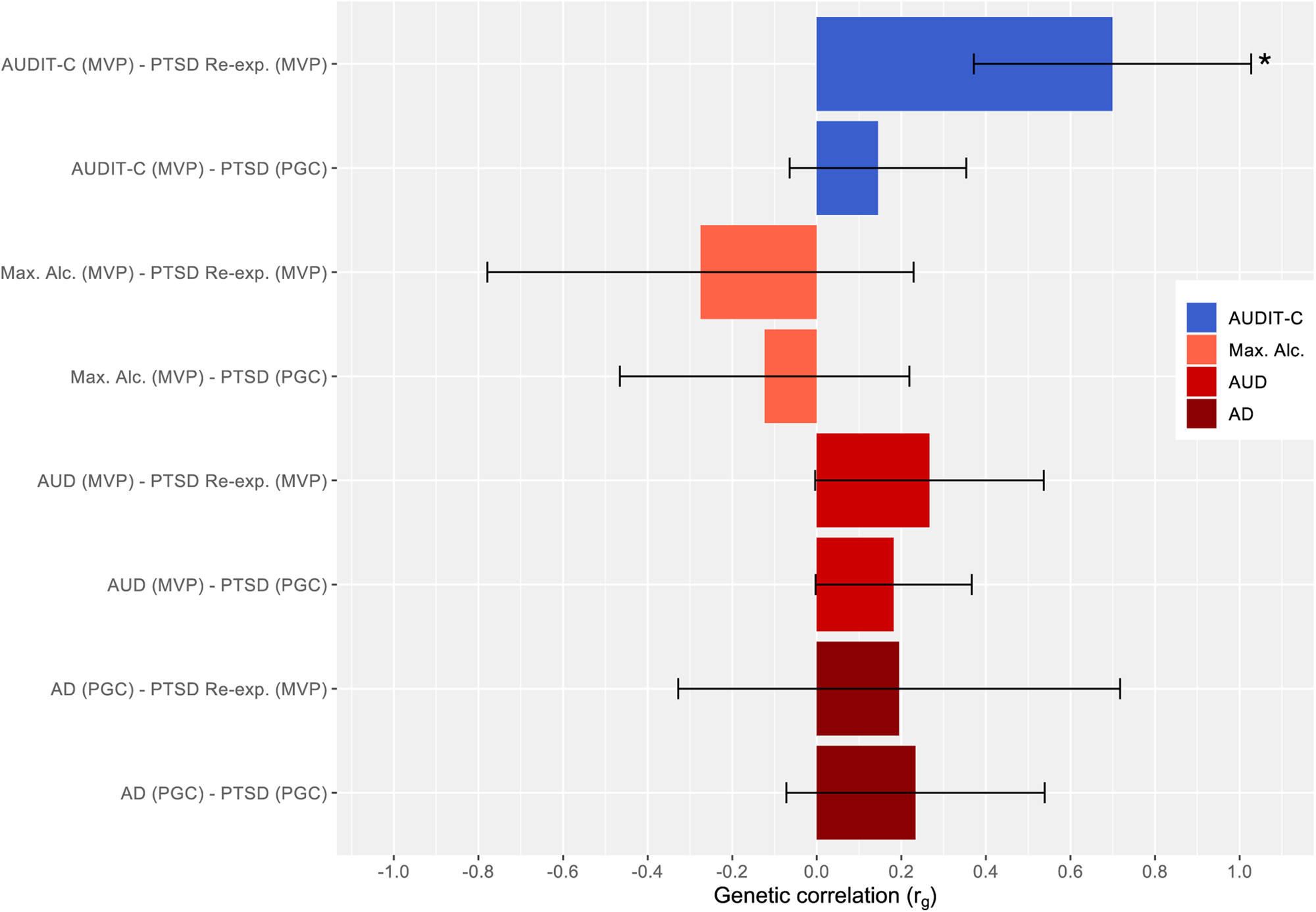
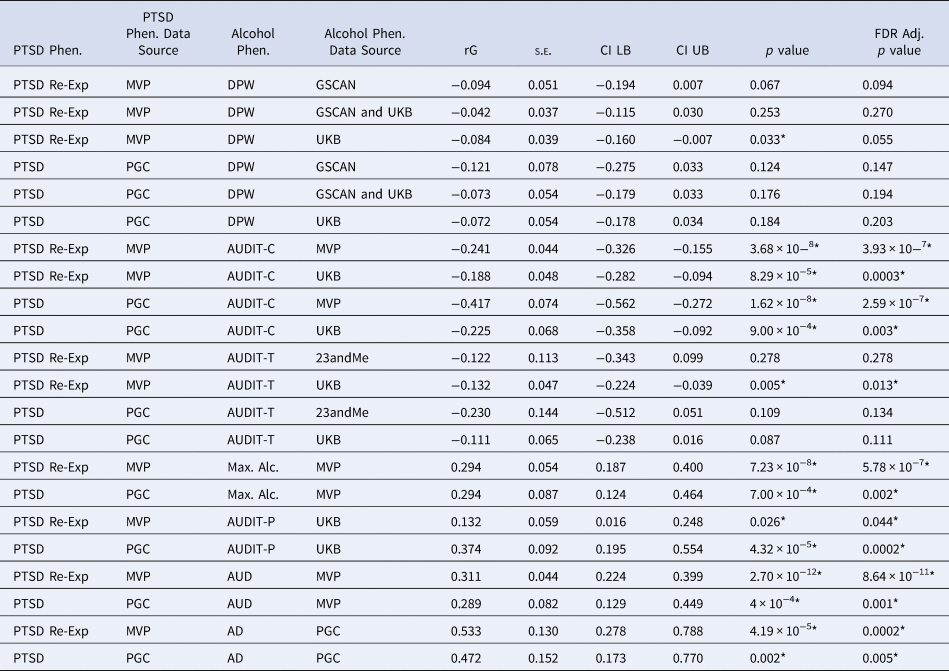
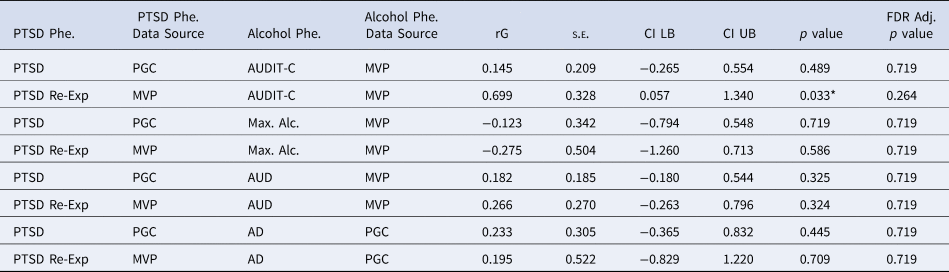
We estimated the rG of PTSD phenotypes [i.e. PTSD (PGC), and PTSD Re-Exp (MVP)] with DPW (from the GSCAN, UKB and both combined), AUDIT-C (from the MVP and UKB), and AUDIT-T (from 23andMe and UKB) (see Table 2 and Fig. 1). We also estimated rG with Max. Alc. (from the MVP), AUDIT-P (from the UKB), AUD (from the MVP) and AD (from the PGC) in individuals from EA. Similarly, we estimated the rG of PTSD and PTSD Re-Exp with AUDIT-C (from the MVP), Max Alc (from the MVP), AUD (from the MVP), AD (from the PGC) phenotypes in AA samples (see Table 3 and Fig. 2).
Genetic Correlations of PTSD and Alcohol Phenotypes (±s.e. bars) – EA
Note: Unadjusted significant p values (p < 0.05) for r Gs are noted with an asterisk. Those passing FDR adjustment are noted with an additional asterisks (total of two asterisks for those passing FDR adjustment). PTSD, Posttraumatic Stress Disorder; EA, European ancestry; s.e., standard error; DPW, Drinks per Week; GSCAN, GWAS & Sequencing Consortium of Alcohol and Nicotine Use; UKB, UK Biobank; AUDIT, Alcohol Use Disorder Identification Test; T, total; P, problems; C, consumption; Max. Alc., Maximum Alcohol Intake; AUD, Alcohol Use Disorder; AD, Alcohol Dependence; PGC, Psychiatric Genomics Consortium; Re-exp., reexperiencing; MVP, Million Veteran Program. Alcohol phenotypes are ordered from more typical to more problematic (top to bottom) and color coded by each type of phenotype (i.e., DPW, AUDIT-C, AUDIT-T, Max. Alc., AUDIT-P, AUD, AD) to draw attention to difference in findings.

Genetic Correlations of PTSD and Alcohol Phenotypes (± s.e. bars) – AA.
Note: Unadjusted significant p values (p < 0.05) for r Gs are noted with an asterisk. Those passing FDR adjustment are noted with an additional asterisks (total of two asterisks for those passing FDR adjustment). PTSD, Posttraumatic Stress Disorder; AA, African ancestry; s.e., standard error; AUDIT, Alcohol Use Disorder Identification Test; C, consumption; Max. Alc., Maximum Alcohol Intake; AUD, Alcohol Use Disorder; AD, Alcohol Dependence; PGC, Psychiatric Genomics Consortium; Re-exp., reexperiencing; MVP, Million Veteran Program. Alcohol phenotypes are ordered from more typical to more problematic (top to bottom) and color coded by each type of phenotype (i.e., AUDIT-C, Max. Alc., AUD, AD) to draw attention to difference in findings.

Genetic Correlations of PTSD and Alcohol Phenotypes in people of EA ancestry

Note: PTSD, Posttraumatic Stress Disorder; EA, European ancestry; Phe., phenotype; r G, genetic correlation; s.e., standard error; CIs, confidence intervals; LB, lower bound; UB, upper bound; Re-Exp, reexperiencing; MVP, Million Veteran Program; PGC, Psychiatric Genomics Consortium; AD, Alcohol Dependence; AUD, Alcohol Use Disorder, Max. Alc., Maximum Alcohol Intake, AUDIT, Alcohol Use Disorder Identification Test; T, total; P, problems; C, consumption; DPW, Drinks per Week; UKB, UK Biobank; GSCAN, GWAS & Sequencing Consortium of Alcohol and Nicotine Use. Unadjusted and false discovery rate (FDR) adjusted p values < 0.05 are noted by one asterisk on their corresponding columns
Genetic Correlations of PTSD and Alcohol Phenotypes in people of AA ancestry

Note: PTSD, Posttraumatic Stress Disorder; Phe., phenotype; rG, genetic correlation; s.e., standard error; CIs, confidence intervals; LB, lower bound; UB, upper bound; Re-Exp, reexperiencing; MVP, Million Veteran Program; PGC, Psychiatric Genomics Consortium; AD, Alcohol Dependence; AUD, Alcohol Use Disorder; Max. Alc., Maximum Alcohol Intake; AUDIT, Alcohol Use Disorder Identification Test; C, consumption. The p value < 0.05 is noted by one asterisk. None passed FDR adjustment.
PTSD- Alcohol-related Problems
Notably, the rG between all PTSD phenotypes and alcohol-related problems phenotypes are positive for EA individuals (rGs: 0.132–0.533, all FDR adjusted p < 0.05). The rG estimates for PTSD with Max. Alc., AUDIT-P, AUD and AD phenotypes were positive and moderate (rGs: 0.289–0.533, all FDR adj. p < 0.01) with the exception of AUDIT-P and PTSD Re-Exp, which was small, still positive (rG: 0.132, FDR adj. p = 0.044). All these rG estimates passed FDR adjustment. Notably, the highest rG were between the two PTSD phenotypes and AD (rG: 0.472–0.533, p < 0.001).
A similar trend of positive rGs was observed for PTSD phenotypes (i.e. PTSD, PTSD Re-Exp) with AUD and AD phenotypes on AA samples (rG: 0.182–0.266, NS). Conversely, PTSD phenotypes and Max Alc correlated negatively for individuals of this ancestry (rG: −0.275 to −0.123, NS). However, regardless of rG direction, these estimates yielded relatively large standard errors (s.e.s) and non-significant results (p > 0.05).
PTSD-alcohol consumption-related phenotypes
The rGs between the PTSD phenotypes and alcohol consumption phenotypes (i.e. DPW, AUDIT-C, AUDIT-T) are negative and varying in degree from small to large for those of AA (AUDIT-C and PTSD Re-Exp rG: 0.145, NS; AUDIT-C and PTSD rG: 0.699, unadjusted p < 0.05), in contrast to the positive and mostly moderate rGs of PTSD and AUD phenotypes. For those of EA, the genetic correlations between PTSD and PTSD Re-Exp and DPW across samples were negative, small, and non-significant (p > 0.05), with the exception of DPW (UKB) genetic correlations with PTSD Re-Exp, however it did not pass FDR adjustment. The rGs between PTSD phenotypes with AUDIT-C and -T were low to moderate. However, the rGs with AUDIT-C across samples were moderate [rG: −0.417 to −0.225; with the exception of AUDIT-C (UKB) – PTSD Re-exp rGs: −0.188], significant and passed FDR correction. Whereas the genetic correlation between AUDIT-T (UKB) and PTSD Re-exp was the only significant association, albeit small, among all the AUDIT-T analyses for EA. The highest rG among PTSD and alcohol consumption-related phenotypes was that of AUDIT-C (MVP) with PTSD (rG: −0.417, FDR adj. p = 2.59 × 10⁻⁷).
The rGs using samples of AA individuals for PTSD phenotypes (i.e. PTSDf2, PTSD Re-Exp) and AUDIT-C were positive, and only that with PTSD Re-Exp was significant; although it did not pass FDR adjustment. Notably, this positive r G estimate in AA individuals, contrasts with the negative r Gs estimates in EA samples for the same phenotypes. See online Supplementary Fig. S2 for boxplot with whiskers display of genetic correlations for those of EA and AA.
Post-Hoc tissue enrichment
In EA samples, only the GWAS from MVP PTSD Re-experiencing symptoms, Drinks Per Week (GSCAN and UKB) and Drinks Per Week (UKB) met the FDR significance threshold for specific tissue enrichment (see online Supplementary Fig. S3). These three GWAS that met for this threshold exceeded the FDR significance value for only tissues having to do with the brain (i.e. not other tissues). In AA samples, none of the included GWAS met the FDR threshold for significance for tissue enrichment (see online Supplementary Fig. S4).
Discussion
PTSD commonly co-occurs with increased alcohol consumption and AUD. While our previous work has demonstrated that there is a molecular genetic correlation between PTSD and alcohol-related problems (Sheerin et al., Reference Sheerin, Bountress, Meyers, Saenz de Viteri, Shen, Maihofer and Amstadter2020), the goal of this study was to determine whether the genetic correlations with PTSD extend to alcohol consumption, and if the architecture of the genetic association with PTSD differs for alcohol consumption and alcohol-related problems. Further, we aimed to test these associations using both EA and AA summary statistics using data from the latest GWASs of PTSD, alcohol consumption-related, and alcohol-related problems. Among EA analyses, this study found positive and significant genetic correlations between PTSD and alcohol-related problems phenotypes, whereas negative with non-significant genetic correlations observed for PTSD and alcohol consumption-related phenotypes. These results indicate that which alcohol phenotype one uses in analyses absolutely matters, and that alcohol use is certainly not ‘close enough’ as a proxy for alcohol-related problems in examining its genetic associations with other conditions. Among those of AA, potentially due in part to having reduced power but also because of ‘noisy’ heritability estimates (Bulik-Sullivan et al., Reference Bulik-Sullivan, Finucane, Anttila, Gusev, Day, Loh and Neale2015a), associations were generally non-significant, with the exception of a positive correlation (not passing FDR adjustment) between PTSD Re-Exp symptoms and AUDIT-C, which was not observed for EA individuals.
PTSD, alcohol consumption, and alcohol-related problems have been shown to be heritable in both twin (Heath et al., Reference Heath, Jardine and Martin1989; Kaprio et al., Reference Kaprio, Koskenvuo, Langinvainio, Romanov, Sarna and Rose1987; Knopik et al., Reference Knopik, Heath, Madden, Bucholz, Slutske, Nelson and Martin2004; Stein et al., Reference Stein, Jang, Taylor, Vernon and Livesley2002) and molecular-genetic studies (Clarke et al., Reference Clarke, Adams, Davies, Howard, Hall, Padmanabhan and McIntosh2017; Sanchez-Roige et al., Reference Sanchez-Roige, Palmer, Fontanillas, Elson, Adams, Howard and Clarke2019b; Stein et al., Reference Stein, Chen, Ursano, Cai, Gelernter, Heeringa and Smoller2016). Not surprisingly, the h 2SNP estimates from our study are smaller than those from twin studies, finding estimates of ~0.38 for PTSD, 0.36–0.40 for consumption, and 0.47 for alcohol misuse, with overall similarities among EA and AA participants. Although the estimated heritability for PTSD [(h 2SNP = 0.193, CI 0.052–0.334) v. h 2SNP = 0.082, CI 0.053–0.111] and Alcohol Dependence (h 2SNP = 0.277, CI −0.044–0.598 v. h 2SNP = 0.093, CI 0.052–0.134) appear higher in AA compared to EA respectively they may not be statistically different as there are large standard errors and wide 95% confidence intervals on the AA estimates (see Table 1). This may be due in part to the larger number of participants of EA included in the discovery GWAS datasets. Large genome-wide studies have historically focused on participants of EA, leading to an important gap in knowledge regarding genetic epidemiology across diverse ancestral groups that our field must address. Future research would benefit from using estimates for similarly sized samples on comparable phenotypes to determine if findings differ due to differences in sample sizes or differences in the phenotypes being examined.
Consistent with previous work (Sartor et al., Reference Sartor, McCutcheon, Pommer, Nelson, Grant, Duncan and Heath2011; Sheerin et al., Reference Sheerin, Bountress, Meyers, Saenz de Viteri, Shen, Maihofer and Amstadter2020), this study found positive genetic correlations between PTSD and alcohol-related problems (Max. Alc., AUDIT-P, AUD, AD) among individuals of EA. Our findings are also consistent with a recent paper finding a moderate positive genetic correlation between PTSD and problematic alcohol use (rG = 0.49), and a more modest genetic correlation between PTSD and the specific portion of problematic alcohol use unique from a larger externalizing factor (rG = 0.26) (Barr et al., Reference Barr, Mallard, Sanchez-Roige, Poore, Linnér, Collaborators and Dick2021). However, when investigating genetic correlations between PTSD and alcohol consumption-related phenotypes, findings generally suggested negative, non-significant or not passing multiple testing adjustment (e.g. in the case of DPW correlations using GSCAN, UKB data, and both combined) associations with PTSD. These discrepancies may have arisen because of differing sample characteristics or differing numbers of studies contributing to these statistics. However, in general, the genetic associations between PTSD and alcohol-consumption phenotypes were different from those of PTSD- alcohol-related problems.
These results suggest that different genetic factors may exist for individuals with PTSD and increased alcohol consumption and for individuals with PTSD and alcohol-related problems. These results are also consistent with the very small amount of work conducted examining genetic associations between PTSD and alcohol use. Specifically, a paper by our group employing Mendelian Randomization (MR) as the primary method also found in secondary analyses using LDSC a non-significant genetic association between PTSD and DPW among those of EA (Bountress et al., Reference Bountress, Wendt, Bustamante, Agrawal, Webb, Gillespie and Amstadter2021). Additionally, a similar trend has been observed with other psychiatric disorders in terms of the genetic association between alcohol consumption v. alcohol-related problems phenotypes, specifically major depressive disorder, which has substantial genetic overlap with PTSD (Polimanti et al., Reference Polimanti, Peterson, Ong, MacGregor, Edwards, Clarke and Derks2019; Sanchez-Roige et al., Reference Sanchez-Roige, Palmer, Fontanillas, Elson, Adams, Howard and Clarke2019b; Walters et al., Reference Walters, Polimanti, Johnson, McClintick, Adams, Adkins and Agrawal2018; Zhou et al., Reference Zhou, Rentsch, Cheng, Kember, Nunez, Sherva and Polimanti2020a). These authors observed positive genetic correlations between major depression and alcohol dependence. However, they also observed negative genetic correlations between major depression and frequency of alcohol consumption. Further, the same trend in attention-deficit/hyperactivity disorder (ADHD) was observed such that problematic drinking was positively genetically correlated with ADHD and alcohol consumption was negatively genetically correlated with ADHD (Sanchez-Roige et al., Reference Sanchez-Roige, Fontanillas, Elson, Team, Gray, de Wit and Palmer2019a). Future work might benefit from additional MR analyses examining the potential causal relations between PTSD and more alcohol phenotypes.
Interestingly, one study found that the genetic association between AUDIT-C and AD was initially negative, but became positive when the ‘healthy volunteer’ effect that tends to occur in alcohol frequency data was taken into account (Mallard et al., Reference Mallard, Savage, Johnson, Huang, Edwards, Hottenga and Anokhin2021). Thus, in cases where the associations between alcohol consumption frequency and alcohol consumption quantity and other phenotypes are in opposing directions, this may be because the frequency item is positively genetically correlated with high SES (Mallard & Sanchez-Roige, Reference Mallard and Sanchez-Roige2021; Marees et al., Reference Marees, Smit, Ong, MacGregor, An, Denys and Derks2020). Another potential explanation for the negative association between consumption and other psychopathology-related outcomes may be related to the finding that some with greater disease burden have in turn, reduced or limited their alcohol consumption (Xue et al., Reference Xue, Jiang, Zhu, Wray, Visscher, Zeng and Yang2020). Our study is the first to observe a negative genetic correlation between PTSD and alcohol consumption phenotypes, among those of EA. Findings from this study, together with the previous literature on genetic correlations between other psychiatric disorders and problematic v. typical alcohol use, consistently indicate that problematic alcohol use and more typical alcohol use are genetically associated with other psychiatric disorders in opposite directions. These findings suggest that alcohol-related behaviors are heterogenous, and specifically that the genetic associations between consumption and alcohol-related problems and PTSD differ in strength and direction.
Importantly, we note that this pattern of results was driven by participants of EA, and that one contrasting finding was observed among AA participants. It is important to interpret the AA findings (i.e. those whose h2SNP Z-scores were less than 4) with caution, as these heritabilities may be less precise (Bulik-Sullivan et al., Reference Bulik-Sullivan, Finucane, Anttila, Gusev, Day, Loh and Neale2015a). For AA analyses, the AFR UKB pan-ancestry LD scores were used, and it should be noted that more research is needed to clarify the extent of bias resulting from using admixed ancestry reference panels (Bulik-Sullivan et al., Reference Bulik-Sullivan, Finucane, Anttila, Gusev, Day, Loh and Neale2015a; Bulik-Sullivan et al., Reference Bulik-Sullivan, Loh, Finucane, Ripke, Yang, Patterson and Neale2015b). Other methods such as cov-LDSC (Luo et al., Reference Luo, Li, Wang, Gazal, Mercader and Raychaudhuri2021), which can construct cohort-specific LD reference panel increase accuracy, but requires access to measured genotypes, which are largely unavailable for the samples in the current study. The field is in critical need of large-scale diverse ancestry cohorts and the corresponding methods development to robustly analyze these data (Peterson, Reference Peterson2021). Increasing ancestral diversity in large genetic studies will enable improved understanding of the epidemiology of PTSD, alcohol use behaviors, and their comorbidity.
Additionally, we note that although prior work by our group found sex differences in the genetic associations between PTSD and AD (Sheerin et al., Reference Sheerin, Bountress, Meyers, Saenz de Viteri, Shen, Maihofer and Amstadter2020), we were unable to test whether that difference extended to other alcohol phenotypes, as summary statistics stratified by sex were not available. Given known prevalence and presentation differences of PTSD and alcohol phenotypes across sex, future research ought to attempt to test this question.
In terms of the post-hoc enrichment analyses, the finding that for EAs, the GWAS that reached FDR significance all met for brain tissues, but not others, is generally consistent with prior work for PTSD and other neuropsychiatric traits (Dalvie et al., Reference Dalvie, Chatzinakos, Al Zoubi, Georgiadis, Lancashire and Daskalakis2021; Gelernter et al., Reference Gelernter, Sun, Polimanti, Pietrzak, Levey, Bryois and Stein2019b). However, additional work is needed to better understand why only three of the GWAS (MVP PTSD Re-Experiencing, DPW GSCAN, DPW UKB) exceeded the FDR cut-off. For AAs, no GWAS exceeded the FDR threshold. It is possible that this lack of significant effects is due to the smaller sample sizes among the AA GWAS.
This investigation attempted to advance the understanding of how the genetic associations between PTSD and alcohol phenotypes may vary depending on which phenotype is being examined. In particular, future research with larger sample sizes and better tuned reference panels are needed to have more confidence in findings that are generated for samples comprised of AA individuals or other admixed populations. Ideally, future work ought to utilize larger primary datasets and more appropriate analytic strategies for admixed populations (e.g. cov-LDSC) as they become available. The findings generated among AA samples herein are a first pass within currently available data and methods and ought to be interpreted with caution. This mismatch in admixture between reference panel and target sample can impact the precision of results including the attenuation of h 2 estimates.
In conclusion, findings from this study extend knowledge regarding the genetic associations of PTSD and AUD, to include a spectrum of alcohol use phenotypes including more typical alcohol use in an ancestrally diverse population. These findings indicated positive genetic associations between PTSD and alcohol-related problems phenotypes and negative genetic correlations between PTSD and alcohol consumption-related phenotypes. Thus, the genetic factors that may lead someone to develop PTSD and high levels of alcohol consumption are not the same as those that lead someone to develop PTSD and alcohol-related problems. These findings support the growing number of studies demonstrating the important differences regarding risk factors for alcohol consumption v. disorder, and their associations with other psychiatric disorders.
Supplementary material
The supplementary material for this article can be found at https://doi.org/10.1017/S0033291722002999
Financial support
The effort of co-authors was supported by NIAAA (1K01 AA028058 [KB], 1K01 AA025692[CS], P50AA022537[REP, BTW]), NIMH (K01MH113848 [REP], R01MH125938[REP, BTW], MH020030-21A1 [DB]), and The Brain & Behavior Research Foundation NARSAD grant 28632 P&S Fund [REP]. Financial support for the PTSD PGC was provided by the Cohen Veterans Bioscience, Stanley Center for Psychiatric Research at the Broad Institute, One Mind, and the National Institute of Mental Health (NIMH; R01MH106595). The PGC-SUD Working Group receives support from the National Institute on Drug Abuse and the National Institute of Mental Health via MH109532. Statistical analyses for the PGC were carried out on the Genetic Cluster Computer (http://www.geneticcluster.org) hosted by SURFsara and financially supported by the Netherlands Scientific Organization (NWO 480-05-003), along with a supplement from the Dutch Brain Foundation and the VU University Amsterdam. This research has been conducted using data from UK Biobank, a major biomedical database (https://www.ukbiobank.ac.uk/). Research reported in this publication was supported by the National Institutes of Health (NIH). The content is solely the responsibility of the authors and does not necessarily represent the official views of the NIH.
Acknowledgements
We would also like to thank dgGaP (accession phs001672.v7.p1). Additionally, the authors thank Million Veteran Program (MVP) staff, researchers, and volunteers, who have contributed to MVP, and especially participants who previously served their country in the military and now generously agreed to enroll in the study. (See https://www.research.va.gov/mvp/ for more details). The citation for MVP is Gaziano, J.M. et al. Million Veteran Program: A mega-biobank to study genetic influences on health and disease. J Clin Epidemiol 70, 214-23 (2016). This research is based on data from the Million Veteran Program, Office of Research and Development, Veterans Health Administration, and was supported by the Veterans Administration (VA) Cooperative Studies Program (CSP) award #G002.
Conflict of interest
None.
Ethical standards
The authors assert that all procedures contributing to this work comply with the ethical standards of the relevant national and institutional committees on human experimentation and with the Helsinki Declaration of 1975, as revised in 2008. The authors assert that all procedures contributing to this work comply with the ethical standards of the relevant national and institutional guides on the care and use of laboratory animals