





Background
The density of the health workforce is directly related to the scope of health services and key health outcomes, such as maternal, infant and under-five child mortality rates (Robinson and Wharrad, Reference Robinson and Wharrad2001; Anand and Bärnighausen, Reference Anand and Bärnighausen2004; Chen et al., Reference Chen, Evans, Anand, Boufford, Brown, Chowdhury, Cueto, Dare, Dussault, Elzinga, Fee, Habte, Hanvoravongchai, Jacobs, Kurowski, Michael, Pablos-Mendez, Sewankambo, Solimano, Stilwell, de Waal and Wibulpolprasert2004). Nevertheless, many countries face challenges in training, recruiting, and deploying their health workforce (Araújo and Maeda, Reference Araújo and Maeda2013). Among OECD (Organisation for Economic Co-operation and Development) countries, Türkiye has the lowest number of physicians per 100,000 population (‘Health resources - Doctors - OECD Data’, n.d.). In addition, there is a marked geographical imbalance in workforce distribution. Despite policies such as increased physician training, compulsory service, and financial incentives, these challenges persist (Yildirim et al., Reference Yildirim, Yildirim, BiLiR, Ari, İŞlek, Özatkan and Özkan2020). Physician migration further exacerbates the problem. Over the past decade, the number of physicians obtaining a ‘Certificate of Good Standing’ to work abroad has increased markedly, rising from 59 to over 3,000 annually (‘X, Turkish Medical Association’, 2023; ‘Artı Gerçek’, 2024). A recent multicenter study reported that 71% of final-year medical students are definitely or potentially planning to work abroad (Eser et al., Reference Eser, Cil, Sen Gundogan, Col, Yildirim Ozturk, Thomas, Sunter, Arslan, Citil, Onder, Picakciefe, Dede, Demirel, Aydin, Caglayan, Aker, Borlu, Durmus, Can, Siddikoglu, Sumer, Uygun, Alkoy, Aktas Aycan, Koruk, Kuzan, Demir, Hacilar, Sari, Kilinc, Onal, Dogan, Emek, Terzioglu, Yapici, Erdal, Eser, Ayhan Akman, Kosan, Yilmaz, Ayoglu, Acikgoz, Musal, Suner, Erdogan, Cilburunoglu, Saygun, Daymaz, Arslantas, Onsuz, Beyhun, Ustundag, Ekuklu, Ozder Tas, Abacigil, Oncu, Hıdıroğlu, Ozaydin, Pirincci, Bulut, Tozun, Eskiocak, Gunel, Torun, Yavuz, Hasde, Camur, Gunes, Kurt, Guler Baysoy, Bakirci, Demir, Catak, Ozyurda and Turan2023).
In Türkiye, public health specialization is a four-year residency programme. Public health specialists (PHSs) are trained to assess population health, develop and implement health policies and manage health services. However, only 15.6% hold managerial positions, and many are assigned to low-population, remote areas rather than to central institutions responsible for designing and coordinating health programmes (Report on the Job Description and Employment of Public Health Specialists Online Workshop, 2021; Report on the Employment and Managerial Status of Public Health Specialists in the Ministry of Health Positions, 2022). These structural challenges highlight the need for more effective employment and retention policies for PHSs.
Discrete choice experiments (DCEs) are quantitative methods based on the assumption that goods and services can be described by their attributes and that the value of these goods derives from the combination of those attributes (Ryan et al., Reference Ryan, Bate, Eastmond and Ludbrook2001). DCEs enable the identification of healthcare workers’ job preferences by quantifying the relative importance of different attributes, the trade-offs individuals are willing to make, and how variations in these attributes influence job choices (WHO, 2012).
Building on this approach, the aims of this study were to examine (a) job preferences and associated individual characteristics, (b) the salary PHSs are willing to forgo for preferred working conditions, and (c) the impact of changes in job characteristics on the probability of choosing one job over another.
Methods
This was a cross-sectional analytical study. The target population consisted of PHS doctors actively working in the field (n = 531) (Report on the Employment and Managerial Status of Public Health Specialists in the Ministry of Health Positions, 2022).
Survey design
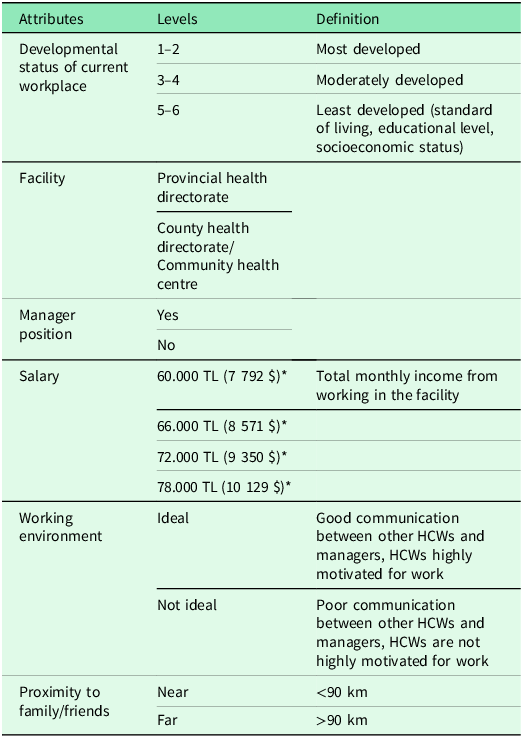
To identify relevant job characteristics (attributes) and their levels, a literature review was conducted (İşlek and Şahin, Reference İşlek and Şahin2023; Cheng et al., Reference Cheng, Tian, Chen, Shang, Gao, Dong, Guo and Liu2024; Luo et al., Reference Luo, Bai, Sun, Li, Liu, Xu and Liu2024; Tozduman and Sözmen, Reference Tozduman and Sözmen2024). These were further refined through semi-structured individual consultations with eight PHSs, focusing on the relevance, clarity, and contextual appropriateness of the attributes and levels. The final set comprised six attributes, each with two to four levels (Table 1).
Job attributes, levels, and definitions

Table 1. Long description
A table with six attributes, each with two to four levels, detailing job characteristics for health workers. The table has three columns: Attributes, Levels, and Definition. The attributes include Developmental status of current workplace, Facility, Manager position, Salary, Working environment, and Proximity to family/friends. The Levels column lists the different levels for each attribute, and the Definition column provides descriptions for each level. The table is structured to show the relevance, clarity, and contextual appropriateness of the attributes and levels for health workers.
Note: *converted with purchasing power parity (PPP) rate(‘World Bank Open Data’, n.d.).
We used JMP Pro 14 (SAS Institute, Cary, NC) to generate the choice sets. Each questionnaire consisted of 10 choice sets, comprising a total of 20 job profiles with different combinations of attribute levels. Six versions of the experimental design were created to improve statistical efficiency.
To reduce cognitive burden, a partial profile design was employed, ensuring that no more than four attributes varied within each choice set. The design was assessed for orthogonality and balance in the distribution of attribute levels.
The DCE instrument also included questions on respondents’ sociodemographic characteristics and professional experiences. Data were collected between September and November 2023. Participants received one version of the questionnaire online and were asked to choose between two job alternatives in each choice set.
To identify respondents whose choices violated basic rationality assumptions, a rationality (dominance) test was incorporated as an additional choice set. In this set, all attributes were held constant except for salary and working environment; the alternative with a higher salary and an ideal working environment was expected to be preferred. Responses to this rationality test were not included in the main analysis.
Respondents
The minimum sample size was estimated as 100 using Johnson and Orme’s method (Orme, Reference Orme1998; Johnson and Orme, Reference Johnson and Orme2003). However, rather than sampling, we aimed to reach the entire target population of PHSs.
Data analysis
Discrete choice experiment
The analysis of DCE data is based on the random utility model. Within this framework, an individual n is assumed to choose among alternative job options by selecting the one that provides the highest utility. The utility (U) derived from a given job is composed of two components: the deterministic and the random components. The utility, U, that individual n derives from job i is specified as:
Uni = Vni + ϵni Vni = α1 + β1x1ni + β2x2ni + … + βmxmni
Here Vni represents the deterministic component specified as a function of m job attributes (x1, x2, ….. xm), with ß coefficients capturing the strength of preference for each attribute level. The random component, ϵni, captures unobserved factors and individual-level preference heterogeneity (Vujicic et al., Reference Vujicic, Alfano, Shengelia and Witter2010; WHO, 2012).
All DCE data were entered into Microsoft Excel 2016 (Microsoft Corporation, USA). Descriptive statistics are presented as means (standard deviations) or frequencies and percentages. Salary was specified as a continuous variable, while all other attributes were dummy coded (1 indicating presence and 0 indicating absence).
A mixed logit (MXL) model was used to estimate preferences for attribute levels, implemented in Stata® 15.0 (Stata Corporation, USA) using user-written commands (Hole, Reference Hole2013). The salary attribute was specified as fixed to enable the estimation of willingness-to-pay (WTP), whereas all other attributes were treated as random parameters. WTP estimates were calculated as the ratio of the coefficient of each attribute level to the negative of the salary coefficient. In addition, changes in predicted choice probabilities resulting from variations in attribute levels were estimated using Hole’s mixlpred command (Hole, Reference Hole2013).
Latent class analysis (LCA)
Given the presence of significant preference heterogeneity, LCA was conducted to identify subgroups of respondents with similar preference patterns, using the poLCA package in R (version 4.3.1). Sociodemographic and professional characteristics (gender, marital status, having children, hometown, income, years of experience as a PHS, work experience in moderately or least developed regions, and managerial experience) were included to explore differences across latent classes.
The optimal number of classes was determined based on model fit criteria, including the Akaike Information Criterion (AIC) and Bayesian Information Criterion (BIC), as well as the interpretability of the resulting class structure. The model estimated class membership probabilities for each respondent, and individuals were assigned to the class for which they had the highest posterior probability.
Results
Of the 531 PHSs, 183 (34.4%) completed the questionnaire. Four respondents (2.1%) failed the rationality test; however, model estimates with and without these respondents did not differ substantially, and they were therefore retained in the main analysis. No participants exhibited dominant preferences, indicating that all respondents traded off between attribute levels.
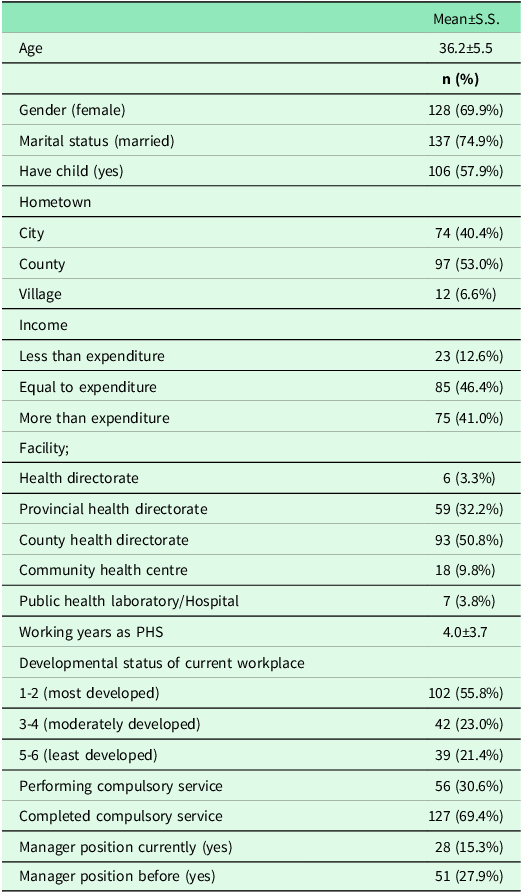
The characteristics of the respondents are presented in Table 2. Overall, 69.9% were female, and the median age was 36.2 years. Most respondents were married (74.9%), and 57.9% had children. Only 6.6% reported a rural background (i.e., having grown up in a village). Regarding income, 12.6% reported that their income was lower than their expenditure. Nearly half of the participants were working in a county health directorate or in a developed region.
The general characteristics of public health specialists

Table 2. Long description
A table summarizing characteristics of public health specialists. The table has 16 rows and 3 columns. The columns are labeled 'Mean±S.S.', 'n (%)', and various characteristics. Row 1: Age, 36.2±5.5. Row 2: Gender (female), 128 (69.9 percent). Row 3: Marital status (married), 137 (74.9 percent). Row 4: Have child (yes), 106 (57.9 percent). Row 5: Hometown (City), 74 (40.4 percent). Row 6: Hometown (County), 97 (53.0 percent). Row 7: Hometown (Village), 12 (6.6 percent). Row 8: Income (Less than expenditure), 23 (12.6 percent). Row 9: Income (Equal to expenditure), 85 (46.4 percent). Row 10: Income (More than expenditure), 75 (41.0 percent). Row 11: Facility (Health directorate), 6 (3.3 percent). Row 12: Facility (Provincial health directorate), 59 (32.2 percent). Row 13: Facility (County health directorate), 93 (50.8 percent). Row 14: Facility (Community health centre), 18 (9.8 percent). Row 15: Facility (Public health laboratory/Hospital), 7 (3.8 percent). Row 16: Working years as PHS, 4.0±3.7.
A total of 15.2% currently held managerial positions, while 27.9% had prior managerial experience. The sample broadly reflected the overall distribution of PHSs in terms of facility type and managerial roles (Report on the Employment and Managerial Status of Public Health Specialists in the Ministry of Health Positions, 2022) (Table 2). More than half of the respondents were working in highly developed regions. In addition, 30.6% were still completing compulsory service, whereas 69.4% had already completed it.
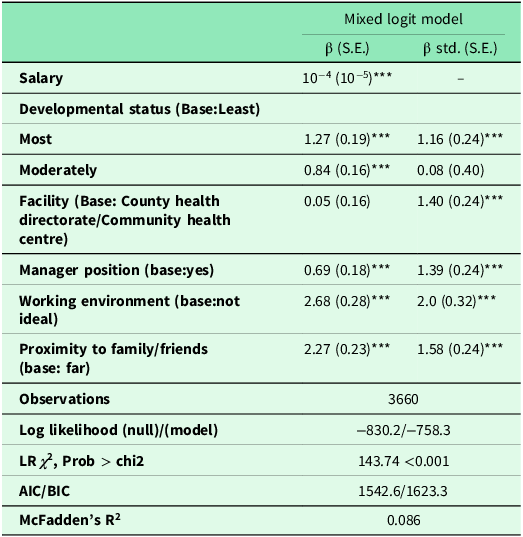
Table 3 presents the MXL model estimates. The coefficients were in the expected direction, with positive signs indicating increased utility relative to the reference levels.
Estimation results from the mixed logit model

Table 3. Long description
A table with estimation results from a mixed logit model. The table has 12 rows and 3 columns. The columns are labeled as Salary, Developmental status (Base:Least), Facility (Base: County health directorate/Community health centre), Manager position (base: yes), Working environment (base:not ideal), Proximity to family/friends (base: far), Observations, Log likelihood (null)/(model), LR χ2, Prob > chi2, AIC/BIC, McFadden's R2. The rows list different variables and their corresponding coefficients (β) and standard errors (S.E.) for the mixed logit model. The table includes specific values for each variable, indicating their impact on the model. Notable trends include positive coefficients for variables like 'Most' and 'Moderately' under Developmental status, and significant values for Manager position and Working environment.
Note: **p < 0.01, ***p < 0.001; AIC: Akaike information criterion; BIC: Bayesian information criterion.
The results showed that PHSs preferred jobs located in the most and moderately developed regions compared with those in the least developed regions (β (S.E. ) = 1.27 (0.19); p < 0.001, β (S.E.) = 0.84 (0.16); p < 0.001, respectively). Higher salary was also positively associated with job choice (β (S.E.) = 10−4 (10−5) per Turkish lira (TL); p < 0.001), along with an ideal working environment (β (S.E.) = 2.68 (0.28); p < 0.001) and proximity to family/friends (β (S.E.) = 2.27 (0.23); p < 0.001). Holding a managerial position was associated with a lower likelihood of selecting a job (β (S.E.) = 0.69 (0.18); p < 0.001). The MXL results also indicated significant unobserved preference heterogeneity across respondents, as evidenced by statistically significant standard deviations of the random parameters.
According to the LCA results, three distinct classes of participants were identified (Table S2). Class 1 (32%) comprised predominantly male respondents, more likely to originate from counties or villages, with income equal to or lower than expenditure, and with longer work experience and prior managerial experience.
Class 2 (35%) consisted mainly of female respondents, with limited work experience in moderately or least developed regions and no managerial experience.
Class 3 (33%) included mostly single participants without children, originating from urban areas, with higher income, fewer years of work experience, and minimal managerial experience.
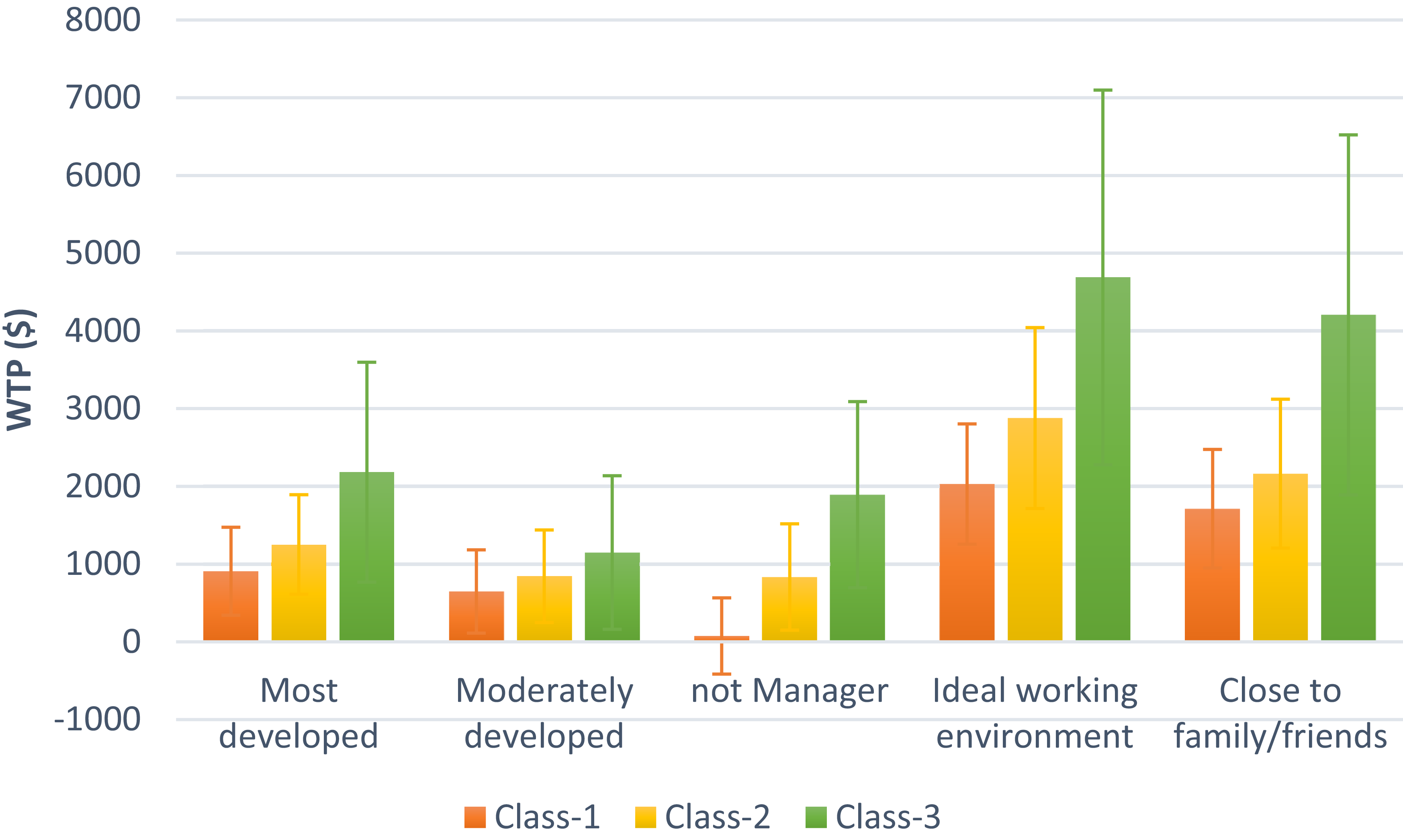
Figure 1 presents the WTP estimates for the three latent classes, converted using purchasing power parity (PPP), along with 95% confidence intervals (CIs) (the exchange rate from October 2023 of 1 US dollar = 27.8 TL, 1 Euro = 29.3 TL, PPP rate = 7.7) (‘TCMB Central Bank of the Republic of Turkey Currency Exchange Rates’, n.d.; ‘World Bank Open Data’, n.d.). Across all classes, the relative ranking of attributes was consistent. Participants in Class 1 exhibited lower WTP estimates for all attributes and did not value managerial positions. In contrast, participants in Class 2 showed higher WTP estimates across attributes, while the highest WTP values were observed in Class 3.
Willingness to pay estimation for three latent class groups.

Figure 2 illustrates the predicted probabilities of job uptake under varying job conditions, along with their standard deviations. Holding all other attributes constant (ceteris paribus), increasing the salary from 7 792 $ to 8 571 $, is associated with a 4% increase in the probability of choosing that job.
Changing in probabilities of taking a job with changing job condition.

Jobs located in moderately and most developed regions are associated with 8% and 11% higher probabilities of selection, respectively, compared with those in the least developed region. In contrast, a managerial role is associated with a 5% decrease in the probability of job choice.
An ideal working environment and proximity to family and friends each increase the probability of choosing a job by 21%. The model further predicts that a combination of proximity to family/friends, an ideal working environment, and a monthly salary of 10 129 $ would increase the likelihood of job selection by 62%.
Additional examples of combined job attribute improvements (incentive packages) and their effects on job choice probabilities are presented in Supplementary Table 3.
Discussion
This study used a DCE to assess job preferences among PHSs. Five of the six job attributes were found to significantly influence choice behaviour. Overall, participants preferred positions located in more developed regions, close to family and friends, with higher salaries, non-managerial roles, and favourable working conditions.
The MXL model revealed substantial preference heterogeneity across all attributes, indicating variability in how individuals value different job characteristics. This finding was further supported by the LCA, which demonstrated that preferences varied according to respondents’ sociodemographic and professional characteristics.
This study identified working environment and proximity to family and friends as the most influential determinants of job preferences. This finding is consistent with previous research, including a study among Chinese healthcare administration students that also emphasized the importance of working conditions (S. Liu et al., Reference Liu, Li, Li, Wang, Zhao and Chen2019). Poor working environments have been shown to increase pressure on physicians and contribute to burnout (Azam et al., Reference Azam, Khan and Alam2017) underscoring the importance of organizational factors in workforce retention. In line with this, a 2017 survey by the Turkish Ministry of Health reported that nearly half of healthcare staff believed that community health centres could function more effectively if roles and responsibilities were more clearly defined (Healthcare Employee Satisfaction Survey Turkey, 2017). In primary care settings, where multidisciplinary teams – including PHSs, family physicians, midwives, nurses, medical secretaries, environmental health technicians, and health officers – work together, effective teamwork is critical. Such collaboration depends on clear role definitions, motivated staff, and supportive relationships between supervisors and team members.
Proximity to family and friends was also a significant determinant of job preferences, consistent with findings from studies conducted in Australia and Canada (Szafran et al., Reference Szafran, Crutcher and Gordon Chaytors2001; Matthews et al., Reference Matthews, Seguin, Chowdhury and Card2012; Harding et al., Reference Harding, Seal, McGirr and Caton2016). Social support is a well-established factor in physician well-being, with lack of support associated with increased risks of depression and burnout(Kuhn and Flanagan, Reference Kuhn and Flanagan2016).
In Türkiye, regulations exist to facilitate family reunification; however, physicians are classified as strategic personnel and are subject to certain restrictions. These policies primarily apply to spouses, while reunification with other family members is permitted only under specific health-related circumstances.
Notably, in this study, single participants valued proximity to family and friends to a similar extent as married PHSs, suggesting that social support extends beyond traditional family structures and plays a broader role in job satisfaction and retention.
Consistent with previous studies, our findings confirm that salary is a key determinant of job preferences (Vujicic et al., Reference Vujicic, Alfano, Shengelia and Witter2010; Liu et al., Reference Liu, Li, Li, Wang, Zhao and Chen2019; Liu et al., Reference Liu, Li, Yang, Liu and Chen2019; Karyani et al., Reference Karyani, Matin, Malekian, Rotvandi, Amini, Delavari, Soltani and Rezaei2020; Bao et al., Reference Bao, Huang, Wang, Yan and Chen2023). This is also reflected in national data: a survey conducted by the Turkish Ministry of Health identified remuneration as the most influential factor in job satisfaction and one of the most frequently cited areas requiring reform (Healthcare Employee Satisfaction Survey Turkey, 2017). Similarly, a DCE conducted among general practitioners in Türkiye ranked salary as the second most important job attribute, further underscoring its role in recruitment and retention strategies (İşlek and Şahin, Reference İşlek and Şahin2023).
Participants also placed significant value on the developmental status of the workplace, consistent with previous studies showing that healthcare workers tend to prefer centrally located positions (Kolstad, Reference Kolstad2011; Smitz et al., Reference Smitz, Witter, Lemiere, Eozenou, Lievens, Zaman, Engelhardt and Hou2016; Liu et al., Reference Liu, Li, Yang, Liu and Chen2018; İşlek and Şahin, Reference İşlek and Şahin2023). Rural and remote areas are generally considered less attractive due to limited educational opportunities for children, inadequate infrastructure, and fewer employment options for spouses (Lehmann et al., Reference Lehmann, Dieleman and Martineau2008; Liu et al., Reference Liu, Li, Yang, Liu and Chen2018).
Although certain policies aim to mitigate these disparities – such as differentiated compulsory service durations and supplementary payments based on development status – these measures appear insufficient to address workforce shortages in underdeveloped regions (Basic Health Services Law, 1987). While rural upbringing has been associated with an increased likelihood of returning to rural practice (Lehmann et al., Reference Lehmann, Dieleman and Martineau2008), our findings did not support this pattern. PHSs evaluated the developmental status of workplaces similarly, regardless of rural or urban background. Notably, WTP estimates were highest among participants predominantly from urban areas, suggesting stronger preferences for favourable working conditions within this group.
Managerial position also had a significant effect on job preferences. In Türkiye, contractual health management was introduced in 2011 as part of the Health Transformation Program to improve efficiency, accountability, and sustainability in healthcare management (Armağan Kaygusuz, Reference Armağan Kaygusuz2022) (Law Decree Regarding The Organızation And Duties Of The Ministry Of Health And Affiliated Institutions, 2011). However, previous studies have shown that healthcare managers often report limited authority, insufficient autonomy, and unclear role definitions (Topcu, Reference Topcu2018).
Participation in decision-making processes is associated with higher job satisfaction (Whalley et al., Reference Whalley, Bojke, Gravelle and Sibbald2006). Consistent with this, a 2010 survey by the Ministry of Health reported higher satisfaction among administrative personnel compared with clinical staff (Healthcare Employee Satisfaction Survey Turkey, 2010) and a subsequent survey in 2017 indicated that managerial roles may enhance satisfaction through financial incentives, promotion opportunities, and increased responsibility (Healthcare Employee Satisfaction Survey Turkey, 2017).
In addition, factors such as experience, autonomy, resilience to burnout, and occupational prestige have been shown to influence job satisfaction (Visser et al., Reference Visser, Smets, Oort and Haes2003). In the present study, holding a managerial position did not have a negative effect on job preferences among PHSs with more than five years of experience or prior managerial roles. This may suggest that, with increasing experience, greater adaptability and adjusted expectations contribute to higher levels of job satisfaction.
Conclusions
Key job features associated with improved recruitment and retention include proximity to family and a supportive working environment characterized by strong communication and high motivation within multidisciplinary healthcare teams. Financial incentives also play a significant role, particularly for managerial positions, where additional compensation appears to be especially important for junior PHSs without prior managerial experience.
Overall, combinations of monetary and non-monetary incentives tailored to individual characteristics are likely to be more effective. Consistent with previous DCE evidence, policies that account for preference heterogeneity – rather than adopting uniform, one-size-fits-all approaches – are more likely to enhance the recruitment and retention of PHSs.
Strengths and limitations
This study is, to our knowledge, the first to apply a DCE methodology to investigate job preferences among PHSs in Türkiye. A further strength is the inclusion of a rationality (dominance) test within the choice sets, enabling the identification of responses that violate basic rationality assumptions.
Several limitations should be considered. The response rate of 34.4% may be regarded as a limitation; however, it is comparable to those typically reported in web-based surveys. To maximize participation and approximate comprehensive coverage of the target population, the questionnaire was disseminated repeatedly through multiple online channels. Despite these efforts, the possibility of non-response bias remains, and the findings should therefore be interpreted with caution in terms of their generalizability.
In addition, the hypothetical nature of DCEs may result in discrepancies between stated and actual (revealed) preferences. Furthermore, DCEs necessarily simplify complex decision-making contexts by limiting the number of attributes and levels; as a result, other relevant job characteristics influencing employment decisions may not have been captured. Therefore, policy makers should interpret and validate DCE-derived evidence in conjunction with real-world data before implementing specific intervention packages (Araújo and Maeda, Reference Araújo and Maeda2013).
Supplementary material
The supplementary material for this article can be found at https://doi.org/10.1017/S1463423626101510.
Data availability statement
The data supporting the findings of this study are not publicly available but can be made available upon reasonable request to the corresponding author.
Acknowledgments
There are no specific individuals or organizations to acknowledge.
Authors’ contributions
BT: Conceptualization, Methodology, Formal Analysis, Writing – Original Draft, Writing – Review & Editing. IZ: Data Curation, Investigation, Writing – Review & Editing. All authors read and approved the final version of the manuscript.
Funding statement
This research received no specific grant from any funding agency in the public, commercial, or not-for-profit sectors.
Competing interests
The authors declare no conflicts of interest relevant to this work.
Ethical standards
This study was approved by the Non-Interventional Research Ethics Committee of Dokuz Eylül University (Decision No: 2023/27-13). Informed consent was obtained electronically from all participants prior to data collection.
The research was conducted in accordance with the principles embodied in the Declaration of Helsinki. Ethical approval was obtained from the Ethical Committee of Noninvasive Clinical Research (Approval number: 2023/27-13). All participants provided informed consent prior to their inclusion in the study. Only those PHSs who agreed to participate were included in the study.


 Open access

