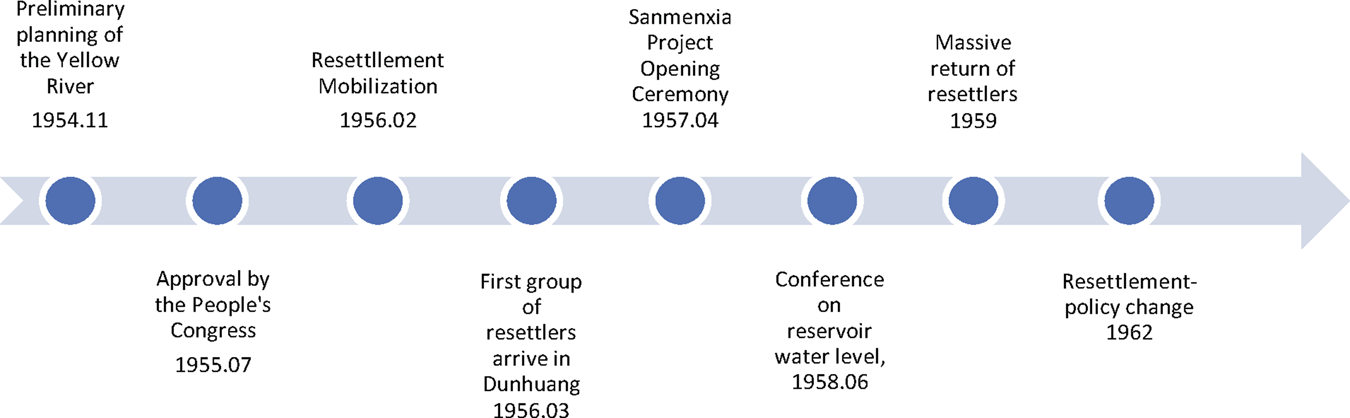
On July 21, 1955, the People's Daily published a report entitled “A Great Plan to Change the Yellow River is Announced!” In this report, the Communist state informed the Chinese people and the world that it would build a large-scale concrete dam on the Yellow River at Sanmenxia between Henan and Shanxi provinces. The project would bring the benefits of flood control, hydroelectricity, irrigation, and transportation.Footnote 1 While propagating its potential benefits and sublimity, the report left out the displacement of hundreds of thousands of inhabitants in the designated-reservoir area. Throughout China's long history, population displacement and migration have been both an outcome of and a fundamental driving force behind political and economic changes. State-sponsored frontier resettlement consolidated state control and facilitated economic and cultural interactions between the Han Chinese and other ethnic groups. When people had to migrate to survive during times of drought, flood, or famine, these movements often led to the fall of an old dynasty and the rise of a new one. The Chinese people continued to be susceptible to displacement during the twentieth century.Footnote 2 Various rationales caused the internal migration of Chinese people during the Mao era. Existing studies present economic and political concerns as the two major incentives, and these motives were often entangled.Footnote 3
Timeline of the Sanmenxia-Project Construction and Reservoir-Resettlement in Henan

In the 1950s and early 1960s, with the rise of the water-conservancy campaign and the pursuit of hydroelectricity, hundreds of large-scale dams were built across China. To make room for large reservoirs, about 7.8 million people were displaced from their homes.Footnote 4 In her brief coverage of the reservoir displacement in China in the 1950s, Diana Lary summarizes the difficulties that resettlers faced: “far away from their homes; there was seldom spare land locally. The loss of land meant the loss not only of a livelihood, but also the loss of home, ancestors, graves, and a sense of belonging.”Footnote 5 This was true of the Sanmenxia project in particular. As the first concrete dam on the Yellow River, the Sanmenxia project was controversial from the beginning. In the early 1940s, Japanese engineers aimed to develop hydroelectric power by building dams on the Yellow River. They viewed the Yellow River as an important source of hydroelectric power for building the Greater East Asian Co-Prosperity Sphere. When Chinese Communists took control, after 1949, they claimed that the primary function of the Sanmenxia project would be flood control. Yet, influenced by the Soviet Union and the Chinese Communist state's industrialization efforts in the 1950s, the engineers also emphasized the generation of electrical power, which resulted in a high dam design. The design of a mega-hydropower project like the Sanmenxia determined the amount of land due for submersion and the number of inhabitants fated for displacement. To create a large reservoir for flood control and electricity generation, the original proposal was a reservoir of 360 meters above the sea level. It would displace more than 870,000 residents in the region. The scale of the displacement was so daunting that some hydraulic specialists such as Huang Wanli and many Shaanxi officials fiercely opposed it. As a compromise, the water level was lowered to 335 meters, which resulted in the displacement of around 37,3678 inhabitants along the upriver of the dam in Shaanxi, Shanxi, and Henan provinces.Footnote 6 In the early 1960s, shortly after the dam's completion, the high dam caused serious silting of the reservoir. As a result, it led to the remodeling of the dam and much lower and unstable power output.Footnote 7
Judith Shapiro's study of the Sanmenxia project largely focuses on the experience of hydraulic engineer Huang Wanli and concludes that radical Maoism led to the repression of intellectual freedom and military-style assaults on the natural world.Footnote 8 In his recent book on the Yellow River, David Pietz introduces the construction and reconstruction of the Sanmenxia Dam, emphasizing the idea of multipurpose development of rivers in the twentieth century.Footnote 9 Yet, without incorporating information from local archival sources, Pietz does not examine the local and social impact of the mega-dam, particularly the reservoir displacement. In Chinese literature, Hu Yingze discusses the Sanmenxia reservoir's impact on the shoaly lands shaped by the river and villagers along the Yellow River between Longmen and Tongguan. He concludes that the Sanmenxia reservoir caused the deterioration of the ecological system of the river valley from Shaanxi to Shanxi by destabilizing shoaly lands along the Yellow River.Footnote 10 Unlike the existing scholarship, this article focuses on the human and social cost of the Sanmenxia hydropower project.
Among the 373,678 reservoir resettlers, the majority were resettled to places with a higher altitude nearby their original homes. Meanwhile, 32,380 resettlers from Shaanxi province and 7879 resettlers from Henan were resettled to Ningxia and Gansu respectively.Footnote 11 In the 1990s, freelance writer Leng Meng interviewed the Sanmenxia-reservoir resettlers and local cadres in Shaanxi province and revealed their struggles to the public for the first time.Footnote 12 In the late 2000s, another writer, Xie Zhaoping, followed in Leng's footsteps, interviewing these reservoir resettlers and delving into the corruption of local officials in Shaanxi.Footnote 13 From a grassroot perspective, both Leng and Xie recorded the suffering and poverty of reservoir resettlers from Shaanxi. In the 1980s, upon learning that their farmlands would not be inundated, thanks to the remodeling of the dam and change of its operation mode, these resettlers wanted their homeland back. Unfortunately, their lands had been occupied by state-owned farms and military institutes. Through years of collective struggle, they reluctantly compromised with state authorities to take back only part of their lands. Yet, Leng and Xie left out the experience of resettlers from Henan. This article serves as a complement to their works: unlike Leng and Xie who rely on interviews, I turn to county and provincial archival documents produced in the 1950s and 60s. Composed by government officials, archival sources are selective and biased in nature. However, they still contain valuable written records of the state-initiated displacement process, which include but are not limited to complaints and resistance from resettlers. With references to Leng's and Xie's works, and critical analysis of official reports, this article combines with theirs to provide a more complete picture of the administrative mechanism on the ground and the human costs of the Sanmenxia hydropower project.
This article examines the experience of Sanmenxia-reservoir resettlers from Shaanxian and Lingbao counties of Henan province. This group of reservoir resettlers shared a similar displacement experience with their Shaanxi counterparts. In the historical context of socialist collectivization, they were involuntarily resettled in Dunhuang, a frontier garrison on the Silk Road that connected Central Asia and China proper (now a county of Gansu province under the People's Republic); after fleeing back to Henan they were repatriated to their resettled places, going back and forth multiple times.Footnote 14 For years, they were unable to acclimatize themselves to the natural environment and indigenous communities in Dunhuang, nor were they allowed to resettle in their native places in Henan; as a result, most resettlers had no permanent place to shelter themselves. Through an examination of the mobilization, resettlement, flight, repatriation, and eventual resettlement nearby their original homes, this article seeks to illustrate the state-initiated displacement process via the lens of local cadres and resettlers. The Maoist state-led rural collectivization intended to transform individual peasants into socialist laborers; the frontier reclamation aimed to transform vast wasteland into socialist granaries; and the pursuit of mega-dams sought to transform every drop of the river into energy for socialist state building. While recognizing the local specificity of socialism and our limited understanding of the effects of campaigns in rural China, this study suggests that we should pay attention to interregional dynamics and tension inside China and the importance of infrastructure construction as a carrier of state policy and direct stimulus social changes in the Mao years.Footnote 15 Through examining the implementation of Mao's demographic engineering and the agency of reservoir resettlers, this article aims to demonstrate the complexity of the displacement process and the resilience of the Chinese people. As subjects of the state-led resettlement program, many of the resettlers complied with local cadres. However, to sustain themselves, many later would overtly or covertly defy the state-resettlement policy in order to survive.Footnote 16 While the silting of the reservoir and remodeling of the concrete dam denoted a setback to the Communist state's hydroengineering ambition, the correlated rural collectivization and the lack of material support aggravated the already challenging long-distance reservoir resettlement and thus exposed the limit of the Communist state's social and demographic engineering efforts.
Mobilizing Reservoir Inhabitants to go to Dunhuang
Shaanxian and Lingbao are located in western Henan on the verge of the Loess Plateau; their combined population was 435,100 by 1952.Footnote 17 Like most other areas of Henan, the local economy of the two counties centered on agriculture. Yet, unlike the central plain in the east, more than 90 percent of their territory is hills or mountains. The most fertile lands lay along rivers that pass through the counties, mostly along the Yellow River. Unfortunately, those were the lands that would be submerged by the rising reservoir. According to the Republican gazetteer of Lingbao, most inhabitants had lived there for generations without ever leaving their villages. Local elites complained that local residents of these two counties lacked national consciousness in the nation-building efforts. Most villagers were indifferent to the baojia system.Footnote 18 In contrast, through land reforms that redistributed lands and other assets among the peasants, the Communist government successfully demolished previous economic and political orders that centered on landlords and the gentry; in rural China, Party branches took their place.Footnote 19
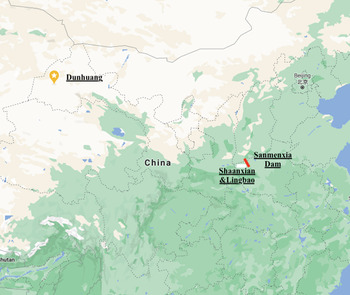
Approximate Location of the Sanmenxia Dam and Dunhuang

In the 1950s, the Chinese Communists followed the model of the Soviet Union, making rapid industrialization the country's economic priority. In other words, the government practiced extractive policy on the Chinese peasants.Footnote 20 In general, the intimate relationship between the Communist government and Chinese peasants persisted until hunger killed millions of peasants in the late 1950s.Footnote 21 Yet, for residents in the Sanmenxia-reservoir region, the tension started a few years earlier. Following the approval of the Sanmenxia-project plan by the state council in July 1955, the state and local administrators commenced to relocate inhabitants in the designated-reservoir area in early 1956. In the very beginning, many reservoir residents preferred to move upward, resettling in higher-altitude places that were not far from their old homes; this allowed them to still have access to their farmland before the water rose. Therefore, Shaanxian county secretary Hao Yujiang 郝玉江 and Lingbao county secretary Zhang Wenying 张文英 proposed to resettle reservoir residents to higher-altitude places in the two counties. They believed that short-distance resettlement would minimize the cost.Footnote 22
Meanwhile, the Communist central government started a national demographic-engineering project, which required densely populated provinces to send laborers to frontier areas, such as Xinjiang, Gansu, Inner Mongolia, and Heilongjiang for land reclamation.Footnote 23 Henan was among one of the most populated regions. Following the call from the top Party leaders, Henan provincial leader Wu Zhipu 吴芝圃 decided to send four million people to the frontier regions before 1959.Footnote 24 People in poverty, especially those who frequently suffered from the effects of natural disasters, became the major candidates for reclamation resettlement. In addition, people who were affected by hydraulic and hydropower projects or other public infrastructure projects were also included in the state-sponsored resettlement. According to the quota assigned by the Henan provincial government, Lingbao and Shaanxian were asked to send 7,000 resettlers to Dunhuang for land reclamation. Both the central and provincial policy makers believed that sending residents from the area near the planned Sanmenxia reservoir to Dunhuang would be a way to kill two birds with one stone.
In the twentieth century, technological innovations and the rise of high modernism had fundamentally transformed the human–nature relationship. From the high-modernist perspective, every person was a valuable laborer, and every drop of the river and every inch of territory were resources. Labor, water, and land were different forms of energy carriers. Leveraging them could maximize the state's capacity to extract energy for modernization. A mega-project like Sanmenxia on the Yellow River promised tremendous energy production that would include electricity generation as well as agricultural-output growth through irrigation expansion and flood elimination. Meanwhile, the building of a reservoir would submerge farmlands, villages, and towns. In order to decrease the negative impact and cost of reservoir displacement, the Communist state chose to resettle reservoir residents to the northwestern frontier regions for reclamation. Therefore, in the official narrative of the Sanmenxia-reservoir displacement, clearing the space for the reservoir and transforming the so-called frontier wasteland into fertile farmland for agricultural growth became an “honorable” assignment for these reservoir residents.
However, “designed or planned social order is necessarily schematic; it always ignores essential features of any real, functioning social order.”Footnote 25 In this process, those reservoir residents’ original residences would be submerged or simply demolished. Even worse, in the process of adapting to the destination communities, it would be difficult for them to earn their living without their own farmland. While the design and the remodeling of the dam posed a technical challenge, the reservoir displacement and resettlement posed a political and social challenge to the local governments and people.
In the post-Mao era, the standard process of reservoir resettlement could be divided into three phases: first, mobilization or education and persuasion which aimed at winning the cooperation of reservoir residents; second, relocation or the payment of compensation for old houses and land prior to the allocation of new land, along with the construction of new houses and new site infrastructure; third, production development or providing the means of production to generate improved incomes.Footnote 26 During the Mao years, however, the socialist rural collectivization and the Great Leap Forward simplified the process and aggravated the hardship of the Sanmenxia-reservoir resettlers.
Taking it as a political assignment from their superiors, local governments in both the origin and destination areas made the resettlement program a priority. From the Communist cadres’ perspective, the process would require the ideological and political education of the masses to successfully accomplish reservoir displacement.Footnote 27 To mobilize the masses, the state needed to organize an efficient team of propagandists and exert force. The county governments summoned village cadres and activists for meetings, informing them about the resettlement decision and further training them on how to mobilize the masses. Through years of building political revolution and pursuing land reform, the Communist Party had developed both a Party-centered administration and mobilization tactics in rural China.Footnote 28 The official propaganda underlined that the project would bring safety and economic prosperity to eighty million people in the lower Yellow River region. The “inevitable” cost of the security of tens of thousands of residents in the reservoir area was worth it.
In Henan, along with local cadres and activists, local governments of the two counties also mobilized primary-school teachers, students as well as amateur troupes to perform drama and patter in streets and markets beginning in mid-February of 1956. They took advantage of broadcast facilities and group meetings to indoctrinate people as to the economic benefits and political significance of the reclamation-resettlement program and the hydropower project. Cadres from Gansu also came to Henan to assist the mobilization. Through visiting villages and households, the group aimed to resolve the resettlers’ concerns and hesitation. The cadres said that under the leadership of the Communists, the people of Dunhuang had eliminated flood and drought disasters by using river and spring water for irrigation. In contrast, many places in western Henan area still “relied on heaven for food,” as no efficient irrigation system was available. To help members of the to-be-displaced communities sacrifice their self-interest and embrace the socialist construction enterprise, these cadres presented a positive image of the agriculture-friendly natural environment and virtuous indigenous residents in Dunhuang.
Seeing is more persuasive than hearing. Hence, from Shaanxian and Lingbao counties, officially selected resettler delegates who were seen as politically reliable, as well as local cadres, took an inspection tour to Dunhuang. No individual survive, only the official report of the tour, which said that the delegation learned that Dunhuang had over 250,000 mu of arable land and that the population was merely 40,000. The area urgently needed laborers from other places to cultivate those lands. Dunhuang's natural environment was very suitable for wheat and cotton cultivation. People in Lingbao and Shaanxian were more experienced in cotton cultivation. Therefore, the report concluded that resettling reservoir residents from Lingbao and Shaanxian in Dunhuang would not only pave the way for the reservoir project but also would benefit the socialist agricultural expansion. In hindsight, the resettler delegation and its report was clearly part of the government's propaganda tactic. According to interviews of activists and local cadres from Shaanxi, resettler delegates were under huge political pressure to comply with the state resettlement policy, and they were prohibited from sharing any negative aspects of the designated resettlement place with the public. Some migrant cadres later would confess that they had deceived their fellow villagers.Footnote 29
Following the delegation's return, both the Lingbao and Shaanxian county governments immediately summoned all district and commune cadres for meetings, mobilizing them to work hard to persuade reservoir residents to go to Dunhuang. In the meetings, the county secretary and magistrate introduced the positive situation in Dunhuang, proposing slogans like “Resettlers are honorable,” “One person moves, ten thousand people are safe,” “One household moves, ten thousand households are saved,” and “Develop the Northwest, support the frontier.” Unlike the “welfare” resettlers from disaster-stricken regions, according to the Party secretary of Shaanxian, Sanmenxia reservoir would be resettled at Dunhuang to help the Dunhuang peasants cultivate cotton.Footnote 30 Therefore, many reservoir resettlers believed that they would be highly respected in Dunhuang. To accomplish the quota assigned by their superiors, many resettlement administrators chose to exaggerate the advantages of Dunhuang while downplay the challenges. For example, some cadres praised Zhangye, the district which Dunhuang County belonged to:
There are green mountains, rivers never stop flowing, many cattle and sheep wander on the grassland. We never worry about food, because we have granaries full of grain; we use tractors to plow the land, electric bulbs to light the darkness. Schools and hospitals are everywhere; socialism relies on hard work; our happy life shall last for tens of thousands of generations.Footnote 31
As suggested above, local-resettlement cadres did realize that material incentive was indispensable in persuading people to move. However, to complete the resettlement goal set by their superiors, cadres from Gansu failed to provide a more complete picture of the material conditions and natural environment in Dunhuang. As an oasis surrounded by the Gobi Desert, Dunhuang's annual precipitation was under fifty mm and the potential for agricultural expansion in the area was thus limited. Because the official propaganda downplayed the climatic and geographic differences between the two places, many resettlers would find themselves unprepared upon their arrival at Dunhuang.
Nonetheless, not all reservoir residents would buy the official propaganda; local cadres also resorted to coercive methods. Those who complained about the resettlement or resisted cooperation with the government would be criticized as ideologically and politically “backward.” In the Maoist social classification, some reservoir residents were classified as landlords, rich farmers, or people with criminal records. Any complaints from them would be labeled as anti-revolutionary rumors. The Maoist proletariat dictatorship justified the suppression of dissidents before and during the displacement process. Even though many peasants were reluctant to leave their relatives and properties behind, very few of them dared to express their personal opinions on the resettlement program in public.
According to the official resettlement policy, people had to meet certain criteria to be chosen as frontier resettlers. Under the influence of Marxist class-revolution theory and the Chinese Communist Party's social classification in rural China, the government took reservoir residents’ class identity as the essential criterion to select qualified resettlers. Only people with superior class identities, such as poor or middle peasants, would qualify.Footnote 32 The reclamation resettlement also valued laborers. Families with seniors and children were considered potential burdens, and thus were not preferred. Despite the importance of class identity in the official policy, some former landlords and other politically “backward” people requested to be included in the long-distance resettlement program, hoping to start a new life in a new milieu. In those cases, the county resettlement committee would consult village cadres for their evaluation of those applicants. For instance, Su Yuren 苏玉仁, a former landlord from Shengli agricultural commune, applied for migration to Dunhuang to reunite with his family. The letter the commune cadre addressed to the county resettlement committee reported that Su was passive in political movements. From the beginning of collectivization, he had been sentenced to two years confinement in the commune from 1956 to 1958. Moreover, the commune cadres were skeptical of the motivations of Su's resettlement request and stated, “First, his woman was afraid of intensive labor during the confinement period. Second, he wanted to get rid of his landlord identity by moving to a new place.”Footnote 33
In the official vetting practice, however, regardless of the political identity of the applicant, meeting the assigned resettler quota was the major concern of local cadres. Although Su was labeled as dishonest, local cadres in Henan were happy to let him go, because he was obviously seen as a political burden to the commune. Despite the violation of the political requirement and the potential threat to the sustainability of the resettlement program in Dunhuang, local cadres in Henan did send so-called “politically backward” people like Su to the frontiers for land-reclamation resettlement. However, the special correspondence about Su's case between local cadres also suggested that local cadres were cautious of sending “hostile” classes to Dunhuang. In other words, it also suggests that the majority of the long-distance-resettlement families were poor or middle peasant classes.
To cultivate a positive atmosphere for the mobilization, the government claimed that more than 1,000 people voluntarily had submitted applications and pledge letters asking to migrate to Gansu to the local government. Local cadres reported to their superiors that people were enthusiastic toward the resettlement program. Fathers encouraged sons, wives encouraged husbands, and brothers encouraged each other to apply for the reclamation-resettlement program. Whereas the official reports exaggerated the enthusiasm of the reservoir residents, we should also realize that for reservoir residents, upon learning that their lands would be submerged and there were arable lands available in Dunhuang, many of them believed that resettling at Dunhuang would be a better choice than staying in the Sanmenxia area.
In the meantime, many residents were worried about the forthcoming resettlement. The sentiment of “reluctant to leave my hometown” was common among many seniors. In villages along the Yellow River, some villagers started to sell their furniture, some spent all day drinking and eating, with no motivation for work. Some seniors said, “(Rather than leaving) we had better take some poison and die in Shaanxian.”Footnote 34 In contrast, many young people were more curious about the outside world; they were in favor of resettlement and thus easy to mobilize. To ease the anxiety of the resettlers and make resettlement permanent, the local government also encouraged close relatives of reservoir resettlers who were not directly involved in the reservoir displacement to join the resettlement program. For those who refused to cooperate, local cadres would not hesitate to demolish their houses or use other coercive methods. In the end, with the promise of land and material support in Dunhuang and the persuasive and coercive mobilization efforts made by local cadres, Lingbao and Shaanxian completed the resettlement registration on time. The official document recorded that there were around 7,879 registered reservoir residents ready to go to Dunhuang, which exceeded the quota of 7,000 residents assigned by the provincial government.
Daily Life and Struggles in Dunhuang
On the night of March 12, 1956, under the surveillance of resettlement cadres, the first group of selected resettlers started their journey to Dunhuang. When the migration started, many pledged villagers were hesitant to leave. Some even jumped off the train when the journey started. Unfortunately, because of the lack of medical service, the long journey led to the deaths of eighteen resettlers, including eleven older people and seven babies.Footnote 35 They had to spend several days on the train from Henan to Hongliuyuan railway station in the west of Zhangye and then take a bus to Dunhuang. It took at least a week to arrive at their destination. When they transferred at the Hongliuyuan railway station, to prevent the spread of cotton bollworm, the Gansu government requested the steaming of all resettlers’ clothes and quilts. Without advance notice or an explanation, many resettlers felt they were being looked down upon and took it as a discrimination against them. In addition, many of them worried that the steam could damage their belongings. Some seniors, in particular, were upset when Gansu administrators took away their clothing for steaming.Footnote 36 Nonetheless, the sanitizing of all cotton belongings was performed before the resettlers’ arrival at Dunhuang.
Although the resettlement to Dunhuang was part of the state hydroelectric and land-reclamation projects, the central and local governments left specific resettlement costs to Dunhuang inhabitants and the Henan resettlers themselves. Before the arrival of resettlers, official reports claimed that the Dunhuang government visited every designated household to persuade them to accommodate resettlers from Henan. Local officials stated that “socialist construction needs people, and it is for the people, nothing could be done without people (labor).”Footnote 37 Despite the fact that many resettlers from Henan were struggling because of the displacement, in Gansu officials’ propaganda, these resettlers were held up as socialist models. “Henan people are progressive and have high political consciousness. They positively follow the call of the country, leaving their hometown behind to support the socialist construction. We should learn from their high socialist consciousness and patriotism.”Footnote 38 In the end, local cadres persuaded some indigenous residents—but also mandatorily assigned many others—to assist the resettlement program.
Moreover, Gansu cadres also organized native residents to stand in line to welcome resettlers from Henan at the railway station. In order to reduce the cost of resettlement, most resettlers were settled sparsely in different agricultural communes. In an official report, Dunhuang County cadres promised to have “eight things” ready for resettlers upon their arrival: housing, a kang (bed), stove, vat, flour, light, oil, and a meal.Footnote 39 Yet, we shall see that local accommodations were very limited, if there were any. According to the testimonies of resettlers from Shaanxi to Ningxia, they had to dig caves to shelter themselves upon their arrival at the officially designated resettlement sites.Footnote 40 Moreover, to strengthen the bond between resettlers and local inhabitants, female cadres also acted as matchmakers. In the first year of resettlement, some resettlers became engaged to or married local people. In Dunhuang County, resettler-indigenous couplings accounted for seven marriages, twenty-four engagements, twenty-one couples in relationships, and fifty households in sworn kinships.Footnote 41 At the beginning of the resettlement process, according to the official narrative, resettlers and indigenous residents got along well—like a big family.
However, the officially cultivated harmonious situation did not last long. Custom differences, housing shortages, unfair treatment, and the dry, windy, and cold climate in Dunhuang stimulated serious homesickness among resettlers from Henan. In daily life, without any property, the resettlers often borrowed donkeys, mills, and crates from local households without giving any form of payment. Some goods were accidentally broken or lost by resettlers. Thus some local residents were no longer willing to share their goods with their new neighbors. Or, if they did, they added extra charges that made the resettlers feel unwelcome.Footnote 42
Moreover, surrounded by Gobi Desert, Dunhuang had precious little surface water. The shortage of drinking water exacerbated the challenges for these resettlers. Most local households built cellars to collect rain as drinking water for people and livestock. Henan resettlers, however, disliked sharing a water cellar with livestock. Meanwhile, local residents were upset that the resettlers used water cellars to wash clothes, which was a huge waste of water in the arid natural environment. Trees and shrubs were rare and valuable in Dunhuang. Local people relied on them to protect villages from the threat of sandstorms and moving dunes. Without any experience of living in the Gobi Desert, some Henan resettlers felled trees for fuel, which was not appreciated by local residents. Compared to Sanmenxia, Dunhuang was much colder in the winter. There were less water resources and a lower annual precipitation. People were resettled in Dunhuang in the name of farmland expansion, but it turned out that most of the so-called wastelands were not arable. Their reclamation efforts destroyed the fragile ecology of the meadows and other types of land surrounded by the desert. In other words, Henan resettlers struggled to acclimate themselves to the natural environment of Dunhuang.
Unable to open up new farmland, these resettlers had to work in the same fields with local residents. As members of communes, many resettlers complained of how local commune cadres recorded working points and deducted payments. They earned fewer working points than local residents for doing the same work. For instance, in Fengquan commune of Nuanquan district, resettler Liu Yongzhi 刘永治 worked together with local commune members in the same field to remove wheat straws. The native commune members received eighteen points each day while Liu received only twelve points. During the harvest, sixteen resettlers reaped nine mu while twenty local villagers reaped seven mu, but the natives still received eight more working points than the resettlers each day.
Unsurprisingly, violent confrontation between the resettlers and local residents started to emerge. In January of 1957, there was a massive gang fight involving hundreds of resettlers from Henan and natives in Minle County, on the southeast of Dunhuang. Although reservoir resettlers were not directly involved in this conflict, the tension spread widely in Gansu.Footnote 43 In Dunhuang, violent confrontation was limited on the individual level, but tensions persisted despite the Gansu government's mitigation endeavors. In 1958, as Dunhuang County started the transition into people's commune, the county Party secretary, Ma Jiying 马骥英, made the demand that all villages must contribute half of their cattle and sheep to the commune. To avoid the requisition, many villagers chose to slaughter their livestock. Even worse, many requisitioned cattle and sheep died because of mismanagement.Footnote 44 Therefore, local villagers lost their sideline production to the collectivization process. With the lowering of living standards and emergence of starvation, many local villagers started to blame the resettlers for causing their daily difficulties.
The tension existed not only between ordinary resettlers and local inhabitants but also between resettler cadres and native cadres. To ease the management of resettlers from Henan in Dunhuang, village cadres from Henan were arranged to maintain their identity as community leaders in Dunhuang. Consequently, local cadres were worried that the resettler cadres might undermine their authority. They therefore excluded resettler cadres from the policy-making process in the communes. According to official design, the cadres from Henan were supposed to act as moderators between the resettlers and local cadres in case of confrontation. Having been excluded by local cadres, they limited their efforts to help the resettlers to settle in Dunhuang. For instance, resettler cadre Liu Shuanzhou 刘栓周 said, “Local cadres don't trust me. Many resettlers complained about the difficulties of living in this place. I'd better leave all these issues behind. If the resettlers choose to go back to Henan, so will I.”Footnote 45 As mentioned above, local cadres treated the resettlers as a burden. For example, Wang Yukuan 王玉宽, accountant of the fifth production team, Hongdun 红墩 Commune, yelled at a resettler who had complained about the difficulties, “Get out of here if you don't want to stay. Who the hell invited you here!”Footnote 46
The rise of the Anti-Rightist Movement in 1957 aggravated the politicization of the resettlement issue. Historian Cao Shuji has stated, “In rural China, county leaders were the ones who set traps. The Party's attack against rightists at the grassroots was a ruse meticulously planned by the local leaders who carried it out.”Footnote 47 In Dunhuang, local cadres took advantage of the political movement to consolidate their power. The complaints and protests from the resettler cadres about the resettlement policy were construed as anti-Party sabotage. Thus, some resettler cadres were classified as rightists. For example, Chen Zhaoxiang 陈兆祥, who worked as secretary of the Grain Office in Lingbao County before moving to Dunhuang, had been appointed as a cadre in the Financial and Trade Department of the Dunhuang County government. Because of the unfair treatment and housing difficulties, many resettlers from Henan turned to Chen for help. Chen wrote a letter to the vice secretary of Zhangye District, urging the district government to intervene and find solutions. During the Anti-Rightist campaign, Chen's colleagues in the county government defamed the letter and his meetings with Henan resettlers as evidence of his counter-revolutionary activities. Moreover, along with Chen, other cadres from Henan were labeled as members of an “anti-party clique” because “they incited disturbances among the resettlers.”Footnote 48 In June 1958, following a month of public denouncement against Chen, he was officially sacked from the Party; he lost his government position and was sent to Huangdunzi 黄墩子 state farm for labor reeducation. His wife was also fired by the state-run food company she worked for.Footnote 49 The resettler cadres were supposed to consolidate the resettlement program. To the contrary, political attacks from their counterparts in Dunhuang during the Anti-Rightist Movement eroded their determination to establish permanent resettlement in Dunhuang. Many of them would flee Dunhuang in the following years.
Before their departure for Gansu, both the Henan and Gansu provincial governments promised the resettlers new dwellings. Unfortunately, the limited budget made this an empty promise. With the rise of the Great Leap Forward, provincial and county government officials shrugged off their responsibility to provide residences to the resettlers. Instead, they claimed that agricultural cooperatives, communes, and the resettlers should rely on themselves to solve the housing issue. As already mentioned, most resettlers relied on the generosity of their host families in Dunhuang for temporary shelters. The very limited newly built shelters for resettlers were in bad shape. Many of the so-called new residences either had no doors or the walls were too thin to keep the occupants warm. Not being informed by the resettlement officials about the low winter temperatures in Dunhuang, many resettlers from Henan were not prepared for the freezing weather. Most local people had fur coats to keep warm in winter; in contrast, few resettlers had anything warm enough. For example, there were five people in resettler Fan Shouren's 范守仁 household but only one thin quilt. Children in the family were so cold that they could not stop crying and screaming on winter nights.Footnote 50
People needed timber to build shelters. However, Dunhuang was located in the middle of the Gobi Desert, and trees were rare and highly regarded in ecological terms. Timber had to be purchased from other parts of the country, and the costs of long-distance transportation made the price of timber much higher than the national average. The resettlers could not afford timber without financial assistance from the state. According to official records, the central government did provide limited funding to the Gansu provincial government for reservoir resettlement, but the county and commune cadres appropriated the money for administrative expenditure. Two years after their arrival, many resettlers still lived in temporary cellars. In 1959, around 30 percent of the resettlers still had to move frequently because of the lack of permanent shelter.
In 1956, the first year of these resettlers’ arrival, Dunhuang suffered serious drought. Without enough water for irrigation, the agricultural output was lower than in previous years. Moreover, under government direction, some cultivated lands and most newly reclaimed lands were turned into cotton fields. The inflow of resettlers from Henan significantly increased the demand for food, while there was no growth in supply. There were only two meals each day: one in the morning around ten, another in the evening. As newcomers, many resettler families could only get two- or three-days grain rations for each week.
During the Great Famine, thanks to the radical policy of local Party Secretary An Zhen 安振, Zhangye District suffered the worst of Gansu province.Footnote 51 It was reported that “severe famine has become prevalent, and people have been eating tree bark and grass roots to satisfy their hunger.”Footnote 52 There was also cannibalism in Gansu. On April 4, 1961, at Zhangye's railway station, a local peasant named Zhao Yuyin bought 1.5 kg meat and a pair of leather shoes. On his way back, he opened his purchases and discovered that the meat was in fact flesh from a human face, with a nose and ears, which were still identifiable.Footnote 53 As to the resettlers from Henan, no explicit official record has been found of the death toll of people who died from starvation. One archival document in the Dunhuang County Archives records that more than 110 resettler children and seniors died of measles and typhoid fever in the winter of 1958. For those who were still alive but too sick or too weak to work in the field because of malnutrition there was little if any help: instead of taking good care of them with extra supplies, some commune cadres would reduce the already insufficient food ration of those sick resettlers. The cadres defended this inhumane practice by saying that those resettlers did not deserve equal rations because they did not contribute to agricultural production equally.Footnote 54
In retrospect, under pressure from local cadres, local residents of Dunhuang were urged to contribute to the socialist demographic-engineering efforts. In the beginning, they did share their food, dwellings, and other resources with resettlers from Henan. Yet, they were not able to afford this selfless contribution indefinitely. As poor agricultural households, they also expected good returns for their efforts. Unfortunately, limited financial support from the government and economic requisition policy of the Great Leap Forward aggravated their economic hardship. Complaints and antagonism gradually replaced respect and positive expectations between the natives and the resettlers. As for the resettlers, they were not prepared for the harsh environment in the northwest. Many of them were deeply disappointed at their resettlement places. This alienation and the arrival of the Great Famine would finally lead to the massive flight to Henan shortly after their arrival at Gansu.
Fleeing Dunhuang
While some resettlers lied to commune cadres, saying that they needed to visit their families or to attend funerals of their relatives, many just left secretly. The journey back to Henan was not smooth. To consolidate the “accomplishment” of population resettlement, the Dunhuang government prohibited the local bus station from selling tickets to runaway resettlers. To reach the rail station at Yumen, more than 200 kilometers away from Dunhuang, Henanese resettlers had to walk through the Gobi Desert without any guidance. Desert crossing was extremely dangerous. Many resettlers from Shaanxi lost their lives crossing deserts in Ningxia on their way back to Shaanxi.Footnote 55 We will never know how many Henan resettlers died in the Gobi Desert. For those who made it through, government officials monitored both the destination and origin places of railway stations closely. Once identified by officials, fleeing resettlers would be repatriated to the same resettlement places from which they had tried to escape.
Meanwhile, the inhabitants of Dunhuang were happy to see the Henan resettlers leave. The Party secretary of the Xiaotun production team, Shahe Commune, said, “Henan resettlers are politically backward, hard to discipline and educate. Their returning to Henan eliminates our trouble.” Li Jimao 李吉茂, director of the seventh branch of the Xiangqian production team, said, “Resettlers are panhandlers. They asked for everything from us. Their returning to Henan relieves our burden.”Footnote 56 Unlike grassroots cadres, provincial level officials were aware that resettlement was a political task from the central government. A massive flight of resettlers would undermine the authority of the Communist Party.
In order to prevent resettlers from escaping, the Gansu provincial government asked county and commune cadres to respond to their needs promptly. Unfortunately, due to the shortage of food and other resources at the village level, these efforts were not able to turn the situation around. Many native commune members complained that the resettlers took what was left of their already depleted resources. “How shameless that they are back! They know how to run away but not how to work. They should not be given anything to eat!”Footnote 57 Even if they were fortunate to have made it to their native place in Henan, thanks to the collectivization of rural China in the late 1950s, many of them were excluded from joining the newly built people's communes. The Henan government prohibited all communes from distributing food and other daily necessities to returned resettlers. Therefore, many returnees had to resort to asking their friends or relatives for support. Nonetheless, some commune cadres sympathized with their plight and arranged for them to work in communes. For example, Da'an commune accepted returned resettler Zhang Xiaowa 张小娃and put him to work as a livestock feeder. Through personal connections, many returnees started to work on the Sanmenxia hydropower project's construction field, earning daily wages to support themselves for a while.Footnote 58
The increasing number of returned resettlers started to act collectively to plea for acceptance by the Henan provincial government. Under pressure from the provincial government, local cadres were made to locate and “persuade” returned resettlers to go back to Dunhuang. When returnees encountered officials, they would apply various tactics to resist repatriation. Some returnees would act collectively to defend themselves by blaming the government for not telling them the truth about Dunhuang. A few would threaten suicide. Many returnees would tell local cadres that they would return to Dunhuang if the others chose to do so. Some would cry without saying a single word. In addition, some male returnees would say that their mothers or wives were stubborn and refused to go back. To avoid repatriation, many hid themselves in their relatives’ homes for years.Footnote 59
In 1958, Peng Dehuai, Vice Premier of the state, learned about the hardship suffered by reservoir resettlers due to the long-distance resettlement. In response, he proposed that short-distance resettlement should be the first choice, so that the resettlers still could harvest their crops before the flood season.Footnote 60 However, Peng's advice was not appreciated by Mao Zedong and other leaders. After Peng's fall during the Lushan Plenum in 1959, no one dared to redress the long-distance reservoir-resettlement program for fear of being labeled as a “rightist” or a member of the “anti-Party clique.” In the eyes of the Communist officials, returned resettlers subverted state policy. They were seen as selfish, politically backward people without passion and loyalty to the socialist enterprise. Moreover, those who spread their complaints about Dunhuang risked being attacked as counter-revolutionaries. In the meantime, local cadres did recognize that the lack of material support in Dunhuang was the major cause of massive flight, but the state could do nothing to mitigate the dire situation in a time of great famine.
Under pressure from the local government, many returned resettlers were denied access to food rations in the communes. With no other choice, some started to steal food to feed themselves and their families. Local governments realized that the widespread hunger and resentment among returned resettlers could lead to riots. Therefore, the Henan provincial government initiated a temporary-relief plan for returned resettlers. According to the plan, the returned resettlers had to apply for grain aid. It requested that the head of each household, usually male, should come in person to get food. Moreover, each household was obliged to resubmit their application once or twice a month, based on the number of laborers in the family. In so doing, local cadres intended to take advantage of the opportunity to “persuade” them to go back to Dunhuang.Footnote 61
With the spread of the Great Famine, the Henan government also tightened the implementation of the hukou (household registration) system to restrict the mobility of hunger-stricken peasants.Footnote 62 This domestic-passport system would deport or imprison people without local hukou before an official set deadline. This intimidating tactic finally pushed many returned resettlers to go back to Dunhuang. Yet, the situation in Dunhuang was getting worse, so they chose to leave again. Most resettlers went back and forth at least three times, and some as many as seven times. Nonetheless, people's instincts for survival finally crushed the Maoist vision of demographic engineering. In their journeys back to Henan, many resettlers, including their children, slept overnight in the wild. They begged for food along the Longhai Railway. Some even became criminals by robbing other people to survive.Footnote 63 Particularly in 1960, starvation drove almost all resettlers to leave Dunhuang. With the adjustment of the Party's rural policy, in 1962, the Henan government started to adjust its policy on returned resettlers, allowing communes to accept these homeless people. By 1965, 7,500 out of 7,869 reservoir resettlers to Dunhuang had returned to Henan for resettlement.Footnote 64
Returning to Henan was not yet the end of the story. Most resettlers’ original dwellings had been demolished. According to the adjusted resettlement policy, these people were not allowed to resettle in the reservoir area or cities. In particular, no one should resettle under the 350-meter line, the designated water level of the reservoir.Footnote 65 Nonetheless, many resettlers built temporary shelters or caves under the line because of the availability of arable land there. For example, in Dawang commune of Lingbao County, 49.3 percent of resettlers’ shelters were located under the 350-meter line. To cope with official clearance actions, the returned settlers would leave their shelters during the day and return in the night. Thanks to the silting of the reservoir and remodeling of the Sanmenxia Dam in the 1960s, the water level never reached the 350-meter line. Thus, many resettlers continued to live in the designated-reservoir area. Their experience in the post-Mao years awaits study.
Property Compensation
Jun Jing's study of the Yanguoxia reservoir resettlement reveals that many reservoir residents hid their property in the officially conducted resettlement survey; they did this in fear that there would be a second land reform and confiscation of their properties that would result in a very low property compensation.Footnote 66 It is possible that a similar situation also existed in the Sanmenxia reservoir displacement. In 1956, according to official policy, the standard compensation for long-distance resettlement was 790 yuan per person; for short-distance resettlement, it was 610 yuan. The compensation covered housing reconstruction, production recovery, moving, and other public facilities. However, with the rise of the Great Leap Forward, the initial compensation policy was attacked as “right-leaning” by radical Maoists because of its recognition of private ownership and deviation from the principle of self-reliance. Therefore, the Henan provincial government reduced the compensation standard to 350 yuan per person for short-distance resettlement. In practice, however, the average compensation was only 290 yuan per person in 1959.Footnote 67 Moreover, instead of being handed directly to the reservoir resettlers, the money was distributed to the district- and commune-level administrations to cover collective resettlement-housing construction and expenditures of the resettlement administration.
In practice, although it was not common, local corruption also undermined the compensation policy. For example, Yu Youcai 虞有才, chief of the Da'an production team, was accused of embezzlement. Every returned villager was supposed to get five yuan in relief funds. Yu appropriated 0.3 yuan from every returned resettler; he justified it by saying that “all villagers should be grateful to me for the relief funds.”Footnote 68 Hence, he took an extra forty-two yuan from the production team's relief fund. Also, Yu appropriated resettlers’ housing-construction fund in the name of “borrowing.” As chief of the production team, Yu was in charge of the distribution of all funds from the higher administration. In fear of his power, none of the villagers dared to refuse Yu's “borrowing” request. In total, Yu appropriated 286 yuan from the production team's resettlement compensation. Despite the compensation policy determined at the beginning of the reservoir resettlement, political movements, bureaucratic embezzlement, and abuse of power resulted in the construction of only a 0.6-jian bungalow for each resettler. Given the shortage of funds and construction materials, in particular timber, the collectively built residences (houses and caves) were short in quantity and inferior in quality.
Among reservoir resettlers, it was said that “resettlement leads to three years of poverty, it's hard to turn the situation around in a decade.”Footnote 69 After losing their lands without fair compensation, the living standard of many resettlers dropped drastically. Shijiatan, one mile away from the dam site, had been one of the richest villages in Shaanxian, thanks to its fertile farmlands along the river. The village director said that, if a farmer started plowing his land with cattle in the early morning, he couldn't return to where he had started until noon. Despite its hyperbole, this statement testified to the richness of arable land along the river. With the building of Sanmenxia Dam, these lands were submerged. The rise and fall of water in the reservoir determined whether these reservoir residents could harvest their crops. To obtain enough food to feed their families, many resettlers started to open up terraces on the fragile loess hills, and this practice exacerbated erosion in this region.
In the 1950s, hydraulic engineers claimed that the Sanmenxia-reservoir would be the largest man-made lake in China. Ironically, for residents who moved upward to avoid being submerged, drinking water was less accessible than before. In Sanmenxia, due to the rising water level in the reservoir, many wells collapsed and people had to walk miles to get water from the river. Moreover, many newly built cave-houses collapsed. In December of 1959, five cave-houses in Lüjiayao collapsed during construction; thirteen people were buried alive and one injured. Cave builders did not examine the geological condition of those sites carefully, thus resulting in such a tragedy.Footnote 70 Those who resided above the planned water line but along the bank were not safe either. Their caves or semi-brick houses risked collapse when the reservoir started to retain water.
To make room for the workers’ dwellings near the Sanmenxia-project site, Da'an and five other villages were displaced in 1957. In 1962, five years after removal, more than 30 percent of displaced villagers still had no place of their own to stay. Government-built cave-houses started to collapse before people moved in. Therefore, many resettlers refused to put their families at risk.Footnote 71 Instability, economic hardships, rumors about their experience in Dunhuang—all these setbacks had eroded the officially cultivated sense of honor as reservoir resettlers. Years after their return from Gansu, few reservoir resettlers were willing to identify themselves as resettlers, which had turned into a disgrace and a synonym for poverty.
Epilogue
The Sanmenxia hydropower project subjected nearly 400,000 inhabitants of the planned reservoir area to homelessness and impoverishment for decades. This article examines only the tip of the iceberg. Like reservoir displacements in other parts of the world, the stress of the Sanmenxia resettlement can be viewed as a multidimensional insult with psychological, physiological, and socio-cultural components.Footnote 72 The Communist state assumed that reservoir displacement and frontier reclamation were perfectly complementary projects, but this assumption underestimated how factors like the differences in natural environments, bonds to native places, and grassroots tensions would affect resettlers’ strategy for resettlement. Frontier reclamation was thus a failed developmental-resettlement option.
As James Scott and Judith Shapiro suggest, the Maoist ambition to conquer nature always resulted in nature's retaliation. Under state coercion, thousands of resettlers poured into Dunhuang, a place with a fragile oasis ecological system, to expand farmland. These efforts, unfortunately, resulted in the desertification of what had been meadows. While they struggled to survive after returning to the Sanmenxia region, these resettlers gave little thought to soil conservation. They cleared vegetation from hillsides to open up farmland and build cave-houses, which aggravated erosion along the Yellow River and thus accelerated the silting of the reservoir. The Communist bureaucratic system utilized both persuasive and coercive methods to clear space for the first mega-dam on the Yellow River. Without sufficient resources from the central government to support the daunting resettlement program, the hierarchical bureaucratic structure pressured and enabled local officials to act ruthlessly when resettlers acted in defiance of state policy. Since 1949, most large-scale hydropower projects in China, including the Three Gorges project on the Yangzi River, were possible only with state coercion. In the case of the Sanmenxia project, the initial high dam design caused a serious silting problem in the reservoir and an associated flood threat to the Wei river valley. Following its completion in the early 1960s, the dam had to be remodeled several times. This resulted in a total hydroelectric generation capacity of 250,000 kW. Compared to the original design of 1,000,000 kW capacity, the electricity-generation capacity of the project had shrunk dramatically. In other words, as evidenced in the mistakes and negligence of political leaders and engineers, the sacrifice of many resettlers might have been avoided had more rational and scientific studies being made on the design and on potential environmental challenges.
The state-led entanglement of dam construction and frontier resettlement failed when confronted with the daily hardship of tens of thousands reservoir resettlers. The failure of this so-called “killing two birds with one stone” policy corroborates the argument that “state control was not always total and centralized but at times appeared limited and tenuous.”Footnote 73 In the archival records about the Sanmenxia-reservoir-resettlement program, there is no doubt regarding the domination of official rhetoric and the corresponding censorship of the voices of resettlers. Nonetheless, we were able to glean at least a partial sense of their struggles through examining these official reports. While recognizing the overwhelming force of the Communist state in the 1950s, the Sanmenxia-reservoir resettlement serves as another case to underline the pivotal role of grassroots dynamics and tensions in the Communist social-engineering process.